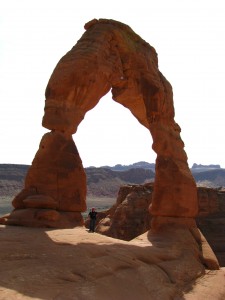
Many Bothans died to bring you this weekend

img_5998This past week was pretty crazy.  Tests, papers, homework…BLEARGH.  Less than satisfying.  What’s more, I was starting to get cabin fever from being in Provo so long.  Every day, doing the same old thing, going the same old places, seeing the same old sights…

…Then I got a call from my friend Ben Fisher, saying that everyone from the old Capitol House was going down for a camping trip near Moab.  Would I like to come?

HECK YES!!!

I basically dropped everything to run away with these guys.  First, I had a late paper that I had to finish–stayed up until 5am Friday to write it, took a 3 hour nap, then went to class.  CRAZY.  Emailed it to professor Ricks, with “many Bothans died to bring you this paper” in the body.  Got my coworkers to cover for me so I could get out early, met up with Ben, and then we loaded up our car with the girls and the camping stuff and basically ran down to catch Steve, Warren, Mike, and the others, who were already at the campsite.
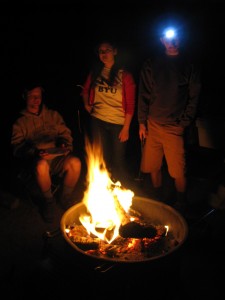
campfireWhat an awesome weekend!  Ben had brought a couple of dutch ovens and tons and TONS of good food!  Dinner was much better than the stereotypical hot dogs and smores (though we did have smores in the morning).  We had cobler, sweet and sour chicken, and fried rice for dinner–awesome!  Plus, it was fun just to hang out around the campfire and talk.  Good times.

We laid out some tarps on the sandy ground, then threw down our sleeping bags and had a big bivouac under the stars.  I fell asleep as Ben was telling us all a story that had something to do with galoshes…I don’t really remember it all that well actually…and then I woke up a couple of hours later and didn’t sleep again the whole night.  I hadn’t brought a mattress, and man, the ground was hard…ugh.  Note to self–get a better sleeping bag and some kind of a camping mattress.  Mike Lebben was the smartest–he brought a cot.
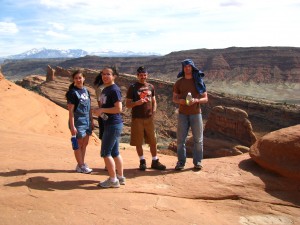
hanging out at ArchesGot up early, restarted the campfire, and we had a good breakfast–biscuits and gravy, and then smores a little while later.  Good times.  We took off a little later and went up to Arches National Park to do some hiking.

We checked out Delicate Arch and Balancing Rock, then did some rock climbing out near Sandstone Arch.  Lots of fun.  I got sunburned really bad (of course), but the weather was really nice!  Not too hot, with a good breeze up near the top of the mountain.
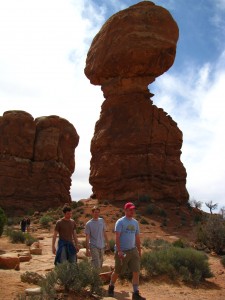
hanging out near balancing rockThis was my first time at Arches, and despite some problems with the parking, it was a lot of fun.  The desert around Arches reminds me a lot of Petra–lots of sandy red rocks in weird formations, making for relatively easy climbing.  In fact, the whole trip reminded me a lot of Jordan and Petra.

One of the most interesting things about these trips is the social dynamic and getting to know new people.  I knew all the guys from the capitol house, but I met a few new people as well.  Natascha was there (she kept telling me to take a candid picture of her, then posed!  The pictures above are some of the few ones where she didn’t know I was pointing the camera at her), and her sister Hannah, who I hadn’t met before, plus her good friend Beth, who always bugs me about the one time I didn’t sub for her at the MTC cafeteria when it was her birthday (for consolation, I told her I was fired the next year–I think it made her feel vindicated to hear that), plus a couple of other friends of the other guys.   It was also good to see the guys from the capitol house again.  Probably my favorite part of the trip was hanging out around the campfire, or the conversations we had driving the three hours up and back.

In a lot of ways, the weekend was a roller coaster.  Beth commented that she was really surprised that all of us from the old Capitol House, with our strong personalities, get along as friends without tearing each other to pieces.  It was a valid comment–me and Warren weren’t getting along this weekend, for some reason.  I think I was still stressed out about the past week, plus I just haven’t hung out with him a lot recently.  So that was one of the lows of the weekend.  Another low was getting up Sunday morning, after we’d gotten back, and finding out that I had a 102 degree fever.  Not too much fun.

Still, there were quite a few highs.  On the way back from Moab, Natascha and her sister got me talking about my mission, and I shared a TON of old mission stories with them.  Good times, even if I was more than a little loopy (or perhaps it was BECAUSE I was so loopy…).  Also, when I got back, I found out that I’d gotten a letter from the English department–turns out I won first place in the Mayhew short story specialty contest!!!  WOOHOO!!!  Awesome!

So, anyways, that was my weekend.  Basically, it was like half of a summer rolled up in 2 days.  It was SOOO good to take a break and get out of Provo!  Good times!
Slow but steady

Okay, quick post before I go to bed.

Things are progressing in this novel, slowly but surely, as you can see from the wordcount.  Unlike past weeks, I’m not pushing myself too hard, mostly because I’ve got a lot of schoolwork right now and if I were to spend much more time on this novel, I would neglect a lot of the more important stuff.  Even though my course load is relatively light this semester, I’m a senior and I’m really not as motivated to do this stuff as I used to be.  I get done what needs to get done, but just barely.

I have been successfully getting up early, however.  And I’ve discovered something very interesting: I’m more productive when I have less free time.  Thursday, I didn’t have class until noon, so when I got on the computer at about 6:30 to write, I opened up the email, opened up facebook…and, by the time I had to leave for class, I had only written about 430 words.  Disgusting.  But today, when I had class at 9:00 am and still had my Arabic homework to do, I got in about 700 words in half an hour.

I still have a lot of self discipline to learn, I guess. 😛  The scary thing is that my idea, up to this point, has been to keep my time open in the summer so that I’ll be able to write.  Err…yeah.  We’ll see how that goes.

I’ve been getting a lot of comments back from my alpha readers on Genesis Earth, and it’s been REALLY fun!  Even the criticism–as long as it’s helpful criticism, I really appreciate it.  This one girl in my ward asked me if she could be an alpha reader, then read the whole thing in only a couple of days.  She had a LOT of positive comments–in fact, almost all of her comments were positive–and she said she really loved it!  So much so, in fact, that she said she was having withdrawals, so I sent her The Phoenix of Nova Terra v1.2.  Hopefully, getting her comments back will give me motivation to pick up that old thing and rework it…goodness knows it needs it.  Needs it bad.

My first two novels, The Phoenix of Nova Terra and Genesis Earth are completely different in some ways, but very similar in others.

<spoiler alert>

They both have an important romantic element, and they both have generally positive endings.  The book I’m writing now is something of a tragedy, at least at it’s core, and there is a completely different dynamic there.  No love stories, no happy resolutions–lots of pain, lots of violence, lots of grappling with difficult issues.

</spoiler alert>

I suppose it’s good to try out a lot of different things early on in your writing career.  That’s what I’m doing.  At the same time, though…I get feedback on the one novel, and I kind of want to work on it instead of the one right in front of me!  And when I think about what I did right in the one I finished, I look at the one I’m currently writing and I think “man, this is crap.” Of course, I keep working on it because I recognize that I ALWAYS think “man, this is crap” at some point before I’m done.  Knowing that doesn’t make it easier, however.

Jason from the FLSR writing group said something interesting about that, however.  He said that writing a draft of a novel is like climbing a mountain: you do it three times.

The first time, you climb it in your mind as you plan it out.  You’re excited and motivated, and busy with all the preparations.

The second time, you actually physically do the work of climbing.  It is long, hard, and frustrating, you get lost a few times, the summit is anticlimactic, and the return is boring.  You can’t wait until you’ve finished and it’s all over.

The third time is when you look back on the experience after you’re safely back down.  No matter how excruciating the climb was, you look back on it fondly and remember all the best parts.  You thrive on the memories and wish that you were back up there, standing on the summit, enjoying the experience.

Right now, I’m on my third climb for Genesis Earth and my second climb for Bringing Estella Home. I can remember how miserable I was when I was still in the middle of Genesis Earth–for a while I seriously thought about throwing the whole thing out and doing something else.  However, now that I’ve been letting it sit for a while, I’m getting really, really excited about it!  I can hardly wait before I can get back and write the second draft.

But that’s not going to happen until I finish Bringing Estella Home.  And, no matter how difficult it gets, I swear I WILL finish this book!  I’m a chapter away from act III, and that’s too deep into the thing to quit and start something else!  This book WILL be finished–if not by April, then by sometime in May!

“You do watcha gotta do for Rock ‘n Roll, ya know?”

Check this out. Apparently, back in the 80s, U2 randomly decided to put on a show on the roof of a liquor store in the middle of LA. A free show. They played one of their best songs, “Where the streets have no name,” and then the police shut them down. This video is apparently footage from that incident.

How awesome is that, dude?

I mean, aside from all the stress they gave the cops, and the crowd difficulties and dangers inherent in pulling a stunt like this, just how freaking awesome is the concept? Dude, I would have LOVED to have been there! Check out the people, standing around, waving their hands, hanging off of traffic lights pumping their arms–it must have been awesome!

U2 is one of my favorite bands of all time. I know people think Bono is way arrogant and self-righteous, that he projects himself as the Pope of Rock ‘n Roll, but honestly, come on, the music is pretty good. I mean, lets not get so caught up in everything that we forget the music. Classic. Truly classic.

And then, when you DO look at some of the stuff these guys have done, it’s pretty freaking impressive, Pope or no Pope. In Chile in the 90s, U2 put on a HUGE benefit concert for the Mothers of the Disappeared, a human rights group calling for an inquiry and public closure on Pinochet’s brutal regime…right under Pinochet’s nose! Right there, Bono called out one of the world’s totalitarian dictators IN HIS OWN COUNTRY. How awesome is that??

And it’s not like Bono is just posing for the camera, throwing concerts to boost his fame and fortune, doing all the showy stuff for human rights but not actually doing the leg work. He puts on his suit, picks up the briefcase, and meets with the major leaders in the non-governmental organizations and trans-national activist networks and works with these guys, behind the scenes. He’s really out there, doing his part.

Plus, just look how long the band has stuck together–thirty years now. How many bands have you seen that fall apart after a year or two, just because the members get all pissy and immature with each other? These guys in U2 aren’t like that–they can work together, they can do much more than just get along with each other. They can really thrive together and build off of each other.

When I was in Jordan, I listened to U2 all the time, especially their older stuff. Their music and message was born out of the conflict in Northern Ireland, and because of that it really resonated me as I lived around some of the effects of the Arab-Israeli conflict. They have a way of singing about love and peace in a gritty, hard-edged way that can still really cut right to the heart of how you feel and how you want things to be. That’s how I feel, at least, and for that reason I listened to U2 just about every day in Jordan.

Man, U2 has got to be one of my favorite bands of all time. These guys really know how to rock out, in the best possible sense of the word.

Slugging it out and summer plans

Ok, last week I wrote almost nothing on this blog, and last night I wrote a quick post before going to bed that didn’t really explain much.  I just got done reading one of Dave Farland’s kick-in-the-pants series of email newsletters and it said, basically, to post every day if you have a blog (unless it cuts into your writing time).  Sounds like a good plan: more, shorter posts instead of fewer, longer posts.  Here goes.

Last week was pretty crazy.  I got everything done by the time it needed to be done…barely…but it was so disorganized and upside down that it really grated on me.  It was one of those weeks where, when Saturday rolls around, you look at the calendar and think “where did all that time go?”

I tried to write every day, in the morning, but it didn’t work out.  At all.  I allowed myself to get distracted, and by the time I was ready to sit down and write, it was time to go to class.  After a couple of days of that, I just stopped getting up altogether.

I wanted to get through the last two chapters of Bringing Estella Home by yesterday, but that TOTALLY didn’t happen.  I’m still in the middle of chapter 9, not even to the major climactic battle that ends the second part.  Bah.  As a result, I’m starting to have doubts that I’m going to actually finish this novel by April.

HOWEVER, on a more positive (and a completely different note), I actually have an idea of what I’m going to do this summer.  I don’t know when or how exactly it hit me, but I have something of an idea, and it’s starting to really grow on me.

Here’s the plan: I spend the spring term here in Provo, retaking a handful of freshman level classes in order to boost my GPA (I got a C- in beginning piano, and a B- in Geo 120…yeah, those could be raised a little).  That’ll give me plenty of time to work on my writing and the opportunity to attend a couple of interesting looking writing conferences out here in Utah, such as BYU Writers for Young Readers and CONduit.

After the spring, I’ll head back East (haha!  ‘back East’!  I’ve been transformed into a Utahan!), spend a couple of days at home, take a train down to New York City and live for a month or two with my old roommate Steve Dethloff, who’s moving to NYC after he graduates.  I’ll try to get a job, possibly doing something writing/editing related, or maybe make some contacts in the publishing world.  Or not.  We’ll see how it goes.  But either way, I’ll have enough time to work on my writing.

Also, if I’m back East in August, I’ll be in a good position to attend Worldcon 2009 in Montreal.  I haven’t yet decided if I’m going to go, but it’s only 4-5 hours from my home.  I could borrow my parents’ car and drive up.  Then, later in August, we’re going to have our family vacation out on Cape Cod, so if I’m back East for summer, I’d definitely be in a good position for that.

Wherever I go, I’ll try to find work, but even if I don’t, I still have enough money left over from the Pell grant that these plans are still viable.  I’m certain I can find work down here in Provo, but I’m not that certain about New York.  Still, if I’m down there for only a month or two, it shouldn’t be too hard.  If I sublet out from Steve, rent should only be about $250-$300 per month.

Trouble is, there isn’t any awesome trip to the Middle East involved in these plans. :'( That’s sad.  But still, if I want to focus on my writing to get ready for World Fantasy and (potentially) Worldcon, it’s probably a better idea to stay in the country.  Going abroad would mean making a lot of difficult cultural and linguistic adjustments, and I’m worried that that would make it difficult to write.  I know that last time I went to Jordan, I didn’t hardly write at all (except in my blog, of course).

So, until I come up with a better plan, that’s what it looks like I’m doing for now.  We’ll see if things change.  And as for my novel, this week I’m totally going to do better.  I got up at 7am this morning and got in a good hour of writing before school.  Momentum is definitely building up again.

Experiment, take two

Ok…the experiment I wrote about last week…yeah, it failed.  Miserably.  Got almost no writing done, and I wasn’t able to get up early hardly ever.

However, I’m going to try it again.  Part of the problem was that I always ended up staying up late, past 1am, even when I intended to get up early, and that just killed me.  Also, whenever I did get up early, I always allowed myself to get distracted by other important things, such as email, homework, etc.  The predictable result?  No productivity.

There were other problems too, however.  It’s the middle of the semester, so the weeks are starting to race by like so much rushing water.  I’m not the only one who feels like the last week was sucked out of my life without my realizing it.  Also, before I started the week, I lost a lot of writing momentum by missing a few of my daily wordcount goals.  I would write 2,000 to 3,000 words one day, the next day, nothing.  Lost momentum can be really crippling.

When you write late at night, you tend to go through this routine of distracting yourself, checking your email, playing a game here and there, chatting with friends, etc, before you finally settle down to start writing.  This is my current routine.  I need to get to the point where I’m able to sit down, open the document, and get started.  Or, if I can’t get to that point, I at least want to minimize the distraction time.

So, this week, I’m trying it again.  I’ll try to get up early, 6am if I can, and get in at least a half hour of writing each day.  We’ll see how it goes.

…and they all lived evily ever after.

Today we had a quark writing group party, and it was lots of fun! We all went up to drek‘s new house, up in Draper, and read some of our really old, really bad first attempts at writing stories. Good times!

Drek, Nick, lexish, slipperyjim, jakeson, gamila, aneeka, and one of my friends from the FLSR writing group all came up. Jakeson and his crew got lost on the way, but we had a good time hanging out, chatting, eating the pita bread and hummous that I’d cooked (I figured everyone else would bring sugar-heavy treats, so I cooked something a little more on the healthy side–still delicious, as evidenced by how much everyone ate!), and talking about how we’d gotten started writing.

I think a lot of us had similar stories–while we all wrote for different reasons, we all tried to do something big in high school, something that marked a turning point of some sort. The other common thread that ran through our stories was…how laughably bad they were! There were gradations, of course (Nick’s story that started with the word “Gandalf” and only got worse was pretty ridiculously crazy), but all of our stuff was pretty bad.

It can be both fun and painful to look back on past stuff, especially the stuff you wrote back in high school. It’s like, all the painful awkwardness of high school is not limited to your social life, it seeps into your writing as well, especially if that’s when you first try out your hand at the craft. So many cliches, so much bad grammar, so many viewpoint errors and info dumps…ARGH!!!

Of course, that is precisely what made it so entertaining. The awkward, emo, immature teenage grasp of the universe, combined with dozens of stale cliches and atrocious grammar–brilliant! I’m glad we were all at a point where we could look back on this stuff and laugh. It can do you good to air out your closet and let go of some of the old stuff you are sure would destroy you if you ever let it saw the light of day.

My first writing attempt was a novel that has since been entirely lost. I printed up a hard copy, once a long time ago, but I’ve lost that one and really have no desire to try and dreg it up. Of course, all the digital copies haven’t survived. My second novel attempt, however, I have in both digital and hard copy. That’s the one that I dipped back into for this writing party.

I actually sent out a copy of this to my aunt in Washington DC, who is/was an editor for a magazine. She read about the first twenty or thirty pages and sent me this letter, which I will use to finish off this post. The only places I’ve used ellipses are when my aunt described problems specific to certain passages and quoted them.

October 14, 1999

Dear onelowerlight [name, obviously, has been changed 😛 ]

The manuscript your mom sent home with Evan has proven to be an interesting read in many ways. It is wonderful to see people take an interest in writing. This pastime has given me many hours of satisfaction. I find that the joy is in the journey and that the process is as important to me as the finished job. However, it is always satisfying to have a finished product that I feel good about.

What it looks like you have is a wonderful outline for a novel. Your language is colorful and descriptive. The battle scene held my interest and made me want to know what was going to happen next. My intent was to read the manuscript from beginning to end purely for the joy of reading it. The urge to edit, an urge that often gets in my way as I write a first draft, got in my way as I read. Hence I was not able to follow through. I have written on some of the pages. What follows are a few other observations.

A really good writer named John Gardner said that a piece of fiction opens up a dream to the reader. Anything that causes the reader to become aware of the author or that jolts him out of the fictive dream does not belong. It is always helpful to let a manuscript cool for several days and then begin to read it. This will help you be more objective. Sometimes the things that seem marvelous turn out to be less enchanting than one thought during the rapture of creation.

Titles are difficult. Would anyone have read Catch 22 by another name? Some people don’t think so. It has been postulated that the reason the story about The Man Who Went Up A Hill And Came Down A Mountain didn’t do better as a movie–and presumable a book–was because of the length of the title. For many authors the title is the last thing to be written.

Your first two or three pages contain a good deal of “throat clearing.” An opening needs to grab the reader so he will continue. There needs to be a problem, action and change. It should be action that is vital to the story. Someone is going on a trip. Someone is going into battle. someone is getting married. Someone is being born. Unless you want to write erotic literature it would be better not to start with conception. Work the background in later. In The Gospel of John the first few verses talk about the Word. Immediately the Word is identified with the Son of God and the story of his baptism. The problem of establishing himself as a teacher is presented. In episode IV of Star Wars the force is not explained to us at the beginning, rather we see what it can do. It isn’t until Solo talks about fools who believe in an ancient religion that we begin to have some idea th at the force is more than magic. The characters give all this information to us.

Point of view is the perspective that the story is told from. T he most difficult and therefore least used these days is the omniscient narrator. A good rule of thumb is to see the story through the eyes of the person with the problem. Many authors write in first person. One can also use second or third person. Third person is similar to first person except the pronoun I isn’t used as much. (Actually it is more complicated than that, but that will suffice for now.) Sometimes a narrator who doesn’t see into anyone’s mind tells a story. Most fiction that looks like omniscient narrator is actually being told from the point of view of one of the characters. The narrator can then see into the mind of one person and all the other action is viewed through his eyes. Sometimes a novel will contain oone person’s point of view in one chapter and that of another character in another. This seems to work. It is confusing when shifts occur without warning.

Psychic distance has to do with how close you want your reader to be to the story. Stephen King wants to inspire terror. He gets his readers as close as he can. You hear breathing, feel sweat, hearts race. Jane Austin keeps her readers at a great distance. You see the lights, you hear the conversation, it is all very proper–no sweat, no breathing, no racing hearts. Just as with the point of view, the important thing is that the narrative remains consistent. It must not switch in the middle of a sentence, paragraph, or chapter.

Write in active voice as much as possible. Your English teacher will tell you all about this. Be aware that verbs ending in “ing” do not help your story. (Running up the hill after Jill and tripping over a rock Jack stumbled.) This slows the action of the story down but when used sparingly can add emphasis. The following construction works better (Jack ran up the hill after Jill. He tripped over a rock and stumbled. “D___!” he grumbled. Jill took water from her bucket and soap from her pocket and washed his mouth out.)…

…You have many long sentences. Your writing will be tighter and stronger with shorter sentences and fewer prepositional phrases…

…There are lots of ways to deal with dialogue. You can put the dialogue first and description second…you can put the dialogue at the end…you can break it up the way you have in your manuscript or you can put description on either sie of it…Like every other element of your story, you don’t want it to call attention to itself.

I believe you changed fonts to show a change in viewpoint or in who is speaking. For me this is very distracting. There are other good ways that work. Also it is easier for me to read when it is double-spaced.

Two books that I have found most helpful are John Gardner’s The Art of Fiction. It is out in paperback. John Gardner also wrote a wonderful fantasy called Grendal. It is not very long. It is told from the point of view of the monster. The other book is The Elements of Style by Strunk and White.

Thank you for sharing your manuscript with me. It takes great courage to share one’s work. I admire you for starting out early. Remember free advice is worth what you pay for and don’t let anybody discourage you. You learn to write by writinig. You have a good start.

Your’s truly,

Aunt Yvonne

Almost at part 3

Wow, writing this novel is going a lot faster than I had thought. At the same time, though, I sometimes worry that I’m not going fast enough.

I broke the 50k mark this week, and I haven’t even gotten to any of the major climaxes yet. This thing could easily go to 90k words before the end. With only 6 1/2 weeks left in the semester, can I finish it in time?

At the same time, I have NO IDEA what I’m doing this summer. Really. I have a lot of possibilities, but no concrete plans. With the semester coming to a close in a little more than a month and my housing contract with the FLSR coming to an end, that is a little bit unnerving.

Whatever I do, I want to devote some serious time to revising and rewriting these novels, getting them polished. Finding a spring/summer contact isn’t that hard in Provo; the question is whether I can find a job. I also want to go to the Middle East for a while, and if I go home to Massachusetts in August (which I would like to do) another possibility is Worldcon 2009 up in Montreal.

As far as how Bringing Estella Home is coming, it’s coming along very well. I have all of the key climaxes mapped out in my head, and the one that ends part 2 and begins part 3 is only two chapters from where I am now. I don’t normally keep a detailed outline of the whole novel, but I can usually see at least one chapter ahead. Kind of like the faith-promoting story of how a train conductor only has to see as far as his headlights, except that with novel writing, getting derailed is a very real possibility. I know I’ve crashed and burned in my novel attempts before. Fortunately, this one seems to be right on track.

This semester hasn’t been too hard, but last week was somewhat harder than usual. However, it seems like things are starting to calm down into another lull (knock on wood), so I think I can shoot a little higher as to where I want to be at the end of this week (in terms of my novel). I’ve found that I can do about one viewpoint scene per day, one chapter per week. This week, I’m going to shoot for two chapters by Monday. It seems a bit tough, but since I’ve already written the first scene in chapter 9, I think I can do it.

Also, as an experiment, I’m going to try to wake up early and get in a solid hour of writing before I start my day. I found a random website the other day (lost the link, sorry) that showed the routines of several famous, successful writers. Almost all of them woke up early in the morning and did most of their work before noon. Right now, I write almost everything between eleven at night and three in the morning, so I’d like to see if I can change that. I may fail miserably, but what the heck. Now is the time in my life to figure out what works and what doesn’t.

White Wolf by David Gemmell

Skilgannon the Damned is one of the mightiest warriors in the world, yet every day the memory of the innocents he has killed haunt him.  He seeks solace in becoming a monk, but as alliances break down and wars sweep the land, mob violence comes to the monastery and Skilgannon once again takes up the swords of Night and Day.  The swords, however, are cursed with an enchantment that corrupts the soul of the one who wields them, and the old witch who gave Skilgannon the swords–and who cursed them–is behind the political machinations that threaten to drive Skilgannon into the hands of his greatest enemy: his old lover, the queen of Naashan.

I’d heard about the Heroic Fantasy subgenre from English 318 last year, and thought I’d try it out.  I’d heard a lot of good things about David Gemmell, both from Brandon Sanderson and Orson Scott Card, so I kept an eye out for his books at the used bookstore and found this one.

White Wolf was an enjoyable read.  I particularly enjoyed the moral and ethical questions that Gemmell raised, both during the fight scenes and between the fight scenes in the dialogue between the characters.  Gemmell will often come right out and have his characters directly address issues like bravery and cowardice, death and sacrifice.  Far from sounding strained or pedantic, these were my favorite parts of the novel, mostly because the characters were struggling with these issues themselves.  Druss and Skilgannon, of course, have a little more experience and know the answers to these things, but the boy Rabalyn, a recently orphaned boy who has nowhere to go but follow the warriors and become one of them, goes through a very interesting growth cycle.

Gemmell also did a very good job creating an evil villain and raising the stakes.  As Skilgannon’s adventure winds in and out, he finds himself on a mission to save a girl who has been tortured to the point where she may lose her very humanity.  However, the villains are not all black and white.  Technically, Skilgannon himself is a villain, or maybe a post-villain, and the queen of Naashan is a similarly complicated character.  Gemmell’s world is populated with uber-heroes and uber-villains, but there are plent of people who fall in the middle as well.

The biggest issue I had with this novel was the plot.  It seemed to follow a loose quest structure, but it had a weak beginning and middle.  Skilgannon is supposedly onthis quest to resurrect this girl he once loved, but prior to this he’s been living the monastic lifestyle, trying to escape the world.  There is no clear moment where he says “I’m going to resurrect this girl,” yet supposedly this is supposed to drive him to travel hundreds of miles to get somewhere and do something.

The middle is littered with flashbacks–they are everywhere.  While the flashbacks are interesting and engaging, they interrupt the action in the present of the narrative, which often gave me the sense that nothing notable was really happening.  I started to lose motivation to read the book somewhere in the middle, just because I had lost that sense of plot progress.  If it weren’t for the characters and the conflict, I probably would have given up on it altogether.

However, I really enjoyed this book.  The last third was really good, and the epilogue was fantastic!  Probably the best epilogue I’ve ever read.  I wish I could say more, but it would give out major spoilers.  It was just a very well written, very well done epilogue.

I’d definitely be interested in reading some more Gemmell, though he’s not on the top of my list right now.  When I do pick him up again, I’d like to start with Legend, the novel that launched him into the big time.  I hear that’s a good one.

Yet another story idea

Ok, here is a cool one that came to me the other day.

One of the time traveling cliches is that of someone going back in time to kill off some infamous world leader in his/her infancy, thus changing the course of history and averting a major disaster (or causing an even bigger one). It’s a common what if scenario: what if someone went back in time and killed Hitler? (Red Alert) What if someone went back in time and supplied the Confederacy with AK-47s? (The Guns of the South)

Well, here’s my take on it: what if time traveling agents have ALWAYS been going back in time, trying to fix up problems like this? What if history is one long story of the screw ups of a bunch of secret agents trying to alter things, trying to get it right, trying to get to some kind of utopia?

Of course, by altering history, they alter their own futures, making it impossible to go back to the future from which they came. Which means that they would have to go forward, see how it worked out, then go back again to make another change, take out another horrible world leader, then go forward again, etc etc.

If that’s the case, perhaps our universe is actually one of the “rough drafts” that this agency has been working on. Perhaps our universe is so screwed up because the agency hasn’t yet made all of the changes they want to make…not in this timeline, anyway.

In order for this to work, the people of this agency would have to all travel together, since leaving someone behind before going back to make alterations would mean leaving that person behind in a timeline that could never be reached again. From this, two things follow: 1) the time travelers would have to have some kind of a really cool ship, on which they all live and travel, and 2) they would be completely autonomous from any kind of government or other institution limited to one particular timeline.

This raises a number of ethical questions. Is it wrong to go back and alter the course of history in this way? Do the people in the original timeline cease to exist, or do they continue to exist in a parallel universe? If you take the latter view, how does that alter the ethics of changing things? You’re not really screwing people over–they still exist, just in an invisible parallel universe. And you’re trying to make the world a better place, too. But, then again…you’re basically playing god with history, and that sounds pretty unethical.

My idea for incorporating this into a story is this: a regular guy from our time bumps into these time travelers and gets sucked into their little plot to build a utopia. He has to struggle with getting taken out of his world, never to return (or never to return to it quite the way it was). There could possibly be a love story of some kind, especially if these are steampunk time travelers (perhaps that would explain why the 20th century was more spectacularly screwed up than any other–the time travelers started in the 1800s and are more concerned about their era than after their era. But then, there are also divisions and disagreements among the time travelers, with some getting fed up and discouraged with the whole thing, others (possibly the leader) with megalomania, and others who are beginning to have doubts about the morality of their undertaking.

Pretty cool, neh? Now, back to doing homework… 😛

Progress!

I’m sludging through the middle of Bringing Estella Home.  I’ve heard people call this the “blue collar work” of writing, all the parts between the beginning chapters and climactic ending chapters.  I believe it.

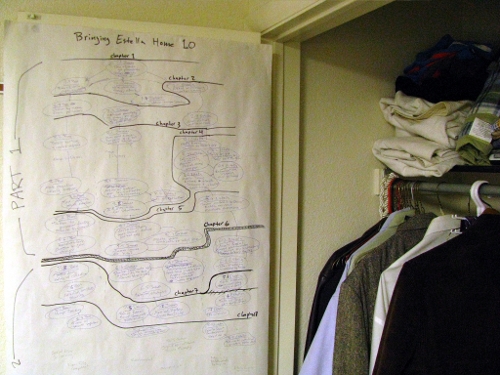
In particular, I was having some difficulty with chapter 7 last week.  I have, basically, three separate plot threads tied up in four viewpoints.  Sometimes, it can be frustrating to give them all equal time while putting the scenes together in such a way that they contrast and build off of each other.  In particular, it’s difficult to get the chapters right.

I’ve heard that each chapter is supposed to be its own distinct sub-story, with its rising action, a mini-climax, and a falling action of some kind.  I’m fairly confident that I can do this intuitively over one or two viewpoints, but over four viewpoints, with three different plot lines?  It’s tough.  Last time I tried was with my first novel, and when I went back for the rewrite I had to reorder several of the chapters, especially the first three ones.

The way I’m doing it for Bringing Estella Home is picking one of the plot lines to be the main subject, if you will, of the chapter.  I build on the other plot lines as well, but the big climax, the big reveal, comes in the plot line that I’ve designated for that chapter.  Typically, I’ll start each chapter with a viewpoint from the plot line that is central to the rising and falling action of that chapter–or, if I don’t start it with the viewpoint, I start it with the characters talking about the idea that is central to the climax of the chapter.

Originally, I thought that the climax / central aspect of chapter 7 would be the brainwashing / mind-altering procedures that Ben undergoes in becoming a soldier for the Hameji.  I started with James discussing the Hameji with the other mercenaries on the ship and talking about various legends they’ve heard of mind-altering drugs that give the Hameji special powers.  The next scene was Ben forced to take some of those drugs.

However, I really hadn’t figured out Ben’s part of the story at this point.  I knew he’d take the drug, and I knew how it would change him, but I didn’t know what happened next.  As a result, the rest of the chapter just felt like a chore, one that I accomplished over several late nights (probably to the detriment of the quality of the writing :P)

It wasn’t working.  The chapter just didn’t feel like it held together.

Then, I had a genius idea–why not make the last scene of chapter 6 the first scene of chapter 7?  The viewpoint was from Estella, meeting the jealous head wife of the Hameji overlord.  That scene set up the conflict for the next two chapters of Estella’s story–in retrospect, why didn’t I make it an opening scene for that reason alone?

I don’t know.  But it worked out wonderfully well!  Once I shifted the central focus of the story to Estella, EVERYTHING fell into place!  Her conflict at this point really was a lot more interesting than anything else in the chapter.

So now, with chapter 7 under my belt, I am WAY excited for chapter 8!  While I was walking back from school one day, I figured out exactly what needs to happen next in his story, and it is amazing!  Brutal, violent, and torturous, but it is amazing!  And this is the perfect chapter to insert James’s philosophical discussion with Danica, the one that I wrote down nearly a month ago just because I had to get it out!  I’m excited.  Maybe I’ll even finish it before Saturday.

Anyways, it is 2:30 am, and I am way tired.  Time to get some sleep.  Thank goodness my first class doesn’t start until noon! 🙂