4k a day

It’s late, but I really need to write something of my recent thoughts on this blog, so this is going to be a stream-of-consciousness word-vomit sort of post.  But please keep reading, it probably won’t be uninteresting.

I haven’t been posting much on this blog recently, but I’ve been thinking a lot about my writing recently–specifically, the practicalities of trying to make this my career, getting serious about it, etc.  

In fact, for the past three weeks, it’s been just about the only thing on my mind.  I’ve been listening and re-listening to just about every episode of writing excuses, the LTUE mp3s that I recorded, the old English 318 mp3s from last year, and various other talks and speeches on the subject of writing as a career.

I don’t have the time to really explain all my thoughts on the subject, but to sum it up, I’ve been angsting over it quite a bit.  Will I be able to break into publishing in the relatively near future, or does my writing need years and years more work?  Am I making a mistake to spend my summer just working on my writing?  Am I making a mistake to be pursuing this so vigorously as my primary career path? and a whole lot of irrational angsting besides all that.  You get the picture.

Well, I’ve gotten sick of doing all this thinking and now I think it’s time to just do it.  I heard back last week from the agency in New York–turns out they already have someone, so I won’t be going there for the internship–but that’s actually alright, because it means I can take the summer to really focus on improving my writing.

Of course, if I’m not doing anything else, I need to be treating this like my full time career.  The standard thing I keep hearing, at least from the professionals in the local scene, is that the average per-day wordcount is 4k.  Depending on deadlines and other projects, that may increase, but the average daily wordcount is 4k.  Since I plan on making writing my focus this summer, that’s my goal: 4k a day.

Last week, my wordcount was above 10k, but that’s actually a bit misleading.  I wasn’t writing 10k words of new material each day, I was doing a quick mid-draft revision to add in a few crucial characters and scenes that I didn’t know I needed until I got midway through the book.  It wasn’t even much of a revision;  when I saw places where my writing really needed work, I made a note for later and kept on skimming.  I only stopped to rewrite the sections that needed major changes in order to set things up correctly for later.

As a result, I feel that I’ve lost a degree of momentum.  Now that I’m through all the old stuff, I’m writing entirely new material, and it’s very hard.  I’ve only been skimming the last few chapters and scenes; as a result, when I picked things up this morning, I had difficulty getting into the story again.

I did 3,248 words today–that’s 3.2k words of new material–and by the end, I felt like the momentum was building and I was  starting to get back into the story.  A couple of weeks ago, when I was still angsting uselessly over the whole writing career thing, I kept feeling like this novel I’m writing is just crap.  Now, however, I’m starting to see my faith in it return.

Writing is like that sometimes: the further you are from your story, the worse it seems, while the more you get into the story, the more faith you’re able to have in it.  If you don’t have faith in the story you’re trying to tell, you just won’t be able to write it.

I could say more about what I’ve learned from my experience these past few weeks, but this post is getting long.  To sum it up, that’s my new goal for this summer: 4k a day, as if I’m doing this full time.  

At that rate, I’ll probably finish this novel sometime before the BYU writer’s conference (which I will be attending, at least the afternoon sessions–just registered yesterday).  The personal deadline I set was June 15th, after the conference, but I think I can get it in early.

Okay, enough word vomiting.  Time to get some sleep.

“That’s what it looks like when the infection sets in.”

So said Howard Tayler at CONduit today when he saw the expression on my face at the Aspiring writers Q&A panel.  We chatted a bit afterward, and he said something very encouraging: that if I continue to pursue my writing career with the same hunger he saw on my face, he believes I will be successful.  Awesome!

This weekend, I attended CONduit 2009 in Salt Lake.  It was my first con experience, and I had a great time!  Besides being just plain fun, it was very educational and inspiring.

I felt a bit unnerved at first to be surrounded by so many people that I barely knew, in a comfort-zone shattering kind of way.  I went up with  Charlie and Laura, though, and it helped to have friends sharing the experience.  By Saturday, we were all getting around very well.  By the end, I figured that I did know a lot of people there–and, surprisingly, that a lot of people recognized me.

I came away with a TON of ideas and things learned!  Here are just a few of them:

  • One of the panelists on Friday suggested this revision method: use search-and-replace to color all filler words (such as “really,” “just,” “very,” “was”; basically, the words I always overuse on this blog).  That way, you can easily see which sentences you need to rewrite.
     
  • Howard and Sandra Tayler mentioned, almost in passing, how they made it a matter of prayer before deciding to go full time on the web comic thing.  I definitely need to include the Lord more as I try to figure out how this writing thing is going to fit into my life.
     
  • In their Saturday panel, Howard made a very interesting remark about cultivating your personal image.  I realized that if I want to be seen as a professional by editors and agents, I need to adjust my wardrobe and appearance accordingly.  I don’t necessarily have to go the suit-and-tie route–Howard’s  image involves jeans and a button-up shirt–but my dress and appearance should say “I am competent, sharp, and serious about what I do.”
     
  • Dan Willis had a very interesting suggestion for writers: get and use business cards.  Networking is one of the most important business activities that aspiring writers can, should, and must engage in, so using business cards at conventions is very important.  It sounds so obvious, but I’d never given it much thought.   I’ll have to get some printed up for myself before I go to World Fantasy and Worldcon later this year. 
     
  • Between panels, I got into a fascinating conversation with Eric James Stone about networking at these conventions.  From that conversation, I learned how important it is to be genuine and personal as you network, to listen more than you talk, and to never see people as mere stepping stones for your career.  He got an anthology contract with Kevin J. Anderson through a con, and he never approached him with that attitude–ever.  Other people he saw who did, Anderson treated politely but never contacted.  You should certainly have a pitch ready, but you should also give time for contacts to develop.  Over time, people will remember your face and recognize you at these events.

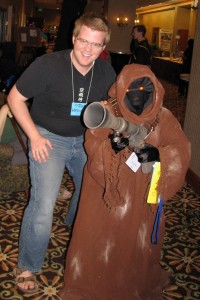
conduit2009-jawaConventions are definitely great for networking, but I absolutely hate walking up to a stranger and asking for favors.  It makes me very nervous.  As a result, I’ve adopted the philosophy of asking myself what I can offer the person I’m trying to connect with, rather than asking something of them.  I tried to follow this philosophy at CONduit, even if all I could offer was a compliment on something they’d said on a panel.

Using this strategy, I was able to get into a lot of interesting, genuine conversations with some of the big names at the con.  Charlie, Laura, and I got into a long, interesting conversation with L. E. Modessitt at one point.  He gave me some advice on women, which Charlie found hilarious (he must have seen us bickering/bantering earlier).  Had some good conversations with Dave Wolverton as well–he probably recognized me as the crazy fanboy who had him sign a poster of his first (now out of print) novel.  It was also good to see Brandon and talk with him–I thanked him for his helpful (if harsh) comments on my English 318 final.  Other people like James Dashner and Julie Wright recognized me from LTUE, which was really cool.

If people in the local scene are starting to recognize my face and my name, I must be doing something right.  That’s very encouraging.  Plus, the convetion was just plain fun. To top it off, the guy in the jawa costume was awesome.  All around, good times.  Very good times.

CONduit 2009 mp3s

I was fortunate enough to attend CONduit 2009 this weekend, up in Salt Lake.  It was a ton of fun, and very educational and inspiring as well;  I’ll sum up more of my thoughts and impressions from the con later.

I recorded most of the panels I attended, and I’ve linked to the full mp3s here.  I haven’t listened to any of them all the way through, so there might be some background noise (or hilarious snorting laughter from my friend Charlie).  I’ll put these out on a CC license so you can touch them up on your own time.

Friday, May 22nd

Clint Johnson’s writing workshop

Writing evil overlords

Culture building in SF&F

Main address: Howard Tayler

Structuring Creativity (Howard & Sandra Tayler)

Saturday, May 23rd

Dan Willis on writing

The stenchless chamberpot

Nuts and bolts of creativity (Howard & Sandra Tayler)

The Mike show

Main address: Dave Wolverton

Sunday, May 24th

Intellectual property

Aspiring writers Q&A

Creative Commons License
This work is licensed under a Creative Commons Attribution-Noncommercial-Share Alike 3.0 United States License.

Spin by Robert Charles Wilson

What would you do if you knew that the world was going to end in the next thirty years? That one day, before the end of your natural lifespan, the oceans will boil and the forests burst into flames, and life on this planet will come to an end? That you, your children, and even humanity itself have no future–that everything will end with you?
When the mysterious beings known as the Hypotheticals encase Earth in a temporal warp field that causes years to pass outside for every second on Earth, that is the uncomfortable question that all of mankind must confront. In five billion years–less than forty years on Earth–the sun will burn up its hydrogen and expand into a red giant star. When that happens, the sun will swallow the Earth and every living thing will die.

Some people turn to religion for answers.  Some turn to Science.  Some put off the question, living their lives as if the end will not come.  But as the years pass and the unavoidable apocalypse looms nearer, humanity begins to spiral out of control, and civilization itself looms on the verge of collapse.

The year the stars fell from the sky, thirteen year old Tyler Dupree discovers that he is in love with his best friend (Jason Lawton)’s sister, Diane.  The dynamics of the friendship between the three, however, make it impossible for Tyler to express his true feelings–and, in any case, Diane doesn’t seem interested in being anything more than a friend.

When the Spin hits, all three of them find themselves on radically different and sometimes conflicting paths.  Diane turns to evangelical Christianity and the frenzied religious outporing the Spin inspires.  Through his father, Jason rises to become one of the most influential scientists and directors in the Perihelion Foundation, the premier aerospace agency and Spin-related policy forming body in the US.  

Tyler, however, pursues the same middle class life he probably would have followed anyway–medical school, followed by a career as a doctor.  Still, his undiminished feelings for Diane and his frienship with Jason draw him into the center of the Spin hysteria and behind the scenes in the circuitous Spin-era politics.

Diane, now married to a fervent believer in a free love fundamentalist cult, comes to rely on Tyler as her only link to the outside world.  Meanwhile, Jason Lawton pursues perhaps the most grandiose and ambitious project mankind has ever attempted; the terraformation of Mars. 

With the temporal distortion of the Spin, millions of years of evolution turn Mars into a verdant green world in only one Earth year.  When Jason launches the first manned mission to the planet, barely a week passes before the the first Martian-born human returns to mankinds ancestral home–a descendant of a civilization millenia older than our own.  This small, dark-skinned, wrinkled man comes with a tantalizing message that may prove the key to finally understanding the Hypotheticals and the Spin itself.

But all of this may be too late, because the Spin membrane is finally beginning to show distressing signs of failure, and the sun has already grown hot enough to boil the oceans and scorch the planet.

I loved this book.  Honestly, I have to say it is one of the best science fiction books I have ever read.  Better even than Ender’s Game, better even than Foundation or any of the other classics.  No other book that I’ve read has done everything that I believe a good science fiction book should do.  I would highly recommend this book to anyone and everyone.

Like Clarke and a lot of the older classics in the science fiction tradition, Spin addresses some of the grand questions with which science and humanity have always wrestled.  What is the ultimate end of mankind?  The ultimate end of evolution?  Are we unique in this universe?  What is our place in the cosmos?  What is transcendence, and can we as a mortal species achieve it?

Unlike much of the older works, however, Spin addresses these questions through solid, developed, rich characters and a human drama that is as engaging as anything in any other genre.  When I read this book, I felt connected with these characters.  I genuinely cared about them.  They were real, distinct people who changed and grew based on their choices and experiences.  Furthermore, their struggles and conflicts echoed my own.  It felt true.  Tyler’s unrequited love was not only utterly believable, it kept me just as engaged as the grand ideas and the science fiction elements.

As science fiction, the ideas in this book were some of the most original and eye-popping ideas I’ve ever seen.  There was definitely a sense of wonder, as thick and beautiful as Clarke or Heinlein or Asimov.  The thing that made these ideas so great, however, was the eminent believability that accompanied them.  Robert Charles Wilson thought out the implications of everything, and showed them through concrete, human details.  His Martian landscapes were as real and believable as his picture of the New England countryside.  I not only felt that I was there, I felt that I was in this world, where the end-of-everything panic had set in, causing all sorts of bizarre, almost post-apocalyptic (pre-apocalyptic?) social changes.  It was truly fascinating.

But it wasn’t just the storytelling that engaged me: Robert Charles Wilson’s prose is among some of the best that I’ve ever read.  Reading this book really was like eating cheesecake.  The writing not only flowed, it shined, yet in a way that illuminated the meaning behind the words rather than drawing attention to the words themselves.  Wilson’s metaphors were not only rich and beautiful, they expressed the meaning behind the text so clearly that in each case, I don’t think he could have gotten across that particular impression, that feeling, in any other way.  Everything was calculated, and I would read pages and pages of text without even realizing how far I’d come.  Incredible.

I did have one issue with my first readthrough, back in July of last year: the Martian civilization, while grand, didn’t feel grand enough.  I mean, in 0nly four thousand years of history, look how far we’ve come here on Earth–all of our religions, all of our science, all of our discoveries and everything else.  We can hardly even remember what it was like, four thousand years ago–yet in Spin, the Martians know all about the reasons why Earth spawned their civilization, all of the questions that the Earthers have been asking about the Hypotheticals, etc.  I almost think that the Martians would have a more mystical view of Earth; that their understanding of us would be steeped in legend, and that they would have forgotten who we really are.

In my second readthrough, however, this was less of an issue to me.  Wilson really does make the Martians seem alien, a separate, distinct culture with a long, rich tradition.  His Martian citizen is very distinct from any of the Earthers, and notices some very small things that we always take for granted.  So, even though there could be more of a feeling of grandeur, Wilson already paints a very believable, very grand view of the Martian civilization he invents.

I am not exaggerating one bit when I say that this is probably the best science fiction book I have ever read.  I would recommend it above and beyond anything else I’ve reviewed here on this website.  If you haven’t already, pick up this book and read it.

Was Jane Austen a man?

Okay, okay, don’t worry, I know the answer to this question.  But in five hundred or a thousand years, will people be so certain?  
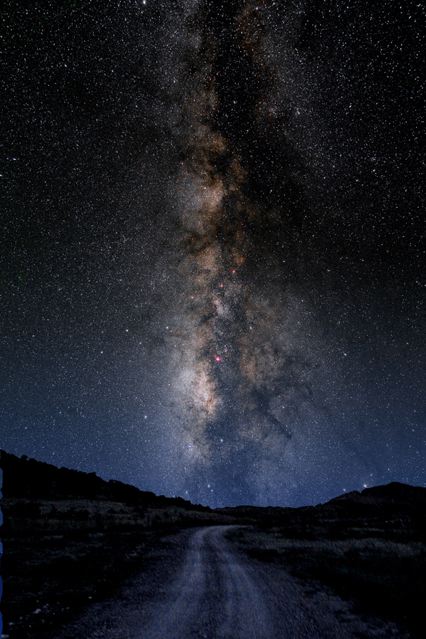
We question the true authorship of Shakespeare’s works.  Some of us even question whether Jesus Christ was a real human being, or just a fiction that some religious group invented.  Five hundred years from now, what’s not to say that people will be questioning whether Jane Austen really wrote her own books–or whether she even existed at all?

I had this idea while I was doing a copy edit with The Leading Edge (apparently, if you help them with their slushpile consistently enough, you get roped into the higher level stuff like copy edits, substantive edits, and even get a position with some authority–eventually).  We were taking a quick break and I was chatting with some of the other editors about story ideas, and somehow out of the conversation this idea spawned.  Good heavens.

I think it’s an awesome idea, but I know for sure that I don’t have the chops to pull it off.  I haven’t read enough Austen to really develop a taste or a love for her work,  or even really an understanding of it.  If someone else with much more knowledge and love of Austen could pull it off, I’d definitely like to see it.  If you think that’s you, feel free to “steal” my idea and run with it.

If I personally were going to write it, I’d extrapolate a crazy middle-far future world that basically resembles our own, with a few key cultural and economic shifts, and focus on the question of her gender.  I’d think of some awesome reason why these futuristic people specifically question whether it was a man who wrote her books and pattern the debate off of the kinds of debates we have about the authorship of Shakespeare’s works.  The characters in the story would probably be literary elites who are WAY WAY worked up over this question–the kind of people who go to war over this stuff.  From there, I would make it a comedy of the sexes, and use the story as a way to examine, in a humorous, upbeat way, some of the timeless differences between men and women.

But that’s just how I’d do it.  Maybe you have a better idea.  If you do write something like this (or know of something similar), please let me know, because I want to read it!

13,837 words in a day?

Yeah, that’s right.  Believe it or not, I barreled through about 13,837 words today.  That’s thirteen THOUSAND, not thirteen hundred.

Now, only about a thousand of that was new stuff  that I was writing.  Most of the rest of it was rearranging scenes that I’d already written, touching them up only a tiny bit.  I did merge a couple of scenes, delete or tone down some stuff, etc.

So really, about 90% of my work today was just revision, and not even really hardcore revision at that.  I’m still treating this version of my story as a rough draft; I’m not taking the time to polish things up and fix the known minor problems.  Really, I’m just running through what I’ve already written to make sure I have what I need to get past the roadblock I hit back in April.

The biggest thing I’m doing right now is rearranging scenes into entirely new chapter arrangements.  This seems to be a problem everytime I write a story with multiple viewpoints: I never seem to get the prelude-rising-falling-resolution-cliffhanger action that good chapters have.  I write scenes as they come to me, in a progression that seems natural at the time, but once I take a step back, I find that things work better on the macro-level if I complete rearrange which scenes come where in the narrative.

Part of that is that sometimes I just need to write a few paragraphs (or even a few scenes) just for me to figure out what’s going on, plotwise or settingwise.  What I’m finding with Bringing Stella Home is that I’m taking scenes from James and Danica’s viewpoints and moving them up a chapter or two, cutting out the filler in the middle.

I’ve got a long way to go before I master the art of good chapter structure.  Or perhaps it’s something that I do better when I’m revising, not drafting.  After all, I think I’m more of a discovery writer than a firm outliner.  Perhaps I write in a sort of puzzled up everywhere kind of way, and then do best when I don’t put all the pieces together until after I’ve vomited them all on the page.

I am getting more excited about this story, though.  Taking a step back and looking at things from a more global perspective has really re-energized me.  I can see the major turning points, and that helps me to build up for them much better.

I’m only worried that the “midpoint” is going to be somewhere around the 3/5ths mark, not the halfway mark as it should be.  One of my goals with this book is to see if I can hold to the three act structure and whether that makes my story any stronger.  But, according to the website, the midpoint occurs “approximately” at the halfway point, so I guess I can fudge it.

Also, the midpoint is supposed to be where the main character hits rock bottom.  Hee hee hee…oh, he will.  He will.  Bwahahahaha!!!

In the meantime, you owe it to yourself to listen to this:

New directions

This past week, I’ve been going through Bringing Stella Home at quite a good clip.  I’m going through the rough draft as I had it at the end of April, making some major revisions that hopefully are going to make it easier to write the middle section.  

I’ve been going along at a good clip, getting through as many as seven thousand words a day (it helps that I’m not taking classes or working right now), but today I hit something of a wall and realized I couldn’t go forward if I didn’t have some serious  backstory worked out.  So, instead of writing much in the book itself, I went through each of the characters in this mercenary unit and wrote out ALL of their backstories.

It was fun, and took a lot more time than I was expecting.  It also surprised me how much it fleshed them out, made them all real people.  I could go through and write a prequel to this novel now, where the viewpoint alternates between all of these characters and tells how they got together and formed the unit that they are now.  I won’t do that, since it would take too much time, but now I can do it, and that’s going to help out a ton in figuring out what has to happen next.

For this project, one of my goals is to experiment with the three act structure and see if I can strengthen my writing by strictly following that story format.  Well…when I say strictly, I don’t mean that I’ll make the characters do stupid things just to move the plot where it needs to go.  At least, I’m going to try not to end up doing that–we’ll see how it ends up.  The first draft is probably going to be horrendous.

Speaking of horrendous, I’ve been surprisingly discouraged with this story in the past few days.  I mean, it’s probably just me, but it seems that this novel is really just a piece of crap.  Of course, it’s a rough draft, so it’s supposed to be crap, but it’s just frustrating.  Then again, my writing group in English 318 seemed to be really into this story–sometimes, it seemed that they struggled to find things to critique about it–but I wonder if a lot of the positive stuff they said wasn’t just because they were being nice.

Meh.  It doesn’t matter.  Of course this draft is going to need a lot of work–it’s a rough draft, for crying out loud.  If I didn’t think it needed some serious work, something would be wrong with me.

The cool thing is that part I ends at about the 30k mark–right smack at 25%, assuming this novel ends up being about 120k.  That’s exactly where it should be, according to the three act structure.  Encouraging!

I mapped things out on my calendar, and I’ve figured that if I do 3,00 words a day, I can finish this draft by the 15th of June.  3,000 words a day shouldn’t be too hard to manage–I’ve got another 40k of stuff from the previous unfinished draft, and while much of that needs some deep revisions, I can probably recycle at least two thirds of it without making too many changes.  I’ve got a couple of conventions coming up here–CONduit and BYU Writers for Young Readers–but I think I can still make things average out quite nicely.

15th of June.  It’s a good target.  It also gives me practically the entire summer to revise and re-revise my other novels, perhaps even start a completely new project.  Huzzah!

(image courtesy photo researchers)

Ugh. Just ugh.

Man, it was hard to write.  So hard, I only just finished, and it’s 1:30 am.  Ugh.

The reason it was hard was because the character’s reactions in this scene needed to be totally revamped.  That also necessitated a complete shift in the structure of the writing, because the rough draft consisted almost entirely of internal feelings and reflections.  Indeed, the rough draft of this scene was about as close to an info dump as I will ever allow myself to come.

Or so I tell myself.  The first rewrite tried to keep things internal, just with the new reactions and motivations, but…well, before I knew what I was doing, I was info dumping.  Yes.  Shame on me, I went and committed one of my greatest pet peeves.  And I felt dirty afterwards, too.

Well, guess what happened?  I just kept writing, dumping out the info that I , but it kept coming out slower and slower, like wringing the last few drops out of a washcloth.  I didn’t know where to end, so I decided to cut it out somewhere in the middle…but then I got to the next scene from this character’s point of view, and realized that I was lacking the right transition to that part of the story.

Everything was falling apart.

So…I couldn’t just cut out all that stuff that I’d vomited onto the page.  It was a butt ugly info dump, but I had to get it across somehow.  I decided the only way to do it was to add in an extra scene.

 Trouble was, for the sake of the flow of the  chapter itself, I couldn’t just add all that stuff in another scene.  For starters, the nature of the stuff I’d just dumped on the page necessitated two scenes, but I didn’t have another one to bring in to break them apart.  I didn’t want to have three scenes all in a row from the same point of view–that would just be clumsy.

Ugh.  Just ugh.

So, how to solve it?  Take out a chainsaw and perform some delicate surgery.  I threw out virtually the entire info dump that I’d spent a good part of my day writing, and made some fundamental changes to the world that I’m writing that totally negated all of that previous stuff (I can do that, you know.  One of the perks of being a science fiction / fantasy writer–you can play god with the world you create).  Then, with the new changes I’d made to the world, I came up with a totally different scene–one that actually worked–and inserted that after the very brief, almost prologue-ish opening scene of introspection.

And then, when I was working with something a little more concrete, I was back in that wonderful place where character shines through and suspense builds through a functional plot.  No more info dumping–I felt so clean, so free of sin.  Great.

It still took bloody forever to finish, though.  All that wrangling from earlier in the day killed my momentum, so it was an uphill battle the whole way.  Ugh.

Looking back, am I satisfied with what I wrote?  Honestly, no.  But the revisions it need are the kind that can wait until the 2.0 draft, not the kind that are preventing me from finishing the first draft.

Those problems, I’m afraid, are yet to come.

Getting into it

Three days into Bringing Stella Home 1.1 and I’m really getting into it.  I’ve reworked the first and second chapters a ton.  It’s coming along surprisingly well, considering I was just about ready to throw in the towel a month ago.

So far I’m over 12,000 words into the story, which shows up on the progress bar as 10% because I upped my estimated ending wordcount to 120k.  I’ve heard that 90k per novel is what you really should be shooting for in science fiction, but then again, some of my favorite sf novels are well over 90k.  Publishers make exceptions, I suppose–as long as the story and the writing is good.

I’ve been spending several hours writing every day, and I’ve noticed that I’m starting to produce more.  Despite the fact that I’ve been doing some fairly substantial revisions to this piece, I’m clocking in at around 5k or 6k every day.  Last week, I felt like I was stretching myself if I did more than 3k.  If I keep this up, maybe by the end of the spring term I’ll be doing 10k or 12k words every day.  Maybe.

That reminds me–I got an email back from the agency in  New York.  Turns out they haven’t yet chosen the person to fill their intern position…and they were wondering if I was in New York so I could interview with Joshua personally.  Well, I’m not in New York, but they told me that was okay and it wouldn’t hurt my chances at getting this thing.

So…maybe I will be going to New York. :p Who knows?  They told me they’d let me know one way or the other, and I haven’t heard back from them, so there is a chance that I’ll be catching a flight back east sometime next week.

The cool thing about this, though, is that whatever happens, it’s a win-win situation for me.  If I stay, I’ll go ahead with the plans I’ve already set, and have an awesome summer working on my writing.  If I go, I’ll have an awesome time in New York getting to know the publishing world a little better.  I can’t go wrong with either option–my happiness and satisfaction doesn’t depend on other people.  That’s the best position to be in.

One final thing: while rummaging around some old posts in my blog aggregator, I came across a link to Shannon Hale’s blog.  She’s a young YA writer with some impressive accomplishments (such as a Newberry award) and some even more awesome things to say about writing, reading, and literature.  One of the really cool things is this collection of essays on writing.  She’s got some advice in there that’s simultaneously sobering and encouraging, which is probably the best kind that’s out there.

It’s finished!

The second draft of my novel is finished! Yay!

I finished up the last scene of the last chapter of Genesis Earth 2.0 this morning, as well as the epilogue, and sent it out to my beta readers.

Would you believe that I’ve got 25 people reading this thing? That’s almost double as many first readers as I had. More than double the number of first readers who got their comments back to me.

Anyways, here is the wordsplash for version 2.0. The second draft clocked in at about 71k words, significantly more than the first draft (which was about 57k). I added a couple of extra scenes, drew out a couple of other scenes and conversations, and didn’t really cut much out.

But yeah! Finished! Now I need to wait for feedback and let it simmer for a little while. Hopefully, it’s sufficiently polished right now to start shopping around with agents and editors; if not, then a month or two from now I’ll do another rewrite to polish it up and make it really shine.

Wordle: Genesis Earth 2.0

EDIT: and now, to shamelessly copy Reigheena and what she does when she finishes one of her novels, I’m going to include a rundown of Genesis Earth 2.0’s stats:

pages: 251
words: 71,481
file size: 479 KB
chapters: 14 & epilogue
start date: 28 mar 09
end date: 5 may 09