NPR’s Top 100 Science Fiction & Fantasy

In case you didn’t know, NPR just put together a list of the Top 100 Science Fiction and Fantasy novels of all time.  The list had a panel of judges who vetted nominations, but the voting was public and turnout–over 60,000–was pretty high.

I usually don’t like top 100 lists, but this one did a pretty good job representing the genre.  I recognized about 2/3rds of the titles, and most of my own personal favorites were included.

There were a few notable exceptions, however.  David Gemmell wasn’t represented at all–a travesty of the highest proportions.  Neither was C.J. Cherryh, which I find very surprising.  Robert Charles Wilson has certainly written some books worthy of the list, and Dave Wolverton’s On My Way to Paradise–which, I would argue, is one of the best science fiction novels ever written–was notably absent.

Also, a few of the titles were further down on the list than I would have put them.  The Dispossessed by Ursula K. Le Guin came in at #78, while I would have put it at least in the top 20.  A Canticle for Leibowitz did better at #35, but was it really an inferior book to The Handmaid’s Tale?  Come on, people.

One thing I don’t think this list represents well (or top 100 lists in general) is the way in which sf&f fandom has split into dozens of communities and tribes, almost like Darwin’s finches on the Galapagos Islands.  Before science fiction went mainstream, it was possible to follow all the various titles and developments.  Now, however, there’s so much out there that it’s impossible to be fully cognizant of everything.

I think fandom has split into some very distinct communities clustered around the popular authors and sub-genres, and there’s not a whole lot of overlap between them.  None of them are large enough to spawn an entirely new genre (with the possible exception of paranormal romance), but lumping them all into science fiction & fantasy can be a bit problematic.

That said, I think this is a pretty good list.  What do you think?

Soundtrack for an untitled book

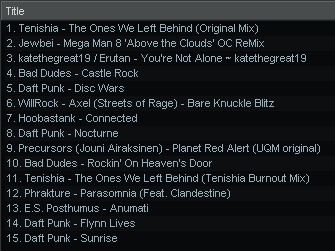
I’ve got this great idea for a novel, with a rough plot outline, an awesome ending, setting and characters all worked out, even the soundtrack–but no title.

I enjoy making soundtracks for my novels, but this is the first time I’ve made one before writing the first draft.  Usually, my first drafts are so all over the place that I end up hating whatever music I try to associate with my work–that, or the feel of the book ends up being so different from the feel of the soundtrack that I just have to abandon it.

In spite of all this, I couldn’t really help myself from putting together a playlist for my next big project, a Gaia Nova novel combining characters from Bringing Stella Home and Desert Stars.  Here it is:

For me, soundtracks are all about the emotion that a story evokes.  I’m going for a tense and gritty feel, with heart-rending losses and soul-crushing defeats interspersed with poignant moments of personal triumph.

The really cool thing is that the soundtrack has helped me out a ton with the outlining process.  I’ve spent a lot of time in the past month hiking in the mountains around Provo, just listening to music and thinking about this story.  Whenever I put on the soundtrack, something would click and I’d see exactly what the story needed.  I kid you not, all of the plot twists and big reveals came to me while listening to this music.

Now if only I could come up with a title…

Quick update

Just an update before I go to bed (and hopefully don’t sleep in like this morning).

My writing’s tapered off a bit this past month, partially because I’ve got a lot on my plate (Worldcon, online TEFL course, moving apartments, working full time, etc), but also because I’m between projects and not totally absorbed in any one.

I’m hoping to finish Sholpan by the end of the week, but that isn’t going to require more than 8k words total.  At the same time, I’m finding it hard to keep myself engaged with that project.  Today, for example, I rebelled a bit and worked on the next Gaia Nova book instead, which doesn’t yet have a title.  Had a blast, but only managed about 800 words.

My writing productivity took a huge dip in the end of July as I got Bringing Stella Home ready to publish, dropping down to between 500 and 1,000 words per day.  I probably won’t be able to raise that significantly until after Worldcon, and even then, I’ll have to juggle a full-time job for probably another month or two (but hey, a job’s a job; I’m not complaining).

Thing is, I really, really, REALLY want to work on this untitled project–so much that I’m treating it as procrastination when I have other stuff to write.  I’m also worried that if I leave off on that project for too long, I’ll lose sight of it.  That’s why I’m juggling it with Sholpan right now, but I think I can handle it, especially since Sholpan should be finished in just a week or two.

I also got an email from a fan (a fan!) asking about Edenfall.  Right now, I don’t have any concrete plans, but I’m hoping to finish the first draft sometime in October/November (after polishing Desert Stars), and have it ready for publication sometime in 2012.  If enough people ask about it, though, I may bump it up in the queue; it all depends.

Other than that, I had a great idea yesterday for a blog series.  It came while I was thinking about my dreams for the future, and the thought came that I should blog about them  But I don’t want it to be just about me; I want to share my thinking about the future and how I’ve come to develop my goals and plans, so that my many friends who are in similar circumstances can glean something useful.

I’ll probably start that in a day or two.  But now…sleep.

Breaking the Top 10, and a big thank you

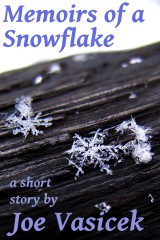
As I’m writing this, “Memoirs of a Snowflake” holds the #8 spot in the Kindle Store for the general short story category — #150 overall.  Almost 1,000 people have downloaded it since it went free over the weekend, and it’s already garnered some fantastic reviews!

All this positive attention makes me want to thank all those who have taken the time to post reviews of my work, so I thought I’d do that here.

Specifically, I’d like to thank L. Christensen for the early 5-star review of Genesis Earth, and her very favorable reviews of my other work.  Full disclosure: L. Christensen is one of my first readers; however, I did not solicit any of her reviews–she posted them on her own.  Also, I’d like to thank Katie Armstrong for the other 5-star review of Genesis Earth–I have no idea who you are (well, a vague idea maybe), but thank you!

Another reviewer who’s been very kind is EA Younker over at goodreads.  She’s posted some glowing 5-star reviews for “Memoirs of a Snowflake” and “Decision LZ1527” on that site, as well as a more critical but still encouraging 3-star review for “From the Ice Incarnate.” Thanks for taking the time to read my work!  I’m glad you enjoyed it.

Over on Smashwords, Ernest Winchester posted a nice 5-star review of “Decision LZ1527,” only a couple hours after I uploaded it.  More recently, Michelle Glorioso and Annie B posted some extremely gratifying reviews of “Memoirs of a Snowflake.” Thanks so much!

Of course, not all the reviews have been glowingly positive. “From the Ice Incarnate” has garnered some criticism from readers who feel that it was missing something, either sufficient character depth or a satisfying ending.  I appreciate the feedback; short stories aren’t my forte, so I’ll be sure to keep that in mind as I work on my short form.  Also, Genesis Earth has garnered a couple of critical yet well-reasoned reviews, most notably from the review site Science Fiction Addiction.  Once again, thanks for taking the time to respond so thoughtfully.  And thanks to all the other generally positive reviews which I haven’t mentioned specifically here.

So far, Bringing Stella Home hasn’t gotten any reviews, so if you’ve read it and enjoyed it, I would appreciate it very much if you would take the time to do that.  In the meantime, thanks for all your support!

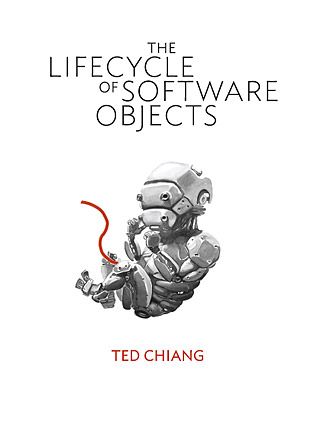
The Lifecycle of Software Objects by Ted Chiang

Ana was a washed-up zoologist turned programmer looking for work; Derek was an avatar designer for the Data Earth virtual reality platform.  The thing that brought them together: Blue Gamma Inc., manufacturer of autonomous self-aware AI pets known as digients.

Like any pet, each digient requires constant attention as they learn and grow.  Soon, Ana and Derek become as attached to their own digients as parents to their children.  But when Blue Gamma goes out of business and the Data Earth platform becomes obsolete, the future for the digients looks grim–until they enter the next phase of their natural evolution.

I really, really liked this story.  It’s got just about everything that makes science fiction so great: futuristic setting, well-rounded characters with believable motivations, one Big Lie with everything else held more or less at the level of our current understanding, and tons of parallels between the fantastic world and our own that makes you step back and really think about things.

The interesting thing about this story was how it played with all the old robot/AI tropes.  Usually, stories of this kind will have the robots rise to transcendence, either becoming the benevolent (or largely absent) rulers of the world, or taking over and enslaving humanity in some fashion. Not so with this story; the scope was much more intimate and personal, driven by characters rather than the Fate of Mankind, and that ultimately made the story much more believable.

If I had any problem with this story at all, it was the ending.  After so much build-up and development, I felt as if it cut off rather abruptly, just as things were getting more and more interesting.  I suppose the author was going for something of a “Flowers for Algernon” feel, but that wasn’t what I took from it.  Or perhaps he ran up against the novella word limit and decided to cut it off; I don’t know.

Regardless, I thoroughly enjoyed this story.  It’s certainly worthy of the Hugo for which it’s been nominated.  Highly recommended.

“Memoirs of a Snowflake” is now free!

So I come back from my camping trip, and what do I find?  Amazon has made my short story “Memoirs of a Snowflake” available for free–and it’s at the #16 spot on the fantasy bestseller list!  Awesome!

Camping was fun, as was the road trip down there.  The stars out at Huntington Reservoir were absolutely amazing–man, when I have the money, I’m totally going to take up astro-photography as a hobby.

Didn’t write a whole lot, but now that I’m back, I should be able to get some work done today.  But first: time to shower!

Going camping and novella update

Just a quick update on things:

I’m going camping this weekend up Huntington Reservoir with some friends, so I won’t be around for a couple of days.  It should be fun; last trip was a good chance to step back and recharge, and I definitely could use that right now.

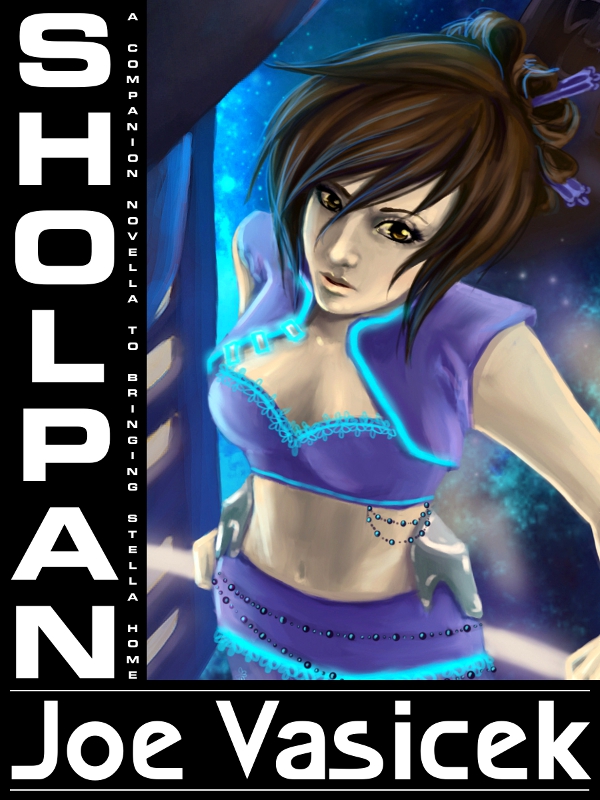
At the same time, I’m working on Sholpan, and it’s turning out to be a lot harder than I’d initially thought.  I’m writing it as a companion novella to Bringing Stella Home, where the story covers Stella’s point of view through about the first half of the novel, with a few extras for the people who read the novel first, and enough loose ends to entice people who read the novella first to pick up the full-length novel.

It’s turning out to be a difficult balancing act, however.  The first draft was basically just all of Stella’s scenes up to the last three/four chapters of the novel, and that ended up being too much.  For those who read the novel first, it didn’t have anything new, and for those who hadn’t read it, it revealed far too much.

So for the next draft, I decided to trim it right up to the point where Stella’s story has its first major twist.  Even though that includes a minor spoiler for the novel, it gives the novella a great story arc with a good reversal.

But that leaves the question: what does the story need in order to be satisfying to those who read the novel first?

I’m not a huge fan of flashbacks, but after wrestling over the last few days with the beginning, I think it’s better to start in media res, which makes flashbacks unavoidable.  I’ll try not to botch them.  Also, I think I’ll give some more background information about her and Lars, as well as develop her relationship with Narju.  But the last thing I want to do is pad the novella with useless filler.

I dunno; what do you think?  If you read and enjoyed a novel, what sort of shorter work based on that story would you want to see?  And if you started with the novella first, how much would be too much, and how much would be too little?

Oh, and in case you’re interested, I took your feedback and redesigned the cover:

Thanks!  I’ll see you when I get back in a couple of days.

Should authors respond to reviews?

In the last six days since it went free, “From the Ice Incarnate” has had almost 2,250 downloads, and with so much attention, reviews are starting to trickle in.  Amazon has a very elegant system, which not only allows other readers to vote on whether a review is helpful, but to comment and start a discussion.

This raises a question, however; when is it appropriate for an author to respond to a review?  I’ve seen answers that go all over the board; some readers love it, while others are adamant that writers should never respond in any way–that to do so would be consummately unprofessional.

From an indie writer’s perspective, this is especially tricky.  On the one hand, we want to engage with our readers, since that’s a crucial part of making this into a viable career (Seth Godin makes some excellent points on that subject).  On the other hand, because reviews are so subjective and judgmental, there’s a very real danger that any discussion involving the author could turn very nasty, very quickly.

Whenever anyone posts a positive review of my work, I want to thank them.  If I only respond to positive reviews, though, that could make me look like I’m ignoring the critical ones.  But if I acknowledge the critical reviews that are thoughtful and well reasoned, what do I do with the inevitable one star reviews written by someone who’s just plain crazy?

The last thing I want is to be forced into taking a reactionary position in a public discussion.  While I’m confident I can keep my ego in check and avoid outright argument, that’s not the only danger I foresee here.  Besides, I believe very firmly that the story should speak for itself, and for that reason I think it’s better for the author to be as invisible as possible.

At the same time, I really do want to thank those who take the time to post a glowing review.  Perhaps the best option is to acknowledge them here or on twitter instead of Amazon?  I’m not sure.  And sometimes, questions arise that aren’t related to the story, where responding directly to the review is the most efficient way to handle it.

In any case, I’m going to be cautious for now, at least until I find a position that makes sense.  If you have any suggestions for how I can balance these concerns, please let me know.

And for those of you who have posted kind reviews: thank you!

Publishing in 2016 by David Gaughran

If you’re a writer with any interest in indie publishing at all, David Gaughran is someone you should be following right now.  He’s an up-and-coming Irish writer with a better handle on the changes in publishing than most.  I’m about halfway through his book Let’s Get Digital, and it’s quite good.

For today’s post, I asked him if he could map out some of the major competing predictions for how the ebook revolution will play out.  At this point, no one really knows, so any person’s speculation by itself isn’t all that useful.  He responded with an excellent analysis which I think you will find quite fascinating.

So without further ado, here he is!

==================================

Publishing in 2016

Predicting the future is always a mug’s game, as the historical advocates for paper clothes, jetpacks, time-travel, and hoverboards will tell you, if you can find them.

But Joe has been kind to me here. He’s not asking specifically for my predictions of what publishing will look like in five years. Rather, he wants diverging views of how things will play out, and the logic behind them.

I‘ve tried to be fair here, and made what I think are quite strong arguments for things I don’t think will happen, but the whole exercise is probably colored by my own views. Feel free to disagree in the comments. I’ll probably join the chorus of boos.

There are hundreds of potential scenarios, but here are two competing visions of publishing in 2016.

SCENARIO #1 – The Empire Strikes Back

Publishers were slow to embrace the digital future, but they learned. They stopped chaining the release of the e-book to print versions, instead releasing digital when ready (sometimes a year ahead of print), vastly reducing publishing time, and allowing them to build up an audience of fans, some of whom would also go on and buy expensive limited edition hardcovers, which proved very lucrative.

They also greatly increased the revenue split with authors which had two effects. First, they stopped losing writers to self-publishing. Second, writers became more motivated to go out and directly promote the book to readers – as the returns they got from each copy sold increased.

Finally, as most agents stopped accepting submissions for anything other than their publishing arms, instead scouring the Kindle Store for prospective clients, the gargantuan slush pile moved online. The ensuing decrease in quality of the average self-published book made readers actively avoid indies and cry out for some form of quality seal.

The publishers, keen to exploit their position as trusted tastemakers, banded together with furloughed newspaper reviewers to create “curation” sites, where readers could safely browse only “quality” works.

The online retailers, fearful of losing customers to the new, popular curation sites, started granting concessions and building storefronts for all the publishers, vastly reducing the visibility of self-published work.

The only indie authors that thrived were the expert self-promoters. As soon as they struggled out of the morass, they were co-opted by the large publishers, while the rest only sold a handful of copies to family and friends.

When enhanced e-books took off, most self-publishers couldn’t afford the initial investment to create all the extra audio, video, and gaming components that readers demanded. Ironically, the first indies to monopolize the e-book market – writers of thrillers, fantasy, and science fiction – suffered most.

Publishers, after merging with gaming companies, returned to their former position at the top of the pyramid, the retailers now cowed and forced to operate on the publishers’ terms, as they controlled all the top quality content.

WHY THIS WILL HAPPEN:

Once the format battles are settled and once the e-reader device war is over, the next fight will be over content. The large publishers still own most of the content, and are getting new content submitted to them every day, mostly by authors who would license it on pretty much any terms.

Publishers are locking down not just current rights, but lots of future potential rights, and e-books will never go out of print like books used to, meaning that authors without some kind of “sunset” clause will never get their rights back.

Some publishers are in trouble, but some are doing quite well out of the digital revolution. Some will learn the lessons, some will compete at lower prices, some will bring digital versions out first. And we shouldn’t forget that most of the major publishers are owned by large conglomerates with very deep pockets.

WHY THIS WON’T:

Any battles between agents, publishers, and authors are only a side-show. The real battle for control of publishing is between the tech giants: Google, Apple, Amazon. Apple are sitting on a cash pile of $78bn. Google have the resources to compete with anyone, in any area, once they make it a priority. Amazon have a lock on the market now and are investing most of their considerable revenue in aggressive expansion.

The notion that readers want “curated” selection is outdated. That has been chipped away at for years by the millions of books available on Amazon. The prize usually goes to the bookstore with the largest selection. Nobody can compete with Amazon here now, and it’s hard to see who can (outside of Google and Apple) in the future.

Readers are voting with their feet. Amazon are on the way to controlling over 50% of the overall US book market by 2012. Readers clearly want an uncurated selection.

This idea of a flood of terrible slush drowning out all the good work is built on a fundamental misunderstanding of how people actually buy books online. Most readers (around 80%) go to an online store with a purchase in mind (usually a recommendation, or another work by an author they have previously enjoyed).

They may add more before they pay, but these are things that caught their eye along the way (as recommended by a powerful algorithm based on their buying and viewing history). That won’t change. In fact, those recommendations will get smarter.

And I’m not convinced that enhanced e-books are the way of the future. Readers want to read a story. I think they will find those extras intrusive. Books may become like DVDs – with extras that can add to the enjoyment of a book after you are done reading, but not something that would normally make or break a purchase. Children’s books may be different, and when that generation grows up they may well have a different idea of what a book is or should be, but that’s far past 2016.

Finally, owning content is one thing, but you need somewhere to sell it. And the publishers have proved singularly unable or unwilling to develop a retail arm to compete with the giants. JK Rowling may be able to do it, but few other content owners could, and anyway, many analysts feel that she could make more by distributing to all the major retailers.

SCENARIO #2 – A Golden Age For Authors

Authors were slow to embrace the digital future, but they learned. They stopped submitting to agents that weren’t reading their work anyway, and started publishing online. Armed with sales records and a proven platform, they found publishing deals much easier to come by. Some used self-publishing as a springboard to a lucrative deal, others preferred to keep going it alone and keep reaping 70% royalties.

Publishers had to downsize rapidly to remain in business. Those who didn’t went under, with the loss of many jobs. But all those editors, designers, and publicists quickly found lucrative work as consultants, advisors, and service providers to the growing band of self-publishers who made investment in professional quality publications a priority.

The publishers themselves saw the flight of the mid-listers. Those authors saw their advances and royalties dwindle as further bookstores closed, and the surviving ones morphed into general merchandize operations which happened to have a selection of books at the back. Those stores only stocked bestsellers – many of whom remained with the publishers.

Initially, forward-thinking publishers saw great success with converting indie stars to trade deals. With a stellar sales record, and an untapped audience in print, these prolific self-publishers were as close as you could get to a sure thing in publishing, and they made a lot of money for themselves and their publishers, as their readership exploded in print.

Agents had mixed fortunes. Some made money spinning off successful self-publishers to publishing houses but, increasingly, the publishers found they could do this job themselves. Others attempted to move into publishing either as service providers to self-publishers or by launching full-blown publishing companies. Some succeeded, but most did not. By 2016, “literary agent” was an archaic term.

Authors, however, thrived. After e-books began to outsell all print in Christmas 2012, their rosy future was sealed. No longer did they have to submit to the query process or struggle to get their self-published work into bookstores. Everyone was buying e-books, and those who weren’t were buying print copies online.

By 2016, e-book growth had plateaued in the US, with print only holding on to 20% of the market. However, as new markets opened up in Brazil, Indonesia, Mexico, India, and China, authors poured in, leading to a boom in translation and local language marketing services.

This was quickly co-opted by the tech companies who hired armies of translators to clean up the text that the translation software spat out. Authors uploading to Amazon, Apple, and Google began to moan about the week it would take before their books appeared in Hindi, Mandarin, and Brazilian Portuguese.

WHY THIS WILL HAPPEN

The genie is out of the bottle. More and more authors are switching to self-publishing every day. Once they get a taste of 70% royalties, complete creative control, prices they set (and their fans love), and the ability to publish whatever they like, whenever they like, they won’t go back.

Some will get tempted by a publishing deal. However, with each bookstore closure and with each group of readers that switches to e-books or starts shopping for print online, the main reason to sign with a publishing company (print distribution) becomes less and less valuable.

Savvy self-publishers may sign a one-off trade deal to expand their readership into print. And once their new publisher does all the heavy lifting, they can switch back to the more lucrative royalties of going it alone, while keeping their higher profile and new readers.

Publishers don’t seem to be learning from their mistakes. They continue to fight the digital revolution, which is like trying to hold back the tide. Instead of offering writers better terms, they are inserting rights-grabs into publishing contracts. This will come back to bite them.

E-reader ownership has doubled in the last six months. It will explode in the run up to Christmas as all those new models come out from all the major manufacturers. Readers will continue to be lured to e-books by lower prices and greater selection, and the defection of their favorite authors to self-publishing.

WHY IT WON’T

Most self-publishers saw a drop in income when Amazon ran a sale of 600 bestsellers from large publishers in June. All of John Locke’s books were knocked out of the Top 100. Amanda Hocking saw a severe drop in rankings. Joe Konrath’s sales fell by 15%. Other self-publishers reported drops of up to 50%.

Amazon covered the cost of that sale, but it was so successful that they ran another in July, with even more publishers onboard – this time sharing the cost burden. These experiments could show publishers once-and-for-all that Amazon were right, that they would make lots more money with lower priced e-books.

Publishers could drop prices across the board, removing one of the prime advantages that self-publishers have: lower prices.

And, if one of the tech companies gets a permanent lock on the retail market, and sees off all competitors, the first thing they could do is demand exclusivity and cut the royalties, leaving writers back at square one.

***
David Gaughran is an Irish short story writer and novelist. His latest book Let’s Get Digital: How To Self-Publish, And Why You Should is available from Amazon and Smashwords for $2.99. The PDF version is available as a free download from his blog, so you can try before you buy.

Copyright (c) 2011 by David Gaughran.
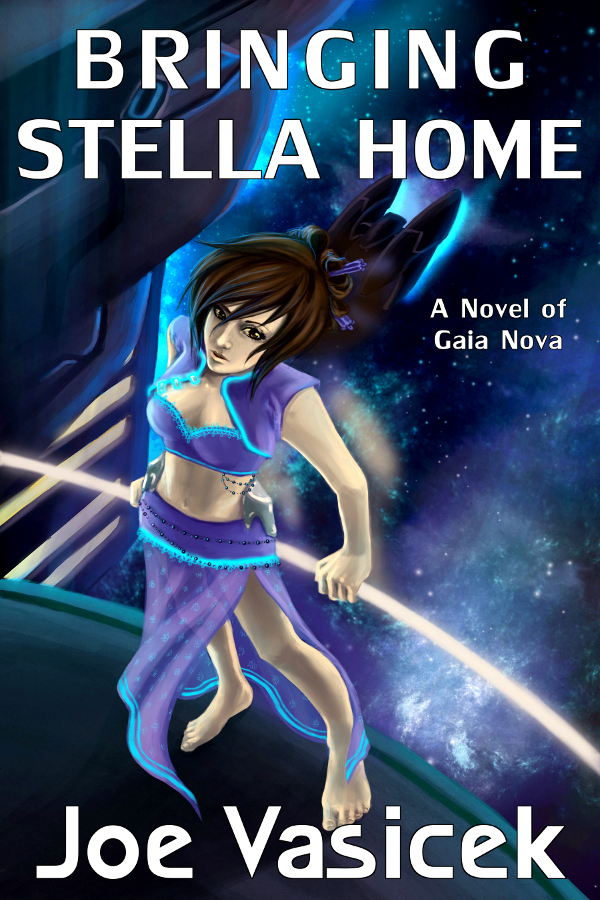
Bringing Stella Home is now up on Amazon!

That’s right–after a whole lot of work, my novel is now up on Amazon for $3.95.  Check it out!

This novel is the first of a much larger series that I have planned.  It’s not a series like Ender’s Game or Song of Ice and Fire, though; all of the novels are supposed to stand alone, though they share the same setting and feature recurring characters.  In that sense, it’s more like Gemmell’s Drenai series.

Even though the series is space opera, I tried to keep the science plausible at least on a high school level.  So while there’s “magic” like FTL and artificial gravity, I’ve tried to bend rather than break the laws of physics.

At its core, the story is more about the characters than the setting or even the plot.  It follows a young boy who is determined, at all costs, to save his brother and sister, even as his world quite literally falls to pieces all around him.  Along the way, he meets up with a mercenary captain who is running from some demons of her own.  The way they help each other overcome their personal challenges is a major driving force throughout the book.

Anyhow, I suppose that’s enough.  I could ramble on forever, but I don’t want to get in the way too much.  Thanks so much, and I hope you enjoy it!