Grape harvest update

Sorry for missing the last Trope Tuesday post.  We’re in the tail end of the grape harvest here in Georgia, so I’ve been spending a lot of time helping out with that.  The next trope post is going to be a big one, so rather than trying to pound it out in the village (where most internet sessions are cut short by a power outage), I figured I’d just wait until next week.

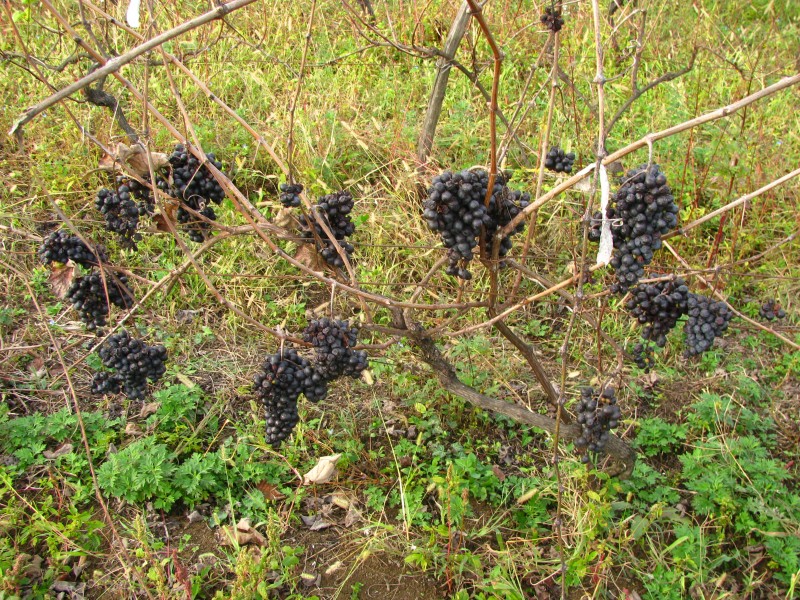
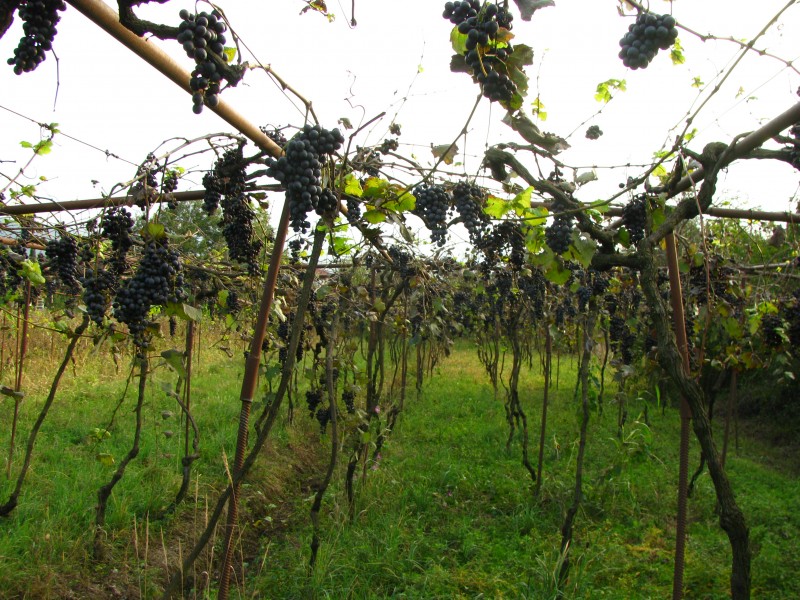
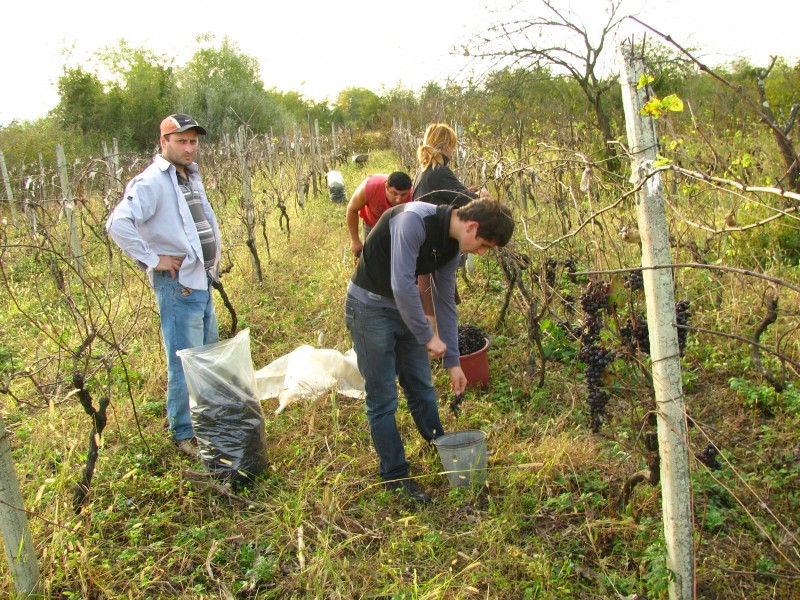
In any case, here are some pictures from the harvest that you might find interesting.  Georgia is pretty famous for its wine and grapes–there are over 500 different varieties in the country, many of them indigenous to the Caucasus region.  Almost everyone in the village has their own vineyard, so most of the stuff you buy in the market is locally grown and locally produced.  Let me tell you, there are few things more awesome than being able to get freshly picked fruit right in your own backyard.

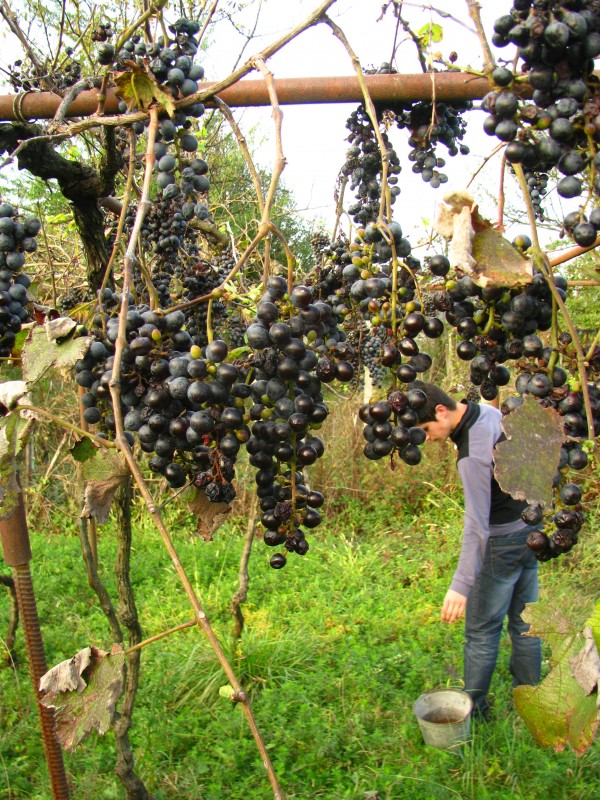
Picking grapes. A bunch of the neighbors came out and helped, in exchange for a basketful of grapes and a nice dinner.
Grapes, fresh on the vine.
It takes a little more infrastructure to grow them this way, but the end result is much better.
The best part of picking grapes is being able to snack while you pick them. 🙂

In terms of writing, I’m making fairly decent progress on my next novel.  It’s a fantasy story, so it’s a pretty big shift from all the space opera stuff I’ve done over the last few years.  At least, that’s what it feels like.  I’m trying not to worry about how much it sucks right now, but if it’s anything like all my other books, it will turn out a lot better than I think it will.

That’s about all for now.  I’ll leave you with this hilarious youtube clip of a bunch of Koreans going ape over a Georgian dance troop.  The Georgians are awesome, but it’s worth watching for the Koreans’ reactions alone.  Seriously, best thing I’ve seen in a long time.

See you around!

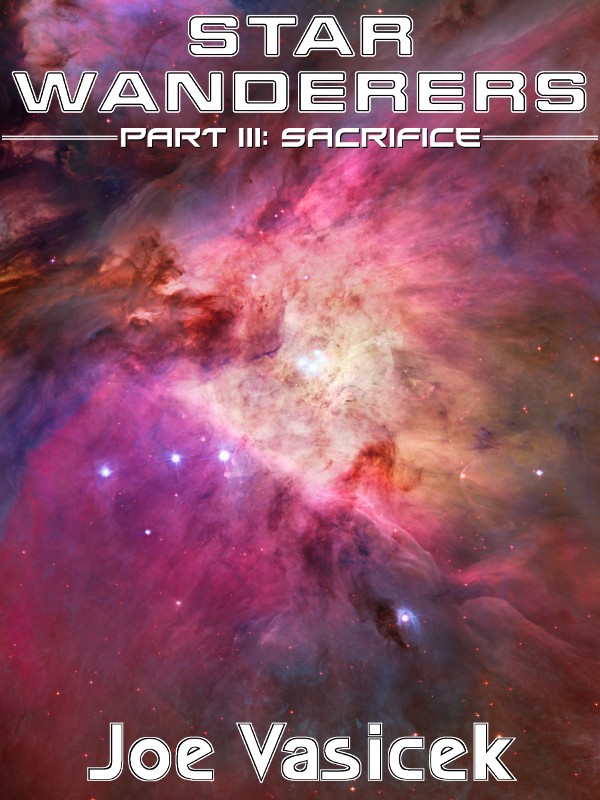
STAR WANDERERS: SACRIFICE is now up!

Hi everyone!  So I got the proofreads for Star Wanderers: Sacrifice (Part III) back a little early, so I formatted the ebook yesterday and published it just an hour or two ago!

It should be up on Kindle and Kobo in a couple of days, and Nook as soon as I can get a better internet connection (for some reason, the internet at the village center keeps logging me off of Pubit).  But it’s up on Smashwords right now, so if that’s where you like to get your ebooks, feel free to pick up a copy!

From the book description:

SHE GAVE UP EVERYTHING TO WANDER THE STARS WITH HIM. NOW, HE MUST DO THE SAME.

When Jeremiah found himself alone on his starship with an accidental bride, he had no idea how much his life would soon change. Now, with Noemi’s quiet confidence supporting him as she carries their first child, it’s hard to imagine life without her.

But life in the Outworlds isn’t so simple. Good men are hard to come by, and Noemi’s friends expect her to share. As part of a colony mission bound for an unsettled star, Jeremiah can’t say no without causing a rift in the community. But if he says yes, his new-found happiness may soon come to an end. One way or another, he will have to make a sacrifice—one that could tear their starbound family apart.

The next installment Star Wanderers: Homeworld (Part IV) should be coming out in about a month.  It’s already written, but I want to run it by my first readers and do another revision before I get it ready to publish.  This will conclude the main arc of the Star Wanderers novelette series, but I still plan to write more stories with the same characters–perhaps even a follow-up novel, eventually.  Who knows?

That’s all for now.  Thanks for everything, and I’ll see you guys around!

Trope Tuesday: Came Back Strong

This trope, also kown as apotheosis, is by far my favorite part of the hero’s journey.

Up to this point, the hero has faced a lot of tests and trials.  Some of them he’s passed, some of them he hasn’t, but the setbacks haven’t yet been enough to stop him.  Sure, the costs have been high–he may have lost a friend or mentor, for example–but at least he’s still in the game.  Then, just as he experiences the power of love (meeting with the goddess) and reconciles with the ultimate power in his life (atonement with the father), what happens?

He dies.

This may be literal or metaphorical, physical or spiritual–but whatever form it takes, the hero has to lose something significant, up to and including…well, everything.  After all, there are so many things worse than death.  While all the other failures up to this point left him more or less intact, this one completely shatters him–and in the process, transforms him.

Like a phoenix rising from the ashes, the hero comes back from the dead, often with a level in badass.  By dying, he gains that last piece of knowledge, experience, or resolve that he needs to defeat the big bad and gain the ultimate boon of his quest.  Whoever or whatever he was before, that person wasn’t strong enough to pass the test–but now, he is.

When done well, this is a stand-and-cheer moment of the best possible kind.  It’s the culmination of everything the hero has gone through, not just in terms of plot, but character as well.  Years from now, you might forget everything else in the story–even the parts that you loved–but you’ll remember how you felt when you got to this part.

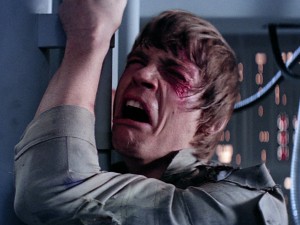
One of my favorite examples of this trope is in the clip I posted from the Matrix.  Seriously, when Neo realizes that he is The One, that is one of the best moments in all of cinema.  The Empire Strikes Back also has a moment like this, though since the movie is essentially a tragedy, there’s a lot more emphasis on Luke’s death (falling through the gas mine shaft after confronting Darth Vader) than his resurrection (getting a new hand and reuniting with his friends).  The oldest examples, of course, come from mythology–Odin gained the ability to use magic by sacrificing himself on Yggdrasil, and before returning to Ithaca, Odysseus first had to journey to Hades to pay his old friend Agamemnon a visit.

So as writers, how are we supposed to get this trope right?  I’m by no means an expert, but my gut instinct tells me that the way to nail it is to be as excited about this moment in the story as we want our readers to be when we get to that point.  Even though storytelling is ostensibly just making stuff up, it’s not something you can fake–if you aren’t excited about your own story, how do you expect your readers to even care?

Fortunately, this is often the part of the story that drives us to write everything else.  There have definitely been times when I could hardly wait to get through the other stuff and finally write the chapter where this happens.  Bringing Stella Home was a big one–and that’s all I can say, at the risk of giving spoilers.  Star Wanderers is another one, though it wasn’t until I was midway through Fidelity that it really came to me.  Desert Stars was more of a Heroic Second Wind, which is basically Came Back Stronger without the death.  However, there was definitely a transformation, both for Mira and Jalil.

So yeah, I really, really, REALLY love this trope.  When done well, it’s one of those things that can turn a run-of-the-mill adventure story into something both soul-searching and powerful.  You can definitely expect to see me play with it a lot in the future.

Still here, wherever that may be

Wow, it’s been forever since I’ve been active on this blog.  I guess living in the developing world will do that to you.

It’s not that I don’t have good internet access, it’s that the places where I can get it are often noisy and crowded, with a fair amount of cigarette smoke.  By the time I’ve checked my email, caught up on all the blogs I follow (or at least the interesting ones), and generally finished screwing around done everything else I need to do on the internet, I’m pretty wiped out.

I’ll try to write my future posts offline, like I did in Jordan, so all I have to do is copy and paste.  I can’t really do that with Trope Tuesday posts, but for everything else, it shouldn’t be a problem.

In any case, I’m still here–wherever “here” is.  Currently, it’s Tbilisi.  I came out for the weekend to pick  up a package from the USA…I was hoping to get the new kindle paperwhite, but instead got the case and adapter.  Turns out the actual device is shipping out next week–I’d say it’s a disappointment, but I’m actually just relieved to know that it wasn’t lost in the mail.

Things are going well out here in Georgia.  The village kids are a lot of fun to teach–I basically feel like a rockstar whenever I’m at the school.  It certainly helps that I give out stickers left and right every time someone actually does their homework.  Whenever I pull them out, the kids say “smiley!” and go crazy.

But yeah, even though I enjoy being out here, I figure it’s time for a change.  Like I mentioned in the last post, I’ve accomplished just about all my goals for coming out to Georgia, which mostly had to do with trying out a TEFL career and seeing if it’s a good fit.  I think it is, so I plan to go out again after a few months, but I want to come back to Utah for a while to see some old friends, spend time with family, and recharge before the next big excursion.  That’s the plan, anyway.

As far as the writing goes, things are going, but slower than I’d like.  I’m only in chapter two of The Sword Keeper, which is kind of frustrating, but I think I’ve overcome most of the hurdles and now it’s just a matter of buckling down and doing it.  I definitely think I can have this novel finished before the end of November, which would make it my second novel for the year (third, if you count Star Wanderers I-IV).

In terms of publishing, though, things are looking great.  I found someone to proofread Star Wanderers: Sacrifice, and she should be getting back in the next few days.  If all goes well, it’ll be up on Amazon and Smashwords by Monday the 29th.  Star Wanderers: Homeworld is also getting close–I just need to get the feedback from my first readers and figure out where to go from there.  If there aren’t any major issues, it should be up by the end of November.

I’m debating whether to splurge on the cover art for the omnibus, and if so, who to ask to do it.  This series have a very different feel from my Gaia Nova series, even though they both take place in the same universe.  Not sure what to do for the illustration, or who to ask to do it, but that’s still a few months down the road.

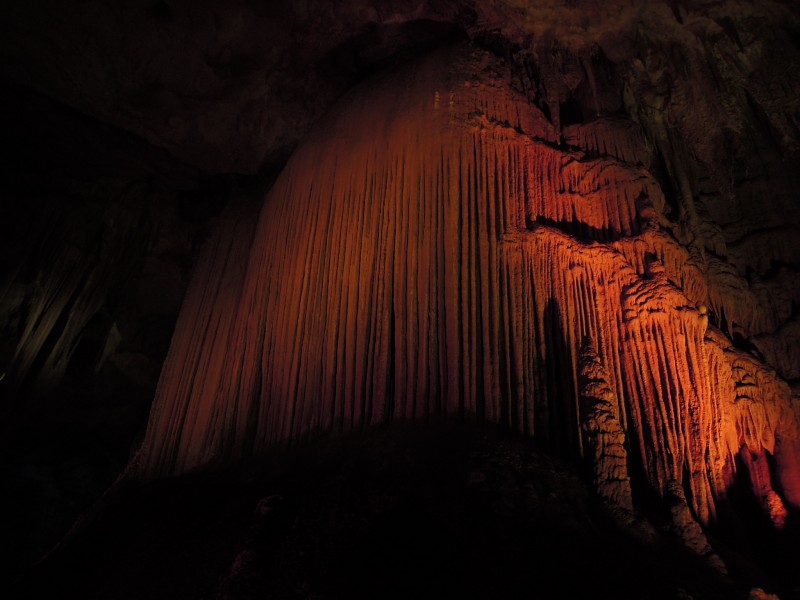
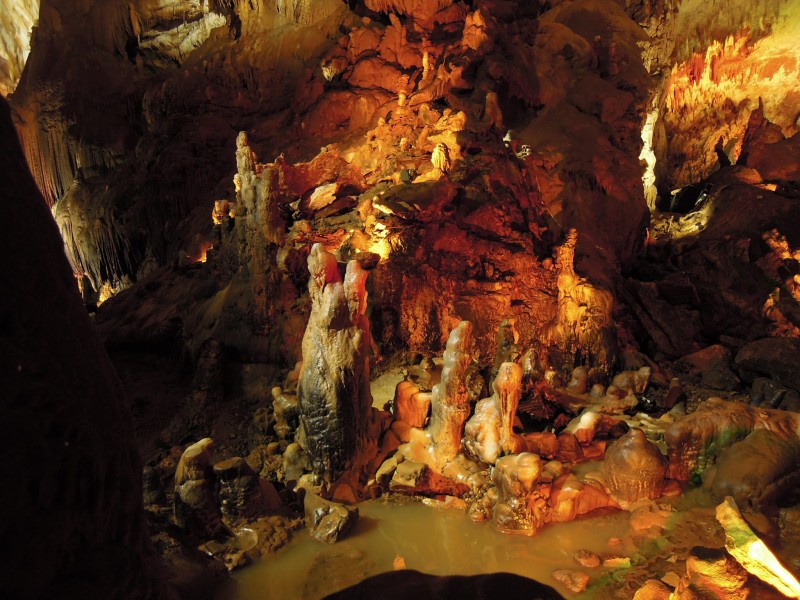
That’s about it for now.  I’ll end with a few shots that my friend took in Prometheus Cave, one of the coolest sites out here in Imereti province.  Imagine about a mile of caverns, brimming from floor to ceiling with formations like these:

Later!
Updates and a book blurb

So I probably won’t do a Trope Tuesday post this week, just because today is going to be kind of busy.  One of my coworkers in a neighboring village has a birthday, and Georgians tend to go all out with birthday parties.  I’m currently blogging from one of the government offices in the village center, which serves as a sort of free internet cafe for the locals.  Things get busy in the afternoon, though, and I’m teaching a class in a couple of hours, so this is going to be short.

I’ve worked out a tentative book description for Star Wanderers: Sacrifice (Part III).  It’s still about two weeks from publication, give or take a few days, so I’d appreciate any feedback that you can give.  This is the third book in the series, so hopefully most readers will already be hooked by this point, but I still want the description to be as solid as possible:

SHE GAVE UP EVERYTHING TO WANDER THE STARS WITH HIM. NOW, HE MUST TOO.

When Jeremiah found himself alone on his starship with an accidental bride, he had no idea how much his life would soon change. Now, with Noemi’s quiet confidence and a baby on the way, it’s hard to imagine life without her.

But life in the Outworlds isn’t so simple. Good men are hard to come by, and Noemi’s friends expect her to share. As part of a colony mission bound for an unsettled star, Jeremiah can’t say no without alienating them from the rest of the community. But if he says yes, his newfound happiness could soon fall apart.

There is another option, of course: leave the colony mission and strike out on their own. But with Noemi’s pregnancy rapidly approaching the third trimester, that may be too much to ask of her. One way or another, Jeremiah will have to make a sacrifice—one that could tear their starbound family apart.

In other news, I’ve more or less decided to come back to Utah in January, after my current teaching contract is over.  I like it here in Georgia, but I’ve accomplished pretty much all of the goals I had when I first came out, and I don’t think I’m going to get much more from staying.  It’s been a great experience, but things are wrapping up and it will soon be time to move on.

That’s about it for now.  I’ve got to go, but I’ll try to post more later.

Trope Tuesday: Well Done Son Guy

What happens when this trope goes horribly, horribly wrong.

So the hero gets the call to adventure, initially turns it down, meets a mentor figure who gives him some sort of supernatural aid, crosses the threshold of adventure, faces a series of tests and trials, loses his mentor, experiences the power of love…and then what?  Well, if we’re playing the hero’s journey straight, the next step is atonement with the father, also known as well done son guy.

Before passing the ultimate test, the hero must first confront the force that holds the ultimate power in his life.  This is often some sort of father figure, though it can also be a close friend or a rival.  Often, the main reason the hero set out on the journey in the first place was because he felt a need to prove himself and gain the respect of this figure.  For that reason, the climax often involves some sort of reconciliation or closure between these two characters.

In discussing this trope, Joseph Campbell said the following:

Atonement consists in no more than the abandonment of that self-generated double monster—the dragon thought to be God (superego) and the dragon thought to be Sin (repressed id). But this requires an abandonment of the attachment to ego itself, and that is what is difficult. One must have a faith that the father is merciful, and then a reliance on that mercy…

The problem of the hero going to meet the father is to open his soul beyond terror to such a degree that he will be ripe to understand how the sickening and insane tragedies of this vast and ruthless cosmos are completely validated in the majesty of Being. The hero transcends life with its peculiar blind spot and for a moment rises to a glimpse of the source. He beholds the face of the father, understands—and the two are atoned.

While this may, on the surface, seem just like a simple “I’m proud of you” moment, the full significance goes much deeper.  This is the moment where the hero finally receives validation for all his struggles, where he realizes that everything he’s been through has been worth it.  It’s a tremendous moment, and an important element of any story that follows the hero’s journey paradigm.

The reason why the hero’s journey resonates so strongly throughout our culture is because it powerfully and effectively fulfills one of the major purposes of all story–to help us better understand ourselves, the world we live in, and what it means to be human.  For that reason, this trope is one of the things that can either make or break a story.  When done well, it can turn the work into a classic.  When done poorly, it can make us wish we had our money back.

I’d talk about this trope in my own work, but I don’t want to give any spoilers.  In Bringing Stella Home, there’s something of a gender inversion, as the title would imply.  In fact, there’s a gender inversion in Star Wanderers as well, though you’ll have to wait until part IV to read it.  In Desert Stars, it’s more of a personal moment, but the whole novel is a lot more intimate and personal than a save the world type of adventure.

Star Wanderers: Outworlder (Part I) is now free on Amazon!

Good news!  Amazon just made Star Wanderers: Outworlder (Part I) free!  It’s been free for a while on all the other eretailers, but if you do most of your ebook shopping on Amazon, it’s now free there as well.

Star Wanderers: Outworlder (Part I) is the first part of a four part series of science fiction novelettes, possibly with other installments after the main storyline is complete.  From the book description:

HE WANDERS THE STARS IN SEARCH OF A HOME. INSTEAD, HE GOT A GIRL WITHOUT ONE.

When Jeremiah arrived at Megiddo Station, all he wanted was to make some trades and resupply his starship. He never thought he’d come away with a wife.

Before he knows it, he’s back on his ship, alone with his accidental bride. Since neither of them speak the same language, he has no way to tell her that there’s been a terrible mistake. And because of the deadly famine ravaging her home, there’s no going back. She’s entirely at his mercy, and that terrifies him more than anything.

Jeremiah isn’t ready to take responsibility for anyone. He’s a star wanderer, roaming the Outworld frontier in search of his fortune. Someday he’ll settle down, but for now, he just wants to drop the girl off at the next port and move on.

As he soon finds out, though, she has other plans.

Also, for those of you who have been looking forward to the next Star Wanderers release, I have a tentative cover for Part III:

Pretty cool, huh?  What do you guys think?

The feedback from my first readers has been mostly positive, so I think this story is mostly ready for publication.  I’ll probably do another quick pass to touch up some relatively minor issues, then it’s just a matter of proofreading, formatting, and crafting a solid author’s note and book description.  If all goes well, it should be up in two or three weeks.

That’s just about it for now.  More updates later, especially on life here in Georgia and that new fantasy series I just started.  See you around!

Trope Tuesday: Supernatural Aid

Getting back to our discussion of the Hero’s Journey, I think it’s important to briefly touch on one of the earlier stages: supernatural aid.  At some point between refusal of the call and crossing the threshold of adventure, the hero typically encounters a mentor figure from the unfamiliar world who gives him something supernatural or otherworldly to help him on his quest.  While the mentor often dies (as we saw last week), the supernatural aid that the mentor gives later proves to be a key to defeating the big bad and passing the ultimate test.

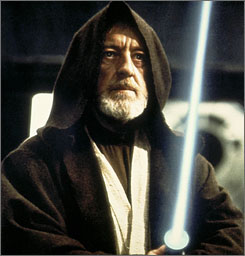
Often, this is an actual object.  In Lord of the Rings, for example, Galadriel gives each member of the fellowship a specific object.  She gives Sam a magical vial, which he uses later to defeat Shelob and save Frodo and the ring.  In The Lion, The Witch, and the Warderobe, Aslan gives each of the kids a weapon item specially suited to their characters (except Edmund, who was a prisoner of the queen at the time).  In Star Wars IV: A New Hope, Obi Wan gives Luke his father’s lightsaber–though for the purposes of this trope, we can also count his special training with the force, since Luke doesn’t use the lightsaber until episode V.

In discussing this trope, Joseph Campbell said the following:

Having responded to his own call, and continuing to follow courageously as the consequences unfold, the hero finds all the forces of the unconscious at his side. Mother Nature herself supports the mighty task. And in so far as the hero’s act coincides with that for which his society is ready, he seems to ride on the great rhythm of the historical process.

So if the mentor is supposed to die (or get put on a bus) in order for the hero to stand on his own feet, why does the hero need some kind of supernatural aid?  Isn’t that just cheating?

Not exactly.  Often, the aid is itself part of the ultimate test, and the hero doesn’t figure out how to use it properly until after he’s already experienced everything from the adventure that he needs.  The silver slippers from The Wizard of Oz are a good example of this.  So is AURYN from The Neverending Story.  The hero doesn’t fall back on the supernatural aid until after he’s completed his growth arc.

That’s not the only reason, though.  In order for the adventure to have meaning and impact, the stakes have to be really high.  Having some sort of mysterious character from the outside world grant the hero something supernatural is a great way to do this, especially at the beginning.  If the hero is part of something bigger than himself–saving the world, for example–then it makes sense that he would get some kind of help from the people depending on him, especially if those people have something supernaturally powerful to give.

The Force from Star Wars is one of my favorite examples of supernatural aid.  I hear that when episode IV debuted in the theaters, the crowds jumped up and screamed when Obi Wan said “use the force, Luke!” in the clip at the top of the post.  Just because it’s so awesome, here’s the full scene (more or less):

“Remember–the force will be with you. Always.”

On the verge of another story

So with Star Wanderers coming to a close, at least as far as the actual writing is concerned, I’ve recently found myself back in that weird writerly place where I don’t have any pressing projects to work on.  Whenever this happens, I find that it’s generally a good idea to start something new.

Until just a couple of days ago, though, I wasn’t sure which project to start.  At first, I thought I should do the sequel to Stars of Blood and Glory, since I’m currently getting that one ready to send off to my editor, but beyond a tentative title (Empress of the Free Stars) and a really awesome opening scene, nothing has really sparked for that one.  With time, I’m sure my ideas will come together, but for now it’s just not ready to come out of the incubator.

So then I went back to The Swordkeeper, going back over the ideas that had sparked that one.  I started the opening scene back in March, but it’s currently lackluster, and none of my attempts at worldbuilding have gotten me anywhere.  For the past six months, I haven’t really touched it.

But when I took the time to just think about the story, something amazing happened.  All my ideas came together, and the ending just came to me–not just for the first book, but for the entire series.  Seriously, I must have spent hours staring out across the Georgian countryside from my farmhouse balcony, totally in awe of the story in my head.

A similar thing happened to me last summer with Stars of Blood and Glory.  It took me a few months to finally get around to writing it, but when I did, the first draft flew out in just a matter of weeks.  I’ve since made a few relatively minor fixes to the beginning and added some scenes that were missing, but otherwise haven’t made any substantial changes, and the comments from my first readers so far confirm that that’s the right decision.

So if all goes well, I’ll finish up with Stars of Blood and Glory by the end of this next week, and restart The Swordkeeper soon after that.  Things are looking good, and I can’t wait to get immersed in this next story.  It’s a fantasy, so that’s going to be a major shift, but I think it will help to keep things fresh.

Anyhow, that’s all for now.  More later.

Trope Tuesday: Mentor Occupational Hazard

Being a mentor to the hero can be a pretty tough job.  Don’t believe me?  Check out the tvtropes page:

If you don’t have to convince The Chosen One who just wants to be normal to grow a spine and accept the Call to Adventure, you have to convince your blindly excited and dangerously eager young pupil that You Are Not Ready to learn the Dangerous Forbidden Technique. When you try to protect The Hero from the Awful Truth, you end up facing their Rage Against the Mentor. You have to maintain an ongoing conspiracy to keep The Hero Locked Out of the LoopIf they’re an orphan, you have to find them a set of Muggle Foster Parents while keeping social services in the dark. You have to endure accusations of insanity when you’re trying to teach your charge that Your Eyes Can Deceive You, give them advice on how to tell a love interest “It’s Not You, It’s My Enemies,” and keep a close eye on them 24/7.

And what is your reward for all this patience and effort?

You die.

And that right there is the heart of the matter: mentors tend to die.  And stay dead.  Even if they do figure later in the story, they tend to be spirit advisors from the other side with little or no chance of coming back from the grave–even if everyone else does.

So why does this happen?

The most obvious reason is that if the mentor and the hero are both working toward the same goal, the mentor cannot overshadow the hero–otherwise, why not forget the hero and send the mentor off to save the world?  The hero may start off weak, which is why he needs the mentor in the first place, but at some point in the growth arc, he’s  going to have to stand on his own two feet.  Oftentimes, the most poignant (and convenient) way to mark that transition is to knock the mentor off.

That doesn’t explain everything, though.  If the only reason for killing the mentor is to give the hero a growth arc, you can accomplish that just as well by putting him on a bus.  So why does he have to die?

Lots of reasons!  Character growth, increasing tension, making the story more meaningful–the list goes on and on.  For an in-depth discussion on killing off characters, I’d recommend checking out this last week’s episode of Writing Excuses.  My own personal take is that everyone dies eventually–even the immortal characters have to pass through some sort of transition from this world to the next–so the best thing I can do for a character isn’t to keep them alive, but to make their lives and their deaths actually mean something.

It’s also worth pointing out that in most stories, the mentor isn’t actually fighting against the big bad, but the dragon–the big bad’s lancer.  Again, the main reason for this is to keep him from overshadowing the hero.  But the dragon is a character in his own right, with his own agenda that may run counter to his boss–think Darth Vader from Star Wars.  And in a lot of stories, the dragon actually tries to tempt the hero to come around and join him.

Perhaps that’s another reason why mentors often die–if they didn’t, then the bad guys wouldn’t ever be able to dissuade the hero through temptation.  The hero would be so protected that he’d never have the opportunity to switch sides, or at least he’d never have to face any moral ambiguity because of the guardian mentor constantly guiding him.

So those are some of the reasons why mentors tend to have a short life expectancy.  Can you think of any good ones?