B is for Space Battles

osc_first_meetingsIf you fell in love with science fiction when you were twelve, chances were it was because of the awesome space battles.  That was certainly the case with me.  When I saw Star Wars for the first time, I spent hours running around the house pretending I was flying my own starfighter.  In some ways, I’ve never really stopped. 😛

Ever since space opera became its own subgenre, space warfare has featured prominently in it, probably for the same reasons that Homer and Tolstoy framed their sprawling epics with a tale of war.  Where else are you going to find enough drama to fill volumes?  The fact that it’s set in space makes it so much cooler.

There are a lot of things about the space setting that make war stories different from those set here on Earth.  For one thing, there’s a huge element of exploration and unknown.  Even before we took the first photographs of Earth from space, there pretty much isn’t any corner on this planet that hasn’t been discovered by somebody.  In space, though, it’s still possible to stumble on a hidden planet, or find a mysterious alien artifact that can turn the tide of the war (Halo, anyone?).

For another thing, the dynamics of battle are completely different.  Sure, some stories treat space like an ocean, and there’s certainly a place for that kind of story, but the more interesting ones (at least to me) take into account all the profound differences.  For one thing, the zero gravity means that there is no “up” or “down,” which means that you have to deal with the possibility of attack coming from any direction, not just along a horizontal plane.  That concept alone drives the battles in Orson Scott Card’s Ender’s Game series, where “the enemy’s gate is down.”

One thing that really tickles me is when the story takes things a step further and incorporates things like orbital mechanics and delta-v.  I haven’t seen many books or games that do this, but the ones that do have really engrossed me by making the world feel that much more real.  Glen Cook did it in Passage At Arms, and the new Battlestar Galactica did it in the viper dogfights (though I’m not sure if they did it on the ship-to-ship scale).

The implications of real-world space physics on warfare are quite fascinating.  Rocketpunk Manifesto is an excellent blog that’s almost entirely dedicated to exploring them all, with all sorts of fascinating discussions on what the “plausible mid-future” may look like.  But even if all you’re looking for is an entertaining romp through space, the story telling possibilities are so much greater when you take the constraints of physics into account.

For example, if it takes months or even years to travel between planets, and orbital trajectories are fairly straightforward to figure out, how does it affect things if you can see the enemy fleet coming at your planet that long in advance?  If escape velocity from a gravity well like Earth is so difficult to achieve, what does that mean about the possibility of long-term planetary sieges?  And if starships are so far apart and moving so fast as to make full-on broadsides unlikely, how does that shape the battle tactics and strategy?  In spite of the physical constraints (or indeed, perhaps because of them), the possibilities are endless.

Man, I love me some good space battles.  One of my recent sci-fi favorites that features some epic battles is Wolfhound by my friend Kindal Debenham.  In my own work, you’ll find lots of them, especially in the Gaia Nova series (Bringing Stella Home, Stars of Blood and Glory, and to a lesser extent Desert Stars).  They say that the golden age for science fiction is about twelve years old, and that’s definitely true for me.  Expect to see lots more space battles from me in the future.
A is for Aliens

cantinaAlien races–what would science fiction be without them?  They’re as fundamental to the genre as elves and dwarves are to fantasy.  If you’re reading a book and an alien being from another planet shows up on the page, that in itself is usually enough to make the story science fiction.

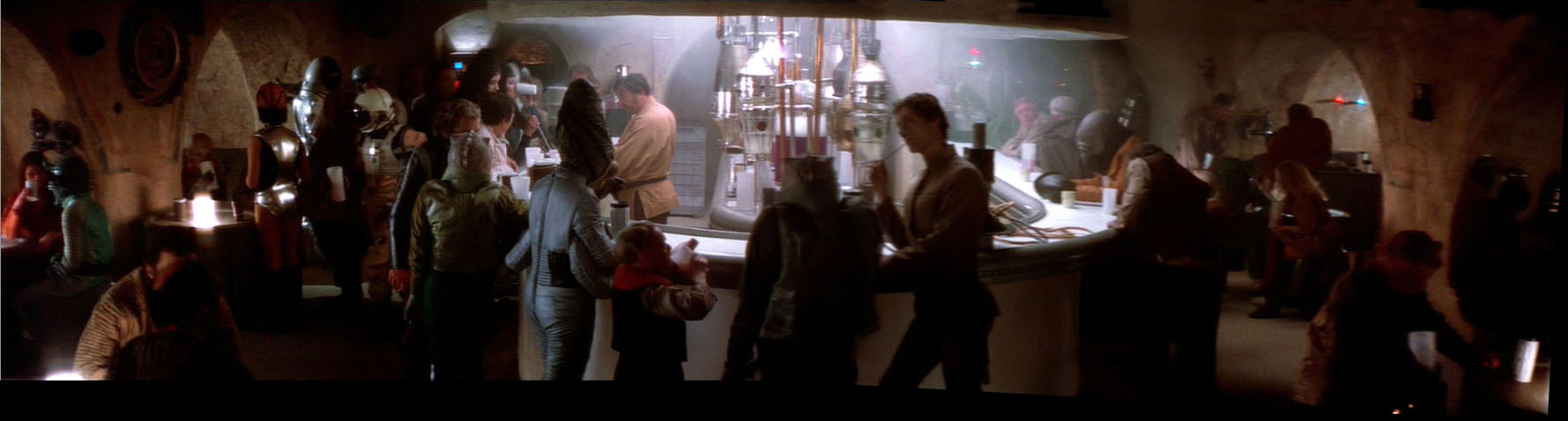
My first exposure to aliens came from Star Wars IV: A New Hope, which I saw as a kid sometime back in the early nineties.  The cantina scene with the weird, catchy music and all the frighteningly creatures both scared and fascinated me.  Here were a bunch of humans, mingling with these things that looked like monsters as if nothing were strange or unusual.  In fact, it soon became clear that these weren’t monsters at all, but regular people–that is, as regular as you can be without being human.

I think the main reason for including aliens in a space opera story is that it makes the setting feel more exotic and otherworldly.  It can also add all sorts of interesting possibilities for plot and character, depending on the different capabilities of the various alien races and the way their culture shapes them.  Babylon 5 is a great example of this, with the characters from each alien race interacting with each other in ways unique to their various cultures.

One way to think of science fictional aliens is to put them on a spectrum with two extremes.  On the one side, you have the more familiar aliens–the races from Star Trek, for example, which are basically human-like except with weird skin or bone ridges to physically distinguish them.  On the other side, you have the truly bizarre–the kinds of aliens that are so different from us, we cannot possibly conceive their thoughts or the way they see the world.

The main advantage of the more familiar alien types is that they’re easy to understand and relate to.  Yeah, they may look weird, but they don’t think or act much differently than the Russians, or the Arabs, or whatever human culture they roughly parallel.  In fact, it’s not uncommon in fiction of this type for the aliens to be less “alien” than the Japanese (at least, in Western fiction–obviously, it’s different in manga and anime).  This, in turn, is the main weakness with aliens of this type: they are so readily understandable that it’s easy to lose that sense of otherness.

The main advantage of the more extreme kind of alien is that it can make a much stronger impact, which makes for a more compelling and thought-provoking story.  For example, the Hypotheticals in Robert Charles Wilson’s Spin trilogy are so fascinating because we know so little about them.  They have the power to shape entire worlds, manipulating space and time itself, and yet none of the reasons behind what they’re doing make sense–if indeed there’s any reason behind it at all.  Or in Octavia Butler’s Xenogensis trilogy, it’s not too hard to figure out what the aliens are trying to do, but the way in which they do it, impregnating the main character through their tri-sexual biological capabilities makes for a profoundly disturbing story.

The disadvantage, of course, is that aliens of this kind are much more difficult for readers to relate to.  If the aliens are so advanced that their thoughts transcend our own, or if their sensory organs are so different that we cannot possibly conceive of how they see the world, then it’s very difficult for us to get inside of their heads.  For this reason, aliens of this kind tend to become more of a force of nature than actual characters–or characters in the aggregate, in the way that humanity is the main character of most of Arthur C. Clarke’s books.

Personally, I’m more of a fan of the extreme alien type.  The universe is so vast, and our understanding of it is so lacking, that it rings a lot truer to me.  The odds that we are alone in the universe are so infinitesimally small that refusing to believe in the existence of aliens would be akin to believing in 1492 that the Earth is flat, and yet if/when we ever make contact, I can’t help but wonder how different from us they’ll be.  So much of what we take for granted is just a fluke of our particular circumstances here on this planet–the chance combination of so many variables that changing any one of them would completely rewrite the story of how our species evolved, much less our civilization.

There is a place for the more familiar aliens of space opera, though. They make for some very entertaining stories, provide a fun escape from this world when that’s what we need.  They also give us a chance to look at ourselves through a lens that strips away our stereotypes and prejudices.  We might have some very strong opinions about immigrants, for example, or people of a different race or color, but none of us are prejudiced against Sand People, or Klingons, or Androsynth.  In space opera, most alien races are loosely based on real-world cultures, so it’s possible to draw parallels without all the cultural and historical baggage.

In a sense, all fiction is just the culture speaking to itself, so when we read about aliens we are really reading about ourselves.  Encountering the Other in a non-threatening fictional world enables us to face the real-world Other with understanding and compassion.

I haven’t written very many alien stories yet, but I have a couple cooking in the back of my mind.  Genesis Earth has an alien encounter with a bit of a twist to it, but the characters in my Star Wanderers and Gaia Nova series are all human (well, mostly).  If/when I do introduce an alien race, I plan to do it right, which will almost certainly involve a first contact story.  But that’s for Saturday’s blog post, not today’s.

New book teaser — what do you guys think?

SW-VI Benefactor (thumb)I’m getting ready to publish Star Wanderers: Dreamweaver over the weekend, but first I need to finalize the teaser / book description for Benefactor so that I can include it in the back.  Here’s what I’ve got so far:

IN A COLD AND LONELY UNIVERSE, A SIMPLE ACT OF GRACE CAN RESONATE ACROSS WORLDS.

Jakob is entrapped in a life he never made for himself. A one-time starfarer, now he struggles to provide for his family of starbound refugees. With the recent Imperial takeover of Oriana Station and the worsening economic situation, it’s only a matter of time before they’re forced to move on—again.

To make matters worse, his wife’s resentment has been growing ever since he sent their two sons away to seek their fortunes across the stars. She claims that he stole them from her, when all he wanted was to give them a chance at a better life. Without her support, it’s not clear how long the family can hold together.

When a young man and woman with an unusual story show up from his wife’s home world, he agrees to take them in, if for no other reason than that they remind of his sons. They soon become part of the family, though this adds even more to the burden he can barely carry on his own.

An outworlder is nothing if not fiercely independent, and Jakob is no exception. He’ll sacrifice everything before he asks for help—even if the only other way out lies through an open airlock.

What do you think?  Does it sound interesting?  What works, and what do you think needs to be cut?

Also, a quick update on the situation with Star Wanderers and Smashwords.  I’ve discovered that the updating problems aren’t just restricted to iTunes, but all of the sites that I distribute to through Smashwords (Sony, Diesel, and Barnes & Noble (for Outworlder)).  We haven’t been able to get the books fixed, so I’ve decided to pull them all and republish.

What this means is that the first four Star Wanderers novellas will be temporarily unavailable from these sites, probably for a week or two.  If you got your copy from Smashwords, you should still be able to access it there–the books have been updating just fine on Smashwords, it’s only with the other retailers that I’ve been having problems.  For Dreamweaver, there shouldn’t be any problems though (I hope).

Thanks for your patience while I get this mess sorted out!

Trope Tuesday: Fridge Logic, Fridge Horror, and Fridge Brilliance

It's amazing how many existential story questions arise from this view.
It’s amazing how many stories suddenly stop making sense from this point of view.

You know that moment after the end of the show, when the credits are rolling and the glory of that crowning moment of awesome is just beginning to fade?  When you go to the fridge to get something to eat, and all of a sudden that gaping plot hole or internal consistency problem with the story hits you?  Yeah, that’s fridge logic.

The key, though, is that it’s not something you normally question while you’re reading the book or watching the show.  While you’re in the story itself, the narrative is so compelling that you just don’t question it–that, or rule of cool is in play.  It’s only after the story is over that those questions start to arise.

It doesn’t have to come from bad writing.  Sometimes, it’s a result of values dissonance, especially for stories written in a different time or culture (although by no means is this phenomenon immune to bad writing).  Sometimes, it’s a result of a tomato surprise, where a reveal of something the characters have known all along completely changes the audience’s understanding of the story (though certainly, this isn’t immune to bad writing either).

Not all fridge logic is bad.  Fridge horror happens when a story becomes even more terrifying the more you think about it.  Some of the scariest horror stories have done this to me, as well as some that weren’t really intended to finish on downer endings but kinda sorta did.  Cracked.com did an interesting article on six movies that went that way.

But the best is when a story turns around and gives you fridge brilliance–that moment when you realize that that thing that bothered you actually changes the nature of the story in a way that suddenly makes it your favorite.

My favorite novel of all time, The Neverending Story, totally did this to me.  When I first read it in fourth grade, there were so many things that made the story awesome: the Temple of a Thousand Doors, the test of the three gates, the old man who is the exact opposite of the Childlike Empress in every way, and of course the signature phrase “but that is another story and shall be told another time.” But when I reread it in college, I realized that the real story–the underlying story that brings everything together–isn’t about a loser kid having all sorts of adventures in a fantastic world, but about the power of storytelling itself, and how it can fill the world with love.

Another moment of fridge brilliance came to me when I learned the story behind the writing of Legend, my favorite novel by David Gemmell, my favorite fantasy writer.  The book is about a hopeless battle that everyone knows cannot be won, and the people who decide to go and fight it anyway.  That’s all well and good, except that David Gemmell wrote it immediately after he was diagnosed with terminal cancer.  The story of the battle itself was a metaphor for his own life, and his struggle with his own impending death.  Lucky for all of us, after he finished writing it the doctor came back and told him that the first test was a false positive–that he was going to live after all.  He then went on to write almost thirty more books, all of them off-the-charts awesome.

So yeah, there you have it.  These are more reader tropes than writer tropes, but as a writer it’s good to keep them in mind.  Don’t be lazy, otherwise your fans will pick your stories apart (or if you have to leave a hole, be sure to hang a lampshade on it).  And if you find yourself smacking your forehead over something you’ve already written and published, see if you can’t revisit it in later books in the series and turn it into fridge brilliance.

1000 posts and counting

1000dollars
Not quite the same, but we’ll run with it anyway.

According to my WordPress dashboard, this is the 1,000th post on this blog.  I was going to hold off and do something big and momentous for the occasion, but then I figured it would be better to do a quick footnote and get on with the regular program.

Nine hundred ninety nine blog posts ago, I was a college student at BYU who had just decided to write my first novel instead of a massive Final Fantasy VI fanfic.  The year was 2007, I had a bunch of unfinished novels and stories left over from high school, but I’d never actually finished anything.  I started this blog so that my writing friends could keep me honest.

If I could have seen myself now, I probably would have thought that I’m crazy (I think I got those verb tenses right…).  Back in 2007, writing was still a hobby.  I had dreams of turning it into something a little bit more, but I never intended to try and make it my full time career–though if you’d asked me what I wanted to do for a career, I couldn’t have given you an answer.

A thousand blog posts from now, where will I be?  Married, probably, with a couple of kids (or at least one on the way).  Hopefully by then, I’ll have turned this writing dream into a full time career–heck, I’m not all that far from making it happen right now.

The 2013 me hopes that I’ll be living somewhere exotic, having an extended overseas adventure with my lovely wife.  But the truth is that I’ll probably be settled down somewhere, trying to pay off a house and raise a family the responsible way.  If that’s the case, I’ll probably look back on my 2013 self and think he’s crazy.

But hey, who knows what the future will bring?

One thing that’s almost certainly true is that I’ll still be blogging.  I don’t just blog to promote my books, or to build my “platform” (oh how I hate that word), or anything slimy like that.  I’ve been blogging since before I decided to turn this writing thing into a career, and I keep on doing it because I love doing it.  Because really, how in the heck can you get to a thousand of anything without loving it?

On that note, I should add that I’ve signed up for the Blogging from A to Z Challenge for the month of April.  Every day (except Sundays), I’ll do a post that starts with a different letter of the alphabet, starting at A and going down to Z.  My theme is going to be things I love about science fiction and fantasy, and it’s going to include a number of common tropes.  It’s going to be fun!

So yeah, here’s to the first thousand posts on this blog.  It certainly won’t be the last! 🙂

An apology to my iTunes readers

Star Wanderers I (thumb)Star Wanderers II (thumb)Star Wanderers III (thumb)Star Wanderers IV (thumb)

If you’re one of my readers on iTunes, I want to apologize because my Star Wanderers novellas will be temporarily unavailable there for the next month or so.

I’ve noticed several errors with the way my books are listed there, most notably with the titles and book descriptions.  I distribute to iTunes via Smashwords, which can be notorious for errors like these.  In the last six months, they’ve done a lot to fix these problems, but for some reason my Star Wanderers books aren’t updating properly so I’ve decided to de-list them from iTunes in order to make sure that the new versions go through.

Sorry if this causes any inconvenience.  If you’ve purchased or downloaded a previous copy from iTunes and want the latest one, just email me your receipt at joseph[dot]vasicek[at]gmail[dot]com and I’ll send you the latest version.  To my knowledge, the errors are just with the title, description, and back-matter, not the actual text, but I’ll be happy to send you an updated copy anyway.

Star Wanderers: Dreamweaver will still go through to iTunes when I publish it in the next couple of weeks, even if the previous books in the series aren’t up by then.  Hopefully, this one will go through without any problems.  Smashwords has done a lot to streamline their distribution process, so I think it will be fine.

Thanks for your patience while I get this worked out!

SFR Brigade Presents STAR WANDERERS: OUTWORLDER

Star Wanderers I (thumb)To my regular blog readers: I recently joined an online community for readers and writers of science fiction romance called Science Fiction Romance Brigade.  Since a lot of my books fall under this sub-genre, I figured it would be good to connect with that community a little better.  If you’ve enjoyed my Star Wanderers novellas, then check out some of the other authors in the SFR Brigade–they seem to be doing some similar stuff.

To any new visitors: welcome!  I hope you enjoy your time here.  I’m a self-published indie writer with thirteen ebooks out so far, and a lot more on the way.  I’ve been writing ever since I read A Wrinkle In Time back in 2nd grade, and sf romance is definitely one of my favorite sandboxes to play in.

For this week’s SFR Brigade Presents feature, I’m sharing an excerpt from the first chapter of Star Wanderers: Outworlder, the first novelette in my Star Wanderers series.  The setup: Jeremiah is a young single starship pilot who arrives at a space station on the Outworld frontier hoping to make some trades.  The station master ushers Jeremiah into his family’s quarters, where he explains that a famine is ravaging the system and everyone on the station is probably going to die.  He then claps his hands, and his five daughters line up on the other side of the room.

*  *  *  *  *

“Choose!” Master Korha bellowed. Apparently defeated, his wife collapsed to the floor in tears.

Jeremiah tugged at the collar of his jumpsuit, sweat forming at the back of his neck. “What? Choose?”

“Yes yes—choose quickly, you take, you go!”

“But this is crazy; how can I—”

“If not take, will die. Choose!”

Jeremiah turned back nervously to the girls. The three youngest ones stared at him in absolute terror. The two oldest ones weren’t quite so frightened, but avoided meeting his gaze directly. They wore their long hair down with glistening sequined headbands across their foreheads, and the innocent looks on their faces cried out to him.

Should I take them both? If they were going to die otherwise, it seemed like the right thing to do—but he didn’t know if he could afford to take even one extra passenger on his ship. And besides, the whole situation had an eerily awkward feel to it, as if he were trading in people, not goods.

“You like? You like?” Master Korha asked, ambling to his side. He pulled the two girls forward to give Jeremiah a better look.

*  *  *  *  *

If you want to read the rest, you can pick up a free ebook copy on Amazon, Barnes & Noble, Kobo, Smashwords, or any of the other major ebook sites.

And if you’ve already read Outworlder, then I’m happy to say that Star Wanderers: Dreamweaver, the parallel novella from Noemi’s point of view, is currently on schedule to come out in the beginning of April!  As always, newsletter subscribers will get a coupon code to download the book for free when it’s released.  I’m just finishing up with the revisions now, and am really excited to get this story up!

That just about does it for now.  Thanks for stopping by, and I hope to see you again soon!

Trope Tuesday: It Has Been an Honor

If there ever was a phrase that invoked manly tears, it’s this one.

It has been an honor” is pretty much the go-to catch phrase for any Heroic Sacrifice or Bolivian Army Ending.  It’s often a precursor to a Crowning Moment of Awesome, and as far as last words go, it ranks right up there with “I die free,” “I die as myself,” and “I regret nothing.” Expect to hear it a lot from blood knights, members of the proud warrior race, or anyone who belongs to a martyrdom culture.

Occasionally, you’ll hear a villain say this when he acknowledges the hero as a worthy opponent.  In such cases, the villain may evolve into a friendly enemy or a fire-forged friend. Or, if the trope is played straight, they just die.

One time you won’t hear this phrase is when someone is trying to play More Hero than Thou.  In that case, two or more good guys in a friendly rivalry basically argue over who has to bite the bullet, so the honor becomes a point of competition between them.

In my opinion, the heart and soul of this trope is the idea that some things are worth dying for.  Obviously, a character facing death is not going to say this unless he values his honor more than his life.  What exactly constitutes “honor” may be up for debate (with the potential for some unfortunate implications, especially in real-life martyrdom cultures like Japan), but the core element here is that the hero is fully willing to give up his life for something greater than himself.  Bonus points if he starts out as a coward and this trope marks the conclusion of his growth arc.

While this phrase often leads to a death of some kind, that isn’t always the case.  The cavalry can still show up to save them, or one of the characters can ultimately survive (either the one who says this phrase, or the one to whom it is said).  The important thing, though, is that the characters face death in a meaningful way.  Without that, this phrase doesn’t have nearly as much power.

In my own work, this trope tends to pop up a lot, especially in the more military sci-fi books in the Gaia Nova series.  It shows up multiple times in Stars of Blood and Glory, and also in Bringing Stella Home, though more in a posthumous way than anything else.  I suppose you could also say it happens in Star Wanderers: Homeworld, if you use a broader interpretation.

But either way, I’m definitely a big fan of this trope.  Expect to see it many more times in my own work in the future.

As a final note, it’s worth pointing out that the bandmaster’s violin from the real-life Titanic has recently been recovered and confirmed genuine.  It’s now on display in Belfast, less than two miles from where the Titanic was built.

Random thoughts on creativity and a cover preview

I’ve noticed that I tend to go through at least two revisions on most of my stories.  The first one generally identifies the problems in the rough draft and eliminates them, while the second one adds anything that’s missing and smooths the story over so that it works as a whole.  They both use different parts of my brain: one critical, the other creative.  Since both are important, I can’t easily skip either of them, and combining them into one mega-revision doesn’t really work because it’s hard to switch from one mode to the other.

I’m currently in the second revision for Star Wanderers: Dreamweaver, and it’s coming along really well so far.  Now that I’m in creative mode, it’s a lot easier to add stuff that was missing from the first draft and tidy up some other parts that seem a little disjointed.  With luck, this revision should be finished in a day or two.  It’s really only one chapter that needs the bulk of the work–according to my first readers, everything else is pretty good.  Far be it from me to fix something that isn’t broken.

###

The other day, an old friend of mine emailed me with a question about the world building / plotting process I followed for Star Wanderers.  I wrote a fairly lengthy response, and while most of it was a more detailed explanation of the stuff I’ve already included in the various author’s notes, I came up with some advice that surprised me:

If I had to give any advice, I’d say that the most important thing is to just feed your creativity.  You can’t force your imagination, just like you can’t get any more golden eggs by killing the goose that lays them.  However, you can organize your life and your environment in such a way that bursts of creativity are longer and more frequent.  A huge and important part of it is learning to turn off your internal critic, especially on the rough draft.  Sometimes, if I spend too much time thinking about writing, it paralyzes me so that I can’t actually write–but if I trick myself into opening my WIP without really thinking about it, then ten minutes later I’m plugging away and the ideas are flowing.  And just as bad habits can be very harmful, good habits can be very helpful.

I think a lot of us creative types tend to force ourselves a little too much, especially when we’re first getting started.  We want to be productive, we want to have something that we can show for ourselves in order to feel validated, especially with so many people raising eyebrows at our dreams and creative pursuits.  But productivity goals, while important, are really only a means to an end–and they’re not even the most important means most of the time.

If you want your work to ring with authenticity, or to reflect the truth and beauty you see in the universe, you have to be in touch with that kind of stuff.  And once you get back in touch with the stuff that drove you to create in the first place, there’s nothing that you want to do more.

This morning, I wrote for three hours in one sitting, and I wasn’t tempted by any distractions at all.  I only produced about 1.3k words, but they were good words that added both to the story and my understanding of the story.  I got back in touch with the spark that drove me to write it in the first place, and hopefully that spark will carry through to the readers.  I think that it will.

So yeah–it’s not about productivity goals, or reworking our creative process to be more like someone else’s, or any number of other writerly insecurities.  It’s all about story, and everything that drives us to tell them.

###

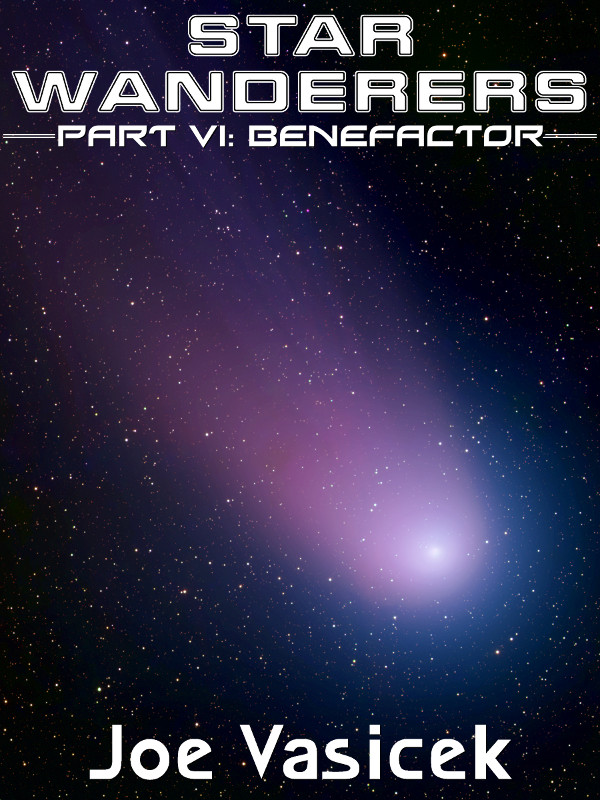
All right, if you’re still reading (or even if you cheated and skipped ahead), I have a treat for you.  I just found the AWESOMEST image for the cover of Star Wanderers: Benefactor, which I hope to finish up later this week after finalizing the revisions for Dreamweaver.  Here’s the cover:

SW-VI Benefactor (cover)

Pretty cool, eh? I <3 NASA. 😀

The picture is of Comet C/2001 Q4 (NEAT), taken by the WIYN 0.9-meter telescope at Kitt Peak National Observatory near Tucson, Arizona.  It was taken on 7 May 2004, and covers an area roughly five times the size of the moon.  As with all NASA images, it’s in the public domain.

The inspiration actually came from comet PANSTARRS, which is visible in the sky right now.  I tried to catch a glimpse of it tonight from the Y Mountain trail head, but there were too many clouds on the horizon to see it clearly.  Hopefully, the skies will be clearer tomorrow.

In related news, comet ISON later this year is expected to put on a really incredible show.  Astronomers think that for a brief time, it may even shine brighter than the moon, making it visible even during the day!  If that happens, it’s going to be AWESOME.  Mark it on your calendars for November–it’s going to be great!

That’s just about it for now.  I’d better get back to forming those good habits I mentioned earlier–like actually getting to bed at a reasonable hour. Later!

I will turn this time suck into a powerful new writing motivator

ftl-game

Last night, I caved and bought the new FTL game that all my friends have been talking about.

OMIGOSH.

Six hours later, I was screaming in agony as my awesome starship went down in flames.  AGAIN.  In sector eight (on the easy setting, though, so not too impressive).

Seriously, this game is AMAZING.  I haven’t seen such a perfect combination of strategy, skill, random chance, and dumb luck since Star Control II.  There are SO MANY things you can do … and SO MANY ways you can die!  I love it!

Granted, with every game like this, there’s a danger that it will become a huge time suck (minecraft, anyone?).  However, this one is different.

Famous last words, right?

But seriously, each round takes only an hour or two, there’s only one save slot, and you die so frequently that it’s hard to become too attached to any one game.  In other words, this is the sort of game I can pick up and put down again without devoting too much mental space to it.  Which (hopefully) makes it a perfect carrot to get me to write more.

Here’s what I’m going to do: for every thousand words in my WIP, I’ll allow myself to play one (and only one!) round of FTL.  If I hit my daily goal, I’ll allow myself to play as much as I want.

It’s still too early to tell if this is going to work, but I’m going to give it a try.  Seriously, though, once I told myself “you can play FTL as soon as you hit that first 1k,” all I wanted to do was write!  And now that I’m more or less finished with this blog post, I think that’s what I’m going to do.

Later!