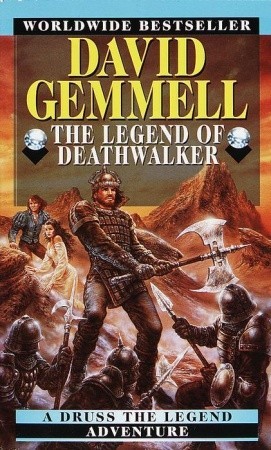
The Legend of Deathwalker by David Gemmell

legend_of_deathwalkerI’m not even going to try to write a synopsis of this story.  It’s just like all the other books in the Drenai series, which is why I love it so much.  Basically, this one gives the story behind the rise of Ulric, khan of the Nadir, and the origin of the Nadir people.  Interestingly enough, Druss the Legend plays a major role.

This was the last book in the Drenai Saga that I hadn’t read, so reading it was a very bittersweet experience.  On the one hand, this one is just as good as all the other books in the series, and made me want to revisit Legend and some of the others.  On the other hand, I knew that once I’d finished it, there wouldn’t be any more Drenai books left.  So I took it slow for the first half, but naturally I finished it at a breathless late-night sprint a day or two later.

I’ve been thinking a lot lately about why I love David Gemmell’s books so much.  There are many reasons, but I think the main reason is that his writing is honest.  He strips away all the incidental stuff and gets right at the heart of the stuff that matters.  He doesn’t pussyfoot around, either–if his characters do something despicable, he doesn’t make any excuses for them.  He tells it like it is.  This can make for a very brutal story, but it also makes for a very cathartic one.

The other reason I love his books so much is because he does such a good job depicting raw, unrepressed manhood–not the stupid stuff like driving big cars and eating meat, but manning up and facing your greatest fears.  It’s about friendship, and honor, and fighting with all of your strength for something you believe in.  It’s about all that raw, pent-up energy we all have, that animal urge that drives us to competitive sports and first person shooters, and channeling it for a heroic cause.

The craziest thing is that the fight itself is actually more important than whatever side the characters are fighting on.  In this book, Druss is actually fighting to help bring about the rise of the Nadir khan who later invades his homeland and kills him on the walls of Dros Delnoch.  None of that matters, though, because Druss doesn’t fight with malice.  For him, it’s all about fighting for something, not against something, and the battle itself is just as important as the victory.  I don’t think I can put it better than this:

“Can we win here?” Sieben asked, as the shaman’s image began to fade.

“Winning and losing are entirely dependent on what you are fighting for,” answered Shaoshad. “All men here could die, yet you could still win. Or all men could live and you could lose. Fare you well, poet.”

The best thing about David Gemmell’s books is the fact that none of the characters–not even the bad guys–are defined by their own evil.  The Nadir are supposed to be the evil chaotic race of the Drenai universe, but when you come to understand what they’re fighting for, their hopes and dreams for a better future, you can really see what’s good in them.  Likewise, the more civilized Gothir are kind of like the evil white men who want to put down the savages and keep them in their place, but there are good and honorable men among them too.

And yet, even though the two sides clash, and good men die on both sides, it somehow isn’t tragic.  That’s the crazy part.  It’s almost like you can feel the characters salute each other as they die in a good cause, the way Ulric gave Druss a proper funeral in Legend, even though the two were blood-sworn enemies.  In David Gemmell’s world, honor and courage are more important than life or money.  Everyone dies; dying well is more important than living without honor.

This book is incredible.  As I was reading it, I decided it was the best David Gemmell book I’ve ever read–which is something I do every time I read one of his books.  I feel like I’m a better man for having read them.  If he had written a hundred books in this series, I would happily read them all.  The fact that there are no more new ones deeply saddens me, but I know I’ll revisit these stories again in the future.

I need to read more. A lot more.

Recently, I’ve come to the conclusion that I need to read a lot more than I have been.  I’ve read a couple of books in the past few months, but to take things to the next level I feel like I should be reading at least one or two novels a week.

I came to this conclusion last week after visiting the Provo Library to pick up a copy of Gettysburg (the movie based on The Killer Angels) that was on hold for me.  Unfortunately, someone had misplaced it, but since I was there I took some time to browse the shelves.

Holy cow, it’s been a while since I was surrounded by actual physical books.  I get about 60% to 70% of my books nowadays on my kindle, so browsing through the shelves, I felt like a kid in a candy shop.  I picked up the last Drenai book that I haven’t yet read (finished it today, actually), a classic by Heinlein, and an Alliance-Union novel by C.J. Cherryh.

The thing about physical library books, though, is that if you don’t read and return them in time, they tend to cost you money.  LOTS of money.  I can’t tell you how much I’ve paid in library fines over the years–it seems like every time I go to check something out, I have to pay a couple of bucks.  What can I say–I’m not a very disciplined reader.  But this time, I figured I would actually go through and do it.  That’s why I limited myself to just three (or was it four?).

If you’re a writer, reading voraciously is essential.  Not only is it a great way to pick up new tricks, it’s absolutely vital in keeping your sense of story honed and sharp.  I wonder how much of what we call “writers block” would actually best be solved, not by just writing through it, but taking some time to just immerse yourself in a good book and recharge your creative batteries by filling your mind with story.

Another reason to read is that it helps to keep you from being stretched too thin by online distractions and obligations.  I picked up this tip from Jeff VanderMeer in his writing book, Booklife.  It’s a good one.  Basically, if you find yourself wasting too much time on the internet, cycling endlessly through your email, your facebook, your twitter, webcomics, message boards, blog aggregator, sales stats etc etc–the best way to break free of that addictive cycle is to sit down and read a book.

A couple of days later, I was at Leading Edge and noticed that they have a whole bunch of unread ARCs in their cabinet.  A couple of small publishers send them stuff every couple of months, and it tends to accumulate, especially in the summer when most of the students are gone.  Well, I ended up coming home with three of them, with a promise that I’d read and review a couple before the next issue goes out in June.

Not that I’m complaining–not at all.  In fact, I’m excited.  I’ve been doing a lot to rework my routine recently, mostly having to do with writing in the mornings and finding a good place outside of my apartment to get stuff done.  I find that it helps to take frequent breaks when writing, so if I can fill those with reading instead of useless internet browsing, I figure I’ll be in good shape.  I’ll let you know in a couple of weeks how that goes.

In the meantime, I’ve got to go, but you can expect another squeeing fanboy review of David Gemmell soon–as in, probably tomorrow.  I just finished the last remaining bok in the Drenai series that I hadn’t yet read, and holy crap, it is AMAZING.  It makes me want to go through and read the whole series all over again!  At the same time, I’m so sad that there aren’t any more of these books left anymoer–if Gemmell had written a hundred Drenai books, I would have read (and gone fanboy crazy over) every last one of them.  Sadly, that is not to be.  But maybe when my soul passes over to the Void, I can sit at his feet and hear them direct from the mouth of the master … okay I’d better end this before I go all fanboy again.  Later.

Author’s Note for THE JEREMIAH CHRONICLES

SW-TJC (thumb)Here’s the author’s note at the end of Star Wanderers: The Jeremiah Chronicles.  It’s the only content in the omnibus that isn’t available anywhere else, and I don’t want my readers to feel like they have to buy something they’ve already read in order to get it.  And if you do want to buy it, there’s a link in the sidebar over there. ———–>

I put an author’s note at the end of every ebook I publish.  It adds a little bit to the progress bar, which can be annoying for readers who expect “the end” to come at 100%, but I think it’s good to briefly tell the story behind the story.  It’s certainly something that I would enjoy reading at the end of some of my favorite books (especially the ones by David Gemmell!).  Whether you read them or whether you skip over them, it’s a feature I plan to keep in every ebook I release.

So, here it is!

==================================================

One of the questions writers get asked the most is ‘where do you come up with your ideas?’ Honestly, that’s probably the hardest question to answer. Orson Scott Card said that everyone runs across at least a thousand story ideas each day, and a good writer will see maybe three. To that, I would add that it might take years before you realize that you’ve seen them.

The idea that eventually grew into Star Wanderers probably came to me the first time I saw Serenity. At the beginning of the movie, there’s this long continuous shot that shows the space ship from the hangar bay doors to the cockpit. I don’t even remember what the characters were talking about, I was just mesmerized by that shot. For weeks, I dreamed about having my own starship like the Serenity, where I could escape the stresses of college and lead an adventurous life out among the stars. I still daydream about it to this day. Having my own starship and piloting it to places where I can be free and independent is one of my greatest recurring fantasies.

Another major catalyst for the idea that became this story was the Lombardo translation of Homer’s Odyssey. The Odyssey is perhaps the most famous epic work of all time, but the Lombardo translation struck a particular chord with me because of how down-to-earth and accessible it is. Instead of some stodgy 19th century translation that passes for cruel and unusual punishment in some high schools, this one made the story come alive. I was first introduced to it in a Western Civ class in college, but enjoyed it so immensely that I picked up a copy over the summer of 2009 and read the whole thing.

As I read it, I couldn’t help but notice the potential for a science fiction crossover. What if the sailing ships were starships, and the oceans the vastness of space? The islands would be like planets, with their strange and exotic cultures, and travel from world to world would be as arduous and difficult as it was for Odysseus to return to Ithaca. A new form of paganism would emerge, one that worshiped the stars and planets just as the Greeks worshiped the rivers and trees. The starfaring people would be as hardy and self-reliant as the ancient Greeks, and as antagonistic toward the more civilized Coreward peoples as the Aegeans to the Trojans. Most importantly, though, the starfarers would feel a sense of powerlessness as they faced the unforgiving vastness of space, just like Odysseus as he braved the wine-dark sea.

I actually started writing that novel in 2010, and got about a hundred pages into it before moving on to the revisions for Bringing Stella Home. Later, I trunked it, but the basic world-building stayed with me as I continued to expand the Gaia Nova universe with Desert Stars and Heart of the Nebula.

The final catalyst for Star Wanderers was the love story from one of my favorite Westerns, Jeremiah Johnson. My college roommates introduced me to that movie my sophomore year, and just like Serenity, I spent the next several days daydreaming what it would be like to be a mountain man. I went to college in Utah, so the frontier landscape where the film was shot is very familiar to me (in fact, I’m writing this author’s note from Slide Canyon just outside of Provo). But the love story—that was the best part. An accidental marriage from a cultural misunderstanding that blossoms into something touching and wonderful, in spite of the language barrier—by far, that was my favorite part of the whole movie.

All of these ideas were bouncing around somewhere in the back of my mind for years, but it wasn’t until 2011 that they all came together. I had graduated about a year and a half before, and was working a number of low-skilled temp jobs, trying to make ends meet as I grew my writing career. I was between projects, trying to work on Edenfall (sequel to Genesis Earth), but nothing was coming together and I just felt very frustrated.

One day, as I was lying on my bed daydreaming for the umptieth time about escaping this planet on my own starship, the thought “what would Jeremiah Johnson look like if it were set in space?” came to me. It was like a supernova exploding in my mind, illuminating my imagination with the power of an exploding star. For the next half hour, I worked through all the details in my head—the famine backstory of Megiddo Station, the Oddysey-like far-future space setting, the wandering lifestyle of the mountain man turned starship pilot. And then, once I’d replayed it half a dozen times in my head and worked myself up to a fever pitch, I rolled out of bed and wrote the first chapter of Outworlder almost exactly as it now stands. The rest of that novelette came just as readily, and in a couple of weeks I had a finished draft.

As a young single guy in my early twenties, I tend to think about love and relationships a lot. I think it’s a myth that women are somehow more interested in romance than men—we just express that interest in different ways. At Worldcon 2011 in Reno, Louis McMaster Bujold said that women tend to write about love and life, whereas men tend to write about love and death, and I’ve found that to hold very true, at least in my own writing. Perhaps that’s why it was so easy and natural to come up with the backstory that put Noemi on Jeremiah’s starship. The rest, with the pregnancy, the polygamy issues, and the baby at the end, all came naturally as I wrote things out. I was originally going to have Noemi miscarry about halfway through Fidelity, but realized almost immediately that that wasn’t going to fly. Once I realized that the natural ending of the story arc would be the birth of their son, everything else just came together.

My goal from the beginning was to write something that I could submit to the Writers of the Future contest. For that reason, I kept Outworlder fairly short. However, when I got to the end, I realized that there was still a lot of story left unwritten, so I decided to follow it out. I’m more of a novel writer than a short story writer, so it was natural to structure the overall story arc in that way. At the same time, I really enjoyed the intimacy of that first novelette, and the way that the shorter structure allowed me to focus on one or two characters and their relationships with each other. Those were all considerations that pushed me into following the novella format, as well as the chance to experiment with publishing a series of shorter works.

Fidelity and Sacrifice were a lot more challenging to write, in particular Sacrifice. Part of this was because I was still trying to figure out where the overall story arc was going, and part of it was because some of the subject matter (such as polygamy) seemed pretty unconventional for a science fiction story. But after taking a couple of short breaks to work on other projects, I managed to push through it, eventually getting to Homeworld which came much more easily. I’ve always been better at endings than at middles, and I went into Homeworld knowing that it would conclude Jeremiah’s main story arc.

As I was working on the later parts to the Star Wanderers series, I moved to the Republic of Georgia to teach English for a year. That had a tremendous impact on how I wrote the language barrier between Jeremiah and Noemi, mostly because my experience was quite similar. I didn’t accidentally marry a Georgian girl (though there are one or two who I still miss sometimes), but when I showed up in the airport in Tbilisi, I didn’t speak a word of Georgian and knew almost nothing about the people or the country. Needless to say, it was quite an adventure. The stresses of living in a foreign culture did slow down my writing a bit, but I managed to get it back by the end and finished Homeworld before coming back to the States for the summer.

When I first started publishing the Star Wanderers series, I saw it as a sort of side project that I would do before getting back to other projects. However, this series has proven to be more popular than any of my other books, so I’ve decided quite happily to expand it. The Jeremiah Chronicles contains the full story arc for Jeremiah, but there are a lot of other characters who I want to explore, and the novella format is perfect for that. If you have any in particular that you’d like to revisit, feel free to shot me an email at joseph [dot] vasicek [at] gmail [dot] com and let me know. I love getting fan mail and do my best to respond to it, so any comments would definitely be appreciated.

If you’ve just discovered Star Wanderers and would like to keep up with the newest books in the series, you can get them for free by signing up for my mailing list. Whenever I release a new Star Wanderers story, I put out a two-week coupon code to get it for free on Smashwords and send the coupon code out to my subscribers via my email newsletter. That way, you don’t have to feel like you’re spending too much once I have fifteen or twenty ebooks out. I figure that if you enjoy these stories enough to sign up for the mailing list, you’ll probably tell a friend or post a favorable review, so I’m happy to make my new Star Wanderers releases available for free.

I hope you enjoyed this omnibus! If you did, please consider posting a review or sharing it with a friend. Every little bit helps, and the more people discover and read this series, the more stories I’ll be able to write. My goal from the beginning has been to make a living telling stories that I love, and it looks like Star Wanderers might actually make that possible.

In the meantime, don’t be a stranger—you can find me on Twitter (@onelowerlight), Goodreads, or Facebook (Joe Vasicek), but the best way to keep up is to follow my blog, One Thousand and One Parsecs. I’ve been blogging since 2007 and plan to keep it up for the foreseeable future. You can also find links to all my books there, on all the major sites where they’re published. And of course, if you want to sign up for my mailing list, you can find the sign-up form on the sidebar.

That’s just about it. Thanks for reading! It’s readers, not writers, who really make a story come alive, and at the end of the day the greatest honor is simply to be read. So thanks for taking a chance on this one, and until next time, I hope to see you around!
STAR WANDERERS: THE JEREMIAH CHRONICLES is now available!

SW-TJC (thumb)Hey guys, exciting news!  I just published Star Wanderers: The Jeremiah Chronicles!   It’s an omnibus that contains Parts I-IV of the series.  You can find it now on Amazon, Barnes & Noble, Kobo, and Smashwords, as well as Omnilit, All Romance eBooks, and Drivethru Fiction.  It should be up on Sony, iTunes, and other eretailers in a week or two.

This omnibus edition doesn’t actually contain any new content, except for the author’s note which I’ll post a little later on the blog.  But if you’re just getting started with the Star Wanderers series, this is a slightly less expensive way to get the first four installments than buying them all individually.  Plus, the cover art is pretty kewl–at least, I think so. 🙂

If you’ve read the series up through Homeworld, I would really appreciate it if you’d take the time to post a review on the omnibus.  There’s no expectation to do so, of course, but it really does help things out a lot.  Also, if you’re a Goodreads user, you can add the omnibus to your library here.

That’s just about it for now.  At some point, I’d like to put out a print version, but I’m not sure whether to do the full omnibus or to do a sort of back-to-back edition, where it’s two novellas with the one printed upside down and on the other side.  What the heck–maybe I’ll do both.  But I still have to format the print version of Stars of Blood and Glory, so it might take a while before I get around to that.

In the meantime, I’d better get back to writing Part VII: Reproach.  This publishing stuff is all good fun, but the important thing is to keep writing.

See you around, and thanks for reading!

Hey! Are you an aspiring writer / artist / creative whatever?

If you are, you really really really need to check out this webcomic about the three jaguars.

It’s about the three main voices in every professional artist’s head, and how they bicker and play off of each other.  As someone whose been in the writing business for a few years, I can say that it’s absolutely spot on (and not just because they’re anthropomorphized jaguars).  Seriously, this webcomic needs to be like a primer for all creative types or something.

The thing I’ve learned the most by following this webcomic has to do with the marketing voice.  I’ve always had it in the back of my mind that marketing is evil.  And if you do it wrong, it really is.  But if you do it right, it’s actually pretty amazing:

…your goal in marketing is to create sustainable relationships with people who want you to succeed; in short, to seek patrons, rather than one-time customers. To do that, you can’t be focused on the money or the one-time sale. You want to inspire customer loyalty. You want people to be invested in your success. You want them to feel special … because they are.

A lot of the stuff I do, like keeping this blog, or putting Author’s Notes at the end of all my books, comes back to this idea of making meaningful connections with people.  I just never saw it as marketing.  But if marketing yourself is really about focusing on people rather than obsessing about sales, that’s totally something that I can do–something that I’m excited to do!

The character I can relate to the most is probably Business Manager.  It’s the entrepreneurial spirit I can trace back to my grandpa, who started his own oil company in West Texas and was successful enough to put all us grandkids through private school.  But Artist is definitely in there as well–it’s why I’m always jumping from project to project, driving my inner business manager crazy.

So yeah, if you’re a creative type, you’ll definitely want to check out this webcomic.  It’s written by the self-published author whose books briefly got pulled from Amazon during the Space Marine controversy (fortunately for all of us, she held out and won).  Lots of good stuff there–she really knows what she’s talking about.

In the meantime, let me leave you with this incredible piece of orchestral trance music.  It’s quite possibly the most epic thing I discovered last week.  The video is pretty good too.

Take care!

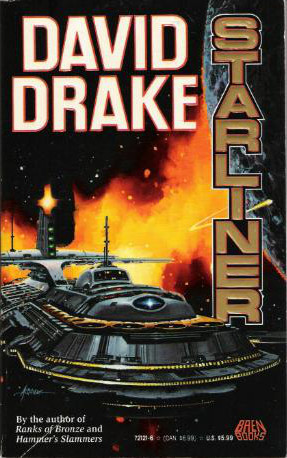
Starliner by David Drake

starlinerWelcome to the Empress of Earth, the finest luxury liner in all of settled space.  Whether you’re alien or human, first class or economy, there is a place on the ship for you.  Just watch out for those Grantholmers and Nevassans–those planets are about to go to war, but don’t worry, the Empress is strictly neutral territory.  The envoys from Earth will see to that.  And as for the rumors that one of those sides might try to hijack the ship, I’m sure the crew is capable enough to deal with such threats.  Even if they are unarmed…
I saw this book on my also-boughts on Amazon, so I decided to pick it up.  It was an enjoyable read.  David Drake is very good at showing competent characters dealing with all sorts of complicated problems, operating within a strict chain of command while sometimes bending the rules a bit to get the job done.

The book is really a series of small vignettes, all tied together through the main viewpoint character, Ran Colville.  There is an overarching storyline about the Empress’s role as a coveted pawn in a larger interstellar war, but that only really drives the story at the very end.  Really, it’s more of a slice-of-life story about the crew of the ship, punctuated by all of the strange and exotic stops along the way–and boy, are there plenty of those!

Even though the Empress is neutral, she’s a potentially valuable military asset that both sides in the Grantholm-Nevassan war want to capture.  To complicate matters further, some of the passengers are dignitaries from either side.  At one point, there’s a romance between the peacenik daughter of a Nevassan diplomat and the son of a Grantholmer nobleman who is honor-bound to fight in the war.  That subplot was a lot of fun.

As you can imagine, there’s plenty of violence.  And really, what would you expect from one of the world’s best military science fiction writers?  Drake does a really good job showing the adrenaline-soaked excitement of combat, as well as all the ugliness.  Even the mooks get a viewpoint from time to time, and when they die, it’s messy and traumatic.  For that reason, the violence feels very realistic, especially in how it affects the main characters.

Ran is something of a player, so there is a fair amount of explicit sex (including a bit of inter-species action).  Drake doesn’t mince words or shy away from the gritty details–he puts it all on the page as matter-of-factly as any other aspect of life.  The sex was brief enough that it didn’t really bother me that much, but Ran’s relationship toward one of his coworkers takes a turn at the end that seemed to come completely out of left-field.  I could understand why, for the purposes of the story, it had to happen, but the way it was handled I just didn’t buy it.

That was probably my biggest gripe.  If I had another, it would be that the story seems to meander a bit in the first two-thirds, but the world-building was interesting enough that it didn’t really bother me.  Overall, it was a fun, light read (well, light for military sf).  The ebook version is free on Amazon, so it’s definitely worth picking up.  If you haven’t read any David Drake yet, this isn’t a bad place to start.

Thoughts on serials and ebook pricing

I’m going to do something potentially dangerous and discuss pricing strategies in a rather candid way.  I may risk turning off some of my potential readers, especially the ones who don’t like shorter works, but I want to be as open and transparent as I can, since I figure it’s only fair, especially to someone who’s just getting started with my books.

First of all, let me just say that if I could, I would make all my books free and write for love instead of money.  The trouble, though, is that I have to eat, and at some point in the (hopefully) not too distant future I’m going to have to feed a wife and children as well.  If I made all my books free right now, I would have to spend all my time and energy doing something other than writing, and as a result there would be far fewer books for you to read.

In the last year, I’ve discovered that the best way to make money self-publishing is to write in series, preferably at a short enough length that you can release a new installment every other month.  A lot of other writers are discovering this, which is why there is such an explosion of series and serials.

I know a lot of readers don’t like this.  And when a writer takes a perfectly good novel and splits it arbitrarily into parts, each one without a solid arc or story structure to hold it together, I get a little bit ticked as well.  But the reality is that if you can tell a story in a series of short, self-contained novellas rather than a single novel, it will probably meet with better commercial success.

The price points for novellas are kind of tricky, though.  For anything priced below $2.99, Amazon takes 65%, whereas from $2.99 to $9.99, the self-publisher takes 70%.  To give that some perspective, you would have to sell 10x the number of copies at $.99 to earn as much on one sale of a book at $4.99, and 6x for a book at $2.99.

The trouble, of course, is that for a series where each installment is priced at $2.99, the readers may end up paying a lot more, depending on the lengths of the story arcs and the size of each installment.  Novellas are kind of in a gray area, where $.99 seems kind of cheap for that much story, but three or four installments at $2.99 really add up–especially with so many other ebooks priced at $5 or below.

Now, I’d like to believe that most readers judge the value of a story by its quality and not by its word count, or by how much they have to pay per word.  There are books like City of the Saints that I don’t mind buying in $2.99 increments at all.  At the same time, though, I think there’s something to be said about keeping prices fair.

This is all on my mind right now because I’m getting ready to release the first Star Wanderers omnibus and expand that series considerably over the next year.  It’s the series that sells best out of any of my books, and the one with the most potential to make it so that I can go full time.  Plus, I really love writing in this universe, and have a lot more stories in it to tell.

Right now, this is the pricing structure I’m following:

  1. Outworlder — free (15,000 words)
  2. Fidelity — $.99 (17,000 words)
  3. Sacrifice — $2.99 (19,000 words)
  4. Homeworld — $2.99 (20,000 words)
  5. Dreamweaver — $2.99 (19,000 words)

Parts I through IV make a complete story arc, though of course each individual novella is a self-contained story on its own.  With Part I at free and Part II at $.99, I figure readers have a good way to figure out if these are the kinds of stories that they’ll want to read.  But if I keep pricing the stories at $2.99, at some point this series is going to get really expensive.

So here’s what I plan to do to alleviate that:

1) Make new releases free to newsletter subscribers.

For every Star Wanderers story up to this point, I’ve made it free for the first two weeks on Smashwords and given that code out through my email newsletter.  I did that originally as an incentive to get people to sign up for my newsletter, but I think it’s a good series strategy as well.  This way, if someone discovers Star Wanderers now, they can buy all the previous installments at the higher $2.99 price point and look forward to receiving any future installments for free.

Some may question the business sense of giving away free books to readers who are willing to buy them, but the way I see it, the fans are the ones who are selling these books, not me.  I’m willing to put a free book in the hands of someone who already loves the series, and is more likely to write a glowing review or to share it with a friend.  And since sales of this series continue to grow, that strategy would seem to be paying off (or at the very least, it’s not biting me in the ass).

2) Try to put more story into each individual installment.

If $2.99 seems a lot for a short novella, then maybe I need to expand on them, with things like extra subplots and viewpoint characters.  Of course I don’t want the stories to feel like they’re padded, but if I can enrich the story in a way that really adds to it, then that’s certainly something that I should do.

For all of the Star Wanderers series so far, each novella is told from the point of view of just one character.  This sort of focus can be good, because it really gets me into the head of that character.  However, sometimes it’s also good to play things off of another character’s story, both to act as a foil and to provide contrast.

That’s what I’m doing with Reproach (Part VII) right now.  It’s not just from Mariya’s point of view, but Noemi’s as well, and that adds a lot to the tension as you see their competing motives and the way their views of the world really clash.  It’s delicious.  Benefactor (Part VI) is just from Jakob’s viewpoint, just because I wanted the story to really focus on his character, but most of the other stories kicking around in my head have room for at least another viewpoint character without taking away from the spirit of the series itself.

3) Price the omnibus editions less than the sum of their parts.

For someone who is just getting started with Star Wanderers, $2.99 might seem like a lot to pay to get caught up.  That’s only going to get more daunting as the series gets longer.  For that reason, I’m inclined to price the omnibus editions much lower–at least $4.95, which is the price of one of my novels.  At 70,000 words or so for Parts I-IV, that seems only fair.

I am a bit worried that sales of the individual novellas will drop off once I release the omnibus, but I figure if I’m constantly releasing new ones, those should cover the slack.  Since Dreamweaver (Part V) is already out, and Benefactor (Part VI) will be out in another month or so, new readers who come in through the omnibus will have more than enough to keep them coming back.

The other benefit of doing it this way is that it reduces the chance that readers will drop out midway through the story arc.  It seems that a few of them are doing that, or at least taking a while to get from Part II to Part III to Part IV, etc.  By having them all in one omnibus and encouraging readers to buy that instead of the individual parts, hopefully they’ll have more of a chance to get hooked, making it all the more likely that they’ll keep coming back.

So that’s my plan, at least for now.  When The Jeremiah Chronicles comes out next week, I’ll price it on parity with my other novels, even though that’s somewhat less than all the individual parts.  I’ll make all new Star Wanderers novellas free for my newsletter subscribers, and do what I can to enrich them with extra viewpoints and subplots (without just padding them, of course).  This way, I hope my readers won’t feel like I’m ripping them off, and I’ll still have a good shot of making a decent living at this.

With the way things have been going, I’m actually really excited.  The slow build approach is working, and if it keeps up then I think I may be making enough to go full-time by this time next year.  I’ll be sure to keep you posted as things come along.

In the meantime, if you have any thoughts or comments, please don’t hesitate to share.  I’m still thinking this issue through, and there’s a lot I have left to learn.  In fact, I feel like I’m only just starting to figure it out, so any other perspectives on this topic would be much appreciated!

Update on STAR WANDERERS and a sneak peek at some cover art

So in case you didn’t know, I’ve been getting an omnibus edition ready for Star Wanderers.  It’s subtitled The Jeremiah Chronicles, and contains parts I-IV (Outworlder, Fidelity, Sacrifice, and Homeworld).  This covers the first major series arc, with all of the stories from Jeremiah’s point of view–hence the title.

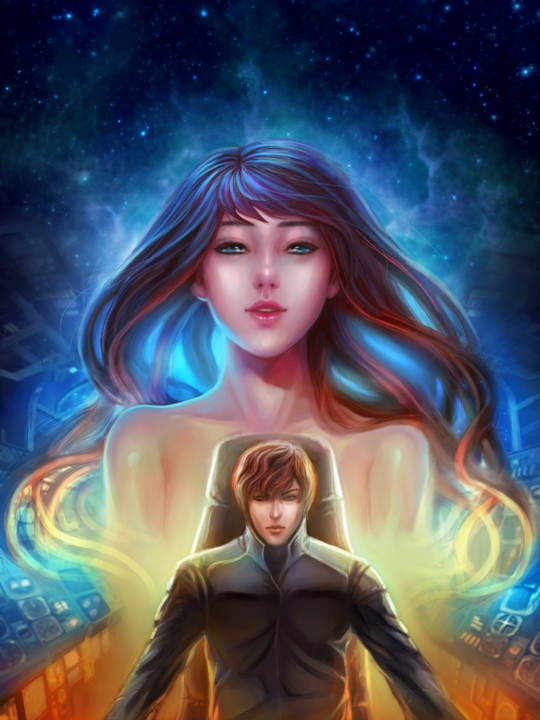
I commissioned Ina Wong from Deviant Art for the cover, and this the result:

JV4 COMP

I must say, I’m rather pleased.  It’s got a very different feel from the current space photography covers, but I think this is a lot truer to the actual story.  I can’t commission art like this for the individual installments, of course, but for an omnibus edition, I figure it’s alright to go all out.

The only content in the omnibus that isn’t already in parts I-IV will be the author’s note, which I’ll either post here or include as a PDF to my newsletter subscribers.  In other words, don’t worry about missing out on anything if you’ve already read the individual installments.

I’m getting feedback from my alpha readers for Benefactor, the next part in the series, so I’ll probably release that one in the next six weeks.  In the meantime, I’ve picked up work on Reproach again (Part VII), and hope to finish the first draft before the end of the month.

Just as Dreamweaver is a parallel novella to Outworlder (from Noemi’s POV), Benefactor is a parallel novella to Fidelity (from Jakob’s POV) and Reproach is a parallel novella to Sacrifice (from Noemi and Mariya’s POVs).  After that, I’ll do a parallel novella to Homeworld with Lucca and Mariya as the main POV characters, and then branch out into some other characters and storylines.

The fun part about writing this series is that each new story seeds at least two or three others.  I just wish I could keep up!

I haven’t abandoned Lifewalker, but I did reach a point where I figured it would be good to take a short break just to keep things fresh.  My creative process seems to work that way.  As much as I’d like to train myself to stay on project until it was finished, creativity can’t be trained so much as fostered.  I set myself a deadline to finish something by May 31st, so now it looks like that’s going to be Reproach.

As for The Jeremiah Chronicles, all I have left is to write the author’s note and book description.  It should be out on Amazon, Barnes & Noble, and Smashwords by this time next week.  In the meantime, I’ll keep working on Reproach so you guys can have plenty more stories to read!

Chance to win GENESIS EARTH and SW-II: FIDELITY

In case you didn’t know, my fellow indie author and KBoards member Elle Casey has put together a book giveaway, and she was kind enough to include a couple of my books in it.  If you would like a chance to win a free ebook copy of Genesis Earth or Star Wanderers: Fidelity (Part II), head over to her blog and check it out.  I’m giving away 10 electronic copies of each title, but I’m only one author of many so if you sign up for my books there’s a very good chance you’ll win one.

The giveaway has a lot of different kinds of books, but they trend more toward YA and New Adult (a recently coined categorization that eludes me).  Out of all my books, Genesis Earth and Star Wanderers seemed like the titles that fit best, so those were the ones I chose.  But there are a lot of others to choose from, with no limit on how many you sign up for, so feel free to take your pick!

Tomorrow (Wednesday) is the last day of the promotion, so be sure to act quick!