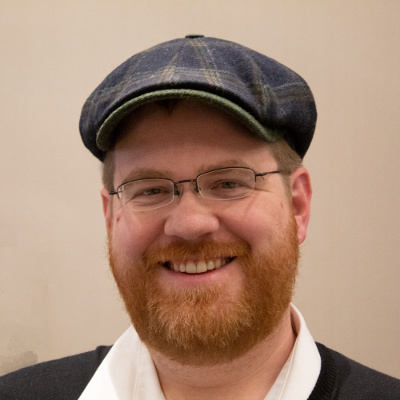
Joe Vasicek is the author of more than twenty science fiction books, including the Star Wanderers and Sons of the Starfarers series. As a young man, he studied Arabic and traveled across the Middle East and the Caucasus. He claims Utah as his home.
I really like your books. I think they are well-written and I enjoyed reading them. (So far, so good, right? Hang on.) However, I have returned them all because you priced them at $0.99 to $2.99, and that is too much to pay for them. I can’t afford to pay that much for a book, even though I liked it. In the future, can you make sure you make all your books free so I don’t have to return them?
Dear Ms. Reader,
Thank you for reading my books. I appreciate your patronage. However, this is why my books are not all free:
If you had lived in Germany before the Nazis came to power and a time traveler had told you how history would play out, what would you have done about it?
The nation was reeling from a massive economic depression after a decade of war exhaustion. In this troubled time, a charismatic democratic socialist ran on a platform promising to share the wealth of the top 1% (the Jews) with the rest of the nation. Violent protesters routinely disrupted his opponents’ political rallies. People in general were fed up with the political system and were eager for a change.
Obviously, there isn’t a 1:1 parallel between 1930s Germany and 2010s United States. But let’s take a quick look at some of the policies that the Nazis successfully championed:
Nationalized healthcare
Centralized education
Taxpayer subsidized abortion
Government mass surveillance
Arbitrary limits on free speech
And finally:
Abolition of private gun ownership
Can you see the chilling parallels between what the Nazis did and the agenda that the Left has been pushing for the last eight years?
Right now, the United States is reeling from the deadliest mass shooting in our nation’s history. The perpetrator was a domestic terrorist who pledged allegiance to ISIS, just like the last mass shooting which happened in San Bernardino. But instead of focusing on the radical Islamic ideology that motivated these shootings, the national discourse is focused on gun control.
This is patently ridiculous.
When a teenager commits suicide because of online bullying, is the solution to censor the internet?
When people spread lies and false rumors on social media, is the solution to place general restrictions on the use of social media?
When a battered wife is stabbed to death with a kitchen knife, do we call for regulations on the length and sharpness of all kitchen knives?
When large numbers of people die in car accidents, do we enforce a ban on “high-capacity” cars that can drive faster than 45 mph?
Better yet, do we allow car owners to sue the manufacturer if they ever get into an accident? Correct me if I’m wrong, but that wasn’t in the terms of the last government bail out.
We’ve had this debate over gun control many times before. Whenever we have a mass shooting in this country, the bodies of the victims are not yet cold before all of the old arguments on both sides are trotted out. So let’s go to the moment when the emotions were hottest, in 2012 after the tragic shooting at Sandy Hook Elementary:
In an interview with Dave Rubin, Ben Shapiro later said that Piers Morgan had actually brought one of the kids from Sandy Hook onto the set to come on in the second segment of the show. The kid was in a wheelchair, and Piers was going to use him as political prop to make a cheap appeal to emotion. Of course, after Ben called him out for standing on the graves of children, Piers’s whole debate strategy fell apart.
This is my response, which is currently the top comment on YouTube:
“Do you genuinely believe that your own government is going to turn on you in a way that you require an AR-15 to challenge them?”
Holy flying fuck, Piers Morgan. Do you have no self-awareness at all? You are talking to a Jew, Piers. A JEW. As in, one of those people who were systematically exterminated by a tyrannical regime called the Democratic Soc—sorry, the NATIONAL Socialist German Worker’s Party. Also known as the Nazis, Piers. The Nazis.
You are familiar with the Nazis, are you not, Piers? You know: the smartly dressed German guys with the swastika flags who bombed your homeland relentlessly for 3+ months back in 1940. If I remember my history correctly, you fought something of a war with them, did you not? Or are you as bad at history as you are at US constitutional law?
People like you are the reason I need an AR-15, Piers. Crybullies like you in the mainstream media who stand on the graves of children as they browbeat the rest of us into giving up our rights and liberty, all in the name of leftist ideology.
And you know what, Piers? When I do get an AR-15, I’m going to name it in your honor. I’m dead serious, Piers. I’m going to etch your name right on the barrel. I’ll keep it right next to François, my Mossberg shotgun (which I named in honor of another anti-gun wanker).
And you know what sound it’s gonna make when I fire it, Piers? That “ratatatat” when I pull the trigger?
That’s the sound of Liberty.
Here is why you need a gun:
When the founding fathers drafted the Constitution, they envisioned a political system unlike any other in existence at the time—one where the government exists only by the consent of the governed. This, they rightly believed, was the way to ensure Liberty.
In order for the system to work, however, the people had to be able to live without fear of the State. In other words, the government had to fear the people instead of the other way around.
The Declaration of Independence had already set the precedent that it was the right of the people to overthrow their government if it ever became tyrannical. The only way for that to happen was for the people to have the right to bear arms.
This is why the second amendment is the second amendment, not the ninth or the sixteenth or the twenty-eighth. It’s also why the second amendment never specified what kinds of arms should be allowed. The idea that founders’ original intent was to restrict gun ownership to muskets is patently ridiculous:
In my experience, people who favor stricter gun control laws generally fall into one of two camps: those who are simply afraid of guns, and those who want to vastly expand the powers of the State.
The first camp of people are generally well-meaning, if a little bit sheltered. Most of them have probably never owned or fired a gun of any kind. Their arguments for stricter gun control tend to be rooted in emotion. When a mass shooting happens, they feel like they need to do something to prevent this kind of massacre from ever happening again.
Unfortunately, these people have been spoon-fed lies from the second camp, which wants to disarm the general public NOT to reduce gun violence, but to vastly expand the powers of the state.
These people are fundamentally opposed to the idea of a government that exists only by the consent of the governed. They want to tear down the Constitution because it prevents them from using the power of the State to advance their political agenda. The principle of Liberty is a roadblock to them, and they want to abolish at every turn, not only with the second amendment, but the first, the fourth, the ninth, etc.
One of their main arguments is that there is no place in this country for private ownership of “assault rifles.” The argument is that these are “weapons of war,” and that therefore they have no place in civilian life.
To someone who has never owned or fired a gun, this is a pretty convincing argument. The term “assault rifle” is never clearly defined, but it effectively conjures up all the fears of guns and gun violence that many of these people have. To push the envelope even further, gun control advocates always associate “assault rifle” with AR-15, the most popular rifle in the United States.
The AR-15 is a de-clawed version of the M-16, which (unlike the AR-15) is fully automatic. That means that with an AR-15, you only get one bullet for every time you pull the trigger. AR-15s are most often chambered in .223/556, a round that is smaller in diameter than the most common handgun rounds. The reason it’s a popular weapons system is because it’s the Mr. Potato-head of guns: you can swap out basically all of the moving parts, or build one from scratch. No matter your needs (hunting, home defense, recreation, competition), you can adjust an AR-15 to meet them.
It’s actually not a scary gun at all, if you know how to use it properly. And judging from how many of them are circulating in the market, responsible gun ownership is the rule, not the exception.
Is the AR-15 a “weapon of war,” though? It can be if you want it to be. That’s kind of the point. Remember, one of the reasons for the second amendment was to enable the people to stand up against a tyrannical government. Without the right to bear arms—broadly defined—you cannot have Liberty.
This is where we get back to the Nazis. There is a reason why totalitarian governments always ban private gun ownership before they commit their worst atrocities. In the words of Mao Zedong, “political power grows out of the barrel of a gun.” When the guns are in the hands of the people, the people have political power and influence over their government. When they lose their guns, they lose that power.
But Joe, do you really fear an American holocaust? Do you genuinely fear that your government is going to turn on you in a way that you require an AR-15 to challenge them?
Yes, I do.
We tend to have this idea that the Holocaust was a historical aberration, a nasty horrible thing that never happened before and has never happened since. That simply is not true. Systematic interment and murder by tyrannical governments is actually the norm throughout history. The only thing that made the Holocaust any different was German efficiency.
Look at the sack of Carthage by the Romans. Look at the destruction of Baghdad by the Mongols. Look at all five times that Jerusalem was destroyed. In our modern era, look at the excesses of the French Revolution, the genocide of the Armenians, the British concentration camps in South Africa—indeed, look at the concentration camps IN THE UNITED STATES that were set up by FDR. Even before that, we had our own horrors like the Indian Removal Act and the Cherokee Trail of Tears.
And lest you think the world learned its lesson after Auschwitz and Dachau, read up on the Soviet Gulag and Chinese organ harvesting of political prisoners. There is a reason why the wait time for a kidney transplant in China is so ridiculously low.
The flipside of the coin of liberty is responsibility. In order for a people to be free, they need to take the responsibility of governing themselves. Part of that responsibility is learning how to defend yourself, not only from criminals, but from an overreaching, tyrannical government.
That is why you need a gun: because there is no Liberty without the means to defend it. That is also why I bought my first gun this past week (François) and why I’m building an AR-15 (Piers). Whenever there is a systematic effort to take away your fundamental rights, it becomes your duty to exercise those rights before they get taken away.
Holy crap, it’s been a long time since the last blog post. I wish I could say that things got busy, but the truth is that things just got disorganized. We’ll see how quickly I can put things back in order.
I spent most of last week either working a landscaping job or doing family history. Until now, I haven’t really blogged much about family history, but it’s something I’ve been working on fairly consistently for the past six months. My ultimate goal is to find all my first generation immigrant ancestors, which may well take a lifetime, but I’m off to a decent start:
The fan chart shows six generations, starting with me at generation zero. I’ve outlined with a sharpie where all the lines hop the pond. My paternal grandfather’s side (blue) is all from the Czech lands, under the Habsburgs and the Austro-Hungarian Empire. My paternal grandmother’s side (green) goes way, way back to colonial America, with most of the lines still needing to be researched.
On my mom’s side, there are only three lines that go back to colonial America, and those are the ones I’ve been focused on. Joseph Moroni Wight goes back to Massachusetts and the Pilgrims, and has been fairly well documented back to the early 1600s. Nancy Jane Rose’s father was cursed by a Mormon apostle, which is just about the only thing we know about him. He’s a brick wall, but her mom’s side goes all the way back just like J.M. Wight.
The other line is Archibald Benjamin Stephenson, which has some colorful history including a brief stint with the Strangites. Unlike all my other Mormon lines, this one has not been thoroughly researched. I’m trying to find out why that is, and to push back further if possible.
My ultimate goal is to specialize in early American research, from the original colonies to the pre-Civil War era. With family history, you really have to be a jack of all trades and a master of one. I’ve got a pretty good grasp of the basics, but I still have a lot of work to do before I develop any sort of mastery.
Of course, my work with family history isn’t going to replace or supersede my writing. If anything, it’s feeding into it. There are tons of interesting family stories I’m uncovering through this research, which makes for excellent writing material. For example, my 6th great uncle Lyman Wight once looked a murderous mob in the eyes and said: “shoot, and be damned.” I’m definitely working that into Gunslinger to the Stars.
So that’s what I’ve been up to. There’s a chance I may branch into historical fiction as I get more involved in family history. For now, all of the story ideas gnawing at my head are science fiction, but who knows what will happen in the future?
I’ll leave you with a little something from the Austrian connection in my family history: Roses of the South by Johann Strauss.
It has been more than a week since I’ve posted here, which is a bit surprising. Then again, I did decide to take a short break from writing, which pushed blogging a little further down the priority tree. The much higher priority has been finishing my friend’s basement before his wife has a baby next week (they’re inducing labor on the 14th). Twelve-hour workday sure are brutal.
In any event, I’ve been reflecting a lot on the craziness of politics these days, and the role of social media in that craziness. Without getting too deep into Trump vs. Clinton vs. Bernie, it seems sometimes that the supporters for each candidate are living in entirely different worlds.
Perhaps that’s because they are.
According to Pew Research, three out of five Americans get their news from social networking sites, with one out of five getting their news from social media often. For Reddit, Facebook, and Twitter, the majority of users get their news from the site.
Do Twitter and Facebook have a right to be politically partisan? Yes. They are private businesses, and as such should be allowed to participate in politics just like any other business (of course there are issues when they lie about being politically agnostic, but that’s a different issue).
The problem is that people have come to rely on social media so much that it completely warps the reality that they live in.
Every online community is, to a greater or lesser extent, an echo chamber that amplifies the viewpoints that the members tend to agree on and suppresses the viewpoints where most of the members disagree. This is why we have Godwin’s Law: because intellectual laziness is easy when everyone thinks you’re right. As online communities grow, the culture becomes even more self-sorting, developing complex narratives to reaffirm and reinforce the rightness of the group.
Essentially, humans are tribal, and the trend is for online communities to be more tribal, not less. Social media accelerates this trend by enabling users to fine-tune their tribes, blocking out any uncomfortable or dissenting viewpoints and creating a “safe space” where the user’s core beliefs are continually reinforced.
When people spend more time with their carefully curated online tribes than they do with people in the real world, the online reality becomes their reality. Instead of facing uncomfortable truths about the way the world actually works, they craft their own worlds where they don’t have to be responsible for their own actions, and their beliefs are always correct, even when they’re based on a failed ideology.
(As a side note, this is why gaslighting is such a big thing nowadays: it’s the art of crafting someone else’s online reality, without them realizing what’s happening. It’s a tactic that we see very often in today’s online politic debates.)
So what happens when one of these social media junkies comes out of their online echo chambers?
Whatever your position on LGBTQ issues, you have to admit that Steven Crowder absolutely destroyed Zack Ford in that debate. It wasn’t even close. The Twitter warrior was woefully unprepared to answer even the most basic criticisms of his underlying assumptions, and seemed frankly shocked that those assumptions were under debate.
This is what happens when you live in a virtual world. When you can simply block or unfollow any viewpoint that’s inconvenient to your preferred narrative, then the narrative becomes your only truth, no matter how false it actually is.
In its extreme form, it’s just as scary as the worst propaganda of the 20th century. In fact, it’s even more scary, because we’re doing it to ourselves.
I feel like I’ve got a unique perspective on this issue because, for most of the last year, I’ve been living without social media. I deleted my Facebook back in 2014, and disengaged from Twitter back in March.
(Since then, I have gone back to Facebook in a limited way, only because there’s a particular church group where the only way to keep up with events is to be part of the Facebook group. But I’ve only friended family and close friends and liked only a couple of political pages, and even then, I’ve felt the pull. When I’m no longer a part of this church group, I will delete my Facebook again and leave the site for good.)
Life is a lot different without social media. It’s a lot less stressful, a lot more satisfying. I get out more. I have deeper and more meaningful conversations with my friends. I no longer feel like I’m perpetually caught up in imbecilic arguments with twats and idiots. I feel a lot more free to pursue constructive things, like my writing.
At the same time, it really does feel sometimes that I went to sleep ten years ago and woke up in a different world. It’s like everyone else is crazy, and I’m the only sane one (until I discovered Ben Shapiro). I’m not sure how much of that has to do with leaving social media, since I only did that recently. Perhaps it was only by leaving social media that I realized how much everything outside of that echo chamber had changed.
I’m actually a lot happier without social media than I was with it. At the same time, I feel a lot less connected with what’s going on in my country right now. But is that only an illusion? Is it kind of like how you always feel like your writing sucks just as it starts to get better?
Whatever the case, I do know that if I were more active on social media, I would definitely be the guy that offends everyone with my political views, including a lot of potential readers. I suppose I could roll with it like Larry Correia, but I’m not quite passionate enough about politics to make that my shtick.
Though with the way things are shaping up politically, I may do a fisking or two on my blog. On that note, I’ll leave you with Ben Shapiro bringing some sanity to the news cycle:
I’m making good progress on The Sword Keeper, but I keep having to push it back to help a friend remodel his basement. His wife is having a baby in a couple of weeks, and he needs to get things finished before his mother-in-law comes over. There have been a ton of setbacks and delays, mostly having to do with the shoddy construction work done by the guys who built the place, but we seem to have passed the biggest hurdle which is to install the bathtub. Now, it’s mostly a matter of installing insulation and putting up drywall.
There’s this really fantastic game that I’ve been looking at called Stellaris. It seems like a combination of Masters of Orion and Europa Universalis. Really really tempted to play it, but as of right now, I’m holding back. When I finish this WIP, though, I may just treat myself.
Also, I recently signed up for a 30 day trial of Instafreebie, a site that (among other things) lets authors do ebook giveaways in exchange for readers’ email addresses. I’m running a giveaway for Genesis Earth, which you can pick up here if you haven’t already gotten a copy. Depending on how things go, I may sign up and run a few more campaigns in the future.
I’m really, really itching to get back to work on Gunslinger to the Stars. That will probably be the next full-length novel that I publish. In the meantime, I’ve got a bunch of short stories that should be coming out soon, starting with a Sad Puppies related piece that is sure to make a lot of people smile. Look for that one in June.
That’s pretty much it for now. Thanks for reading!
The first thing most people think of is the zombie apocalypse. Which makes sense, considering how popular zombie stories are. The signs of collapse are clear and present, with no room for ambiguity. The world has come to an end, and the only thing left is to pick up an improvised weapon and fight.
In the real world, though, collapses are almost never so black and white.
When the housing market collapsed in 2008 and brought down the global economy with it, I was in college. With panicked capital looking desperately for a place to go, gas prices spiked to over $4 a gallon during the height of the summer. Then, as credit markets completely fell apart, retailers were forced to sell at rock-bottom prices just to keep their cash flow problems from driving them into bankruptcy.
So what did that look like? For me, an extremely expensive road trip back out to Utah, followed by a spending spree. I bought a really nice corduroy sports jacket for $15, and thought “hey, I could live with this recession.” Two years later, I was singing a very different tune.
In any collapse, people’s experience of the collapse varies wildly. Take the Euro crisis, for example. A couple of years ago, the Germans I chatted with online dismissed any claim that the EU was on the verge of falling apart. Now, the UK is holding a referendum on exiting the union, and no one really knows which way it’s going to go. Germany has not (yet) experienced the kind of depression-level unemployment that many of the southern countries have. To the middle-class government worker in Athens who lost all their savings in the recession and hasn’t been getting a paycheck for years, the German narrative of Greek laziness as the root cause of the crisis does not conform to reality.
When Ernest Hemmingway was asked how he went bankrupt, his answer was “gradually, then suddenly.” The same can be said of most collapses.
But there are different kinds of collapses. There are total collapses, such as the USSR where the entire national system just completely fell apart. Then there are more segmented collapses, where different parts of the country (Detroit) or sectors of the economy (banking, housing, construction) fall apart, leaving the rest weakened but still standing. Then you have all the stuff that happens on the level of individuals and families, such as bankruptcy.
Each level feeds into the next. If enough regions or sectors go down, it can bring down the whole system with it. Likewise, if the disintegration of families becomes too widespread, every other aspect of society falls apart. We see this right now in a lot of Black communities right now. Police brutality is certainly a problem, but it is a symptom and not a cause.
Very rarely does a super-virus come out of nowhere and turn everyone into zombies. The collapse happens gradually, then suddenly. People who know what they’re looking for can see it coming a long ways away. Everyone else clings to their false and misleading narratives (“the housing market can only go up!” “the rich should pay their fair share!” “Black lives matter!”) because the message is comfortable and doesn’t require them to change.
That is why self-sufficiency is so important, especially for us writers. We cannot afford to be comfortable. We cannot afford not to change. Perhaps there was a time, way before indie publishing, when writers could just sit back and write pretty words all day, but I doubt it. The industry today is changing so quickly that it’s easy to be left behind.
Every career writer will experience a crisis where they will be forced to reinvent themselves or face the utter collapse of their career. That’s according to Dean Wesley Smith and Kristine Katherine Rush, who have been around long enough that I believe them on this point. If you know that your career is going to collapse at some point, shouldn’t you do all that you can to prepare for it? And if you’re already preparing for a personal collapse, why not take the extra step and prepare for something larger?
Personally, I think that the collapse is already upon us. I’m not yet sure what kind it is, or how total it will be, but I do think that when we look back, we will see the Great Recession as a prelude to the main event. Right now, it is easy to ignore or dismiss because no one’s experience of the collapse is the same. We are all like the seven blind mice arguing about the elephant, whether it is a fan, or a pillar, or a rope, or a spear. That’s what makes this period so dangerous: the fact that there’s no shared experience yet. It creates the kind of environment where false and enticing narratives can thrive.
Will we reverse course and take the steps necessary to reverse the collapse? I’m not optimistic. Ever since the Great Recession, our policies have focused on putting off the pain as long as possible rather than fixing the root causes of our social and economic problems. At this point, I doubt that this nation has the political will to endure the pain necessary to fix our problems. In other words, we’re caught in a vicious cycle, and it would take an extraordinary event (like a war) to break us out of it. That, or hitting rock bottom.
But even if something extraordinary did happen, and we avoided the collapse to enter a new era of peace and prosperity, I would still strive to develop the skills and habits of self-sufficiency. Why? Because not all collapses look like the zombie apocalypse. Sometimes, the collapse is so small that no one experiences it except for you.
No matter the variety of collapse, the best way to be prepared is to be self-sufficient. Independence is the ability to take care of yourself when everything else you depend on fails. For that reason, a true indie writer is also a self-sufficient writer.
I came to a realization about productivity just recently. It’s one that I’ve known for a while now, but never really applied to my own quirks and strengths.
In order to accomplish a massive, multi-stage task (like writing a novel), you have to break it down into manageable chunks first. Otherwise, you’ll just get overwhelmed. If you try to eat an elephant in one sitting, you won’t be able to do it, but if you process the ground elephant meat into meal-sized tupperware containers, put some recipes together, set a meal schedule, and freeze the meat until you need it, then eating an elephant becomes much more doable.
The question is, what’s the best way to break down the elephant? The answer, of course, is that it depends on the person.
Some writers break their WIPs down into chapters. Others prefer raw word count as a measure of progress. Others use story beats, or a timer, or a hard and fast deadline. A lot of writers don’t use much of a system at all, which is probably why so many of them fall behind.
The hardest part of writing is often just getting yourself to sit down and do it. The blank page really is the most intimidating part of the job. If I had to guess, I’d say that about 50% of writer’s block is not having a good way of breaking down the elephant. And by “good system,” I mean one that is personalized to work for you.
I’ve tried out a lot of systems that didn’t really work—for me, that is. I’m sure they work just fine for other people.
For a long time, I used raw word count, but then I found myself cutting corners by dropping a project and going back to revise a half-finished one, just to get a higher word count boost. After that, I started tracking hours worked per day, but again the quality of my work fell as I started looking for busywork just to feel like I’d accomplished something.
I bounced back and forth between unfinished projects, sometimes starting new ones, sometimes making progress on old ones. Every once and a while, the story would hit me in just the right way to compel me to finish it, which is how I’ve finished probably 80% of the books I’ve written over the past three years. But that’s a very unreliable way to write books.
Then I started using a timer to break my work down into short, measurable writing sessions. The main reason I did this was to work my way up to hitting 10k words in a day (something I’m still working on). The idea was to develop more focus and train myself to write faster. What I didn’t realize until now was that this is a great way to break down the elephant.
Before, I would wake up in the morning and think “how am I going to write X,XXX words before the end of the day?” Understandably, this was a bit intimidating, and over time it tended to grind me down. But now when I wake up, the question is “am I ready for the day’s first writing session? Why not—it’s only 20 minutes.” And then I’m off.
Now, I’m not completely in that mindset yet. I still tend to think in terms of daily word count, which can make me fall back into the old habits of procrstination. And if the day starts off with something non-writing related, it can really throw me off. But using this method, I was able to get through 66% of Gunslinger to the Stars in about six weeks. And if I keep working on it, I’ll bet I can accomplish much more.
I do not consider myself a fast writer. Some of my professional writing friends think that I’m fast, but there are tons of indies out there who write much faster (and better) than me. But a lot of it really just comes down to the psychology of breaking down the elephant. And now that I’ve got a system, I just need to be better about using it.
If you guys are interested in keeping track of my writing progress, I’ll go back to using the WIP progress bars. I took them down in order to keep the sidebar from getting too cluttered, but that is a major reason why readers come to an author blog (to see the ongoing progress on the author’s next book), so I’ll redesign things a bit and figure it out. It would certainly help me to get back on the horse, knowing that people are following this sort of thing.
Right now, I’m about 35k words from finishing The Sword Keeper, a project I’ve been working on and off on for the last four years. It’s a fantastic book, perhaps even the best I’ve ever written, and getting it done is going to be huge.
After that, I’ll probably finish Gunslinger to the Stars. Put it on the back burner after LTUE, but it shouldn’t be too hard to finish it up. It’s a rip-roaring adventure that doesn’t take itself too seriously, and I could frankly use the break.
And then? I think it may be time to finish the Genesis Earth trilogy. Book two, Edenfall, has been on the back burner for a looong time (almost five years), but there seems to be a lot more interest in it now, with sales of Genesis Earth increasing and readers posting reviews that say “can’t wait for the next book!” When you guys speak, I listen.
So that’s the plan for the next couple of months. Beyond that, I have a couple of short stories coming out soon, so be sure to keep an eye out for those.
“How do I figure into all of this?” Reva asked, her voice trembling. “What do you want from me?”
Gulchina looked her squarely in the eye. “I want you to take us there, Reva. I want you to be a mother to my men. To them, I may well be a god, but I am not immortal. And my dream will take generations to be realized.”
“Your dream?”
“To found a new nation: a people who live beyond the settled stars. With me as their god and you as their mother, we will raise up a free nation beyond the reach of any empire.”
Reva didn’t know what to say. Her hands still trembled, even though her fear now seemed unfounded. She’d known for a long time that Gulchina had been grooming her for something, but to become the mother of a nation? It sounded insane.
Or was it? Gulchina was right about one thing at least: Reva was a stranger and a vagabond. Ever since she had stepped out of that cryotank, she had struggled to find a place for herself in this strange, lonely universe. To become the mother of a nation—it sounded crazy, but if there was even a chance…
“You are an orphan child of the Outworlds,” said Gulchina, breaking the pensive silence. “You have absolutely nothing to lose.”
“What difference does that make?”
“Because it frees you to pursue that which you truly desire. Tell me, is there anything you want more than a new family and a home? A place where you fully belong?”
She’s right, Reva realized. I want that more than anything.
“I don’t know,” she said. “The things I’ve seen you do, I… I don’t know if I could do that.”
Gulchina tapped her tablet and returned to her chair. The holographic projector switched off, and the lights faded back on.
“We have been over this before, Reva. Corporal Sarnai’s execution was unfortunate, but necessary.”
“But making it into a spectacle—don’t you think that was a little excessive?”
“Nations can only be born in blood, Reva. And if I am cruel, it is because the stars themselves are cruel. On a starship such as ours, every duty is of critical importance. A failure at any point could lead to catastrophe, and in the outer reaches of space, there is no one who will come to our rescue. And so I must maintain discipline at all costs.”
“But still—”
“Do you think I took pleasure in his death?” Gulchina asked. “Do you think I enjoyed watching his corpse drift out into the empty void? There may have been an element of spectacle to the execution, but I assure you, Reva, my tears were real.”
“They were?”
Gulchina leaned forward and put a hand on Reva’s knee. At her touch, Reva’s legs went weak, and her hands stopped trembling.
“Yes, Reva. I love my men—all of them. That is why I push them so hard. I want them to become something greater than any of them could be apart.”
“And what about me?” Reva asked, her voice barely louder than a whisper.
“I believe that you are capable of far more than you realize. When I first took you onto this ship, I could see it in your eyes. You may not fully believe in yourself, Reva, but I do. And I am ready to share all that I have with you.”
She means it, Reva realized. She really does.
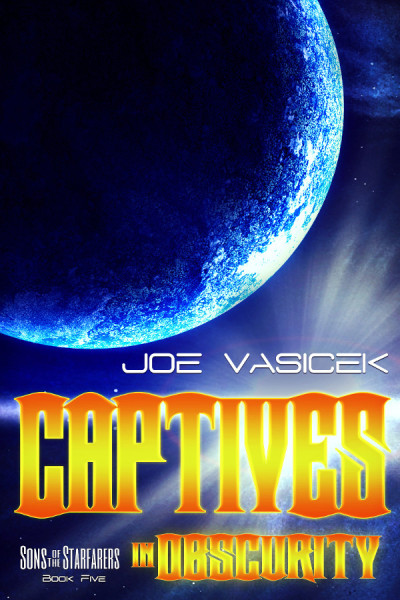
Captives in Obscurity, book 5 in the Sons of the Starfarers series, will be available in ebook form tomorrow. Pre-order or find out more below:
Captives in Obscurity
There is no escape beyond Star's End.
Isaac and Reva are running out of time. Gulchina's cruelty knows no bounds, and on the edge of known space, no one can stop her. But an unexplored planet holds an ancient alien secret that may prove to be a game changer.
The deadliest pirates in the galaxy have stolen the technology that will transform it. Now, on the edge of known space, they are poised to start an empire of their own.
Isaac and Reva are running out of time. Neither of them knows the extent of Gulchina’s plans, or whether the madwoman will keep them both alive after she achieves them.
But an unexplored planet beyond the Far Outworlds holds an ancient alien secret that not even Gulchina has uncovered. That secret will tip the balance in
SONS OF THE STARFARERS BOOK V: CAPTIVES IN OBSCURITY
Joe Vasicek fell in love with science fiction and fantasy when he read The Neverending Story as a child. He is the author of more than twenty books, including Genesis Earth, Gunslinger to the Stars, The Sword Keeper, and the Sons of the Starfarers series. As a young man, he studied Arabic at Brigham Young University and traveled across the Middle East and the Caucasus Mountains. He lives in Utah with his wife and two apple trees.
Some of the links in the page above are "affiliate links." This means if you click on the link and purchase the item, I will receive an affiliate commission. You will not receive any additional charge.
As an Amazon Associate I earn from qualifying purchases.
Gulchina’s private quarters were unlike any other place on the ship. A stunningly ornate rug covered the floor, its intricate woven design mesmerizing the eye. The table that sat in the center was made from authentic wood and inlaid with mosaic patterns of burgundy, teal, and mother-of-pearl. The wallscreens were set to show planetscapes viewed from the surface, mostly of deserts with ancient ruins jutting out like the bones of long-dead civilizations. The only sign that they were still on a starship was the single porthole on the opposite wall.
The door slid shut with a faint hiss, making Reva flinch.
“You are wondering why I called you here,” Gulchina said, waiting for Reva to take the other chair before resuming her seat across the wooden table. “I have many duties to attend to, so we will not waste time with small talk.”
“Very well,” said Reva.
Gulchina tapped the keypad on the armrest of her chair, and a server bot emerged from an unseen receptacle with two glasses of hot tea. Reva accepted one of the porcelain cups and held it in her lap while Gulchina took a sip from hers.
“In the next twenty-four hours, I will leave the Temujin to oversee an operation several parsecs from here. I am leaving Commander Wolf in command.”
“Why are you telling me this?”
“Because I believe you have something to tell me—a secret you have been keeping from me for some time.”
Reva’s heart skipped a beat, and her legs went suddenly numb. “What do you mean?”
“We have already agreed not to waste each other’s time. I advise you not to test my patience.”
Sweat began to pool on the back of Reva’s neck as her mind raced for some excuse. She set her cup down carefully on the table, her hand trembling noticeably. Gulchina eyed her with all the studied patience of a cat waiting to pounce.
“I-I didn’t think you knew.”
“I make it a point to know of everything that happens on my ship.”
“It’s just an innocent fling, I swear. We had a history together, and after you took us captive, our feelings for each other—”
“I’m not talking about your bi-weekly make-out sessions in the fourth deck maintenance closet,” said Gulchina. “That was merely a cover for your true intent.”
Reva’s fear quickly turned to panic. Her clandestine meetings with Isaac, their secret plans to escape—there was nothing Gulchina didn’t know. Corporal Sarnai’s execution and Ensign Matsuda’s ritual suicide flashed across her mind, threatening to break her.
“Are you going to kill me?” she asked softly.
“If you don’t confess, I will be forced to.”
Reva hung her head. “Isaac and I—we were planning to escape.”
Gulchina rose to her feet and began to pace. The wallscreens shifted to display a panoramic deep space starfield. The room dimmed noticeably, with the milky band of the galaxy stretching all around the room.
“It was all my idea though,” Reva said quickly, surprising herself. “I was the one who initiated it. If anyone should be punished, it’s—”
“Ever since I took you on board this ship, I have been testing you,” Gulchina interrupted her. “By now, it must be obvious why.”
“Because you’ve been grooming me as your successor?” Though Reva had always suspected as much, neither of them had openly said it until now.
“Indeed. And I must confess, you’ve performed quite admirably. In only a matter of months, you’ve learned our language and become quite fluent in it. Your insights into history have been incisive, and your observations of the crew have demonstrated a remarkable understanding of the principles of leadership. You have consistently shown yourself to be resourceful, independent, adept, and intelligent.”
But what? What are you trying to get at?
“You have great potential,” Gulchina continued. “If only you had had the ambition to match it.”
“What makes you think I ever wanted any of this?” Reva cried, her heart pounding. “That I wanted to be your—your protégé?” Now that her plot with Isaac had been exposed, she had nothing left to lose. It terrified and invigorated her at the same time to speak so openly.
“Because you are alone in this universe, Reva. You are a stranger, a vagabond. Your people are extinct, their culture and language forgotten. Without me, you are lost.”
“And how can you change any of that?”
Gulchina smiled. “By making you the mother of a great nation.”
Captives in Obscurity, book 5 in the Sons of the Starfarers series, will be available in ebook form on May 15th. Pre-order or find out more below:
Captives in Obscurity
There is no escape beyond Star's End.
Isaac and Reva are running out of time. Gulchina's cruelty knows no bounds, and on the edge of known space, no one can stop her. But an unexplored planet holds an ancient alien secret that may prove to be a game changer.
The deadliest pirates in the galaxy have stolen the technology that will transform it. Now, on the edge of known space, they are poised to start an empire of their own.
Isaac and Reva are running out of time. Neither of them knows the extent of Gulchina’s plans, or whether the madwoman will keep them both alive after she achieves them.
But an unexplored planet beyond the Far Outworlds holds an ancient alien secret that not even Gulchina has uncovered. That secret will tip the balance in
SONS OF THE STARFARERS BOOK V: CAPTIVES IN OBSCURITY
Joe Vasicek fell in love with science fiction and fantasy when he read The Neverending Story as a child. He is the author of more than twenty books, including Genesis Earth, Gunslinger to the Stars, The Sword Keeper, and the Sons of the Starfarers series. As a young man, he studied Arabic at Brigham Young University and traveled across the Middle East and the Caucasus Mountains. He lives in Utah with his wife and two apple trees.
Some of the links in the page above are "affiliate links." This means if you click on the link and purchase the item, I will receive an affiliate commission. You will not receive any additional charge.
As an Amazon Associate I earn from qualifying purchases.
Isaac turned down the next side corridor and walked quickly, his heart beginning to race. At the end of the corridor, a hatch led to the maintenance shaft for the docking bay equipment. It was the only way to get close enough to the outrider shuttles to sync with one without being seen. Isaac was pretty sure he could do it without alerting the ship’s AI, but he didn’t know the network’s architecture well enough to be sure. This was going to take some time.
After glancing behind him to make sure no one was watching, he swung the hatch open and climbed in. The only light in the place came from a single caged bulb on each level, glowing a sickly reddish orange. He ran down the stairs as quietly as he could manage and pushed into the narrow crawlspace on his knees and elbows.
Pipes and conduit ran along the walls on either side of him, some of them corroding. He slid carefully around a section of exposed and fraying wires. At length, he reached the section where he estimated the outriders to be. By pressing his face against the floor in the narrow crawlspace, he managed to reach around to his back pocket and pull out the console.
“Come on, come on,” he whispered as the device cycled out of sleep mode. Footsteps sounded through the bulkheads somewhere above him.
As soon as the console was active, he toggled through a series of menus, looking for the connectivity options. Thankfully, it didn’t automatically connect to the ship’s network—Reva must have had the foresight to turn that functionality off. But the operating system was one that he’d never seen before, and the GUI was counterintuitive and difficult to navigate. All of the options were in the wrong places, and none of the menu options made sense.
Sweat formed on his forehead as he tried to figure out how to work the damn thing. If he was gone much longer, someone was bound to get suspicious. The crawlspace was too narrow to turn around in, and he soon felt as if the walls were closing in.
Taking a deep breath, he paused for a moment to calm himself and try again. This time, things began to fall into place. He found the menu for connectivity and began cycling through the options.
At that moment, the bulkheads began to hum. Isaac ignored it at first, thinking it was just in his head, but the humming soon became too loud for him to ignore. He frowned and looked around him, only to realized that the floor grating was starting to vibrate.
We’re about to make a jump, he realized.
He paused for a few moments to wait it out. Instead of resolving, though, the humming became louder and more intense. The walls of the crawlspace seemed to collapse on him, while paradoxically growing wider at the same time. He closed his eyes, expecting it to end at any moment, but the buildup only became more intense.
Just when he thought he couldn’t possibly handle it anymore, the universe seemed to flip inside out. He gasped, and in a moment of panic thought that he was outside the ship. But when he opened his eyes again, he found himself lying in the crawlspace exactly as before.
That wasn’t a normal jump, he realized. We must have gone almost a light-year. Maybe even farther.
The thought made his heart start to pound. Normal starships never made jumps that big—it was just too dangerous. The farther one tried to travel in a single jump, the harder it was to predict where the ship would actually emerge from jumpspace. And while the likelihood of crashing into a planet or an asteroid or the heart of a star was practically infinitesimal, emerging in a high density region like a nebula or a molecular cloud could cause irreparable damage.
Not if the pirates are using the jump beacon technology they stole from us, Isaac realized. That technology would allow even a large ship like the Temujin to jump from beacon to beacon with hardly any risk. A voyage of months could be reduced to a few days.
Either way, the message was clear: He and Reva had to escape at the earliest opportunity.
Captives in Obscurity, book 5 in the Sons of the Starfarers series, will be available in ebook form on May 15th. Pre-order or find out more below:
Captives in Obscurity
There is no escape beyond Star's End.
Isaac and Reva are running out of time. Gulchina's cruelty knows no bounds, and on the edge of known space, no one can stop her. But an unexplored planet holds an ancient alien secret that may prove to be a game changer.
The deadliest pirates in the galaxy have stolen the technology that will transform it. Now, on the edge of known space, they are poised to start an empire of their own.
Isaac and Reva are running out of time. Neither of them knows the extent of Gulchina’s plans, or whether the madwoman will keep them both alive after she achieves them.
But an unexplored planet beyond the Far Outworlds holds an ancient alien secret that not even Gulchina has uncovered. That secret will tip the balance in
SONS OF THE STARFARERS BOOK V: CAPTIVES IN OBSCURITY
Joe Vasicek fell in love with science fiction and fantasy when he read The Neverending Story as a child. He is the author of more than twenty books, including Genesis Earth, Gunslinger to the Stars, The Sword Keeper, and the Sons of the Starfarers series. As a young man, he studied Arabic at Brigham Young University and traveled across the Middle East and the Caucasus Mountains. He lives in Utah with his wife and two apple trees.
Some of the links in the page above are "affiliate links." This means if you click on the link and purchase the item, I will receive an affiliate commission. You will not receive any additional charge.
As an Amazon Associate I earn from qualifying purchases.
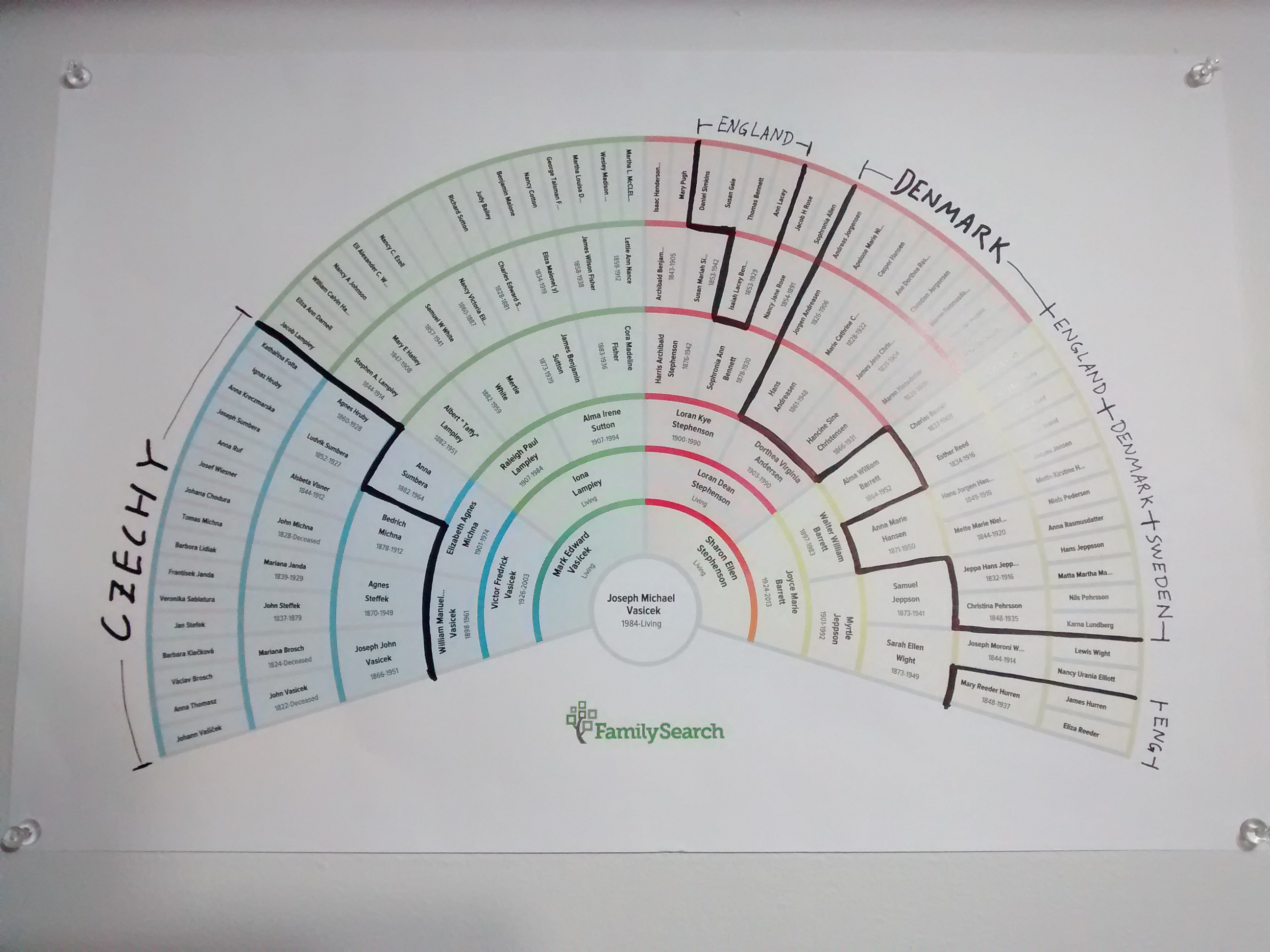 The fan chart shows six generations, starting with me at generation zero. I’ve outlined with a sharpie where all the lines hop the pond. My paternal grandfather’s side (blue) is all from the Czech lands, under the Habsburgs and the Austro-Hungarian Empire. My paternal grandmother’s side (green) goes way, way back to colonial America, with most of the lines still needing to be researched.