

Why I love writing novellas

Star Wanderers I (thumb)Star Wanderers II (thumb)Star Wanderers III (thumb)Star Wanderers IV (thumb)SW-V Dreamweaver (thumb)SW-VI Benefactor (thumb)thumb (Sholpan)

For the first half of this year, almost every project I’ve worked on (with the exception of an unfinished short novel) has been a novella.  It’s not a form I was familiar with when I first started writing, but I’ve come to enjoy it immensely, and look forward to writing much more in the future.

The technical definition of a novella is pretty simple, at least according to SFWA.  It mainly has to do with word length:

  • Novel — 40,000 words or more
  • Novella — 17,500–39,999 words
  • Novelette — 7,500–17,499 words
  • Short Story — 7,499 words or fewer

That one simple distinction leads to a host of other differences, though, since words and story length are so crucial to the different types of stories you can tell.

Short stories tend to be more situational.  A good short story writer (which I am not) can use the form to explore all sorts of other story elements, but there’s always something of a tradeoff.  A good short story will have strong characterization but a simplistic or nonexistent plot, or center around a compelling concept but not provide an immersive setting.  It’s a very minimalistic form–there’s always something of a sacrifice.

A good short story can pack a real punch, but it doesn’t really immerse you in another world.  It might resonate for a long time after you read it, but you finish it almost as soon as you start it.  It’s a form that I enjoy in audio form, but don’t actually read very much.  It’s great for the commute or a road trip, but not so great when I’m curled up in the lovesack looking to get lost in a book.

That’s just me, at least.  And as for writing them, I need a lot more practice before I have anything useful to say on that.

With novels, it’s exactly the opposite.  They are so expansive that they tend to have multiple viewpoints, subplots, character arcs, and setting elements all woven together in one sprawling whole.  There are differences, of course, between a 200k word fantasy epic and a short 60k word thriller, but complexity is an important part of the form.  It’s not enough to have an interesting situation, or a single mind-blowing idea–you have to have several, and they have to work together.

When done well, the effect can be tremendous.  A good novel is much more than just the sum of its parts, and the climactic moments when everything comes together can be truly spectacular.  They’re incredibly immersive, too–I’m pretty sure that some of my childhood memories are things that never happened except in the pages of a book.

But sometimes, it can be hard to get into a novel, either because it starts off slow or because from the very beginning it’s so complex.  Also, it requires much more of an investment, especially in time.  I can’t tell you how many novels I’ve checked out from the library, only to return a few weeks later with a hefty overdue fine on my account–not because I didn’t like them, but because I just couldn’t find the time to finish.

In terms of writing, all of that storytelling complexity can make the task positively gargantuan.  It depends on the length of the novel, of course, but the longer it gets, the harder it is to keep everything straight.  And when something is off and the story just doesn’t seem to be coming together, it can be incredibly difficult to figure out exactly what is broken.  Even if it’s small, or something that’s easy to fix, you can easily find yourself revising in circles.

The novella falls more or less in the “Goldilocks” zone of these other forms.  It’s long enough to give you the space you need to play with things on a novelistic scale, but short enough that you don’t have to worry about bringing all that complexity to the page.

Generally, I’ve found that there isn’t much of a difference between novellas and novelettes.  I’ve dabbled with both, and found that the difference has more to do with brevity and less to do with actual structure or form.  A well-written novelette can do all (or at least most) of the things a novella can do, just in a slightly more economical fashion.  And of course, the differences in all of these forms is subjective and fuzzy.  Your experience could very well be different.

But personally, I find novellas (and novelettes) much more fun to write because it allows me, sometimes even forces me, to get a lot more intimate with my characters and their individual points of view.  A situation or idea alone is not enough to carry the story for the required length, but exploring multiple viewpoints (or at least more than two) tends to push the story too far.  Consequently, I find myself really diving into my characters and trying to see things from their perspective.

It’s similar with novels, but without all the other subplots or character arcs, there are fewer distractions–and fewer ways to screw up.  I can stay in the character’s head without having to break out to fix something else.  Also, my first drafts tend to be a lot cleaner, with less need for massive substantial revisions.  And even if the draft is irredeemable, I can toss it out and rewrite from scratch with a lot less pain, since it’s only 30k or 40k words.

So yeah, I really love writing novellas, which is something that would have surprised me only three or four years ago.  There aren’t a whole lot of traditional markets to sell them to, but that doesn’t matter because they’re perfect for ebooks and self-publishing.  It’s also a lot easier to take a loss on a perma-free novella than it is on a full-length novel.

I’ve found that I can write a good first draft of a novella in anywhere between two and six weeks.  I wish I could do it quicker, but I’m not a very fast writer, so thirty days is a pretty good cap for a deadline.  And because they’re shorter, they tend to be quicker to revise, and easier to hand off to alpha readers who will give you a good turn-around time for feedback.

For those of you who prefer more long-form stories, don’t worry–I haven’t given up on writing novels.  In fact, I’ve got a half-finished epic fantasy novel that I’ll probably work on next, once Star Wanderers: Benefactor (Part VI) has gone through a major revision pass.  But if you enjoy reading novellas as much as I enjoy writing them, then you’ve got a treat, because I’ve got a bunch of Star Wanderers novellas that will be coming out in the next few months!

And after that?  Who knows …

STARS OF BLOOD AND GLORY 1.1 is finished!

That’s right!  After what felt like six hours of un-anesthetized brain surgery, Stars of Blood and Glory 1.0 is finally complete!  Here are the stats:

words: 76,326
chapters: 18, prologue & epilogue
ms pages: 360
start date: 20 Dec 2011
end date: 2 Feb 2011

Some extended stats, just for fun:

days spent writing: 36
miles traveled: ~5,500
viewpoint characters: 5
characters from other novels: 9
major characters who die: 3
space battles: 5
planets slagged: 1

The wordsplash:

Wordle: Stars of Blood and Glory 1.1

And the most influential song while writing:

It’s good to finish another novel, but this one definitely needs a lot of work before I feel that it’s of publishable quality.  I think I know how to fix it, but my mind needs a break in order to give it a fresh approach.  I’ll probably let it settle for a few months, then come back either this spring or summer.

I’m pleasantly surprised with how quickly I was able to finish this book.  Thirty-six writing days is something of a personal record.  Still, it feels like it needs a little more fleshing out.  76k is definitely too short for a novel of this type; hopefully in the second draft, I’ll be able to bring it up to 80k or 90k.

In other news, I heard back from the TLG program, and I’m happy to say I’ve been accepted!  I’ll fly out to Georgia in a little less than two weeks, have a seven day orientation period at Kutaisi, then ship off to wherever the Ministry of Education decides to send me.  I’ll be there until at least June, then either renew for a second semester or go somewhere else, maybe Eastern Europe or the Middle East.

Needless to say, I’m pretty excited!  Hopefully, this new career will be a good fit, and I’ll have many awesome adventures in the next few years.  Even if my writing starts to take off and my books start selling hand over fist, I’ll probably keep teaching for a while just for the experience.  Writing is fun, but when you have nothing else to keep you busy it can also get quite boring.

The next few weeks are going to be pretty freaking busy, so I’m probably going to ease off on the writing, at least until I get settled into the new routine.  Before I leave, I need to:

  • Find affordable expat insurance.
  • Pick up a 220 to 120 volt converter and plug adapter.
  • Publish Journey to Jordan on Amazon and B&N.
  • Get some new clothes.
  • Clean my parents’ guest room.
  • File state taxes for Utah (federal taxes are already filed).
  • Write up the last couple of Trope Tuesday posts for the backlog.
  • Finish the covers for Star Wanderers (while I still have access to my desktop computer).
  • Read up on Georgian customs and mentally prepare myself for the inevitable culture shock.

Shouldn’t be too hard, but it’s only going to get crazier once I’m over there.  I’ll be sure to keep you updated as much as I can, though; this is going to be fun!

So yeah, another novel down; this one makes my sixth.  Just another 94 to go before I reach my lifetime goal of one hundred!

Writing log results

For the last month or so, I’ve been keeping track of my daily writing habits to look for patterns that might give me some insight on how to improve my creative process.  I’ve amassed somewhere around 65 data points, and I think the results are clear enough to notice some trends.

Just some preliminary background information: for most of this time, I’ve either been on vacation or at my parents’ house, waiting to start an English teaching job in another country.  I haven’t had school or a full-time job, so my schedule has been pretty open and flexible.  Also, the numbers track progress on the first drafts for Star Wanderers and Stars of Blood and Glory, and do not count revisions of any kind.

Here are the results:

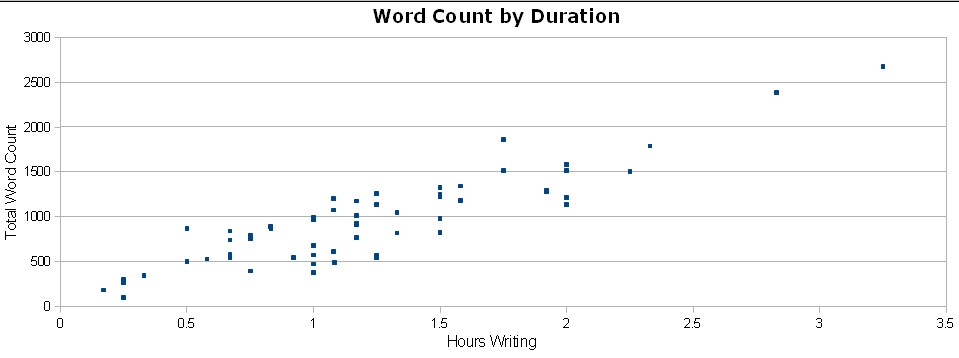
The first graph plots word count by duration spent writing.  As you can see, there’s a definite trend: the longer I write, the more I tend to write.  No surprises there.  Most writing sessions are somewhere between 45 and 90 minutes, or 500 and 1,500 words.

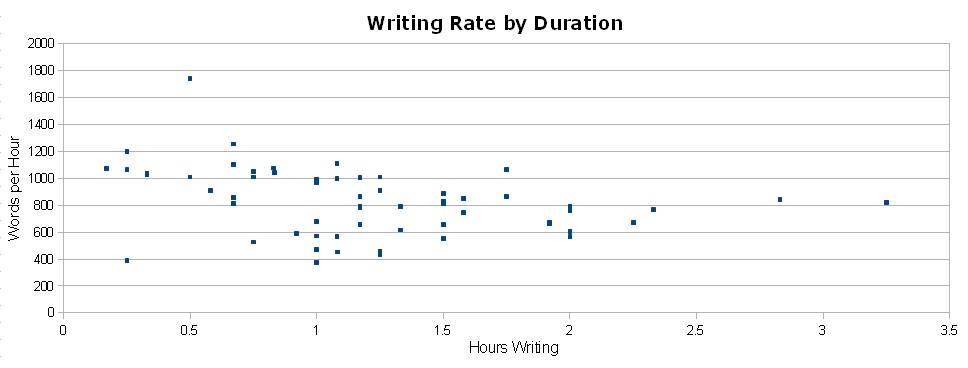
The second graph plots the average writing rate (in words per hour) per session by hours spent writing, and it’s a little bit murkier.  In writing sessions of less than 45 minutes, I tend to average a little over 1000 words/hour, but things get murkier between 45 and 90 minutes, and after 90 minutes, I tend to be around 600 and 800 words/hour.

The overall trend appears to be down–that is, the longer I write, the slower I tend to write–but there appears to be a counter-trend, too, where if I start off slow I can increase the pace by writing for a longer amount of time.  Is that true, or is that simply a sharper downward trend line?

I think it’s a genuine counter-trend, and here’s why:

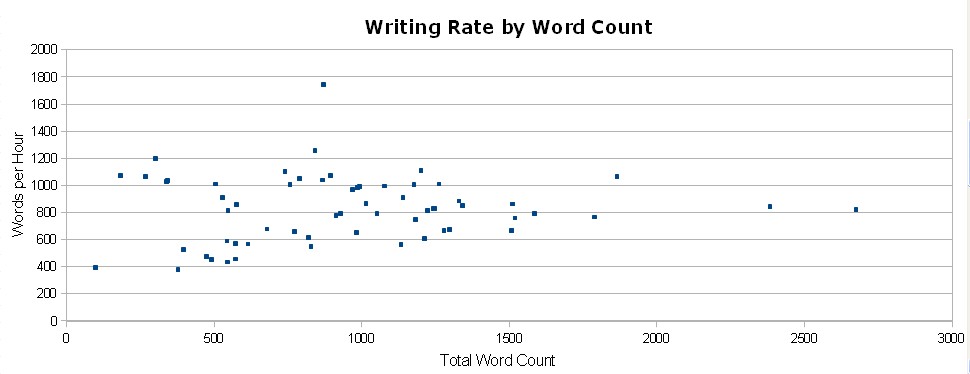
This graph shows writing rate plotted against word count, and it pretty clearly shows two trend lines: one starting at 1,000 to 1,200 words/hour and going slightly down, the other starting at 400 to 600 words and going up.  At about 1,500 total words, they converge at around 800 words/hour and appear to remain flat, though there isn’t really enough data to be able to say.

What I think this shows is that I have two different writing styles.  The first is to start off slow and gradually write my way into the story, picking up the pace but never really going over 800 words/hour.  The other is to start off at a sprint of 1,200 words/hour or so, but to slowly drop off to 800 words/hour at around 90 minutes or 1,500 words.

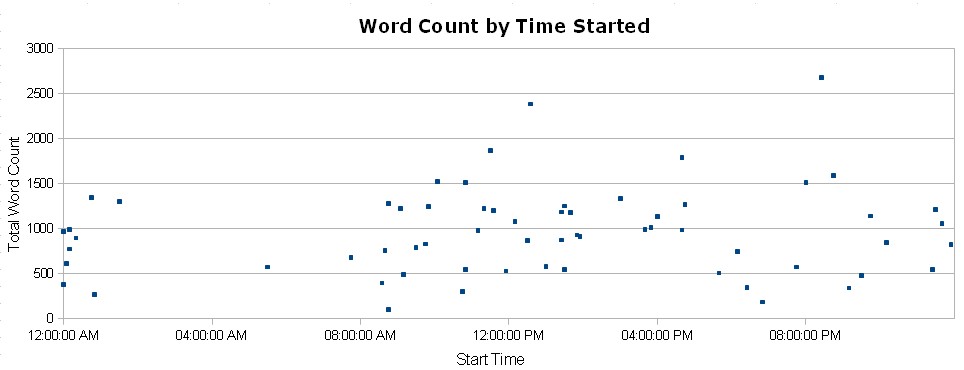
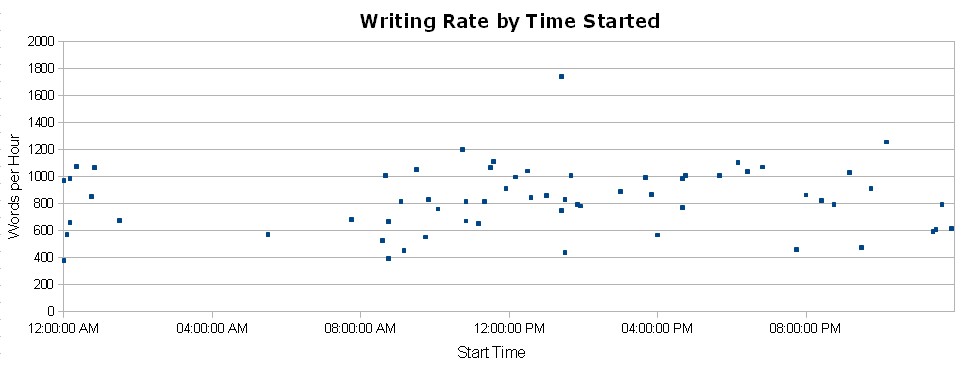
The next graph plots the total word count of each writing session by the time of day in which I started the session.  Interestingly, there is no trend; the points are all over the map.  This tells me that there is no “best time” for me to write.  Other time-related factors might influence how much I can write, but time of day itself does not.

A quick glance at the next graph confirms this.  It plots writing rate by time of day, and the results are much the same as the graph for word count.  I tend to write at a more consistent pace in the afternoon–around 1,000 words/hour–but really, there is no consistent trend.

This tells me that my first session of the day tends to be slow and gradual, but that once I’ve written myself into the story, the writing comes a lot faster.  In other words, if I wake up early and hit the ground running, I tend to write more and write faster throughout the day.  If I get lazy and sleep in, the whole day tends to be shot.

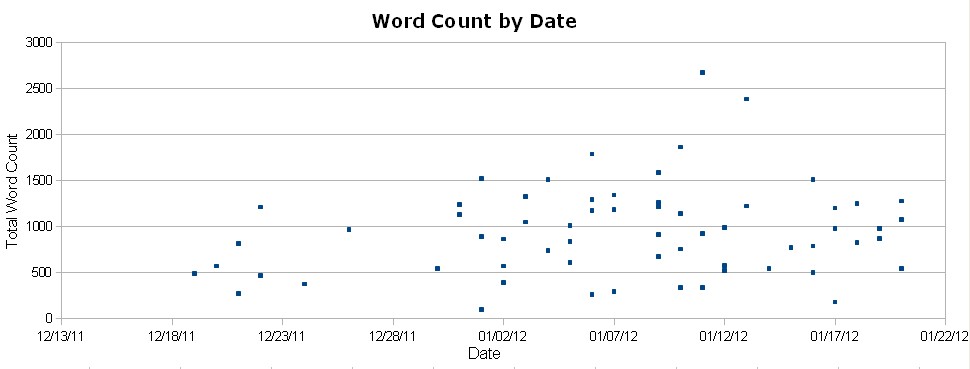
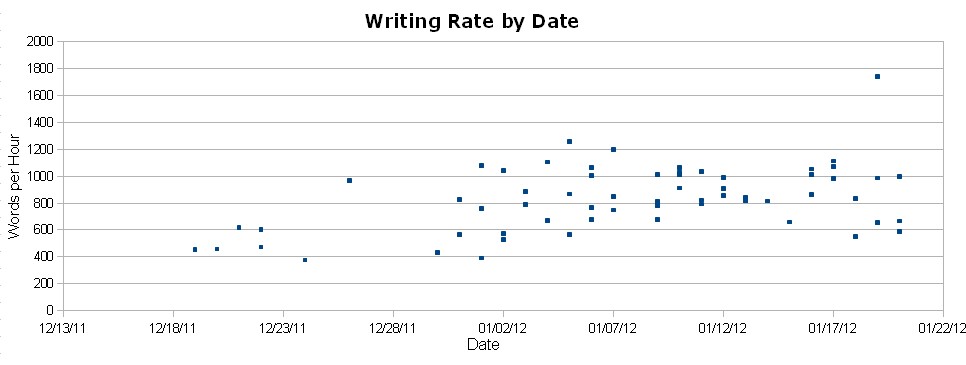
The last two graphs plot word count and writing rate by date.  Before January 3rd or so, I was either spending time with family or on the road / traveling cross-country by train.  Even so, there wasn’t a whole lot of variation, though my writing rate converged around 800-1,000 words/hour for a while before fluctuating again.

What this tells me is that stability and momentum tend to lead to more consistency in my writing habits.  If I’m constantly on the road, it becomes more challenging to keep up the pace.  Even so, as long as I can find make at least 45 to 90 minutes to write, I can pound out about the same number of words per session.

So in conclusion, it seems that the best way to improve my writing habits and streamline my creative process would be to:

  1. Get up early and start the day writing.
  2. Write in short, condensed sessions of 45 to 90 minutes each, with periodic breaks in between.
  3. Don’t worry about time of day when planning time to write; just do it whenever time can be made available.

However, unless I can get to the point where I’m regularly averaging +1,000 words after two hours, it’s going to be really hard to put in 10k words or more per day.  At 800 words/hour, it takes 12.5 hours to hit 10k, and after about four or five sessions at 1,000 words/hour, the well starts to dry up.

A much more practical goal, for now at least, would be to shoot for a consistent 5k words per day.  The week before last, I hit about 5.5k on Monday, a little less than 4k on Tuesday and Wednesday, and back around 2.5k for Thursday, Friday, and Saturday.  My running 7-day total for the entire week was above 20k, which is pretty good, but if I could get to stay between 25k and 30k for some time, that would be an accomplishment.

I haven’t totally given up on hitting a 10k/day average, but at this point, it seems that I need to set some stepping stones first.  5k/day seems like a much better goal for now–especially since I don’t know how things are going to change once I’m traveling again.  But at least I have a better idea of how my own process works.  I expect I’ll be writing a lot more in the weeks and months to come!

Writing Resolutions for 2012

As I write this post, I’m riding on the California Zephyr through western Colorado, going to my parents’ house in Massachusetts before heading out overseas on an adventure that I have no idea where it will take me before the end of the year. It’s an interesting time to make New Year’s resolutions, because so much is up in the air at this point, but two things are for certain: I will continue to write, and I will continue to publish.

A lot has changed for me since 2010. Around this time last year, I was still in query-writing mode, looking for an agent, and getting a little desperate for work. I eventually found work at an alarm company, which lasted through the summer until I realized it wasn’t helping me advance towards my long-term goals. And as for the query-go-round, I made the tremendous paradigm shift into indie publishing around the same time, eventually publishing three novels, three short stories, and one novella. Sales haven’t been spectacular, but they have been earning me a trickle of money that amounts to a few hundred dollars by now. Not quite a living yet, but if I keep at it, it might just become that.

My dream since 2009 has been to make a full-time living telling stories that I love. With all the opportunities made possible through ebooks and indie publishing, I have great hopes of accomplishing that within the next few years. However, I do think it’s going to take time, which is why I’ve decided to go abroad to teach English for a while. It’s the perfect kind of career for young people going through a transitional time in their lives, and I think I’ll find it a lot more enriching than bouncing around dead-end warehouse jobs until the writing starts to take off.

I can’t foresee exactly where this path will take me, but I can take accountability for the things within my control. So with that in mind, here are my resolutions:

1: Independently Publish At Least Two Books in 2012.

This shouldn’t be too hard. Journey to Jordan is already in the queue; all I have to do is make a final self-editing pass and figure out how to insert the photos. Besides that, I have the direct sequel to Bringing Stella Home, Heart of the Nebula, which I should be able to revise, polish, and publish before the end of the year, perhaps as early as summer.

Besides these projects, though, the queue is conspicuously empty, which is why I’ve come up with the following resolution:

2: Constantly Work on Producing New Material.

This is a big one–in the past, I’ve taken time off from new projects to work on major revisions, and as I mentioned in this post, it’s slowed me down a lot more than I would like. I’ve never been able to juggle two projects for more than a week, but this is a skill I should probably learn if I’m going to do this professionally.

I hesitate to put a concrete number like “four completed novel drafts before 2013” because this is an aspect of my writing process that I still need to explore. If I peg myself to a number, I could as easily find that I’ve set it too low as that I’ve set it too high. The important thing at this point is to learn the self-discipline.

3: Read and Review a New Book Every Week.

This is a tricky goal that I’ve tried and failed at before, but I really feel that reading voraciously is going to help my writing more at this point than working on craft or attending conventions. Those are good too, of course, but there’s something about reading and analyzing other works, both inside and outside of your chosen genre. I’ve been slacking off on this a lot lately, and if I’m not careful, my writing will get worse because of it.

With my Kindle ereader and low-priced ebooks, I have a lot of reason to be optimistic about this goal, even though I’ll be on the go for most of the year. It’s like having an iPod for books–and with the sampling system, I don’t have to worry so much about whether or not it’s worth buying the book. Simply download the free sample, and if I’m still interested by the end, click and continue.

4: Experience at Least Three 10k Days.

This ambitious resolution comes from a post I wrote earlier in reaction to this post here. Basically, I want to boost my productivity and break through some mental barriers that have been in place for the past few years, and pushing myself to do a couple 10k sprints will hopefully help to reset my stride at a much higher rate.

At first, I was going to say “three consecutive 10k days,” but with all the uncertainty accompanying my travels and new TEFL career, that doesn’t seem like a good idea at this point. If/when I’ve saved up enough money to take a few months off from everything else, then I’ll set a goal like that.

5: Attempt to Write a Novel in a Week.

This is more of something I want to do for fun, just to see if I can. Apparently, Michael Moorcock used to write novels in three days, and while I’d like to try that too, a week seems like a more realistic goal. At 40,000 to 50,000 words minimum, I don’t even have to break 10k/day to do it. 🙂

So those are my writing resolutions for the next year. As always, I’ll continue to write for this blog, hopefully with a lot more book reviews in the coming months. In the meantime, though, this post is getting long, and I’d better get back to writing.

Happy New Year everyone! Here’s to 2012 and all the possibility it brings!