Some new thoughts on productivity

I’ve been thinking a lot about writing and productivity, mostly because I seem to be struggling a lot with it lately. With nanowrimo just starting, this is a pretty topical thing to blog about, but I also want to look at it from a long-term career perspective, since that’s what I’m personally more interested in.

As writers, when we spend all our time procrastinating or fail to meet our word count goals, we tend to beat ourselves up and frame the problem in terms of a lack of self-discipline. If only we had greater will power, we could buckle down and pound out five or ten thousand words a day like those super-prolific authors.

While there’s definitely something to say for raw self-discipline, though, I think there’s another dimension to writing productivity that we tend to miss. Not all writing-related activities are productive–and not all non-writing related activities are totally unproductive. In order to make the most efficient use of our writing time, I think it’s more important to understand and respect our individual creative process than it is to merely force ourselves to produce more words.

To better understand my own creative process, I took a little time to group every writing-related thing I do into four different categories:

  • Writing activities
  • Fill-the-well activities
  • Publishing chores
  • Procrastinating

WRITING ACTIVITIES

This should be pretty self-explanatory. It’s basically all the stuff that leads directly to a finished manuscript. It requires the highest amount of energy and produces the most important content.

Activities in this category include:

  • Writing new material
  • Making substantial revisions (putting in and taking out)
  • Updating chapter and scene outlines

FILL-THE-WELL ACTIVITIES

This is the non-writing stuff I do that helps me to be more productive when I switch back to the writing activities. Basically, it’s the stuff I do before and after I write that helps me to maintain a creative momentum.

Activities in this category include:

  • Reading
  • Blogging
  • Catching up on blogs
  • Listening to podcasts
  • Doing mindles chores
  • Going on walks
  • Exploring new places
  • Watching movies
  • Playing RPGs
  • Talking with friends
  • Reviewing first reader feedback
  • Writing character outlines
  • Making book soundtracks

PUBLISHING CHORES

This is all the professional stuff that I have to do, which may feel productive while I’m doing it, but actually takes time away from the stuff I should be doing. I still have to do it, but I should waste as little time doing it as possible.

Activities in this cateogry include:

  • Ebook formatting
  • Producing cover art
  • Writing blurbs and book descriptions
  • Writing author’s notes
  • POD typesetting
  • Handing financial stuff (royalties, invoices, etc)
  • Researching the publishing industry
  • Processing copy edits
  • Sending out email newsletter

PROCRASTINATION

Again, pretty self-explanatory. This is the stuff I shouldn’t do, but end up doing anyway in order to avoid stuff that feels like work. It’s all the stuff that I need to cut out entirely if I want to maximize my productivity.

Activities in this category include:

  • Minecraft
  • Alpha Centauri
  • Any other game that I can’t stop thinking about
  • Checking ebook sales numbers
  • Dicking around on Facebook and Twitter
  • Browsing the Kindle Boards
  • Watching TV and Youtube
  • Minecraft

So now that that’s done, what next?

I’m still figuring this part out, but I think the best thing to do would be to put as much distance as possible between the stuff that boosts productivity (writing and filling the well) and the stuff that doesn’t (publishing chores and procrastination).

The way I see it, there are basically two ways to do this:

  • Physically separate the activities. Do all your writing on a machine that’s disconnected from the internet and doesn’t have any games installed, and do everything else on a separate computer.
  • Set aside blocks of time specifically for writing. Organize your schedule so that writing is a priority, while acknowledging the need to take breaks and refill the creative well.

I can’t really do the first one while I’m here in Georgia, but I definitely can do the second. So far, I’ve found that waking up early to start the day with an hour of writing helps me a ton to build and keep momentum. However, I need to do a better job setting time aside in the afternoon, both for writing and for refilling the well. If I don’t, I usually end up procrastinating by default without realizing it until it’s too late.

So anyhow, those are some of my latest thoughts on writing and productivity. What are yours? Does this square with your experience, or is there a better way to think about it that I’ve missed?
Managing time and mental space in a foreign country

Some of you asked for a writing update, so I figure I might as well do a quick post on my current projects and where they are.  I’ve also been experimenting with my daily schedule a bit, so it would probably be good to blog about that as well.

Right now, the main project taking up all of my attention is the 3.0 draft of Heart of the Nebula.  It’s a direct sequel to Bringing Stella Home, and continues the story from James McCoy’s point of view, five years later.  I’m making a lot of changes, toning down the romantic subplot and emphasizing the more interesting social and ethical issues.  When I’m through, I think it will be completely different from the first couple of drafts, but in a way that’s truer to the spirit of the first book.

I’ve only been managing about 500 to 1,500 words per day, though, which is abysmally low compared to my usual word count.  Part of that is because I’m throwing out entire sections and drafting new ones from scratch, but the more significant part is that I don’t have as much mental space for writing as I did back in the States.

Basically, moving to a foreign country and starting a new career has taken a lot more out of me than I thought it would.  I teach 18 lessons per week, some with as many as 30 or 35 kids, across grades 1 through 12.  Culturally, everything is completely different too.  So far, the shock hasn’t been too bad–I really love it out here in Georgia–but it’s made the writing a little bit more difficult than I’d expected.

I have a lot of free time, though, so that’s not a problem: the problem is clearing my mind and keeping the creative juices fresh.  Here’s how I’m going to do it:

  1. Limit internet time.  As tempting as it is to turn to the familiarity of the internet, it’s a huge time-suck and doesn’t really do anything for the culture shock.  A much better thing for that would be to spend more time reading.  From now on, I’m going to limit myself to one internet session per day, no longer than 2 hours (more if there’s something I actually need to do).
  2. Get out more.  I get cabin fever very easily, and it’s only gotten worse now that I’m in a foreign culture.  Fortunately, there are tons of places to explore, and in my local neighborhood I’m kind of a celebrity (hey look, it’s the American!  Let’s chase him and shout ‘hello’!).  The prime time for this is the late afternoon, when everyone’s out and things are still open.  If I check the internet right after school and get out immediately after, I think that will help me better to focus.
  3. Get up early to write in the morning.  I tried this last week, and it was a great way to get focused and build more momentum.  Even if I only manage a couple hundred word, it gets me thinking about the story for the rest of the day, which makes it easier to pick up in the afternoon and evening.

So that’s the plan for now.  My goal is to finish Heart of the Nebula before the end of May, which is going to require a significant change of pace.  It should be pretty straightforward, though, and after this draft it shouldn’t need too many more revisions before it’s ready to publish.  If all goes well, I foresee a publishing date sometime in the fall or winter.

Do you have any other ideas for ways to manage creativity in a totally foreign culture?  If so, I’d love to hear it–that’s my biggest struggle right now.

Writing log results

For the last month or so, I’ve been keeping track of my daily writing habits to look for patterns that might give me some insight on how to improve my creative process.  I’ve amassed somewhere around 65 data points, and I think the results are clear enough to notice some trends.

Just some preliminary background information: for most of this time, I’ve either been on vacation or at my parents’ house, waiting to start an English teaching job in another country.  I haven’t had school or a full-time job, so my schedule has been pretty open and flexible.  Also, the numbers track progress on the first drafts for Star Wanderers and Stars of Blood and Glory, and do not count revisions of any kind.

Here are the results:

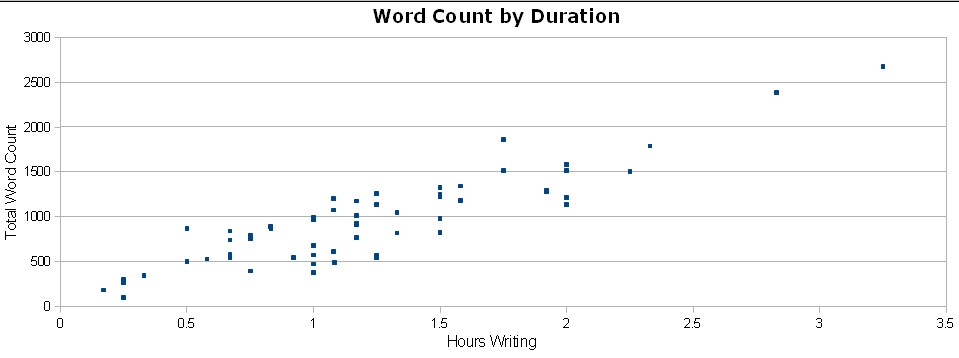
The first graph plots word count by duration spent writing.  As you can see, there’s a definite trend: the longer I write, the more I tend to write.  No surprises there.  Most writing sessions are somewhere between 45 and 90 minutes, or 500 and 1,500 words.

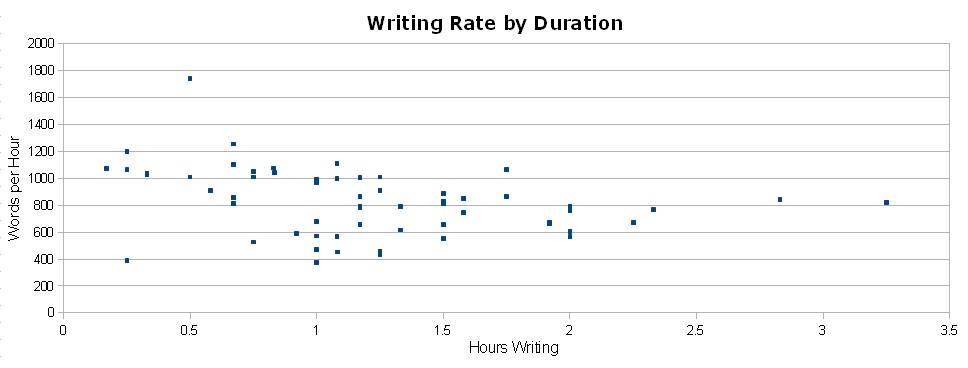
The second graph plots the average writing rate (in words per hour) per session by hours spent writing, and it’s a little bit murkier.  In writing sessions of less than 45 minutes, I tend to average a little over 1000 words/hour, but things get murkier between 45 and 90 minutes, and after 90 minutes, I tend to be around 600 and 800 words/hour.

The overall trend appears to be down–that is, the longer I write, the slower I tend to write–but there appears to be a counter-trend, too, where if I start off slow I can increase the pace by writing for a longer amount of time.  Is that true, or is that simply a sharper downward trend line?

I think it’s a genuine counter-trend, and here’s why:

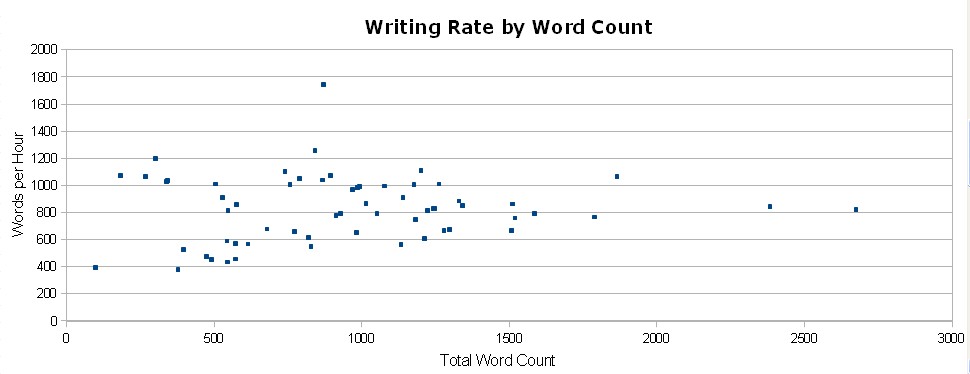
This graph shows writing rate plotted against word count, and it pretty clearly shows two trend lines: one starting at 1,000 to 1,200 words/hour and going slightly down, the other starting at 400 to 600 words and going up.  At about 1,500 total words, they converge at around 800 words/hour and appear to remain flat, though there isn’t really enough data to be able to say.

What I think this shows is that I have two different writing styles.  The first is to start off slow and gradually write my way into the story, picking up the pace but never really going over 800 words/hour.  The other is to start off at a sprint of 1,200 words/hour or so, but to slowly drop off to 800 words/hour at around 90 minutes or 1,500 words.

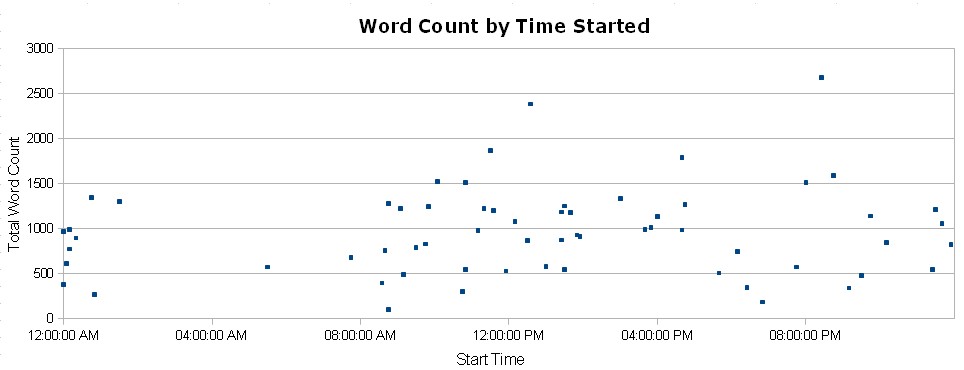
The next graph plots the total word count of each writing session by the time of day in which I started the session.  Interestingly, there is no trend; the points are all over the map.  This tells me that there is no “best time” for me to write.  Other time-related factors might influence how much I can write, but time of day itself does not.

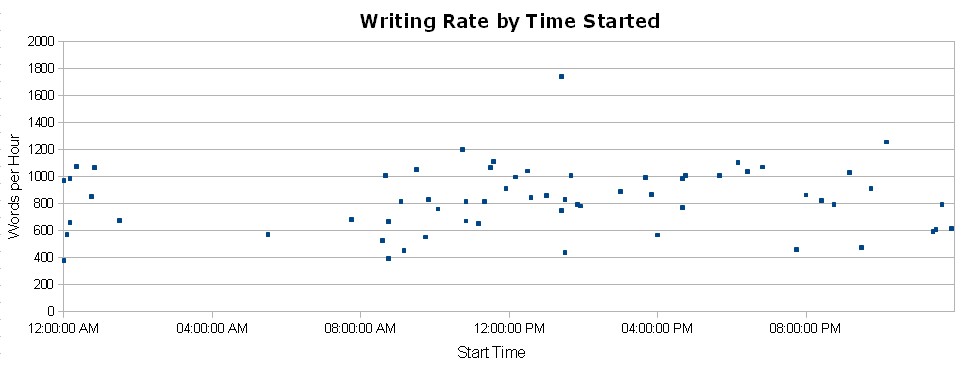
A quick glance at the next graph confirms this.  It plots writing rate by time of day, and the results are much the same as the graph for word count.  I tend to write at a more consistent pace in the afternoon–around 1,000 words/hour–but really, there is no consistent trend.

This tells me that my first session of the day tends to be slow and gradual, but that once I’ve written myself into the story, the writing comes a lot faster.  In other words, if I wake up early and hit the ground running, I tend to write more and write faster throughout the day.  If I get lazy and sleep in, the whole day tends to be shot.

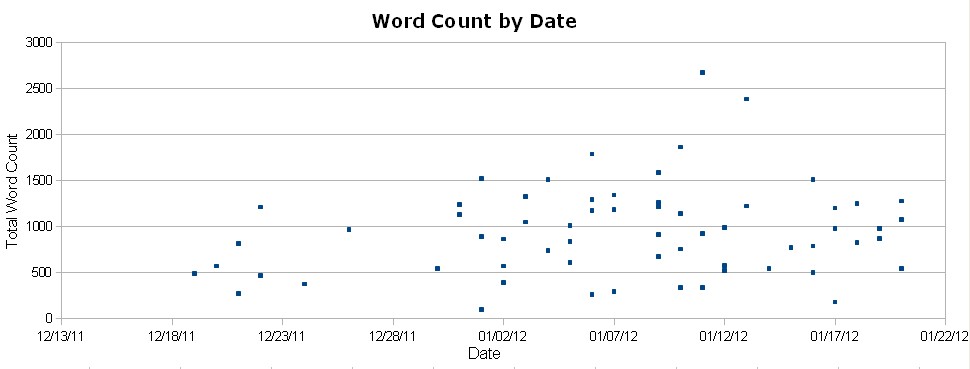
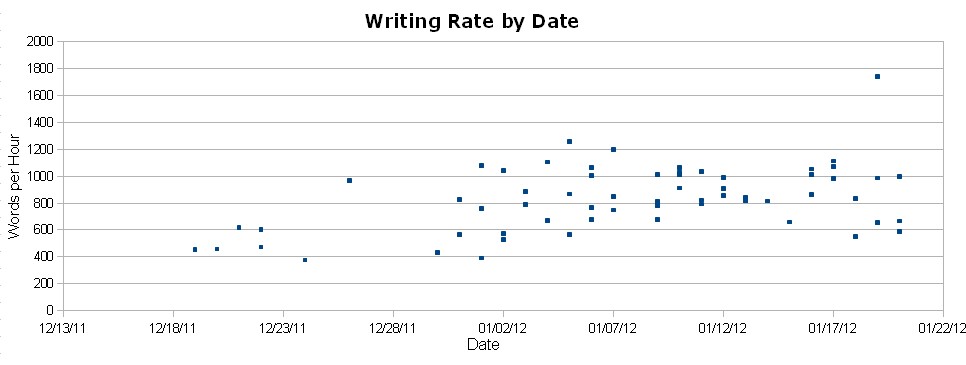
The last two graphs plot word count and writing rate by date.  Before January 3rd or so, I was either spending time with family or on the road / traveling cross-country by train.  Even so, there wasn’t a whole lot of variation, though my writing rate converged around 800-1,000 words/hour for a while before fluctuating again.

What this tells me is that stability and momentum tend to lead to more consistency in my writing habits.  If I’m constantly on the road, it becomes more challenging to keep up the pace.  Even so, as long as I can find make at least 45 to 90 minutes to write, I can pound out about the same number of words per session.

So in conclusion, it seems that the best way to improve my writing habits and streamline my creative process would be to:

  1. Get up early and start the day writing.
  2. Write in short, condensed sessions of 45 to 90 minutes each, with periodic breaks in between.
  3. Don’t worry about time of day when planning time to write; just do it whenever time can be made available.

However, unless I can get to the point where I’m regularly averaging +1,000 words after two hours, it’s going to be really hard to put in 10k words or more per day.  At 800 words/hour, it takes 12.5 hours to hit 10k, and after about four or five sessions at 1,000 words/hour, the well starts to dry up.

A much more practical goal, for now at least, would be to shoot for a consistent 5k words per day.  The week before last, I hit about 5.5k on Monday, a little less than 4k on Tuesday and Wednesday, and back around 2.5k for Thursday, Friday, and Saturday.  My running 7-day total for the entire week was above 20k, which is pretty good, but if I could get to stay between 25k and 30k for some time, that would be an accomplishment.

I haven’t totally given up on hitting a 10k/day average, but at this point, it seems that I need to set some stepping stones first.  5k/day seems like a much better goal for now–especially since I don’t know how things are going to change once I’m traveling again.  But at least I have a better idea of how my own process works.  I expect I’ll be writing a lot more in the weeks and months to come!

Climbing the 10k mountain

Many Bothans died to bring you this.

I recently read an amazing blog post by Rachel Aaron, in which she explains how she went from writing about 2k words per day (about what I’m doing) to routinely breaking 10k.

This is something I really want to do with my own writing.  As I noted a couple of weeks ago, I need to pick up the pace if I’m going to keep up with my professional goals.  If I could go from 2k to 10k, and make 10k the standard…holy cow, that’s a 500% jump in productivity.  Who wouldn’t want that?

From Rachel’s blog:

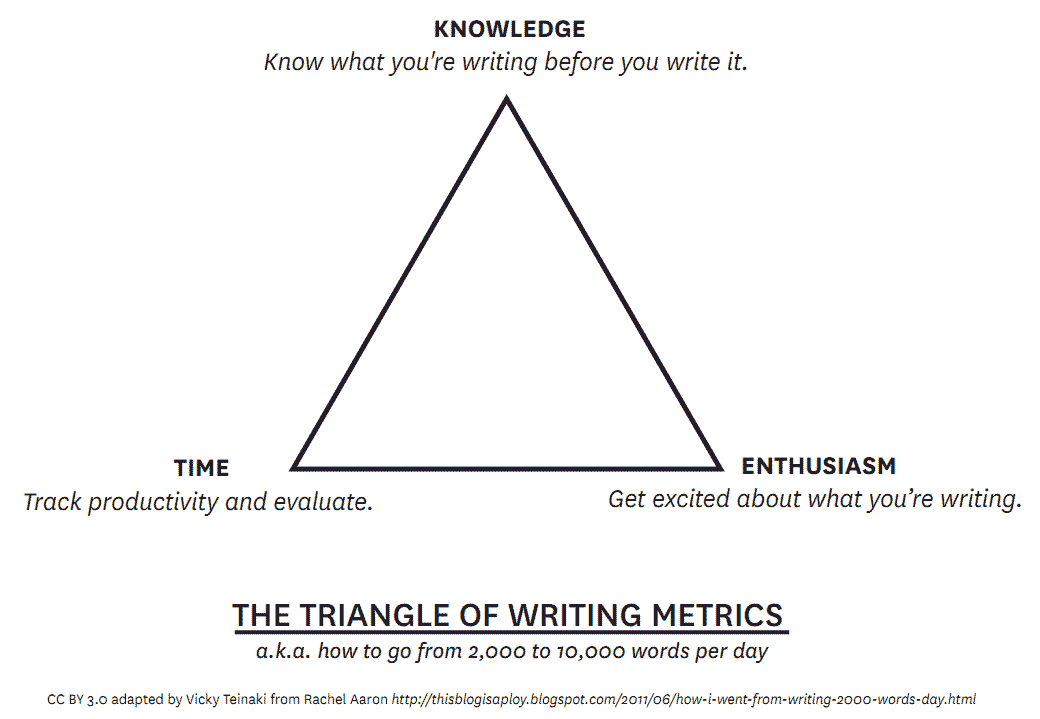
Drastically increasing your words per day is actually pretty easy, all it takes is a shift in perspective and the ability to be honest with yourself (which is the hardest part). Because I’m a giant nerd, I ended up creating a metric, a triangle with three core requirements: Knowledge, Time, and Enthusiasm. Any one of these can noticeably boost your daily output, but all three together can turn you into a word machine. I never start writing these days unless I can hit all three.

The point that I probably need to work on the most is time: I tend to start off the day slow, checking Facebook and blogs and other stuff before getting into the writing, then write for a little while before running off and doing some chore or allowing myself to get distracted again.  Sometimes, I don’t really buckle down until a couple of hours before I should go to bed, and that’s bad.

But really, I think the main obstacle is just thinking that writing is difficult.  If everything comes together in the right way, there really isn’t any reason why 5k or 6k or even 10k should be too difficult–and yet we naturally think that if 2k is hard, anything more should be that much harder.

I’m in a weird state of limbo right now between moving and preparing to go overseas, but I’m going to start a daily writing log so that I can figure out what time of day is most productive.  You can’t wait for life to settle down before you get to work; you have to roll with what you’re given.  Also, I’m going to put a lot more effort into outlining and planning, so that I don’t get hung up by research when I should be writing.  Even discovery writers need a little bit of time to ponder things before putting words to the page.

Also, after considerable thought and effort, I’ve decided to put Star Wanderers on the back burner again.  I finished the novelette last week and submitted it to Writers of the Future; I think it’s quite good, and stands a good chance of finding a home in one of the short markets.  But the full length novel, for various reasons, just isn’t coming to me.  I don’t know if it’s because I lack the life experience to write it, or because I’m too close to it to see what’s broken, but regardless of the reason, I need the break.

I’m not sure whether to do Edenfall or Stars of Blood and Glory next, but I’m leaning towards Stars of Blood and Glory.  This is a novel set in the Gaia Nova universe, with characters from Desert Stars, Bringing Stella Home, and Heart of the Nebula.  I’ve been itching to write it since this summer, but never got around to it because other projects got in the way.  Well, hopefully now that will change.

I know from emails and other correspondence that some of you are really looking forward to Edenfall, but don’t worry, I’ll get around to it soon.  In order to do it justice, I feel I need to reread Genesis Earth and immerse myself in some Carl Sagan, but right now I’m still running on a sci fi adventure trip.  If I can implement some of these metrics and push my daily word count upwards of 10k, it shouldn’t be long before Edenfall gets my attention again.  My goal is to finish it before the end of the year, so there’s a very good chance it’ll be published sometime in late 2012.

As for Star Wanderers, I’ll shop the novelette around after I hear back from Writers of the Future.  I think it has a good chance at winning the quarter, but of course I can’t count on it.  At this point in my career, I should probably be playing both the traditional markets as well as the indie field.

That’s just about it.  Now, if you’ll excuse me, I need to write…

Picking up the pace

I’m writing this post from somewhere in Iowa, riding the California Zephyr from Chicago to Salt Lake City. Since I hate sleeping on the train, I figured now is as good a time as any to write a blog post.

One of the good things about traveling by train is that you have lots of time to just sit and think. Yesterday I took a long, hard look at my writing over the course of the last year, and was surprised at what I found. Long story short, I think it’s time for a major recalibration.

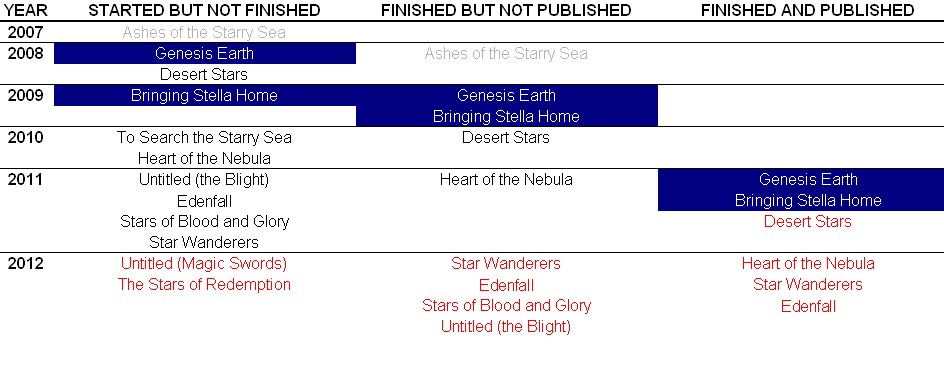
As you know, my main writing goal is to produce a minimum of two novels per year, fully polished and of publishable quality. Desert Stars will be my third this year, if I can get it up before January. But after that, I don’t have a whole lot lined up in the queue. Heart of the Nebula is a finished rough draft, but it’s the only one; everything else is either incomplete or just an idea floating around in my head.

Perhaps the best way to see it is to look at this chart. It lists all of the novels that I started, finished, and published by year. The titles highlighted in blue are novels that I’ve epublished. Ashes of the Starry Sea was a practice novel, so I’ve grayed it out, but everything else is a project I intend to carry to completion.

While 2011 was a great year for me in terms of starting new works, it was a downright horrible year in terms of actually finishing anything new. I’m worried that unless I can force myself to buckle down and produce new material at a much faster rate, this handicap is going to bite me in the butt next year.

Here’s another way to think about it: if I want to write two novels per year, and I can only focus on one novel at a time, I should be able to complete any project in no more than 26 weeks. And yet, when I look at my word count spreadsheet (which only goes back to May 2009), here’s what I see:

  • Genesis Earth: 22 to 26 weeks
  • Bringing Stella Home: 50 to 54 weeks
  • Desert Stars: 52 to 56 weeks
  • Heart of the Nebula: 18 weeks (unfinished)
  • Edenfall: 2 weeks (unfinished)
  • Star Wanderers: 9 weeks (unfinished)

What this tells me is that my current writing method is unsustainable. Either I need to learn how to juggle two projects at once, or I need to learn how to produce quality material in half the time–and in all reality, I should probably learn how to do both.

For those of you who might be worried that I’ll sacrifice quality for speed, let me assure you that I don’t intend for that to be the case. Dean Wesley Smith makes a very compelling argument on this subject, how speed and quality are not mutually exclusive. The more I write, the more practice I’ll get, which will hopefully improve the quality of my writing.

One thing I really ought to do is write something new every day. For most of 2011, I was revising something I’d originally written in 2008 or 2009, maybe throwing out a couple of scenes to start from scratch, but overall simply revising an older work. It’s made me a little rusty, and I can feel it. I can say right now, that needs to change.

My biggest concern is that once I’m overseas, it will be much harder to balance these writing goals with everything else going on. However, this isn’t 2008; I don’t have all the obligations of a student. As for whether the obligations of a teacher are any worse, we’ll have to see.

What I really want to do is write a novel in a week–preferably, in three days. Even if the first draft isn’t very good, just the act of doing it will break down some major barriers, I feel. If I finish Star Wanderers by mid-January, I’ll turn it around and write a novel with the same events from Noemi’s point of view, all in a weekend if possible.

In short, this is what I want to do:

  • Produce a minimum of 2 publishable novels per year.
  • Reduce the time for each draft to 6 weeks average.
  • Write a minimum of 500 new words each day.
  • Learn to juggle two projects when revising.

This isn’t going to be easy; I have the feeling that it’s going to involve a fundamental shift in the way I approach writing. However, if I can pull through it, I think this might just transform my career in the way that I need in order to take things to the next level.

In the meantime, I’d better get some sleep. I’ve got a long day of travel ahead tomorrow, and I’ll need all the energy I can get if I want to get some serious writing done.

Plans for Edenfall

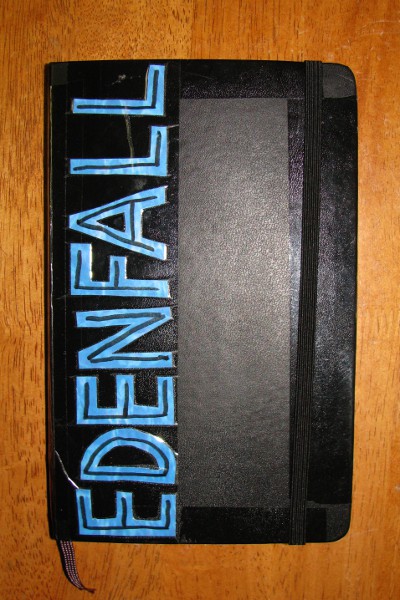
I’m trying something a little different with Edenfall: I’m writing the first draft entirely in longhand.

I first got the idea a couple of years ago, when I was camping in Moab.  The beautiful landscape of southern Utah made me realize that I wanted to write Edenfall while experiencing that sort of connection with nature, and pen and paper seemed to be the best format in which to do that.  This year, when I decided that I’d definitely write it, I ordered the notebook on the left and fitted it out for the project.

With every novel I write, I like to challenge myself in some new way.  In Genesis Earth, I tried out a first person POV with an unreliable narrator.  In Bringing Stella Home, I tried to write a believable female viewpoint character.  I also like to experiment with my writing process, trying out different outlining techniques and writing schedules.  Sometimes, these experiments fail spectacularly, but they also teach me a lot and keep me sharp.

The goal with this experiment is to see how divorcing myself from my computer (with all its myriad distractions) and getting out in nature changes my writing.  I live a short bike ride from the Provo River Trail, and weather permitting, that’s where I’ll probably spend most of my writing time in the next few days. Besides, I want to see how much of a difference the format makes.

Books existed long before word processors, so I have no doubt that writing a novel longhand is entirely possible.  How much of an adjustment it will be remains to be seen.  My handwriting is messy, and I can’t write as fast as I can type, but that hardly matters since rough drafts are slow going for me anyways.

In any case, it’s going to be interesting to see how it turns out.  It’s been a little slow so far, but that’s mostly because I haven’t settled into a routine yet.  By the end of this week, I hope to be fully immersed in the world of this story.

In other news, I sent off the manuscript for Sholpan to my editor, and he just got finished with his first pass, so I’m hoping to get the edits back in a couple weeks and have it epublished by mid-September.  More on that as things develop.

Also, an old friend from Brandon’s 318 class posted a favorable review of Bringing Stella Home up on Amazon.  He was one of my first readers back when the story had a lot of problems, so I’m glad he enjoyed the final version.  Thanks Stephen!  And yes, I’ve got a lot more novels forthcoming in the Gaia Nova universe, including a direct sequel to Bringing Stella Home.  Will the McCoy family save the universe from the Hameji?  Well…you’ll see. 🙂

Finally, I plan on participating in the Out of This World blog tour being organized by the SFR Brigade, which means you’ll be seeing some guest posters in the near future.  That’ll probably wrap up the Genesis Earth blog tour too, since it’s been winding down for the last month or so.  If I agreed to write a guest post for your blog and haven’t done so yet, let me know and I’ll do my best to get that out to you.  Sorry to be a bit of a flake these past few weeks; I’ll try to organize my next tour a little better.

And that just about does it for now.  I’ll be sure to keep you posted on how things go with Edenfall.  Until then, take care, and thanks for reading!

Soundtrack for an untitled book

I’ve got this great idea for a novel, with a rough plot outline, an awesome ending, setting and characters all worked out, even the soundtrack–but no title.

I enjoy making soundtracks for my novels, but this is the first time I’ve made one before writing the first draft.  Usually, my first drafts are so all over the place that I end up hating whatever music I try to associate with my work–that, or the feel of the book ends up being so different from the feel of the soundtrack that I just have to abandon it.

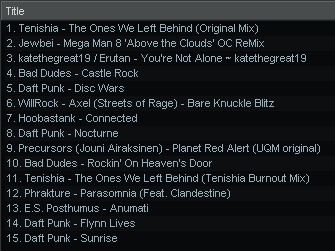
In spite of all this, I couldn’t really help myself from putting together a playlist for my next big project, a Gaia Nova novel combining characters from Bringing Stella Home and Desert Stars.  Here it is:

For me, soundtracks are all about the emotion that a story evokes.  I’m going for a tense and gritty feel, with heart-rending losses and soul-crushing defeats interspersed with poignant moments of personal triumph.

The really cool thing is that the soundtrack has helped me out a ton with the outlining process.  I’ve spent a lot of time in the past month hiking in the mountains around Provo, just listening to music and thinking about this story.  Whenever I put on the soundtrack, something would click and I’d see exactly what the story needed.  I kid you not, all of the plot twists and big reveals came to me while listening to this music.

Now if only I could come up with a title…

Encouraging realizations

So today I realized something about my writing process that encouraged me quite a bit.  With every project so far that I’ve finished, revised, and polished (or will soon be polishing), I went through a depressing period where the draft absolutely sucked and I questioned whether I was just wasting my time with the whole project.  I went through it with Genesis Earth, I went through it with Mercenary Savior, and I’m going through it right now with Worlds Away from Home.

None of that is new, of course; what’s new is the realization that this phase is an essential part of my personal writing process. In other words, it’s not a distressing thing that I’m going through this phase–it’s actually a sign that things are normal.  The story has potential but needs a significant overhaul, so until I complete that overhaul I’m only going to see how much it sucks.

The trick, of course, is keeping momentum.  I’ve found that if I consistently write 2,500 words per day, my mind is so absorbed in the story that I can make good headway on it.  I only revised through about 1.4k today, but I cut off at least another 2k of useless fat, so I suppose that works.

I also submitted Genesis Earth to two agents, so overall, today was quite productive.  I’ll probably count those as my submissions for this week, to allow people time off for the holidays.  Of course, I won’t stop writing!

10k words and going strong

Today I crossed the 10k mark for my newest project, Into the Nebulous Deep. It’s a little bit behind in terms of nanwrimo, but I’m confident it will be on par before the end of the week.  I wrote 2.6 words today, and I’m hoping to keep that fairly steady as I move on into the month.

Since I’m between jobs at the moment, I’m hoping to get my daily word counts up to between 4k and 5k and keep it there consistently.  Sounds daunting, but I know it’s possible because I did it back in June and July of 2009.  If I could enjoy that kind of productivity again, that would be awesome.

Over the past few weeks, I’ve taken a good, hard look at my routine from that time to figure out how I did it.  Here are some of the key things that stood out to me:

1) I was waking up each morning in a timely manner.
2) I was exercising regularly.
3) I was splitting my time between two projects (one revision, one drafting).
4) I would leave my apartment and go somewhere else to write.
5) I had a short ritual I’d go through to focus myself on the project.

Of these, I think the most important were 1, 2, and 3.  A strong, early start to the day is always helpful, and exercising is not only good for you physically, it boosts your creativity for a short period of time as well.  For that reason, I recently bought a pair of good running shoes and started running.  Today was the first day, and it felt great!

Three was the most surprising, because whenever I was busy with school, I found it impossible to juggle two projects at once.  But out of school, it makes sense: work on the first one until you hit a rough patch, then shift gears and work on the other until you find what you need to pick up the first one again.  It helps to exercise two parts of the brain, so juggling between revision and drafting t is probably for the best.

As for going somewhere else, I’m reluctant to do that since my only other computer is a tiny little netbook–but if things get rough, you may start seeing me around the Provo Library more often.  I remember over the summer, this one chapter in Worlds Away from Home was just killing me, so I took my netbook to the Provo river trail, sat down on a bench, and muscled my way through it.  It surprised me how quickly I punched through it–because if I were at my apartment, I know it would never have gotten done.  It was just too tough.

The last one was kind of a quirky little thing for the second draft of Mercenary Savior (I called it Bringing Stella Home back then), but it would be a good idea to do the same with these other projects.  For Mercenary Savior, it involved watching the opening credits of Fistful of Dollars.  For Into the Nebulous Deep, I’m not sure what the ritual will be, but whatever it is I’ll make it awesome–without spending too much time on it.

So anyways, that’s what’s going on on the writing front.  In response to a nibble from an agent, I’m doing a fifth draft of Genesis Earth, but I haven’t gotten past the first chapter (which I posted).  Soon, I’d like to be doing about 2k to 2.5k on Nebulous Deep per day, and 2k to 2.5k in the revision of Genesis Earth.

There’s more, but I’m starting to fall asleep at my keyboard, so it’s time to wrap this up and post it.  Keep up the writing, nano-ninjas, and good luck!

Most and least productive days

Man, I don’t know how it happened, but I did not get a word in in my novel today.  No, wait, I know how it happened: my schedule looked like a piece of moldy Swiss cheese.

First, there was work, then plasma, then a few hours of free time followed by an interview for an internship with the Utah County Democrats (which went extremely well–more later), then Leading Edge, and then Dr. Strangelove.

So yeah.  No writing, unfortunately.  Gotta work on the self discipline.

But as far as figuring out what the heck I’m going to do with the next 6 months to 1 year of my life, today was remarkably productive.  I recently applied for a paid internship with the Utah County Democrats and the interview was today.  I think it went really well, too–the board members seemed quite impressed.  I was dressed up, showed up early, and answered every question by pointing to something specific from my work or volunteer experience.  Finally, a job that I’m actually qualified for!

Honestly, when I went, in, I wasn’t too sure if this was something I was interested in doing.  I didn’t have a very positive experience in DC with the internship, and the back and forth of partisan politics really grates on me.  However, there seems to be a big difference between national politics and local politics–local stuff seems much more down to earth, with less of the rhetoric and bickering.  A lot more hands-on, grassroots kind of stuff, without the constant abstractions or the hyperfocus on career priorities that turned me off so much to Washington.

Politically, I’m currently an independent, leaning more to the right.  Surprisingly, that seems to put me in good company with the Utah County Democrats.  One of the guys on the board described them as center / right of center–basically, a moderating influence in the face of right wing nutcases like Glenn Beck and Rush Limbaugh that are so deplorably common out here.

The internship pays a $2,000 stipend for 4 months of work: 10 hours per week at first, moving up to 20 hours per week closer to November.  For this part of the country, that’s decent money.  Plus, if the candidate I work for gets elected, it may open job opportunities in Salt Lake City.

The catch?  That I’ll no longer be able to be a political independent–that I’ll be picking sides, in such a way that the other side may never consider me credible again.  At least, that’s how it works in DC: there’s Team Republican and Team Democrat, and if you work for any organization even loosely affiliated with one of the teams, no-one on the other side will ever have anything to do with you.

But…then again, that may not be so bad.  I don’t agree with everything the national Democratic Party stands for, but neither do the Utah Valley Democrats.  In fact, the Democrats here mirror my political views almost perfectly.  Plus, I suppose it’s easier to change things once you’re on the inside.

I don’t know.  I’ll definitely have to think about it.

So yeah, as unproductive as things were writing-wise, they were actually quite productive in other ways that mattered.  It’ll be interesting to see what happens in the next couple weeks; I sense more than a few major decisions coming up (gah!).