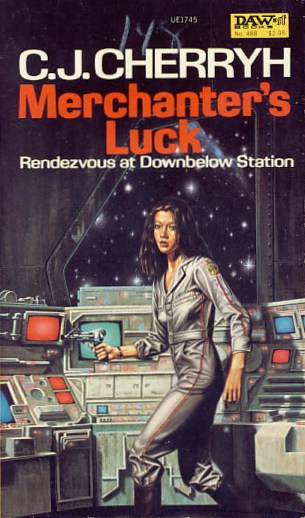
 He was a down and out merchanter, the captain, crew, and sole proprietor of a run-down bucket of bolts spacecraft. She was a daughter of one of the finest starfaring clans, with seven hundred cousins standing between her and the one thing she wanted more than anything else: command of a starship.
They met at Pell during the height of the Company War–the key strategic point on the border between Union and Earth. Their fateful meeting would affect not only the outcome of the war, but the course of their own lives–for the starship Lucy of Wyatt’s Combine was not at all what she seemed to be.
Before I review this book, I need to issue a disclaimer: you probably aren’t going to enjoy it very much unless you’ve already read Downbelow Station. Cherryh isn’t the best at easing her readers into her worlds, and without the background on Union, Alliance, and the Company War, you’ll probably be hopelessly lost.
That said, I absolutely loved this book.
The premise is so awesome. Space adventure hardcore, with a beautiful love story set amidst an epic interstellar war, where alliances are constantly broken and no one can be trusted…oh man, I LOVED this book!
While the premise seems pretty standard, C. J. Cherryh transcends the well-worn tropes and cliches of her genre by intimately developing her characters and working their motivations into the story until they are the ones driving the plot, and not the other way around.
Every character is unique, and though they act in ways that may seem strange to our modern sensibilities, there are always reasons for everything they do, cultural or otherwise. As windows into their far-future spacefaring culture, they give the reader a wonderful view of Cherryh’s unique and marvelously constructed universe.
The thing that surprised me the most, however, was the sharp contrast between this book and Downbelow Station. While Downbelow Station traces the epic arc of the Company War through the viewpoints of a large cast of characters, much like Tolkien or Dune, Merchanter’s Luck focuses more on the characters themselves, in much the same way as David Gemmell or Ursula K. Le Guin. In other words, while Downbelow Station is comparable to “high” or epic fantasy, Merchanter’s Luck would fall closer to “low” fantasy or sword & sorcery.
The interesting self-realization I took from the book was that I’m much more interested in the intimately personal stories than the sweeping epic tale of the Rise and Fall of cultures and civilizations. I suppose that’s why I’m more of a David Gemmell nut than a Tolkien fanatic, and perhaps why I’m more into space opera and military sf than epic fantasy. In all of my novels, the focus is always on the individual characters and their personal conflicts, and whenever I get sidetracked and focus too much on the overworld story, it always falls apart.
Merchanter’s Luck definitely doesn’t get sidetracked, and that’s why I loved it so much. I fell in love with the characters almost from the very first page–from the blurb on the back cover, even. And most of all, I fell hopelessly in love with the starship Lucy:
 You know you’re doing science fiction right when your readers bemoan the fact that they weren’t born in the 26th century, when they could command their own spaceship. C. J. Cherryh is an amazing writer, and if I had the chance, I would teleport into her Union-Alliance universe in a heartbeat.
If you love well-crafted far-future worlds and stories about the people that live in them, check out Downbelow Station (or really, just the first chapter–that’s all you need for a solid grounding) and read this book!
 A couple days ago, I finished writing through the material I’d written for Worlds Away From Home back in 2008 before I dropped the project. For the first time since March, I find myself drafting entirely new material.
 Worlorn is a planet without a sun, wandering on the fringes of the galaxy where the skies are starless. Though it came to life briefly as it passed the red giant Fat Satan, those days are over, and the world is slowly dying.
 Urras and Annares, a world and its moon, separated by the gulf of space and two hundred years of mutual contempt. On Urras, capitalist and socialist nations vie for dominance over the world’s rich and abundant resources. On Annares, the anarchist exiles scrounge for a meager living, but live in peace–and in hope.
.jpg) Hundreds of thousands of years ago, an ancient race of sentient aliens known as the Amarantin went extinct just as their civilization experienced a golden age. No one knows why, but archeologist Dan Sylveste is determined to find out. Unlike the other colonists on the remote planet of Resurgam, he believes that the answer may be important.
Hundreds of thousands of years ago, an ancient race of sentient aliens known as the Amarantin went extinct just as their civilization experienced a golden age. No one knows why, but archeologist Dan Sylveste is determined to find out. Unlike the other colonists on the remote planet of Resurgam, he believes that the answer may be important.