Thoughts on the Charlie Kirk assassination

I heard the news shortly after dropping off my daughter at BYU kindergarten. The shooting apparently happened while we were on the road. Utah Valley University is only a couple of miles from our house, and the hospital where he died is only a mile from us.

I saw the videos of the assassination, including the now-censored one that showed it up close. I also saw the videos of the alleged shooter being hauled off in police custody, though now it appears that the University is saying that he wasn’t the shooter. This is such a fast-moving story that we probably won’t know exactly what happened until at least 24 hours from now, and there may be some things that we never know. And since I wasn’t there when it happened, I can’t comment on the shooting itself.

I just have to say, this is not who we are here in Utah. The shooter may turn out to be a Utah man, but that is not who we are—the rest of us. And I don’t just mean right vs. left, conservative vs. liberal. Most of us here in Utah swing MAGA (in fact, I’ve got a couple of neighbors who are still proudly flying their Trump flags), but we’ve also got some neighbors with rainbow flags and decals, and I’m sure that the vast majority of them are just as horrified that this assassination happened in our community. In fact, they’re probably afraid of how the rest of us will react.

My thoughts and prayers go out to Charlie Kirk’s family. I can’t imagine how horrible that must be, not just to lose your husband and father, but to have the footage of his violent death plastered all over the internet. I hope that more good than evil ultimately comes of this national tragedy, and that Charlie Kirk’s work will live on for many years to come.

Blade Runner 2020

Saw this, couldn’t resist.

We’ve got smoke here in Utah, too, but nowhere near as bad as California (for the moment). A couple of new fires started here in Utah Valley over the past week, and it looks like they may have been human caused, but the firefighters put them out very quickly. But whenever California is on fire, the smoke finds its way over here.

Here’s another one:

Why I’m moving out of Provo for good at the soonest opportunity

  • Neverending road construction.
  • Corrupt local officials who take kickbacks from the neverending road construction.
  • Massive public transit projects that seek to fix a problem that doesn’t really exist.
  • Incompetant construction contractors who can’t get the job right the first time, and have to redo it five times in as many years.
  • Parking Nazis who ticket local residents for parking on the street, even when their car has a parking permit.
  • Incompetant bureaucrats in city hall who fail to renew parking permits.
  • Insanely bad drivers.
  • Selective enforcement of the law by local police.
  • Attempts by the local police to enforce laws that don’t actually exist, especially regarding front lawn gardens.
  • A hidden tax placed in everyone’s utility bill to pay for Google Fiber, when it turned out the city had lost the blueprints Google needed to install the fiber network, and thus had to pay more than $1 million to map it out.
  • The Google Fiber deal in general. Very bad deal for the city.
  • The fact that most of the rental properties are owned by two or three families, who jack up prices in order to rip off students.
  • Corrupt city officials who grant building permits that violate residential zoning laws in exchange for kickbacks, after ignoring public outcry from local residents.

There are more reasons, I’m sure, but these are the ones I have direct experience with.

Back in Utah

So! It’s been a while since I updated this blog, and there’s actually a good reason for it. I quit my day job in Iowa a couple of weeks ago and just moved back to Provo. In other words, I made the pioneer trek in the wrong direction and repented.

Driving across Wyoming, I got a small sense of what my pioneer ancestors must have felt as they made the trek to Utah. Compared to Iowa and eastern Nebraska, Wyoming is a lonely, windswept wasteland. It’s not quite as empty as Nevada, but wow, is it a forlorn place. Beautiful, but lonely.

After passing through Evanston, route 80 descends from an altitude of about 7,000 feet into the mountain valleys of northern Utah. I have to say, the stretch between Evanston and Park City is gorgeous. Absolutely gorgeous. From there, I came down the eastern side of the Wasatch mountains through Heber and Provo canyon, which is also gorgeous this time of year. Fall foliage, with just a little bit of snow on the highest peaks.

It’s good to be back. I’m renting a room from my friend and cowriter Scott Bascom, who is letting me pay him back in labor to clean and improve his house. He went through a series of major life crises in the last couple of years, and a back injury prevents him from getting the house back in shape. That’s where I come in. It’s a suitable arrangement for both of us and I think it will work out quite well, especially once we get a virtuous cycle going with our writing.

That’s my going to be my focus for the next several months: writing. I have a very aggressively release schedule for the first half of 2018, and a much better business foundation after taking a small business class in Iowa. I also saved up enough money from the old day job that I can afford to focus exclusively on writing and publishing for the next several months. So that’s the plan.

In 2014, I had my first 4-figure month and thought I was doing well enough to go full time in the near future. But looking back, I can see that I didn’t have the foundation set up to sustain a profitable business. The market shifted, the things I was doing to sell suddenly didn’t work anymore, and I made some stupid mistakes that drastically hurt my business. But I learned a lot from all that, and now I’m coming back with a much better foundation, a detailed plan for how to build on it, and enough experience to know how and when to abandon that plan as circumstances change.

Lots of stuff to talk about on that end, but I’ll leave it there for now. One thing you can definitely expect, though, is for the Sons of the Starfarers series to be complete before the end 2018–hopefully before the summer. Also, Gunslinger to the Galaxy should be out next year as well. And if you’re a fan of print books, I hope to put out a paperback of every book that I’ve written in the not so distant future. Audiobooks too, in the long run.

So if you haven’t already, be sure to sign up for my email newsletter, since that’s the best way to stay abreast of my new releases. I’m not always as good at posting about them here as I should be. Also, now that the big move back to Utah is complete, expect to see more on this blog.

So long, and thanks for reading!

Further impressions of Iowa

This post could just as well been titled “Oh my heck, Toto, we’re not in Utah anymore.”

What is up with all of the tattoos everywhere? Call me old-fashioned, but unless it’s a part of your cultural heritage (Arab, Indian, Polynesian, etc), I don’t really find it interesting or attractive. It’s like someone vandalized your body.

Utah is pretty insulated in this regard. Sure, you can find people with tattoos, but only if you look for them. Here, every other person has a tattoo somewhere.

Is this part of a wider trend across the United States? If so, is it connected to the crappy economy? People with stability and security in their lives don’t typically get tattoos. Or maybe it’s all of my fellow Millennials who don’t know what they’re doing with their lives and are sort of just drifting.

I’ve probably got readers who are thinking right now: “dude, WTF? You’ve got a character in Sons of the Starfarers who has a full body tattoo, and doesn’t mind showing it off.” To which I would say: 1. it’s temporary (henna), 2. it’s part of her cultural heritage, and 3. it’s fiction.

The other big thing I’ve noticed (which again, is probably just going to show how insular Utah can be) is that no one has any concept of food storage. There’s a store out here called Mills Fleet Farm, which is kind of like a Home Depot swallowed a feed store and ate a Walmart for dessert. Asked three employees for foodsafe five-gallon buckets, and none of them had any idea what I was looking for.

In Utah, you can get foodsafe five-gallon and two-gallon buckets from any grocery store. At Macey’s and Winco, they sell the gamma lids. You can also buy 50 lb bags of oats or wheat, 25 lb bags of beans or rice, and twice a year they have case-lot sales where you can buy canned goods by the case upwards of 50% off. Freeze dried foods and can rotation systems are also a perennial.

Am I the weird one for thinking it’s a good idea to keep 90 days worth of non-perishable food in your pantry? Aside from all the prepper reasons for why that’s a good idea, it’s also a lot cheaper to buy in bulk. And it’s not like people don’t keep gardens around here. Though I do have to admit, there aren’t nearly as many home gardens as Utah.

But the people seem friendly enough, and aside from those two points, this place is actually a lot more culturally similar to Utah than other places in the country where I’ve lived. It’s more conservative than California, more churchgoing than New England, and a hell of a lot more honest than Washington DC. About the only other place I’ve been that comes close is Texas, but Texas is Texas. Nothing else compares.

I could see myself ending up in Texas someday, if I don’t move back to Utah first. Utah isn’t for everyone, but I love it there and wouldn’t mind putting down some permanent roots. California, on the other hand… you couldn’t pay me to live there. Same with Washington DC.

Iowa’s not a bad place, though. Time will tell how it rubs off on me.


First impressions of Iowa

It’s flat, but not as flat as I was expecting.

There are lots and lots of pickup trucks. The ratio of pickup trucks to other vehicles is probably higher here than it is in Utah.

There’s definitely a lot of aggressive drivers, but they all tend to be aggressive in the same ways, so it’s not that bad. Very different from Utah Valley, which has some of the worst driving I’ve ever seen (and I’ve been around!)

Why don’t the roads have suicide lanes or shoulders? Seriously, it would make the driving so much better!

Okay, enough about driving…

The weather can get really windy. On the highway, I’m almost always fighting a headwind or riding a tailwind (so much for no more driving).

Twilight lasts FOREVER. This is definitely big sky country.

The people seem friendly enough. A little self-depreciating, but not overly so. One of the things I hear from them is how “uncultured” or “stuck in the old ways” Iowa is, but I see little free libraries all over the place here.

People tend to have rounder faces or more Irish complexions. Most everyone is white, though there are a fair number of Asians and Hispanics.

I’ll probably get in trouble for saying this, but the young women in Iowa aren’t quite as attractive as the young women in Utah. That’s a very high bar to hurdle, though, and of course there are exceptions.

I’m genuinely surprised how much Mormon stuff there is out here. I thought it was mostly just in Utah. There’s Winter Quarters, Nebraska, which of course has a large historical site, but there’s also a bunch of smaller historical sites in Iowa proper, connected with the Mormon trail. Haven’t even made it out to the east either, which is right next to Nauvoo.

That’s pretty much it for first impressions. I’m looking for part-time work, but haven’t found anything yet, though I have landed a couple of interviews. Hopefully something works out. In the meantime, I’m working hard to build my writing career, especially the publishing side of the equation. I’m not that far off from writing full-time again; I just need to build things up into a sustainable business. More on that some other time.


Lights Out by Ted Koppel

About a year ago, while doing research for prepper-type stuff, I came across this interview of Ted Koppel, discussing his book Lights Out.

It piqued my interest, especially since Ted Koppel is not the kind of person I’d peg as much of a prepper/survivalist. The part about the Mormons sounded interesting too, so I reserved the book from my local library and checked it out.

I was not disappointed.

Lights Out is a fascinating examination of the possibility and ramifications of an attack on the US power grid, written by a veteran journalist with dozens of high-level connections across both the government and the private sector. It starts with a tour of the system’s vulnerabilities, quickly moves on to the government’s contingency plan (or lack thereof), then assesses the general preparedness of the rest of the country and what we could expect to happen if the power grid went down. Ted Koppel makes a compelling case that:

The infrastructure of the power grid is highly dependent on the internet.

This dependence has created a series of vulnerabilities that could destroy large portions of this infrastructure.

The private sector has failed to reliably safeguard against these vulnerabilities, mainly because the companies at the failure points have little incentive to develop the safeguards.

State and Federal agencies cannot impose sufficient safeguards because of lobbying efforts and privacy concerns.

Because most of the infrastructure is generations old and not standardized, it would take months or even years to replace key components in the event of a successful attack.

The Russians and the Chinese already have the capability to bring down our power grid, and with the proper expertise it is fully within the capability of rogue states like Iran or North Korea, or non-state actors like ISIS, to do so as well.

The Federal government fully expects an attack on our power grid in the mid to near future, but the various agencies do not have a clear plan for how to deal with such a contingency.

The general US populace is woefully unprepared for such an attack, except for certain communities such as the Mormons. They would not be able to provide for everyone, however, and would probably use force to defend themselves in the event of a collapse.

The only way our society could survive an attack is if everyone who can afford it would store three to six months of food, water, and emergency supplies. Otherwise, if the power grid went down, a collapse would be swift and catastrophic.

Freaky stuff. What was really freaky was the way that people who should have been taking more responsibility, such as the CEOs of major power companies or the directors of Federal agencies such as the DOD or DHS, all seemed content to pass the buck and give Ted Koppel the run-around. He described in detail some of his interviews, and the way in which various officials passed him off to one another like a hot potato.

And then he got to the Mormons.

I have to say, the chapters about the Mormons were some of the more fascinating parts of the book. Ted Koppel only expected to get a phone interview, but instead, Elder Henry B. Eyring flew him out to Utah and gave him a personal tour, including the welfare farms, the distribution centers, the canneries and home storage centers—they even found a local Utah family to cook him a food storage dinner! The gold-ticket treatment definitely impressed him, and that shines through in the book.

Of all the books about Mormons written by non-Mormons, I have to say that Lights Out gives one of the fairest treatments I’ve ever seen. Ted Koppel touches only lightly on church history and doctrine, but he makes it clear how these things tie into our emphasis on self-sufficiency and preparedness. While his impressions are quite favorable, he doesn’t shy away from asking the difficult questions, such as whether we would take up arms to defend our supplies if roving hordes threatened to take them from us by force. As he points out, there’s a great deal of constructive ambiguity from our leaders on that point.

If you’re as interested in potential doomsday scenarios as I am, or in emergency preparedness and self-sufficiency, this is a great book. It raises some frightening concerns without being too alarmist or devolving into sensationalism. For those who are concerned about this sort of thing but don’t have much experience with preppers or prepper culture, the book offers a fascinating look at this growing subculture and the motivations that drive it. Definitely worth a read!

Of pioneers and politics

Today is Pioneer Day here in Utah, where we celebrate the achievements and heritage of the Mormon Pioneers. One hundred and sixty-eight years ago today, Brigham Young looked over the Salt Lake Valley (a barely hospitable desert at the time) and declared “this is the place.”

I feel a great deal of pride for my pioneer heritage. My ancestors walked across the plains in the Willie Handcart Company, they organized one of the most successful cooperatives of the United Order, they fought in the Utah Wars, and they built numerous cities across the Intermountain West. Before the pioneer exodus, they built and later abandoned the Nauvoo Temple, endured the horrible conditions at Winter Quarters, and left trails of bloody footprints as they fled their homes and lands during the Missouri persecutions.

One of my direct-line ancestors was Lyman Wight, leader of the Mormon Militia. When the Missouri mobs captured the Mormon leadership and a kangaroo court sentenced them all to death, Lyman Wight’s reputation was so fierce that the mob hesitated to execute him. They offered to let him free if he would renounce Joseph Smith.

Lyman Wight looked the Missourians in the eye and said “Joseph Smith is the best friend you ever had.”

The leaders of the mob asked him why he said that.

He told them: “if it weren’t for Joseph Smith, I would have slit all your throats years ago.”

The mob then threatened to execute him. Lyman Wight answered without hesitation:

“Shoot, and be damned.”

None of the members of the mob dared to execute him, fearing that his ghost would haunt them to the end of their days.

There are tons and tons of stories like that in my family, and even more that belong to my friends. History is alive here in Utah, where monuments to our pioneer heritage are scattered throughout the state.

The Mormon corridor has a very unique subculture compared to the rest of the United States. It’s a unique and sometimes paradoxical blend of individualism and collectivism, of self-reliance and communal spirit, of libertarian ideals and obedience to moral authority. To an outsider, I’m sure it must be extremely perplexing, but there’s nowhere else in the United States where I feel so totally at home. These are my people. This is my home.
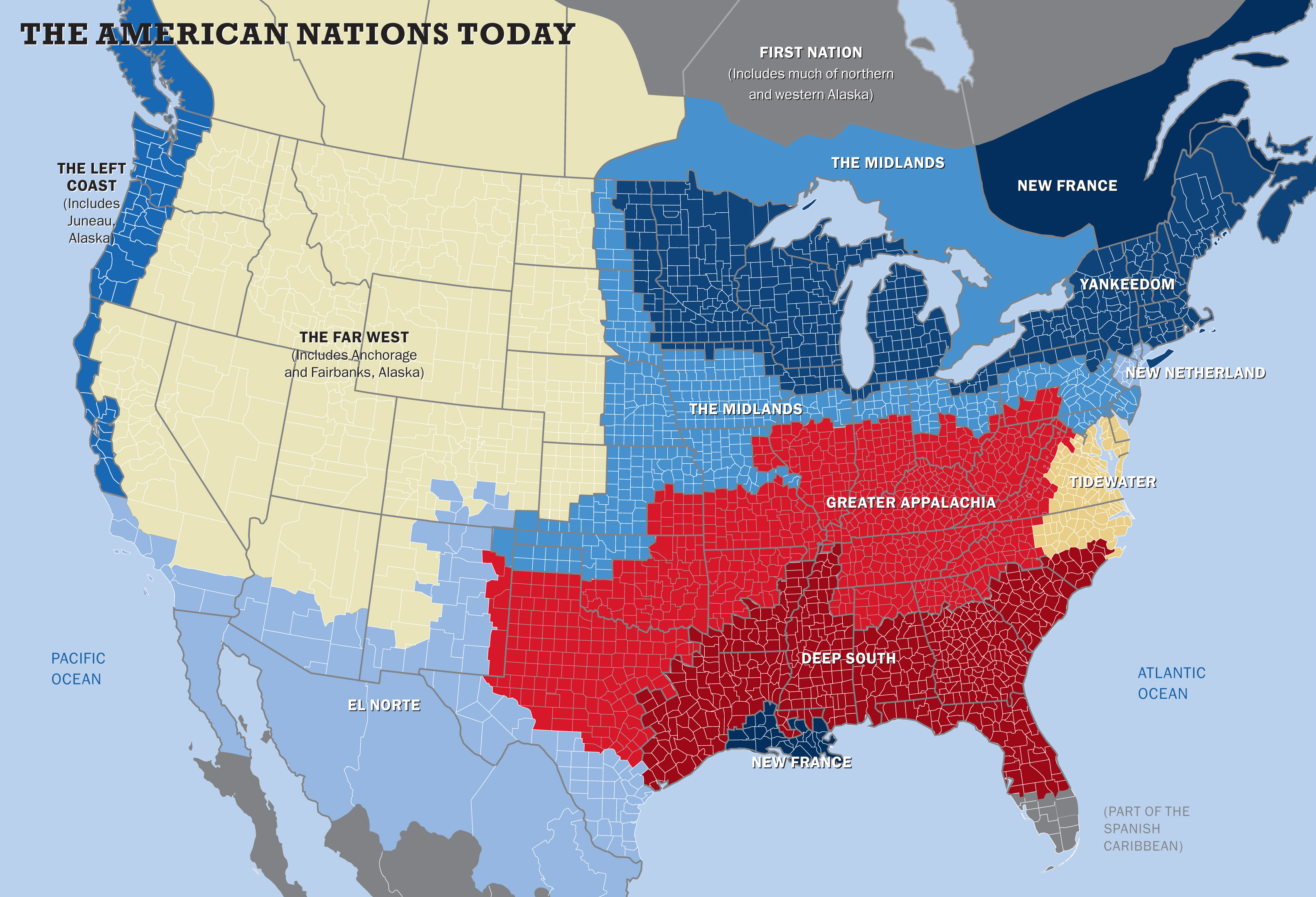
upinarms-map-largeThat’s why I found this map of the “eleven American nations” so fascinating. According to the corresponding Washington Post article, almost all of the battles in the culture wars can be explained by the lines on this map. Furthermore, the mobility of American society is causing these regional differences to grow sharper as Americans pick up and move to the places where the dominant culture best suits them.

A further explanation can be found here, where the author of the map (and the book American Nations) states:

The borders of my eleven American nations are reflected in many different types of maps—including maps showing the distribution of linguistic dialects, the spread of cultural artifacts, the prevalence of different religious denominations, and the county-by-county breakdown of voting in virtually every hotly contested presidential race in our history. Our continent’s famed mobility has been reinforcing, not dissolving, regional differences, as people increasingly sort themselves into like-minded communities, a phenomenon analyzed by Bill Bishop and Robert Cushing in The Big Sort (2008). Even waves of immigrants did not fundamentally alter these nations, because the children and grandchildren of immigrants assimilated into whichever culture surrounded them.

The thing that I find most fascinating about this map is how closely the borders of the Far West “nation” parallel the State of Deseret, first proposed by Brigham Young and the Mormon pioneers. The Mormons didn’t get along very well with Congress, and the territory was eventually pared down to the current boundaries of the state of Utah (the name “Deseret” was also replaced). But cultural boundaries cannot be declared by presidents or kings.

According to the author, the development of this region “was largely directed by corporations headquartered in distant New York, Boston, Chicago, or San Francisco, or by the federal government, which controlled much of the land.” I’m not so sure that’s the case, however. Corporations certainly became important players after the railroads crossed the country, but culturally, I would argue the pioneers had a much deeper and more lasting impact.

The Intermountain West is remarkably conservative, with Utah ranking as one of the reddest states in the nation. With the government expansion under President Obama and the Tea Party revolt in the Republican party, the politics in this part of the country have taken a decidedly libertarian turn. As issues like healthcare, gun control, gay marriage, and late-term abortion have each swept the nation in turn, my positions have changed to reflect the libertarian attitudes of the culture in which I live.

In 2008, I considered myself “agnostic” as far as politics were concerned. Perhaps there was a greater truth out there as far as politics were concerned, but I wanted nothing to do with it. Now, however, I believe very strongly that individuals and families should be free to live their lives as they see fit, without being subject to Leftist schemes to redistribute their wealth or bloated, self-serving government that overreaches its constitutional bounds.

I think this view would resonate very deeply with the pioneers. They came to the West to practice their religion freely, and emphasized self-reliance and thrift. Their industriousness was a means of guarding their independence from the governments that had oppressed them in the east, and continued to oppress them as they sought to build their Zion. Though they could be quite collectivist at times, it was local and voluntary, a far cry from State-enforced socialism. And while they cared for the poor and needy, they did all they could to keep them from becoming dependent on welfare.

These are interesting times we live in, and interesting cultures we hail from as well. As I look back on my own pioneer heritage, I can’t help but look forward as well. The “shoot and be damned” independent streak of my ancestors is still with me today, and I have no doubt that pioneer spirit will continue to guide me in the future.

Idea for a new blog series

So a little background information: about a month ago, I tripped over my brand new laptop’s power cord and broke the DC port, making it impossible to recharge my battery. After sending it in to a local shop to get it worked on, I discovered that the motherboard itself was broken and that the computer was now useless except for parts. Fortunately, I was able to find the exact same model for less than $300. It should arrive on Tuesday.

This whole debacle made me realize how much better I write when I’m somewhere other than where I live. Whenever I sit in front of my desktop machine, it’s like I have this uncanny aversion to doing anything writing related. It’s stupid, and I probably need to get over it, but I am definitely looking forward to having a laptop again so that I can get out and write.

Which made me think: why don’t I do a blog series on interesting places to write? There’s quite a few around here in Provo that I frequent: the city library, the HBLL, Pioneer Book (their new location), the Wash Hut, Slide Canyon. Branching out a bit, there’s Amtrak and the Frontrunner, two places where I’ve done a lot of good writing. Beyond that, I’m sure there are a ton of other places that I’ve never been to, but would be fun to explore and try out.

Besides giving each place a standard 1-5 star rating, I could review it based on how many distractions it has, how comfortable it is, whether it has wi-fi (not always a good thing!), ambient noise, people-watching opportunities, etc. It would be fun to break things down and see what makes a place good for writing, and what makes it not so good.

What do you guys think? If I did this, what sort of criteria would you like me to look at? Are there any places around Provo or Salt Lake that you think I should try out? This new computer cannot come soon enough!

Back in Provo!

Wow, do pageviews drop off sharply if you don’t blog for a while.

So after spending the last couple of weeks visiting family across the country–literally across the country, from Massachusetts to Iowa–I’m back here in good old Provo, Utah, surrounded by the mountains once again (I can just hear my grandma … “what’s so great about a pile of rocks?”).

Here were some of the highlights:

  • Seeing my parents (yay!) and spending some quality time with them.
  • Babysitting my niece and nephews and spending time with that side of the family.
  • Beach bumming on the Cape Cod National Seashore.
  • Eating fried clams and lobster in Wellfleet at Moby Dick’s.
  • Playing Shanghai with my parents every night for a week and a half.
  • Beating my brother-in-law at Settlers of Catan for the first time (he’s good!).
  • Watching the entire Ken Burn’s Civil War documentary series.
  • Touring Nauset Light and the Three Sisters.
  • Touring the Cape Cod Potato Chip factory.
  • Hanging out with Mom in Downtown Hyannis.
  • Acquiring an awesome new Indiana Jones style hat.
  • Going to church with a bunch of high priests sporting crocs.
  • Picking Monsanto corn and getting the whole corn experience.
  • Browsing a bookshelf of Ursula K. Le Guin novels I’ve never read.
  • Getting a bunch of awesome new story ideas (see previous post).
  • Taking the California Zephyr across the country–twice!

So yeah, it was a pretty awesome summer vacation.  It’s good to be back in Utah, though.  As much as I have a love/hate relationship with Provo, Utah really is my favorite place on Earth.

I’ve only been back a couple of hours, but it seems that it’s been an eventful two weeks since I’ve been gone.  One of my former roommates ran off without paying his share of the utilities, after jacking up the AC all summer (lovely).  After filing a police report, however, we may be able to get some of that back.

My tomatoes have been growing like CRAZY.  Only one has been harvested, but there are dozens hanging off of the vines.  Anybody want to make salsa?

As far as church goes, the ward boundaries have been completely rearranged.  Seriously, the map looks like a shredder went to it.  On our block, it’s us and the house two doors down from us (we think), then one of the apartments from Liberty Square, then another random house a block north of us.  Crazy.

I don’t know yet if I’ll be sticking around in my current place for the fall or not.  It’s a good situation, and the roommates are great, but the neighborhood is full of freshmen and sophomore college students.  I need to find some more people my age to hang out with.  Next month marks the beginning of the final year of my twenties, and I plan to make it count.

I got a lot of work done on Star Wanderers: Reproach (Part VII) while traveling on the train, but I still need some of my first readers to give it another read-through before I’m confident enough to publish it.  Hopefully, that shouldn’t take too long–I’m shooting for publication before the end of September.  Also, the print edition of Stars of Blood and Glory will hopefully be finalized before the end of the month as well.

That’s just about it for now.  I’ll leave you with some folk music from the Caucasus Mountains, this time on the accordion:

Rousing stuff.  I wish I could play the accordion like that.

Take care!