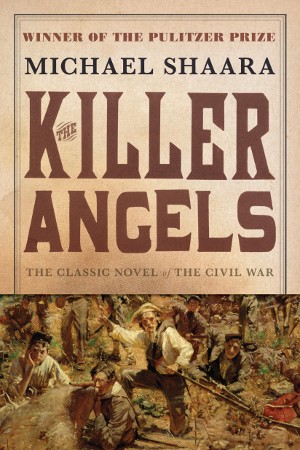
The Killer Angels by Michael Shaara

June, 1863.  In a bid to destroy the Army of the Potomac, Robert E. Lee invades Pennsylvania with an army of 70,000 men.  Using the mountains to screen his movements, he advances toward Harrisburg, fully expecting to secure a victory that will end the American Civil War.

But two weeks into the campaign, Stuart’s cavalry still hasn’t reported back, leaving the Confederate army blind.  Deep in enemy territory, with reports of the Union advance beginning to trickle in, Lee moves his forces to converge on a small town named Gettysburg.

In the titanic clash that follows, friend will fight against brother, generals will knowingly send thousands of men to their deaths, and the fate of the United States of America will lie in the hands of farmers and mountain men, immigrants, West Point classmates, and a New England professor.

This book is awesome.  Epic, in the best and truest sense of the word.  I’m not a civil war buff, but it reduced me to tears.  The scope is tremendous, and yet at the same time the characters feel like real people.

For some, like Chamberlain, the war is about slavery and equality–something that disturbs him when he comes across a black man for the first time.  For others, it’s about states’ rights and self-government.  But for most everybody else–including Robert E. Lee–it’s about a myriad of other things, like honor, duty to country, boredom, a desire to prove one’s manhood, and a hunger to be part of something greater.

What’s remarkable is how so many good people, who more often than not respect the opposing side and hold them in the highest regard, end up getting swept into such a horrific and bloody battle.  No one, especially the generals, have the power to prevent any of it–all they can do is leave it in the hands of God.  And the tragedy of it all is summed up so perfectly in the film rendition of this book, when General Armistead reaches the high-water mark of the Confederacy and falls, only to hear that his friend and classmate on the Union side, General Hancock, has fallen too (skip to 23:15):

“Not both of us!  Not all of us!  Please, God!”

I’ve been to Gettysburg several times, and stood on the ground where the most critical parts of the battle were decided.  And yet, I feel that living as an expat on  the other side of the world has given me a much greater appreciation of my country’s history.  Perhaps that’s one of the reasons why this book was so moving to me at this time.

Here are some of my favorite quotes:

He was a man to depend  on, and there was this truth about war: it taught you the men you could depend on.

According to the now retired General Schwarzkopf, The Killer Angels is “the best and most realistic novel about war that I have ever read.” You really get a sense of what it’s like to be in command–what it’s like to depend on the actions of your men, and what goes through your mind as you lead them.  The only other novel I’ve read that comes close to capturing that is Ender’s Game.

If the war goes on–and it will, it will–what else can we do but go on?  It is the same question forever, what else can we do?  If they fight, we will fight with them.  And does it matter after all who wins?  Was that ever really the question?  Will God ask that question, in the end?”

Robert E. Lee’s words after the Confederate defeat on the third day.  There is, of course, some criticism about how much artistic license Michael Shaara took in portraying the central historical figures.  Regardless, this novel gave me a much greater respect for Lee and his men.  There are no “bad guys” in this book–and therein lies the heart of the tragedy.

In the presence of real tragedy you feel neither pain nor joy nor hatred, only a sense of enormous space and time suspended, the great doors open to black eternity, the rising across the terrible field of that last  enormous, unanswerable question.

Well put.  I’ve never experienced any tragedy on the scale of the American Civil War, but I do know what it’s like to lose family and loved ones, and this captured a bit of that for me.  I can only imagine what it must be like to experience the tragedy of war.

This novel is a classic.  If you have any interest in American history, it is absolutely a must-read.  And even if you don’t, if you enjoy reading stories about war, whether modern, historical, or fantasy, you will almost certainly enjoy this book.
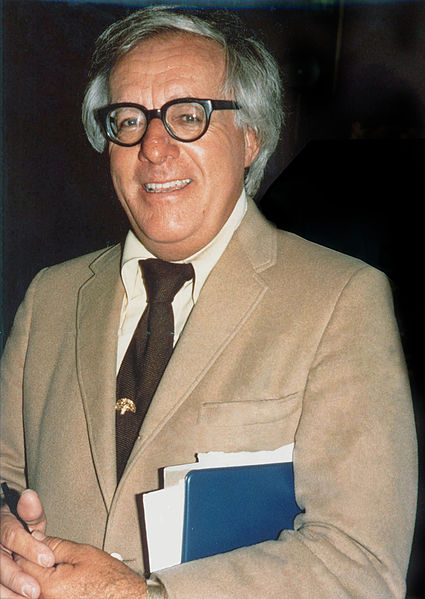
Ray Bradbury, 1920-2012

Ray Bradbury, 1920-2012

Wow.  Ray Bradbury, one of the greatest writers of our time, just passed away at the age of 91.  The news is affecting me a lot more than I thought it would.

My first exposure to Bradbury’s work came in seventh grade, when I read Farenheit 451 as part of the required summer reading.  Most of the books I read in middle school and high school were quite forgettable, but that one stuck with me, especially the scene with the professors scholars sitting around homeless in front of the fire.

Later in college, when I was just starting to find my footing as a writer, I read Zen and the Art of Writing, and it had quite a positive impact while I was still largely insecure about my own writing.  The most memorable piece of advice I gleaned from it was to write about the stuff that really moved me–to infuse all my writing with passion, and not give a damn about those who told me otherwise.  That helped give me the strength to tell the stories that I love, which is now a huge part of everything I do.

My favorite Bradbury work is his collection The Martian Chronicles.  The stories in that book are just amazing, and infused to the core with passion.  I remember breathlessly reading the one about the astronauts who land on Mars, only to find a beautiful Ohio village populated with all of the friends and family that they’d left behind.  Wow.

Whenever I pick up a Bradbury story, it’s like having this little old man clasp his hands on my shoulders and, with a gleam in his eye, shake me until I’m sure I’ll never forget it.  Every story is like a roller coaster, with stunning heights, beautiful views, and drops that make you scream for your life.  It’s awesome.

It brings tears to my eyes to know that he’s gone, but they’re bittersweet tears of the best kind.  The man had a rich, full life, and lived to see his work appreciated for how great it truly is.  At 27 novels and over 600 short stories, with more than 8 million copies in print in at least 36 languages, he has truly left us a great wealth of literature.  Some mourn that the world is a poorer place because of his passing, but I rejoice for how rich the world is because he lived at all.

Goodbye, Ray Bradbury.  Your stories truly changed the world.

Trope Tuesday: Bittersweet Ending

WARNING! CONTAINS SPOILERS FOR AMERICAN GODS, LAGAAN, LORD OF THE RINGS, TREASURE ISLAND, AND CROUCHING TIGER HIDDEN DRAGON.

And he sang to them, now in the Elven-tongue, now in the speech of the West, until their hearts, wounded with sweet words, overflowed, and their joy was like swords, and they passed in thought out to regions where pain and delight flow together and tears are the very wine of blessedness.

Tolkien, J.R.R. The Return of the King.

I love bittersweet endings.  I love stories that warm my heart even as they make me cry.  There’s something about reading them that makes me feel alive, and something about writing them that makes me feel like I’ve truly told a story worth telling.

The tvtropes page claims that bittersweet endings fall more to the cynical side of the sliding scale of idealism vs cynicism, but I disagree.  Without tasting the bitter, how can we know the sweet?  Too many of our modern stories are like high fructose corn syrup, where everything gets tied up with a pretty bow and the characters remain essentially unchanged.  I firmly believe that it’s only through sacrifice that we can know true joy, and stories that follow this often end up being bittersweet on some level, even if they are idealistic.

The tvtropes page lists six types of bittersweet endings, which are:

  • Did Not Get the Girl: When the hero either loses the girl or has to give her up to win the day.  American Gods is a good example of this, I think: Shadow never actually gets back with Laura, even though he spends most of the book looking for a way to bring her back.
  • The Greatest Story Never Told: When the hero fades into obscurity after winning the day.  Lagaan, one of my favorite Bollywood movies, is an excellent example of this.  The last line of the movie is the narrator explaining how after the events of the story, the village faded into history until it was forgotten.
  • End of an Age: When the triumph over evil transforms the world so completely that there is no going back to the way things used to be.  Lord of the Rings is the best example of this: after the one ring is destroyed, all the other rings lose their power, and the elves must pass into the west.
  • Heroic Sacrifice: When victory comes only after the death of many or all of the main characters.  This is basically every David Gemmell book ever written, which is why I can’t get enough of him.
  • Only the Leads Get a Happy Ending: Where life is great for the main characters but everyone else ends up suffering.  I can’t think of any examples where this is done well; it’s probably just bad storytelling.
  • Karma Houdini: When the bad guy doesn’t get what’s coming to him.  The best example of this is probably Treasure Island, where Long John Silver gets away with the treasure in the end, leaving the good guys to say “I can almost find it in my heart to hope he makes it.”

It’s important to point out that this trope is not simply a tragic tale with a heart-wrenching twist.  Crouching Tiger Hidden Dragon, for example, is a straight up tragedy: even though Mu Bai confesses his love to Shu Lien, he promptly dies, and Jen commits suicide.  It’s an awesome ending to an awesome story, but there is no sweet in it.

When done poorly, a bittersweet ending can feel confusing or anti-climactic.  When done well, however, I think it adds a wealth of depth and feeling, as well as a degree of believability and realism.  After all, how many of our victories are complete?  How often do we have to give up something good for something greater?

So yeah, I love this trope.

Soundtrack for an untitled book

I’ve got this great idea for a novel, with a rough plot outline, an awesome ending, setting and characters all worked out, even the soundtrack–but no title.

I enjoy making soundtracks for my novels, but this is the first time I’ve made one before writing the first draft.  Usually, my first drafts are so all over the place that I end up hating whatever music I try to associate with my work–that, or the feel of the book ends up being so different from the feel of the soundtrack that I just have to abandon it.

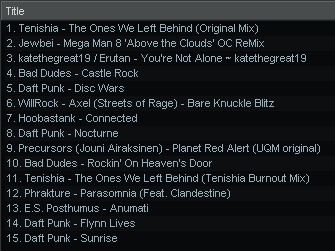
In spite of all this, I couldn’t really help myself from putting together a playlist for my next big project, a Gaia Nova novel combining characters from Bringing Stella Home and Desert Stars.  Here it is:

For me, soundtracks are all about the emotion that a story evokes.  I’m going for a tense and gritty feel, with heart-rending losses and soul-crushing defeats interspersed with poignant moments of personal triumph.

The really cool thing is that the soundtrack has helped me out a ton with the outlining process.  I’ve spent a lot of time in the past month hiking in the mountains around Provo, just listening to music and thinking about this story.  Whenever I put on the soundtrack, something would click and I’d see exactly what the story needed.  I kid you not, all of the plot twists and big reveals came to me while listening to this music.

Now if only I could come up with a title…

Gah! It sucks

I’m about a third of the way through To Search the Starry Sea, and my greatest fear at this point is that it isn’t as good as the last novel I wrote.  Because if it isn’t as good, that means that I’m getting worse, not better, and if I’m getting worse, that means I’m never going to make it as an author, because I’m not even published yet, and if I’m not going to make it as an author, that means I’m going to have to do what I’m doing NOW for the rest of my life, which means that I’m going to be miserable and life is going to suck…

<pant> <pant> <pant>

Seriously, though, sometimes I wonder if I’ve really made the right choice.  To Search the Starry Sea is much more of a happy adventure story, but sometimes I feel that it lacks depth and meaning.  I’m starting to get feedback from my alpha readers for Bringing Stella Home, and their reactions to it are surprisingly encouraging.  That story moved people–but this one?  I don’t know.

Then again, Bringing Stella Home is dark, gritty, and very tragic.  I remember feeling depressed by the story even as I wrote it.  Is that the kind of story I want to be known for?  If I can write something deep and meaningful and have it be optimistic and adventuresome, that would be a lot better.

I’m discovery writing it hardcore, which means that side characters often come to play a much more central role than I’d thought, and events that I thought I could cover in a chapter, I have to cover in two.  I have an idea where the story is going to end up, though, and it’s going to be awesome. How awesome?  Let me show you:

Yeah, it’s going to be awesome.

I think the key to keeping it meaningful is 1) to keep in mind the main character’s inner conflicts, framing them in a way that the readers can relate to their struggles, and 2) keeping the overall growth arc constantly in mind.  How does what’s happening affect how the character is changing?  That kind of stuff.

I hope I can finish this in two months.  I’m mired in the middle of it right now, and the end is far from sight.

In the meantime, I think I’ll get some sleep.

The second wind of inspiration

The more I write, the more I’ve come to realize that in order to finish a novel, you have to rediscover something powerful about the story that motivates you to tell it.  The thing that motivates you to start the story is rarely the thing that drives you to finish it.

Around the second half of the novel, I usually find yourself losing steam and groping for inspiration. As I write, the story takes its own shape and morphs into something different than it was when I started. My initial motivating idea becomes obsolete, and I have to find another source of inspiration to drive me to finish.

For Genesis Earth, that thing was a scene in the fourth chapter. Late at night sometime in March 2008, I sat down in the FLSR laundry room to clunk out the 2,000 words required for my English 318 class that week. I don’t know what it was, but everything aligned just right and the words flowed out beautifully onto the page. When I was finished, I looked over what I had written and realized that it wasn’t that bad.  On the contrary, it was unusually good.

A few months later, when I was about halfway through, everything seemed to be going wrong. The characters weren’t working, the conflict was petering out, my writing sucked, and it was all terrible. I was honestly tempted to throw out the whole novel and forget about it.

But then I remembered that scene–the one that was so much better than all of the other stuff that I’d written. I realized that if I threw out the novel, that scene would die with it. I had to finish my story, if for no other reason than to give that scene a place to live. As a result, I pulled through and finished the novel–and I’m glad I did, because that work represents a major landmark in my writing life.

The scary part is that you can never really know what it is that will give you your second wind. If you’re too critical, too judgmental of your own work, or sometimes just too focused, you’ll miss it. To find it, you have to be flexible with your outline, sensitive to new thoughts, emotions, and impressions, and (perhaps most important of all), you just have to have faith in the story you’re trying to tell.

I recently found the inspiration for my second wind with Bringing Stella Home. It’s a scene that I wrote just last week, where a major character dies.  I’d planned it out as a gut-wrenchingly tragic moment, the ultimate low point in the protagonist’s quest.  When I wrote it, however, I realized that it was much more than that: it was a merciful release for the character who died, and (though he doesn’t realize it) a victory of sorts for the protagonist.

That scene affected me in ways that I was not expecting. While the prose itself needs tightening and the scene needs revision, I realized that it has some great potential.  Because of that, I now have a driving desire to see the story finished.

Breaking a roadblock

About a month ago, I stopped working on my novel Bringing Estella Home because I hit a roadblock.  Basically, I realized at the end of the second part that I had failed to work out all of the secondary characters and their duties and responsibilities in the mercenary group that the protagonist hires.  I had a pilot and a navigator but no engineer, no medical officer, and no difference between the officers and the enlisted men.  When I came up to a battle scene, I realized that most of the characters I’d be killing off were either invisible or nonexistent, and that didn’t help out the dramatic tension very much.

Well, after the last post, it seems that my two most interesting projects (according to my friends) are Bringing Estella Home and The Phoenix of Nova Terra.  Bottom line: as much as I want to avoid it, this is probably one of my most promising projects and I really should revive it.

So today I opened up my outline for the story (I’m not very consisten about keeping outlines while drafting a new novel, but I usually have at least a couple of notes here and there in them), and I diagrammed out the mercenary organization.  I figured out what all the important officer roles are, reassigned/added new characters to fit those roles, figured out how many enlisted men there would be and who would be in charge of them,  and figured out everyone’s responsibilities.  Here is what I’ve got:


    * Captain — Commanding officer of the mercenary unit.  Lead missions, accept contracts, look over welfare of the crew, etc.

    * Chief Petty Officer (NCO) — Provide link between officers and grunts, relay commands from the captain to the enlisted men.

    * Astrogator/Pilot — Navigate routes, pilot during combat.

    * Cybernetics and Intelligence Officer — Provide useful intelligence to captain, infiltrate enemy networks, general cybernetic espionage.

    * Chief Engineer — Maintain, repair, and upgrade the ship, keep inventory of ordinance, foodstuffs, and other supplies, maintain shipwide computer network.

    * Chief Medical Officer — Maintain the health of the crew, perform surgeries and medical operations as needed, etc.

    * Wing Commander — Remotely pilot and command fighter drones, monitor enemy movements within the field of operations.


So, that’s seven officers, including the NCO (I’m not really a military person, so I’m not sure if you’d count the NCO with the officers or the enlisted men…man, I’m so ignorant when it comes to the military).  On the enlisted side, I’ve got two sergeants commanding two squads of twelve soldiers each.

Did I miss anything?  Please let me know if I did.

I’ve got to admit, the structure of this mercenary unit comes from my own very, very limited understanding of the military, drawn mostly from 1) conversations with my military roommate over the Jordan 2008 study abroad, 2) the Schlock Mercenary webcomic (which is a lot more space opera than military  sf), 3) Joe Haldeman’s Forever War, and 4) Wikipedia.  

You know, I really should join the military before I attempt to write military science fiction (no, really, I’m only half joking–it is a temptation).  But yeah, that’s the best I can come up with…so, really, this is pseudo-military sf, or the best space opera imitation of military sf that I can come up with.

But the cool thing is that as soon as I had everything diagrammed out like this, it all clicked together and the roadblock was gone.  Gone!  A month ago, when I started hitting the rough patch, I really didn’t have a lot of motivation to keep working.  It was broken, I knew it was broken, and I couldn’t really move on until I’d fixed it.  Well, now I know exactly how to fix it, and I really want to get back to this project and do it right.

Except…this is such a dark story.  It’s so tragic.  Just as I started to come along and really like my characters…but it’s better that way.  You’ve got to torture them, cause them pain.  It makes the story much more interesting and engaging, raises the stakes.

But first, I’ve got to finish Genesis Earth.  And go to bed.  Probably not in that order.

Some thoughts

This is going to be real quick, since it’s 1:30 am and General Conference is tomorrow.   The revision is going along really well for Genesis Earth–I am really excited about this project.  My only regret is that I don’t have more time to dedicate to it.  As it is, I’m probably putting too much time into it already.  But it’s worth it–it makes me happy, and I feel I’m telling a story worth hearing.

Yesterday was also the awards banquet for the English department.  It was a very positive experience.  I saw a few familiar faces–Chris from my English 318 reading group last year, and slipperyjim from Quark.

The main address and proceedings in general were very interesting.  There was a lot of talk about the value of literature, its importance in our society, but more than that, the importance to write good literature.  By that, I don’t mean the kind of stuff that has the stamp of approval of some elite clique of stuck up literary types somewhere–by that, I mean literature that has purpose and meaning, that shows us something worth living for, not merely pointing out the absurdities of our modern world.  There are plenty of absurdities and paradoxes and stupid little meaningless things, but where does it really get us to be pointing those out all the time?

I came away from the conference with something really valuable: a heightened awareness of all the things that made me want to write Bringing Estella Home, the novel I’ve been working on this semester. 

Bringing Estella Home is very tragic, a little dystopian, and has a lot of unrealized hopes–a lot of shattered lives.  It’s essentially a tragedy, and I’ve found that I don’t particularly enjoy writing tragedies.  When you’ve worked on one for a few months, it tends to grate on you–all of these suffering characters, and you with the knowledge that it’s only going to get worse.  Not very feel-good.

But that’s not the thing that made me want to write this book.  There were two things that I wanted to get across, two major ideas: sacrifice and loyalty.  If that makes any sense.  I guess it won’t, unless you read the finished book, but I wanted to show how people struggling to do the right thing in a world turned upside down could find meaning and depth in their suffering, in their trials.  Suffering comes and goes, but it shapes you in ways that last forever, and I wanted to show good people becoming better through their suffering.  I guess that’s the best way to put it.

I think I’d lost sight of that recently.  This novel needs a lot of major changes to it, especially in the middle section, which I was just wrapping up when I put it on hold.  But with a clearer idea of the overarching goal of the story–what deeper meaningfulness I’m trying to get across–I think I’ll be able to pick it up again and give it a strong finish.  That’s good.

I don’t know if I’ll ever write another tragedy again.  This one has been quite a ride.  However, I shouldn’t just throw it out and run away from it–I really need to listen to this story and tell it like it needs to be told.  I guess that’s the ultimate motivation, or should be.  I don’t just sit down and write because it’s what I do, I do it because it is something meaningful, something that can help others see the world in a new, better way, and obtain those truths that will really bless their lives.

Slow but steady

Okay, quick post before I go to bed.

Things are progressing in this novel, slowly but surely, as you can see from the wordcount.  Unlike past weeks, I’m not pushing myself too hard, mostly because I’ve got a lot of schoolwork right now and if I were to spend much more time on this novel, I would neglect a lot of the more important stuff.  Even though my course load is relatively light this semester, I’m a senior and I’m really not as motivated to do this stuff as I used to be.  I get done what needs to get done, but just barely.

I have been successfully getting up early, however.  And I’ve discovered something very interesting: I’m more productive when I have less free time.  Thursday, I didn’t have class until noon, so when I got on the computer at about 6:30 to write, I opened up the email, opened up facebook…and, by the time I had to leave for class, I had only written about 430 words.  Disgusting.  But today, when I had class at 9:00 am and still had my Arabic homework to do, I got in about 700 words in half an hour.

I still have a lot of self discipline to learn, I guess. 😛  The scary thing is that my idea, up to this point, has been to keep my time open in the summer so that I’ll be able to write.  Err…yeah.  We’ll see how that goes.

I’ve been getting a lot of comments back from my alpha readers on Genesis Earth, and it’s been REALLY fun!  Even the criticism–as long as it’s helpful criticism, I really appreciate it.  This one girl in my ward asked me if she could be an alpha reader, then read the whole thing in only a couple of days.  She had a LOT of positive comments–in fact, almost all of her comments were positive–and she said she really loved it!  So much so, in fact, that she said she was having withdrawals, so I sent her The Phoenix of Nova Terra v1.2.  Hopefully, getting her comments back will give me motivation to pick up that old thing and rework it…goodness knows it needs it.  Needs it bad.

My first two novels, The Phoenix of Nova Terra and Genesis Earth are completely different in some ways, but very similar in others.

<spoiler alert>

They both have an important romantic element, and they both have generally positive endings.  The book I’m writing now is something of a tragedy, at least at it’s core, and there is a completely different dynamic there.  No love stories, no happy resolutions–lots of pain, lots of violence, lots of grappling with difficult issues.

</spoiler alert>

I suppose it’s good to try out a lot of different things early on in your writing career.  That’s what I’m doing.  At the same time, though…I get feedback on the one novel, and I kind of want to work on it instead of the one right in front of me!  And when I think about what I did right in the one I finished, I look at the one I’m currently writing and I think “man, this is crap.” Of course, I keep working on it because I recognize that I ALWAYS think “man, this is crap” at some point before I’m done.  Knowing that doesn’t make it easier, however.

Jason from the FLSR writing group said something interesting about that, however.  He said that writing a draft of a novel is like climbing a mountain: you do it three times.

The first time, you climb it in your mind as you plan it out.  You’re excited and motivated, and busy with all the preparations.

The second time, you actually physically do the work of climbing.  It is long, hard, and frustrating, you get lost a few times, the summit is anticlimactic, and the return is boring.  You can’t wait until you’ve finished and it’s all over.

The third time is when you look back on the experience after you’re safely back down.  No matter how excruciating the climb was, you look back on it fondly and remember all the best parts.  You thrive on the memories and wish that you were back up there, standing on the summit, enjoying the experience.

Right now, I’m on my third climb for Genesis Earth and my second climb for Bringing Estella Home. I can remember how miserable I was when I was still in the middle of Genesis Earth–for a while I seriously thought about throwing the whole thing out and doing something else.  However, now that I’ve been letting it sit for a while, I’m getting really, really excited about it!  I can hardly wait before I can get back and write the second draft.

But that’s not going to happen until I finish Bringing Estella Home.  And, no matter how difficult it gets, I swear I WILL finish this book!  I’m a chapter away from act III, and that’s too deep into the thing to quit and start something else!  This book WILL be finished–if not by April, then by sometime in May!