Am I swamped, or am I lazy?

This post might get a little emo, so I apologize in advance.

I feel like I have so much on my plate right now, and yet when I look back at what I’ve accomplished each day, I wonder if I couldn’t have been more productive.  I’m moving out of my apartment on the 21st, so that’s the deadline for pretty much everything, and here’s what I’ve got to do before then:

  • Run through the copy edits for Desert Stars and rewrite the epilogue.
  • Get the cover art and publish Desert Stars.
  • Write the epilogue for Journey to Jordan and publish it.
  • Finish Star Wanderers and submit to Writers of the Future.
  • Do a guest post for Slava Heretz.
  • Finish the application for the TLG program.
  • Get rid of all my remaining books.
  • Figure out electronic W2 and other forms for taxes (before leaving in January).
  • Write up the “About My Books” page on blog.
  • Do a couple of recap posts on the travel blog.
  • Pack and ship my desktop computer.
  • Pack all my remaining stuff.
  • Get post office to forward all mail to home address.
  • Clean apartment for move-out inspection.
  • Find suitable traveler’s insurance.
  • Go clothes shopping.
  • Half a dozen other things that I’m sure I’ve forgotten.

In other words, this is not the time to be playing minecraft.

And yet, taken individually, most of these tasks are not all that difficult.  A lot of them are just mindless chores associated with moving, and the other ones, while requiring hard work, are pretty straightforward.  So am I really swamped, or am I just disorganized and lazy?

This is something I’ve struggled with since graduating last year.  When I was in school, I was constantly busy, but I was also constantly producing.  Even though my writing suffered a bit when I was swamped, I still found time to write three novels (Ashes of the Starry Sea, Genesis Earth, and Bringing Stella Home) and hold down a student job.  For the last year, I haven’t had any school and most of the time I haven’t had a job, and yet my productivity doesn’t seem to have improved.

Part of it has to do with structuring time and organizing myself.  In the past year, I’ve learned that a routine isn’t something you should hang onto doggedly, but something you need to constantly reinvent.  And yet, when I’m staying up until 2am-3am and not getting up until 8am-9am, I can’t help but feel that something’s off.  The whole moving limbo thing certainly doesn’t help, but hey, the work’s still got to be done.

Maybe it’s just deer in the headlights syndrome.  I’ll try making a checklist of everything I want to accomplish in the next two weeks and go for it.  In the meantime, I’m going to get out of this apartment and take a walk, because if I don’t, I’m going to go insane.

Also, as a token of gratitude for putting up with my babbling, here’s something cool I made the other day:

See you around!
Picking up the pace

I’m writing this post from somewhere in Iowa, riding the California Zephyr from Chicago to Salt Lake City. Since I hate sleeping on the train, I figured now is as good a time as any to write a blog post.

One of the good things about traveling by train is that you have lots of time to just sit and think. Yesterday I took a long, hard look at my writing over the course of the last year, and was surprised at what I found. Long story short, I think it’s time for a major recalibration.

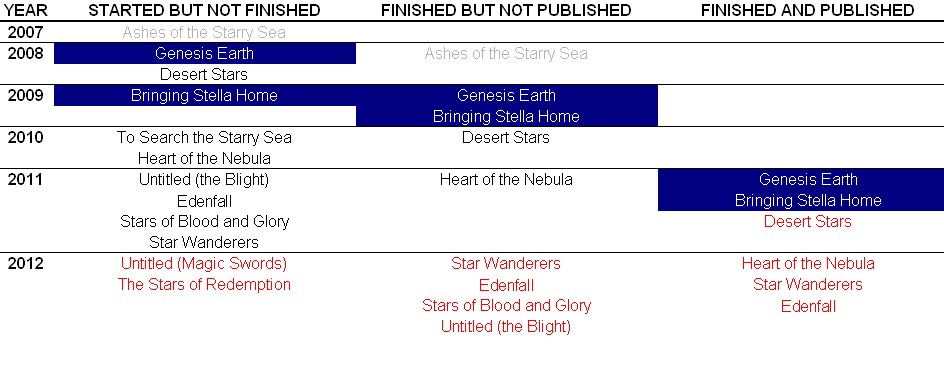
As you know, my main writing goal is to produce a minimum of two novels per year, fully polished and of publishable quality. Desert Stars will be my third this year, if I can get it up before January. But after that, I don’t have a whole lot lined up in the queue. Heart of the Nebula is a finished rough draft, but it’s the only one; everything else is either incomplete or just an idea floating around in my head.

Perhaps the best way to see it is to look at this chart. It lists all of the novels that I started, finished, and published by year. The titles highlighted in blue are novels that I’ve epublished. Ashes of the Starry Sea was a practice novel, so I’ve grayed it out, but everything else is a project I intend to carry to completion.

While 2011 was a great year for me in terms of starting new works, it was a downright horrible year in terms of actually finishing anything new. I’m worried that unless I can force myself to buckle down and produce new material at a much faster rate, this handicap is going to bite me in the butt next year.

Here’s another way to think about it: if I want to write two novels per year, and I can only focus on one novel at a time, I should be able to complete any project in no more than 26 weeks. And yet, when I look at my word count spreadsheet (which only goes back to May 2009), here’s what I see:

  • Genesis Earth: 22 to 26 weeks
  • Bringing Stella Home: 50 to 54 weeks
  • Desert Stars: 52 to 56 weeks
  • Heart of the Nebula: 18 weeks (unfinished)
  • Edenfall: 2 weeks (unfinished)
  • Star Wanderers: 9 weeks (unfinished)

What this tells me is that my current writing method is unsustainable. Either I need to learn how to juggle two projects at once, or I need to learn how to produce quality material in half the time–and in all reality, I should probably learn how to do both.

For those of you who might be worried that I’ll sacrifice quality for speed, let me assure you that I don’t intend for that to be the case. Dean Wesley Smith makes a very compelling argument on this subject, how speed and quality are not mutually exclusive. The more I write, the more practice I’ll get, which will hopefully improve the quality of my writing.

One thing I really ought to do is write something new every day. For most of 2011, I was revising something I’d originally written in 2008 or 2009, maybe throwing out a couple of scenes to start from scratch, but overall simply revising an older work. It’s made me a little rusty, and I can feel it. I can say right now, that needs to change.

My biggest concern is that once I’m overseas, it will be much harder to balance these writing goals with everything else going on. However, this isn’t 2008; I don’t have all the obligations of a student. As for whether the obligations of a teacher are any worse, we’ll have to see.

What I really want to do is write a novel in a week–preferably, in three days. Even if the first draft isn’t very good, just the act of doing it will break down some major barriers, I feel. If I finish Star Wanderers by mid-January, I’ll turn it around and write a novel with the same events from Noemi’s point of view, all in a weekend if possible.

In short, this is what I want to do:

  • Produce a minimum of 2 publishable novels per year.
  • Reduce the time for each draft to 6 weeks average.
  • Write a minimum of 500 new words each day.
  • Learn to juggle two projects when revising.

This isn’t going to be easy; I have the feeling that it’s going to involve a fundamental shift in the way I approach writing. However, if I can pull through it, I think this might just transform my career in the way that I need in order to take things to the next level.

In the meantime, I’d better get some sleep. I’ve got a long day of travel ahead tomorrow, and I’ll need all the energy I can get if I want to get some serious writing done.

Killing the sacred cows while doing data entry

Sorry for the lack of blog posts; I’ve been working 40 hours a week at this temp job, which doesn’t leave a lot of time for other things outside of writing.  I’m still plugging along at about 1k to 2k words per day, but a lot of other stuff is falling behind.  Fortunately, the job only lasts another two weeks, and that should earn me enough to take the next month off and focus on writing.  I’m really looking forward to that.

This job isn’t too bad; it’s tedious, but I can read blogs and listen to podcasts and music while I do it, so I’ve been catching up on a lot of business research.  Last week, I read all of Kris Rusch’s The Business Rusch Publishing blog series, and right now I’m working my way through Dean Wesley Smith’s Killing the Sacred Cows of Publishing.

Let me just say, this stuff is pure gold.  Every post (and a surprising number of the comments, especially those by Laura Resnick) have been extremely eye opening.  At the outset, almost everything Dean or Laura say about the industry seems absolutely blasphemous…but it all makes so much sense.

Like the post about how agents shouldn’t be giving authors any career advice… because they’ll usually advise you to write to the market, not to what you’re passionate about (and can therefore write well). Or how if you’re a midlister, it’s usually in the agent’s best interest to side with the editor, since they may have ten or more clients at stake in this house and you only represent a $3k annual revenue stream to them (or less).

The best piece of advice across the whole series so far comes from Dean:

Don’t listen to rules (myths) and do what works for you and if it doesn’t work, try something else, and when that stops working, try something else. Don’t do it my way or Larry Brooks way or Laura’s way or Harlan’s way. Steal parts from all of us and do it your way.

The thing I find most gratifying, however, is the fact that I figured out on my own that submitting to agents first probably isn’t the best way to break in. But man, there is so much awesome, paradigm-shifting stuff in these posts, it is amazing.  Pure gold.

In the meantime, Into the Nebulous Deep is going surprisingly well.  I should have it finished by mid-May, and though it will probably need some serious revision (unlike Dean, my creative mind gets more fired up in the revision process than the drafting process), the major story arc is coming along very nicely.

I wonder if that has to do with the fact that ITND will be my fifth completed novel.  My first one, Ashes of the Starry Sea, was mostly smooth to write, but it was also a practice novel and as such royally sucks.  Genesis Earth went through an EXTREMELY convoluted writing process, but it was good enough to get to the quarter-finalist stage of the 2011 ABNA contest (and in two days, I’ll find out if it made the semi finals…<fingers crossed>).  Bringing Stella Home was also pretty tough to write, as was Worlds Away from Home, though the revisions have been more straightforward so far.

So does this mean I’m starting to come into my stride as a novelist?  I hope so, because I want to start pushing myself.  After ITND, I want to revise WAFH in six weeks or less–and I’ll probably throw out 1/3 to 1/2 of the material and completely rewrite it.  After that, I want to do Sholpan in two or three weeks–but that shouldn’t be hard, because the material is mostly there already.  Whether Genesis Earth wins or loses the ABNA contest, I’ll want to write Edenfall–before August, if I can manage it.  And then, there’s always that post-apocalyptic blight project…

Anyhow, sorry for the rambling.  The point is, I want to take my writing to a new level this summer, and after this temp job is finished, I’ll be in a great position to do it.  In the meantime, I’ll merrily watch Dean kill the sacred cows while I fill out UPS shipping data for the next two weeks.

And now, here’s some candy for your ears:

An interesting concept

Last night, I was hanging out with a friend of mine and a couple of girls in the apartment complex where I currently live.  We got to talking about books, and one of the girls said something really interesting:

Every book needs to have one thing that the main character knows that the reader doesn’t know, and one thing that the reader knows that the main character doesn’t know; otherwise, it’s too boring.

That’s a fascinating concept.  I know that both things are important, but I’ve never connected them together.

When the reader knows something that the main character doesn’t, it can make for great suspense.  A good example of this is this scene from Xenogears, when the characters are trying to hunt down a monster in the sewers (skip to 6:37):

It’s harder to pull off having the characters withhold information from the readers, but it can be done. I think a good example of this is the scene from Star Wars V: The Empire Strikes Back when the Millenium Falcon arrives at Bespin and C3PO gets shot:

Granted, nothing really vital is withheld here, since by this point Master Yoda has seen Luke’s friends in danger, and Bobba Fett has clearly followed them to Bespin–but the audience still doesn’t know exactly what’s going on, and so it creates suspense.

In terms of Orson Scott Card’s MICE quotient, this would definitely fall under the “information” component of stories. In Brandon Sanderson’s class (and in my own reading), I’ve focused a lot on character, setting (milieu), and plot (event), but I haven’t thought a lot about information.

I wonder how my own novels measure up to this principle. Let’s see…

In Genesis Earth, there are a lot of things that Michael and the reader doesn’t know, but not much that one knows and the other doesn’t. There are, however, quite a few things that Terra knows that the reader doesn’t. Those all come out in the middle, though. In terms of information withheld from the reader, I suppose you could count Terra’s feelings for Michael, in the buildup before the climax, but that’s about it.

In Mercenary Savior, the reader knows a TON of stuff that James doesn’t know–it’s a major source of the suspense in that novel. In terms of things the characters know that the reader doesn’t, there’s much less, but I can think of a few things Danica knows that are kept mysterious until a key climax. Those aren’t foreshadowed until maybe 50 or 100 pages before the reveal, but I suppose it still counts.

Thinking WAY back to my first practice novel, Ashes of the Starry Sea (which I will probably never publish), there is, again, a TON of stuff the reader knows that the characters don’t. Basically, every character is clueless in some crucial way, and the resulting comedy of errors drives the plot. In terms of information withheld from the reader, though, there’s not as much. There is a point where Ian runs off without an explanation, but I’m not sure if that’s just my own poor writing. I could probably pull it off in a revision, but I don’t know when or if that will ever happen.

So yeah, I suppose I’ve done that in my own writing. I suppose it’s much easier to do this in third person, however–Genesis Earth is entirely in first person, and there isn’t anything Michael thinks about that the reader doesn’t see. He is an unreliable narrator at times, but he’s not the character withholding the information–and if he was, I don’t think it would have worked very well.

In any case, it’s a very interesting principle. I’ll have to keep it in mind.

Old story notebook, part 3

Alright, it’s time to finish up with the old story notebook I discovered a couple of weeks ago.  These ideas were written down back in 2007, when I was writing the first draft of Ashes of the Starry Sea. Without further ado:

In the future, people live in arcologies, and wars are fought outside by robots. It will be a new system of feudalism: arcologies are like castles or walled towns, and people won’t die in the wars, just change sides.

I’m not sure I knew very much about feudalism as an economic system back then, but the basic idea, I think, was that life would be localized in the arcologies and nationalism as a unifying principle would die out.

In the Middle Ages, warfare was basically a contest between nobles, and though it certainly disrupted the lives of the peasants, they didn’t really care which side they were on because it didn’t make a difference. Napoleon revolutionized the world because he galvanized the peasants through the new concept of nationalism and made them actually care about the outcome of the wars.

An AI falls in love with a CS major, but the CS major loves a real girl.

The Little Mermaid, with a modern twist. And the mermaid AI commits suicide by uploading herself to a trashy old computer that’s on the verge of crashing. The final scene shows the wrecked computer somewhere in rural China, being scrapped for the metal parts in a vat of toxic chemicals. Awesome.

A character who’s an android and sees the world in terms of numbers.

The story should revolve around the question: if math is a language, how do you say “I love you” in numbers?

An election where people can scientifically predict best and worst case scenarios, based on each candidate’s qualities and the world situation.

Political science may not be a hard science, but it is awesome for science fiction.

Voter preferences are normally distributed around a common mean, but parties choose opposing points of view because of an information shortfall about the nature of that mean. What if the information problem were solved?

We would have exactly two parties that are identical in every meaningful way…wait a minute…

Someone discovers a language that is intuitive in all humans and overcomes many barriers of language in describing the world.

Linguistics is good for sf&f, too.

What if galaxies themselves were sentient?

Sounds like something out of a Robert Charles Wilson novel. I love it!

A space colony that, due to information technology, is a pure democracy.

I’m using this idea right now in Mercenary Savior. When I first started planning the novel, I wanted to do a story about the Mongols in space, but I knew it would need more than that, so I thought “what if one of the places they invaded was this pure democracy?” As soon as I combined the two ideas, BAM! I had a story.

An advanced society without public education or health care.

Uggggh, don’t even want to go there. Not until Obama’s out of office.

The Mormon pioneer exodus in space.

I tried to use this idea with Hero in Exile, but for some reason it didn’t work. It was as if the story wanted to go in a completely different direction. Oh well–you win some, you lose some. Besides, it’s not a total loss; it’s always possible to recycle.

A kingdom that will be cursed if ruled by anyone other than a direct heir. What if the direct heir is a child?

An attempt to brainstorm some fantasy.

Robot prostitutes–one who has no feeling or emotion, but develops artificial intelligence. This is what will fuel the development of androids.

Sad, but true.

A spaceship so massive that it generates tides when it enters orbit.

Sounds like something out of Arthur C. Clarke.

A tomagachi becomes sentient and uploads itself to the internet. OR…an AI disguises itself as a tomagachi.

Tomagachis! Whatever happened to them? They were so trendy…for like six months in the 90s.

What if our most deeply held beliefs had the power, under the right circumstances, to turn into monsters–real, literal, fantastic beings of awesome power?

Now there’s an idea with some interesting potential. We could build battle arenas and watch our beliefs duke it out, literally. Which ones would win?

A society that values myths more than facts.

I’m sure that societies like this have actually existed–or may still exist today.

American suicide bombers.

Hey! It could happen.

Ghosts on a spaceship.

Nowhere to run, nowhere to hide…

A culture where kissing (or any other public display of romantic affection) initiates marriage.

Now THIS I would like to see, or maybe even use someday. It could be interesting.

And that concludes the old story notebook, bringing us to the end of 2008 when I finished Ashes of the Starry Sea and left for the 2008 BYU Jordan study abroad.

Old story notebook–found!

Guess what?  Last night, when I was looking through old boxes at my parents house (looking for my old ratty copy of On My Way to Paradise, specifically) I found my very first story notebook–the one I thought I’d lost on the Jordan study abroad two years ago!

Wheeeeee!!!

This notebook is a real gold mine–not just of story ideas, but of some of my oldest thoughts on writing.  I started keeping it back in the 90s, long before my mission.  I kept it up sporadically for a little while, but it really took off in 2007 when I decided I was going to pursue writing professionally.

For the 07-08 school year, I kept this notebook with me all the time.  I had a huge burst of story ideas as I finished my first novel, and I wrote the majority of them in here.

When the summer came around, I got a couple new notebooks in preparation for the study abroad.  Later, when I was established in the homestay, I searched everywhere for this notebook and couldn’t find it.  I thought it was lost.  The whole time, it turns out, it was in my shoebox of momentoes in Provo.

Wheeeeeee!!!!!!!!!!!

Ahem.  So now, without any further ado, let’s go through this thing.

A boy learns how to consciously control his dreams and visit other people in theirs.

For a long time, this was my one big idea–the one that I was sure would turn into a fantastic book and make my entire career, if I could just keep it secret long enough to write it. It’s a pretty good story idea, but I’ve got so many other, better ideas by now that I’m not too concerned about making it public.

A girl falls overboard from a colony ship and is stranded on an island.

Kind of like a female Robinson Carusoe, I guess. I actually wrote the first fifty pages of this story, in the summer before I left for my mission. Never finished it, but at least I ran with it.

A secret organization of warriors fights to keep a mysterious enemy from taking over the land.

Hehe, sound familiar? I think every other fantasy story has some kind of subplot like this.

A kidnapped girl fights to make her way home.

Kind of like the Odyssey, but with the genders reversed. Hmm, maybe I haven’t changed all that much…

A band of foreign, elite warriors sells their services to a population, then slowly begins to corrupt the society’s morals to satisfy their lusts.

Kind of like Seven Samurai meets Ibn Khaldun.

Two brothers find themselves fighting for opposing armies.

Already done: Gettysburg, the movie.

A general fights to save his people and then his daughter is kidnapped by asymmetrical terrorists.

I’m not sure what the significance is with the terrorists–maybe conventional warfare vs. asymmetrical warfare or something like that.

The next few are all ideas for non-science fiction stories; I tried to brainstorm as many of them as I could, in case (for some absurd reason) I decided to write mainstream fiction. I’ll give them all at once:

A guy finds a girl and they click, but he has to convince her that the people she dates are bad for her (which is true).

A guy and a girl go on a road trip to find out more about themselves.

A guy tries to improve himself to attract a girl, then discovers he’s not interested.

A boy is chauffering people around and doing errands, then finds a life-changing thing.

A homeless runaway is taken in by a wise truck driver and learns to reconcile himself with the world.

A boy goes on a road trip to do research to reunite a dying relative with an old friend.

Moral of the story: If it’s not science fiction, it’s got to involve a road trip. Otherwise, it’s dead boring.

A soldier away from home makes his way back to his country, which has fallen into warlordism, and tries to rebuild his life and his homeland.

This was the novel I tried to write the year after my mission. It tanked really bad, but it got me to the point where I could write Ashes of the Starry Sea and actually finish it. If I were to try this idea now, I would take it in a completely different direction than I did then.

That concludes all the ideas in the notebook before October 15, 2003. The notebook then took a hiatus until the summer of ’07, which is where I’ll pick up next time.

Summer roundup

Alright, with the first week of school already over, I figure I should recap and evaluate my writing progress this summer.

When school ended in April, I was still waiting to hear back from Brandon Sanderson’s agent about an internship.  My backup plan (which I started as soon as classes ended) was to stay in Provo and write full time.

Sanderson’s agent ended up taking on a different intern, which ended up being the best for both of us, since I get the sense that he was looking to mentor someone who would go on to become a professional agent.  Me, I was just looking to network and develop some connections in the publishing world, which I did anyway (at least in the local Utah scene).  Besides, Provo is WAY cheaper than New York!

From the beginning, I treated writing as a full-time job.  I set project deadlines, daily and 7-day wordcount goals, and spent somewhere around 8 hours a day working on my various projects.  I submitted a full to an editor from the BYU Writing and Illustrating for Young Readers conference and partials to the other two editors.  I also submitted to the Writers of the Future contest and to the LDS Publisher Christmas story contest (much smaller, but geared toward a niche market).

I started keeping my stats on May 25th, using a spreadsheet to keep track of my daily wordcount for each of my projects, the daily total wordcount, the 7-day cumulative wordcount, and any writing I did for synopses or revision notes.  Since BYU’s summer recess begins in April, I missed the stats  for the first three weeks or so, but I kept consistent records since then until now.

From May 25th to August 31st, I wrote 244,065 words in 8 projects (3 short stories and 5 novel drafts).  I averaged 2,490 words per day.  Adjusting for Sundays (I typically take Sundays off), I averaged 2,906 words per day.

My goals were to write 4k words per day, and to shoot for a constant 7-day total of 24k, but to never let that total dip below 12k words.  In 98 days, the 7-day running total only went below 12k eleven times–on those particular days, I was either traveling, moving out, moving in, or extremely busy with back-to-school chores.  For the two weeks I was on vacation, I still wrote more than 12k words each week.

Interestingly enough, out of the eight fiction projects, only one was a rough draft–a short story that I worked on for two days and never completed.  The vast majority of my writing went into revising novels that I’d already written.

I completed the first draft of Bringing Stella Home in early June (my third complete novel rough draft).  Later, in July, I began the second draft.  I’m currently just over halfway through with the revisions and hope to finish by October 10th.

I started a revision of my first novel, Ashes of the Starry Sea, but decided midway through that I was running up against diminishing returns and decided to drop it (I completed the rough draft in April of 2008–it was my first finished novel and the reason I started this blog, waaaaay back in August 2007).

I started a new draft of Hero in Exile, making some drastic revisions, but found it difficult to juggle more than one writing project at a time and put it on the back burner.  I may or may not pick it up again once Bringing Stella Home 2.0 is finished.

I completed the third draft of Genesis Earth and started to submit it.  I will probably do one language/readability edit before the World Fantasy convention in late October and try to sell it while I’m there.

Overall, the summer was a practice run to see if I could write full time and survive the insanity.  I always feared, as a child, that if writing became my full time job I would come to hate it.  I found, however, that writing full time (8+ hrs/day, 6 days/wk) only made me enjoy it more.  Now that school is back in session, I already wish I had more time and mental space to dedicate to my writing.

I miss the summer, but not because of the lazy days, or the parties, or the vacationing–I miss the opportunity to write full time!  Provided I can find a way to support a family off of this, I can definitely see myself turning this into a career.  In the meantime, I’ll keep honing my craft and start working on getting an agent.

Now, more than ever, I feel that breaking in is more of a question of ‘if’ than ‘when.’

🙂 🙂 🙂

Refocusing

If you’re a regular of this blog, you may have noticed that I took off the statusbar for Ashes of the Starry Sea 2.2.  I’ve decided to discontinue that project for the foreseeable future, while I work on Genesis Earth and Bringing Stella Home.

It’s not that I think that Ashes doesn’t have potential, or that I can’t rewrite it.  It’s just that I don’t want something good to keep me from doing my best.

Ashes, in its first incarnation, was very much a practice novel.  It has potential, but it’s going to take a lot of work to get it publishable.  In the meantime, I’ve got two other novels that are much better–much more workable.  I don’t want them to be any worse because I’ve diverted too much attention toward something else.

When I wrote Ashes two years ago, I cringed at the thought that this was going to be just a practice novel.  It was my magnum opus, the best thing I’d ever written!  Well, since then, I’ve written a lot of other stuff that is much better.  I’m able to let this baby sit on the back burner while I polish the better stuff.

(baby…back burner…okay, disturbing image)

In unrelated news, I had an AWESOME story idea today at Leading Edge!

Ever read the Illiad or the Odyssey? Didn’t you think that the Greek gods were just so petty, with their stupid feuds and their dumb wagers?  Did it disturb you how they toyed around with humanity, ruining people’s lives just for sport?

Well, imagine this: an ancient Greek Van Helsing who slays gods instead of vampires!

Yeah, man!  That’s gotta make for some interesting story material right there!  The godslayer…the man who dares to challenge fate and takes up arms against the forces of the universe, slaying the immortals, overpowering the omnipotent, and outwitting the omniscient.  Sounds like…like Richard Dawkins meets Sparticus. =P

Anyway, that’s the idea.  What’s your take on it?

Uh oh…more projects?

That’s right.  I recently formed a writing group with some friends, and decided to workshop Bringing Stella Home through it.  They went through the first chapter yesterday and tore it apart.  I appreciate the help a TON, but I’m going to have to start making revision to it now, so that subsequent submissions to the writing group won’t have the same issues.

So, that makes three major ongoing projects for me now: the Genesis Earth 3.0 revision draft, the Ashes of the Starry Sea 2.2 draft, and now, Bringing Stella Home 2.0.  It’s going to be very hard to juggle all three, and one of them will probably fall through  the cracks (probably Ashes, to be honest).  However, I’m going to do my best to give them all equal time.  We’ll see if I succeed.

In order to accomplish this, I’m probably going to have to make some changes to my daily routine.  Right now, I work out, eat breakfast, read the Book of Mormon, and arrive on campus ready to write…at about 11:00 am.  And that’s on a good day.  I write until about 2:00 or 3:00 pm, then go home for lunch, take a nap, check the internet, be lazy, etc.  At about 7:00 or 7:30 pm, I head back up to campus and write until about midnight.

So far, it’s been working.  I’ve been averaging 4k words per day pretty regularly these past couple of weeks.  However, if I’m going to work on these projects, I might have to focus and up that wordcount a bit.

Therefore, I’m going to try to cut back on IMing while I’m writing.  Usually, during the day, I’ve got gmail open on my browser and I check it from time to time.  I’ve got a couple of friends with whom I usually keep a running chat for the entire day, which can be maddening when you’re trying to concentrate.

I’ve been thinking about cutting back on the IMing for the last few weeks, but thus far it hasn’t been too much of an issue.  However, if I’m going to buckle down, something’s got to go.  Sorry.

(Of course, it remains to be seen if I keep this resolution.  Internet habits die hard.)

In unrelated news, I cooked the AWESOMEST chili today!  Best chili of my life, and what’s even better, I cooked it in MASSIVE amounts!  Here’s what I put in it:

corn
diced onions
ground beef
kidney beans
pinto beans
black beans
crushed tomatoes
diced jalapenos
plain yoghurt
spices

The secret ingredient was definitely the yoghurt.  Adds a creamy texture, like sour cream without the unhealth stuffy.  Also give it a rich and interesting flavor.

Good stuff!

Fistful of words

I’ve recently developed a taste for Ennio Morricone’s music. My writing process these days consists of me sitting down and watching this youtube clip:

After that, I’m all gunned up and ready to work!

Holy crap, today I sent out the first three chapters of Genesis Earth to the other two editors from the BYU Writers for Young Readers conference. What a rush! I spent a couple hours writing a chapter by chapter synopsis, rushed out a couple cover letters, bought $4.81 in wood pulp for both copies of the work, headed on over to the BYU Bookstore for the envelopes and all, and voila! Sent ’em off!

We’ll see what comes of them–probably more form rejections. It’s funny how when you print something off to send it out, it seems ten times worse than you remembered.

Well, I sent it out anyway. With writing, good things never happen to those who wait.

The question in my mind is now: does that synopsis count towards my daily word count goal? Because I only wrote 1,072 words in Genesis Earth 3.0 today (nothing in Ashes, sadly), but that synopsis was upwards of 2,800 words and took up a good chunk of my normal writing time. Eh, I’m counting it.

In unrelated news, I saw Star Trek the other day. Found it entertaining, but wasn’t very impressed. Too many holes that stretched the believability.

<spoilers>

For example, in the beginning, Kirk’s wife goes into labor during the evacuation and the child pops out…like, five minutes later? Or the red, fleshy monster on the ice world: no visible fat, no fur…how does that thing stay insulated in such a hostile environment? Or the Romulans drilling to the core of the world to create the black hole: why don’t they just create a black hole on the surface?  Gets the job done a lot easier.  Better yet, when Nero realizes that he’s gone back in time and his home world hasn’t yet been destroyed, why doesn’t he save his people instead of avenging himself on the Vulcans? Or…you get the point.

</spoilers>

I was never a big Star Trek fan growing up, though (except for Star Trek Voyager–I loved Voyager!). I can understand how the nostalgia would make a lot of people enjoy the movie. And really, it was very pretty–the graphics were great. Lots of action. It was entertaining, just…not as good as everyone makes it out to be, IMO.

I could say more, but that’s enough for tonight.  Have a wonderful Sabbath!