Midichlorians vs. the Philotic Web, or a new dimension to Brandon Sanderson’s first rule of magic

I got into an interesting discussion today with my brother-in-law about science fiction & fantasy, specifically about whether explaining something too much takes away from the sense of wonder that is so critical to those genres.  It started out with a discussion of Star Wars I: The Phantom Menace, which (surprisingly) he actually kind of likes, and eventually got on to Brandon Sanderson’s first law of magic.

I was trying to explain why The Phantom Menace was so broken, and after hemming and hawing over various things came to the midichlorians.  That, more than anything else, threw me out of the story.  By explaining the Force in such a banal, insipid way, it undid all the magic of the previous trilogy and completely sterilized it.  There was no sense of wonder after that point–explaining the Force completely killed it, just like over-explaining any magic system always kills that sense of wonder.

… or does it?  Because there are quite a few wonder-inducing magic systems that get explained in great detail.  Take the Philotic Web, for example.  In Xenocide, Orson Scott Card explains, in great detail, how the physics behind the ansible system works.  And yet, by doing so, he increases that sense of wonder to the point where Xenocide is one of my favorite of his books.  Why?  Because it introduces a bunch of implications that lead to even more questions, more mysteries.

With The Phantom Menace, of course, that isn’t the case–the midichlorian thing is basically a clumsy ass pull that fails in the magic department just as hard as Jar-Jar Binks does at comic relief.  But it doesn’t fail because it over-explains things, it fails because it explains the magic in a way that doesn’t allow room to explore the implications.  As much as I hate to admit it, Lucas could have pulled off the midichlorian thing if the implications had been relevant to more things in the story than just a simple plot point.

This is where Sanderson’s first law comes in.  Basically, Sanderson’s first law states that there’s an inverse relationship to how well the magic can induce wonder versus how well the magic can advance the plot.  In order to advance the plot through magic, you have to explain how the magic works to some degree, and that’s going to take away from the sense of wonder.

But as we’ve just shown, that isn’t always the case.  Sometimes the sense of wonder gets even stronger the more the magic gets explained.  This is especially true in science fiction that follows the one big lie approach, where one thing (wormholes, reactionless drives, time travel) is truly fantastic and everything else more or less follows the laws of physics as we understand them; in order to maintain the suspension of disbelief, the story is basically forced to explore all the implications of the magic, often to great detail.

In other words, explaining the magic isn’t always like building a wall–sometimes, it’s like building a door.  Yes, it lays down a boundary that closes off the imaginative spaciousness that a story really needs to convey that sense of wonder, but if the explanation leads to new questions–new mysteries–then that sense of wonder can be maintained.  Instead of walling the reader in, it throws the reader into a maze with countless secret chambers to explore.

The relationship between plot-based magic and wonder-based magic is not linear, as Brandon Sanderson’s first law implies.  Rather, there’s a second dimension that has very little to do with his law, and learning how to traverse that dimension is key to maintaining the sense of wonder in any story.

I haven’t figured out a pithy way to explain all this yet, but I’m going to, hopefully within the next few days.  If you guys have any thoughts on the subject, please feel free to share.  I’m definitely interested in hearing your perspectives on it.

Trope Tuesday: Dreaming of Things to Come

When a character in a story has a dream, there’s almost certainly a reason for it.  If it’s not thrown in just to show how scarred or tortured he is (or alternately, how repressed he is), chances are good he’s dreaming of things to come.

I’m a huge fan of this trope, as you may be able to tell if you’ve read any of my books.  It’s a special form of foreshadowing that lends a mystical, otherworldly flavor.  It’s also something that we can relate to: how often have you had a dream that was so powerful, so moving, that it just had to mean something?

When played straight, this trope often implies some sort of all-seeing being who sent the dream on purpose.  However, this doesn’t have to be the case.  I often find it much more satisfying when we don’t know where the dream came from.  It’s very easy to shatter the sense of wonder by over-explaining things, especially when it comes to the dream world.

Of course, the character doesn’t just have to dream of things to come to capture that sense of wonder.  They can also dream of times gone by, discovering something previously unknown about the past, or dream of the truth, working through a previously unsolvable problem in their sleep.  The mystical, otherworldly flavor still holds true for all of them.

As you might expect, this is a fairly common trope in fantasy.  Some prominent examples include:

  • Lord of the Rings
  • The Silmarillion
  • A Game of Thrones
  • The Black Cauldron
  • American Gods
  • Most of the Redwall books
  • Dragonsflight
  • Watership down

Why is so popular?  Even though dreaming is such a common, universal experience, it’s still shrouded in mystery.  It resonates deeply with us because we can all relate to it, and at the same time it opens all sorts of windows into the fantastic because there is so little we understand.

Like I said before, this is sort of a pet trope for me.  Consciously or not, I tend to throw in at least one dream sequence in every book I write.  It seems to have worked pretty well so far, so I don’t think I’ll be changing that anytime soon.

Thoughts after finishing Vortex by Robert Charles Wilson

Whoa.

If I had to sum up my thoughts with one word, that would be it–though of course, by itself that word is hopelessly inadequate.  Let’s just say that, for me at least, this  was a truly astounding book, a literary journey that left me wide-eyed with my mouth hanging open, blinking wearily as I looked up from the last page and returned, reluctantly, to the world of physical reality.

I don’t plan to spend this blog post talking about how awesome this book is, however; I’ll save that for a review.  Rather, I want to spend some time talking about how this book has influenced the way I think about science fiction and my own writing, and to share a few of my thoughts having just finished it less than an hour ago.

If anything, this book has shown me that science fiction–real science fiction–is about staring into the unblinking void of the cosmos with a deep and abiding need to find answers, or perhaps more accurately, to ask questions.  This inevitably produces a sense of wonder, but that’s merely incidental; the genre is really about fulfilling an almost religious need to connect with something greater than oneself.

I enjoy reading science fiction and experiencing that connection, but I don’t need it–not in the way that I sense some of the grand masters of the genre truly did.  Instead, I hunger for the sense of wonder and adventure that is more characteristic of fantasy.  In my own writing, it’s not so much the grand sweep of the cosmos that interests me as much as the intimacies of human nature–which isn’t to say that the two are incompatible, but that my preferences lean more to the one than the other.

What I’m saying is that it’s not science fiction that I write, so much as science fantasy.  I still feel drawn to space adventures and the trappings of science fiction–I’m not at all interested in writing about elves or dragons–but at their heart, the books I write are more fantasy than true science fiction.

Which might be a purely esoteric distinction to the average reader, but if it helps me to understand my own writing, it’s a distinction worth making.  If science fantasy is the sub-genre that really speaks to me, then that’s the kind of literature that I should explore.  Of course, it’s important to be well-read in multiple genres, but if there’s a particular one in which you want to write, it stands to reason that that’s the one on which you need to be an expert.

So that’s my new goal: to explore fantasy, science fantasy in particular, and the ways in which other sub-genres like space opera and space adventure lean more toward the fantasy side of things than pure science fiction. And to keep reading really awesome books.

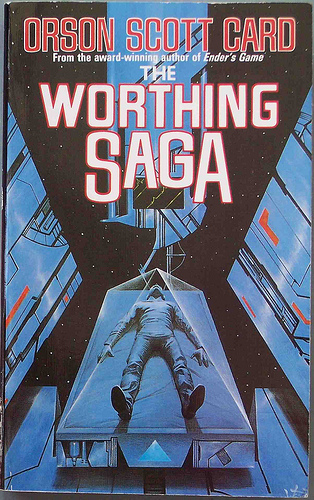
The Worthing Saga by Orson Scott Card

Somec: the miracle drug that allowed the rich and well connected to sleep through the centuries and postpone death almost indefinitely.  While the masses continued to live out their lives in normal time, the social elite watched over centuries as their investments multiplied, and their kingdoms grew into empires…

…and ultimately crumbled.

Thousands of years have passed.  Somec is unknown, except to the one man who saved humanity from its own corruption.  He has slept through the eons to find out if his last gambit brought about the peaceful and benevolent society that he hoped to leave behind.

But as he awakens from his slumber, he finds himself in a universe infinitely stranger than he could have imagined–among a people who revere him as their god.

I’ve heard that Orson Scott Card considers this book his best work, and I’d have to say, I agree with him.  Right up until the ending, it’s at least as good–if not better–than Ender’s Game, his most famous book.

The book unfolds magically from the first page, drawing you in to this beautiful, fantastical world.  The characters have depth and feeling, especially the ones from ages long past, whose stories are powerful and haunting.

I absolutely loved this book–right up to the end, which had a twist that caught me off guard, and not in a good way.

Story-wise, the ending was great.  It was a beautifully foreshadowed twist, right on the order of Ender’s Game and Speaker for the Dead.  Thematically, however, I had a hard time not feeling that it undermined everything that had come before.  I can’t get into details because I don’t want to give spoilers, but the last couple of pages jolted me out of the book and left me saying: “Huh?  How is that right?” I eventually warmed up to it, but it took a while.

Still, I’d definitely give the book five stars, or at least four and a half.  Everything about it is monumentally amazing.  The characters, the worldbuilding, the sense of wonder, the thought-provoking questions and issues it raises, and just the sheer joy of the experience of reading it.  This is a book that I can get lost in, and not just once.

As a side note, the book includes the short novel The Worthing Chronicles, as well as several short stories that take place in the same universe.  The short stories were all quite good, but personally I preferred the novel by itself.  Perhaps it’s because the epic scope came through so much better in the novel than in the stories, or because the stories didn’t allow me to spend much time with any of the characters.  Your mileage may vary, of course.

Interestingly, The Worthing Chronicles is a retelling of Hot Sleep, Orson Scott Card’s first novel.  As a writer, I find it interesting that Card revisited his first novel in this way–to basically rewrite it, keeping all the major events but telling it from the point of view of someone who meets the main character of the first (Worthing) much later in his life.  I haven’t read Hot Sleep, so I can’t compare the two, but The Worthing Chronicles turned out amazingly well.

Will I ever attempt something like this?  Not sure–but it’s interesting to think about.

Spin by Robert Charles Wilson

What would you do if you knew that the world was going to end in the next thirty years? That one day, before the end of your natural lifespan, the oceans will boil and the forests burst into flames, and life on this planet will come to an end? That you, your children, and even humanity itself have no future–that everything will end with you?

When the mysterious beings known as the Hypotheticals encase Earth in a temporal warp field that causes years to pass outside for every second on Earth, that is the uncomfortable question that all of mankind must confront. In five billion years–less than forty years on Earth–the sun will burn up its hydrogen and expand into a red giant star. When that happens, the sun will swallow the Earth and every living thing will die.

Some people turn to religion for answers.  Some turn to Science.  Some put off the question, living their lives as if the end will not come.  But as the years pass and the unavoidable apocalypse looms nearer, humanity begins to spiral out of control, and civilization itself looms on the verge of collapse.

The year the stars fell from the sky, thirteen year old Tyler Dupree discovers that he is in love with his best friend (Jason Lawton)’s sister, Diane.  The dynamics of the friendship between the three, however, make it impossible for Tyler to express his true feelings–and, in any case, Diane doesn’t seem interested in being anything more than a friend.

When the Spin hits, all three of them find themselves on radically different and sometimes conflicting paths.  Diane turns to evangelical Christianity and the frenzied religious outporing the Spin inspires.  Through his father, Jason rises to become one of the most influential scientists and directors in the Perihelion Foundation, the premier aerospace agency and Spin-related policy forming body in the US.  

Tyler, however, pursues the same middle class life he probably would have followed anyway–medical school, followed by a career as a doctor.  Still, his undiminished feelings for Diane and his frienship with Jason draw him into the center of the Spin hysteria and behind the scenes in the circuitous Spin-era politics.

Diane, now married to a fervent believer in a free love fundamentalist cult, comes to rely on Tyler as her only link to the outside world.  Meanwhile, Jason Lawton pursues perhaps the most grandiose and ambitious project mankind has ever attempted; the terraformation of Mars. 

With the temporal distortion of the Spin, millions of years of evolution turn Mars into a verdant green world in only one Earth year.  When Jason launches the first manned mission to the planet, barely a week passes before the the first Martian-born human returns to mankinds ancestral home–a descendant of a civilization millenia older than our own.  This small, dark-skinned, wrinkled man comes with a tantalizing message that may prove the key to finally understanding the Hypotheticals and the Spin itself.

But all of this may be too late, because the Spin membrane is finally beginning to show distressing signs of failure, and the sun has already grown hot enough to boil the oceans and scorch the planet.

I loved this book.  Honestly, I have to say it is one of the best science fiction books I have ever read.  Better even than Ender’s Game, better even than Foundation or any of the other classics.  No other book that I’ve read has done everything that I believe a good science fiction book should do.  I would highly recommend this book to anyone and everyone.

Like Clarke and a lot of the older classics in the science fiction tradition, Spin addresses some of the grand questions with which science and humanity have always wrestled.  What is the ultimate end of mankind?  The ultimate end of evolution?  Are we unique in this universe?  What is our place in the cosmos?  What is transcendence, and can we as a mortal species achieve it?

Unlike much of the older works, however, Spin addresses these questions through solid, developed, rich characters and a human drama that is as engaging as anything in any other genre.  When I read this book, I felt connected with these characters.  I genuinely cared about them.  They were real, distinct people who changed and grew based on their choices and experiences.  Furthermore, their struggles and conflicts echoed my own.  It felt true.  Tyler’s unrequited love was not only utterly believable, it kept me just as engaged as the grand ideas and the science fiction elements.

As science fiction, the ideas in this book were some of the most original and eye-popping ideas I’ve ever seen.  There was definitely a sense of wonder, as thick and beautiful as Clarke or Heinlein or Asimov.  The thing that made these ideas so great, however, was the eminent believability that accompanied them.  Robert Charles Wilson thought out the implications of everything, and showed them through concrete, human details.  His Martian landscapes were as real and believable as his picture of the New England countryside.  I not only felt that I was there, I felt that I was in this world, where the end-of-everything panic had set in, causing all sorts of bizarre, almost post-apocalyptic (pre-apocalyptic?) social changes.  It was truly fascinating.

But it wasn’t just the storytelling that engaged me: Robert Charles Wilson’s prose is among some of the best that I’ve ever read.  Reading this book really was like eating cheesecake.  The writing not only flowed, it shined, yet in a way that illuminated the meaning behind the words rather than drawing attention to the words themselves.  Wilson’s metaphors were not only rich and beautiful, they expressed the meaning behind the text so clearly that in each case, I don’t think he could have gotten across that particular impression, that feeling, in any other way.  Everything was calculated, and I would read pages and pages of text without even realizing how far I’d come.  Incredible.

I did have one issue with my first readthrough, back in July of last year: the Martian civilization, while grand, didn’t feel grand enough.  I mean, in 0nly four thousand years of history, look how far we’ve come here on Earth–all of our religions, all of our science, all of our discoveries and everything else.  We can hardly even remember what it was like, four thousand years ago–yet in Spin, the Martians know all about the reasons why Earth spawned their civilization, all of the questions that the Earthers have been asking about the Hypotheticals, etc.  I almost think that the Martians would have a more mystical view of Earth; that their understanding of us would be steeped in legend, and that they would have forgotten who we really are.

In my second readthrough, however, this was less of an issue to me.  Wilson really does make the Martians seem alien, a separate, distinct culture with a long, rich tradition.  His Martian citizen is very distinct from any of the Earthers, and notices some very small things that we always take for granted.  So, even though there could be more of a feeling of grandeur, Wilson already paints a very believable, very grand view of the Martian civilization he invents.

I am not exaggerating one bit when I say that this is probably the best science fiction book I have ever read.  I would recommend it above and beyond anything else I’ve reviewed here on this website.  If you haven’t already, pick up this book and read it.