Is Gunslinger to the Stars for You?

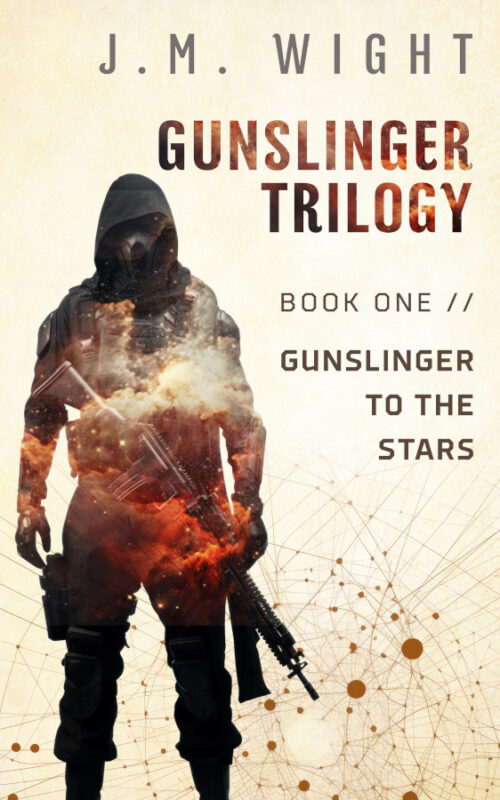
Gunslinger to the Stars is a character-driven space opera novel that blends Western adventure, first-contact science fiction, and pulpy action. It’s fast-paced, voice-driven, and built around a loyal, reluctant hero navigating a dangerous galactic frontier. It’s told in the unmistakable voice of Sam Kletchka—half gunslinger, half star-hopping troubleshooter, and 100% fun.

What Kind of Reader Will Love This Book?

If you like…

  • Classic space adventure with modern voice and humor, where the hero solves problems with grit, guts, and an outrageous arsenal of lovingly described guns
  • Found-family dynamics between a rough-around-the-edges gunslinger, a principled xenolinguist, a telepathic outcast, and a trio of shapeshifting empaths
  • Galaxy-spanning mysteries, alien politics, and first-contact stakes that push characters to their limits
  • The feel of a Western gunslinger dropped straight into a richly imagined galactic frontier

…then Gunslinger to the Stars is absolutely your kind of story.

What You’ll Find Inside

Gunslinger to the Stars (Book 1 of the Gunslinger Trilogy) follows Sam Kletchka, a New Texas gunslinger stranded in the Gorinal Cluster just as the local jumpgate—the only way out—mysteriously goes dark. What starts as a simple job escalates into a battle for survival involving hidden alien races, shape-shifting empaths, worldships, and a rising threat the Immortals never wanted anyone to discover. The tone blends wry humor with escalating danger, and the style is fast-paced, voice-driven, and cinematic—equal parts action romp and big-idea sci-fi. The result is a story that feels both classic and fresh: a pulpy, heartfelt adventure that’s as much about loyalty and moral clarity as it is about space battles and exotic technology.

What Makes It Different

Fans of Firefly and Schlock Mercenary will recognize the snappy banter, the found-crew dynamic, and the blend of humor with high-stakes action. But Gunslinger to the Stars pushes those familiar ingredients in new directions: the gunslinger-as-space-ranger angle gives the book a distinctive American-frontier voice, while the empath culture, the Immortals’ centuries-deep manipulations, and the emergence of the Draxxians create a myth-arc that feels simultaneously expansive and personal. Where many space operas lean on military hierarchy or techno-fetishism, this one leans into character, moral philosophy, and the uneasy tensions between peacekeeping and necessary force—all told through Sam’s dry, self-aware perspective.

This story blends classic space western tropes — the reluctant hero, the ragtag crew, and the dangerous frontier — with a deeper mystery about ancient alien powers. If you enjoy space western stories with a strong first-contact throughline, you’re going to enjoy this book.

What You Won’t Find

If you’re looking for grimdark bleakness, heavy technobabble, or a cynical antihero who never grows, this isn’t that. And if you want romance-heavy sci-fi or endless political intrigue, this book doesn’t go down those roads either. But if you want hopeful, character-focused adventure with humor, heart, and a hero who takes responsibility for his choices—sometimes reluctantly—you’ll feel right at home.

Why I Think You Might Love It

I wrote this story at a time when I needed to shake things up creatively, by writing something fun, energetic, and different from what I had been writing at the time. I was also going through a time when my worldview was changing, and I was questioning a lot of my old assumptions. This book grew out of a number of things: from my conversations with close friends, my love of classic pulp sci-fi, and from the idea of a lone wanderer who tries—however imperfectly—to do the right thing. The result, I believe, was a book with a lot of heart that captures that spark of wonder that made me first fall in love with science fiction. If that’s what you’re looking for, I think you’re going to love it!

Where to Get the Book

Related Posts and Pages

Explore the series index for the Gunslinger Trilogy.

Visit the book page for Gunslinger to the Stars for more details.

Read about moral courage in Gunslinger to the Stars.

See all of my books in series order.

Going for fun

They say that you should put as much of yourself as you can into what your right, and that’s true to some extent. But when you’re writing SF&F, there’s a much more important rule:

BE ENTERTAINING.

While I don’t think I’ve necessarily broken this rule, I haven’t always paid close attention to it. So for my current WIP, I’m pulling out the stops. I figure that the best way to entertain people in a book is to make it fun to read, and if it’s fun for me to write, I figure it will be fun for my readers as well. So my primary goal with this book is to have fun.

The working title is Gunslinger to the Stars, and if I had to give you the Hollywood pitch it would be this: Monster Hunter International meets Guardians of the Galaxy on the set of Firefly.

The main character is a freelance starship pilot named Sam Kletchka, who travels the galaxy taking various mercenary jobs. He was born and raised in the Gliese colonies, on a planet called New Texas, but although he was a gifted student, he dropped out of Earthfleet Academy his freshman year because he didn’t get stuck on a refitted Cold-War era submarine protecting colony ships in Earth-space (the galactics gave us cheap ground-to-orbit, which means that we used what we had when building our first fleet of starships).

The book starts when he gets stranded in the armpit of the galaxy, natch. The only other human who’s stranded there with him is an attractive twenty-something xenolinguist named Jane Carter, with whom he has a history. Let’s just say that she isn’t all that enthusiastic to see him.

At one point, he describes his guns:

MERCY is a supressed Ruger 22 Charger™ Rimfire Pistol. She’s fairly small and doesn’t pack much of a punch, but she’s as silent and stealthy as a Zan cloakship in deep space. Besides being perfect for cloak-and-dagger type stuff, Mercy is also good for hunting small game, on the few occasions where I’ve been stranded planetside without supplies.

The next two guns are really different components of the same gun, an AR-15 with two uppers that I can swap out depending on my needs. FAITHFULNESS is a suppressed 300 Blackout with a 9” barrel, perfect for boarding action. I use a homemade subsonic round with the ballistics tuned down just a notch, to allow for onboard fire that won’t accidentally puncture the ship’s hull. The suppressor is excellent for firing in confined spaces, and the standard 30 round magazine gives you plenty of firing capacity to stay in the fight.

RIGHTEOUSNESS is a .50 Beowulf upper that I can swap out for Faithfulness. This massive gun packs an enormous punch, enough to blow through a bulkhead and vent some atmo. I mix an oxidizer in the cartridges to allow it to fire in a vaccuum, making it an excellent weapon for extravehicular assaults. You just have to be careful to lock your magnetic boots firmly onto the ship’s hull, otherwise Newton’s third law will send you flying.

JUDGMENT is an M203 grenade launcher that attaches quite nicely onto Faithfulness and Righteousness. She makes the rifle a little heavier, but in zero gravity, that doesn’t really matter much. With the proper munitions, Judgment can light up a firefight like Christmas.

PRESERVATION is an 18” Mossberg 590A1™. She’s a tough little girl that can pack a serious punch. I keep her on the wall of my cabin within easy reach for home defense purposes. She has a capacity of 8+1, but I usually don’t load her with slugs unless I’m doing a breach and entry. The best thing about shotguns, though, is that the ammunition is super easy to fabricate. If I were going away for a while and could only take one gun with me, it would be Preservation.

LOVE is my father’s trusty old 1911. She’s been in the family for quite a while, and when I left the Gliese colonies for the stars, he wanted me to take her with me. She’s chambered in 9mm and has a capacity of 17+1. In spite of the .45’s stopping power, I prefer a good 9mm handgun simply for the increased accuracy and carrying capacity. Besides being stupidly rugged, the 1911 is also quite easy to maintenance or to fabricate replacement parts. For that reason, it’s the handgun of choice for most offworld colonists.

KINDNESS is the Gliese Arms 2011 .45 ACP that you’ve already met. The 2011 is a lot like the 1911, but the 140mm double stack magazine allows for a capacity of 14+1. As you already saw from the gunfight at the Oasis, Kindness has gotten me out of a lot of tough spots.

TRUST is a Himalayan Imports Chainpuri 15” Kukri: not a gun, but an excellent combat knife. The Nepalese Gurkhas were some of the most badass warriors of Earth, and the kukri is their signature weapon. I acquired Trust at the Earthfleet Academy on Luna, after winning a game of poker with my fellow cadets. She’s such a beauty, I wouldn’t dream of ever gambling her away.

Thing is, he’s as good with guns as he is horrible with women. As you can probably guess, hilarity ensues.

The book was actually inspired by the most recent Schlock Mercenary storyline, where one of the subplots involves rescuscitating Vog, the twelve million year-old member of an alien race that is functionally immortal. When the mercenaries revive him, he’s lost ten million years of his memories and thinks he’s an elite warrior from when his race was in its prime. Little does he know, his civilization has collapsed, and the mortal junior races have gotten a little uppity.

Thinking about the implications of immortality on intergalactic politics made me come up with a fantastic idea for a near-future space opera universe. When CERN does a new sub-atomic particle experiment, it alerts the galactics to our presence, much like Zefram Cochrane’s first flight with the warp drive alerts the Vulcans in Star Trek. The galactic junior races have all been patronized by the Immortals, who have built a massive jumpgate network that unites the galaxy together. The Immortals don’t interact with the junior races directly however: they use mediator races as proxies. And the Immortals aren’t interested in ruling the junior races so much as… I won’t spoil it for you.

In any case, that’s the story I’m writing right now, and even by chapter three it has been loads of fun so far. Lots of shooting, lots of action, lots of intergalactic secrets and intrigue. With luck, Gunslinger to the Stars should be out sometime early next year.

O is for Orbit

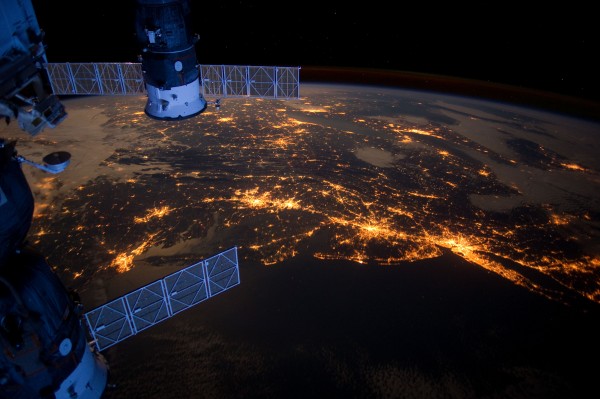
iss030e078095

One of the key things that makes space different from Earth is that nothing is ever stationary.  Anything close to our planet that isn’t moving at a good clip (measured in miles/kilometers per second) is liable to plummet like a brick.  Gravity is still in effect, even though you’re in free fall and thus don’t really feel it.

The way to get around the falling problem is to orbit whatever celestial body you’re plummeting towards.  When your tangential velocity gets high enough, gravity becomes your centripetal acceleration, and the system becomes rotational rather than discrete.  In other words, you’re still falling, but you’re moving fast enough to cross the edge of the horizon before you hit.

Just to give you a scale of how fast you have to go to make this work, the International Space Station (ISS) is orbiting at about 230 miles (370 kilometers) above sea level, and it makes a complete rotation around the earth every 90 minutes.  That means that the good folks who live and work up there see about 16 sunrises and sunsets per day.

If you’ve spent your whole life living planetside, orbital mechanics can be a bit difficult to grasp.  Here are just a few of the basics:

Since orbit is basically free fall, you don’t need to fire your engines to stay aloft.  In fact, once you’re parked in a stable orbit, you can stay there almost indefinitely.  This is how satellites work: we use a rocket to put them in position, but once they’re there all they need is a minor adjustment from time to time.  The moon is basically a giant natural satellite, and it doesn’t need any sort of thrust to stay aloft.

As objects fall closer to the body they’re orbiting, they orbit faster.  Just think about how figure skaters speed up when they pull their arms in closer to their bodies.  The main reason for this is that the object has a much shorter distance to travel to make a complete revolution.  To understand how this works, take a CD and measure the inside edge versus the outside edge.

However, since your tangential velocity is proportional to your centripetal acceleration (ie gravity), the way to jump to a higher orbit is to speed up.  Conversely, the way to fall to a lower orbit is to slow down.  An object’s angular momentum (mass X tangential velocity) is proportional to the distance of the object from the rotational system’s center of mass, so changing the object’s velocity will also change its distance from the center.

So if you’re in a spaceship and you’re about to collide with an object on a parallel orbit, the way to avoid it is not to nose your ship up like an airplane.  Instead, fire your engines and try to go faster (or slower, as the case may be).  It’s a bit counter-intuitive, but your altitude will change accordingly.  The anime/manga series Planetes really got this right.

However, even though you’re moving faster at a higher orbit, you have a lot more distance to travel, so it actually takes longer to make a complete orbit.  If you go high enough, you can eventually get to the point where the orbital period equals the rotational period of the celestial body you’re orbiting.  We call this a geosynchronous orbit.  If you’re orbiting around the celestial body’s equator, then to a person on the surface, it appears as if you’re stationary.  You’re not, of course–nothing in space really is–but both you and the person on the planet’s surface are moving in tandem, so that’s how it appears.

Ever wonder why satellite dishes all point in the same direction?  This is why.  The signal comes from a satellite in geostationary orbit, where it doesn’t move relative to the people on the surface.  Thus, if you know where to point your dish, you will always get a signal since the satellite doesn’t appear to move.

An orbit doesn’t have to be circular, but the barycenter (ie the center of mass for the whole system, where the mass of both objects cancels each other out) has to be at one of the focal points of an ellipse.  This is how comets work.  An object in an elliptical orbit will speed up when it gets closer to the object it’s orbiting, and slow down when it gets further away.

It’s possible–indeed, quite common–to orbit two celestial bodies simultaneously.  For example, since the Earth orbits the sun, anything orbiting the Earth must also orbit the sun at the same time.  If you’re close enough to the Earth, this doesn’t really matter since the Earth exerts a much more immediate force.  But when you get further away, interesting things start to happen.

A Lagrangian point is a point of gravitational balance between two orbiting celestial bodies of unequal mass.  Basically, they’re points of equilibrium where objects appear to remain stationary, so long as they continue to orbit in tandem with the other two celestial bodies.

In science fiction, these are great places to put space stations and other orbital settlements, since they appear as fixed points relative to the planet or moon that they’re moving around.  In real life, asteroids tend to clump around these points in a planet’s orbit, especially the L5 and L4 points.  Jupiter has so many of them that we call them the Trojans and the Greeks.

Since orbital mechanics can be a bit difficult to grasp, a lot of science fiction gets it wrong, especially space opera.  For a recent example, just look at the Halo series–unless those Covenant ships have some sort of magical drive, there’s no way they could hover above the surfaces of planets the way they do.  Orbiting does NOT equal hovering.  And in Halo: Reach, where Jorge knocks out the main ship for the Covenant advance force … yeah, if a ship that large actually fell from orbit into the surface of a planet, it would be moving fast enough to make a crater the size of a small continent, kicking up enough dust and debris to cause a mass extinction event like the one that killed the Dinosaurs.

At the same time, when a science fiction story goes the length to get the orbital mechanics right, it can add a surprising amount of realism.  A good example of this is Passage at Arms by Glen Cook.  I loved how he depicted the orbital siege of the main colony world, with the way the orbital space battles looked like from the planet’s surface.  The human forces were able to keep a toehold on space due to a low orbiting asteroid that the aliens couldn’t get to without exposing their forces to attack, and that served as the staging ground for the main characters to fight back.

For hard sci-fi, orbital mechanics is absolutely essential–you’ll be tarred and feathered if you get any of it wrong.  For soft sci-fi like space opera, it’s not essential, but it adds a lot to the story if you can get it right.  In any magic system, the limitations are what make it interesting.  If you’re writing science fiction, then physics is your magic system, so knowing how it works can really add a lot to your story.

For example, in the recent Schlock Mercenary storyline, the characters board a spaceship with an artificial gravity generator centered around a large cylindrical pylon that runs the length of the ship.  One of the implications of having Earth-strength gravity around such a small object is that you can actually throw a baseball into orbit.  And that’s just the beginning!  Needless to say, I’m really interested to see where Howard Tayler takes this story in the weeks and months to come.

Even though I write more space opera / science fantasy type stuff, I do the best I can to get my orbital dynamics right.  You can see this in the space battles in Stars of Blood and Glory and Bringing Stella Home, as well as the setting elements in Desert Stars.  When the desert tribesmen look up at the night sky, they gaze at the stars and satellites–hundreds of satellites, many of them starships bound for distant spaceports on the more civilized side of the world.  One of the reviewers said that the world felt so real it was almost like he could reach out and touch it, so I guess I did something right.  I’ll definitely keep it up in the future.

Trope Tuesday: Chaotic Neutral

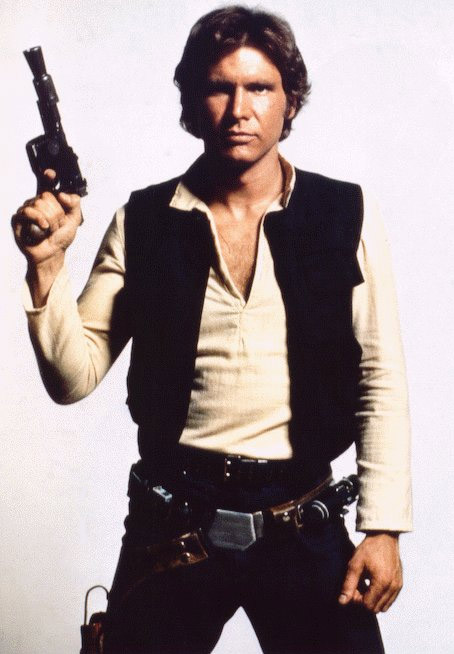
Look, I ain't in this for your revolution, and I'm not in it for you, Princess. I expect to be well paid--I'm in it for the money.

If you’ve ever read a space adventure with smugglers and pirates, or a sword & sorcery with rogue thieves and master-less swordsmen, or a western with gritty outlaws and mountain men, you know this character alignment.  If you’re a fan of any of these genres, chances are you love him, too.

The Chaotic Neutral‘s one consistent rule is to always look out for #1.  Beyond that, he’s a free spirit who believes in individuality and resists anyone or anything that tries to control him.  Rebellious spirits and lovable rogues tend to fall into this alignment, but so do tricksters and wild cards.  Their resistance to any form of personal restriction makes them unreliable allies, despite what Jack Sparrow says.

From the easydamus alignment page:

A chaotic neutral character follows his whims. He is an individualist first and last. He values his own liberty but doesn’t strive to protect others’ freedom. He avoids authority, resents restrictions, and challenges traditions.

A lot of characters start out as this but tend to shift as the story progresses.  Han Solo, for example, shifts from Chaotic Neutral to Chaotic Good as he becomes more and more involved with the Rebellion.  The Jägers from Girl Genius are Chaotic Neutral until they have a Heterodyne to lead them.  But in other stories, such as Pirates of the Caribbean and Schlock Mercenary, the Chaotic Neutral serves as an anchor.

My favorite Chaotic Neutral is probably Waylander from David Gemmell’s Drenai series.  The Jerusalem Man is another good one–in fact, just about every one of his books has a Chaotic Neutral that I love.  Haruhi Suzumiya is an excellent example of a female Chaotic Neutral–in fact, she’s probably the queen of this particular character alignment.

In my own work, the best example of a Chaotic Neutral would probably be Tamu from Bringing Stella Home / Sholpan.  Even though she’s technically a slave, she doesn’t really mind it because she has everything she wants and doesn’t have to be beholden to anybody (not even Qasar, really, since she’s his favorite).  Amina from Desert Stars is also Chaotic Neutral, in contrast with Surayya, who is more of a Lawful Neutral, though sometimes it’s hard to tell.  And in Genesis Earth, Terra is definitely a Chaotic Neutral at the beginning, though she shifts a little somewhere around the middle.

I’m hesitant to admit this, but when I took the character alignment test for myself, I tested out as a Chaotic Neutral.  As to what that means, exactly…I’m not going to say. o.0

Trope Tuesday: Celibate Hero vs. The Fettered

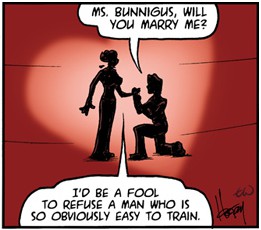
Yes, there are still good men out there...and they tend to know who's boss.

I’m mashing up two tropes this week because I’m not satisfied with the one.  There are a bazillion tropes about characters who are sexually active, but very few about sexually chaste characters that don’t portray them as weak, clueless, or socially inept.

According to tvtropes, a celibate hero is a main character who “doesn’t do the romance thing.” Unlike the chaste hero, who is just clueless, the celibate hero has made a conscious decision not to engage in sexual relations or get tied down in a relationship.  There may be any number of reasons for this, but it usually comes down to some combination of Love is a Weakness, Love Hurts, and It’s Not You, It’s My Enemies.

(As a hilarious example of this: TESLA!!!)

But what about the character who isn’t necessarily opposed to romance, but feels that they should wait until marriage to have sex?  Unfortunately, this trope is pretty rare nowadays.  I can only think of two mainstream examples: Edward from Twilight and Reverend Theo from Schlock Mercenary.

Theo in particular is a great example of this, because he’s not clueless, he’s not weak, and he not only gets the girl, he gets the girl that everyone wants.  The only reason he holds out is because his religious order forbids sex before marriage.  It does permit priests to marry, however, so Theo does manage to balance the two.

So why are characters like this so rare?  Unfortunately, I think it comes down to the widespread notion that a true man isn’t a virgin, and that sex makes people cool.  If we accept these tropes as true, then that means that men who exercise self-restraint are actually weak and pitiful, and couples who choose to wait are pathetic losers.

It’s worth pointing out that both Edward and Reverent Theo were created by writers who are practicing Mormons–people who belong to a religious community where it’s still the norm to wait until marriage.  If literature is the way that the culture speaks to itself, then this goes to show just how unrestrained the rest of Western society has become.

This is why I think that the better trope for this kind of character is The Fettered.  Unlike the celibate hero, who usually gives up sex for some kind of external reason, the fettered gives it up as a matter of principle.  Living by his ideals isn’t easy, and he’s constantly tempted to give in and break his moral code.  However, by resisting these temptations, the fettered gains great strength, and can stand like a beacon of light in an otherwise disillusioned world.

This is actually something that I tried to do with my latest novel, Desert Stars.  The main character, Jalil, is a man who believes in honor, and follows a code of abstinence before marriage.  However, to manipulate him into staying at the camp, his father charges Mira, the female protagonist, to seduce him.  Since the fettered’s strength is also his greatest weakness, if Mira can get Jalil to sully her honor, then out of shame he will return and marry her.

The catch?  She actually has feelings for him, and doesn’t want to manipulate him in this way.  In this way, merely persuading him to have sex isn’t a win condition–in fact, if done in the wrong way, it could be a very serious “game over.”

Whether or not I actually pulled it off well is up to the readers to judge.  But one thing I was definitely shooting for was to write a character who fulfills this trope in an unconventional yet powerful way.  And if you’ll permit me to step onto my soapbox for a little bit, I think our culture desperately needs more heroes like this–heroes who show that real men are capable of self-restraint, and that following a moral code is still cool, even if it means waiting to consummate a relationship.