Fantasy from A to Z: U is for Unicorns

If you were expecting a post on unicorns or other mythical beasts, I hate to disappoint you again, but that’s not what this is going to be. Instead, I want to write a bit about that most mythical of all human creatures: the full-time fiction writer.

Okay, perhaps we’re not that mythical. After all, Brandon Sanderson estimates that of all his students over the years, perhaps as many as 10% of the ones who set out to become full-time writers actually make that dream into a reality. I sometimes wonder: would Brandon count me as one of those 10%? Should he? The answer to that is… complicated. 

One of the first questions I get whenever I tell people that I’m a writer is “oh, wow—how is that working out for you?” Which is really a roundabout way of asking how much money I make, and whether I’ve been able to turn it into a full-time career. I am not (yet) a major bestselling author, and the closest thing I’ve had to a breakout thus far has been my (now unpublished) Star Wanderers novella series, which managed (mostly by accident) to hit the algorithms correctly back when a permafree first-in-series with lots of direct sequels was the best path to success. Then the publishing landscape changed, the algorithms shifted to favor pay-to-play advertising, and my books got left behind.

I will admit that if it weren’t for my wife’s income, I wouldn’t be able to pursue writing full-time. As a family, we’re following a path very similar to my Scandinavian ancestors, where the wife tends the farm while the husband goes off a-viking. In other words, my wife has the stable, traditional career that provides our family with some degree of security, while I have the more risky career that has the potential to catapult us into transformative levels of wealth and prosperity. We’re doing just fine, but it does sometimes feel like my Viking ship has yet to land ashore.

Because here’s the thing: something like 90% of the money in book publishing (after the booksellers and publishers and other middlemen take their often-exorbitant cuts) goes to less than 1% of the writers who actually make any money (and something like 30% of kindle books never sell a single copy). 

For every Brandon Sanderson, there are thousands—perhaps hundreds of thousands—of published authors who write on nights and weekends while holding down a day job to pay the bills. My writing contributes enough to the family budget to justify pursuing it, but if I were still single, I would need at least a part-time job.

Indie publishing has created a lot of opportunity for authors to make a career out of their writing, and there are many successful indies who are making a decent living at it. At the same time, indie publishing has also massively exploded the number of books that are published, so the proportion of full-time to still-aspiring authors is probably about the same (and may have actually tilted the other way). 

In recent years, it has very much turned into a zero-sum pay-to-play game, especially with advertising. From what I can tell, most authors lose money on advertising, and most of those who are making money are spending upwards of $10,000 each month to make $11,000. The elite few who learn how to successfully game the algorithms to blow up their books often put their writing on the backburner to launch their own companies or provide publishing services, leveraging their expertise to make a lot more than they otherwise would.

The algorithms are changing books in some very strange ways. If J.R.R. Tolkien or Roger Zelazny or Robert E. Howard were writing today, would they be able to make it in today’s publishing environment? 

Howard’s Conan stories would either have to be a lot sexier, or else would have to include the sort of tables and character stats you find in LitRPG. His covers would also be a lot more anime, and show a ridiculous amount of cleavage (which he actually might not have had a problem with, judging from some of the old Weird Tales covers). 

Zelazny’s Chronicles of Amber would all be far too short to make it in Kindle Unlimited—to make it in that game, you have to have super long books that max out on page reads, in order to maximize advertising ROI so that you can outbid your competitors. And if you aren’t winning the pay-to-play advertising game, your KU books will sink like rocks. Also, Zelazny took way too much time between books. Gotta work on that rapid release strategy, Roger.

As for Tolkien… hoo boy, there’s an author who did everything wrong. Decades and decades spent polishing his magnum opus, with a short prequel novel that falls squarely in the children’s category (totally different genre) as the only other fantasy book published in his lifetime. I suppose he could have serialized Lord of the Rings, except nothing really happened in episode 1: A Long-Expected Party. Certainly not anything that would adequately foreshadow all the dark and epic battles to come. Perhaps if he followed a first-in-series permafree strategy, and just gave away Fellowship of the Ring for free… and then made The Hobbit his reader magnet for signing up for his email list… maybe that could have worked? After all, there’s always BookBub…

I jest, of course. Each of these authors’ books became classics, not because of their marketing strategy, but because they hit the cultural zeitgeist in exactly the right way. But is it possible for an author to do that today without also getting a boost from the algorithms? Or do the algorithms have more power to shape our culture than anything else? Those are disturbing questions, and I honestly do not know the answer.

And then there’s the question of AI, which is massively disrupting all of the creative fields. In the interest of full disclosure, I am actually quite sanguine about generative AI, and have already been working to incorporate it into my creative process. I’m not a fan of AI slop, but I don’t feel particularly threatened by it. I decided a long time ago that if AI ever became good enough to write an entertaining book, it still would never be able to write a Joe Vasicek book. That’s insulated me from most of the doom porn out there.

Right now, there is a HUGE fight happening between authors like me who are embracing AI, and authors who treat it all as anathema, and have vowed to never use any sort of AI in any of their books (except Grammarly, of course, because… reasons. And Microsoft Word. And…) Frankly, it reminds me of the big debate between indie and traditionally published authors, back before self-publishing had lost its stigma. The biggest difference is that the level of online outrage has been ramped up to 11, mostly as a result of the social media algorithms (which weren’t as robust or as powerful back in the early 2010s). I suspect that we will ultimately settle on a “hybrid” approach, much like we did with publishing, but the sheer level of vitriol has made me wonder about that. 

On the reader end of things, though, it seems like most readers don’t really care if a book was written with or without AI assistance, so long as it’s actually a good book. Which means that there is a real opportunity for authors who 1) know how to tell great stories, 2) have already found and honed their voice, and 3) know how to strike the right balance between the AI and the human elements. 

Which describes my own position almost perfectly. Over the last fifteen years, I’ve read, written, and published enough books that I have a pretty good handle on what makes a great story. I’ve also honed my voice well enough that I can write in it quite comfortably. And as for the balance between AI and human writing, I’ve been working hard on that since ChatGPT burst onto the scene in 2022. Half a dozen books and about a million words later, I’ve learned quite a lot about how to best strike that balance.

Will AI replace authors entirely, making this particular unicorn extinct? I don’t think so. But AI may radically change our concept of what “books,” or “writers,” or “writing” really are. A long time ago, I realized that even if AI became good enough to write a decent book, it would never be able to write a Joe Vasicek book. Only I can do that. Whether or not that’s worth something is up to the readers to decide.
2020-01-23 Newsletter Author’s Note

This author’s note originally appeared in the January 23rd edition of my email newsletter. To sign up for my newsletter, click here.

Every week, when I sit down to write the author’s note for this newsletter, I try to come up with something that you’ll find genuinely interesting or insightful. I don’t want to talk about myself too much, since that tends to get boring rather quickly, and I also don’t want to talk too much about writing, since for non-writers that also tends to get boring. Most of my fans probably aren’t professional writers, and those of my colleagues who do subscribe to this newsletter probably just want to keep tabs on what I’m doing and aren’t themselves fans (except for you, J.R. Handley).

Then again, since you’re someone who 1. actually opens the newsletter, and 2. bothers to actually read it, you probably do have some interest in both me and my writing. So I hope you’ll indulge me, because the thing that’s on my mind this week has to do with a couple of blog posts I read by Kristine Katherine Rusch and Dean Wesley Smith.

I have tremendous respect for Kris and Dean. Their opinions on writing and publishing had a huge impact on my decision to jump into indie publishing nearly nine years ago. That said, their advice has been a mixed bag: some of it ranks among the best writing and publishing advice I’ve heard, but some of it has sent me down the wrong path, sometimes for years.

On Wednesday, Dean wrote a blog post where he explained his big secret:

It actually boils down to one simple thing… I don’t care what anyone thinks of me. Or of my writing, or methods of writing.

I just flat don’t care.

In other words, the grand key to understanding all of Dean’s writing and publishing advice is this: don’t give a damn about anything else except having fun.

All of a sudden, everything began to fall into place; both his good advice (don’t let agents scam you, trust your own voice, don’t let writing groups boss you around, don’t devalue your work) and his bad advice (never revise anything, never read reviews, do all of your own covers, write everything quickly, don’t outline anything, don’t actively promote your books). It all comes down to his core philosophy of not giving a damn.

But is that really the best approach?

Dean’s advice is very good for writing a certain kind of book. But the kind of books that I want to write are the ones that I like to read: books that really stick with you, either because they get you to think deeply about something, or feel deeply about something in a way you’ve never felt before. And I may be wrong, but Deans approach of not giving a damn seems like a terrible way to write those books.

Another thing that Dean always talks about is “critical voice.” Basically, all writers have two voices in their head: one that understands story and makes you want to write, and the “critical voice” that tells you what’s wrong with everything and makes you want to give up writing forever. Maybe he’s right about that. But does it necessarily follow that the only way to write anything is to get your critical voice to shut up?

For the last few years, I’ve been developing a new method for outlining my books. I used to think that outlining is terrible because it takes all the fun out of writing—in other words, exactly what Dean says. Instead, outlining helps me to keep my “critical voice” in check, because when something is broken the outline helps me to see where the problem is, and how to fix it. It also helps me to eat the proverbial elephant one small bite at a time.

Is there a useful place for “critical voice” in the writing process? Can giving a damn actually be the key to writing a better book, or making writing fun again?

This past week, I was writing a new scene in Star Wanderers from Noemi’s point of view. It takes place during the events of Fidelity and Benefactor, when Mariya’s father loses his job and the family doesn’t know what they’re going to do. It felt like a slog until I realized that the conversation between these two characters, Mariya and Noemi, offered a really interesting chance to explore questions of faith, doubt, and the problem of evil. Suddenly, the scene really came alive for me, and the key was asking myself “what can I offer my readers here? What will they take away from this?” In other words, giving a damn actually made the writing more fun, not less.

A few weeks ago, Kris wrote a really interesting blog post where among other things she said:

If a writer isn’t afraid of what she’s writing, then she’s doing it wrong because she’s not stretching herself. You should always reach just a bit, go a place you haven’t gone before.

I like that. And if I didn’t actually care about what you or others thought—if it was all about myself and “having fun”—I don’t think I’d ever really stretch myself as a writer. Or perhaps I would, but not in the right way. I’d be like one of those bodybuilders, with massive pecks and teeny tiny legs.

All of which is to say that I think I finally understand now why Dean Wesley Smith’s writing and publishing advice is so hit-or-miss. And also, that I understand a little better how to write the kind of books that made me want to write in the first place.

Thoughts on Minimum Viable Product

So I read an article on Draft2Digital’s blog about Minimum Viable Product and what it means for writers, and it got me to thinking about what that means for books in general, and my own books in particular.

From what I’ve managed to gather (and I could be totally wrong), the controversy in the indie writing community over MVP began when the guy who started 20 Books to 50K first started a topic on KBoards, talking about how he’d used the MVP concept to launch a successful career. This rubbed the KBoards groupthink in the wrong way, and they ran him out with torches and pitchforks, so he started his own group. Indie writers have been arguing about it ever since.

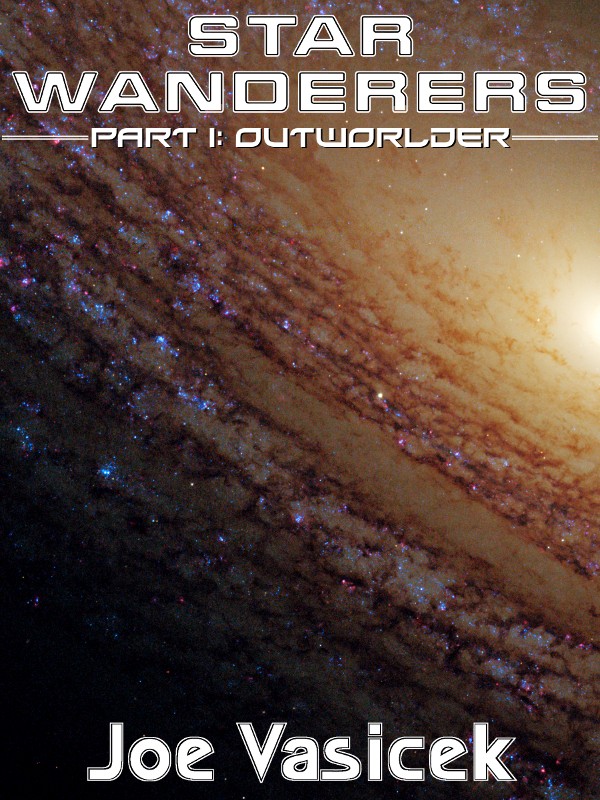
On the one hand, I can’t really criticize the concept, because I kind of followed it myself. When I published my first three books, I sunk a fair amount of money into them, and when I realized it was going to take a long time to earn that back I shifted strategy, publishing the best quality work that I could on a shoestring budget. The result was this:

Ah, the good old days when I was young and stupid (now I’m just stupid). Cover art taken from NASA, which is all in the public domain. Title and subtitle font taken from a free font site, author font cribbed from an old 90s-era Sid Meier’s Alpha Centauri CD-ROM. No gradients or visual effects on the text itself—even the drop shadow is just a mirror image of the text in black, offset diagonally by a few pixels. As if that’s not enough, the aspect ratio is 3:4, which makes me want to grate my teeth.

So that was my minimum viable product at the time. The other novellas had very similar covers, with NASA space art, free fonts, and everything else. I also self-edited most of them, though I did have some editing student friends who volunteered to proofread the later ones. Surprisingly, the books sold. By 2013, they’d earned enough that I could afford to hire out a cover designer, who made the covers the books have today. Needless to say, the quality is much better.

I guess you could say the MVP strategy worked for me, though I’m not so sure it would work as well today. The key point, though, is that once I could afford to upgrade to a better quality product, I did so. The production aspect of a book is stuff like the cover art, copy editing, proofreading, etc. Most of that stuff can be upgraded over time, so if you have to do it on a shoestring budget, it’s not such a big deal.

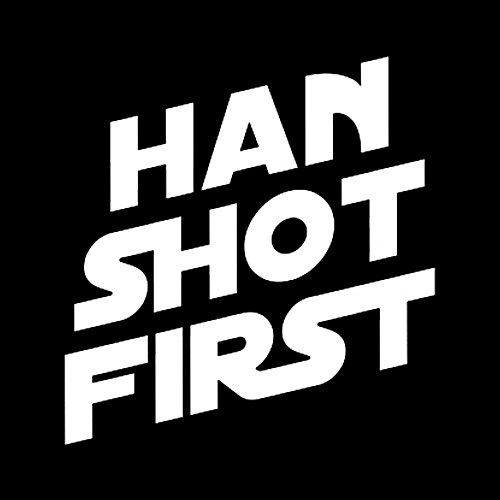
But in my opinion, the writing itself is completely different. Some writers will go back and rewrite their books after they’re published, but I think that’s a horrible idea. What about the readers who enjoyed the first version? It’s okay to fix things like typos, or maybe remove some bad language but changing things so completely that the story itself changes is just wrong. It’s how we end up with memes like this:

A lot of people got pissed at George Lucas for the changes he made to the original Star Wars trilogy, myself included. It’s one thing to update the CGI for the X-wing dogfights, but it’s something else entirely to rewrite the characters. Han shot first, dammit!

So as far as MVP goes, I don’t think it works for writing—at least, not the kind of books that I’m trying to write. Perhaps in some genres, like porn, clickbait, and Buzzfeed articles, it’s better to put as little time and energy into the writing as you can get away with, but for the books I like to read, I want to know that the author did their best work. You can’t produce your best work and simultaneously aim for what’s minimally viable.

Of course, as the Draft2Digital blog post points out, that doesn’t mean that you should write slowly and slog through endless revisions. Sometimes the best books are written quickly, in a single draft. One of the great enduring myths is that there’s a correlation between how good a book is and how long it takes to write it, and another enduring myth is that revisions always make a book better.

I know there are some indies out there who have had great success by reading the one-star reviews and rewriting their books accordingly. To which I say: you shouldn’t use paying customers as beta testers like that.

Some media formats, like blogs, TV, or magazines, are designed to be ephemeral or to be changed or updated over time. Books are not. As Stephen King put it in On Writing, when we write a book, we are acting as time travelers, packaging up our stories and sending them forth, to be recreated in the mind of a reader long after we have written it. Books are unique like that.

So that’s what I think about minimum viable product. It’s a useful way of thinking about all the stuff you can update later, but for the story itself, it’s a horrible idea. Write the best book you can right now, then send it out into the world and write another one. That’s my strategy, at least.

Rethinking free

I recently read an interesting blog post on Dean Wesley Smith’s blog, about how, how not, and whether to make your books free. The conclusion he comes to is this:

Free is short time, limited supply, and never on the major bookstore shelves.

In other words, no permafree, no free pulsing, and no publishing free online content on sites like InstaFreebie unless it’s for a limited time.

Three or four years ago, I probably would have pushed back pretty hard against this advice. There are still points of it that I disagree with, such as the idea that giving anything away for free devalues all your other work. Perhaps that’s true for physical product, but for digital content I think there’s a solid argument to be made that the rules have changed.

That said, a lot has happened in the last three or four years. Permafree worked really great until about the middle of 2014, at which point I noticed that it was a lot harder to generate any kind of interest in my free books. I switched to a free pulsing strategy in 2015, which was a lot more effective at giving away free books, but that didn’t always translate into more sales.

In fact, there’s a passage from Dean’s blog that sums it up real well:

A customer walks through your door and you have a wall of twenty pies in glass cases, all the smaller short story pies in a case in the center, and some specials near the cash register.

And there on your wall are three pies that say, “Free.”

And a bunch of short stories that are “Free.”

The customer can take an entire pie for free or buy one. As a customer, what would you do? Duh. You take the free pie and leave.

And pretty soon your customers start to change. The only people who come through the door are people who only want the free stuff. They would never buy something under any circumstances, but you are giving your pies away for free, so they take one.

Pretty soon there would be lines out the door to get your free pies and you would make nothing. The free takers would crowd out and devalue the pies you are trying to sell.

Now, I don’t entirely agree with Dean here. My 90-day sales chart on Amazon shows a predictable uptick in sales every time I set a book free and send out an email to my list. Most of my subscribers signed up through InstaFreebie, which means they’re probably not quite fans yet (and probably signed up for a bunch of authors’ lists).

But my long-term data tends to agree with Dean. Back in 2012 and 2013, there was a very clear correlation between free downloads and royalties / paid sales. Then, in 2014, that correlation started to become fuzzy. Over the next several months, it got progressively fuzzier (even though I was giving away more books), until today there’s really no correlation at all.

Obviously, YMMV and I can only speak for my own books. But there have been a lot of major shifts in the ebook market over the last five years. Kindle Unlimited has had a huge impact on the effectiveness of permafree, or any kind of free book strategy for that matter.

Point is, it may be personally useful to rethink my free strategy. I’m not going to stop doing the free book thing altogether, since I do think there’s still value to it (if for no other reason than that little sales bump, plus the handful of “thank you!” responses I get from my email subscribers each month). But instead of free pulsing two books each month, usually including a first-in-series novel, it may be better to do a 99¢ novel and a free short story.

The two biggest mistakes I’ve made so far in my writing career have been 1. underpricing my books, and 2. unpublishing books that were still selling. (I still can’t believe how stupid I was) Holding onto a free books strategy that isn’t working could easily become a close third. I’m not going to throw the bus into reverse while it’s barrelling down the highway at 70 mph, but some experimentation and a course correction may be in order.

Writing is not a business

I recently read Rich Dad, Poor Dad by Robert Kiyosaki. It’s a fantastic book, not only because it gives you a basic education on financial literacy, but because it gives you a solid foundation for making money in general. It’s one of those books that really deserves its bestseller status.

About midway through reading it, I realized that I’ve been thinking all wrong about my writing. Everyone always says that if you want to write professionally, you should treat your writing as a business. But that’s not entirely correct.

Writing is not a business, it is an investment. Publishing is a business.

The basic argument of Rich Dad, Poor Dad goes like this: if you want to be wealthy, don’t work for money—make your money work for you. How? By owning more assets than liabilities. An asset is something that puts money in your pocket. A liability is something that takes it away.

When you write a book, you are creating an asset. A book is an intellectual property that generates money. Dean Wesley Smith compares it to a piece of pie in a magical bakery, where you can cut infinite pieces for your customers. With online publishing through ebooks and print-on-demand, that’s not a bad analogy.

If I were to cease all of my publishing activities right now, including all marketing and promotion whatsoever, my books would still generate income. It probably wouldn’t be a lot, but it would still be something. Even starting from zero, with a single book on Amazon under a totally unknown name, over time it will generate a small trickle of income.

A book is an asset. Writing is how you create that asset. Publishing is how you service that asset to make it more profitable.

As an indie writer, I am my own publisher. The business that I own is a publishing business, not a writing business. It’s a subtle but important distinction. I could still create books if I weren’t my own publisher, but at that point I’d be a contractor, not a small business owner.

Writers are not paid by the hour. As an indie, I’m still earning money on work I did ten years ago, and I fully expect to continue earning income on that work for the rest of my life. That’s because writing is an investment. Not a job. Not even a business. An investment.

Which is not to say that the publishing aspect—or in other words, the business aspect—is less important. Quite the contrary. A rental property is an asset, but it won’t make any money unless you find renters and take care of the upkeep. Similarly, a prime plot of farmland is an asset, but it won’t make any money unless you work it.

So how do you “work” your books? By publishing them, of course. Publishing is your business. This includes marketing, promotion, branding, and the like. Publishing is the business that makes your assets—your investments—profitable.


The implications of this are really interesting. For example, suppose you have a book that doesn’t sell very well, or that gets a bunch of negative reviews. Does that make you a failed writer? Does it spell doom for your career? It’s easy to think so if you think of writing as your business.

But when you think of writing as an investment, everyone changes. Got a book that tanked? That’s okay, it’s just that book. Every investor gets it wrong every once in a while. Learn from the mistake and pick a better investment next time.

If all your books are tanking, is that a sign that you’re just not cut out for this writing thing? Possibly… or it could just be that you need to work on your publishing. Even the richest farmland needs to be tilled, and fertilized, and watered properly. Perhaps you just need to learn how to market better, or brand your books better, or do a better job of finding and connecting with your readers.

On the flipside, suppose you have a book that used to do well, but now it isn’t selling as well as you would like. You’ve clearly done a good job of marketing it in the past, but what can you do now? Market it even harder? Or recognize that this is just a normal part of the investment cycle and go out to develop a new asset?

If writing is your business, then the success or failure of your books is a direct reflection of yourself as a writer. With that kind of mindset, it’s easy to fall into some traps. On the one extreme are those who believe that publishing well is secondary to writing a good book, and that therefore they should devote the bulk of their time and energy to writing. On the other extreme are those who seek validation so hard that they put all of their effort into the publishing aspect and neglect the writing. The truth is NOT somewhere in the middle, because both extremes grow out of a faulty premise: that writing is your business.

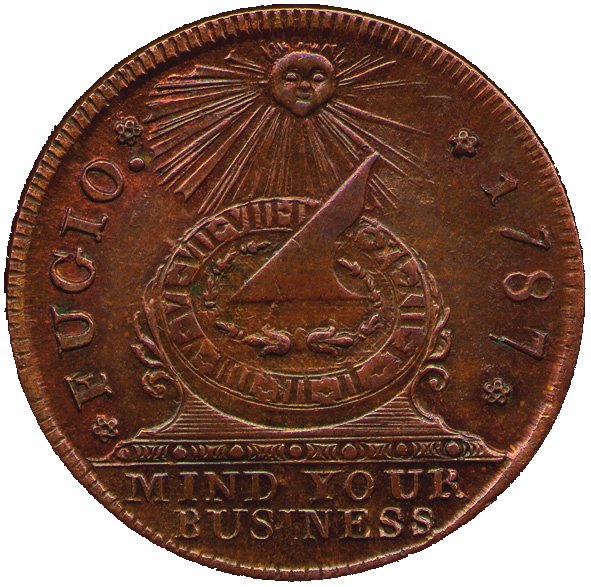
This is the Fugio cent. It was commissioned by the Continental Congress before the ratification of the Constitution, and designed by Benjamin Franklin. Fugio means “I fly,” referring to the sundial, which represents time. Taken with the inscription below, it is a reminder that we can all leave the world a better place by doing our best in whatever line of work we choose to pursue.

For many of us, writing is more than just a hobby, or a job, or even a career. It is a vocation. It is our calling. And yet, we live in a commercial world, where the price of a thing is often conflated with its value. How, then, can we best fulfill our calling as writers? By ignoring the demands of the market? By fancying that our books are simply unappreciated by those of inferior tastes? Or by losing sight of our calling for that lucre that will perish with us?

Benjamin Franklin’s message is that we can best fulfill our calling by pursuing excellence in every aspect of it. That includes the commercial aspect as well as the artistic, the practical as well as the spiritual. When we truly learn how to excel, we will see that there is no contradiction between the two sides.

Writing is our calling. Publishing is our business. Our books are investments, many of which may very well outlive us. By understanding this, I firmly believe that we can mind our business as well as Franklin admonished us, and truly fulfill our calling.

So you’ve written a short story…

So you’ve written a short story, and you’re wondering what to do with it. You think it’s pretty good and you want to see it published, but you’re wondering what’s the best way to do that.

I can’t guarantee that this is the best way, but it is the way that I do it. Let’s start with the basics.

Indie vs. Traditional

Traditionally, short stories were published in magazines, anthologies, or collections. These were known as the “markets.” The editor was the one who chose which stories would go in and shepherded them to publication. Because of the periodical nature of the markets, there were a lot more short story slots than openings at the big publishing houses for novels, and many editors considered it a way for new writers to cut their teeth and prove their chops. It was also a great way for writers to get feedback, on the rare occasion that an editor wrote a personalized rejection.

In the 90s and 00s, the short story markets entered a period of decline, mostly due to the technological disruption of this newfangled thing called teh internets. Subscription rates for all the major sci-fi magazines went down, just like they did for newspapers. However, several new markets emerged to take advantage of the new ways to reach readers. The same innovations that spurred the indie publishing revolution also gave birth to new short story markets.

Today, when you write a short story, the first question you’ve got to answer is “do I want to self-publish this, or should I submit it to the markets first?” If you’re a happily self-published indie writer like me, the urge will be to self-publish first and ask questions later.

But Wait!

The awesome thing about short stories is that you can get the best of both worlds. How? Because unlike the major publishing houses, the traditional short story markets don’t impose prohibitive measures designed to gobble up your rights and lock down your publishing options. Publishing the same story in multiple markets is not only possible, it’s encouraged.

To maximize your returns, you have to be patient and impervious to rejection. You also have to learn some key terms. But first, as with any job, you have to select the right tools.

Get Thee to the Grinder!

To start out, you’re going to have to need some way to track all of your story submissions. By far, the Submission Grinder is the best free tool on the internet to do that. It’s a massive database for every English-speaking short story market, with stats compiled from user data. Not only does it tell you where you can submit, it gives you all sorts of useful statistics about each market. Create a free account, log your story, and use the Grinder’s search tools to find out where you can submit it.

Because I’m paranoid and believe in redundancy, I also keep a spreadsheet with all of my story submissions. At this point, though, it’s largely a backup. There’s no one right way to keep track of your submissions, but you absolutely need a system to keep track of them, and the best one out there is the Grinder.

Pro vs. Semi-Pro vs. Token

To decide whether a market is worth submitting to, you first have to determine how professional that market is. The best way to do that is by looking at the pay rates.

In the old days, when SFWA was more than just a snobbish in-crowd full of petty drama, you could tell that a market was professional if it was on the qualifying list for SFWA membership. Today, though, any market is considered professional if it pays at least 6¢ per word.

If a market pays between 1¢ and 6¢ per word, it is considered semi-pro.

If it pays less than 1¢ per word, it is considered a token-paying market.

Original vs. Reprint

Some markets want to be the first place where a story appears. If it’s already published elsewhere, they won’t touch it. Other markets don’t really care, though they may pay less for reprints.

The thing to look for here is “original fiction” or “first publication rights.” If a market’s submission guidelines specify either of those, then they won’t take your story if it’s self-published. Obviously, if you want your story to appear there, you can’t self-publish it first.

Most of the markets that accept reprints don’t mind if your story is already self-published. A couple of them do, which is super annoying, but whatever. As always, read the submission guidelines carefully before you submit.

In general, the more a market pays, the less it’s willing to accept reprints. Adjust your publishing strategy accordingly.

Multiple and Simultaneous Submissions

If the first thing you do after finishing a short story is submit it to every market that might possibly accept it, you’re liable to get yourself blacklisted and make a lot of editors angry. There is etiquette and protocol to the traditional publishing game, and if you want to succeed by going that route, you’re going to have to learn it.

simultaneous submission is when you submit the same story to more than one market simultaneously.

multiple submission is when you submit another story to the same market where you already have a story in consideration.

Most editors hate multiple and simultaneous submissions. If they like your story and want to buy it, the last thing they want is to find out that another editor beat them to the punch. Likewise, if they’re swamped with submissions (as they usually are), the last thing they want is more stories from someone who’s already submitted something to them.

For that reason, assume that a market does not accept multiple or simultaneous submissions, unless their guidelines say otherwise.

Of course, what’s bad for the editor isn’t necessarily bad for the writer. You can greatly speed up the submissions process by submitting to all the simultaneous-friendly markets at once, or by not having to wait for a response before submitting to a market again. The faster you can get through the submission process, the sooner it makes sense to self-publish.

With That Out of the Way…

Before you decide which publishing path to take, you first have to determine your publishing goals. Are you trying to make money, to build an audience, or both? Can you afford to be patient, or is time not on your side for whatever reason? Once you’ve determined what you personally want to accomplish, you’re able to make the important decisions that will take you there.

As a professional writer, it’s important for me to maximize profits. Also, I’ve found that I can do more to build an audience by self-publishing than by going through the traditional markets. That said, the prestige of publication in a pro market is still important in my field, so I find it worthwhile to submit original fiction to the pro markets before self-publishing.

Here are my criteria for submitting original fiction:

  • Will I make at least $100 from this story sale? ($20 for flash)
  • Is the average wait time for this market more than 60 days?

In a world where I can self-publish my stories and sell them directly, or give them away as freebies to build a readership for my other books, the traditional submission process costs both time and money. Also, if a market has eggregiously long wait times, that’s usually a red flag. Publish with them at your own risk.

However, for reprints I will submit my stories just about anywhere. They cost neither time nor money, because they don’t care if you self-publish first; all they want is non-exclusive publication rights. They don’t typically pay as well, but who cares? It’s free money, and the extra exposure isn’t going to cost you anything.

When making simultaneous submissions, I generally do it by tiers. If the story is at a pro market that accepts simultaneous submissions, I will only submit it to other pro markets. Likewise, if a story is at a semi-pro market, I will only simul-submit to other semi-pros. This is the best way to maximize your potential returns for original fiction.

In practice, though, since most simultaneus markets don’t pay more than $100, I usually end up submitting to them after I’ve already self-published. At that point, it doesn’t really matter where I submit, since a sale to a token market isn’t going to keep a semi-pro market from buying it too.

So in short, here’s my process:

  1. Submit to all the markets that will pay at least $100 and respond in a reasonable manner (usually takes 1-2 years).
  2. Self-publish.
  3. Submit everywhere that accepts reprints and pays at least token rates.

A Word About Royalty-Share

In today’s rapidly changing publishing environment, a few markets are experimenting with non-traditional forms of payment. Royalty share is one of those. Instead of paying up front by the word, these markets pay you a share of the profits after the work is published.

In general, this is what I think of that:

Unless the royalty share arrangements are made against some sort of an advance, the publisher is basically asking you to take the risk for their venture. For original fiction, I’m generally not open to that, especially for markets with long exclusivity periods after publication. Tried that once, got burned, learned my lesson.

However, once I’ve self-published, the reprint rights are basically free money anyway, so I’m happy to give it a shot. Worst case scenario, I neither lose nor gain anything. And there are some places like Digital Fiction that are doing some really interesting things with non-traditional payment methods. I just signed a contract with them this week.

So yeah, that’s my process. The money in short fiction isn’t all that great, but if you’re systematic, organized, and prolific, you can make a decent profit at it. It’s one of the few areas of publishing where it still makes sense to go traditional, but you’ve got to know when to pull out and go indie. If you can afford to wait, it makes sense to run down all the pro and semi-pro markets with your original fiction. Otherwise, you have to figure out the cutoff point where it no longer makes sense to hold out.

Good luck and happy publishing!

An open letter to my 2008 self

Dear Joe,

This is yourself from the future. I know, that sounds kind of cheesy, but it’s true. Pay attention, because there are things I need to tell you. This is not to replace the life lessons that you’ll soon be learning, but to help you learn them faster so you can move on to the important stuff.

Right now, your college career is in full swing. You’re writing a lot of books on the side, and that’s great—keep it up. You will find a lot of success in your goal to be a professional writer. You’re also studying Arabic and Political Science with vague ideas of having some sort of an impact on the world. That’s fine, but unless you make those goals more specific and focused, you’re not going to accomplish anything by them. And before you try to change the world, you first need to take the time to understand it.

At this very moment, the world is transforming right before your eyes in ways that will cause you to look back and wonder. The financial collapse and housing bubble have thrown the global economy into chaos, and the resulting fallout will have a greater impact on your life than 9/11 or any other event. Up until now, you’ve focused on the Middle East, but the place you should be looking to is Europe. Why? Let’s just say there is a reason why every world war has had its origins in the European penninsula. Study the continent. Spend some time there. Learn a couple of languages, and pay attention to current events. Always be aware that you live in interesting times.

Your political affiliation on Facebook is “agnostic,” which you think is really funny. Frankly, that’s bullshit. Good and evil have political dimensions, and you aren’t doing anyone any favors by sitting on the fence. Pick a side, and choose it well. But always have the strength and integrity to admit it when you were wrong.

You’re proud of the fact that you never voted for George W. Bush. In the future, though, you’re going to regret your vote for Obama more than you ever would have regretted a vote for Bush. Obama will break every campaign promise he ever made, except to get us out of Iraq, and that will be the biggest mistake of his presidency (yes, the Iraq War was a mistake, but trust me, Obama will make it unimaginably worse). However, you will never regret your vote for Romney in 2001.

One of the most important lessons you will ever learn is that there are two kinds of people in this world: makers and takers. The makers believe in expanding the pie by creating wealth and value for everyone. In contrast, the takers believe that everyone should get “their fair share.” Somehow, this always ends up with the takers being the ones to cut the pie, with them getting the biggest slice. Don’t be a taker. Be a maker.

Enough about politics. Let’s move on to personal advice.

Don’t be afraid to change your major. Don’t put off doing an internship. Those will be the biggest regrets of your college career. Even so, there is nothing you do in college that you will deeply regret, so don’t worry about it too much. Continue to take full advantage of your time there.

At the same time, don’t worry too much about grad school. Your real education won’t begin until after you leave academia. Book learning is good, but it’s no substitute for real-world experience. Learn how to master your own personal finances. Never be ashamed to work an honest job, no matter what that job may be.

Contrary to what you currently believe, marketing and sales are not evil (though human resources certainly is). The only reason you think they’re evil is because they rule the world, and from your sheltered academic perspective you can’t see the good that capitalism creates. Embrace marketing. Learn how to properly sell yourself. You don’t have to be dishonest to be a good salesman.

People who self-publish are not as crazy as you think they are. The publishing industry is about to be turned on its head, and that is going to create a lot of opportunities for you. Keep your eyes open, but be aware that the best and worst publishing advice you will ever hear will come from the same source. Also, Miss Snark is full of shit.

Finally, don’t worry too much about dating or getting married. Definitely put yourself out there, but spend less time obsessing about it and more time having fun. Contrary to what you may think, there are actually attractive women out there who will be attracted to you. Keep an open mind, grow out your beard, and you’ll find them (if they don’t find you first!).

That pretty much sums it up. Always be happy, but never be content.

Your 2015 self.

P.S: If you want to lose weight, lift weights. Running and hiking just don’t cut it for your body type.

A is for Advice

For this year’s Blogging from A to Z Challenge, I’m going to write about self-publishing. I’m not a huge bestseller, but I have been a self-published indie author for the past three years, and I’m more or less making a living at it now (it’s still touch and go from month to month, but writing is my primary income now and it looks like it’s going to stay that way for the foreseeable future).

To start off this blogging challenge, I’d like to say something about publishing advice. I’ve heard a lot of it over the years, nearly all of it controversial in some way. The book industry has changed so much over the past few years, with so many publishing paths opening up to writers, that any piece of advice is bound to be contradicted in some way by another that sounds equally valid and well-reasoned.

So how do you know which advice to follow and which to discard? I don’t have easy answers, but I can point to a few things that have helped me to refine my crap-o-meter.

First, if the person offering the advice can’t back it up with a demonstrable level of success, then it’s just their opinion and should only be regarded as such. Good advice is backed by data, especially in today’s digital world.

Second, even if the person offering the advice does have a high level of success, if they present their advice as the Only True Path, they’re probably dead wrong on some level. Every writer is different, every book is different, and every path to success is different. Writers have so many options in this new world of publishing that anyone who takes a binary view is bound to be blindsided.

Third, just because a large number of people believe something doesn’t make it any more valid. This is something to be especially wary about when trolling online communities, since those tend to become echo chambers over time. No matter how many times a piece of advice is repeated, if it’s crap to begin with, it will still be crap when it gets to you.

Ultimately, it’s important to keep in mind that no one in this industry knows anything with any degree of certainty. With the way the book world has changed over the past few years, decades of publishing experience don’t count for much anymore. And even if someone knows what’s worked for them, it’s impossible to know whether it will work for you until you try it.

So how do you know if a piece of advice is good? By trying it, of course! One of the nice things about being an indie writer is the flexibility to reinvent yourself as often as you want. I’ve got twenty books out and I’m still re-inventing myself–still trying out advice and learning new things. There’s a lot of uncertainty, yes, but with uncertainty comes opportunity, as long as you don’t get locked down.

Over the next few blog posts, I’m going to share a lot of my own personal opinions and experiences, with a bit of advice thrown in just to be helpful. None of it should be taken as gospel. For everything that’s worked for me, I’m sure that the opposite has worked just as well for someone else.

My current publishing to do list

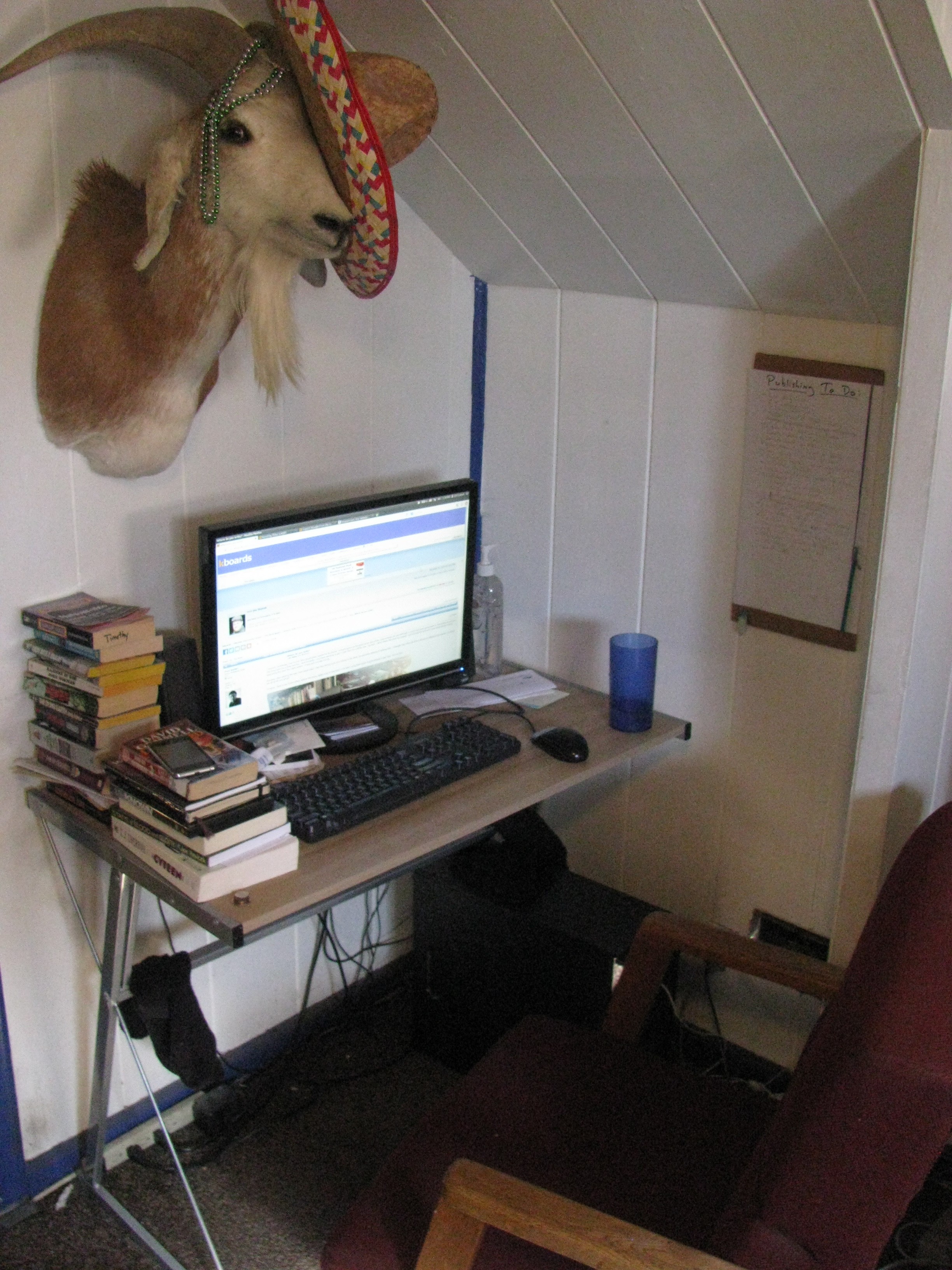
IMG_4022This is what my current writing space looks like. It’s hard to see, but there’s a board taped to the wall with the label “Publishing To Do.” Even though that board is right next to me whenever I’m working on stuff, I hardly ever look at it, and the tasks just keep piling up. So to put a little pressure on myself to get them done, I thought I’d list them here.

For those of you who are just curious, consider this a look behind the curtain of a working self-published writer.

  • Publish Star Wanderers: Tales of the Far Outworlds (Omnibus V-VIII) — I actually haven’t bothered to write this one down, but since it’s the top priority task, it’s the one most likely to get done. Everything is finished except the book cover, and I’m finalizing that with the designer right now.
  • POD Star Wanderers: Deliverance (Part VIII) — “POD” means “print-on-demand.” All the other Star Wanderers books are out in print now, except for this one. Coming soon!
  • Optimize keywords — There are a bazillion things I need to do to optimize my keywords on Amazon, as I learned just recently. Better get on that.
  • Optimize categories — Same as above. Starting here.
  • Upload books to DriveThru Fiction
  • Figure out how to format PDFs for DriveThru Fiction — I hear that customers at DriveThru Fiction like to buy PDFs that they can print out and bind as books themselves. I have no idea how to format that sort of thing, so I need to find out from someone more knowledgeable than me and figure out how to do that. For all of my books. Blargh.
  • Upload books to ARe/Omnilit
  • Upload books to Xinxii
  • Upload books to Google Play — The main reason I haven’t uploaded my books to these sites is because I’m going to be getting new covers for all the Star Wanderers books soon. Why do something twice if you only have to do it once? But yeah, I should probably just take a day or two and upload all the current versions anyway.
  • Update Amazon Book Descriptions via Author Central — This is made complicated by the fact that there are separate Author Central pages for each Amazon store. AARGH.
  • Figure out Amazon Affiliate Program — I am probably leaving a fair amount of money on the table by not putting those affiliate tags on each of my Amazon links, so yeah, better get on that.
  • Donate books to the Provo Library — I’m not sure if they’ll take them, though. My roommate says they won’t, but my brother-in-law’s father works there, so maybe he can help me find a connection.
  • Donate books to the HBLL — Since I’m a BYU alum, I’m pretty sure I can convince them to take my books. I’ve seen other self-published stuff in there.
  • POD Star Wanderers Omnibuses — Since I need to get new covers for all the individual ones first, this one falls kind of low on the list.
  • Figure out distribution on Xinxii — I heard from somewhere that they do free ISBNs now. Then again, that might have been a holiday deal. Either way, it’s something to look into–after I upload all my books there, of course.
  • Fill out Smashwords interview — This will probably be the funnest thing to do on this list.
  • Add books to Find Read Love — As well as any other book sites that are awesome.
  • Get active on Goodreads — If there’s any social media site that isn’t a waste of time, it’s probably Goodreads. I should try to be a more active user of that site, not just as a writer but as a reader. For starters, I should transfer all of the stuff from my book review section and join some groups that look particularly interesting. I’m already a member of Sword & Laser, but I haven’t done anything more than introduce myself on the forums. I listen to their podcast, though, and really love it.

That’s the list, more or less. I would absolutely love it if I had an assistant who could take care of this stuff, but I’m not currently making enough to hire one, and it would just be weird to take on an intern. Besides, the main reason I haven’t done any of this stuff yet is because I’m lazy. If I did a bit here and there, I could probably knock it all out in a couple of months. Maybe if I made a new personal rule to do something from this list before logging on to Steam? Hmm … that might actually work.

In any case, that’s what the publishing side looks like around here. When you’re self-published, you more or less have to do all of this yourself. It can be a chore sometimes, but it still beats writing personalized query letters. 😛