2019-10-17 Newsletter Author’s Note

This author’s note originally appeared in the October 17th edition of my author newsletter. To subscribe to my newsletter, click here.

I had a major realization about my creative process while writing “Sex, Life, and Love under the Algorithms.” My original goal was to take a short break from The Stars of Redemption in order to work through a creative block. Instead, I came away with a plan that could revolutionize the way I write everything.

The major realization was that my natural writing length is between 10k and 30k words. When I try to write short stories, they tend to balloon very quickly into something longer. But when I try to write novels, I always run into a creative block somewhere in the middle, usually around the 30k-40k word mark.

This doesn’t mean that I can’t write novels; just that I have to find ways to work through this problem. I remember asking Brandon Sanderson a question about this ten years ago while taking his writing class:

Me: So I have this problem, where every time I try to write a novel, I always get stuck in the middle and have to put it aside for a few months before I can finish it.

Brandon: But you finish it, right?

Me: Uh, yeah. But—

Brandon: Then what’s the problem? So long as you end up with a finished novel, your creative process is still working. It might not work the same as someone else’s, but it works.

Ever since then, that’s basically been my process. I work on a novel until I hit a creative block, then lay it aside and pick up another half-finished novel and work on it until I either finish it or hit another creative block, at which point I lay it aside to work on something else.

But in 2017, I decided that wasn’t good enough. I wasn’t producing novels fast enough to keep up the rigorous release schedule that I needed in order to stay relevant in the indie publishing world. So over the course of the next two years, I developed an outlining method to write faster, cleaner, and more efficiently.

I’ve written three or four novels using this new method, and in spite of all my best efforts, I always find myself getting stuck somewhere in the middle—in other words, after surpassing my natural writing length. At the same time, I still haven’t managed to write more than 2-3 novels per year.

It’s very difficult to keep writing on something that won’t be finished for months when your sales are starting to flag and you know you need a new release to boost everything again. Some people thrive on that sort of pressure, but not me.

That’s why “Sex, Life, and Love under the Algorithms” was so refreshing to write. From start to finish, it only took a month to write (and the only reason it took that long was because I was taking it easy). No creative blocks. No long breaks. What’s more, I now have a story to submit to the major markets, or self-publish, or do whatever else I can think of to earn money and reach new readers.

This made me wonder: what if I could write all of my novels this way?

In the golden age of science fiction, there was this thing called the “stitched novel.” Most SF writers specialized in short stories, but found it much more difficult to write novels. The solution they found to this problem was to stitch together several short stories that took place in the same world, and turn that into a novel. Asimov’s Foundation books were written this way, for example.

What if, instead of stitching together a novel after the fact, I used my novel outlines to come up with short stories or novelettes that I could later assemble into a finished novel? Each story would be a complete story in itself, and I might only reuse half of it in the novel, or rewrite it from a different character’s point of view.

Not only would I avoid hitting creative blocks, but I’d also be able to get paid during the novel-writing process itself, and also have more frequent new releases. I would also have more material to submit to the major magazines and other traditional short story markets, potentially getting my name out that way.

To keep my readers from paying for the same story twice, whenever I self-published one of these stories, I would make it free for the first couple of weeks. I would also retire most of these stories after the novel itself came out, though I might use one or two of them to help promote it.

There are a couple of novels I still need to finish using the old method. The Stars of Redemption is one of them, and I should probably also finish the Twelfth Sword Trilogy before doing anything too experimental. But I have some new story ideas that could really work out well with this assembled novel technique. Also, I think it’s time to retire the Star Wanderers novellas and combine them into a single novel, which could serve as a proof-of-concept.

I have no idea if this plan will work or not, but I figure it’s worth a try. If breaking things down to my natural writing length enables me to write more novels in the long run, that would be fantastic. And if the quality of my novels goes up because the short stories help to flesh out things like character and setting, so much the better.

Novella woes and farmers markets

Today I wrote about 2.6 words in my current WIP (Sons of the Starfarers), which didn’t really feel like it because I was constantly getting distracted.  Still, 2.6 words is pretty solid–it’s about mid-range for me.  If I can hit that every day from here on out (which is doubtful, but hey), the rough draft should be finished before the end of the month.

The crazy thing is that I just hit the inciting incident at the end of today’s writing session, after passing the 6k word mark.  For a mid-sized novella, that’s pretty late.  In the classic three act structure, the inciting incident usually hits between the 12%-15% mark, but this one is well past 20% for a 30k word novella–and just barely at 16% for a 40k.

So in layman’s terms, how long is this book going to be?  Probably longer than any of the Star Wanderers stories, but not quite as long as Genesis Earth.  It probably won’t turn into a full-fledged novel, since there’s only one viewpoint character, but I can already tell that it’s going to flirt with the line between novella and novel.

We’ll see how it turns out.  I’m still really excited about this story, and even though I don’t have a clear idea how to write the ending, I do know exactly how it’s going to end, if that makes any sense.  I’ve got a clear idea of the series arc that this book is going to set up, but I don’t yet have a clear idea of the book’s self-contained arc.  Once I figure that out, maybe I’ll be able to trim it down to a 30k novella after all.

============================================================

I visited the Stadium Farmer’s Market in Provo for the first time today.  It was pretty neat–lots of great produce, a nice community atmosphere, and a few quirky things like Jalapeno Jelly and tie died baby jumpers that you can’t really find in a mainstream grocery store.  I came away with some excellent peaches and a hankering to come back next week for more.

Anyhow, the trip got me thinking how indie publishing is kind of like a farmer’s market.  You’ve got everything from the guys who sell their produce out of unmarked paint buckets (writers who toss their books up to amazon with hardly a thought) to the local farm operations with pretty banners, pretty baskets, and laminated fact sheets drilling down on every possible difference between Elberta and Briscoe peaches (writers who go to great lengths to organize their own small presses and become Facebook/Twitter/Blogging personalities).

Almost everyone gives away free samples, which actually does a lot to drive sales.  In a similar way, most indie writers either have a couple of perma-free titles or free-pulse their books.  Everyone at the farmer’s market tries to be friendly and reach out to the customers (kind of like authors on Facebook and Twitter), but for me personally this kind of drives me away.  A good entertaining sales pitch, though, can be quite interesting.  I listened to the guy selling honey for almost twenty minutes, going on and on about his wares.  It’s clear he’s in a business that he loves.

Even though the fruit in the farmer’s market tends to have more blemishes than the stuff you find in the mainstream store, it is WAAAY more fresh and delicious.  Similarly, the stuff from the mainstream presses might be a lot more edited and polished, but the true innovation and formula-breaking stuff is happening in the world of self-publishing.  Publishers want things to be more predictable and formulaic so that they can have a better idea how something is going to sell, but indies are free to try almost anything.

Those aren’t the only parallels, either.  The more I think about it, the more it seems that being a self-published indie writer (or “author-publisher,” a newer term that I think I actually prefer) is a lot like being a local small farmer.  I’m sure there are differences, but the similarities are quite striking.

And now I’m really wishing I’d bought some of that honey.

Things I’ve learned from STAR WANDERERS

Star Wanderers I (thumb)Star Wanderers II (thumb)Star Wanderers III (thumb)Star Wanderers IV (thumb)SW-V Dreamweaver (thumb)SW-VI (thumb)SW-VII Reproach (thumb)

When I published the first couple installments of Star Wanderers, it represented both an experiment with a new publishing format and a departure from the more long-form styles that I was used to.  Now, a little over a year later, I can say it’s been a success.  The series isn’t finished, and I’m still learning as I go, but here are some of the big lessons that I’ve picked up:

Novellas are surprisingly well-suited to series. They read fairly quickly, contain enough focus to sustain an episode of a larger story, and yet at the same time contain enough space to develop a wider arc.  Plus, they are a lot quicker to write than novels and generally don’t require as much editing, since it’s easier to get the story right on the first pass.  This means that you can put out novellas faster and more regularly than long-form novels, maintaining good momentum for the series as a whole.

It’s hard to write anything shorter than a novella without leaving readers unsatisfied.  By far the biggest criticism I’ve received for Outworlder (which is really more of a novelette than a novella) is that the story feels too short.  If the novella (17,500 to 40,000 words, or 80 to 150 pages) has all the benefits of the novel and the short story, then it seems that the novelette (7,500 to 17,500 words, or 30 to 80 pages) has all of the drawbacks.  Then again, it could just be that I have yet to master the form.

The satisfying element in a series is at least as important as the returnable element.  Every successful episodic story has some sort of returnable element–something about the story that makes the audience ravenous for more.  Often, this takes the form of a cliffhanger, leaving something unresolved.  However, it’s not enough just to string readers along, holding back whatever your story has promised them.  In every installment, you have to deliver.

It’s a delicate balance, to be sure, but the advantage of erring on the side of satisfaction is that the satisfaction can actually become a major hook in itself.  If readers know that they’re going to be satisfied whenever they pick up one of your books, you don’t have to ratchet up the tension to eleven in order to keep them coming back.  Several Star Wanderers reviews mention that it’s more relaxing and not as fast paced as other space opera, but sales of parts III through VI are almost 1:1.

Readers love to revisit a good story from another character’s point of view.  Some of the most glowing reviews I’ve received for this series are for Dreamweaver, which is basically a parallel novella to Outworlder but from Noemi’s point of view.  In Outworlder’s Amazon also-boughts, it sometimes even appears ahead of Homeworld, which actually comes before it in the series order.  This tells me that readers love to revisit a story, or to hear the same story again but from a different point of view.  Head-hopping from episode to episode can be a great way to add variety and depth.

Plenty of readers are willing to pay $2.99 per book for a series they enjoy.  When I published the omnibus for Star Wanderers I-IV, I wondered if sales of the individual novellas would taper off since I priced the omnibus much lower than their sum.  To my surprise, sales for both the omnibus and the individual installments have actually remained about even.  Since the omnibus clearly shows up on Amazon’s recommendations, this tells me that $2.99 is not too high of a price, even for a novella.

Perma-free works; however, free and $.99 attract some bad apples.  Do not underestimate the power of free, especially perma-free for the first book in a series.  I credit that strategy for at least 90% of the Star Wanderers sales, since the series itself has boosted my total sales numbers by more than an order of magnitude.  However, there are people out there who never fail to find something to complain about.  These are usually the same people who don’t like to pay for anything, and when they realize that the rest of my series is not free, they tend to leave unhelpful and/or incomprehensible reviews.

I priced Fidelity at $.99 to try to give readers more of a hook from part I to part II, but the sales ratio between part II (Fidelity) and part III is about 2.5:1–in other words, pretty bad.  Judging from some of the reviews, it seems that a fair number of the people who are dropping out are the bad apples.  I haven’t decided whether to raise the price, but if things keep going the way they have been, I probably will.

Series don’t usually take off until the third or fourth installment.  Do you know how many sales Outworlder had in the month when I first published it?  About 10–and that was actually a surprise.  When I published Fidelity, I had even fewer, and Sacrifice hardly sold anything until Outworlder went perma-free.  When it did, sales of the other two novellas picked up, but it wasn’t until after I’d published Dreamweaver that the sales of Fidelity started hitting triple digits.  The lesson to me is clear: it takes time for a series to pick up steam, so don’t be like Fox.  Give it a chance to grow.

Nothing sells a book like writing and publishing more books.  This is probably the main driving factor behind the last point.  I’ve done almost no promotion for Star Wanderers, other than putting out new books on a fairly consistent basis.  Amazon’s algorithms have probably done their part (sales on other outlets haven’t been growing nearly as much), but at the end of the day, there is no substitute to writing more and better books.  Any sort of promotional or marketing activity that takes away from my writing time is just not worth it–not when I’ve got stories to tell.

Right now, I’m getting ready to start a new spin-off series, which hopefully will be even more successful.  I’ll to try out a few new things (mostly along the lines of better covers and meatier novellas), but mostly, I’m going to try to replicate the success I’ve achieved with Star Wanderers by keeping these lessons in mind.  I have no idea how this new series is going to go, but I figure I know enough about the publishing side now that I can focus my attention on writing an awesome story, which is the most important thing after all.

Do you like your chapters named or numbered?

There’s an interesting article linked on The Passive Voice blog about the importance of a table of contents, especially in ebooks.  The article is geared mostly for non-fiction, which is a whole different beast from novels and novellas, but the discussion on TPV got me thinking: for ebooks, is it better to name chapters or to merely number them?

In the comments section on TPV, Jamie makes an interesting point:

With e-books in particular I think there needs to be more care taken with the TOC. I can easily find my place with a print book even without a book mark, but with an e-reader, it’s possible to lose your place very easily, and “loc 4950″ is not going to be committed to my memory banks. I know what happens in the chapter titled “His Grace of Avon Takes Command of the Game,” but I’m not sure if that was chapter 16 or 15 “loc 1730″ or what. I won’t remember the number.

For organizational purposes for my own use I title my chapters, and I believe that readers will appreciate that habit, too, and will be more forgiving if they use the Look Inside feature and see those headers vs. if they just see “1, 2, 3.”

I try to make sure the titles are enticing and pique the curiosity of anyone who would see them in a TOC. They’re not spoilers, because unless you’ve made it to the end of the previous chapter, you’ll likely have no idea what the next chapter’s title is referring to (and if it is obvious, it simply increases the suspense/curiosity). The titles Makes Sense in Context (TM).

When I first learned how to make an ebook, the concept of a table of contents for a novel seemed pretty weird.  I was used to reading print books, which you can flip through much easier and find what you’re looking for just from the feel of the pages.  But with ebooks, obviously that’s much different.  A table of contents is more than just a list of chapters, it’s an important navigational tool that can’t be overlooked.

But if chapter hyperlinks are perhaps the only way to flip through the middle of the book, does that mean that merely numbering the chapters is insufficient?  I have to admit, the concept of naming each chapter seems a bit old-fashioned, but the technology has changed and as writers, we need to change with it.

In the context of a hyperlinked table of contents, numbers are practically meaningless.  They can even be quite ugly, if there’s a huge list of them that sprawls beyond the screen.  Chapter titles can sprawl even more, but they at least provide some idea of what lies on the other side of the link.

I’ve done it both ways.  For example, the table of contents for Genesis Earth looks like this:

Table of Contents

Copyright Page
Table of Contents

The Wormhole | The Mission | Terra | Cryothaw | The Ghost Ship | Trust and Deception | Betrayal and Discovery | Arrival | First Contact | Call and Answer | Earth | Rescue | Emotion and Reason | Planetfall | The Natives | Origin and Destiny | A New Genesis | Epilogue

Author’s Note | Acknowledgments

Most of the chapter titles are pretty mysterious, but I was kind of going for that.  And in any case, is it possible to make them completely unambiguous without spoiling key parts of the story?  It seems like the art of naming chapters is much subtler and more complex than you’d think at a first glance.

In contrast, the table of contents for Desert Stars looks like this:

Table of Contents

Copyright Page
Table of Contents

Prologue
Book I: Dome and Desert
1 | 2 | 3 | 4 | 5 | 6 | 7 | 8 | 9 | 10
Book II: Sand and Stars

11 | 12 | 13 | 14 | 15 | 16 | 17 | 18 | 19 | 20 | 21 | 22

Author’s Note | Acknowledgments

I kept the numbers for the chapters, but divided the novel into two sections or “books” and listed the numbered chapters as minimally as possible, to save space.  I suppose it looks all right, but as a guide to navigating the book, I’m not sure how useful it is–not to mention how hard it can be to click on a hyperlink that’s only one character long, especially on a touchscreen.

For Journey to Jordan, there were so many entries that I didn’t bother listing them all in the table of contents.  Instead, I divided each part into sections based on location, then listed the locations in the table of contents and the posts/chapters at the head of each section, complete with hyperlinks.

As a side note, it’s actually pretty amazing how internal hyperlinks can change the experience of the book.  For one thing, it opens up all sorts of possibilities for alternate endings and “Choose Your Own Adventure” type stories.  Is it possible to list a chapter in the <manifest> without including it in the <spine>?  I don’t think it is (at least, not in a well-formatted ebook), but if you could find a way to do that, you could add all sorts of hidden content and Easter eggs …

In any case, for my shorter Star Wanderers novellas, I think I actually prefer numbered chapters.  The stories are short enough that the numbered subdivisions still have meaning, and the chapter lists aren’t long enough to look too cluttered.  Besides, I’ve already started the series in this particular format so I think it will be better to keep it this way.

But for future books and future series … I don’t know.  What do you think?  Are ebook chapters better off named or numbered?

Why I love writing novellas

Star Wanderers I (thumb)Star Wanderers II (thumb)Star Wanderers III (thumb)Star Wanderers IV (thumb)SW-V Dreamweaver (thumb)SW-VI Benefactor (thumb)thumb (Sholpan)

For the first half of this year, almost every project I’ve worked on (with the exception of an unfinished short novel) has been a novella.  It’s not a form I was familiar with when I first started writing, but I’ve come to enjoy it immensely, and look forward to writing much more in the future.

The technical definition of a novella is pretty simple, at least according to SFWA.  It mainly has to do with word length:

  • Novel — 40,000 words or more
  • Novella — 17,500–39,999 words
  • Novelette — 7,500–17,499 words
  • Short Story — 7,499 words or fewer

That one simple distinction leads to a host of other differences, though, since words and story length are so crucial to the different types of stories you can tell.

Short stories tend to be more situational.  A good short story writer (which I am not) can use the form to explore all sorts of other story elements, but there’s always something of a tradeoff.  A good short story will have strong characterization but a simplistic or nonexistent plot, or center around a compelling concept but not provide an immersive setting.  It’s a very minimalistic form–there’s always something of a sacrifice.

A good short story can pack a real punch, but it doesn’t really immerse you in another world.  It might resonate for a long time after you read it, but you finish it almost as soon as you start it.  It’s a form that I enjoy in audio form, but don’t actually read very much.  It’s great for the commute or a road trip, but not so great when I’m curled up in the lovesack looking to get lost in a book.

That’s just me, at least.  And as for writing them, I need a lot more practice before I have anything useful to say on that.

With novels, it’s exactly the opposite.  They are so expansive that they tend to have multiple viewpoints, subplots, character arcs, and setting elements all woven together in one sprawling whole.  There are differences, of course, between a 200k word fantasy epic and a short 60k word thriller, but complexity is an important part of the form.  It’s not enough to have an interesting situation, or a single mind-blowing idea–you have to have several, and they have to work together.

When done well, the effect can be tremendous.  A good novel is much more than just the sum of its parts, and the climactic moments when everything comes together can be truly spectacular.  They’re incredibly immersive, too–I’m pretty sure that some of my childhood memories are things that never happened except in the pages of a book.

But sometimes, it can be hard to get into a novel, either because it starts off slow or because from the very beginning it’s so complex.  Also, it requires much more of an investment, especially in time.  I can’t tell you how many novels I’ve checked out from the library, only to return a few weeks later with a hefty overdue fine on my account–not because I didn’t like them, but because I just couldn’t find the time to finish.

In terms of writing, all of that storytelling complexity can make the task positively gargantuan.  It depends on the length of the novel, of course, but the longer it gets, the harder it is to keep everything straight.  And when something is off and the story just doesn’t seem to be coming together, it can be incredibly difficult to figure out exactly what is broken.  Even if it’s small, or something that’s easy to fix, you can easily find yourself revising in circles.

The novella falls more or less in the “Goldilocks” zone of these other forms.  It’s long enough to give you the space you need to play with things on a novelistic scale, but short enough that you don’t have to worry about bringing all that complexity to the page.

Generally, I’ve found that there isn’t much of a difference between novellas and novelettes.  I’ve dabbled with both, and found that the difference has more to do with brevity and less to do with actual structure or form.  A well-written novelette can do all (or at least most) of the things a novella can do, just in a slightly more economical fashion.  And of course, the differences in all of these forms is subjective and fuzzy.  Your experience could very well be different.

But personally, I find novellas (and novelettes) much more fun to write because it allows me, sometimes even forces me, to get a lot more intimate with my characters and their individual points of view.  A situation or idea alone is not enough to carry the story for the required length, but exploring multiple viewpoints (or at least more than two) tends to push the story too far.  Consequently, I find myself really diving into my characters and trying to see things from their perspective.

It’s similar with novels, but without all the other subplots or character arcs, there are fewer distractions–and fewer ways to screw up.  I can stay in the character’s head without having to break out to fix something else.  Also, my first drafts tend to be a lot cleaner, with less need for massive substantial revisions.  And even if the draft is irredeemable, I can toss it out and rewrite from scratch with a lot less pain, since it’s only 30k or 40k words.

So yeah, I really love writing novellas, which is something that would have surprised me only three or four years ago.  There aren’t a whole lot of traditional markets to sell them to, but that doesn’t matter because they’re perfect for ebooks and self-publishing.  It’s also a lot easier to take a loss on a perma-free novella than it is on a full-length novel.

I’ve found that I can write a good first draft of a novella in anywhere between two and six weeks.  I wish I could do it quicker, but I’m not a very fast writer, so thirty days is a pretty good cap for a deadline.  And because they’re shorter, they tend to be quicker to revise, and easier to hand off to alpha readers who will give you a good turn-around time for feedback.

For those of you who prefer more long-form stories, don’t worry–I haven’t given up on writing novels.  In fact, I’ve got a half-finished epic fantasy novel that I’ll probably work on next, once Star Wanderers: Benefactor (Part VI) has gone through a major revision pass.  But if you enjoy reading novellas as much as I enjoy writing them, then you’ve got a treat, because I’ve got a bunch of Star Wanderers novellas that will be coming out in the next few months!

And after that?  Who knows …

Author’s Note for THE JEREMIAH CHRONICLES

SW-TJC (thumb)Here’s the author’s note at the end of Star Wanderers: The Jeremiah Chronicles.  It’s the only content in the omnibus that isn’t available anywhere else, and I don’t want my readers to feel like they have to buy something they’ve already read in order to get it.  And if you do want to buy it, there’s a link in the sidebar over there. ———–>

I put an author’s note at the end of every ebook I publish.  It adds a little bit to the progress bar, which can be annoying for readers who expect “the end” to come at 100%, but I think it’s good to briefly tell the story behind the story.  It’s certainly something that I would enjoy reading at the end of some of my favorite books (especially the ones by David Gemmell!).  Whether you read them or whether you skip over them, it’s a feature I plan to keep in every ebook I release.

So, here it is!

==================================================

One of the questions writers get asked the most is ‘where do you come up with your ideas?’ Honestly, that’s probably the hardest question to answer. Orson Scott Card said that everyone runs across at least a thousand story ideas each day, and a good writer will see maybe three. To that, I would add that it might take years before you realize that you’ve seen them.

The idea that eventually grew into Star Wanderers probably came to me the first time I saw Serenity. At the beginning of the movie, there’s this long continuous shot that shows the space ship from the hangar bay doors to the cockpit. I don’t even remember what the characters were talking about, I was just mesmerized by that shot. For weeks, I dreamed about having my own starship like the Serenity, where I could escape the stresses of college and lead an adventurous life out among the stars. I still daydream about it to this day. Having my own starship and piloting it to places where I can be free and independent is one of my greatest recurring fantasies.

Another major catalyst for the idea that became this story was the Lombardo translation of Homer’s Odyssey. The Odyssey is perhaps the most famous epic work of all time, but the Lombardo translation struck a particular chord with me because of how down-to-earth and accessible it is. Instead of some stodgy 19th century translation that passes for cruel and unusual punishment in some high schools, this one made the story come alive. I was first introduced to it in a Western Civ class in college, but enjoyed it so immensely that I picked up a copy over the summer of 2009 and read the whole thing.

As I read it, I couldn’t help but notice the potential for a science fiction crossover. What if the sailing ships were starships, and the oceans the vastness of space? The islands would be like planets, with their strange and exotic cultures, and travel from world to world would be as arduous and difficult as it was for Odysseus to return to Ithaca. A new form of paganism would emerge, one that worshiped the stars and planets just as the Greeks worshiped the rivers and trees. The starfaring people would be as hardy and self-reliant as the ancient Greeks, and as antagonistic toward the more civilized Coreward peoples as the Aegeans to the Trojans. Most importantly, though, the starfarers would feel a sense of powerlessness as they faced the unforgiving vastness of space, just like Odysseus as he braved the wine-dark sea.

I actually started writing that novel in 2010, and got about a hundred pages into it before moving on to the revisions for Bringing Stella Home. Later, I trunked it, but the basic world-building stayed with me as I continued to expand the Gaia Nova universe with Desert Stars and Heart of the Nebula.

The final catalyst for Star Wanderers was the love story from one of my favorite Westerns, Jeremiah Johnson. My college roommates introduced me to that movie my sophomore year, and just like Serenity, I spent the next several days daydreaming what it would be like to be a mountain man. I went to college in Utah, so the frontier landscape where the film was shot is very familiar to me (in fact, I’m writing this author’s note from Slide Canyon just outside of Provo). But the love story—that was the best part. An accidental marriage from a cultural misunderstanding that blossoms into something touching and wonderful, in spite of the language barrier—by far, that was my favorite part of the whole movie.

All of these ideas were bouncing around somewhere in the back of my mind for years, but it wasn’t until 2011 that they all came together. I had graduated about a year and a half before, and was working a number of low-skilled temp jobs, trying to make ends meet as I grew my writing career. I was between projects, trying to work on Edenfall (sequel to Genesis Earth), but nothing was coming together and I just felt very frustrated.

One day, as I was lying on my bed daydreaming for the umptieth time about escaping this planet on my own starship, the thought “what would Jeremiah Johnson look like if it were set in space?” came to me. It was like a supernova exploding in my mind, illuminating my imagination with the power of an exploding star. For the next half hour, I worked through all the details in my head—the famine backstory of Megiddo Station, the Oddysey-like far-future space setting, the wandering lifestyle of the mountain man turned starship pilot. And then, once I’d replayed it half a dozen times in my head and worked myself up to a fever pitch, I rolled out of bed and wrote the first chapter of Outworlder almost exactly as it now stands. The rest of that novelette came just as readily, and in a couple of weeks I had a finished draft.

As a young single guy in my early twenties, I tend to think about love and relationships a lot. I think it’s a myth that women are somehow more interested in romance than men—we just express that interest in different ways. At Worldcon 2011 in Reno, Louis McMaster Bujold said that women tend to write about love and life, whereas men tend to write about love and death, and I’ve found that to hold very true, at least in my own writing. Perhaps that’s why it was so easy and natural to come up with the backstory that put Noemi on Jeremiah’s starship. The rest, with the pregnancy, the polygamy issues, and the baby at the end, all came naturally as I wrote things out. I was originally going to have Noemi miscarry about halfway through Fidelity, but realized almost immediately that that wasn’t going to fly. Once I realized that the natural ending of the story arc would be the birth of their son, everything else just came together.

My goal from the beginning was to write something that I could submit to the Writers of the Future contest. For that reason, I kept Outworlder fairly short. However, when I got to the end, I realized that there was still a lot of story left unwritten, so I decided to follow it out. I’m more of a novel writer than a short story writer, so it was natural to structure the overall story arc in that way. At the same time, I really enjoyed the intimacy of that first novelette, and the way that the shorter structure allowed me to focus on one or two characters and their relationships with each other. Those were all considerations that pushed me into following the novella format, as well as the chance to experiment with publishing a series of shorter works.

Fidelity and Sacrifice were a lot more challenging to write, in particular Sacrifice. Part of this was because I was still trying to figure out where the overall story arc was going, and part of it was because some of the subject matter (such as polygamy) seemed pretty unconventional for a science fiction story. But after taking a couple of short breaks to work on other projects, I managed to push through it, eventually getting to Homeworld which came much more easily. I’ve always been better at endings than at middles, and I went into Homeworld knowing that it would conclude Jeremiah’s main story arc.

As I was working on the later parts to the Star Wanderers series, I moved to the Republic of Georgia to teach English for a year. That had a tremendous impact on how I wrote the language barrier between Jeremiah and Noemi, mostly because my experience was quite similar. I didn’t accidentally marry a Georgian girl (though there are one or two who I still miss sometimes), but when I showed up in the airport in Tbilisi, I didn’t speak a word of Georgian and knew almost nothing about the people or the country. Needless to say, it was quite an adventure. The stresses of living in a foreign culture did slow down my writing a bit, but I managed to get it back by the end and finished Homeworld before coming back to the States for the summer.

When I first started publishing the Star Wanderers series, I saw it as a sort of side project that I would do before getting back to other projects. However, this series has proven to be more popular than any of my other books, so I’ve decided quite happily to expand it. The Jeremiah Chronicles contains the full story arc for Jeremiah, but there are a lot of other characters who I want to explore, and the novella format is perfect for that. If you have any in particular that you’d like to revisit, feel free to shot me an email at joseph [dot] vasicek [at] gmail [dot] com and let me know. I love getting fan mail and do my best to respond to it, so any comments would definitely be appreciated.

If you’ve just discovered Star Wanderers and would like to keep up with the newest books in the series, you can get them for free by signing up for my mailing list. Whenever I release a new Star Wanderers story, I put out a two-week coupon code to get it for free on Smashwords and send the coupon code out to my subscribers via my email newsletter. That way, you don’t have to feel like you’re spending too much once I have fifteen or twenty ebooks out. I figure that if you enjoy these stories enough to sign up for the mailing list, you’ll probably tell a friend or post a favorable review, so I’m happy to make my new Star Wanderers releases available for free.

I hope you enjoyed this omnibus! If you did, please consider posting a review or sharing it with a friend. Every little bit helps, and the more people discover and read this series, the more stories I’ll be able to write. My goal from the beginning has been to make a living telling stories that I love, and it looks like Star Wanderers might actually make that possible.

In the meantime, don’t be a stranger—you can find me on Twitter (@onelowerlight), Goodreads, or Facebook (Joe Vasicek), but the best way to keep up is to follow my blog, One Thousand and One Parsecs. I’ve been blogging since 2007 and plan to keep it up for the foreseeable future. You can also find links to all my books there, on all the major sites where they’re published. And of course, if you want to sign up for my mailing list, you can find the sign-up form on the sidebar.

That’s just about it. Thanks for reading! It’s readers, not writers, who really make a story come alive, and at the end of the day the greatest honor is simply to be read. So thanks for taking a chance on this one, and until next time, I hope to see you around!

Star Wanderers: Part I is now available!

That’s right–the first part of my novel Star Wanderers is now available on Kindle and Smashwords for $2.99!  Barnes & Noble, iTunes, and Kobo editions should be coming out shortly (though I’m waiting for Kobo to launch their direct publishing platform, which may take a while).

This is the first part of a four part novel, but really it’s more of a series of short novellas since each part has its own distinct story arc with a beginning, middle, and end.  This one is about 15,000 words (or 40-60 pages), and takes place in the Gaia Nova universe about a thousand years before the events of Bringing Stella Home.  It’s about a boy and a girl who don’t speak the same language but find themselves alone on a starship together.  Here’s the description:

HE WANDERS THE STARS IN SEARCH OF A HOME. INSTEAD, HE GOT A GIRL WITHOUT ONE.

When Jeremiah arrived at Megiddo Station, all he wanted was to make some trades and resupply his starship. He never thought he’d come away with a wife.

Before he knows it, he’s back on his ship, alone with his accidental bride. Since neither of them speak the same language, he has no way to tell her that there’s been a terrible mistake. And because of the deadly famine ravaging her home, there’s no going back. She’s entirely at his mercy, and that terrifies him more than anything.

Jeremiah isn’t ready to take responsibility for anyone. He’s a star wanderer, roaming the Outworld frontier in search of his fortune. Someday he’ll settle down, but for now, he just wants to drop the girl off at the next port and move on.

As he soon finds out, though, she has other plans.

Also, I’m happy to report that I finished the full-length version of Star Wanderers over the weekend, making it my seventh written novel!  Here are the stats:

words: 68,367
chapters: 20
ms pages: 317
start date: 1 September 2011
end date: 1 July 2012

And some other stats, just for fun:

kilometers traveled: ~32,000
languages encountered: English, Georgian, Russian, Mingrelian, Hebrew, Arabic, Turkish, Farsi, Polish, Slovakian, German, Armenian, Spanish, French, and Australian
other books started before finishing: 4
other books finished before finishing: 2
other books published before finishing: 2

Part II is pretty close to publication, but Parts III and IV still need a bit of work.  Since the rough draft is finished, though, it shouldn’t take too long to get everything else ready.  If all goes well, I’ll publish Part II in August or September, and the other parts in two month intervals.

This novel was a lot of fun to write, in spite of how difficult it sometimes was.  I always knew it was a story worth telling, and that gave me both the motivation to finish it and the courage to send it out into the world.  I think you guys are really going to like it, especially if you’ve enjoyed my other sci fi romance stuff.  As I said on Twitter back in 2011, girl + starship = WIN!

So yeah, check it out!  And be sure to keep an eye out for Part II, which should be coming out in just a month or two!

Still here

Sorry about missing the Trope Tuesday post yesterday.  My internet was sporadic, and I didn’t think it was worth it to keep refreshing every time I wanted to access tvtropes.  I’ll make it up next week with a good one.

The rest of the week is going to be pretty busy.  We have a make-up class on Saturday and I’m going to Tbilisi on Sunday for church, so things might be a little sporadic on this blog.  However, I’m making good progress on Star Wanderers, even if it is a bit slower than I would like.  I should finish up Part III this week and Part IV sometime in early May.

I haven’t heard anything from Writers of the Future yet, but judging from the forums, neither have most of the others who submitted this quarter.  The official results should come out in May, though, and as soon as they do, I’ll publish the first part of Star Wanderers (provided it doesn’t win).

I’m really excited about this one; it’s one of those stories that came when I least expected it, and practically wrote itself.  The first part, which stands completely on its own, is about 17k words, or 60 print pages–basically, a very short novella.  It’s a science fiction romance set within the same universe as my other Gaia Nova novels; in the next few days, I’ll post a blurb and the first couple chapters for you guys to check out.

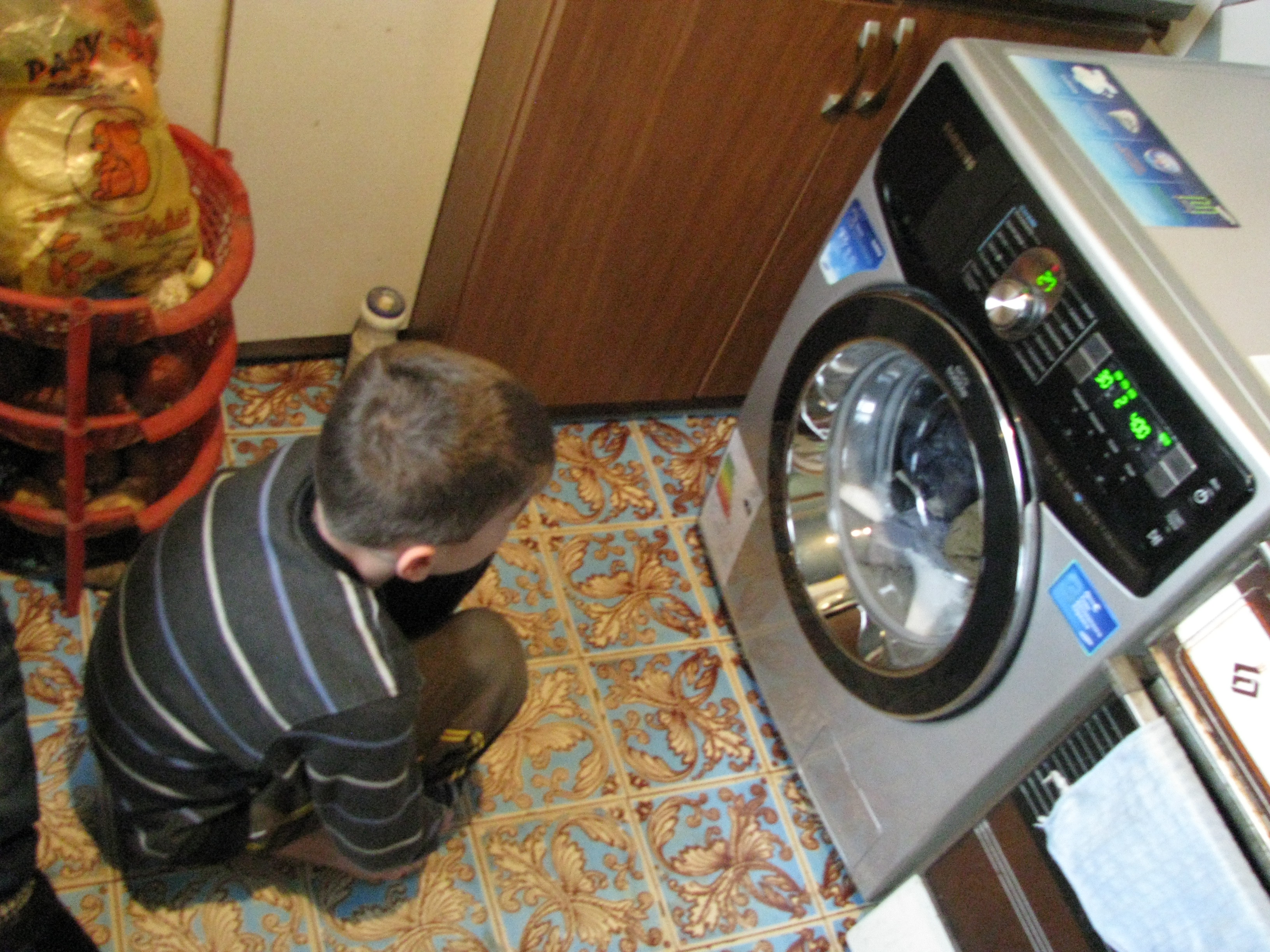
So that’s what’s going on out here.  In other news, my Georgian host family just got a washing machine, and the excitement it generated reminded me of that scene in Fiddler on the Roof when the village gets its first sewing machine.  Here’s the youngest son watching it go round and round:

Between this, internet TV, and the hot water heater they installed a few months ago, they seem to be moving steadily up in the world.  Hopefully I’m not putting too much of a burden on them.  I buy fruit from time to time and got the host mom a piece of silverware from Turkey.  From what I could tell, she was really happy with it.

Anyhow, it’s getting late and I’d better go.  ღამე მშვიდობის!

Part I of Star Wanderers is finished!

That’s right–I was up until about 2 am last night finishing it.  Man, time goes by fast sometimes.  This is probably just the first part of a much longer novel, but I hit a good stopping point so I’ll probably put it on the back burner for now while I finish Edenfall and do a final polish for Desert Stars. 

What I really want to do is submit this first part to Writers of the Future, since it falls just under 15k words.  I might be a little biased, but I think it’s got potential. 🙂 It’s going to need some work, though; the story literally sprung out of my head one day, and while that doesn’t necessarily mean that it’s bad, it’s probably missing a couple of scenes and needs some work with the transitions.  Also, the tone completely shifts midway, from a happy go lucky space adventure to something much more serious.  Not sure what to do about that.

So yeah, I’ll probably set this story aside for a little while so I can come back at it with fresh eyes.  It’s not too long, so the revisions should be pretty quick; hopefully, I’ll have it ready to submit to Writers of the Future before January.  If it doesn’t make the contest, I’ll shop it around the short markets for a year while I finish the novel-length version.  At some point I’ll probably epublish it, but I’m not sure when.

In other news, my short story “Decision LZ1527” just went free on Amazon, so if you want to pick up a copy or tell your friends, go right ahead!  It’s right around #200 in the Kindle free category now, but for some reason hasn’t hit any of the lists.  Hopefully that’ll change before the ranking drops back down.

“Decision LZ1527” first appeared in the December 2009 issue of Leading Edge, and was my first traditionally published short story.  Basically, it’s about a college freshman working up the courage to ask out a girl he likes, as told from the perspective of the little men inside his head.  Like Star Wanderers, the story just sprung out of my head one day.  It was a ton of fun to write, and I’m glad that so many others seem to enjoy it too.

In other news, I just got back the edits for Sholpan, so I’ll hopefully have that up on Amazon and other eretailers over the weekend.  More on that as it happens, but it’s happening soon.  I’d also like to put together a blog tour for Bringing Stella Home and Sholpan both, so if you’d like to have me on as a guest blogger, shoot me an email at joseph dot vasicek at gmail dot com.  More on that later as well.

And that’s just about it for now.  Take care, and I’ll see you around!

Sholpan 2.0 is finished!

Today I finished the second draft of the novella Sholpan, only two days after the deadline I set for myself.  Here are the stats:

ms pages: 173
words: 37,466
file size: 94 KB
parts: 5
start date: 1 Aug 2011
end date: 15 Aug 2011

I decided to divide it into parts because I read somewhere that novellas aren’t typically divided into chapters, and I felt that foregoing chapter divisions would give it more of a sense of unity.

Still, I divided it into five parts, which essentially function as very large chapters.  I did this because it seemed that the story needed it, to better develop conflict and theme, as well as the transitions and turning points.

Like I’ve said in the earlier posts, this is a “companion novella,” which means that it repeats one of the story lines from the novel with additional scenes that (hopefully) elaborate and flesh out that particular story line.  Ideally, this will entice readers of the novella to pick up the full-length novel, and give readers of the novel a satisfying experience by using the new scenes to cast everything else in a new light.

By my entirely non-scientific calculations, Sholpan contains about 80% repeated material from the novel (with a little touching up and fleshing out to get more inside of Stella’s head) and 20% entirely new material, most of it in the form of flashbacks to Stella’s life before she was captured and enslaved by the Hameji.  It ends about halfway through Stella’s story arc from Bringing Stella Home, and includes one of the major twists, but hopefully that won’t spoil too much.

In terms of story, I think there are some subtle deviations between Stella’s arc in the novel, and Stella’s arc in the novella.  Even though the novella ends just after one of the novel’s major shifts, the ending felt very satisfying–almost a little too much.  Still, it’s good for the story to be complete in itself, and there are enough loose ends that I think it will drive interest in the novel.

Anyhow, I’ve sent the project out to a couple of alpha readers, just to get a sense for whether or not I’m totally off base.  If all goes well there, I’ll send it out to my copy editor and get it up for sale sometime in mid-September.  I haven’t tried out the $.99 price point yet, so this will be a good test case to see how it works.

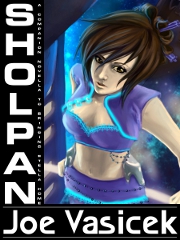
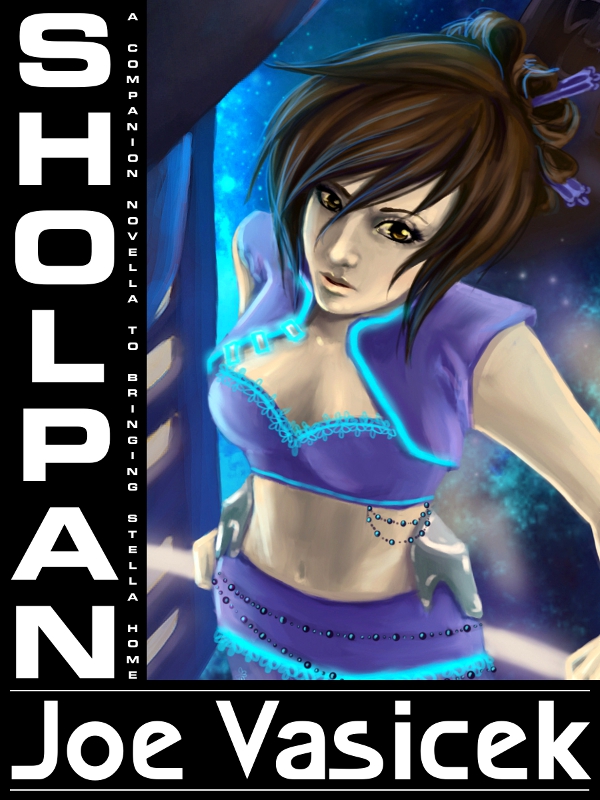
For those of you who are interested, here’s the cover:

And that’s about it.  I’m leaving the day after next for Worldcon, so I’ll do a post on that before I head out.  Probably won’t write much this week, but hopefully the con will help me make connections, pick up a few pointers, and get a good feel for the current zeitgeist in the science fiction and fantasy genres.  More on that to come.