Fantasy from A to Z: Z is for Zeitgeist

What is the future of fantasy literature? Where is the genre headed, based on current cultural trends?

For a long time, epic fantasy was basically Tolkien-light. There were exceptions, of course, but most readers wanted something that felt a lot like Lord of the Rings, and the most successful writers were the ones who gave it to them. There was a little bit of innovation, probably culminating in Robert Jordan’s Wheel of Time series, but if you picked up a random epic fantasy off the shelf, you could have a pretty good idea of what you were getting into.

Then, in the 90s and 00s, fantasy started to get dark and gritty, with writers like Joe Abercrombie and George R.R. Martin setting the tone. This new subgenre or flavor of fantasy, called grimdark, really came to dominate during this time, to the point where some were calling Martin an “American Tolkien” (though all that talk more or less died with the terrible finale of the show). Grimdark is still quite dominant, though an increasing number of readers are turning to “cozy” fantasy or slice-of-life in subgenres like litRPG. And of course, romantasy is taking off like crazy, though as we’ve already discussed, most romantasy is basically just porn.

So where are we going from here?

Our culture tends to pass through a cycle of seasonal turnings, where each season is the length of a generation, and the cycle itself is the length of a long human life. Reduced to its simplest form, the cycle follows a pattern like this:

Strong men create good times (first turning).

Good times create weak men (second turning).

Weak men create hard times (third turning).

Hard times create strong men (fourth turning).

We are currently living in a fourth turning, which is the period when all of the major wars and catastrophes tend to happen. In other words, the fourth turning is basically a grimdark world—or rather, when the full consequences of a grimdark world become manifest. But the grimdark subgenre really took off in the third turning, when dark and grim fantasy worlds resonated with the “hard times” that we all were starting to live through. This is also why dystopian YA became so popular in the 90s and 00s.

(As a side note, I have to say that I find it both perplexing and hilarious how so many zoomers think of the 90s as a simple and wholesome time, to the point where they think they experience nostalgia for it. Those of us who lived through the 90s remember it very differently, as an era of school shootings, political scandals, collapsing churches, teenage pregnancies, and ever-escalating culture wars. There’s a reason why Smells Like Teen Spirit was the decade’s anthem. Though in all fairness, I suppose that if someone from the middle ages were to visit our own time, they would find the nostalgic yearning on which the whole fantasy genre is based to be just as perplexing and hilarious.)

I believe we are on the cusp of a major cultural wave that is going to change everything, to the point of making our world almost unrecognizable to those who lived through the 90s and 00s. And just as the grimdark authors like Martin and Abercrombie rose to prominence by riding the wave in their part of the generational cycle, there are a lot of noblebright authors who stand to benefit from riding this next wave, which is only now beginning to break.

After all, there is another way to formulate the generational cycles. It looks something like this:

Complacent men create a spiritually dead culture (first turning).

A spiritually dead culture creates awakened men (second turning).

Awakened men create a spiritually vibrant culture (third turning).

A spiritually vibrant culture creates complacent men (fourth turning).

In the summer of 2024, I think we passed through a critical fork in the current timeline. If the generational cycle had followed its usual course, then our current crisis period would have ended with a period of unification under a new order, based upon the spiritual foundations that were laid during the 60s and 70s. In other words, the woke left would have won, and we’d be living under the sort of regime that would enforce woke values. Dissent would not be tolerated, because dissent is never tolerated in a first-turning world.

The second most likely outcome would have been a complete shattering of the generational cycles. In other words, we would have fallen into some sort of national divorce or hot civil war, with the United States splitting apart and the Western world completing its cultural suicide, which has been ongoing for several decades now. There has never been a time when such a major cultural rift has been accomplished by peaceful means. It is always accompanied by a terrible, bloody war.

But when President Trump survived the assassin’s bullet at the rally in Butler, Pennsylvania, that’s the point where I think our timeline diverged—and it followed the least likely path, which has only ever happened once in the history of modern generational cycles. We skipped from a fourth-turning straight into a second-turning, skipping straight from crisis to revival.

The last time this happened was with the US civil war. Usually, after a culture survives an existential crisis, you get a period of national unity, which often results in a brief golden age (or at least, an age that is remembered as such, often by those who did not live through it). But after the civil war, there was no national unity. Instead, we skipped right to the second turning, which is typically characterized by a major spiritual awakening.

Whatever your opinions of President Trump, the fact that he survived the assassination attempt in Pennsylvania and went on to win the 2024 election in a landslide means that we have (for the moment) avoided the first two scenarios. At this point, it’s difficult to imagine the woke left taking back the culture and leading us into a first-turning world in their own image. And though the US may yet fall into a hot civil war, from where I’m standing in flyover country that no longer seems quite so imminent.

Don’t get me wrong, though. We are not about to enter a period of national unity anytime soon. Certainly not a period of national unity whose foundations were laid by the previous spiritual awakening, which is what the generational cycle requires. At the same time, because President Trump survived the Butler assassination attempt (thank God), I think we avoided a hot civil war.

Because of all this, I think that we are about to experience a major cultural upheaval, the likes of which have never been seen in living memory. We will not get a period of unification. We will not experience a golden age period of material prosperity (though there may be a few years of plenty before the years of famine begin in earnest). But we will experience a cultural and spiritual revival that will burn through our culture until it has utterly demolished the woke worldview and values laid down during the 60s and 70s, and built something entirely new in its place.

What will that look like? And how will it affect the trajectory of fantasy literature?

Culturally, it will be a period of incredible dynamism. We will see an explosion of creative expression in every field, including in literature. Books and movies and games that are cultural mainstays now will be totally forgotten within a couple of decades, and everything that is popular now will feel dated and out of touch in the space of just a few years.

The authors and artists who will do the most to shape this new culture are today almost completely unknown, but they will become household names in surprisingly short order. Others will take decades to become known, but they will write their most important works in just the next few years.

The country will hold together. There will be no civil war, though there may be a global one. And there will almost certainly be an economic collapse, like the Great Depression, except much deeper and much longer. But all of this will only serve to fuel the spiritual revival, and the revival in turn will fuel the cultural dynamism, until the country and ultimately the world have been entirely transformed.

In more practical terms, I think we are going to see a lot of publishing houses fold, and a lot of popular authors fall out of favor. Many of them will keep their core group of fans, but they won’t be nearly as culturally relevant moving forward. New authors will rise from unexpected places to replace them, especially as the old institutions (publishers, conventions, magazines, review sites) collapse.

Romantasy will ultimately be recognized as the pornography that it is, though not until after it’s done great damage to the fantasy genre as a whole. The damage will be healed by a return to the genre’s spiritual roots. Grimdark will fade, and noblebright will rise, though it will ultimately take a different name and be recognized for other characteristics. It all depends on which of the thousand blooming flowers get picked.

LitRPG will mature into a long-term stable subgenre, and capture most of the innovation in the field. It may spin off into multiple long-term stable subgenres. Meanwhile, epic fantasy will return to its roots and grow as the spiritual revival takes hold. But instead of getting Tolkien clones, we’re going to see a lot of original and innovative work.

That’s the zeitgeist as I see it. The next few years are going to be a wild ride. Are you up for it? I hope that I am.


Fantasy from A to Z: N is for Noblebright

In the grim darkness of the far future, there is only war.

While the quote comes from Warhammer 40k, a science fiction franchise, it very soon became applied to the “darker and edgier” fantasy that started coming out in the 80s and 90s. Indeed, the quote itself spawned the term “grimdark” for a fantasy subgenre that became very popular in the 00s, with the rise of George R.R. Martin’s Song of Ice and Fire and subsequent Game of Thrones TV series.

Grimdark combines the scope and feel of epic fantasy with the savagery and moral greyness of sword & sorcery, ramping up the violence and savagery to levels that would have made even Robert E. Howard blush. It often features twists that subvert the old fantasy tropes, such as killing off the “chosen one” hero who would typically be the protagonist, or presenting a horrifying dystopia of a world that is the utter antithesis of an escapist fantasy.

In part, I think the grimdark phenomenon was a reaction to the Tolkien formula that dominated fantasy for so long. After J.R.R. Tolkien’s Lord of the Rings became wildly popular, his publishers tried to replicate that success by explicitly creating a formula that they wanted their writers to follow. This resulted in a bunch of Tolkien clones, such as Terry Brooks’s Shannara series and David Edding’s Belgariad series. For a couple of decades, these dominated the fantasy shelves, until writers began to revolt, and their books began to take off. After all, Game of Thrones was originally published in 1996.

But while there’s some truth to that theory, I don’t think it’s sufficient to explain the rise of grimdark. After all, Stephen R. Donaldson was rebelling against the Tolkien formula back in the 70s, and while his Thomas Covenant books were quite successful, they didn’t spawn a new subgenre (though arguably, they paved the way for later writers like Martin and Abercrombie). Instead, I think there’s something generational about the grimdark subgenre—that it’s the sort of thing that only could have arisen in the 90s and 00s, because of how the generational cycle works.

I wrote a lengthy blog post about this, which remains one of my more popular posts. My basic thesis is that the fantasy genre goes through generational cycles just like history goes through generational cycles. In its simplest form, the cycle looks something like this:

  • Hard times create strong men.
  • Strong men create good times.
  • Good times create weak men.
  • Weak men create hard times.

During the hard times, we tend to resonate more with stories that feature grim characters and dark fantasy worlds—hence, the rise of grimdark. But during the good times, we tend to resonate more with noble characters and bright fantasy worlds. 

(It’s a little more complicated than that, of course. The fantasy cycle is offset just a little, since we tend to resonate less with darker stories as we become exhausted from living in a darker world. Indeed, the yearning for the next phase of the cycle drives us to tell more hopeful stories, which in turn drive us to build a more hopeful world. But to read the full analysis, go check out my original post.)

So what is noblebright fantasy, then? It’s basically the antithesis of grimdark—a backlash against the backlash. And while it hasn’t yet manifested as a distinct subgenre, with a George R.R. Martin or a Joe Abercrombie to champion it, I think it’s only a matter of time before we see an author who rides this cultural wave to massive literary success. And as soon as that happens, I think we’ll have a much better idea of what “noblebright” actually is.

In other words, noblebright fantasy is currently in the process of being born—and after it has emerged fully formed into the world, it will probably take a different name. Indeed, “noblebright” as a term is itself merely a knee-jerk reaction to “grimdark.” To subvert the original Warhammer 40k quote: 

In the Noble Brightness of the far future, there is only HIGH ADVENTURE!” 

Currently, there are only a handful of writers who are explicitly labeling their books as “noblebright fantasy.” I am not one of them, though I suspect that my books (and my readers) have a lot of overlap. As it exists right now, noblebright is characterized by heroic quests and the triumph of good over evil, with an emphasis on hope, virtue, and making a positive difference in the world. It’s also very common for these authors to include Christian themes, though from what I can tell, the books aren’t explicitly religious.

While I haven’t yet joined the pioneers of this budding new subgenre, I expect that I will in the not-too-distant future. I’m currently working on an epic fantasy trilogy based loosely on the life of King David, which features many of these noblebright tropes and themes. But it’s going to be a while before I release the first book, since I want to publish the books of the first trilogy all within a month of each other. Since these books are going to fall in the 150k to 200k word range, a lot of things can change between now and then. Perhaps the term “noblebright” will have been abandoned, with people looking down on it as a passing fad of the early 20s.

But I don’t think the broader trend toward brighter, more hopeful fantasy is going to reverse course anytime soon. In fact, I think it’s generational. Whether or not it takes the name “noblebright,” I think that we’re going to see a new subgenre of fantasy emerge very soon. It’s starting right now as a backlash to grimdark, but as the wave crests and it begins to gain some staying power, I expect that it will stop defining itself by the thing it opposes and start to define itself in a more independent way.

I’m really hoping to catch this wave, and I think that my Soulbound King series has some real potential to do so. But whether or not I catch it, I know that this is the kind of stuff I like to write, and I hope to be able to write it for a long time to come.

In Defense of Black & White Morality

I was born in 1984, and for most of my life, stories with black and white morality—in other words, stories about the struggle between good and evil, with good guys who are good and bad buys who are bad—have been considered unfashionable and out of style. This is especially true of fantasy, where grimdark has been the ascendant subgenre for basically the past two decades. The Lord of the Rings movies gave us somewhat of a respite from this, but the popularity of George R.R. Martin’s Game of Thrones seems to have turned everything darker and grittier, to the point where I just don’t enjoy reading most new fantasy anymore.

I remember going to conventions like World Fantasy 2009 and talking with other aspiring writers, most of whom could not stop gushing about this George R.R. Martin guy and how he was subverting reader expectations in new and innovative ways. So I picked up a copy of Game of Thrones, and after finishing it, I thought: “yeah, the writing was pretty good, and the story did have a lot of unexpected twists… but I hated literally every character in this book who was still alive by the end of it.”

Looking back, it seems like the greatest reader expectation that GRRM subverted was the expectation that he would finish the damned books. Then again, the books only really took off after the TV series got big, and I suspect that the real reason the TV series got so big was because of all the porn sorry, the sexposition that the writers threw in. (Sex + exposition = sexposition. Seriously, the term was coined because of Game of Thrones.)

So for at least the last three decades (Game of Thrones came out in 1996), grimdark fantasy has been in style, with its morally ambiguous characters and its gray-on-grey or gray-on-black morality. Meanwhile, stories that are unambiguously about the struggle between good and evil have been considered trite, passé, or otherwise out of style. We live in a modern, complex world, and stories with such black-and-white conflicts are far too simplistic and unsophisticated to speak to our times.

That’s a load of horse shit, and here’s why.

But first, because we live in the stupidest of all possible timelines, I need to preface this discussion by stating what should be obvious to anyone capable of free and independent thought: namely, that talking about morality in terms of “black” and “white” has not a damned thing to do with anyone’s race. Seriously. It is not racist in any way to use “black” to symbolize evil and “white” to symbolize good, and the term “black and white morality” is not an example of white supremacy or whatever. Frankly, only a racist would think that it is.

But if you’ve only recently recovered from the insane left-wing cult that dominates every aspect of our society right now, and terms like “black” and “white” still trigger you, perhaps it will help to keep these two images in the forefront of your mind as we talk about morality in terms of black and white:

Now, on to something of actual substance.

The biggest complaint against black and white morality is that it divides all of the characters into black hats and white hats. In other words, all the bad guys are unambiguously bad, and all the good guys are unambiguously good, with no room in the middle for moral ambiguity or complex ethical dilemmas. So in other words, the spectrum of morality in your story looks something like this:

Now, while that may work for a certain kind of story, I will concede that it’s usually a sign of poor writing. This is especially true of epic fantasy, where complex worldbuilding and an expansive cast of characters is typical for the genre. Black hats and white hats might work for a twenty minute episode of a classic western, but not for a multi-book epic fantasy series.

However, when black and white morality is done well, it looks a lot more like this:

Notice that every shade of gray is contained within the spectrum. Indeed, allowing for the extremes of good and evil is the only way to hit every shade of morality and have it mean anything at all.

Think of Lord of the Rings. Yes, there are purely evil characters like Sauron, and purely good characters like Gandalf, but in between those two extremes there is a lot of moral ambiguity. For example, you have Boromir, who falls to the temptation of the ring but redeems himself with his sacrifice; Gollum, who ultimately rejects the last remnants of good that is in him, but still ends up serving the good in the end; Sam, who isn’t particularly noble or heroic, but bears the ring without succumbing to its temptation because of the power of friendship; Faramir, a noble and heroic figure who nevertheless knows his own limits and recognizes that the ring will corrupt him if he takes it; etc etc. Even the hero of the story, Frodo nine-fingers, succumbs to temptation in the end, and only succeeds in his quest by a brilliant subversion of the reader’s expectations.

Now, let’s contrast (pun intended) black and white morality with gray and grey morality, which TV Tropes defines as “Two opposing sides are neither completely ‘good’ nor completely ‘evil’.” Here is what that looks like when it’s done poorly:

…and here is what that looks like when it’s done well:

Does anything about those two images stand out to you? Because the thing that stands out to me is that they look almost identical—which means, as a newbie writer, it’s much easier to get away with a badly written gray-and-grey story than a badly written black-and-white story. Little wonder that all those aspiring writers at World Fantasy 2009 were gushing about George R.R. Martin.

Of course, since there’s only so much of this morally gray soup that readers can stand, two other sub-tropes of graying morality have emerged to satisfy the readers’ unfulfilled needs: black-and-gray morality, which TV Tropes defines as “Vile villain, flawed hero,” and white-and-gray morality, where “the best is Incorruptible Pure Pureness, and the worst is an Anti-Villain.”

Representing both of those visually, here is what black-and-gray morality looks like:

…and here is what white-and-gray morality looks like.

Much more satisfying than the nihilistic, soul-sucking soup that is gray-on-grey morality, but taken individually, neither one truly represents the full spectrum of moral complexity. The only way to include every shade of gray within your story is to do black-and-white morality, and to do it well.

Also, do you notice how the gray on the right side of the black-and-gray spectrum looks a lot darker than the gray on the left side of the white-and-gray spectrum? Those are both identical shades of 50% gray, but they appear darker or lighter than they actually are, simply by association with only one of the extremes.

Likewise, even if a black-and-gray or white-and-gray story is done well, it will still feel like it’s totally black or white. And if you read a white-and-gray story for the contrast reading after a black-and-gray story, the effect will be more similar to reading a badly written black-and-white story, regardless of the quality of either one.

To get the full spectrum of morality, with all of its finer nuances and shades of gray, you must include both extremes of good and evil. Remember, here is what that looks like:

Which is why it’s a load of horse shit to say that black and white morality is “unsophisticated” or “simplistic.” Done poorly, perhaps that’s true—but you can say that of any book done poorly. Done well, though, a black-and-white tale of good and evil is more satisfying and complete than any other kind of tale is capable of being, even if done well.

“But Joe!” some of you may be saying right now. “What about blue-and-orange morality? What about that most bizarre of moral codes that is neither good nor evil, lawful nor chaotic, but bacon and necktie? What does that look like, represented visually?”

Fine. Here’s your blue-and-orange morality, which TV Tropes defines as “morality that’s bizarre, unconventional and distorted by human standards”:

He who takes the bacon path shall be with dinner blessed,
But he who takes the necktie path shall be for dinner dressed.

And here’s a poem by ChatGPT to explain the finer nuances of it:

In bacon’s sizzling embrace, flavors shall dance and sing,
A feast for the senses, a delightful offering.
Juicy and savory, its aroma fills the air,
Blessed is the one who follows the bacon’s dare.

Yet the necktie path, with elegance and grace,
Leads one to adornment, a refined embrace.
In formal attire, he walks the path of class,
Dressed for the occasion, ready to raise a glass.

For bacon nourishes the soul, brings joy and delight,
A savory indulgence, a culinary highlight.
While the necktie adorns, a symbol of esteem,
Preparing for gatherings, where memories gleam.

So choose your path wisely, with heart and desire,
Whether blessed with bacon or dressed to inspire.
For in the journey’s choice, a tale shall unfold,
Of dinners blessed or dressed, both stories worth being told.

Short-form vs. long-form fantasy

For the last month, I’ve been doing a lot of research into the fantasy genre, rereading all of the original Conan the Barbarian stories by Robert E. Howard and a bunch of the other ones too, by authors like L. Sprague De Camp, Lin Carter, Bjorn Nyberg, Robert Jordan, etc. I’ve also been reading a lot of epic fantasy, like the Wheel of Time series by Robert Jordan and the Stormlight Archive by Brandon Sanderson. And I’ve also read some essays on the genre, most notably “The Critics, the Monsters, and the Fantasists” by Ursula K. Le Guin, and “The Making of the American Fantasy Genre” by David Hartwell. Oh, and opening a bunch of chats with ChatGPT, though those are of limited usefulness (for some reason, ChatGPT hallucinates like crazy when you ask it to recommend any noblebright fantasy that isn’t more than two or three decades old).

From what I’ve gathered, there are basically two camps or schools within secondary-world fantasy: the heroic / sword & sorcery camp, based off of Howard’s Conan the Barbarian, and the epic fantasy camp, based off of Tolkien’s Lord of the Rings. According to David Hartwell, those are the only two franchises to achieve breakout success: everything else has either achieved only moderate commercial success in its time before petering out, or gained only a niche audience. Apart from Conan, the fantasy genre as a whole didn’t really take off until Terry Brooks immitated Tolkien with his Shannara series, thus launching a wave of Tolkienesque epic fantasy in the 70s and 80s that morphed into Grimdark in the 90s, 00s, and 10s.

So for a while, I was looking into all the various tropes and archetypes that make Conan and LOTR tick, and trying to use those to differentiate the two. But lately, I’ve been wondering if maybe I’ve been overthinking all of this, and the real difference between the two is that Tolkien mastered long-form fantasy, and Howard mastered short-form fantasy. In other words, what if the defining difference between the two camps doesn’t have to do with tropes so much as with the length of the actual story?

I suspect that short-form fantasy is poised to make a resurgence, especially with all of the challenges associated with writing and selling long-form fantasy in the 2020s. Larry Correia is right: Rothfuss and Martin have ruined the epic fantasy field for new authors by failing to finish their series in a reasonable timeframe. Unless you are independently wealthy or already have a large and loyal following of readers, it just doesn’t make commercial sense to write a lengthy series of +200k-word fantasy epics. Better to write shortier, punchier 40k-word novels instead, especially if you can churn them out every other month or so. That seems to be the model that works best for indies, at least in adjacent genres like urban fantasy and paranormal.

Anyway, that’s my current thinking on the subject. What’s your take on it?

Three common tropes that I hate (and what I’d like to see more of instead)

So I’ve been reading a lot of books in the last few months, which means that I’ve been DNFing a lot of books too, and I’ve noticed some recurring patterns in the books that I’ve DNFed. A lot of these are tropes that I’ve either gotten sick of seeing, or that tend to make for a much weaker book. Or both.

I thought it might be interesting to point a few of them out, but I don’t want this post to be totally negative, so I’ll counteract that by also sharing some positive tropes that I’d like to see more of instead. If you guys enjoy this post, maybe I’ll do something like it again in a couple of months.

The Only True Love is LGBTQ Love

I see this one all the time in SF&F these days. Basically, if there are two characters who are romantically involved with each other, or if there is a romantic subplot to the story (not the main plot: sci-fi romance is a separate thing, for purposes of this trope), then that romantic relationship has to be gay, trans, or queer in some way. Or polyamorous, I suppose (does poly fall under the “+” in “LGBTQ+”? Maybe it’s the “P” in “LMNOP.”)

From what I gather, this trope began when LGBTQ activists pointed out that their particular kinks and orientations were “under-represented” in SF&F. Publishers, editors, and authors responded by filling their stories with more LGBTQ relationships, in order to avoid getting singled out as not being sufficiently LGBTQ-friendly. It’s the same principle as the zombie apocalypse: you don’t actually have to be the fastest runner, you just have to run faster than the guy behind you. Of course, since the SF&F field is so thoroughly dominated by leftists, pretty soon every story had an LGBTQ romance in it, to the point where straight romantic sub-plots are now actually kind of rare, at least in the books that are winning all the awards. Which is how you know the “under-representation” angle was a lie from the beginning.

It’s gotten to the point where if any character at all announces themselves as LGBTQ in the first few chapters of a novel, or the first few paragraphs of a short story, I immediately DNF. Call me homophobic; I don’t really care. These stories are so predictable that I can often pick out both which characters are going to be LGBTQ and which ones will end up together, within a page or two of them stepping into the story.

Of course, the main reason I don’t like these stories is because I’m not LGBTQ myself, and personally find straight romantic subplots to be much more interesting and satisfying. But there is another reason, and it has to do with the way that all of these stories aren’t just about entertaining readers, but about promoting LGBTQ pride.

This is going to get me a lot of hate, but it’s true so I’m going to say it anyway: the only thing that unites the LGBTQ movement together is the normalization of sexual perversity.

Think about it for a moment: what do each of the letters in LGBTQ really have to do with each other? Most gays would be happy to live in a world without women, and most lesbians would be happy to live in a world without men. Both of them view bisexuals with veiled suspicion and sometimes outright hostility, as if they’re somehow traitors to the wider homosexual cause. Transgenders affirm their identity by playing into as many stereotypes of masculinity and femininity as they can, which puts them directly at odds with masculine women and feminine men. And queers adopt all sorts of positions that contradict—or even negate—every other letter in the pantheon.

The LGBTQ movement is so full of internal contradictions that the only way it can hold together is to unite against a common enemy, and the only enemies that they all have in common are the people who affirm that there is a moral dimension to human sexuality, and that some forms of sexual expression are immoral. Even the modern notion that all consensual sex is fine goes too far for these people, because it excludes pedophilia, since children are not capable of giving their consent. And does anyone really doubt that one of the LGBTQ movement’s ultimate goals is to normalize pedophilia? When it’s not uncommon to see children under 12 at pride parades, drag shows, and drag queen story hour at the local library, sometimes as the very stars of the show?

I’ll say it again: the only thing that unites the LGBTQ movement is the normalization of sexual perversity. As soon as the leaders of the movement draw a line in the sand and say “this is not okay, this goes too far,” the movement will turn on itself and the revolution will eat its own. Thus, every new form of sexual perversion must be one-upped by something even more perverse. That is why we are literally butchering and chemically castrating children now.

(As a side note, it’s worth pointing out that being gay does not automatically make you part of the LGBTQ movement. My brother in law is openly gay, but he’s also a practicing Latter-day Saint who rejects all of this stuff. His faith is directly at odds with the LGBTQ movement, and he has chosen to keep his faith.)

So now, whenever I read a book with two (or more) characters in an LGBTQ relationship, I can’t help but feel that I’m reading “message” fiction, where the message is ultimately to normalize some other aspect of sexual perversion. Sorry (not sorry), but no thanks.

Instead: More pro-family, pro-natalist, life affirming fiction

So what do I want see instead? More stories with strong, healthy families. Stories about motherhood and fatherhood, that affirm the importance of both parents in raising children. Pro-natalist stories where having children is seen as a good thing, not as destroying the environment or burdening the world with more mouths to feed. In other words, stories that affirm and celebrate the intrinsic value of life—every life.

The one thing that all LGBTQ relationships have in common is that they cannot naturally produce children. Because of this, stories that follow the “all true love is LGBTQ love” tend to be about found families, rather than natural families. Parents are often absent or abusive in these stories, and children are either adopted or non-existant. A significant number of these stories also tend toward the macabre, since affirming the intrinsic value of life ultimately invalidates many of these LGBTQ relationships.

But that’s not why I want more pro-family, pro-natalist, life affirming stories. It isn’t about bashing LGBTQ, but about presenting a vision that stands apart from the LGBTQ movement, and doesn’t kowtow to the activists’ demands. It can even have room for some LGBTQ characters and relationships. Kings of the Wyld by Nicholas Eames is a good example of that, where one of the side characters is monogamously gay, and the protagonist is very much a family man. Another life affirming book I really enjoyed was To Sleep in a Sea of Stars by Christopher Paolini.

All Christians are Evil or Stupid

This is one you probably don’t notice if you aren’t Christian yourself, but I see it all the time, as do most other Christian readers that I know. If a character in a book or a story is some sort of Christian, then invariably they will turn out to be a villain, or so stupid that they’re less of a help and more of an obstacle to the protagonist. Or an eccentric curiosity.

It wasn’t always this way. Back in the 80s and 90s, there were lots of science fiction novels where the good guys were Christians. But these days, if the Christian character turns out to be a good guy, the author is either indie or a pariah to the rest of the SF&F field, like Larry Correia, John C. Wright, or Orson Scott Card.

Activists like to point out that if a majority of books tend to portray a particular race, gender, or sexuality in a negative light, it’s a sign that the field itself is racist/sexist/etc. They aren’t wrong. Now apply that to how mainstream science fiction and fantasy tends to portray Christians, and you begin to see the problem. There is a ton of anti-Christian bigotry in the culture right now, and it shows when you read most of these books.

Instead: More badass Mormons

So what do I want to see instead? More stories with badass Mormons. I’m only partially joking. As a member of the Church of Jesus Christ of Latter-day Saints, of course I would love to see more books with members of my faith doing awesome and inspiring things, but I’d be happy to see other kinds of Christians too.

Even books with generic Christians as good guys would be nice, but it would be better if something unique about their faith is central to the story. For that, you need to go deeper than a generic approach, so it would be better to make the character a member of a particular church or creed. And even though we Christians have our own theological differences, and sometimes argue quiet passionately over them, I wouldn’t at all mind to read stories with more Catholic main characters, or Evangelical, or even a well-written Jehovah’s Witness.

But personally, I want to see more badass Latter-day Saints.

An Innocently Profane and Vulgar Childhood

This one isn’t quite as prevalent as the other two, at least in the books I’ve read recently. However, it is definitely a common trope, especially in more recent books. Basically, it’s when something profane or vulgar invades a character’s childhood, but that isn’t portrayed as bad or even significant. For example, when there’s a child on the page and the people around them are swearing, or maybe even the children themselves. Or as a child, a character is exposed to something sexual, but it’s not a big deal.

In most of these books, it doesn’t seem like the author is doing it intentionally. But as Jonathan Haidt points out, liberals tend not to value things like purity and innocence as much as conservatives, or even really at all. Since the SF&F field is so thoroughly dominated by leftists, I think they often tend to violate the innocence of childhood without realizing that they’re doing it.

But in some books, it seems like the author is doing it intentionally to make a point: either that innocence itself is an illusion, or that children do better when they aren’t sheltered from the harsh realities of the world (they don’t). Or often, the author just thinks it’s funny to juxtapose childhood innocence with the profane (it isn’t—at least, not to me).

Instead: More noblebright

This isn’t generally a trope that you see in noblebright fiction. Not that noblebright doesn’t wrestle with questions of profanity, vulgarity, and evil, but it does tend to respect the boundaries of childhood innocence. And even after the characters lose their innocence, they still tend to become purified by the events of the story. There is a difference between being innocent and being pure, and a lot of really excellent noblebright stories explore the finer nuances of that difference.

Noblebright isn’t very popular right now, but I hope that will change in the coming years. There are some very good reasons to think that it will. Of course, noblebright can be done poorly, and stories that don’t put their characters into any real peril tend to be boring and unengaging. But it is possible to put children in peril without violating their innocence, or rejecting the concept of innocence to begin with. That is what I want to see.

The Generational Cycles of Grimdark vs. Noblebright

A couple of months ago, I was discussing genre trends with my indie publishing mastermind group where we drew some fascinating connections between grimdark fantasy, noblebright fantasy, and Strauss-Howe generational theory. In that discussion, we came up with a theory that predicts when each type of fantasy (grimdark, nobledark, noblebright, and grimbright) will be ascendant, and explains exactly why. According to this theory, grimdark is currently in the beginning phase of a multi-generational decline, and will be replaced by noblebright as the ascendant form of fantasy by about the mid-2030s.

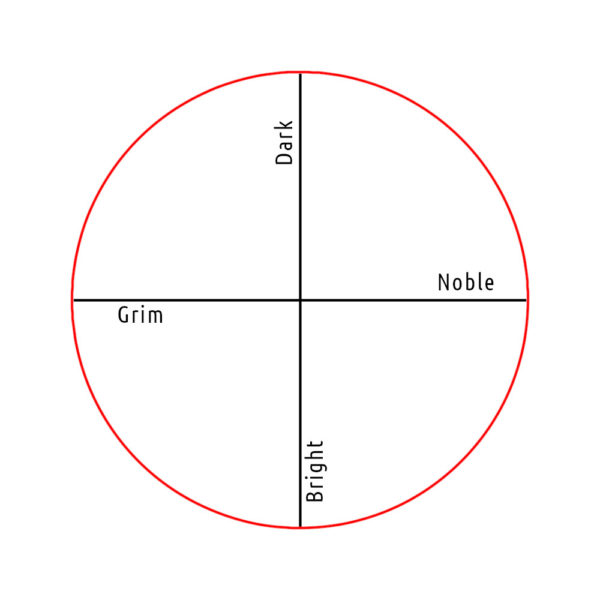
To start, we need to understand the difference between grimdark and noblebright. Both forms of fantasy exist on a field with two axes: noble vs. grim and bright vs. dark.

The bright vs. dark axis describes whether the fantasy takes place in a world where good usually triumphs over evil (bright), or a world where evil usually triumphs over good (dark).

The noble vs. grim axis describes whether the characters have the power to change the world (noble), or whether they do not (grim).

Thus, with these two axes, we get the following combinations:

  • Noblebright: A fantasy world where good usually triumphs over evil and the characters have the power to save it.
  • Grimbright: A fantasy world where good usually triumphs over evil, but the characters aren’t on a quest to save it and are usually preoccupied with smaller concerns.
  • Grimdark: A fantasy world full of moral shades of gray, where evil usually triumphs over good and the characters are either anti-heroes or otherwise fail to save the world.
  • Nobledark: A fantasy world where evil usually triumphs over good, but the characters are empowered to change it.

These categories are subjective to some degree, and fans will often disagree about which category to put each book/series. However, I think that most fans will agree on the following examples:

  • Noblebright: The Chronicles of Narnia by C.S. Lewis
  • Grimbright: The Princess Bride by William Goldman
  • Grimdark: A Song of Ice and Fire by George R.R. Martin
  • Nobledark: Lord of the Rings by J.R.R. Tolkien

Next, let’s review in the broadest possible terms William Strauss and Neil Howe’s generational theory. To really understand their work, I highly recommend that you read The Fourth Turning. I have some criticisms of the finer nuances of that book, but their ideas are really excellent, and their predictions hold up surprisingly well three decades later.

If I had to boil their theory down to one simple, easy-to-understand statement, it would be this:

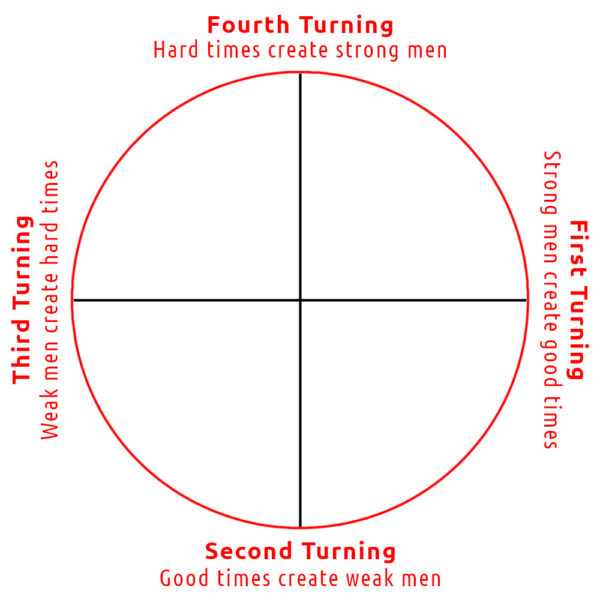
Strong men create good times.

Good times create weak men.

Weak men create hard times.

Hard times create strong men.

Thus, our society and culture passes through a secular cycle that takes about 80-100 years to complete (or in other words, the length of a long human life). The cycle has four seasons, or turnings, each one corresponding to a generational archetype (since it takes about 20-25 years for people born in the one turning to start having children of their own, thus moving us into the next generational turning).

The first turning happens when the society comes together after resolving a major crisis (eg the Revolutionary War, the Civil War, World War 2) and builds a new, stable order. The second turning happens when their kids rebel against that order, seeking freedom (eg the First and Second Great Awakenings, and the various counterculture movements of the 60s). The third turning happens when the order breaks down completely and everyone goes their own way (eg World War I, the Roaring Twenties, and the culture wars of the 90s). Finally, the fourth turning happens when the society faces a major existential crisis that totally reshapes it.

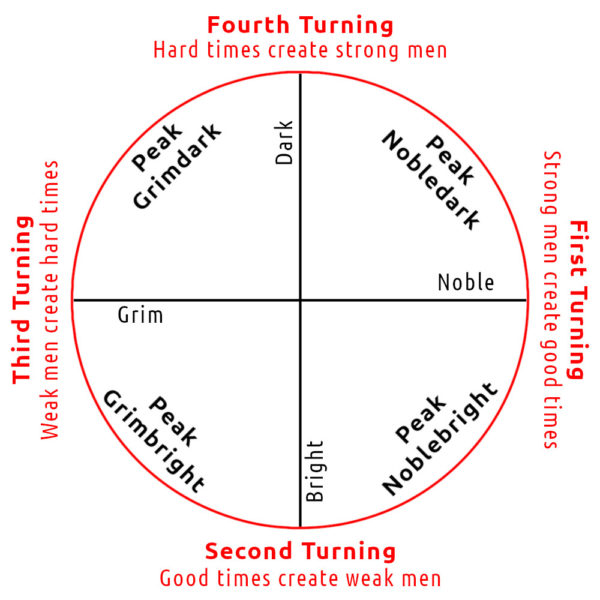
According to the theory, each axis of the grimdark/noblebright field corresponds to a different generational turning. Thus, stories that are noble have the most resonance in a first turning, stories that are bright have the most resonance in a second turning, grim stories resonate most in a third turning, and dark stories resonate most in a fourth turning.

In other words, the generation that comes of age during a major existential crisis will tend to gravitate more toward fantasy where evil typically triumphs over good, whereas the generation that comes of age during a period of rebuilding will tend to gravitate more toward fantasy where the characters have the power to change the world. And so on for bright and grim stories: the generation that comes of age during a spiritual awakening will gravitate more toward stories that take place in a world where good usually triumphs over evil, and the generation that comes of age in a declining and/or decadent society will gravitate more toward fantasy where the characters are relatively powerless.

Another way of thinking about it is to consider what each generation is not going to be drawn to, or which stories are not going to resonate well. An American who came of age in the 40s and 50s, when US power was on the rise and the Pax Americana was reshaping the world, isn’t going to resonate well with grim stories about powerless characters. Likewise, a boomer who came of age during the counterculture movements of the 60s and 70s isn’t going to resonate well with a dark fantasy world where evil usually triumphs, because (as much as they hate to admit it) they grew up in a very sheltered world that generally made sense—so much so, in fact, that they couldn’t help but rebel against it.

According to this theory, the next generational turning begins when one of the four forms of fantasy (noblebright, grimbright, grimdark, or nobledark) is at a peak. Over the course of the turning, that fantasy form declines until the next form in the cycle becomes ascendant, at which point the next generational turning begins.

Thus, at the start of a first turning, nobledark stories are typically ascendant, where the fantasy worlds are dark and morally gray, but the characters are empowered to save the world. As that generation successfully establishes a new order, the culture’s taste in fantasy shifts away from dark stories and toward noblebright stories, where the characters are still empowered but the world is more ordered and stable.

At the start of the spiritual awakening that characterizes a second turning, noblebright fantasy is ascendant: stories with an optimistic outlook on the world where the characters are larger than life. But as the awakening progresses, people in the society care more about freedom and individuality and less about the group, so stories about characters who sacrifice everything to save their world resonate less with them. Thus, by the end of the second turning, the ascendant form of fantasy is grimbright, which is really more of a slice-of-life fantasy about beloved characters having fun (but not world-altering) adventures.

At the start of a third turning, where the social order has started to break down and corruption begins to permeate all levels of the society, these grimbright stories start to take a darker tone. Readers find it too “unrealistic” to believe that good always triumphs over evil, and they certainly do not believe that good people have the power to change the world—at least, not the “smells like teen spirit” world that they inhabit. Their tastes shift away from the fun, adventurous slice-of-life of grimbright, and toward the dark and gritty anti-heroes of grimdark.

Finally, at the start of the fourth turning, grimdark is ascendant, but readers are starting to lose patience with it. As each new crisis in the real world compounds with all the others, they find it unbearable to read about characters that don’t have the power to change the fantasy worlds they inhabit. At the height of the fourth turning, society reaches an existential breaking point where, in the words of Strauss and Howe, “all of [our] lesser problems will combine into one giant problem, [and] the very survival of the society will feel at stake.” (The Fourth Turning, p277) At this point, readers are ravenous for books about characters who are empowered to fight back against the tides of evil and darkness. Grimdark fantasy declines and nobledark fantasy ascends.

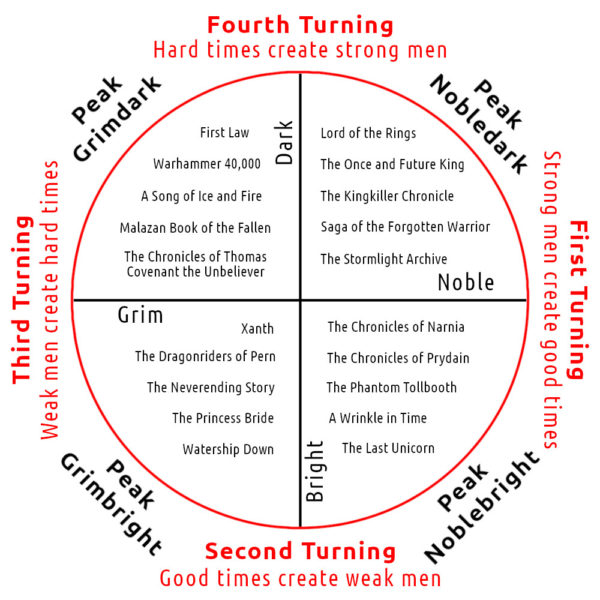
I haven’t read all of the series in the diagram above, but I do have a pretty good sense of most of them, and I put the diagram together with the help of my mastermind group. The key thing about it is that each fantasy series came out in roughly the generational turning that corresponds with each quadrant.

Now, it’s worth pointing out that these trends aren’t absolute. In each of the secular seasons, you can find examples of contemporary fantasy that runs counter to trend. For example, David Gemmell’s Drenai Saga came out in the 80s, at the start of the last third turning when grimbright should have been ascendant, and yet the Drenai Saga is solidly nobledark. Terry Pratchett’s Discworld books had their heyday in the 90s, 00s, and arguably 10s, but they probably fall into grimbright (though you could make the argument that, as absurdist fantasy, they are more similar to grimdark: stories where good and evil really doesn’t matter, and the characters are just doing their best to go along).

But the theory doesn’t state that each fantasy form’s antithesis dies completely when that form is ascendant: only that it reaches a nadir of decline in its resonance with the culture. But without sufficient contrast, the ascendant form cannot stand out. Thus, there still has to be some noblebright Paolini to provide sufficient contrast with the grimdark of Abercrombie and Martin, some low fantasy slice-of-life Legends and Lattes grimbright to make the epic nobledark high fantasy of Sanderson stand out stronger.

According to this theory, as we continue to muddle our way through this present fourth turning, the decline of grimdark fantasy will accelerate, and the bestselling fantasy books of the 2020s will mostly be nobledark. And indeed, we can already see that happening with the meteoric rise of Brandon Sanderson (especially his Stormlight Archive series), the popular enthusiasm surrounding Larry Correia (whose Saga of the Forgotten Warrior falls squarely into nobledark), and the enduring anticipation of Patrick Rothfuss’s fans for the conclusion to the Kingkiller Chronicle. Meanwhile, enthusiasm for George R.R. Martin has waned significantly with the train wreck of Game of Thrones, and Abercrombie, though still quite popular, seems to be testing the nobledark waters with his YA books.

It would really be interesting to do a deep dive on the generational archetypes and make a study of how that affects the fantasy forms that run counter to the cycle. But that’s beyond the scope of this blog post, and frankly I need to get back to writing my own books. But what do you think of this theory? Does it resonate with you, or is there something that we missed?