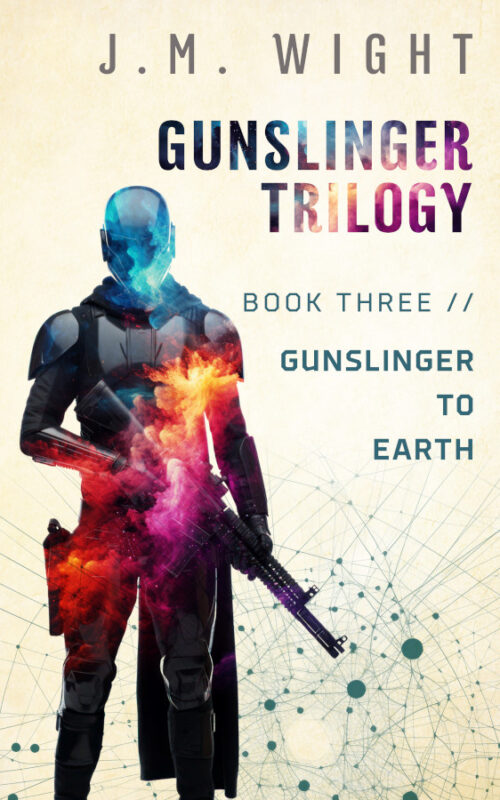
Is Gunslinger to Earth for You?

Gunslinger to Earth is a character-driven space opera adventure about crossing a cosmic no-man’s-land to discover what happened to the home you thought was lost forever. It blends gunslinger-style starship action, found-family dynamics, political revolution, and end-times mystery as Rex Carter, Sam Kletchka, and Jane Kletchka risk everything to follow Earth into an impossible anomaly. It’s a fast, hopeful, and surprisingly tender finale that wraps up the Gunslinger Trilogy with both high stakes and a genuine sense of homecoming.

What Kind of Reader Will Love This Book?

If you love…

  • Space opera that feels like Firefly meets end-times science fiction, with a gunslinger pilot, a loyal found family, and a war-torn galaxy trying to pull them apart
  • Stories where faith, prophecy, and cosmic mystery actually matter to the plot, not just as window dressing
  • Coming-of-age under fire, as Rex Carter tries to decide who he is and where he belongs while revolutions, wormholes, and vanished planets rearrange the map of human history
  • Character-focused military SF with moral clarity, loyalty, and hope, rather than grimdark cynicism

…then Gunslinger to Earth is probably your kind of story.

What You’ll Find Inside

Gunslinger to Earth is a story rooted in space opera adventure, end-times science fiction, and prophecy-driven mystery. The hero of this third book in the trilogy is Rex Carter, a cadet still reeling from the day Earth and Luna vanished into an impossible anomaly. Torn between his patriot girlfriend Charlotte, his loyalty to Sam and Jane, and his fear for his family back home, Rex has to grow up fast as he’s swept into a mission to follow Earth across the “world-bridge” and find out what really happened.

The mood balances tense, boots-on-the-deck action (derelict ghost ships in the anomaly, desperate battles near wormholes, claustrophobic escapes from Luna) with a deep, almost awe-struck sense of wonder as the crew finally confronts a transformed Earth and the fulfillment of ancient prophecies. The style is fast-paced, voice-driven, and accessible—more “frontier adventure with big ideas” than hard-science textbook—with a strong throughline of family, faith, and the search for home.

What Makes It Different

Fans of classic space opera and military SF—think Firefly, The Expanse, or David Weber—will recognize the starship battles, political tensions, and ragtag crews, but Gunslinger to Earth takes those ideas in a very different direction. Instead of treating religion and prophecy as background flavor, this book leans straight into them: the disappearance of Earth isn’t just a physics problem, it’s tied to the City of Enoch, the fulfillment of Latter-day Saint-style millennial prophecies, and a literal “new Earth” where history has turned a corner.

Where many space war stories focus on winning the next battle or installing the next regime, this one asks what happens when the war is suddenly dwarfed by something much bigger—when the homeworld itself is renewed and taken off the game board. It’s less about toppling empires and more about how ordinary, stubbornly decent people respond when God, history, and politics all collide at once. And because it’s the capstone of the Gunslinger Trilogy, it doesn’t just raise the stakes; it actually lands them with a clear, hopeful ending.

Readers who enjoy the moral backbone of Lois McMaster Bujold, the frontier grit of Firefly, and the cosmic mystery of The Expanse will find familiar elements here—but woven together in a way that feels genuinely new.

What You Won’t Find

You won’t find grimdark nihilism, graphic sex, or wall-to-wall gore here. The story has violence, war, and real loss—this is a revolution and an end-times crisis, after all—but it’s written at about a PG-13 level, with the camera panning away from anything needlessly explicit. You also won’t find a sneering, anti-religious tone; faith and prophecy are treated respectfully and sincerely, even when characters struggle to believe them. This is a cleaner-but-still-intense sci-fi adventure that focuses more on meaning, loyalty, and wonder than shock value.

Why I Think You Might Love It

I wrote Gunslinger to Earth during a major turning point in my own life—just after I started dating the woman who would become my wife, at a time when I was reinventing my writing process so I could tell better stories more consistently. In a lot of ways, this book is about that same kind of turning point on a galactic scale: the moment when old patterns break, a long-promised future finally arrives, and you have to decide who you’re going to be on the other side of it. My hope is that if you care about loyalty, about home, about the possibility that history is going somewhere meaningful, then this story will leave you with the same feeling it gave me while I was writing it: that even in the middle of chaos, there’s a way through—and it leads somewhere worth fighting for.

Where to Get the Book

Related Posts and Pages

Explore the series index for the Gunslinger Trilogy.

Return to the book page for Gunslinger to Earth.

The Choice to Believe in Gunslinger to Earth.

See all of my books in series order.

An interesting concept

Last night, I was hanging out with a friend of mine and a couple of girls in the apartment complex where I currently live.  We got to talking about books, and one of the girls said something really interesting:

Every book needs to have one thing that the main character knows that the reader doesn’t know, and one thing that the reader knows that the main character doesn’t know; otherwise, it’s too boring.

That’s a fascinating concept.  I know that both things are important, but I’ve never connected them together.

When the reader knows something that the main character doesn’t, it can make for great suspense.  A good example of this is this scene from Xenogears, when the characters are trying to hunt down a monster in the sewers (skip to 6:37):

It’s harder to pull off having the characters withhold information from the readers, but it can be done. I think a good example of this is the scene from Star Wars V: The Empire Strikes Back when the Millenium Falcon arrives at Bespin and C3PO gets shot:

Granted, nothing really vital is withheld here, since by this point Master Yoda has seen Luke’s friends in danger, and Bobba Fett has clearly followed them to Bespin–but the audience still doesn’t know exactly what’s going on, and so it creates suspense.

In terms of Orson Scott Card’s MICE quotient, this would definitely fall under the “information” component of stories. In Brandon Sanderson’s class (and in my own reading), I’ve focused a lot on character, setting (milieu), and plot (event), but I haven’t thought a lot about information.

I wonder how my own novels measure up to this principle. Let’s see…

In Genesis Earth, there are a lot of things that Michael and the reader doesn’t know, but not much that one knows and the other doesn’t. There are, however, quite a few things that Terra knows that the reader doesn’t. Those all come out in the middle, though. In terms of information withheld from the reader, I suppose you could count Terra’s feelings for Michael, in the buildup before the climax, but that’s about it.

In Mercenary Savior, the reader knows a TON of stuff that James doesn’t know–it’s a major source of the suspense in that novel. In terms of things the characters know that the reader doesn’t, there’s much less, but I can think of a few things Danica knows that are kept mysterious until a key climax. Those aren’t foreshadowed until maybe 50 or 100 pages before the reveal, but I suppose it still counts.

Thinking WAY back to my first practice novel, Ashes of the Starry Sea (which I will probably never publish), there is, again, a TON of stuff the reader knows that the characters don’t. Basically, every character is clueless in some crucial way, and the resulting comedy of errors drives the plot. In terms of information withheld from the reader, though, there’s not as much. There is a point where Ian runs off without an explanation, but I’m not sure if that’s just my own poor writing. I could probably pull it off in a revision, but I don’t know when or if that will ever happen.

So yeah, I suppose I’ve done that in my own writing. I suppose it’s much easier to do this in third person, however–Genesis Earth is entirely in first person, and there isn’t anything Michael thinks about that the reader doesn’t see. He is an unreliable narrator at times, but he’s not the character withholding the information–and if he was, I don’t think it would have worked very well.

In any case, it’s a very interesting principle. I’ll have to keep it in mind.

Why I love Robert Charles Wilson

From Mysterium, which I plan to review here soon:

“Do you ever wonder, Howard, about the questions we can’t ask?
“Can’t answer, you mean?
“No. Can’t ask.
“I don’t understand.”
Stern leaned back in his deck chair and folded his hands over his gaunt, ascetic frame. His glasses were opaque in the porch light. The crickets seemed suddenly loud.
“Think about a dog,” he said. “Think about your dog–what’s his name?”
“Albert.”
“Yes. Think about Albert. He’s a healthy dog, is he not?”
“Yes.”
“Intelligent?”
“Sure.”
“He functions in every way normally, then, within the parameters of dogness. He’s an exemplar of his species. And he has the ability to learn, yes? He can do tricks? Learn from his experience? And he’s awarer of his surroundings; he can distinguish between you and your mother, for instance? H’es not unconscious or impaired?”
“Right.”
“But despite all that, there’s a limit on his understanding. Obviously so. If we talk about gravitons or Fourier transforms, he can’t follow the conversation. We’re speaking a language he doesn’t know and cannot know. The concepts can’t be translated; his mental universe simply won’t contain them.”
“Granted,” Howard said. “Am I missing the point?”
“We’re sitting here,” Stern said, “asking spectacular questions, you and I. About the universe and how it began. About everything that exists. And if we can ask a question, probably, sooner or later, we can answer it. So we assume there’s no limit to knowledge. But maybe your dog makes the same mistake! He doesn’t know what lies beyond the neighborhood, but if he found himself in a strange place he would approach it with the tools of comprehension available to him, and soon he would understand it–dog-fashion, by sight and smell and so on. There are no limits to his comprehensions, Howard, except the limits he does not and cannot ever experience.
“So how different are we? We’re mammals within the same broad compass of evolution, after all. Our forebrains are bigger, but the difference amounts to a few ounces. We can ask many, many more questions than your dog. And we can answer them. But if there are real limits on our comprehension, they would be as invisible to us as they are to Albert. So: Is there anything in the universe we simply cannot know? Is there a question we can’t ask? And would we ever encounter some hint of it, some intimation of the mystery? Or is it permanently beyond our grasp?”

This is the kind of science fiction that I love: the kind that brings me right up to the limits of human knowledge and makes me feel naked in the face of the unknown. The kind where the aliens truly feel alien, not like an unusually bizarre race of human beings. I want the aliens to surprise me–I want to feel that there’s something about them that is completely beyond my comprehension. Something sublime, something romantic.

In all of his books that I’ve read, Robert Charles Wilson captures this feeling spectacularly. So does Arthur C. Clarke, C. J. Cherryh, and Orson Scott Card. Larry Niven, Jerry Pournelle, John Scalzi and Alastair Reynolds are excellent writers, and I’ve genuinely enjoyed their books, but their aliens are too…understandable. Too clear cut, too defined. After a while, you don’t feel that there’s anything left to surprise you, anything that is so alien it’s beyond your grasp.

In some ways, I think this boils down to the author’s worldview. Those with a more positivist worldview believe that the world is fundamentally understandable, and that every phenomenon can be modeled and predicted, provided that we have a sophisticated enough understanding of natural law. The interpretivist worldview, on the other hand, posits that while truth may exist, there are limits to our understanding–that some things are inherently unpredictable and impossible to model.

I used to think that I was a positivist. Then I took Poli Sci 310 with Goodliffe, and it turned my world upside down. Genesis Earth is, in some ways, a product of that personal worldview shift. I don’t think I’m anywhere near on par with my aliens as Wilson, Clarke, and Card are with theirs, but I hope I’m on my way.








