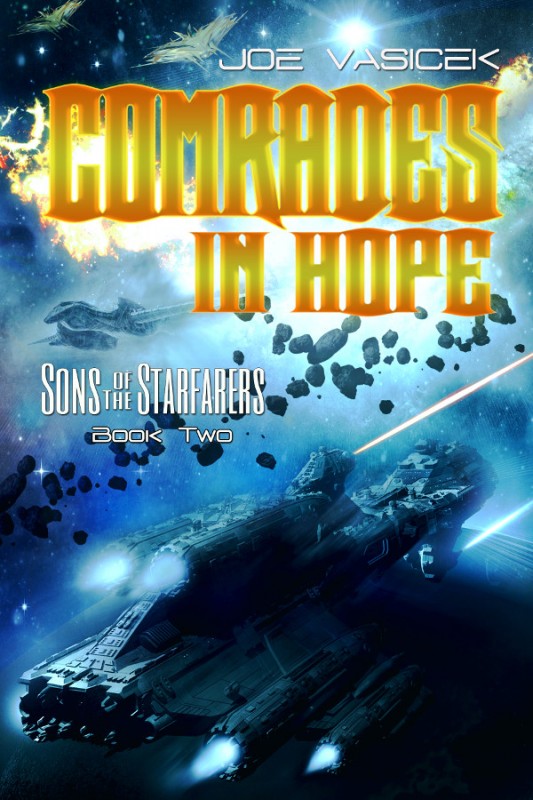
War has a way of shrinking the future until all you can see is the next breath, the next corridor, the next impossible choice. Comrades in Hope is a character-driven military science fiction novel that asks a simple question with a hard edge: what does hope look like when you’ve already seen the worst—and you don’t get to look away? In this book, hope isn’t optimism or denial. It’s what you do after the damage, when survival alone isn’t enough.
Where the Idea Came From
Part of the spark for this theme came from pairing two kinds of characters I wanted in the same story: a young man who still believes the universe can bend toward good, and a survivor who has learned—through loss—that the universe doesn’t care what you believe. Aaron arrives in the Outworld Flotilla carrying naïve expectations and a private vow, while Mara has already been forged by catastrophe, grief, and the long-term psychological trauma of war. Their shared culture and language create a lifeline between them, but it also forces the question into the open: can hope survive trauma without becoming a lie?
How Hope and Trauma Shape the Story
From the beginning, Aaron is out of place—linguistically, culturally, militarily—and that displacement matters, because Comrades in Hope is not a story about winning battles, but about surviving war with your humanity intact. It comes from not understanding the world you’ve been thrown into, from feeling helpless at the exact moments when competence would save lives. Aaron leans on translation tools and improvisation, while Mara carries the grim competence of someone who’s already paid the price of being unprepared. Their relationship becomes a pressure chamber where hope and trauma argue with each other in real time: Aaron keeps reaching for the possibility of a better outcome, while Mara keeps pointing to the body count and the way war turns people into numbers. Yet even her pessimism has a wound behind it—she doesn’t reject hope because it’s childish; she rejects it because she’s afraid of what it costs to believe again.
As the conflict escalates, the book keeps putting hope in the least comfortable place: inside terror, exhaustion, and grief. There are moments where survival narrows to shared oxygen, sealed compartments, and the blunt math of “who made it and who didn’t.” In those scenes, hope stops being a feeling and becomes a decision—sometimes as small as refusing to abandon someone, sometimes as stubborn as continuing the search when every rational signal says it’s over. One of the most revealing turns comes when Aaron challenges Mara’s refusal to hope for herself, and she answers that she can still hope for someone else. That’s the heart of the book: trauma isolates, but hope reconnects—often first as hope for another person, when you can’t yet hold hope for yourself.
What This Theme Says About Us
Most of us won’t fight aboard captured battleships or live under the constant threat of empire, but we do know what it’s like to be changed by pain—and to wonder whether what we lost can ever be rebuilt. Comrades in Hope leans into a truth that shows up again and again in real life: trauma doesn’t only injure the body or the memory; it injures the imagination. It makes the future feel unsafe to picture. And yet, again and again, people choose hope anyway—not because they’re sure things will work out, but because they refuse to let suffering have the final word on who they are. This is why stories like Comrades in Hope resonate with readers who care about resilience, found family, and the quiet moral choices people make under pressure—especially in times of war and displacement.
Why This Theme Matters to Me
I wrote Comrades in Hope fast, almost breathless, and in a very “discovery writer” way—following the characters into the war and letting their struggles shape what the book became. What I love about this story is that it doesn’t treat hope as a motivational poster, especially in the context of war and trauma. It treats it as something you earn, something you protect, and sometimes something you borrow from the people beside you when you’ve got nothing left. And on a personal level, I keep coming back to how much this whole career—and every book I get to write—depends on readers choosing to care, choosing to share, choosing to keep stories alive. That’s its own kind of hope, and I don’t take it for granted.
Where to Get the Book









Related Posts and Pages
Explore the series index for Sons of the Starfarers.
Return to the book page for Comrades in Hope.