A slightly truncated version of this excerpt won first place in the 2009 Mayhew short story contest at BYU. I’ve made a few minor edits since then, mostly for clarification, but nothing too major. Enjoy!
They say that cryofreeze is the closest thing to death short of actually dying. I believe it.
First, you strip off your clothes and lower yourself down into the coffin-shaped cryo chamber. The glass seals shut above you, and a cold, green mist fills the narrow space, penetrating your naked skin. The mist contains chemicals that freeze your cells properly, so that they don’t crack or break when you thaw out–but it has a nauseous smell to it, and makes you feel sticky. Your skin starts to change from pink to white to light blue, slow enough not to notice right away, but quick enough to catch if you know what to look for.
As the chemicals continue their work, you start to shiver. Just before the cold becomes unbearable, sleeping gas seeps in through the top valves of the chamber. You pass out, too stiff to peacefully fall asleep. The rapid freezing process–where your heart and lungs cease their natural functions–happens while you’re unconscious.
They say that you don’t dream when you’re in cryo, but that’s a lie–they just don’t know how to explain it. Neither do I, but I can say something about the experience. The lines between the senses and your own thoughts blur together, until reality itself becomes utterly unrecognizable. Imperceptible images flash across your awareness, beyond your ability to process them.
Maybe that’s what nothing itself feels like; after all, is it really possible to comprehend non-existence without thinking of it in terms of space and time? I don’t know–I just know that I don’t want to go back there.
By the time you regain consciousness, the thawing process has already run most of its course. The flashes and images become brighter and more perceptible. You have a sort of falling sensation, during which you become aware of your body.
Painfully aware.
When you open your eyes, you’ve got a splitting headache and a nauseous stomach. Every time you move, another muscle cramps up on you. If you aren’t careful, you empty your bowels right there in the chamber.
The glass hisses open, the chamber tilts up to a forty five degree angle, and your limp body slides down the cold metal back until you find yourself sitting on your ankles. Your breath feels like fire in your lungs, and even though steam envelopes your body from all sides, you feel deathly cold. Too weak to stand up, you fall forward onto your hands and knees instead.
The vomiting is the worst. Forty year old bile splatters cold across the floor, followed by a good ten minutes of dry heaving. Each convulsion is so painful, it makes you feel as if you’re coughing up your own stomach. After you’re finished, you want to do nothing but lie on the ground–in your vomit or to the side, it doesn’t really matter–and cry.
But all that passes with time. After lying on the floor for what seems like hours, your body starts to take strength. The headaches die down, and the cramps slowly diminish. When you open your eyes again, the stars fade away like some kind of ebbing soda fizz, revealing the unfamiliar room in which you have awakened. You bend your fingers, lift your arms, and slowly drag yourself away from that god-awful place.
After that, what is there to do? Wash up, get dressed in your vacuum wrapped forty year old clothes, and clean up the mess.
My stomach throbbed as I walked onto the bridge, but I ignored the pain. My aching body could wait; I had more important things to do.
The instruments showed that we had arrived nearly thirty light hours out from the central star, just outside the orbit of the fourth planet in the system. An unfamiliar starfield shone through the windows, dimmed somewhat by the presence of EB-175 even though the star was still far away. A quick review of the automated ship’s log showed that no significant objects had come anywhere close to the ship in the last two months. Nothing had been sent to intercept us.
I blinked and reread the log, just to make sure. If there was intelligent alien life, maybe they were waiting, watching us from a distance. Or maybe the log was wrong.
My bodily needs eventually overcame my scientific obsession, however. I stood up from my seat on the bridge and made my way to the ship’s tiny mess hall where I could find something to satisfy my cramping stomach.
I felt sick and disoriented for nearly an hour. In that time, I ate some meal and fruit drink, but not much else. It felt eerie to be alone on the ship, but I didn’t want to thaw Terra until I had recovered my strength.
After an hour, I was ready. At least, I thought I was.
Terra didn’t look human–she looked like a giant doll, a pale, lifeless marionette. Her skin was a whitish-blue, while her other features–fingernails, toenails, lips, nipples–stood out in high contrast shades of black and purple. Her hair was darker than I remembered, as if the cryofreeze had sucked the color out of that, too. The glass of the chamber was cold to the touch, and the expansion of her frozen bodily fluids made her body look slightly bloated. I felt like a voyeur staring at her, but the sight was so morbidly fascinating that I could hardly turn away.
Eventually, however, I got myself together and started the thawing process. A hissing sound came from within the chamber, and a greenish mist washed over her. Gradually, almost imperceptibly, redness and color began to return to her skin. Her body deflated as the temperature in the chamber rose and her bodily fluids began to melt. A robotic arm with two suction cups fastened onto her chest and twitched as a series of quick electric shocks restarted her heart.
I periodically glanced down at the control screen, monitoring the various measures of her status. My legs felt stiff, and my hands trembled–I’d never run through this procedure before, and I barely knew what I was doing. The process was supposed to be fully automated, but cryonics is an imperfect science, and problems frequently arise.
About ten minutes in, I noticed something unusual. Little blue splotches were forming on Terra’s skin at the extremities on her hands and feet. After half a minute, they started showing up on her thighs and torso. I frowned; that didn’t seem right. I adjusted the heating pattern inside the chamber, but the blotches didn’t go away. Instead, the bleeping from the computer that marked her heartbeat started drifting into an unpredictable pattern.
With sweaty palms, I accelerated the thawing process. The uneven heating was probably causing blockages in her veins and arteries. I’d need to break those up soon, if her heart, brain, and lungs were to fully revive their functions. She could only last so long on the machine–
Without warning, the bleeping turned into a constant monotone.
I glanced down and cried out in shock. The line showing her heartbeat had flatlined–according to the machine, she was clinically dead.
I frantically keyed in a series of commands on my console. The robotic arm reattached the suction cups to Terra’s chest and reapplied the electric shocks. To my relief, her heart started beating again, but weaker and more erratic than before. A second later, the warning indicators on half the instruments blinked on. My heart skipped a beat as they flashed in rhythmic chorus. This was serious–very serious.
“Please, no,” I said, face paling. There was no-one on the ship to hear me, though; I was alone.
Within seconds, I figured out what the problem was. Micro-cramps in her muscles were causing uneven heating, cutting off the arteries and capillaries in various parts of her body. Her heart hadn’t recovered sufficiently to break the blockages, so they were spreading.
My hands trembled so much I doubted my fingers could type a coherent sentence. In spite of that, I worked as quickly as I could to counteract the complications, maintaining constant periodic shocks to her heart and significantly increasing the heat on her upper torso. With any luck, her blood would warm up enough to relax the contracted muscles and break the blockages. Still, most the indicators remained in the red–the electric shocks were simply unsustainable. I waited as long as I thought I could, then crossed my fingers and shut them off. Her heart kept pumping, but the beat soon drifted back into unpredictability.
I glanced up at the cryo chamber and caught my breath. Her arms, legs, and chest twitched and convulsed at utter random, undulating in a slow motion seizure. She had no control of her body. Chills ran down my neck and arms.
She needed more than the machines could give her. I pulled out a syringe from the medical cabinet and nervously fumbled through nearly four dozen canisters of liquid drugs. The wrong injection could kill her, but if I didn’t give her something right away, she didn’t have a chance. I grabbed the formula that I thought would best relax her muscles and filled the syringe.
A few of the indicators were moving out of the red when I returned, but the situation was still serious. A brainwave scan showed that her body was operating 85% autonomously from the machines and that she had regained partial consciousness. I waited until the indicator reached 95% and cracked open the glass.
Steam poured out of the chamber and splashed across the ceiling, while the sound of violent coughing came from within. Terra half slid, half fell to the ground. I rushed forward and caught her before she hit the floor, and she responded by vomiting on the front of my shirt.
Despite the heat of the steam, her skin felt cold, and her vomit even colder. I held her off to one side and patted her back to help her force it out. She stopped twitching and coughed a couple of times, but quickly grew weak in my arms.
“Come on, Terra!” I pleaded. Her breathing was too ragged for her to respond.
There wasn’t any time to lose. I pulled out the syringe and balled my fingers around it into a fist. It was built for a fast, emergency injection–the kind that could be jammed into someone’s leg. I brought it down on her right thigh. Her blotchy-blue skin rippled a little, and the fluid went in almost immediately.
A couple of seconds passed before the medicine took any effect. When it did, her whole body went stiff, and her eyes opened wide, revealing dilated pupils. Before I could react, she started convulsing violently, as if she were going into a seizure. I set her on the floor as gently as I could and held onto her head to make sure that she didn’t injure herself.
After about fifteen seconds, her body went limp again. I put two fingers up to her neck and felt for a pulse. To my relief, it was steady and strong. I sighed and practically collapsed.
As if in response, her chest heaved and she started vomiting again. I scrambled to my knees and turned her onto her side. How much stuff did she have in there–hadn’t she followed the 24 hour no food rule? No time to worry about that–just help her get it out without choking on the stuff.
She vomited and coughed until snot dripped down her face and the hoarse sound of her dry heaving filled the room. She was still too weak to sit up, so I supported her as best I could until she stopped. Sobs of pain slowly replaced the retching.
“Are you all right?” I asked.
What a stupid thing to say!
She looked up and gave me an icy glare. Tears and snot mingled on her cheeks. “No!” she shouted, then went back to coughing.
I held her until she began to quiet down. With the worst of it gone, relief came slowly to my nervous body. Her skin was getting warmer and her heartbeat was steady now. After forty years on the threshold of death, she was alive again.
Alive and completely naked. My cheeks flushed, and I set her on the floor.
“Can you stand up yet?” I asked.
“Not…yet,” she groaned. “Cramps…everywhere.”
I grabbed a towel on the side of the control panel and hastily draped it over her. She reached up with a hand and weakly held onto it. I waited until her breathing became less labored before asking her again.
“How about now?”
She clenched her teeth and nodded.
I stood up and took her by one hand, pulling her gently to her feet. She bent her knees carefully as she sat up, still holding onto the towel. When she was standing up, she let go of my hand and reached out for the wall. The towel fell off of one side, but she didn’t make any attempt to fix it. She still seemed fairly incoherent.
“What’s…our…status?” she asked.
“Everything is going well. We’re about two light hours out from the system.”
“Good,” she groaned, slowly wrapping the towel back around her. I almost reached out a hand to help, but hesitated.
“D–do you need help?” I stammered.
“No, thanks, I think I’ve got it.” She glanced up at me, then down at my chest and grinned. “Sorry about your shirt.”
“What?” I looked down and saw the vomit. “Oh, that. Don’t worry about it.”
She nodded weakly and closed her eyes.
“Are you sure you don’t need help?” I asked.
“I don’t…think so. Getting…better.” She staggered away from the wall and nearly fell over. “So…cold…”
She had stopped shivering. That was a bad sign.
“Here,” I said, taking her hand. “Follow me.”
If she wasn’t shivering, her body wasn’t generating enough heat yet and she was at serious risk for hypothermia. The best way to counteract that was to immerse her in warm water. I led her down the hall and into the narrow, cylindrical shower unit in the bathroom. She nearly passed out on the way there, and I practically carried her the last half of the way. The towel fell off in the hallway, making things only more awkward for me, but that was no longer important.
I leaned her up against the smooth wall of the unit, and she slid down to her knees. Her skin was sickly pale, her arms limp, and she mumbled incoherently as her head flopped back against the wall, hair partially covering her face.
I bit my lip and reached around the side to activate the water. Should I turn the heat up to full, or would that give her system too much shock? My heart pounded in my chest–no time to waste. I set the temperature to low-warm and hit the activate button.
Jets of lukewarm water shot out from all sides, drenching my already soiled shirt and running out into the room. Rivulets ran down Terra’s face and pale skin, but she didn’t move.
“Come on,” I said, ignoring the water soaking my clothes as I knelt down and put my hands on her shoulder. “Terra, are you alright? Terra!”
I pressed my fingers against her neck and found a pulse. Her body shuddered and she coughed. Nothing else to do but give her some space and let the shower do its work.
My heart still pounding, I stepped out of the unit and shut the door. My shirt was soaking wet, and Terra’s watery vomit ran down my legs and pooled on the floor. As I stood there dripping, Terra stumbled noisily to her feet, teeth chattering. The diffuse glass began to steam up, indicating that she’d turned up the heat on her own.
She was recovering.
“Your clothes are outside,” I said as I pulled out the vacuum sealed bags and put them on a shelf next to the door.
“Okay,” she groaned.
“Are you okay? Do you need any more help?”
“No…thanks,” she muttered. I left the room.
When I reached the hallway, I leaned against the wall and promptly collapsed in exhaustion. A puddle of grimy water formed around me on the floor, but I no longer cared. I sat there by myself for a long time.
 This past week was pretty crazy. Tests, papers, homework…BLEARGH. Less than satisfying. What’s more, I was starting to get cabin fever from being in Provo so long. Every day, doing the same old thing, going the same old places, seeing the same old sights…
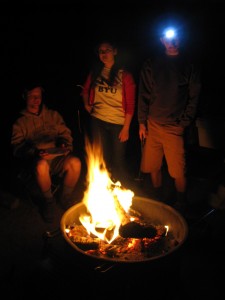 What an awesome weekend! Ben had brought a couple of dutch ovens and tons and TONS of good food! Dinner was much better than the stereotypical hot dogs and smores (though we did have smores in the morning). We had cobler, sweet and sour chicken, and fried rice for dinner–awesome! Plus, it was fun just to hang out around the campfire and talk. Good times.
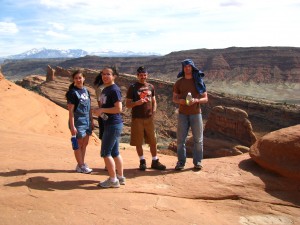 Got up early, restarted the campfire, and we had a good breakfast–biscuits and gravy, and then smores a little while later. Good times. We took off a little later and went up to Arches National Park to do some hiking.
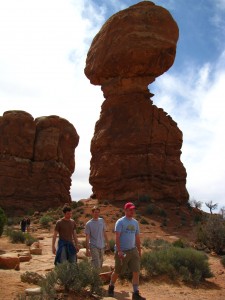 This was my first time at Arches, and despite some problems with the parking, it was a lot of fun. The desert around Arches reminds me a lot of Petra–lots of sandy red rocks in weird formations, making for relatively easy climbing. In fact, the whole trip reminded me a lot of Jordan and Petra.