I don’t generally have much time these days to argue with strangers on the internet. While on the whole, that’s certainly a good thing, it also means that I tend to be out of the loop when it comes to most of the current cultural debates.
One term that I see a lot of these days is “AI slop.” It’s always used in a derrogatory way, and seems to be paired with the ongoing debate about the ethics or desireability of AI generated content, in various settings. I haven’t been following that debate very closely, but I can tell that there are some very strong anti-AI feelings out there, and some very vocal and passionate people espousing them.
But is the “slop” really an AI problem, or a symptom of something greater? I tend to think the latter, and here’s why.
I watched this video recently, about how most restaurants these days are producing literal slop. According to Matt Walsh, the reason (in case you don’t have twenty minutes to watch the video) is basically that all of these restaurants have been taken over by investors who are looking to maximize the value of their investment, and the best way to do that is to cut costs down to the bone and put out a minimum viable product.
It strikes me that “minimum viable product” is basically just another way of saying “slop.” It’s just barely good enough that people will generally consume it, but not so great that it takes a lot of time or energy to produce. As an example:
My kids love watching lego videos. In fact, they are starting to become low-key addicted to them (which we are doing our best to keep from getting worse). But within this genre on YouTube, there are some really good videos, like the one above… and this one, which my daughter insists on watching every day.
The first video features some truly elegant designs, with a detailed breakdown not only of how to build them, but how they operate, complete with foot paths, frame paths, etc. Even after watching the video some two or three dozen times, I am genuinely impressed by some of these models.
The second video is an obvious copycat video, with some slap-dash, crappy designs that look like zero thought went into them at all. I mean, seriously? Square wheels? And what’s with the two-legged walker, with the weight on the far back? More like “dragger” than “walker”—at least give the thing a wheel! And the tilt-rover? All the weight is on the back wheel, but the thing is front-wheel drive—of course it’s going to fail all the tests!
But even though the content itself is obvious copycat slop, slapped together quickly in order to capitalize on a trend within the genre (the YouTuber even tries to “hack” the algorithm by mashing two videos together, kind of like how some authors mash books together in order to maximize KENP page reads), my daughter still wants to watch this video more than the higher quality video. Why? Probably because of the flashier visuals and music, which makes the slop more appealing on a surface level.
Here’s the thing, though: as far as I can tell, there was no AI involved in making the lego video slop. It appears that the YouTuber actually built and actually tested these lego models. I could be wrong about this, of course, but I’ve watched these videos so many times with my kids that if there were any AI-isms in the video, I think I’d be able to spot them.
And then, we get something like this:
From what I can tell, every part of this video is made with AI, down to the actual writing (what kind of human would write “tunnels run like sacred veins”?) and the musical performance—and of course, the stunning visuals. But is it slop? The YouTuber appears to be a shitposter and meme-artist, which means he probably made this thing for the love of making it. And after watching it a couple of times, it really shows. Not like it’s fine art, of course, but there is so much packed in here—so many easter eggs and veiled cultural references—that even after watching it a dozen times, I am genuinely impressed.
So is that slop? It’s obviously AI, but is it a “minimum viable product”? I honestly don’t think so. Rather, I think the creator had something burning within him that he wanted to create, and he poured all of that into his creation, using AI tools to do all the things that he otherwise couldn’t have done. And the result is genuinely impressive. Seriously, I can’t stop watching it.
So is “slop” an AI problem? I don’t think so. Rather, I think that the explosion in poor-quality AI generated content is revealing our modern, capitalist, consumer culture’s tendency to settle for a minimum viable product rather than strive for excellence and greatness. We were getting slop long before we had AI. The only thing that’s fundamentally changed is that AI is increasing the quantity—and frankly, the quality—of the slop.
This isn’t exactly a long-form podcast episode, but it is a really great interview on a subject that is near and dear to my own heart. Andrew Klavan is a fantastic author—I’m currently reading his latest Cameron Winter novel, A Woman Underground, and loving it—and of the Daily Wire hosts, he gives the most interesting commentary and insights on cultural issues (which isn’t surprising, given his age and Hollywood background).
I am sending this email to you because your voice mailbox is full, no doubt from listeners (such as myself) of popular conservative commentator Matt Walsh who gave us your (publicly listed) number and email address and encouraged us to reach out to you. Lest you think that this email constitutes harassment, I am a father of two young children who is actively researching our long-term education options and considering whether or not to encourage them to attend a university such as your own. I myself attended the Williston Northampton School in Easthampton, MA, and many of my high school classmates went on to attend Brown.
It has come to my attention that a PhD student and member of your university community named Sarah Celeste Griffith has, for several months, been calling for the vigilante execution of Matt Walsh at his home. This is an explicit call for violence that, to my knowledge, is not protected by even the most liberal (in the non-political sense) interpretation of the first amendment, and yet your university has not taken any action to censure or discipline this student.
Based on the fact that this has been happening for several months, I can only conclude that your administration tacitly supports explicit and illegal calls for violence against Matt Walsh and his family. Is this correct, or is there more to this story (such as the incompetence of your own administration and staff) of which we are unaware? Now that Brown’s support of this student’s illegal and lawbreaking behavior has been made public, will you take actions to discipline or expel this student? Or is such violence and political intolerance exemplary of the values of a Brown University education—values that I, as a parent of young and intelligent children, can expect Brown University to instill in them, should I send them to Brown?
Of or pertaining to the mass formation psychosis currently gripping the United States and most of the developed world. This mass formation psychosis is led by radical leftist ideologues and driven by social media addiction. Due to the collusion between major technology companies and the US government, there is also an element of state-sponsored propaganda and control.
The mass began to form in the late 2000s with the popularization of social media. As these technologies began to replace face-to-face human reactions, it created the pre-conditions of social isolation and free floating anxiety, in large part due to the addictive nature of the algorithms which promoted content most likely to induce outrage and anger in the end-user (see CGP Grey, “This Video Will Make You Angry”). Once these pre-conditions were in place, all that was necessary to create the psychosis was a target or series of events to focus the attention of the mass.
The 2010s were characterized by several of these focusing events, starting in 2012 with the shooting of Michael Brown and the subsequent riots in Ferguson, Missouri, and continuing with numerous mass shootings such as Orlando and Sandy Hook, several landmark Supreme Court decisions on gay rights such as United States V. Windsor and Obergerfel v. Hodges, and the rise of such controversial movements as Gamergate and the Sad/Rabid Puppies. The culminating event in the creation of this mass formation psychosis was the election in 2016 of Donald J. Trump as President of the United States.
Following Trump’s election, rogue elements of the bureaucracy, the administrative agencies, and the intelligence community (colloquially referred to as the “deep state”) successfully exploited this mass formation psychosis in an effort to hamstring the Trump administration and ultimately remove him from power. These deep state actors acted in collusion with the Silicon Valley technology companies that ran the social media platforms.
Because of the inherently left-leaning political bias of these Silicon Valley companies, this mass formation psychosis always had a leftist bent, and tended to promote radical leftist ideologues as its leaders. However, in any mass formation, the leaders are often just as caught up in the psychosis as the followers. This soon became manifest in the moral and rational incoherence of its leaders (see “What Is a Woman?”), and in the various internal contradictions of their own respective causes and beliefs. While “wokeism” is inherently political, it is not primarily characterized by a unified political ideology or movement.
The high water mark of the mass formation psychosis occured in 2020 during the covid-19 pandemic, during which it took on all of the defining characteristics of a cult (see “What is the Covid cult?”). The George Floyd riots were the major culminating event, but Trump’s ostensible defeat in the disputed 2020 elections and his subsequent removal from power in the January 6th color revolution removed the central focusing element necessary for the mass formation psychosis. Since then, the deep state and political establishment has attempted several times to find a new focusing element for the psychosis, with such issues as climate change or the Russo-Ukraine war, but thus far these efforts have proven unsuccessful (see: “I SUPPORT THE CURRENT THING!”)
At this time (March 2023), it is unclear how this mass formation psychosis will end. If Trump is re-elected in 2020, it may catch a second wind, or it may be replaced by the right-leaning mass formation psychosis characterized by Trumpism and the MAGA movement. It may fizzle out slowly, or it may be defeated by the growing demand for a religious revival in the United States. Alternately, it may prove to be the precursor of a much more dangerous mass formation psychosis, this time driven by AI and the outbreak of World War III. Regardless, the events of the next 12 to 18 months will determine which course our society will take.
For the last several months, I’ve quietly been running these Christian Author group promotions on Book Funnel and Story Origin. I started them in response to some other group author promotions that I saw floating around on Facebook, with banners that have the standard woke progressive litany. You know how it goes: in this home, we believe that love is love, science is real, black lives matter, vaccines are yada yada yada.
Anyway, I saw those super left-wing promotions floating around, and thought: how can I signal to the readers who think that woke nonsense is insane that I also think it’s insane and don’t have any of that woke crap in my books? In other words, how can I organize a group promotion for non-woke authors without actually coming out and saying “we aren’t woke!”
The reason I don’t want to just come out and say “we aren’t woke!” is because if that’s the way you define yourself, you’re going to be overtly political, just in the opposite direction. For that reason, books that advertise as “anti-woke” are often just as terrible as woke books—or in other words, just as infected with toxic politics. Since the whole point was to get away from the toxic politics, I wanted to anchor the promotions on something that is very much antithetical to the woke nonsense, but not overtly political.
Hence the reason I settled on Christian authors as the theme: not on overtly Christian books, but books that are written by Christians. The thinking was that authors who self-identify as Christians probably wouldn’t go for all that woke nonsense that is, after all, antithetical to Christian teachings, and that readers who want to read Christian authors are also probably trying to avoid fiction that is infected with woke ideology.
Then I read Church of Cowards by Matt Walsh, and I realized that my plan had a fatal flaw: Christianity itself has become so infected with woke ideology that it no longer serves as an effective filter or signal against it. Of course, I knew that this was a problem, but I didn’t know serious the problem had become. In my church, we all still dress in church clothes on Sunday, still actually go to church on Sunday, believe in scripture as the literal word of God, and, you know, accept Jesus Christ as our Lord and Savior. Apparently, all of those points are now super controversial among those who profess to be Christians. Go figure.
Also, Christian fiction comes with its own baggage that isn’t doing these group promotions any favors—which is a shame, because it’s not the books that are explicitly Christian, just the authors themselves. But apparently, Christian fiction has become so sappy and poorly written that I can hardly blame most readers for looking at those banners and thinking “uh, no thanks”—even the believing Christian readers. In particular, Matt Walsh took apart the God’s Not Dead series, which is apparently worse than most self-published stuff. Also, I tried out Left Behind last month, and DNFed it before the end of the first chapter just because of how ludicrous the setup for that book/series is.
(Seriously, Russia makes an alliance with… Ethiopia? …and randomly decides to wipe Israel off the face of the Earth, only to have their ENTIRE AIR FORCE destroyed in a day by a supernatural event? Every combination of the words in that sentence is laughably nonsensical to anyone who follows contemporary geopolitics. The current situation in the Middle East, with Russia and Iran basing forces in Syria, and Iran supplying Russia with kamikaze drones, is a more believable fulfillment of the Gog and Magog prophecies—and that’s before the Russo-Ukraine war spirals into a global conflict. Reality is far more terrifying—and far more Biblical—than anything the Left Behind series cooked up.)
With all of that in mind, it’s not much of a surprise that these Christian Author promotions have underperformed, not just among my existing newsletter subscribers, but among readers generally. So now I’m looking to try out some different themes for group promotions. Some of them are going to be totally non-political: I’ve always had success with the September Space Adventure group promo, after all. But how to reach that reader who thinks that this woke nonsense is insane?
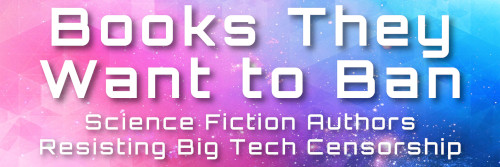
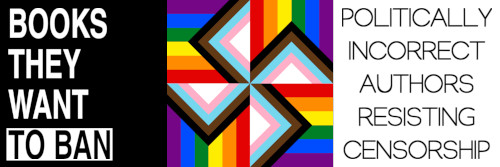
The second banner might be a little too on-point (not to mention, it may get me banned from a few places), but I’m trying out this Books They Want to Ban theme again right now. I did something like it a while ago, and it didn’t do super well, but it’s worth running at least a couple of times to see how it goes.
So what do you think? Should I try running with this theme, or just totally avoid the woke / anti-woke politics altogether?
I never know which posts of mine China Mike Glyer is going to pick up for his pixel scroll, or whatever he calls the daily bucket of chum that he feeds the folks over at File 770 (the ones who aren’t Chinese bots, anyway). I’ve written at much greater length about my 2022 reading resolution here, and my insights and impressions gained through the experience here and here, but for some reason the post he decided to pick up was the last one. Perhaps he thought that it would be better at ginning up outrage than the other posts? But if that were the case, surely he would have picked up the one before that instead. It was practically written for ginning up outrage among the File 770 crowd (or at least the ones who aren’t Chinese bots).
So when I got the pingback last night, I glanced over the post over at File 770 and saw this comment from Cora Buhlert:
I have to admit that whether or not writers have children is not a characteristic I pay the slightest bit of attention to. Never mind that it is difficult to tell, because even today, not every writer chooses to talk about their family or private life.
But I guess that Joe Vasicek is the sort of person for whom people without children, particularly women without children, are by definition evil.
Cora is an indie writer from Germany that I used to interact with a lot on the KBoards Writer’s Cafe, and some other indie author hangouts. She’s earned the ire of Larry Correia a couple of times, and she has a bad tendency to straw man any opinions or perspectives that challenge her worldview. On one thread, we went back and forth over whether Hitler was a creation of the political right or the political left. I tried to explain that “left” and “right” mean different things in the US than they do in Europe, but it was like trying to have a discussion with a brick wall.
So it doesn’t surprise me in the least that she’s completely mischaracterized me in the comment above. I do not believe that childless women are evil—if I did, I would not have served in the bishopric of a mid-singles ward (a mid-singles ward is a Latter-day Saints congregation of unmarried and divorced people in their 30s and 40s. I was the ward clerk—basically, the guy who handled all the finances and other paperwork for the congregation). My faith teaches me that people are not evil, but are all children of God, no matter who they are born to or what their life choices may be.
In fact, my interest in the parental status of the Hugo and Nebula winning authors has nothing to do with religion or morality, and everything to do with life experience. I didn’t get married until almost a decade after I had started to write professionally, and the experience of becoming a father was so completely lifechanging that it’s transformed my writing as well: what I choose (and don’t choose) to write about, who I choose (and don’t choose) to write for, as well as the themes and ideas that I explore in my books.
You can see this transformation if you read my Genesis Earth Trilogy. Genesis Earth was my first novel, but it wasn’t until almost nine years later—after I’d met my wife and was engaged to be married—that I felt I had the life experience necessary to write the sequel, Edenfall. And the final book, The Stars of Redemption, was not the sort of thing I was capable of writing until after I had become a father and knew what it was like to help bring a child into the world.
When my daughter was born, the very first thought that came into my mind was “this is her story now, not yours.” We all like to say that we’re the hero of our own story, and in a very basic way, that’s true. But when you become a parent (assuming that you’re a responsible parent, and not a scumbag), you’re no longer living just for yourself, but for your children. “He who findeth his life shall lose it: and he that loseth his life for my sake shall find it.”
Having a child changes your perspective on everything. Among other things, you have a much deeper and more personal investment in the future, since you know that your child will inherit that world. Your perspective on your own family history changes too, as you have become a link in the generations, not merely a byproduct of it. Life becomes a lot harder, but it also becomes more meaningful. Things that took up a great deal of your time and attention when you were single suddenly become trivial, and other things that didn’t make much sense to you about people before suddenly click into place.
So that was why, when I decided to read all of the Hugo and Nebula winning novels, I was curious about the parental status of the authors. I wanted to know if the experience of being a parent had affected the quality of their writing, since I know it’s affected mine. And honestly, it’s not that hard to look up: almost all of these authors have Wikipedia pages with a section about their personal lives. Obviously, the details about their children are sparse, but the only thing I cared about was whether or not they had any.
(As a side note, there were other stats that I decided to track, such as the age of the author when they won the award. That hasn’t seemed to have impacted my taste, except that I have not enjoyed a single award-winning novel by an author who was in their 20s at the time that they won. The only exception was Isaac Asimov with the retro-Hugo for The Mule (Foundation and Empire), but that wasn’t awarded until after he was dead. There are also three authors whose age I was unable to determine from a quick internet search: Michael Swanwick, Sarah Pinsker, and Charlie Jane Anders.)
(As another side note, I’ll be the first to admit that I may have made some errors in my research. For example, if a five-minute internet search on an author didn’t tell me anything about their kids, I assumed they didn’t have any. It’s entirely possible that they just prefer to keep that information private. Also, I didn’t bother to look up when they had their children, so it’s possible that they were still childless at the time they won the award.)
Why should I be interested in this sort of thing? Why look at things like an author’s age, gender, or parental status?
Two reasons. The first is that I wanted to do a deep dive on the Hugos and the Nebulas, the two awards which represent themselves as representing the very best of the science fiction genre. Since that is the genre that I write, I want to understand not just the kind of books that win these awards, but the kind of authors who win them. The goal is to have a deeper understanding of the genre, and to look for trends and movements within it.
Second, and more importantly, I want to have a better understanding of my own reading tastes. All of this is subjective, of course, since the act of reading is always a collaboration between the reader and the writer. I’m sure that some of the books I think are terrible are considered by others to be the best in the world, and vice versa. My goal is to look for patterns that will tell me whether I’m likely to enjoy a book (or an author), so that I can find the best books more efficiently. I don’t do this for all of the books that I read, but since the Hugo and Nebula winning books are supposed to be the very best, I figured it was worth it to do a deeper analysis—especially since my goal is to read all of them.
The thing that surprises me is that it isn’t parental status that matters, but gender + parental status. I can think of a couple of reasons why this would be the case. The most obvious is that it’s easier for me to empathize with a childless man, since that was me for such a long time. And I do think that’s a major part of it.
But I also think that there’s something specifically about being a mother—or deliberately choosing not to be one—that’s also a factor. And yes, I’m talking about biological essentialism. I mean, I’m not a biologist, but I know that I will never be able to be a mother—that’s a life experience that I will never be able to have. Conversely, I will never be able to deny my potential motherhood, an equally major life decision. Both of those experiences are bound to have a major impact on an author’s writing, either way.
I also think this factor is what lies at the heart of Roe v. Wade, the worst decided Supreme Court case since Dred Scott v. Sanford. Certainly the cultural impact of that decision has profoundly influenced how our society views children and motherhood. It’s also why I am sooo looking forward to Matt Walsh’s documentary What Is a Woman? coming out in two weeks:
With all of this in mind, I find it fascinating that every Hugo Award for best novel after 2015 (the year that the Sad Puppies had their high water mark) was won, as far as I can tell, by a childless woman. It would be interesting to see if that trend extends to nominees, or to the other categories like best short story, best novelette, and best novella. Maybe I’ll look that up sometime.
And now that I’ve referenced Roe v. Wade, I’m sure that Cora Buhlert (if she’s reading this) is saying to herself: “yup, he just thinks that all childless women are evil.” And to the extent that File 770 is read by humans and not bots, they’re no doubt picking and choosing those parts of this post that confirm their prejudices (if China Mike Glyer even has the balls to cross link to a post that includes that trailer—do it, China Mike! I dare you!)
But I don’t really care either way, because now I have a much better understanding of my own personal reading tastes, and how they contrast with the Hugo/Nebula crowd. For me, the best books are those that are written by authors who have had the life experience of being a mother, and the worst books are by those who have chosen to deny themselves that path. Apparently, the Hugo/Nebula crowd takes the opposite view. Good to know.