How to say “I love you” in math

I was having dinner at the McQueens today, and after chatting with my brother in law’s cousins about numerous interesting subjects (zombie contingency plans, preferred food substances to swim in, and the amount of sugar it would take to launch  you into space), we got onto the subject of math as a language.

Side note: I am on a quest (well, more of a subquest) to prove that math is not a language–at least, not in the same way that English is.  The question I always pose to throw people off is “how do you say ‘I love you’ in math?”

Well, I posed the question, and Sarah came up with the best answer I’ve heard yet:

7i + 3u < 24u

Har.  Har.  Har.

In unrelated news, I’m going to find out on Tuesday (read: tomorrow night) if I made the semi-finals for the 2011 Amazon Breakthrough Novel Award contest.  I’m starting to freak out a little bit about it, but at least it’s come this far…okay, who am I kidding?  GAAAAAHHHH!

In related news, I am totally going to base a character in one of my novels off of Sarah…but only tangentially, of course.

What have you learned from reading science fiction?

While trolling around the new Facebook questions app, I came across this interesting question.  Unable to resist, I spent the next hour crafting my answer.

This is what I wrote:

Gosh, what HAVEN’T I learned from science fiction?

Because of science fiction, I do not fear the alien. I do not feel threatened by people of different places or cultures, but take great interest in learning from them. I look at them and love them, because I can see myself in them.

Because of science fiction, I can look out at the vast expanse of the universe and not despair because of my insignificance. I know my place within it, and can appreciate the wonders and endless possibilities all around me.

Because of science fiction, I can look at the world and know which questions to ask. I can see through the lies that society constantly feeds me, and know how to fight against them.

Because of science fiction, I can look to the future with hope. Having seen the best and the worst of all possible worlds, I know which paths to avoid and which paths to follow. With this knowledge I can inspire my fellow men, because I know that nothing is inevitable.

Because of science fiction, I have a deep and endearing love for the world in which I live. I know better what it means to be human, and knowing this helps me to take no human life for granted. I have a greater capacity to love those around me, and that is the most important thing of all.

Science fiction has enriched my life beyond measure. By constantly stretching the bounds of my imagination, science fiction has led me to more truth than any other literary genre–and not only led me to that truth, but helped me to incorporate it into all that I do. So long as I live, I will always be a reader and a writer of science fiction.

Answering this question reminded me of my interview with Shayne Bell a couple weeks ago.  In it, he talked about how rich and vibrant science fiction is as a literary genre, and how it deeply impacted his own life.  Listening to him speak, I couldn’t help but feel that I was in the presence of a great man.

I don’t think he’d be comfortable with me posting the full audio of that interview, but many of his comments will appear in the article I’m putting together for the December issue of Mormon Artist.  Between working full time and trying to finish the fourth draft of Mercenary Savior in time for World Fantasy, I haven’t had much time to work on it, but it’s going to be awesome.

What have YOU learned from science fiction?  How has it enriched your life?

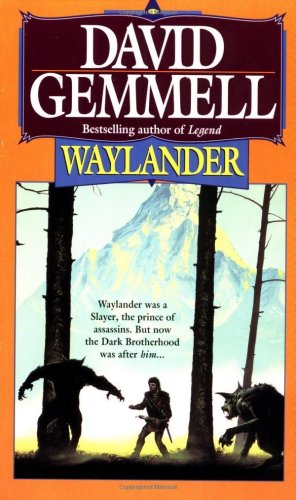
Waylander by David Gemmell

The Drenai lands have been overrun, and the Vagrian conquerors, led by Kaem and the Dark Brotherhood, are laying waste to all that lies before them.  Only the stronghold at Purdol withstands them, but unless the Drenai can rally a counterattack, all will be lost.

In these trying times, a strange old man visits the assassin Waylander and urges him to go to the sacred Nadir mountain of Raboas and retrieve the legendary Armor of Bronze.  With this armor, the Drenai commander Egel can rally the army that will save the kingdom.

But Waylander is a hunted man–a man of dark secrets and many enemies.  Kaem wants him dead for killing his son.  The Nadir want him dead for violating their lands.  And the Drenai want him dead for assassinating their king.

I love David Gemmell.  When you pick up one of his novels, you know exactly what you’re going to get: gritty, complex characters, bloody battles, ruthless villains, and difficult moral decisions that transform even the most depraved individuals into true heroes, if only for a few moments before they die.  Waylander is no exception.

Perhaps the most interesting part of the book is the story behind the founding of the Thirty.  When the young Source priest named Dardalion forsakes the pacifism in order to save the lives of his fellow countrymen, twenty nine fellow priests join him to form the band of legendary warrior monks.  This religious order goes on to play a pivotal role in some of Gemmell’s best works.

Waylander himself is also an interesting, memorable character.  During the events of Waylander, he’s basically hit rock bottom, but as he learns again what it means to love and fight for what he loves, he climbs out of that dark place.

I really enjoyed this book.  My only complaint is that the ending felt a little rushed.  All the plots and subplots get tied up, but some of them so abruptly that there’s little room to savor the emotional impact.  Still, the novel was quite satisfying overall.  I look forward to reading the next book in the Waylander saga.

Falling in love: does it actually happen?

I like to tell people that I don’t believe in the concept of “falling in love”–that true love isn’t something you fall into, it’s something you grow into.  The thing you fall into is called “infatuation,” which by itself doesn’t last long.  It’s happened to me many times, and look at how single I am.

However, I was listening to this week’s episode of This American Life, and the first story got me to think about the concept of “falling in love.” The story was about an American exchange student in China who went back a year later in order to chase down this girl he’d met over there.  Miraculously, he found her, and in a short period of time, they married each other.

The story doesn’t end there, though, nor does it gloss over or ignore their struggles since getting married.  In fact, they’re both surprisingly candid.  Even though they could have broken up, though, they said that the incredible story of how they got together kept them going until they worked through the crisis.  The narrator finished:

..Eric and Yuen-Yuen had to make that same transition that all couples do, from the crazy, in-love stage to the other thing—the hard part of love. And it’s when you’re in that struggle that you most need the story of how you’re meant to be, because the alternative–that the person you’re with could be one any one of hundreds or thousands of other people–well, if that’s true, then why even try?

This got me to wondering–is there something besides sentimental hogwash to the notion of falling in love? Is it a necessary myth? Or is it more than a myth? Growth is generally something you control, but if all you can say is that you and your significant other “grew” into where you are today, is that enough to keep you going?

Snarkiness aside, I suppose it’s different for everybody. Some people have to believe they were fated to be together, while others abhor anything but the idea that love is something that grew slowly and steadily, without crazy flashes in the pan.

The important thing, I suppose, is that when it comes to love, we all have to have a story that we tell ourselves. Without a story to help us make sense why we’re with our significant other, it’s possible to think about leaving them.

By definition, every story has a beginning, a middle, and an end. In a love story, I suppose that “falling in love” happens in the beginning, while “growing in love” has to do with the middle, while the end is this hopeful, optimistic future, full of wonderful possibility. No one part makes any sense without the two others, but together they must give a comforting sense of direction, of destiny.

So maybe there is something to the idea of “falling in love.” I don’t think for one second that the initial “falling in love” is the most important part of any functional romance, but I’ll grant that it has its place in the story.