Thanksgiving report from Texas

So for Thanksgiving this year, I drove down with my sister and brother in law to have Thanksgiving in Houston with my other sister’s family.  It’s Friday night, and I’m about to hit the sack to get prepped for the long 24+ hour drive back to Utah, but let me say, this vacation has been great!

It’s so good to spend time with family, especially when you live across the country and can’t see each other very often.  My niece has grown so much in the past year, and she is so freaking cute it’s unbelievable.  Earlier tonight, we were watching slide shows on my sister’s projector and playing around with my niece: “Where’s Aunt Dot?  Where’s Oopah?  Where’s Uncle Joe?” Heh, Uncle Joe.  I will do my best to live up to the awesomeness of that title.

Thanksgiving dinner was AMAZING.  Holy freaking crap, my sisters can cook.  They put together a traditional dinner from scratch, and everything was perfect.  I’m so glad they’re sending a bunch of leftovers with us on the drive tomorrow, because I would much rather subsist on that than random junk food from gas stations.
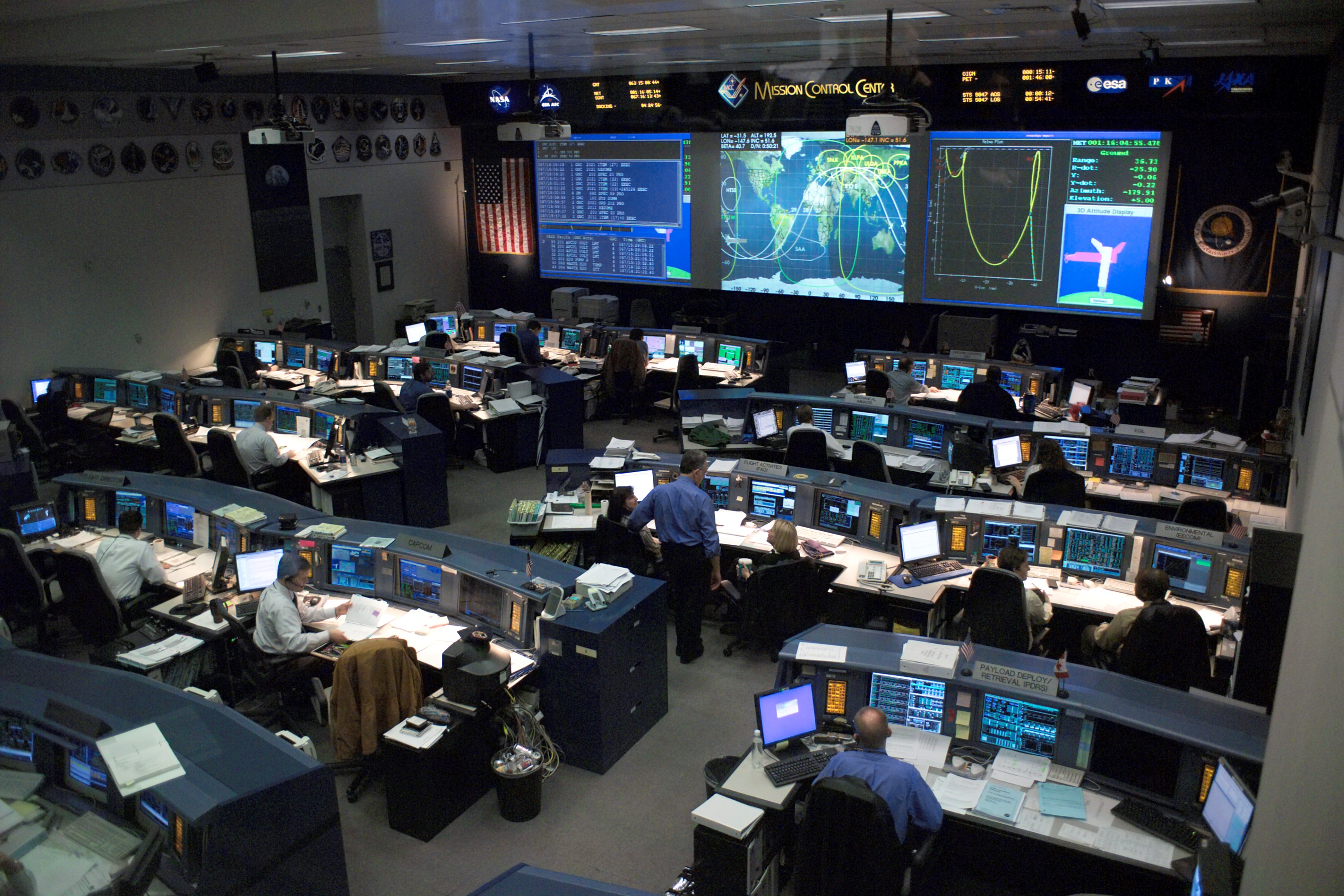
Besides family, though, one of the coolest parts of the vacation was visiting the Houston Space Center and seeing mission control and one of the original Saturn V rockets.  That’s right–see that room in the picture?  I was there.

Which immediately begged the question: Why am I not in space right now?  Seriously, I would do just about anything to go up in space.  Thinking about the Pilgrims made me think about colonizing other planets, and how the difficulties may be similar and yet different.  It also made me think about my latest novel, Into the Nebulous Deep, which (I’m hoping) is a colonization story set in space, and how I can use some of the stuff from the Pilgrims in my own work.

Speaking of which, the writing has been going very slow recently.  A lot of it has to do with interruptions from the vacation (which frankly are more important), but it also has to do with my growing frustrations with the current project.  I’m about 15k in the rough draft of ITND, and…it just doesn’t seem as good as my other work.  Of course, it’s just a mental thing–none of my rough drafts has ever been any good–but man, it’s tough to get through.

To complicate things, I’m going to have to find a job for the Christmas season, at least to tide me over.  I’m really hoping to get that wilderness job, but the training starts January 13th, and I don’t have the funds to spend all my time writing, like I have this past month.

I’ll know for sure the first week of December whether I’ve been invited to the training–and if I am, it’s going to throw a real kink in my writing routine.  Each job shift lasts a full week, during which time I’ll be completely unplugged, living in the wilderness.  I might get some time to work on poetry or short stories, but no novels.

The upside is that I get six days off completely free to do whatever I want, but I’m worried that it’ll be difficult, at least at first, to regain sufficient momentum in that short time.  I’m sure I can get used to it eventually, but for the first few months, it will probably be tough.

For that reason, I want to get as far in ITND as I can before January 13th, perhaps even finish it (HAHAHAHA!!!  As if that’s going to happen).  So the fact that I haven’t progressed from this one scene for like a week is really killing me.  Throw in a temporary job for the Christmas season, and I’ll probably go crazy.

That’s what my writing angst says, anyways.  In other words, everything is fine and life is great.  Now I’m going to get some sleep before driving across the freaking country all day tomorrow and Sunday.  Night!
Crunch time

Sixty six percent!  I’ve officially passed the two thirds mark in the fourth revision for Mercenary Savior–and not a moment too soon.  With only a week and a half until World Fantasy 2010, it’s crunch time.  I’ll probably quit my temp job a week early in order to devote the last few days of the month to finishing it.

As I’ve been working on Mercenary Savior, though, a fascinating idea for a sequel has been stewing in my head.  It was sparked by an online conversation with one of my first readers:

Reader: I was never fully convinced that James felt he had closure
Me: I see
Reader: but I was satisfied with the thought that he would get it sometime after the story ends
he’s still young, so he’s still maturing
even at the close of the novel
Me: yeah
hmm
interesting

It’s true; James does have a lot of room to grow and mature after the events of Mercenary Savior. In that book, his character growth arc (without giving away spoilers) is about him learning to accept change and stop running from adulthood.

Nothing in that arc has much to do with the kind of person James grows up to be, however, or the significant other with whom he comes to share his life.  In other words, there’s a whole lot of untapped potential for building James’s character and giving him a romantic interest.

The question that immediately rose to my mind was: what’s the story?

Now when it comes to sequels, I think the best ones take a long, hard look at the first installment and answer the question: therefore, what? Thus, in Star Wars IV, V, and VI (which I believe to be one of the best examples of a trilogy in any medium), the Rebels defeat the first Death Star in episode IV, but find themselves on the run in episode V because the Empire knows the location of their base.  Luke uses the force to pull off a last-minute victory in episode IV, but finds in episode V that becoming a true Jedi takes a lot more discipline and self-mastery than he thought.

So I applied that principle to my own work and came up with the following overarching conflict: the Hameji occupation of Karduna is devastating the people of the Colony to the point where they collectively decide to depart en masse and establish a new community somewhere else.  It’s a logical conclusion taken from the ending of Mercenary Savior; the people are well enough off to survive, but too poor and oppressed to do much of anything else.

You may not know this, but the first story I wanted to set in this fictional universe was about a group of starfaring pioneers traveling into the heart of a nebula to escape religious persecution and establish a thriving community on the fringes of settled space.  That’s right–I basically wanted to set the Mormon pioneer exodus in space.

For various unrelated reasons, that never worked out, but the desire has always been there in the back of my mind.  What can I say–I think that pioneers are cool, and stories about colonizing unsettled new lands just fascinate me.  I’ll probably write a massive Utah pioneer epic someday.

But anyways, I started playing around with this old idea to see whether I could recycle it.  Right now, I think that I can.  The idea is that James becomes the leader for one of these emigrant groups, and has to see them safely through to a young planet in the heart of this nebula.  They decide to fly into the nebula in order to isolate themselves from the Hameji, since the FTL tech in my universe doesn’t work within a Nebula.

And then something really crazy happened.  This scene popped into my head, stronger than any other idea I’d had so far.  I imagined that a group of pirates had captured the expedition and refused to let them go unless they gave the pirates three young women to keep as slaves.

Pretty standard conflict, right?  But then, I thought: what if three young women of their own free will stepped forward and offered to sacrifice themselves to save the others?  What would James do then?

Well, it wasn’t hard to figure that out at all.  James would never let them go.  He’d fight the pirates, even if it meant risking all the lives of those he’s trying to protect.

This raises some interesting questions of morality.  Is it right to risk the lives of everyone in the community when three individuals have already offered to sacrifice themselves for the good of the whole?  Is it right to deny someone the opportunity to give their own life to save others?  Or is James just being stubborn and reckless?

At a first glance, that’s the way it looks.  But then I imagined what James would say to justify himself.  After what he learns from the events of Mercenary Savior, James would argue that the community needs to stick together–that in order for the whole to survive, everyone has to know with absolute certainty that no-one will be left behind.  Once the leader shows that he’s willing to sign his followers over, how can any of them trust him with their lives?  Under such conditions, trust breaks down and the community falls apart.

From that, a whole host of other ideas started gradually coming to mind.  How does this event tie into James’s romantic interest?  Does it tie in at all?  What would the people’s reaction be to this decision?  Coming from the background of the Colony, would they want to put the issue to a vote instead?  Is it ever right to suspend democracy when facing a crisis, and if so, under what conditions? 

So anyway, I won’t tell you what I have in mind, but I have a lot of really interesting ideas.  It’s gotten to the point, in fact, that I may just write the sequel after I get back from World Fantasy.

In closing, let me leave with this excellent track from one of ocremix’s latest albums, a rearrangement of Donkey Kong Country 2.  Believe it or not, this song could be the main theme of this novel.  Listen to it and I think you’ll see why.

Good night!

Gliese 581g: The first New Earth?

My friends, the revolution has begun.

Scientists from UC Santa Cruz announced today the discovery of Gliese 581g, the first planet discovered in the habitable zone of its star.  Let me repeat: the first planet discovered in the habitable zone of its star.

In this habitable zone, temperatures are just right to support life as we know it here on Earth–that’s why it’s known as the “habitable zone.”  Of course, there are several other conditions that need to be met before we can know whether the planet is truly habitable, but one of the most important criteria has already been met.

According to the report, this planet sounds like one of the rainbow worlds from Isaac Asimov’s Foundation trilogy.  It’s tidally locked to its star, which means that one side of the planet is always in day, while the other side is always in night.  If life as we know it exists on this world, it’s probably limited to the narrow band of twilight between the extremely hot day zone and extremely cold night zone.

The scientists calculate that the planet is about three times as massive as Earth, which means that if it’s a rocky world (as opposed to an ocean world), gravity on the surface would be about 1.2 times that of Earth.  The host star, Gliese 581, is only twenty lightyears from Earth–the 86th closest star to our solar system.

But the best part is that the scientists feel that there are many, many more worlds like this out there.  They detected Gliese 581g using the radial velocity method, which uses the star’s wobble to detect the planets tugging on it.  Typically, this method is only good for discovering “hot jupiters”–very massive gas giants in extremely tight orbits (sometimes with a period of only a few Earth days).  However, by the fact that scientists were able to find a planet in the habitable zone using this method, they predict that similar Earth-like planets are extremely common.

That is so cool, I don’t know what to say other than “the revolution has begun.” And truly, it’s a revolution.  When we start discovering hundreds of Earth-like planets, and find that several of them have conditions perfect for supporting life (or better yet, actual evidence of life present), it’s going to change everything about how we think of our place in the universe.

This is an incredibly exciting time to be alive!  Now if only I could live long enough to join the first colonization mission to one of these worlds…

The Martian Chronicles by Ray Bradbury

Welcome to Mars, a magical world of ancient ruins like giant glass chess sets and canals of wine and sandy desert seas. A world inhabited by golden eyed people who can telepathically project hallucinations–some of them still live up in the hills. A desolate, empty world, the next frontier for a new generation of pioneering spirits, each with different dreams, different reasons, different goals and outlooks on their new life in the new world. Some come with respect and reverence to the ancient world, while others come to exploit it. But no matter why they come, everyone is deeply and profoundly changed. Some never return.

Ray Bradbury is one of the biggest names in science fiction, and this book is one of his greatest works. A lot of my friends really love Bradbury, but strangely, I haven’t read a lot of him (Fahrenheit 451, way back in Middle School, and a few essays, but that’s pretty much it). After putting this book down, all I can say is wow. Now I know what my friends were talking about.

The Martian Chronicles is more of a collection of short stories than anything else. That’s understandable, when you consider that science fiction began with short stories, not with novels. Keep that in mind as you read it, too. This is not a book you can read all in one go; you have to take time between the chapters to let each one soak in, otherwise your mind will just get overloaded. Bradbury delivers a bang! ending to just about every story in this book, and some of them are really deep. My favorite one was the one with Sender, and how the fourth rocket discovered that all the Martians were killed off by the chicken pox. There are some really profound ideas in that one, and I loved reading it.

A lot of hard sf purists tend to call Bradbury a writer of fantasy disguised as science fiction, and I can see where they’re coming from. There’s nothing really scientific about this book; the Mars of Bradbury’s stories is a purely fantastic invention (even for the 50s). I remember the story about the third rocket, and how it landed on a grassy green lawn, and all the crew stepped out and found themselves in a little Ohio town, and all I could think was “what??” It was very fantastic, very surreal and even trippy at parts, but once you get the hang of it, it’s not so bad. And really, I’d argue with the whole “Bradbury = fantasy” thing–I think some of the ideas in these stories definitely blur the line between fantasy and science fiction.

One thing Bradbury is fantastically good at is infusing all of his writing with passion. There wasn’t a moment in this whole book when I couldn’t envision Bradbury himself, his eyes wide and bloodshot, gripping me by the shoulders and shaking me. His imagery was amazing, and his twist endings were incredible. You really read Bradbury for his prose and for his ideas; everything else takes a back seat, but he does so well with the first two that that’s ok.

These are the kinds of stories that stick with you long after you’ve read them. They might not be consistent with each other or follow in a coherent, logical order, but they will deeply and profoundly move you.