An open letter to Tor.com in reference to Irene Gallo

To whomever it may concern,

I am writing to withdraw my short story, “The Curse of the Lifewalker” (submission id: 55c13821ebd3) from the Tor.com slushpile effective immediately. In light of the highly unprofesional recent behavior of Ms. Irene Gallo, an associate publisher of your organization, I cannot in good conscience support or be associated with Tor.com.

On May 11th, posting on Facebook in her official capacity, Ms. Gallo said the following of the Sad Puppies Hugo slate:

There are two extreme right-wing to neo-nazi groups, called the Sad Puppies and Rabid Puppies respectively, that are calling for the end of social justice in science fiction and fantasy. They are unrepentantly racist, misogynist, and homophobic. A noisy few but they’ve been able to gather some Gamergate folks around them and elect a slate of bad-to-reprehensible works on this year’s Hugo ballot.

Not only was her comment highly unprofessional (especially considering how many Tor authors have been nominated by the Sad Puppies), it also represents a grave insult to the honor of Mr. John C. Wright, one of the Tor authors that Ms. Gallo so flippantly dismisses as “bad-to-reprehensible.” On his blog, Mr. Wright commented:

My father in law, may he rest in peace, was a Jew serving in the US Military during World War Two in the European Theater. In fact, he won a Purple Heart medal for wounds to his hands he received while liberating a Nazi death camp. His unit was standing about idly, troopers on one side of the wall, ragged prisoners on the other, waiting for the carpenter to arrive with tools to tear down the planks, but in a fury of impatience he did it with his bare hands, like a superman. He turned down the award, thinking others whose wounds were from the enemy deserved it, not he. That is the kind of man he was, an odd mixture of towering ego and meek humility.

Irene Gallo should have been penning me polite notes of congratulation on receiving an historically unprecedented number of awards for the prestigious Hugo Award, and rejoicing that any victory for me or for Mr Anderson (who would be receiving his first ever Hugo for his life’s work producing over 50 bestsellers) would reflect well on our main publisher whom we both loyally serve, Tor Books.

Instead, Irene Gallo just said I was a member of the barbaric and racist National Socialist totalitarian political movement that my family fought, suffered, and shed blood to expunge from the earth.

In light of these recent events, I consider Ms. Gallo to be a toxic personality and therefore cannot, in good conscience, associate or do business with an organization in which she is an associate publisher. If she apologizes for her behavior or is dismissed from your organization, I will reconsider my decision. Until such time, I will no longer submit any of my stories to Tor.com.

Joe Vasicek

UPDATE

Since Ms. Gallo’s inflammatory statements went viral, she has issued an apology “to anyone hurt by my comments.” While I feel that this is a step in the right direction, without retracting her statements it amounts to little more than an apology for how other people feel—in other words, a non-apology. In my view, she should take responsibility for her statements and retract them, at which point I will accept her apology and encourage others to do the same.
Hugo 2013 nominations, if you’re so inclined

So a bunch of the sf&f author blogs I follow have been mentioning that the nominations are open for the 2013 Hugo Awards, and listing their works that are eligible.  Since that seems to be the tradition, I thought I’d do the same.

For those of you who don’t know, the Hugos Awards are the highest awards given in the literary fields of science fiction & fantasy.  They’re held at Worldcon each year, and voted on by everyone who is registered for the convention.  If you plan on attending Worldcon this year, or if you attended it in 2012, you are eligible to nominate!

At this point in my career, I know it’s pretty unrealistic to think that I have a chance of winning.  Still, it doesn’t hurt to dream a little.  I figure that since all the other authors in the field list their eligible works each year, I should do the same.

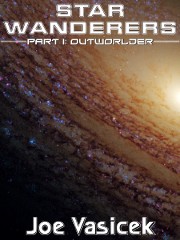
Star Wanderers I (thumb)

I have one work that qualifies for the novelette category: Star Wanderers: Outworlder.  There are others in the series that also qualify, but I think this is the best one, and also the one that works best as a standalone.  It’s available for free from every major ebook retailer, so if you haven’t already read it, feel free to pick up a copy.

That’s just about it.  I didn’t publish any novels in 2012, but I should have at least a couple out for consideration next year.  The nomination form for the 2013 Hugo is here, and the nominations are open until March 10th.

That’s just about it.  Thanks, and I’ll see you around!

Worldcon 2011: Saturday

Alright, I should just write this up and finish my convention report before life sweeps me away completely.

Saturday was the main day of the con.  To be honest, I forgot all the panels I went to, except this really awesome one by a guy at NASA on near Earth objects (NEOs).  Holyfreakingcow there are thousands of these objects AND WE ARE SENDING MISSIONS TO THEM!!!  So cool!

I went to a kaffeklatsch with Nancy Kress, which turned out to be quite an interesting experience.  She’s an extremely gracious person, much like Tracy Hickman, and gave some excellent career advice: 1) no matter the obstacles or difficulties, always find a way to keep writing, and 2) always be true to the story.

Had dinner with some other Utah writers, and I wish I could say it was pleasant, but for some reason it got very antagonistic.  I know it takes two to tango, but I honestly don’t know what I did to make it that way.  Perhaps stress levels were running high, or people misread my tone, but the conversation at our table completely fell apart at least twice.  It was very wierd.

Part of it might have to do with the fact that I’ve become something of a trailblazer for indie publishing within the SLC / Utah Valley writing community.  Which brings me to another side note: everyone talks about how militant and polarizing self publishers are, when in my experience it’s the advocates of traditional publishing who tend to adopt an us vs. them attitude.  To be sure, there are plenty of desperate to be published writers who take the indie path just to “stick it to the man,” but those people tend to fade away once they realize it isn’t a silver bullet.

Anyway, the Hugo Awards in the evening were great!  Robert Silverberg presented the award for Best Novella, and for fifteen minutes he was my favorite person in the world.  So hilarious!  I’ve tried to find a video, but there doesn’t seem to be one up yet.  Utah writers were nominated in six categories, and even though none of them won, the competition was pretty dang good, so I don’t feel so bad about losing.

All in all, it was a great convention!  I had a lot of fun, even if I did feel a little exhausted by the end of it.  I’m not sure if I’ll be attending future worldcons in my current capacity as a beginning writer, but I most likely will buy supporting memberships in order to vote in the Hugos (and download the voting packet).  It’s a good community, and I’m glad to be a part of it.

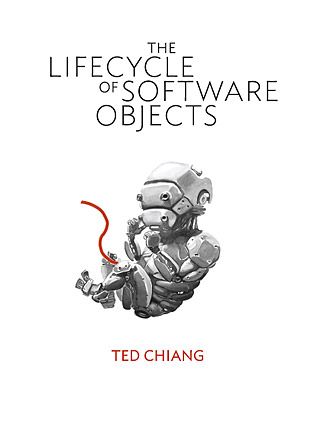
The Lifecycle of Software Objects by Ted Chiang

Ana was a washed-up zoologist turned programmer looking for work; Derek was an avatar designer for the Data Earth virtual reality platform.  The thing that brought them together: Blue Gamma Inc., manufacturer of autonomous self-aware AI pets known as digients.
Like any pet, each digient requires constant attention as they learn and grow.  Soon, Ana and Derek become as attached to their own digients as parents to their children.  But when Blue Gamma goes out of business and the Data Earth platform becomes obsolete, the future for the digients looks grim–until they enter the next phase of their natural evolution.

I really, really liked this story.  It’s got just about everything that makes science fiction so great: futuristic setting, well-rounded characters with believable motivations, one Big Lie with everything else held more or less at the level of our current understanding, and tons of parallels between the fantastic world and our own that makes you step back and really think about things.

The interesting thing about this story was how it played with all the old robot/AI tropes.  Usually, stories of this kind will have the robots rise to transcendence, either becoming the benevolent (or largely absent) rulers of the world, or taking over and enslaving humanity in some fashion. Not so with this story; the scope was much more intimate and personal, driven by characters rather than the Fate of Mankind, and that ultimately made the story much more believable.

If I had any problem with this story at all, it was the ending.  After so much build-up and development, I felt as if it cut off rather abruptly, just as things were getting more and more interesting.  I suppose the author was going for something of a “Flowers for Algernon” feel, but that wasn’t what I took from it.  Or perhaps he ran up against the novella word limit and decided to cut it off; I don’t know.

Regardless, I thoroughly enjoyed this story.  It’s certainly worthy of the Hugo for which it’s been nominated.  Highly recommended.

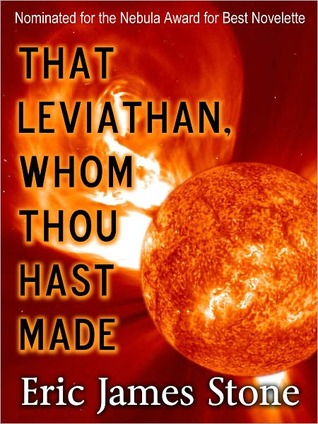
That Leviathan, Whom Thou Hast Made by Eric James Stone

When Harry Malan’s work transferred him to Sol Station deep inside the sun’s core, he didn’t expect to become a Mormon branch president over more than a hundred alien converts to the faith.  The Swales, ancient sun-dwelling beings with their own history and culture, travel the universe by naturally teleporting between stars.

When Harry learns that one of the members of his congregation has been raped, he determines to take it up with the chief Swale.  But at several thousand meters long and more than a hundred millenia old, the chief is revered by the Swales as a god incarnate.  To make matters worse, the only other eligible female on the station is an atheist xenoanthropologist determined to stop Harry from “polluting” the Swale culture.

In an alien society millions of years older than humanity, where gods were dwelling among mortals long before the birth of Jesus Christ, is there a place for those who convert to any of the human faiths?

This story was awesome, and I’m not just saying that because I’m a practicing Mormon.  The story concept was brilliant, the alien world was fascinating, and the issues raised were dealt with in a very balanced way.  This is a must read for any Latter-day Saint science fiction writer–or for aspiring writers of any religious faith, for that matter.  In fact, Eric James Stone has it available right now on his website for free–so check it out!

My only issue was that the story didn’t feel fleshed out enough.  The Swales were so fascinating, I wanted to spend more time with them–I wanted to explore their culture, learn more about their history and evolution, etc.  I also wished there were more detailed descriptions to make me feel like I was there.

I think that has more to do with the shortcomings of the medium than anything else, though.  The piece is an 8,000 word short story / novelette, so there isn’t a whole lot of room to flesh things out.  Still, the world is so fascinating, can you blame me for wanting more?

All things considered, “That Leviathan, Whom Thou has Made” definitely deserves the Nebula Award which it won earlier this year, and I wouldn’t be surprised if it wins a Hugo as well.  It represents a significant milestone in LDS literature, and is an excellent mainstream piece as well.  Whether you’re Mormon, Christian, Muslim, or whatever, if you’re a religiously devout writer of science fiction, this is a must-read.  And even if you’re not, it’s still a great story.  Highly recommended.