With a hat tip to Extra History and the many EU4 and Sabaton fans in that community.
With a hat tip to Extra History and the many EU4 and Sabaton fans in that community.
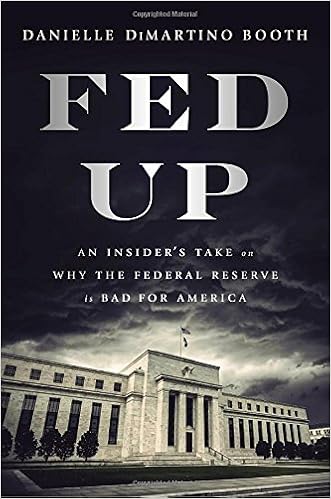 When the economy crashed in 2008, few people were in a better position than Danielle DiMartino Booth to witness the crisis as it unfolded. At the Dallas Fed, she’d been sidelined for years for warning that housing was in a bubble. That changed very quickly when Lehman Brothers collapsed, and from 2009 to 2015, she became the eyes and ears for Richard Fisher, on of the most important dissenting voices within the Fed.
As Bernanke and Yellen flooded the market with helicopter money, massacred savers and pension funds with a decade of zero percent interest rates, exploded the Fed’s balance sheet to the tune of trillions, and dragged the US economy through one of the worst “recovery” periods in history, Danielle was there, right in the thick of it. And now, she’s written a book to explain what the hell happened—and what happens next.
This was the first in-depth financial book I’ve read. It did not disappoint. Danielle’s writing has a sarcastic and witty edge that is both insightful and incisive. She has the enviable ability to take dry technical analysis and make it entertaining.
At the same time, this is not a lightweight book. To someone who is unfamiliar with the financial world and is still confused by things like the subprime mortgage crisis or the housing collapse, this is not a good entry point (for that, I’d suggest The Big Short).
However, for someone with some passing familiarity on the subject, who understands the basics of finance and the Federal Reserve, and has a growing sense that something, somewhere, is very very wrong in our economy, this book is fantastic.
I’m not in total agreement with Mrs. Booth. The most pertinent point of disagreement was probably this:
Though [Ron] Paul made some good points [with his book End the Fed], America is not a banana republic. It needs a strong and independent central bank.
A country that grants a quasi-government entity a monopoly on the right to counterfeit money is much closer to a banana republic than the likes of the Roman Empire, which endured for one and a half millennia because their monetary system was anchored to gold. But if I only read books or listened to sources that I always agreed with, I would be locking myself in an intellectual prison of my own making.
Towards that end, Danielle DiMartino Booth offers a fascinating and unique perspective that I’ve found to be invaluable. If, like me, you feel that something is deeply wrong in our economy and want to know what it is, or if you believe that we’re on the verge of another economic collapse and want to educate yourself on the things that are driving it, I highly recommend this book.
Also, she posts a regular column on her site! Check it out!
 How will your life impact the world in a thousand years?
It’s an easy question to dismiss. After all, how can one person possibly shape the course of history? Even if we accept the impact of certain great men, how can we have the hubris to think that we might one day join them?
But the truth is that our lives have more impact than we realize. Each one of us is literally a product of our ancestors. Their decisions, for good or for evil, have put us where we are today. We also have a hand in shaping the people we come into contact with. That impact can be felt through multiple degrees of separation—and how many degrees does it take to encompass the world?
In the year 1017, Europe was rising out of the ashes of the Viking age. Kievan Rus was ascendant in the east, vying with the Romans who dominated the religion and commerce of Europe (we know them today as the Byzantines). However, tensions were rising between Constantinople and the bishopric of Rome, where one of the last vestiges of the Roman state in the West would soon break communion and form the Catholic Church. Meanwhile, an apocalyptic Muslim death cult known as the Fatimids had swept from North Africa all the way to Baghdad, the cultural and scientific capital of the world. From the harsh steppe wilderness of central asia, the Seljuk Turks were building an empire that would save Baghdad from destruction, while in China, the Song dynasty had invented the first paper currency.
In short, it was a completely different world. How different will things look a thousand years from now?
By the year 3017, we will probably have established an independent colony on Mars. Other parts of the solar system will probably also be colonized, and we may have even begun our expansion to the stars. After all, faster than light starship drives are about as fantastic to us as cars, airplanes, and space stations would be for medieval serfs.
It is highly unlikely that the United States—or any other country, for that matter—will exist with its current borders. In fact, it’s highly unlikely that the majority of countries extant today will even exist at all. China is probably an exception, but let’s not forget that China is a civilization pretending to be a country.
Pessimists will say that there’s a good chance humanity won’t exist at all. They point to things like climate change, pandemics, and global war as challenges we may not overcome. But in the last millennium, we faced all those challenges and rose above them (little ice age, Mongol hordes, black plague). Same with the millennium before (extreme weather and crop failures of 535-536, Muslim conquests, plague of Justinian).
So how will your life impact the world a thousand years from now? What sort of impact do you want your life to have? How have the things you’ve done today brought you closer to leaving that legacy?
I’ve thought about this a lot over the past few weeks. I want to impact the world through my books, but it’s unlikely that most of my books will still exist. My family and descendants will, though. I want to leave them with the best foundation I can. Here’s how I plan to do it:
Provident living is more than just learning how to do your laundry and keep up with the maintenance of your car. It’s learning how to live sustainably, with a degree of self-reliance that can see you and the ones you love through hard times. It’s all the stuff I’ve been writing about in the Self-Sufficient Writer blog series.
I’ve made a lot of progress in this area, but there’s still a lot of progress left to make. Here are the next few steps I want to take in this area:
A lot of these steps are going to have to wait until I have my own land, which brings us to:
When you live on someone else’s land and owe them a portion of your labor, that’s a form of serfdom. In both historic and modern times, this has been the norm for the vast majority of people.
It shouldn’t be.
When my ancestors came from Europe to the United States, one of the first things they did was buy land. There was a reason for this. In the old country, they were serfs. They paid the corvée. They were not free.
They knew that unless they lived on land that they owned, in a home that was theirs, their children would not be free either.
We’ve enjoyed a century of prosperity in the United States. It’s led us to believe that home loans and mortgage payments are normal. They aren’t. When your home is the collateral for a loan you’ve taken from the bank, and you spend most of your adult life paying it back to the tune of 250%, that is a modern form of serfdom.
Until you own it outright, your house is a liability, not an asset. And in some places, true ownership is impossible. After all, if the government has the power to seize your house for non-payment of taxes, did you really ever “own” it to begin with?
It’s a similar thing with debt. All debt is a form of bondage. “Leverage” is when someone else has control over you or something that belongs to you. Unless you can get out from under it, you will never truly be free.
If most of your life is spent in serfdom and bondage, the thousand-year impact of your life will be muted.
The Habsburg dynasty started with a small castle on the top of a hill. From that starting point, the family went on to shape the development of Europe into the modern world. The castle was so important in that effort that the family took their name from it.
I know how to live debt-free. I’ve been doing it for several years. But I do not currently live in a place that I own. That is my overriding goal: to own the place where I live within ten years.
The government isn’t making it easy. Neither are the central banks. A decade of 0% interest rates has ravaged the middle class. As a direct consequence, home ownership rates are dropping to historic lows. 70% of Millennials have less than $1,000 saved for a down payment on a house, while at the same time, the helicopter money from the Fed has inflated a new housing bubble larger than the one that burst in ’08. In California, Google employees with six-figure incomes are living out of RVs because they can’t afford to buy a house.
It’s brutal. These are the same economic pressures that led to the rise of medieval serfdom in Europe. But there are also opportunities, for those who know how to take advantage of them. Which leads to:
Poor people buy luxuries. Middle class people buy necessities. Rich people buy investments. If I want to leave something behind for my children and descendants, I need to master the skills of investing and managing wealth.
This goes back to the thousand-year view. The biggest impact I’m probably going to make on the world is going to be through my children and descendants. Raising them will be the most important investment I can ever make. I want to give them a life of opportunity, so that they, like me, can make a thousand-year impact on the world.
This is what my ancestors did for me. My Mormon ancestors crossed the plains in the Willie handcart company so that their descendants could grow up in Zion. My first-generation immigrant Czech ancestors invested in Texas farmland that still pays a small dividend to their descendants (greatly increased now because of oil royalties). There are many other countless others who made great sacrifices so that I could enjoy a life of privilege and opportunity. I’m sure that’s not unique to me.
We seem to have forgotten, here in the United States, how important it is to make sure that our children enjoy better lives than we have. To some generations much is given, while of others much is required. I fear that we are transitioning from the former to the latter. Nations are born stoic and die epicurean, surrounded by mountains of debt.
This is why it is so important to build wealth: not for your own personal consumption, but for the security of your children and descendants.
The most important investment you can make is in your education. If I’m going to develop these skills, that’s what I need to do: invest in my own financial education.
I also need to learn by experience, so I’m taking $100 of my book earnings each month and investing them. I’ll probably experience a couple of big losses, but that’s called paying tuition. The knowledge I gain from doing this will hopefully help to accomplish this goal: to build wealth that will bless the lives of my children and descendants for generations to come.
A lot of things fall into perspective when you take the thousand-year view. When you focus on the challenges of the present, it’s easy to become pessimistic, but when you take a clear-eyed look at the future—not just the immediate future, but the long-term future as well—you cannot help but take an optimistic view.
How will your life impact the world in a thousand years?
How did Trump become the leader of the most powerful nation on Earth?
A lot of people are asking that question, while a lot of other people already know (hint: it wasn’t the Russians). But I want to get beyond the circus that is Washington DC, and answer that question by asking another:
Can politics solve our nation’s greatest problems?
I think there is a dawning realization among Americans that it doesn’t really matter who lives on 1600 Pennsylvania Avenue. Republican or Democrat, the outcome is pretty much the same.
Never at any point in living memory have we been so politically divided, but the party distinctions have become increasingly meaningless. Trump campaigned on providing universal healthcare. Clinton campaigned on escalating our military involvement in Syria. Which one was the Republican, and which one was the Democrat?
In the previous post, I said:
I am convinced that the grand key to understanding United States history in the 20th century—and by extension, current events in the 21st—is a deep knowledge of monetary policy and the financial system.
What is that system?
It is a system of debt. Pure and simple. We have turned our debt into money, and made every other form of money illegal. And the rest of the world has followed us gleefully off the cliff.
Washington is bankrupt. Literally bankrupt. Every year, the Treasury runs an internal audit, and every year, that audit fails. The government’s single biggest asset on their balance sheets is… $1 trillion in student loan debt. Social Security is insolvent and, according to the government’s own reports, will completely run out of money in less than twenty years.
So if Washington is bankrupt, why haven’t they declared bankruptcy? Because they can just keep printing money through the Federal Reserve.
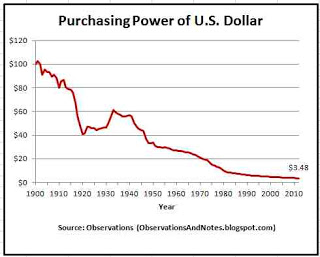
Because of this, the US dollar has lost about 97% of its value since the Federal Reserve system was established in 1913. A time traveler from the new Wonder Woman movie couldn’t buy $5 worth of stuff with $100 of our dollars today. And to keep up this Ponzi scheme we call “money,” Washington has gone nearly $20 trillion in debt.
How much longer can we keep that up?
If we could grow our economy fast enough, and never stop growing, we could keep up the Ponzi scheme for a very long time. But growth is no longer a solution, because the debt is bigger than the economy. The debt is the reason we can’t grow.
If we could innovate fast enough, we could lower the cost of living so much that the poor don’t realize that they’re poor. To some extent, we’ve already done that. But the effects are too uneven: startphones and computers are super cheap, but houses and health care are practically unaffordable.
Which brings us to serfdom.
Let’s go back in time a couple thousand years. Before the days of the empire, the Roman dream was that every family would have their own plot of land, making them independently wealthy, and the head of every family would take up arms in defense of his country whenever called upon by the state. This was not all that different from the Jeffersonian ideal of the yeoman farmer.
Then the Punic wars happened, which, for the Mediterranean world, was basically the ancient WWI and WWII. As Rome became a major world power, the military-industrial complex made a few select elites fabulously wealthy, who kept the masses pacified with welfare handouts.
But the endless cycle of foreign wars came at a heavy cost. Decades of budget deficits and an unsustainable national debt forced the Romans to debase their currency, which completely collapsed. Trade halted, the middle class lost everything, and the 1% became fantastically wealthy, buying up all the real estate and forcing everyone else out. The Roman dream was dead, replaced by a form of bondage called serfdom.
Serfdom came in a number of different flavors:
The corvée was a tax, paid in labor, that non-landowners owed by law. Basically, for every XX days out of the year, you worked for the state. It continued even after the abolition of serfdom, until the revolutions of 1848. My Czech ancestors paid the corvée, which is probably one of the reasons they and their children emmigrated to the United States.
But wait—we pay the corvée too! It’s called the federal income tax: for XX days out of the year, you work for the state. The taxes are even higher if you’re self-employed or a small business owner.
Except… not everyone pays the income tax. In fact, nearly half of Americans pay no income tax. Why? Because the politicans know that they can use the welfare system to buy votes. If you’re on welfare, who are you going to vote for: the guy who plans to cut your handouts, or the guy who says that the wealthy should pay their “fair share”?
And sitting at the top of it all are the central bankers.
The medieval serfs were bound to the land and worked for the landlords. In contrast, modern debt-serfs are bound to their debt—national debt, student loan debt, mortgages, consumer debt—and work for the banks.
So I ask again: can politics solve this problem? Can we find a political solution to our national debt?
Unfortunately, there is only one political solution: default on the debt. If we default on entitlements like social security, there would be chaos, riots, and anarchy… and we still wouldn’t pay down hardly any of the debt. If we defaulted on our treasury bonds, it would send a ripple of financial panics across the world, destabilizing the flashpoints in Europe and Asia before returning to our shores. Stocks, mutual funds, and pensions would all be wiped out. Almost the entire savings of the Baby Boomer generation, gone.
But there is another option, though it’s hardly a “solution”: kick the can a little further down the road. Print the money, devalue the debt, and inflate the currency to oblivion.
This is the path we’ve been on since 1913. This is the reason why our dollars buy a little less each year. And this is the reason why we, as a nation, are backsliding into serfdom.
We’ve seen this happen before. Rome fell because of it. Europe came under the yoke of serfdom as a result of it. Our ancestors fled to this country to escape it. And now, we are repeating it.
This isn’t a political problem: it’s a math problem. The numbers just do not add up. The next financial crisis could very well be the “extinction level event” that puts the final nail in the coffin of the US dollar, throws the world into a global war, and sends the United States into its greatest existential crisis since the Civil War. The Republicans don’t have the solution, and neither do the Democrats, because the problem is not political.
This is what the end of politics in America looks like. We’re watching it happen in real-time. Our politicians have become the clowns in the bread-and-circuses routine. Meanwhile, the central bankers are shackling us in chains with every dollar that passes through their hands.
What are you going to do about it?
There’s this really fantastic video on YouTube that’s been making the rounds, and if you’ve found any of my discussions of history interesting (like this one, which I need to do a followup on), you’ve probably either seen or are going to really love it:
Some thoughts/reactions:
I had a really fascinating experience last year that has turned into something of a journey of discovery. It’s still ongoing, and I’m sure it will affect my writing in years to come.
It started with family history. Long time readers of this blog will know that I’ve been interested in family history for some time. My sister is a professional genealogist who specializes in Czech records (she keeps a blog here), and I got started by helping her.
In the United States, the census records are only useful to about 1850. Before that, you have to get into land records, probates and wills, and local courthouse type stuff to really go anywhere. But in the Czech lands, the Catholic Church has kept meticulous parish records going back to the 15th and 16th centuries. They’re handwritten in old German and totally unindexed, but the books are all digitized and available online.
As I worked on this research with my sister, I started to wonder: how far back can we push these lines? What are the limits?

The Czech lands were part of the Holy Roman Empire, under the Austrian Habsbugs. In the 15th century, the Hussite Wars shook things up quite a bit, and that’s about as far back as the Catholic parish records go. But the noble genealogies were very well kept, and go back quite a bit further. If one of your lines connects to the nobility (which is very possible, given how many bastard children were running around), you can push back really far.
But past the 8th century, things start to get sketchy. Most of the nobility in Europe are descended from the barbarian tribes who invaded the Roman Empire: the Goths, the Franks, the Vandals, etc. Same thing with the Slavs and the Byzantine Empire, though the Byzantines held out much better than the Western Roman Empire (it was the Turks, not the barbarians, who eventually did them in).
The trouble is that when these barbarians took over, they tried to establish their legitimacy by fabricating genealogies. Plenty of royal European lines go back all the way to Adam and Eve, but how reliable is that really? As rulers of Christian lands, of course they would try to connect themselves to famous characters from the Bible.
The Dark Ages might not be as dark as we think they are, but in terms of records and record-keeping, they certainly are. The largest and most civilized empire in the world had just collapsed, with barbarians running amok in the countryside and the Persians threatening the last vestiges of the empire in the east. Very few historians have documented this era, and it was a huge dark spot in my own understanding of the world.
So I set out to study it. I scoured Wikipedia, subscribed to the Western Civ podcast, and listened to the entire History of Rome by Mike Duncan (excellent podcast, by the way). The Roman Empire had dominated Europe right up to the early middle ages, and I wanted to learn why it had fallen.

That led to a journey of discovery all in itself. Roman history is a fascinating subject in its own right, and the four or five centuries from the Punic Wars through the reign of Marcus Aurelius are very well documented. Rome faced a lot of challenges, and even a few existential threats, but for more than a thousand years they dominated the known world.
So why did they fall?
The more I studied about the Romans, the heavier this question weighed on me. I learned about Diocletian and the Tetrarchy, the crisis of the third century, and Constantine the Great—a period of Roman history that was much less familiar to me. And then things started to click.
My Czech ancestors were serfs. They emmigrated to Texas shortly after the last vestiges of serfdom were abolished in 1848. Under serfdom, they were little better than slaves. The land they lived and worked on was owned by the Hukvaldy Estate, and they were bound to it by feudal law.
When Diocletian became Augustus, the Roman Empire was reeling from half a dozen existential crises, including an economic collapse. The money was so worthless, most of the empire had resorted to a barter economy. Diocletian established a system of exchange where people could pay their taxes with trade goods rather than money. However, the only way for that system to work was 1) for everyone to take the profession of their parents, and 2) for no one to move without Imperial permission. Otherwise, you might have too many pig farmers in one province and not enough blacksmiths in another.
In other words, the system of feudal serfdom that my ancestors labored under had its roots in the reforms of Diocletian. But it went much deeper than just one man. Diocletian reforms were necessary because the Roman economy had collapsed, and the economy had collapsed because for more than a hundred years, the Empire had been in massive debt, and had serviced its debts by devaluing its currency.
Sound familiar?

The Roman Empire fell because of deficit spending, government debt, and currency devaluation over the course of several generations. In 1913, the United States established the Federal Reserve, beginning our own process of currency devaluation. Our national debt has doubled every eight years since 2000, when the stock market peaked as measured in gold. Right now, our debt-to-GDP is 104%. One hundred four percent.
And that’s just our sovereign debt. Our household debt is north of $12 trillion, or another 73% of our GDP. The largest portion of that is student loans, which cannot be resolved through bankruptcy.
Seven out of ten Americans have less than $1,000 in savings.
Half of Americans would have to beg, borrow, or steal if slapped with an unexpected $400 expense.
Twenty percent of American households do not have a single person that is working.
Fully one-third of America is in debt collections, meaning that they have an unpaid debt more than 180 days past due.
Is it any wonder that the middle class is shrinking? We’re following the same path that Rome followed, except where they merely walked, we’re running headlong. With our modern communications, the pace of life is so fast that I suspect we’re completing the cycle in a fraction of the time.
And then you realize that what passes for money these days isn’t “money” at all, but government paper backed by government debt. What happens when we default? What happens when the credit markets freeze up and contagion spreads across the global economy? What happens when you wake up one morning, only to find that all the ATMs are down, the banks are all closed, and everyone’s accounts are all frozen?
So what started as an interest in family history took me down a rabbit hole where I learned all about how Rome fell, and how we’re following in the footsteps of Rome. It led to a keen interest in monetary policy and our global monetary system. It also gave me a new hobby: coin hunting.
The Romans devalued their currency by melting down the old gold and silver coins, and minting new ones mixed with copper. Over time, the melt value of the coins went down, and that’s exactly what’s happening to our US currency now.
Before 1965, dimes and quarters were made from 90% silver. After, they were made from copper with a thin nickel coating. Nickels have always been made from a 75/25 copper-nickel alloy, however, and pennies were all 95% copper until 1982. Right now, the melt value of a US penny is actually 1.8¢. At the height of the “jobless recovery” it was closer to 4¢.
Now, it’s illegal to melt down pennies because they are currently legal tender. However, as the currency continues to inflate, the penny will become even more worthless, eventually reaching the point where it doesn’t make sense to make anymore. Right now, the material cost alone of each zinc penny is 70% of the face value. Canada has already discontinued minting pennies, and we aren’t far behind.
I started dabbling in copper hoarding. But as I went through lots of pennies, I started coming across some really old ones. Which got me to wondering if maybe the numismatic value of some of these coins eventually might be more than their melt value. After all, when everyone’s melted down their copper pennies, a complete collection of Lincoln cents is going to be something special.

So I started building a collection of Lincoln cents. Then I got into state quarters, first as a cool Christmas gift for one of my nephews, then for myself. Then I got into Jefferson nickels, and started finding silver.
Right now, I have a complete set of Lincoln Memorial cents. They’re all from circulation, and some of them are pretty beat up, but there are a few really nice ones in there too. My wheat cents collection is much less complete, but the coolest piece is a 1909 VDB in very fine condition, with all the wheat berries still showing. That’s a $10-$15 penny that I found in a normal coin roll.
It’s a fun hobby, and it comes around full circle to what got me started down this rabbit hole in the first place. Each one of these coins is a small piece of history. That 1909 VDB is more than a hundred years old. I’ve got coins that my parents and grandparents would have used, and a penny for every year of my father’s and mother’s lives. With a bit of luck and a lot of patience, I’ll be able to find a penny for every year of my grandparents’ lives as well.
So yeah, it’s been a fascinating journey of discovery, and it’s still ongoing too. I just got started with Roosevelt dimes, and I’m catching up on Mike Duncan’s Revolutions podcast, which is just as interesting as his History of Rome. Turns out that the French Revolution also happened because of deficit spending and a runaway government debt. Surprise, surprise.
Life is a giant rabbit hole when you’re curious about everything!

I’ve been making good progress lately on Gunslinger to the Stars. My original deadline for the rough draft was today, but I think it will take no more than two additional weeks to finish it. There’s about four chapters left, and I’m so eager to write the last one that the others will almost certainly fly by.
I’ve also got a short story that should be going up soon. Some of you may remember the cover art I previewed a while ago for “The Gettysburg Paradox.” I’m gettting ready to publish that one, and it should be up over the holiday weekend.
Today is the anniversary of the first day of the Battle of Gettysburg. Some people celebrate the 4th of July by watching Independence Day; I celebrate it by watching Gettysburg. The American Civil War was a true watershed moment for this country and did more to make us who we are than any other war, including the Revolutionary War. Also, it was fought on July 1st, 2nd, and 3rd. As Martin Sheen said in the movie (acting in the role of Robert E. Lee), “God has a sense of humor.”
I’ll leave you with what is probably the best scene from the entire movie: the charge of the 20th Maine on Little Round Top. Incidentally, this is also the opening scene of “The Gettysburg Paradox.”
Take care!
If you had lived in Germany before the Nazis came to power and a time traveler had told you how history would play out, what would you have done about it?
The nation was reeling from a massive economic depression after a decade of war exhaustion. In this troubled time, a charismatic democratic socialist ran on a platform promising to share the wealth of the top 1% (the Jews) with the rest of the nation. Violent protesters routinely disrupted his opponents’ political rallies. People in general were fed up with the political system and were eager for a change.
Obviously, there isn’t a 1:1 parallel between 1930s Germany and 2010s United States. But let’s take a quick look at some of the policies that the Nazis successfully championed:
And finally:
Can you see the chilling parallels between what the Nazis did and the agenda that the Left has been pushing for the last eight years?
Right now, the United States is reeling from the deadliest mass shooting in our nation’s history. The perpetrator was a domestic terrorist who pledged allegiance to ISIS, just like the last mass shooting which happened in San Bernardino. But instead of focusing on the radical Islamic ideology that motivated these shootings, the national discourse is focused on gun control.
This is patently ridiculous.
When a teenager commits suicide because of online bullying, is the solution to censor the internet?
When people spread lies and false rumors on social media, is the solution to place general restrictions on the use of social media?
When a battered wife is stabbed to death with a kitchen knife, do we call for regulations on the length and sharpness of all kitchen knives?
When large numbers of people die in car accidents, do we enforce a ban on “high-capacity” cars that can drive faster than 45 mph?
Better yet, do we allow car owners to sue the manufacturer if they ever get into an accident? Correct me if I’m wrong, but that wasn’t in the terms of the last government bail out.
We’ve had this debate over gun control many times before. Whenever we have a mass shooting in this country, the bodies of the victims are not yet cold before all of the old arguments on both sides are trotted out. So let’s go to the moment when the emotions were hottest, in 2012 after the tragic shooting at Sandy Hook Elementary:
In an interview with Dave Rubin, Ben Shapiro later said that Piers Morgan had actually brought one of the kids from Sandy Hook onto the set to come on in the second segment of the show. The kid was in a wheelchair, and Piers was going to use him as political prop to make a cheap appeal to emotion. Of course, after Ben called him out for standing on the graves of children, Piers’s whole debate strategy fell apart.
This is my response, which is currently the top comment on YouTube:
“Do you genuinely believe that your own government is going to turn on you in a way that you require an AR-15 to challenge them?”
Holy flying fuck, Piers Morgan. Do you have no self-awareness at all? You are talking to a Jew, Piers. A JEW. As in, one of those people who were systematically exterminated by a tyrannical regime called the Democratic Soc—sorry, the NATIONAL Socialist German Worker’s Party. Also known as the Nazis, Piers. The Nazis.
You are familiar with the Nazis, are you not, Piers? You know: the smartly dressed German guys with the swastika flags who bombed your homeland relentlessly for 3+ months back in 1940. If I remember my history correctly, you fought something of a war with them, did you not? Or are you as bad at history as you are at US constitutional law?
People like you are the reason I need an AR-15, Piers. Crybullies like you in the mainstream media who stand on the graves of children as they browbeat the rest of us into giving up our rights and liberty, all in the name of leftist ideology.
And you know what, Piers? When I do get an AR-15, I’m going to name it in your honor. I’m dead serious, Piers. I’m going to etch your name right on the barrel. I’ll keep it right next to François, my Mossberg shotgun (which I named in honor of another anti-gun wanker).
And you know what sound it’s gonna make when I fire it, Piers? That “ratatatat” when I pull the trigger?
That’s the sound of Liberty.
Here is why you need a gun:
When the founding fathers drafted the Constitution, they envisioned a political system unlike any other in existence at the time—one where the government exists only by the consent of the governed. This, they rightly believed, was the way to ensure Liberty.
In order for the system to work, however, the people had to be able to live without fear of the State. In other words, the government had to fear the people instead of the other way around.
The Declaration of Independence had already set the precedent that it was the right of the people to overthrow their government if it ever became tyrannical. The only way for that to happen was for the people to have the right to bear arms.
This is why the second amendment is the second amendment, not the ninth or the sixteenth or the twenty-eighth. It’s also why the second amendment never specified what kinds of arms should be allowed. The idea that founders’ original intent was to restrict gun ownership to muskets is patently ridiculous:
In my experience, people who favor stricter gun control laws generally fall into one of two camps: those who are simply afraid of guns, and those who want to vastly expand the powers of the State.
The first camp of people are generally well-meaning, if a little bit sheltered. Most of them have probably never owned or fired a gun of any kind. Their arguments for stricter gun control tend to be rooted in emotion. When a mass shooting happens, they feel like they need to do something to prevent this kind of massacre from ever happening again.
Unfortunately, these people have been spoon-fed lies from the second camp, which wants to disarm the general public NOT to reduce gun violence, but to vastly expand the powers of the state.
These people are fundamentally opposed to the idea of a government that exists only by the consent of the governed. They want to tear down the Constitution because it prevents them from using the power of the State to advance their political agenda. The principle of Liberty is a roadblock to them, and they want to abolish at every turn, not only with the second amendment, but the first, the fourth, the ninth, etc.
One of their main arguments is that there is no place in this country for private ownership of “assault rifles.” The argument is that these are “weapons of war,” and that therefore they have no place in civilian life.
To someone who has never owned or fired a gun, this is a pretty convincing argument. The term “assault rifle” is never clearly defined, but it effectively conjures up all the fears of guns and gun violence that many of these people have. To push the envelope even further, gun control advocates always associate “assault rifle” with AR-15, the most popular rifle in the United States.
The AR-15 is a de-clawed version of the M-16, which (unlike the AR-15) is fully automatic. That means that with an AR-15, you only get one bullet for every time you pull the trigger. AR-15s are most often chambered in .223/556, a round that is smaller in diameter than the most common handgun rounds. The reason it’s a popular weapons system is because it’s the Mr. Potato-head of guns: you can swap out basically all of the moving parts, or build one from scratch. No matter your needs (hunting, home defense, recreation, competition), you can adjust an AR-15 to meet them.
It’s actually not a scary gun at all, if you know how to use it properly. And judging from how many of them are circulating in the market, responsible gun ownership is the rule, not the exception.
Is the AR-15 a “weapon of war,” though? It can be if you want it to be. That’s kind of the point. Remember, one of the reasons for the second amendment was to enable the people to stand up against a tyrannical government. Without the right to bear arms—broadly defined—you cannot have Liberty.
This is where we get back to the Nazis. There is a reason why totalitarian governments always ban private gun ownership before they commit their worst atrocities. In the words of Mao Zedong, “political power grows out of the barrel of a gun.” When the guns are in the hands of the people, the people have political power and influence over their government. When they lose their guns, they lose that power.
But Joe, do you really fear an American holocaust? Do you genuinely fear that your government is going to turn on you in a way that you require an AR-15 to challenge them?
Yes, I do.
We tend to have this idea that the Holocaust was a historical aberration, a nasty horrible thing that never happened before and has never happened since. That simply is not true. Systematic interment and murder by tyrannical governments is actually the norm throughout history. The only thing that made the Holocaust any different was German efficiency.
Look at the sack of Carthage by the Romans. Look at the destruction of Baghdad by the Mongols. Look at all five times that Jerusalem was destroyed. In our modern era, look at the excesses of the French Revolution, the genocide of the Armenians, the British concentration camps in South Africa—indeed, look at the concentration camps IN THE UNITED STATES that were set up by FDR. Even before that, we had our own horrors like the Indian Removal Act and the Cherokee Trail of Tears.
And lest you think the world learned its lesson after Auschwitz and Dachau, read up on the Soviet Gulag and Chinese organ harvesting of political prisoners. There is a reason why the wait time for a kidney transplant in China is so ridiculously low.
The flipside of the coin of liberty is responsibility. In order for a people to be free, they need to take the responsibility of governing themselves. Part of that responsibility is learning how to defend yourself, not only from criminals, but from an overreaching, tyrannical government.
That is why you need a gun: because there is no Liberty without the means to defend it. That is also why I bought my first gun this past week (François) and why I’m building an AR-15 (Piers). Whenever there is a systematic effort to take away your fundamental rights, it becomes your duty to exercise those rights before they get taken away.
Praise the Lord and pass the ammunition!
So as part of my effort to blog more often, I’ve decided to bring back the trope posts. If you’ve been reading this blog for a while, perhaps you remember the Trope Tuesday series that I used to do. Those were mostly just a rehashing of each trope’s tvtropes page, with a bit of commentary at the end. For this new series, though, I’m going to assume you’ve already read the page and are familiar with the trope, and focus on the commentary. I’m calling this series Playing with Tropes, and I’ll do a new post on the first and third Monday of each month.
To start off this new series, I’d like to take a look at Pragmatic Villainy. There’s something especially chilling about a villain who not only possesses power, but knows how to wield it too. In fact, one of the scariest villains is the guy who rises up the ranks through sheer ruthlessness and ambition, starting as an underling and rising to the top. These villains know how to inspire and manipulate their followers, how to use their limited resources efficiently, how to form secret alliances and backstab their enemies, and how to keep a strategic perspective while making brilliant tactical plays. It doesn’t matter whether they command an empire or whether all they’ve got is a cargo-cult following on some far-off backwater. No matter where you put them, these are the guys who are truly dangerous.
 It’s worth pointing out that there are a lot of figures from history who fit this trope. A badass colonel when the French Revolution began, he took advantage of the chaos to rise to power, declaring himself emperor and restoring order to his broken country. He then took his armies and conquered nearly the whole of Europe and the Mediterranean, destroying the Holy Roman Empire, invading as far as Egypt and the Nile, and leading his troops through the gates of Moscow before suffering defeat before the Russian Winter. Ever the pragmatist, he developed the modern canning process in order to supply his troops with food. And even after the European powers crushed his armies and exiled him to the island of Elba, he still found a way to escape and very nearly did it all again.
And Napoleon is by no means the most prominent historical example. Hitler was extremely pragmatic, and probably would have won the war if he’d actually listened to his generals and not interfered with their ability to do their jobs. Stalin was also quite pragmatic, identifying and removing his rivals and ruling with an iron fist. Today, Vladimir Putin and Xi Jinping are some of the best examples of this trope.
Sometimes, it’s difficult to tell whether a pragmatic villain is really a villain at all. This is because pragmatic villains often see evil as a means, not an end. You won’t see a lot of gratuitous puppy-kicking with these guys—in fact, you may even see them pet the puppy for the cameras… before quietly taking it out back to skin it.
That’s not to say that pragmatic villains are more redeemable than your average big bad. Far from it, in fact. As Darth Vader put it, “if only you knew the power of the dark side!” In the clash between good and evil, evil often has the upper hand right until the middle of the third act. Even when evil doesn’t have the upper hand, the old poem often applies:
Might and Right are always fighting
In our youth it seems exciting.
Right is always nearly winning.
Might can hardly keep from grinning.—Clarence Day, “Might and Right”
To really pull off a pragmatic villain, it’s important to make sure that your villain is truly evil. Grand Admiral Thrawn from the old Star Wars Expanded Universe was a great example of this, as was Admiral Ysanne Isard. Even with limited resources, they pulled off some brilliant moves: Thrawn by placing a cloaked warship beneath a planetary shield, to make it appear that he had shield-busting weapons, and Isard by spreading a lethal pandemic that, while curable, was extremely expensive to treat, thus spreading panic and instability as everyone fought over the cure. Yet in spite of their pragmatism, it was clear that neither of them would stop at nothing in their rise to power.
What’s really awesome is when a pragmatic villain manages to pull off a Xanatos Gambit. In fact, pragmatic villains are the only kinds of villains who can pull that kind of gambit, simply because of all the planning and foresight that must necessarily go into it. For the same reason, there tends to be a lot of overlap between this trope and the Chessmaster.
When a villain falls short, it’s often because they were lacking in this trope. A huge example of this for me was The Hunger Games. When the villains in that book backpedaled after Peta and Katniss threatened to kill each other, I pretty much threw the book at the wall. The kind of people who can be manipulated by angsty lovestruck teenagers are not the kind of people who rise to power in a totalitarian dictatorship. And while there’s certainly a place for B movie villains, the Evil Overlord List exists for a reason.