Fantasy from A to Z: B is for Battles

One of the things about fantasy that I love the most are the epic battle scenes, where the good guys and the bad guys face off across the field of battle in a conflict that will determine the fate of everything they hold dear. My favorite scene in the Lord of the Rings movie trilogy is the ride of the Rohirrim, where Theoden comes to the aid of Gondor and gives his rousing speech before his men charge into the fray, shouting the battle cry “death!”

I feel like the big set-piece battles are more common in older fantasy, which drew a lot more from J.R.R. Tolkien and Robert E. Howard. Many of these older fantasy writers, including C.S. Lewis and Lord Dunsaney, were drawing from history as they told their stories and created their worlds—specifically, the old-fashioned understanding of history, where the things that mattered most were the clash of civilizations and the great men at the head of those civilizations. 

In some ways, it’s good that we’ve moved to a much more holistic view of history, but there really is something to be said about those battles where everything stood on the edge of a knife, and the course of the next thousand years was decided in a single day. When I read about the numerous times the Muslim invaders were turned back by the Theodosian land walls of Constantinople, it takes me back to the siege of Minas Tirith and the Battle of Pelennor Fields. When I rewatch the scene from Gettysburg where Lawrence Chamberlain leads the charge of the 20th Maine, it stirs something deep within me that, outside of historical military fiction, I have only ever found in fantasy.

Tolkien and Howard were both really great at writing epic battle scenes, but the best, in my opinion, is David Gemmell. His debut novel /Legend/ is one of the most soul-stirring depictions of war that I have ever read. More than anything else, it captures the deep sense of meaning, purpose, and love that comes from staring death and the face and deciding which things (or which people) are worth dying for. In the words of Mel Gibson from Braveheart: everybody dies, but not everybody really lives.

The military aspect of fantasy tends to appeal more to male readers, which is probably why it’s more common in old-fashioned fantasy. Some subgenres like grimdark have preserved it, but with the rise of subgenres like romantasy and the increasing gender divide within publishing, it’s been dying out (not the least because of all the other baggage that grimdark brings, which I will discuss in G is for Grimdark vs. Noblebright). 

Call me old-fashioned, but I much prefer the rousing battle scenes from Tolkien, Howard, and Gemmell to much of the stuff that is coming out today. Will the market swing back? If and when it does, I hope to be a part of that. I don’t always put epic battle scenes in my books, but when I do, those are the authors who inspire me.

Was Winston Churchill the true villain of WWII?

There’s this clip from Tucker Carlson that’s going around right-wing alternative media right now, from a guest who made the claim that Winston Churchill was the true villain of WWII. The best (ie least hysterical) analysis of this claim that I’ve heard is probably from Michael Knowles, which you can see here:

I have to be honest, though: while most of the stories like this that make the rounds on the internet turn out to be cheap ragebait, I think that this claim deserves some actual reflection, especially when you consider the following:

  1. World War I and World War II were essentially two phases of the same global conflict.
  2. The main reason Hitler came to power in Germany was because of the total German defeat in WWI, which only happened because the US entered the war.
  3. The US only entered the war because of the sinking of the RMS Lusitania by a German U-boat and the deaths of nearly a hundred US citizens on board (never mind that it turned out the Lusitania was gunrunning at the time, and therefore a legitimate military target, but that’s another story).
  4. Winston Churchill was the First Lord of the Admiralty at the time, and deliberately withdrew the Lusitania’s destroyer escort knowing that U-boats were operating in the vicinity, because he (correctly) calculated that the sinking of the Lusitania would bring the US into the war. (For more on this, read chapter 12 of The Creature from Jekyll Island by G. Edward Griffin, which lays out the whole story.)

Of course, while this does throw some pretty serious shade on Winston Churchill, taken alone it’s not sufficient to make him the “true villain” of the period. For that, you have to accept a couple of other arguments, namely:

  1. The true purpose of WWI was to tear down the existing global order (especially the Concert of Europe) and clear the ground for the rise of a global socialist movement, led by the British deep state and central bankers. The Fabian Society was especially involved in this process, and a rough sketch of their blueprint for the global order they hoped to create can be found in Brave New World by Aldous Huxley.
  2. The Bolshevik movement was funded by the British deep state and central bankers. Once again, you can read about this in The Creature From Jekyll Island, as well as None Dare Call It Conspiracy by Gary Allen. The Bolshevik revolution was not a true uprising of the Russian people: it was a globalist coup that hijacked the true revolution, which occured in 1907.
  3. In similar fashion, Adolf Hitler was a creation of the British deep state, who only became the villain after he threw off his leash and went rogue. Which is not to say that he wasn’t evil, only that he was, at least initially, a British puppet.
  4. After WWI, the British deep state recolonized the United States by creating their own deep state across the pond, which is more or less under the control of British Intelligence. In fact, you can draw a straight line from the British socialist movement of the early 20th century to our current American deep state, through the Fabian Society, the Roundtable Group, and the Council on Foreign Relations.
  5. This also gets into Ezra’s Eagle, because the first feather (according to Michael B. Rush’s interpretation) is Herbert Hoover, a founding member of the CFR.

So if you accept most of that, it’s actually not that crazy to entertain the idea that Winston Churchill was the “true villain” of WWII, given how he was clearly an agent of the British deep state during the most crucial decades of the 20th century.

Personally, I don’t think he was the “true villain” any more than I think he was the “true hero” of the war. He was a complicated character from a complicated time. And as tempting as it is to simplify WWII as an epic fight between the “good guy” Allies and the “bad guy” Axis, that narrative has run its course and is no longer a useful way of understanding the world. Most wars are bad guy vs. bad guy, at least in the top leadership, with the little people on both sides doing most of the actually fighting and dying.

#GiveThanks Day Seven

(87) I’m grateful for my pilgrim ancestors who came to this country seeking to build a more godly community, and gave us a heritage of self-government and self-sufficiency.

(88) I’m grateful that my pilgrim ancestors actually survived, which was not at all a foregone conclusion, or even likely.

(89) I’m grateful for the native Americans like Squanto who welcomed the pilgrims and helped them to make it through that first winter, when everything was so precarious.

(90) I’m grateful that the tradition of Thanksgiving was established in our American culture, and that we have a holiday where we remember the pilgrims and the contributions that they made to our culture and history.

(91) I’m grateful for turkey and cranberry sauce. It’s a wonderful combination of flavors, and I always forget how good it is until Thanksgiving rolls around.

(92) I’m grateful for Thanksgiving leftovers and how delicious they are!

(93) I’m grateful for the opportunity to celebrate Thanksgiving with family this year, and that Utah wasn’t nearly as Draconian with the lockdowns as some places.

(94) I’m grateful for all of the people who are defying the lockdowns to practice their religion and celebrate the holidays. At this point in the pandemic, given all that we now know about the virus and how to treat it, I consider it an important act of civil disobedience against would-be tyrants who care less about our health and safety and more about power and control.

(95) I’m grateful for the unexpected growth in book sales that I’m currently experiencing, and the fact that my sales have more or less held steady through this difficult time.

(96) I’m grateful for how much I’ve grown as a writer in just the last few years.

(97) I’m grateful for every short story sale that I’ve made, including the ones to the token paying markets.

(98) I’m grateful for all of the readers who follow my newsletter and reach out to me via email from time to time. I wish I could respond in a timely manner to all of them!

(99) I’m grateful for all of the readers who take the time to post a rating or a review. It really does help other readers to find and enjoy my books.

(100) Finally, I’m grateful to be alive in what is, without a doubt, the best time in history to be a reader or a writer!

Marxism is the new Black

The 21st century disciples of Karl Marx have a problem: all of Marx’s theories have been debunked, and all of his predictions have failed.

The workers of the world never rose up.

Capitalism never gave way to communism.

The class wars ended because extreme poverty ceased to be a global issue.

The labor theory of value was slain by the free market.

Materialism, not religion, proved to be the opiate of the masses.

So what’s a Marxist gotta do?

In the 00s and 10s, the Marxists made a subtle but insidious change to their ideology. They created a bunch of victim groups, and invented a thing called “intersectionality” to determine who was the greatest victim based on how many victim groups they could claim. Anyone who ranked too low on the victimhood scale was deemed “priviledged” and an “oppressor.” In this way, the Marxists created a new opressor class, and transposed their whole ideology onto the framework of identity politics.

Their greatest success came on the issue of race. The Democratic Party—the party of slavery, Jim Crow, and the Ku Klux Klan—had, through government handouts and welfare programs, created a dependent black underclass. In 100 years, these policies had done what 250 years of slavery could not: destroy the black family. With their families thus shattered, their communities fell apart, and the members of this black underclass found themselves trapped in a multi-generational cycle of poverty and violence.

Marxist ideology depends on envy and resentment in order to survive. That’s why it found such fertile ground in this dependent black underclass. But there was a problem: race relations in the United States were getting better, racism was on the decline, and through hard work and self-reliance (both of which are anathema to Marxism) an increasing number of black Americans were escaping the Democrat plantations. In fact, things had gotten so good that the United States had just elected their first black president.

So the Marxists spun a new narrative, calculated to foster as much envy and resentment as possible. They told the black underclass that all of their problems are due to racism, that all white people are racist against them, and that no matter what they do, they will never be able to get ahead—because racism. They sowed fear and dischord between blacks and the police, proclaiming falsely that the police were killing blacks in disproportionately large numbers. And when blacks who had climbed out of the underclass rose up to challenge this new narrative, the Marxists derided them as “Uncle Toms” or “not black enough.”

At the same time, the Marxists told white Americans that they were all guilty of “privilege” and “systemic racism.” They turned white supremacy into a boogeyman that was under every bed. They used hate speech to silence free speech, and replaced real justice with social justice. They forced us to hire them as diversity directors, and used Maoist struggle sessions to force us to confess our “white fragility.” Those who dared to challenge the intersectional narrative were fired from their jobs, removed from the internet and social media, and otherwise driven into the wilderness. The ensuing fear of cancel culture kept everyone else in line.

Which brings us to the Coronapocalypse.

Marxists work on a four-step playbook to subvert the societies that they want to control. The first step is demoralization, and it takes about a generation. The second step is destabilization, and it takes about 10-15 years. However, the third and fourth steps—crisis and normalization—happen very quickly.

If there’s one good thing about this global pandemic, it’s that the ideological masks are coming off even as the n95 and face masks are coming on. Whether or not the virus itself was engineered, the Marxists certainly aren’t letting this crisis go to waste. They see an opportunity to get everything they want, and they are doing all they can to seize it, setting our cities on fire and leaving hundreds of dead black Americans in their wake.

At this point, I can only see one way to defeat the Marxists, and that is for black America to rise up and reject this new narrative. It has to be the blacks, because it is their story that has been hijacked by the toxic Marxist ideology, and they need to take it back. No one else can do it for them. In the 20th century, the rallying cry was “we shall overcome;” in the 21st century, it needs to be “we already overcame.” Otherwise, I think we may see the fall of the republic and the end of the American experiment, which is exactly what the Marxists want.

It would make me profoundly sad if the American story turned out to be a tragedy, but such could very well be the case. If the American Revolution was the beginning, then the seeds for America’s collapse were sown in the patriots’ failure to reject slavery. The first civil war was the end of the beginning, Woodrow Wilson was the beginning of the end, and if black America fails to stand up for the republic, the tragedy will come full circle and the Marxists will win.

But what makes this so insidious is that the new Marxism is far more racist than anything else this country has ever seen. Under segregation and Jim Crow, blacks still had a place in society. They were treated as second class citizens, but they still had a place. Even under slavery, blacks were generally praised for being loyal and hard-working. But within the intersectional narrative, there is no place for “whiteness.” If “people of color” are the new proletariat, then whites are the new capitalists and need to be purged for the crime of being white.

That is why, in true Orwellian fashion, they had to change the dictionary definition of “racism.” The most racist people in American history are now in the streets chanting “black lives matter!” and attacking—sometimes even killing—those who dare to say that all lives matter. And when you try to point out that all black lives matter, they reject that as well, because at the end of the day, it isn’t about black lives at all. It’s about ideology.

War is peace.

Freedom is slavery.

Ignorance is strength.

Marxism is the new black.

2020-02-20 Newsletter Author’s Note: Thoughts on the History and Future of Science Fiction (Part 1)

This author’s note originally appeared in the February 20th edition of my newsletter. To sign up for my author newsletter, click here.

One of the projects I hope to get to someday is to make a podcast on the history of science fiction. I’m a huge fan of podcasts, and subscribe to almost 100 of them, and some of my favorites are history podcasts like Hardcore History, History of Rome, Revolutions, The Cold War: What We Saw, etc. At this point in my life, I don’t think it’s the right time to get into podcasting, but at some point in the next few years I’d really like to try my hand at it.

I have thought a lot about what this History of Science Fiction podcast would look like, though, and it’s led to some interesting thoughts about the future direction of the genre. Let me explain.

Modern science fiction began with Mary Shelley’s Frankenstein, which laid the groundwork for just about everything else. Authors like Jules Verne and H.G. Wells picked up the torch, launching “scientific romance” as its own literary genre. Many of the conventions and tropes of science fiction were set during this era, which lasted from the 1820s through the early 1900s.

The next major era of science fiction was the era of the pulps, which experienced its heyday in the 1920s and 30s. The publishing innovations that had made the penny dreadfuls possible only a generation earlier now led to a proliferation of novels and short story magazines, opening up all sorts of opportunities for new writers.

This was the era of bug-eyed aliens and scantily-clothed damsels in distress, as frequently displayed in the cover art. Science fiction, mystery, western, adventure, and true crime stories were all mashed up together. Major names from this era include Edgar Rice Burroughs and Hugo Gernsback, who coined the term “scientifiction” to distinguish the stories that would later be called under the name “science fiction.”

The pulps laid the groundwork for the golden age, which lasted through the 40s and 50s. It was greatly influenced by John Campbell’s tenure as editor of Astounding Science Fiction, and the authors that he mentored. This was when science fiction really came into its own. Major authors from this era include Isaac Asimov, Robert A. Heinlein, Arthur C. Clarke, George Orwell, and Ray Bradbury.

The next major era was the New Wave, when authors like Ursula K. Le Guin, Michael Moorcock, Frank Herbert, and Phillip K. Dick broke out of the conventions established by Campbell and other golden age figures, experimenting with new styles and creating new tropes. This was when we began to distinguish between “hard” science fiction that revolved around the hard sciences like physics and math, and “soft” science fiction that revolved instead around things like political science and social studies. The political radicalism of the 60s and 70s also influenced the science fiction of this era.

At this point, most histories of science fiction point to an era called “cyberpunk” or “the digital age,” which emerged in the 80s and defines the period that we’re currently living through. However, I don’t think this is correct. Instead, I think that literary science fiction went through a dark age from the mid-80s to the late 00s, and only recently began to emerge from it. Let me explain.

In film, TV, and video games, the 80s and 90s were a golden age. For books, however, it was exactly the opposite. The rise of the big box stores like Borders and Barnes & Noble drove independent booksellers out of business, which caused many local distribution companies to collapse. This, in turn, led to a period of mergers and consolidation within the publishing industry, giving rise to the “big six”: Hachette, HarperCollins, Macmillan, Penguin, Random House, and Simon & Schuster.

At the same time, the rise of the internet led to a massive and precipitous decline across newspapers and periodicals, including traditional short story magazines such as Analog and Asimov’s. Most of the science fiction magazines folded, unable to adapt their business models to the changing world. This would later change as podcasting and crowdfunding, but before those innovations would later revolutionize the industry, many considered short stories to be dead.

The effect of all of this was that literary science fiction entered a period of managed (and sometimes catastrophic) decline. As the publishing houses merged and consolidated, their offices all moved to New York City in order to pool talent and resources into one geographic center. However, this also led to problems like groupthink as publishing fell in an echo chamber.

Science fiction began to balkanize. The proliferation of cyberpunk, steampunk, deiselpunk, biopunk, and all the other _____punk subgenres is emblematic of this. Furthermore, as all of the major editors became caught up in the echo chambers of progressive, blue-state politics, they increasingly overlooked red state authors from “flyover country.” Baen, whose offices are in North Carolina, has never suffered from this, but Tor and the other New York publishers really have.

I think Orson Scott Card really bookends this period. In the 80s, he was the first author to win the Hugo and the Nebula in the same year. In the 00s, he was all but excommunicated from the canon for his allegedly homophobic views. Science fiction had transformed from the big tent genre of the 50s, 60s, and 70s to something so balkanized, elitist, and radical that “wrongthink” had unironically become a crime in the very genre that had invented the term.

And then indie publishing happened.

This author’s note is getting long, and there are other things (including writing) that I have to do today, so I’ll have to end on that note. I’ll follow up in my next newsletter with my thoughts on current trends in the science fiction genre, and where we’re heading from here. I think the 20s will see some massive creative destruction, but ultimately I’m hopeful that the best is yet to come. The dark age is over, and there’s never been a better time to be a reader—or a writer!

2019-08-29 Newsletter Author’s Note

This author’s note originally appeared in the August 29th edition of my author newsletter. To subscribe to my newsletter, click here.

I’ve recently been relistening to the History of Rome podcast by Mike Duncan. If you haven’t heard of it yet, you’re in for a treat. It’s about 180 episodes, each one about thirty minutes long, and it covers the legendary founding of Rome by Romulus and Remus to the dismantling of the western empire in 476. Great stuff.

Anyway, listening to the podcast again has given me all sorts of story ideas. 5th century Rome is basically a more interesting version of Game of Thrones, without the stupid ending (though I do have to admit, blasting the throne with dragon fire is much more awesome than sending the scepter and diadem to Constantinople). The schemes within schemes, plots within plots are rich with story potential, either for a grand fantasy epic or a sweeping space opera.

This isn’t a new thing, of course. Many sci-fi and fantasy authors have drawn inspiration from Roman history, including Asimov for his Foundation series and Frank Herbert for Dune. That’s partly because of how rich the history is, but it’s also because of how foundational Rome it is to our modern world. All of our institutions of government, law, and culture were built on the ashes of Rome, and the grand arc of Western Civilization traces an unbroken path from Augustus and Constantine to the present day.

I first became interested in Roman history by doing my own family history. My ancestry is a mixture of Czech, British, German, and Scandinavian origins, with lots of violent upheavals along the way (my British ancestors were basically the bad guys in The Last Kingdom). We know a lot about the Czech lines, where the records go back to the Battle of White Mountain after the protestants were expelled from the Czech lands. Beyond that, the records are scanty.

As I traced my lines back, I wanted to know how far it would be possible to trace them reliably. In the Czech lands, the cutoff is basically the Hussite wars. However, if you have royal ancestry (and most of us do, if you go back far enough—it was good to be the king), the records go back much further. Trouble is, most of the European genealogies get fantastical at some point, either connecting to ancient pagan gods or to the Bible.

Realistically, you can only trace European lines back to the 8th or 9th centuries with any reliability. Most of the royal families were founded by the descendants of the barbarian chieftains who had destroyed the Roman Empire, and to legitimize their rule, they traced all their bloodlines back to divinity. That was what I learned when I got into family history.

Of course, that answer led to even more questions. Why was there so much chaos after the fall of Rome? If the empire was so strong only a few centuries before, why did it fall? What caused all of the migrations, and why did the barbarians decide to invade the empire? Was the fall of Rome inevitable? Where were my ancestors when all of this was happening?

For the last three years, I’ve been on this personal journey of discovery, and it’s led to some very profound changes in my understanding of the world. It hasn’t ended yet, either. My big family history goal is to find all of my first generation American immigrant ancestors, which will probably take the rest of my lifetime to accomplish. In the meantime, it is fascinating to place my ancestors in the context of history and to think “when that big thing was happening, this is where my ancestors were.”

History is rich with stories, but it’s the personal connection that makes those stories relevant. That’s just as true for fiction as it is for history. Without the personal connection of characters just like us, or like we aspire to be, a book is just so many words on the page. It’s when we can see ourselves in the story that it begins to feel real and memorable.

I don’t know yet what kinds of stories I’ll write in the months and years ahead. It’ll take another year to finish the Genesis Earth Trilogy and the Twelfth Sword Trilogy, but after that, my writing schedule is wide open. Whatever I end up writing, however, I’m sure that the things I’m reading and learning about now will have an influence. So many ideas, so little time!

Defying Hitler by Sebastian Haffner

I picked this one up from Glenn Beck’s recommended reading list, and found it to be pretty good. The most disappointing part is that it was never finished, so what starts as a history of the Third Reich up to 1939 actually ends in 1933. It would be really fascinating to get Haffner’s account of events like the Night of the Long Knives or Kristallnacht, but unfortunately we never will.

That said, what we do have is a truly remarkable account of the fall of the German Empire, the chaos and collapse of the post-war order, and the transformation of German society as the Nazis rose to power. Most histories try to be objective, or at least try to limit their subjectivity. Not so with this book. As Haffner puts it:

Clearly, historical events have varying degrees of intensity. Some may almost fail to impinge on true reality, that is, on the central, most personal part of a person’s life. Others can wreak such havoc that there is nothing left standing… I believe history is misunderstood if this aspect is forgotten.

This book is not quite a history, and not quite a memoir. Rather, it falls somewhere between the two, combining the best of both forms to paint an extraordinarily vivid picture of one of the most terrifying times and places in modern history.

By far, the best part of this book is the depth and precision with which Haffner describes historical events and their effects on the German people. The only other author I know who is more precise with his language is Jordan Peterson. Because of this, it is very easy to imagine yourself in Haffner’s position, and to see the struggles of our time reflected in his story.

The parallels in Haffner’s account between Germany of the 1920s and 30s, and the United States today, are truly striking. It’s not a one-for-one comparison, of course, and the people today shouting “Nazi!” the loudest are obviously dead wrong. But the trends are headed in the same direction, and some of the more disturbing nuances are starting to rhyme.

My biggest takeaway from the book was this: when we reach a point where our neighbors are getting disappeared, it’s time to either take up arms or bug the hell out. In Germany, that happened well before the Nazis rose to power, which surprised me. But that wasn’t the only takeaway, by far. The book is full of them.

For anyone with an interest in the rise of Fascism and 20th century history, or anyone with an interest in politics and current events, I highly recommend this book.

A Change in Direction

This is going to be a rather long post. I’ll preface it with some demographic trends among my generation, then tie that in with my situation and how I got here. From there, we’ll see where it goes.

I was born in the early 80s, which technically makes me a Millennial, though it doesn’t always feel that way. Millennials get maligned for a lot of things, which is pretty typical of all generations as they rise, from what I can tell. Civilization is constantly under attack by barbarians, most of whom we call “children,” which is really just another way of saying this:

So how is my generation currently reinventing the world?

Thus far, not very well. The Great Recession hit us just as we were coming of age, and it shows. We were much more likely to move back in with our parents than previous generations. We’re putting off marriage and home ownership, some because we’re more focused on our careers, others because we just can’t seem to launch.

At the same time, not all of this is bad. In spite of the fact that most of us were never taught home economics or personal finance in high school (thanks, Baby Boomers, for all the participation trophies), we are rapidly learning more responsibility than our parents. Where six out of ten Americans would have to beg, borrow, or steal to cover a $500 emergency expense, nearly half of us Millennials have $15,000 or more in savings.

And yet, the problems we’ve inherited are truly daunting. Our national debt is $21 trillion and counting, and without facing a recession, war, or other emergency event, our deficit is still set to exceed $1 trillion per year for the forseeable future. Just this month, we learned that Medicare is set to run out of money in eight years, and Social Security is not far behind that. And don’t even get me started on the house of cards that is our national pension system.

Up until the 60s, previous generations saved and invested so that their children could be better off than they were. The Baby Boomers not only squandered this wealth, but they stole their children’s and grandchildren’s inheritance as well. History teaches us that there will be a terrible price to be paid for all of this. Our parents have proven themselves incapable of doing anything other than kicking the can down the road to oblivion.

That probably sounds more bitter than I intended it to be. Unfortunately, it’s the truth. Our parents just don’t understand the world that we’re living in. We’ve come of age in a world with far less opportunity than they did.

I had a conversation with my mother last year that demonstrates this. My mother likes to make cascarones for special events, like Easter or birthdays. To make them, however, you need a hollowed-out eggshell, which requires removing the yolk and whites in a very particular way. If you’re accumulating shells through normal consumption, it can get to be rather tedious.

One day, I came into the kitchen to find my mother blowing out eggshells and dumping the whites and yolks down the sink. She’d bought a whole bunch of them for 35¢ a dozen, and decided to just make the cascarones all at once instead of accumulating the shells over time. When I saw this, I was horrified.

“How could you waste all those eggs?” I asked.

“It’s not a waste,” she said. “They were 35¢ a dozen.”

“Yes, but we could have eaten them. That’s perfectly good food you’re dumping down the drain.”

She shrugged, as if it didn’t really matter. But I pressed her a bit further, until I came to a disturbing realization:

My mother has never been as poor as I am.

When I pointed this out to her, her answer was even more disturbing. With anger in her voice, she snapped “that’s because you choose to be poor.”
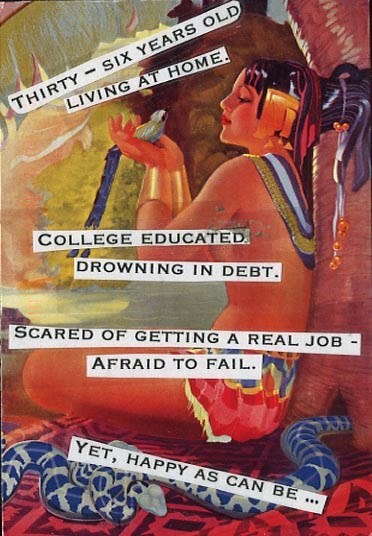
Is that true? Am I, a Millennial, poor because I choose to be poor? Perhaps. I’m not so irresponsible that I won’t own up to my life decisions, which have brought me to this place. But I think there’s this perception in the minds of our parents and grandparents that Millennials are generally like the person who wrote this postsecret above. Drowning in debt, living at home, so afraid to fail that we’ve utterly failed to launch, and yet blissfully oblivious to all of it. Perhaps that’s true for some of us, but not for those who will reinvent the world after our parents are gone.

To be clear, I love my mother and father. I don’t hold any of this against them personally, or anyone else of my parents’ generation (except the politicians who sold our Constitutional birthright, but that’s another rant altogether). Unfortunately, hard truths do not become softer because we choose to ignore them. And hard truth is this:

Hard men make good times.

Good times make soft men.

Soft men make bad times.

Bad times make hard men.
I graduated college in 2010. Through a combination of scholarship money, campus jobs, and (yes) generous parents, I was fortunate enough to graduate without any student debt. At the same time, it was the height of the Great Recession, and jobs were nearly impossible to come by. I can’t tell you how many of my writing friends put their dreams on hold, or abandoned them altogether. Almost all of them.

As a side note, I agree with Mike Rowe that “follow your passion” is bullshit advice. It ranks right up there with “be yourself,” and “you can be anything if you put your mind to it.” Don’t follow your passion. Follow opportunity, and take your passion with you.

But in 2010, I had an opportunity. Without any debt, and without any dependents or other obligations, I decided to pursue a writing career. And unbeknownst to me at the time, the industry was undergoing a revolution that would open the doors to make that possible.

I indie published my first short story, Memoirs of a Snowflake, in March 2011 and never looked back. Since then, I’ve published dozens of novels, novellas, short stories, and other works. It’s been an exhilarating journey. At the same time, it’s been the most difficult struggle of my life. And that is why I must now confront one of my most crippling fears.

Unlike the girl in the postsecret, I am not crippled by the fear of failure. If I were, I would never have published that first story, let alone all the others that followed. Instead, I have a fear of admitting failure, both publicly and to myself. It feels too much like an admission of defeat.

It’s an important distinction to make, though. The Romans admitted failure often and early—it’s how they learned from their defeats, ultimately going on to build one of the most powerful militaries in the ancient world. But they never admitted defeat. Even after Cannae, when Hannibal threatened the republic with utter extinction, the Romans refused to be defeated. And so, while Carthage fell into decline and decadence, the Romans endured until Scipio finally gave them victory at Zama, paving the way for the rise of Western Civilization.

I haven’t had a personal Cannae moment yet, but I do feel like I’ve been fighting a war of attrition. In 2014, the market shifted with the launch of Kindle Unlimited, and I failed to adapt. At that point, I was just on the cusp of going full-time with my writing, though looking back I can see that I didn’t yet have the foundation for a lasting career. Still, to have that dream snatched away when I was just on the verge of catching it, you can understand why I kept plugging along, believing that I was just a month or two from turning things around.

That’s basically what I’ve been doing for the last four years: writing full-time even though the writing doesn’t pay full-time wages. Maybe my mother is right. Maybe I have chosen to be poor.

And yet, while I now believe that I do have the foundation for a lasting career, I need to confront the fact that it may be ten years or more before I achieve it. Should I continue, like so many of my peers, to delay major life decisions until my career reaches that point? Is it worth it to put off marriage, family, and home ownership until my forties or fifties, if that’s what it takes? Or is it time to admit failure so that I can leave this dead end and find another way?

Back in 2010, I had no plan B. It was the Great Recession. I didn’t have a day job because I couldn’t find one—hardly anyone could. And from 2013 to 2014, writing paid well enough that I didn’t need one. Things were looking up, and I was just a couple months away from a sustainable long-term career.

Well, it’s time to admit that that line of thinking has turned out to be a trap. I’m approaching my mid-thirties and I’m still single and poor. I need some kind of long-term backup, because I can’t count on the writing career to take off like I need it to, at least not anytime soon.

So I’ve moved my writing onto a part-time footing. I’m limiting the number of words I write each day, leaving time for other pursuits. And I’m looking for a day job, preferably one that teaches me something useful and pays well enough to make ends meet.

I haven’t been defeated yet, though. Failure is not final until you decide to give up. I have not given up, and will continue to write, even if only on a part-time basis. And when I am making enough to go full-time, I have the foundations in place to do so.

In the meantime, though, I’m not going to put my life on hold for a dream.

Five awesome history podcasts

At my former day job in Iowa, I had the opportunity to listen to a great deal of audio while I was working. Consequently, I discovered some really fascinating podcasts on a wide variety of subjects.

As a writer, I particularly enjoy history podcasts. Not only do they give me lots of interesting story ideas, but they help to expand my mind and give me some useful perspectives on where we came from and how we arrived at where we are in the modern world today. Before I started listening, there were a lot of dark areas in my understanding of world history. Now, much less so.

I tried out a wide variety of history podcasts, some good, some acceptable, and a few that were less than useful. Of all the podcasts I tried out, here are the five best.

History of Rome by Mike Duncan

Of all the history podcasts out there, Mike Duncan sets the standard with History of Rome. Short and concise, yet full of fascinating insights and connections, this podcast opened my eyes to Roman history and lightened what was previously a very dark section of my understanding of the world.

Where other podcasts lose sight of the forest for the trees, History of Rome never does. And where other podcasts advance a single narrative without exploring alternate explanations of events, History of Rome retains enough curiosity for this never to be a problem. Indeed, for major events like the crisis of the third century or the migration period, Mike Duncan explores multiple causative events, both proximate and ultimate. He’s not just presenting somebody else’s version of history: he examines original sources and comes to his own conclusions.

Histoy of Rome was what got me into history podcasts in the first place. It’s also what opened my eyes to things like monetary systems and the rise of serfdom. There was a hole in my understanding of the world, and History of Rome not only filled it, it gave me a bridge to knowledge I wasn’t aware I didn’t possess. Definitely recommended.

History of Byzantium by Robin Pierson

When the History of Rome ended with the fall of the western Roman Empire, Robin Pierson didn’t want it to end. So he started a podcast of his own, about the eastern Roman Empire from the reign of Zeno in the fifth century to the fall of Constantinople to the Turks in 1453. The result is The History of Byzantium.

This podcast is very much a continuation of the History of Rome. It’s a little more difficult to follow, mostly because Byzantine history is so… well, Byzantine. However, Robin does a good job tying it all together and making it comprehensible. He also interviews a number of historians and other subject experts, which can be very interesting.

I never realized how pivotal and important the eastern Roman Empire was. From Justinian and Theodora to the apocalyptic wars with the Muslims that stopped them from overrunning Europe in the 7th and 8th centuries, the history of Byzantium is absolutely fascinating. Well worth a listen.

Revolutions by Mike Duncan

After finishing the History of Rome, Mike Duncan started a new history podcast called Revolutions. This podcast explores the major political revolutions of the modern era, starting with the English civil war and ultimately leading to… well, we don’t know yet! Once again, this was a relatively dark area in my understanding of the world that Mike Duncan quite effectively illuminated.

It’s been particularly interesting to see how all of these revolutions are connected. The English civil war in many ways laid the groundwork for the political philosophy of classical liberalism, which led to the American Revolution. In turn, the American Revolution inspired the French Revolution, which triggered the Haitian Revolution (the only successful slave revolt in history), which spilled over into South American with Simon Bolivar. The failures of the French Revolution led to Napoleon, the restoration of the Bourbons, and the backlash of Metternich and European conservatism. This led to the tensions which exploded in the revolutions of 1848, whose failures led to the rise of socialism and communism.

Revolutions has shaped up to be just as good as History of Rome, if not better. Definitely worth subscribing.

Western Civ by Adam Walsh

The scope of Western Civ is a lot broader than the other podcasts I’ve listed, and that’s part of what I like about it. Instead of diving into the minutiae, it gives a very good sweeping overview of civilization, starting with the prehistoric fertile crescent and ultimately leading to… well, so far we’re at the high middle ages, but I get the sense that we’re ultimately headed for the modern day.

Adam Walsh also does a lot of readings from stuff like Homer, Cicero, Beowulf, and Norse mythology. It can be really interesting to hear the original documents in translation, especially after getting a context for them. It’s clear from his reading that he’s got a passion for this stuff, which bleeds over into the whole production.

For a broad overview of Western history, both to get a sense where your blind spots are and to put everything else into context, Western Civ is probably the best history podcast I’ve found for that.

History of English by Kevin Stroud

Years ago, in college, I took an ELANG class for my English minor and found it absolutely fascinating. The History of English Podcast combines all the best parts of that linguistics class with the history of the people who spoke it. Starting with the Indo-Europeans and what archaeologists have managed to piece together about them, Kevin traces the origins of just about every aspect of the English language.

In particular, I’ve really enjoyed learning about the Anglo-Saxons and the language they spoke. Kings and Earls, pagans and Christians, far-reaching marriage alliances and invasions from the Vikings and the French. I never considered how the English language itself is a historical artifact, but it really is. As a writer, I find this particularly fascinating.

The History of English Podcast goes really in-depth about things like the Norman conquest and the English monarchy, but it’s never too dry or difficult to follow. Also, each episode is packed with some really fascinating insights into our everyday language. Definitely worth subscribing, especially if you like to write.