Operation SB #3: L’enfer, c’est la solitude

Title: L’enfer, c’est la solitude
Genre: Science Fiction
Word Count: 6,962
Time: about 40 days

I can’t stand people who humbrag, so I’m just going to come out and say that this story is awesome. Seriously. Kickass freaking awesome. It may be the best short story I’ve written to date. Six months from now, I may come to hate it (like I’ve come to hate some of my other stories), but I seriously doubt that will be the case with this one. This represents some of my best work, and I’m extremely proud of it.

Now that that’s out of the way, I guess I should explain a little what this story is about. The title (which I didn’t figure out until after I’d written the story) is a play on the Sartre quote: “L’enfer, c’est les autres” (“hell is other people”). The story basically takes the exact opposite point of view, by showing how two people from opposing planets stranded on an isolated post basically go through hell because of their isolation, and the way it both brings them together and pits them against each other.

The idea for the story came to me years ago, when I was studying political science and modern philosophy. I imagined a situation where two worlds in a cold war type standoff both claimed an isolated, unpopulated planet somewhere, where each maintained a tiny outpost with only one person in order to stake the claim. Even though they’re enemies, the two opposing soldiers would, in many ways, be closer to each other than to their other comrades. Or would they?

The balance of power changes when one soldier’s station goes down in a meteoroid collision and he’s forced to go over to the other soldier’s station in order to survive. On the way, though, he gets a transmission from his superiors that their two worlds are now at war, and he has orders to kill the enemy soldier who has just saved his life. Can he carry them out? Is it right for him to do so? Or did the other soldier receive the same order, and is he now planning to kill him?

The idea for this story bounced around in my head for a long, long time, but I never sat down to write it because I didn’t know how to resolve it. Then, a little over a month ago, I got a crazy awesome idea for how to do it. All the other details came together, and I knew exactly what was supposed to happen.

I wish I could say that the story practically wrote itself from there, but unfortunately that was not the case. I started it back in early February, but kept putting it off because the story in my mind was so awesome, I didn’t know if I could do it justice on the page. That fear was absolutely crippling, and it’s the main reason I didn’t write any short stories at all for the month of February. It wasn’t that what I had written was bad–in fact, the beginning was pretty good. It was the fear that my skills just weren’t yet up to writing this one.

Well, those fears were pretty unfounded. While talking about the story with some friends this last Tuesday, I realized that the whole thing was silly and I should just sit down and write it. Two days later, the story was finished–and it was actually pretty good.

I know as a part of this short story challenge, I’m supposed to keep Heinlein’s rules, including rule 3 which states “you must refrain from revising, except to editorial order.” I mostly kept to that rule for this one, but not entirely. I did a lot of cycling–reading through and tweaking previous sections before putting new words on the page–as well as some significant cutting. The original draft clocked in at about 7,700 words, and Analog puts a cap at 7,000, so I went through and cut about 10%. Hopefully, though, that will just make it stronger.

I really, really like this story. It’s in first person, and the voice is quite a bit darker than some of my other stuff, but I really connected with the viewpoint character and I think it shows. Besides that, the buildup and suspense was just a ton of fun. I really hope this story gets picked up soon, because I think you’re really going to enjoy it!

This brings the number of short stories on submission now to three. I’ve garnered two rejections for “The Infiltrator,” but that’s it so far. I’m honestly not sure whether to just trunk that one, but I’ll keep it on submission for a while just in case. As Kris Rusch said in a recent blog post, you should let the editor decide what goes in her magazine without pre-editing for her.

That’s just about it. One short down for March–seventeen days to write the second one. Let’s do it!

Operation Short Blitz

Primary Objective: To master the art and craft of short-form storytelling.

Secondary Objective: To achieve name recognition in the speculative fiction field through publication in the major short story magazines.

For some time, I’ve wanted to branch out and learn how to write well in short form.  I’ve written several novels, and I feel I have a pretty good understanding of that form, but short stories have always eluded me.  I want to turn that around and really gain a degree of proficiency with short fiction, so that it’s not a big blind spot for me and that I can really master that aspect of storytelling.

My purpose in doing this isn’t to make money, though I certainly hope to make something (I write for a living, after all).  Rather, it’s to expand my storytelling capabilities and build a name for myself.  Most working SF writers have a short story component to their careers, so I figure it’s time to work on my own.

Since prestige is more important than money, I’m going to focus on getting published in the major magazines, and won’t self-publish unless either the story fails to sell anywhere (at which point I may just trunk it) or the first publication rights have already been exercised.  I do expect to self-publish my stories eventually, but not until I’ve gotten as much mileage out of them as I can.

Strategic Outline:

The Science Fiction & Fantasy Writers of America (SFWA) keeps a list of qualifying markets for membership, which is useful for picking out the best magazines to submit to.  If I can get my stories published in these magazines, which pay the highest rates and have the widest circulation within the field, I figure that Operation Short Blitz can definitely be considered a success.

In addition to the SFWA qualifying markets, there are a number of semi-professional markets that would be good to submit to as well.  I’ve heard that Ralan.com is a good site for finding those, as well as Duotrope (though the site now requires a subscription).  I won’t submit to the semi-pros until I’ve exhausted the professional markets first, though.

Even if I seriously doubt that a story is good enough to get picked up by the best markets in the field, I’ll still start at the top and work my way down.  I remember hearing that the editor of Analog (or was it Asimov’s?) once got really mad at a writer who told him that he didn’t have a story that was good enough for his magazine, since that writer was basically trying to do his job for him, and writing his own rejections instead of giving his stories a chance.  That isn’t going to be me.

(Although, there are some markets like Tor.com that have ridiculously long response times.  For those, I suppose it’s better to wait until I’ve really got a zinger of a story to send them, since I can only send one submission to a place at a time.)

I fully expect to get rejected by everybody, multiple times for multiple stories.  That’s okay–it’s all part of the process.  I’ll probably get a sidebar widget or something to track my progress, with total rejections as a prominent stat.  Maybe when I hit 500 or 1,000 or something, I’ll do something special.  It’s a milestone of progress, or at least of effort, so I definitely plan to own it as such.

Even though my goals aren’t financial, I probably won’t submit to markets that only pay in contributor copies (or don’t pay at all, for that matter).  Those publications aren’t really going to help me make a name for myself, and if I wanted to write for exposure, I could just as easily publish my stories myself.  There’s no sense in writing for exposure unless you’re the one who has the control.

Of course, I’m going to have to write a lot in order to have a lot to submit.  My goal for now is to write at least two short stories per month, preferably one every week.  I figure that’s a good balance to strike between this and my other writing projects.  My novels and novellas still take priority, but I’ll make time for Operation Short Blitz as well.  Besides, sometimes it helps to take a break and work on something that you can start and finish quickly.

For fun, I’ll post a quick summary of each story I write, with the word count, genre, how long it took me to write, and what my thoughts are on it.  If you guys can keep me honest and make sure I don’t slack too much, that would be awesome.  I won’t be posting them, though, or really any excerpts either, since I need to keep the first publication rights in order to sell them (almost no-one takes reprints, unfortunately).

Logistical Considerations:

In order to do this as efficiently as possible, I’ve put together a spreadsheet of all of the magazines I hope to submit to, ranking them in order of preference and listing all of the relevant information about them.  This information includes:

  • Name of the publication.
  • Word count requirements.
  • Genre qualifications.
  • Payment rates.
  • Expected response time.
  • Name(s) of the editor(s).
  • Link to their guidelines.
  • Link to their submission system.
  • Whether they accept reprints.
  • Whether they accept multiple/simultaneous submissions.
  • Whether they’re a SFWA qualifying market.
  • The length of any exclusivity period in their contracts.

In addition to everything listed above, I’ll also keep a column for each story I’ve written, to indicate which markets I’ve sent them to and any result.  I’ll keep things color coded for convenience: red = standard form rejection, yellow = personalized rejection, green = currently on submission, blue = published, white = haven’t submitted yet, and gray = doesn’t qualify for submission.

Basically, it looks something like this:
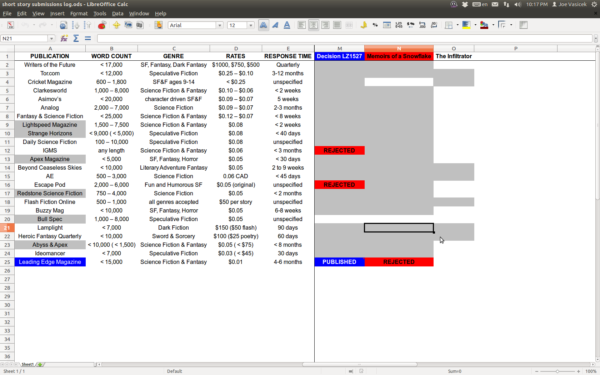
Screenshot from 2013-12-10 22:17:50Whenever I write a new story, I’ll list it in a new column on the spreadsheet, gray out any markets that I don’t plan to send it to, and immediately send it out on submission, starting with the market at the top and working my way down.  If it goes through all the markets and doesn’t get picked up by any of them, then I’ll either trunk it or self-publish, but not until I’ve gone through all the markets first.

I’ve got to admit, one of the big motivations for me is this spreadsheet.  There’s something about having all of my stories organized and color coded in a place where I can see them all that makes me want to write more of them.  What can I say?  I’m a nerd.

Tactics:

For the duration of this operation, I’m going to adhere strictly to Heinlein’s rules, which are:

  1. You must write.
  2. You must finish what you write.
  3. You must refrain from rewriting, except to editorial order.
  4. You must put what you write on the market.
  5. You must keep it on the market until it has been sold.

No matter how great the temptation, I will not revise a story after it’s finished.  If it’s broken, I’ll just trunk it and write something else, or rewrite it from scratch.  If I workshop it, I’ll do it the way Dean Wesley Smith advises, which is to workshop it after you’ve sent it out, in order to learn how you can improve on the next one.

The reasons for this are twofold.  First, a lot of writers I whom respect (especially short story writers) swear by Heinlein’s rules, so I plan to try them out and see just how well they work for me.  Second, I don’t want to become a master reviser or editor, I want to become a master writer.  I wrote almost all of my college essays the night before they were due, and could easily pound out an A+ essay on a first draft by the end of my college career.  I wouldn’t be surprised at all if short stories are similar.

Since I have a lot of other writing projects to deal with, I’ll probably limit myself to two or three days at most for each story.  I average around 2,500 words a day when I’m on project, so if it takes me a week to write a 5,000 word short story, I’m probably doing something wrong.

Like I said above, my goal is to write at least two stories per month, preferably one per week.  I usually take Sundays off, so I figure that Friday/Saturday would be a good time to work on a short story.  It’s at the end of the week, so it won’t interrupt my normal work flow too much, and gives me a chance for a nice break.  If I don’t finish it in one weekend, I can put it off until the next one.  I’ll try that out and see how it goes.

Of course, the only way to get great at writing short stories is to read a lot of them too.  I already subscribe to Escape Pod and the Clarkesworld podcast, and just signed up for Daily Science Fiction as well.  If any of you guys have good recommendations for short stories or magazines, let me know–I’m definitely interested in reading as much great stuff as I can.  And of course, I’ll still keep working at the slushpile for Leading Edge.

That just about does it, I think.  This is definitely uncharted territory for me, so I expect I’ll be learning a lot of great stuff along the way.  For now, though, this is how I plan to go about doing it.  It will probably take a couple of years before Operation Short Blitz really comes to fruition, but I plan to stick with it until it does.

Wish me luck!  And if you want to join me by doing something similar, let me know how it goes!
Stars of Blood and Glory 2.0 is finished!

On Tuesday, I finished the second draft of my latest writing project, Stars of Blood and Glory!  Here are the basic stats:

words: 78,746
pages: 372
chapters: 20, epilogue, and prologue
start date: 3 July 2012
end date: 24 July 2012

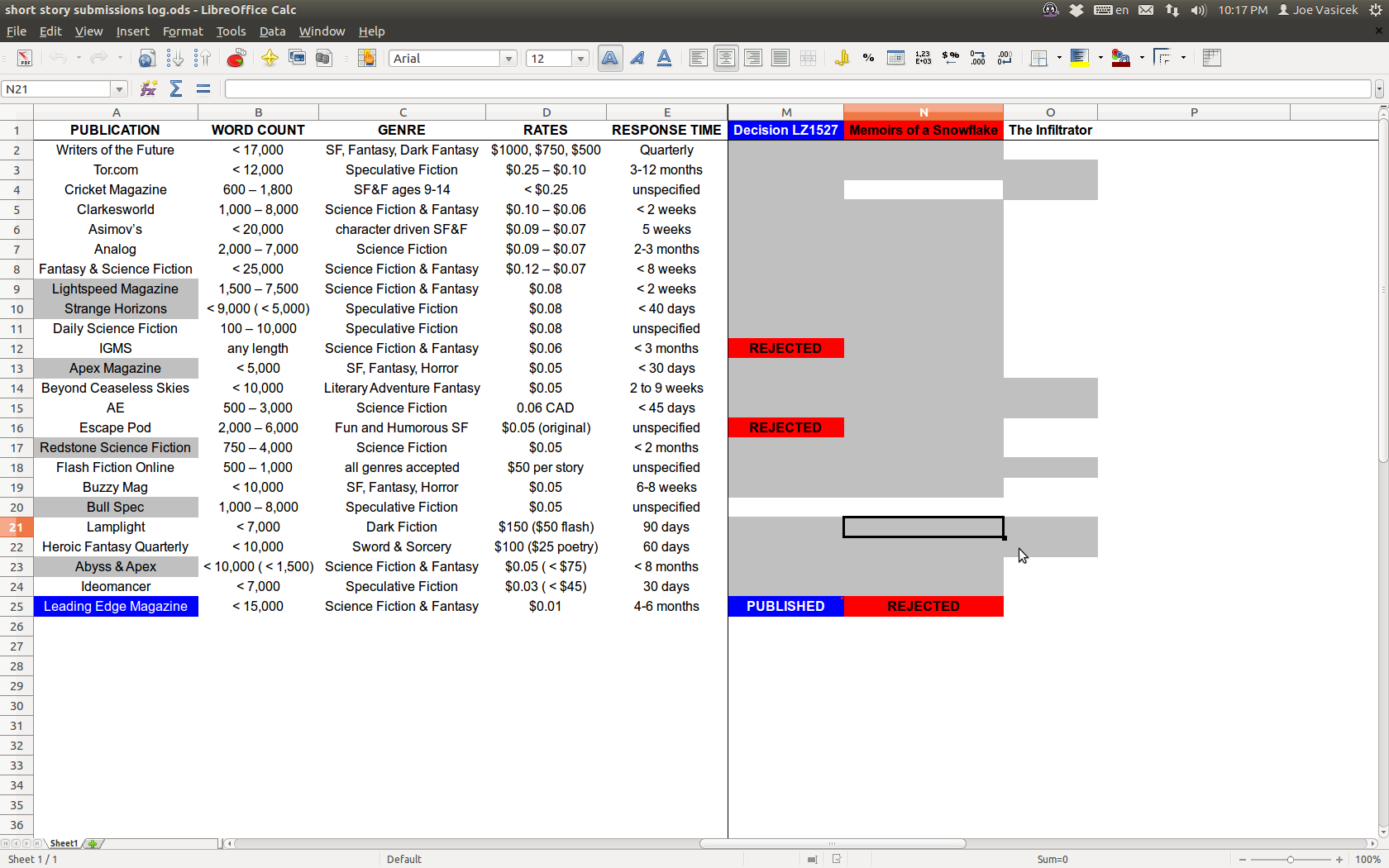
Also, this is probably really dorky, but I made a logo for the title:

They say to use only Courier or Times New Roman in your manuscript, but whatever.  I think it looks pretty cool.

This was a lightning-fast revision, compared with the ones I did for Bringing Stella Home and Desert Stars.  Part of that is because I want to try and follow Heinlein’s rules more closely.  I recently looked back at how I’ve spent my writing time over the past three years, and found out that as much as 3/4ths of it was tied up in revisions, not in producing new material.  Yeah…that’s something that needs to change.

For this draft, I resisted the urge to do a line-by-line edit, and instead focused on rearranging the scenes in their proper order and inserting new ones that were essential to the story but missing from the first draft.  That’s probably why it only took three weeks to finish.

I don’t think there are any glaring holes in the story, but if my first readers find any, I’ll probably do another scene rearranging draft much like this one.  If they give me the green light, though, I’ll do a quick pass to fix any errors and send it off to my editor to start the publication process.

Two things about Stars of Blood and Glory have really surprised me: first, how little time it’s taken to write it (two months for the first draft, a little less than one for this one), and second, how short it is.  Even with five viewpoint characters, it’s less than 80k (Bringing Stella Home was 110k).  The pacing feels right, though, so that’s probably its natural length–it’s just that I seem to be writing shorter and shorter novels lately instead of longer ones.  Maybe it has something to do with all those David Gemmell novels I love to read.

There’s more I could say, but I don’t want to bore you guys too much.  Besides, you probably want me to move on to the next one.

My next writing project is Star Wanderers: Part II, which should take me about a week to revise and another week or two to finalize and publish.  If any of you want to help me proofread the final draft, let me know–I’m willing to exchange services and/or give you a free copy.

In the meantime, I’d better get back to writing.

No more word counts and other paradigm shifts

This August, it will be five years since I decided to start writing on a professional level.  A lot of things have changed since then, and in some ways they’re changing even faster now.

For example, in May 2009 I started a spreadsheet to keep track of my daily word counts.  I’ve been keeping it diligently ever since then, with graphs and everything.  But just recently, I’ve decided to stop doing that.  Word count is a very shallow indicator of progress: it only measures quantity, and often leads to unnecessary angst or diverts attention from more important things.

Instead, I’m going to focus more on deadlines and work to develop some other, better indicators.  Number of books published per year is probably a key one, as well as number of manuscripts finished.  But deadlines are probably going to be the most important drivers from here on out: publishing deadlines as well as writing deadlines.

Another thing that’s shifting is my revision process.  I know that a lot of beginning writers hate Heinlein’s rules, but almost all the long-term professionals swear by them–especially the ones with careers that I would like to emulate.  This makes me think that I need to scale back on the revisions and develop more trust in my creative voice.

Just as a point of reference, Heinlein’s rules are:

  1. You must write.
  2. You must finish what you write.
  3. You must refrain from rewriting, except to editorial order.
  4. You must put the work on the market.
  5. You must keep the work on the market until it has sold.

I’m currently on the second draft of Stars of Blood and Glory, and what I’ve found so far is that the overall story is actually pretty good.  Some of the scenes are a little out of order, and some of the plot-lines are missing elements that need to be added in, but aside from a few chapters where I got lost for a couple of pages, not a lot needs to be changed.

Of course, I could spend a draft or two tweaking every other sentence, tossing out most of what I wrote in the heat of my creative passion–but would that really make the story any better?  I recently had Kindal’s writing group critique my first chapter–the one that I revised pretty heavily in April–and they found all sorts of problems that weren’t in the original draft, as I wrote it back in December.

Don’t get me wrong–I do think there is an important place for revision.  But I think it’s best epitomized by Tracy Hickman in this episode of Writing Excuses:

We write from the heat of our passion, but we edit to see the fire through the smoke.

And even Tracy only does three drafts.

The other thing that’s changing is how I look at alpha reading.  I used to have different tiers of alpha and beta readers–most of whom were writers in other genres, and not really fans of  science fiction.  I asked them to give me as much feedback as they could, and bugged them for weeks or months at a time asking if they’d read my story.  I then compiled all their line-by-line comments into one giant master-file, which I kept open on the left side of my screen as I made the changes to my manuscript on the right.

Well, I’ve started to realize that there’s a huge difference between reading for criticism and reading for enjoyment.  Because of that, a lot of the things my alpha and beta readers pointed out were things that most regular readers probably wouldn’t have noticed.  Towards the end, I started to get wise on this, and only followed about a third of the criticism that I received.

Don’t get me wrong–I do appreciate the feedback.  A lot of it helped me to see and fix problems that I’d otherwise missed.  But a lot of it came out in casual conversations with my readers after they’d finished the story–not in the line-by-line comments on the original draft.

For those reasons, I think I’m going to change the way I ask for feedback.  Instead of alpha and beta readers, I’m going to go with a handful of “test readers”–readers who enjoy the kind of science fiction I like to write, but who may or may not be writers themselves.  Instead of asking for a detailed, line-by-line critique, I’m going to ask them three things:

  1. Did you enjoy the story?
  2. If you stopped reading it, where did you stop?
  3. Did you enjoy it enough to pay for it?

I’ll ask them to give it three chances, and if they still can’t finish, that’s okay–just let me know where the hangups were.  And if they do finish it, I might have some questions for them–but then again, I might not.  It all depends on the story.

Compared to where I was when I started out–or even where I was three months ago–those are some pretty huge paradigm shifts.  I have no idea how it’s going to turn out.  I’ve grown a lot as a writer recently, and I hope that this is moving me in the right direction, but I won’t really know until I’ve tried it out for a while.

In any case, this post is long enough.  I’d better get back to writing.