Just a little something fun to start the week!
Tag: guns
Color Revolutions and Collusion News Network
For most of 2012, I lived in Georgia, a former Soviet Republic of the USSR. I came to know the people, the culture, and the politics of that part of the world first-hand. In particular, I was there for the 2012 elections, a watershed moment for modern Georgian politics.

A little bit of background. Georgia won its independence in the 90s during the fall of the Soviet Union, and immediately fell itself into a civil war. Three regions broke off: Adjara in the south, South Ossetia in the north, and Abkhazia in the northwest. It was a very difficult time, where the national army was little more than a deputized gang of thugs.

When the chaos settled down, the man in charge was Eduard Shevardnadze, a former high-ranking member of the Soviet Politburo. If you had to compare it to something, it would be like the United States falling apart and George W. Bush taking over Texas. An old establishment politician from a dynastic family returning to his newly independent home country to head it during troubled times.
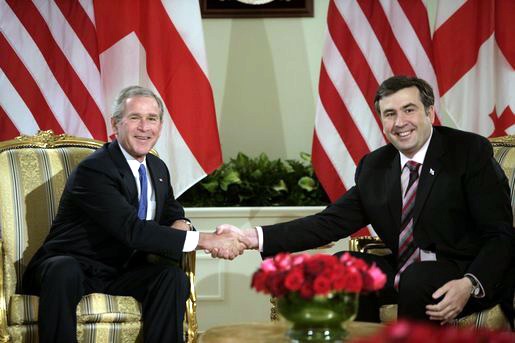
But then, in 2005, something interesting happened: a “color revolution” broke out. George Soros, members and allies of the Bush Administration, and other foreign actors began to stir up protests in Tbilisi against Shevardnadze’s government. The tensions culminated with Mikheil Saakashvili and other agitators storming parliament with roses in their hands, taking over the podium and forcing Shevardnadze to flee with his bodyguards. He later resigned, and Saakashvili ran unopposed in the following election. He won by 96.2%.

It was political theater of the highest order, accomplished by collusion with a meddling foreign power. Once Saakashvili was in charge, Georgian foreign policy took a hard turn towards the West, causing massive tensions with Russia that culminated in the 2008 Russo-Georgian War.
This was a very bad move. Georgia is basically the Mexico of Russia; the two countries are closely linked both culturally and economically, with a large volume of remittances flowing from expatriots in Russia back to their families in Georgia. By turning so sharply to the West—not to mention, starting an actual war—Saakashvili did his people a great disservice.
Fast forward to 2012. I was teaching English in a village called Rokhi, about half an hour south of Kutaisi. I knew the basic outlines of this history, but very few of the specifics. The people were generally friendly to Americans, but they were very quiet about politics, at least to me.
Then the elections happened, and against all odds the Georgian Dream party completely overthrew Saakashvili’s ruling party in the parliament. Politicians started fleeing across the border into Turkey. Those who didn’t flee were arrested, sometimes on spurious charges, sometimes on legitimate ones. The courts became weaponized in a political struggle between Saakashvili and the Georgian Dream. It wasn’t a transfer of power so much as an ongoing coup.
All of a sudden, people starting speaking up and telling me what they really thought. While Saakashvili was in power, people were always careful around me because they assumed (since I was an American) that I was some sort of spy. But when the Georgian Dream Party took over, people felt it was safe to share their true feelings about how much they hated this guy who had taken over their country and driven it into the ground.
This is what foreign collusion and meddling looks like. America does it all the time. There’s a saying in the former Eastern Bloc that goes something like this:
“Why has there never been a color revolution in the United States?”
“Because there is no US embassy in the United States!”
Except now, I’m not so sure. Because the hyperbolic media response to the latest mass shooting in Florida shares some very disturbing similarities with a color revolution, and it frankly scares the hell out of me.
Take the CNN town hall that happened earlier this week. That wasn’t democracy in action, or even journalism. It was political theater, pure and simple. It was a political witch hunt and full-on push for gun confiscation.
A lot of things about the Florida shooting don’t add up. The alleged gunman managed to slip away with the fleeing students, instead of getting killed by law enforcement on the scene as is the pattern with most mass shootings. The FBI knew about this kid, had a file on him, knew what he was planning, and did nothing—absolutely nothing—to stop him. His classmates just happen to be pro-gun control activists, and they just happen to put together this massive national children’s crusade literally before the funerals for all the victims have been held.
Look, I’m not saying the kids are crisis actors. I’m not saying that what they went through isn’t absolutely horrific, or that they don’t have a right to feel the way that they do. What I’m saying is that the politicization of this shooting is massively suspicious and full of red flags.
Consider the three major mass shootings that happened last year, and the differences in the media’s response to each of them.
The first was the Congressional baseball shooting in June. A Bernie Sanders supporter tried to assassinate most of the Republican caucus by hunting them down at a baseball practice. It was deliberate, it was planned, and it very nearly threw this country into a major political crisis.
Within a week, the major news outlets were no longer covering the story.
The Las Vegas shooting was next, in October. A horrible tragedy and watershed moment for mass shootings in America. And yet, after all these months, there are so many unanswered questions. Where are the Casino tapes? Why haven’t we seen them? What was the involvement of the shooter’s girlfriend? Who is the other person of interest that the FBI hasn’t revealed? Was there a second shooter? What about all of the problems with the timeline?
None of these questions have gotten much airplay outside of alternative media. Also, the fact that the shooter was on mood-altering drugs hasn’t factored into the public debate nearly as much as the guns that he used—or didn’t. We don’t really know.
A month later, in November, we had the Sutherland Springs church shooting. The shooter was stopped by a bystander with a gun. A classic example of how the right to bear arms protects and makes us safer.
Once again, the mainstream media buried the story within a week.
Now we have the Florida shooting, with its own set of details that don’t quite add up. Far from burying the story, the mainstream media has blown it up to eleven, with nonstop political theater, witch hunts, appeals to emotion, and above all else, unyielding demands for a total confiscation and ban on all guns.
Who benefits from the politicization of mass shootings? The people who want to destroy the right to bear arms. Who is that? No one so much as the people who want to sow chaos in this country.
If the feds attempted a total gun confiscation, it would spark a second American civil war. Russia would benefit greatly from this. And if the confiscation were ultimately successful, it would leave us that much more vulnerable to a foreign takeover in the style of a color revolution.
This is the stuff of political thrillers, and it’s happening in realtime before our very eyes.
Who’s behind this? I don’t know. I have my suspicions, but I cannot yet say anything with any degree of certainty. But because certain factions benefit from the politicization of these mass shootings, I believe they will continue, and will probably increase in frequency.
We hear of wars in far countries, and say that there will soon be great wars in far countries, but do we know the hearts of the people in our own land?
If ye are prepared, ye shall not fear.
Trope Tuesday: Chekhov’s Armory
The famous Russian writer Anton Chekhov had a rule:
Remove everything that has no relevance to the story. If you say in the first chapter that there is a rifle hanging on the wall, in the second or third chapter it absolutely must go off. If it’s not going to be fired, it shouldn’t be hanging there.
This is, of course, where we get the trope called Chekhov’s Gun. If a gun shows up at the beginning of a story, you can almost always be sure that it will be fired at some point before the end.
Chekhov’s armory is where the story starts out in a place like this:
 Or this:
 Or this:
 What the hell, I might as well just give you the link to the blog where I got all these photos. There’s plenty more gun porn where that came from.
My first time playing with this trope was Gunslinger to the Stars, and I have to say, it made for a really fun story. My outline literally consisted of listing a different gun for every chapter, and figuring out how to work it in. Chapter two was where all most of the guns were listed, but after that, it was pretty much “open fire” and “reload” right up to the grand finale at the end (with a little bit of kissing thrown in for good measure).
Seriously, though, it’s not a bad way to write a book: list all the things that need to go boom and figure out which order to put them in.
The biggest criticism I’ve received for Gunslinger to the Stars is that I should have described the guns in a more personalized detail. To be honest, my life experience is sadly lacking in this regard. I own a couple of guns, most notably an old Mosin 91/30, but most of my shooting experience comes from the Boy Scouts (though to be fair, I did impress the shotgun shooting instructor with a 40+ shot streak). This is a shortcoming that I am eagerly working to rectify.
So yeah, Chekhov’s Armory. It’s a really fun trope to write. When I’m finished with Sons of the Starfarers, I look forward to doing it all again with the next two books in the trilogy: Gunslinger to the Galaxy and Gunslinger to Earth. Expect book two before the end of 2018!
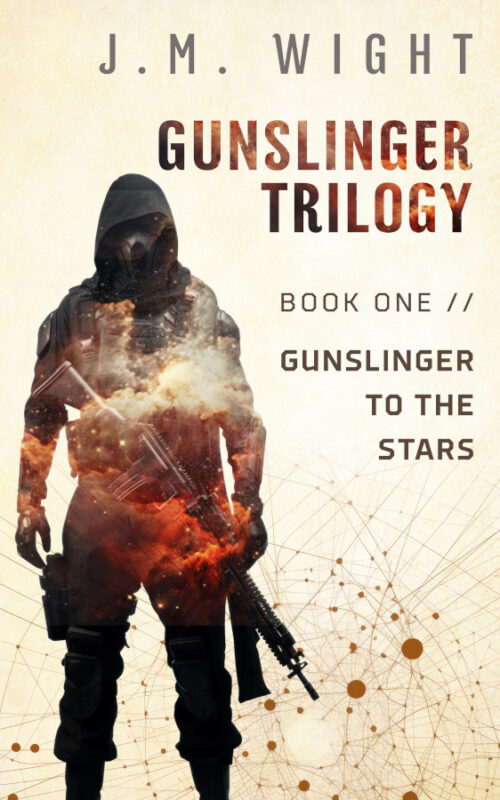
Gunslinger to the Stars
$15.99eBook: free sale!Audiobook: $2.99 sale!
Sam Kletchka here, freelance gunslinger and interstellar privateer. This, my friends, is how I went from being stranded in the armpit of the galaxy to becoming the luckiest human being in the universe.
More info →









Unthinkable truths
If you told the average person that you believed with near 100% certainty that intelligent alien life exists in the universe, they would consider you crazy. Yet the truth is that our universe is so incredibly vast, so full of Earthlike planets, that the odds that intelligent life only emerged here are low enough to be indistinguishable from zero.
Yet the near-certainty of intelligent life is, to most people, an unthinkable truth. It’s something that many people, perhaps even our entire society, just cannot accept.
Our world is full of unthinkable truths. Indeed, our society is built upon them. We can find examples of them in our taboos and social mores, or in the unspoken things that everyone “just knows.” In order for civilization to function properly, there are certain things we must all agree on, such as the idea that all men are created equal, or that we all have certain rights. It’s easier and more efficient to just program people not to accept some ideas than it is to encourage them to examine everything, and hope that truth prevails.
For Americans, one of our most unthinkable truths is the idea that our constitutional rights and freedoms are fragile, and can all be taken away. Those of us who were born in this country don’t realize that the United States is, in many ways, an aberration. We take it for granted that the world around us will continue the way it always has, and that our nation will endure. Anything else is unthinkable.
But how many nations have endured? How many republics have survived the crucible of history? Rome barely lasted a thousand years, and the republic was dead long before the empire reached its greatest glory. The Middle East is full of the bones of dead empires, from the Hittites and Babylonians to the British and the French. Even the most powerful dynasties ultimately fall into ruin, and the periods of relative freedom are the exception in history, rather than the rule.
I got into an argument on Facebook (yes, I’m back on Facebook, though I haven’t decided whether to stay back permanently) where the other person said, quite unironically:
We live in an Era in which our rights are secured by the free dissemination of information; not through the ability to send rounds down range… the fact that you can type those words is proof enough that [you don’t need an AR-15].
As a student of history, this argument strikes me as obscenely absurd. There are numerous countries in the world today that have access to “the free dissemination of information” via the internet just as we do, but are horribly repressive even by historical standards. In China, for example, political prisoners are held in concentration camps and harvested for organs. In Syria and Iraq, ISIS burns people in cages and carries off young non-Muslim girls as sex slaves. In Canada and Europe, you can be imprisoned or fined for merely saying things on social media that the government deems “right-wing.”
The mere existence of Liberty does not guarantee its preservation. The only way that any people have ever remained free is by cultivating a culture of self-sufficiency. Without the right to bear arms, self-sufficiency is impossible, because it forces people to depend on the government for their own self-defense and preservation of their Liberty.
I’ve blogged before about why I need a gun. This post is largely a continuation of those thoughts. It’s unthinkable to us here in the United States that our country may one day fall, but if history is our teacher then that fall is inevitable. It may not come for another thousand years, but it may also come within the next ten.
Truth prevails—even the unthinkable truth.
Why I need a gun (and you do too)
If you had lived in Germany before the Nazis came to power and a time traveler had told you how history would play out, what would you have done about it?
The nation was reeling from a massive economic depression after a decade of war exhaustion. In this troubled time, a charismatic democratic socialist ran on a platform promising to share the wealth of the top 1% (the Jews) with the rest of the nation. Violent protesters routinely disrupted his opponents’ political rallies. People in general were fed up with the political system and were eager for a change.
Obviously, there isn’t a 1:1 parallel between 1930s Germany and 2010s United States. But let’s take a quick look at some of the policies that the Nazis successfully championed:
- Nationalized healthcare
- Centralized education
- Taxpayer subsidized abortion
- Government mass surveillance
- Arbitrary limits on free speech
And finally:
- Abolition of private gun ownership
Can you see the chilling parallels between what the Nazis did and the agenda that the Left has been pushing for the last eight years?
Right now, the United States is reeling from the deadliest mass shooting in our nation’s history. The perpetrator was a domestic terrorist who pledged allegiance to ISIS, just like the last mass shooting which happened in San Bernardino. But instead of focusing on the radical Islamic ideology that motivated these shootings, the national discourse is focused on gun control.
This is patently ridiculous.
When a teenager commits suicide because of online bullying, is the solution to censor the internet?
When people spread lies and false rumors on social media, is the solution to place general restrictions on the use of social media?
When a battered wife is stabbed to death with a kitchen knife, do we call for regulations on the length and sharpness of all kitchen knives?
When large numbers of people die in car accidents, do we enforce a ban on “high-capacity” cars that can drive faster than 45 mph?
Better yet, do we allow car owners to sue the manufacturer if they ever get into an accident? Correct me if I’m wrong, but that wasn’t in the terms of the last government bail out.
We’ve had this debate over gun control many times before. Whenever we have a mass shooting in this country, the bodies of the victims are not yet cold before all of the old arguments on both sides are trotted out. So let’s go to the moment when the emotions were hottest, in 2012 after the tragic shooting at Sandy Hook Elementary:
In an interview with Dave Rubin, Ben Shapiro later said that Piers Morgan had actually brought one of the kids from Sandy Hook onto the set to come on in the second segment of the show. The kid was in a wheelchair, and Piers was going to use him as political prop to make a cheap appeal to emotion. Of course, after Ben called him out for standing on the graves of children, Piers’s whole debate strategy fell apart.
This is my response, which is currently the top comment on YouTube:
“Do you genuinely believe that your own government is going to turn on you in a way that you require an AR-15 to challenge them?”
Holy flying fuck, Piers Morgan. Do you have no self-awareness at all? You are talking to a Jew, Piers. A JEW. As in, one of those people who were systematically exterminated by a tyrannical regime called the Democratic Soc—sorry, the NATIONAL Socialist German Worker’s Party. Also known as the Nazis, Piers. The Nazis.
You are familiar with the Nazis, are you not, Piers? You know: the smartly dressed German guys with the swastika flags who bombed your homeland relentlessly for 3+ months back in 1940. If I remember my history correctly, you fought something of a war with them, did you not? Or are you as bad at history as you are at US constitutional law?
People like you are the reason I need an AR-15, Piers. Crybullies like you in the mainstream media who stand on the graves of children as they browbeat the rest of us into giving up our rights and liberty, all in the name of leftist ideology.
And you know what, Piers? When I do get an AR-15, I’m going to name it in your honor. I’m dead serious, Piers. I’m going to etch your name right on the barrel. I’ll keep it right next to François, my Mossberg shotgun (which I named in honor of another anti-gun wanker).
And you know what sound it’s gonna make when I fire it, Piers? That “ratatatat” when I pull the trigger?
That’s the sound of Liberty.
Here is why you need a gun:
When the founding fathers drafted the Constitution, they envisioned a political system unlike any other in existence at the time—one where the government exists only by the consent of the governed. This, they rightly believed, was the way to ensure Liberty.
In order for the system to work, however, the people had to be able to live without fear of the State. In other words, the government had to fear the people instead of the other way around.
The Declaration of Independence had already set the precedent that it was the right of the people to overthrow their government if it ever became tyrannical. The only way for that to happen was for the people to have the right to bear arms.
This is why the second amendment is the second amendment, not the ninth or the sixteenth or the twenty-eighth. It’s also why the second amendment never specified what kinds of arms should be allowed. The idea that founders’ original intent was to restrict gun ownership to muskets is patently ridiculous:
In my experience, people who favor stricter gun control laws generally fall into one of two camps: those who are simply afraid of guns, and those who want to vastly expand the powers of the State.
The first camp of people are generally well-meaning, if a little bit sheltered. Most of them have probably never owned or fired a gun of any kind. Their arguments for stricter gun control tend to be rooted in emotion. When a mass shooting happens, they feel like they need to do something to prevent this kind of massacre from ever happening again.
Unfortunately, these people have been spoon-fed lies from the second camp, which wants to disarm the general public NOT to reduce gun violence, but to vastly expand the powers of the state.
These people are fundamentally opposed to the idea of a government that exists only by the consent of the governed. They want to tear down the Constitution because it prevents them from using the power of the State to advance their political agenda. The principle of Liberty is a roadblock to them, and they want to abolish at every turn, not only with the second amendment, but the first, the fourth, the ninth, etc.
One of their main arguments is that there is no place in this country for private ownership of “assault rifles.” The argument is that these are “weapons of war,” and that therefore they have no place in civilian life.
To someone who has never owned or fired a gun, this is a pretty convincing argument. The term “assault rifle” is never clearly defined, but it effectively conjures up all the fears of guns and gun violence that many of these people have. To push the envelope even further, gun control advocates always associate “assault rifle” with AR-15, the most popular rifle in the United States.
The AR-15 is a de-clawed version of the M-16, which (unlike the AR-15) is fully automatic. That means that with an AR-15, you only get one bullet for every time you pull the trigger. AR-15s are most often chambered in .223/556, a round that is smaller in diameter than the most common handgun rounds. The reason it’s a popular weapons system is because it’s the Mr. Potato-head of guns: you can swap out basically all of the moving parts, or build one from scratch. No matter your needs (hunting, home defense, recreation, competition), you can adjust an AR-15 to meet them.
It’s actually not a scary gun at all, if you know how to use it properly. And judging from how many of them are circulating in the market, responsible gun ownership is the rule, not the exception.
Is the AR-15 a “weapon of war,” though? It can be if you want it to be. That’s kind of the point. Remember, one of the reasons for the second amendment was to enable the people to stand up against a tyrannical government. Without the right to bear arms—broadly defined—you cannot have Liberty.
This is where we get back to the Nazis. There is a reason why totalitarian governments always ban private gun ownership before they commit their worst atrocities. In the words of Mao Zedong, “political power grows out of the barrel of a gun.” When the guns are in the hands of the people, the people have political power and influence over their government. When they lose their guns, they lose that power.
But Joe, do you really fear an American holocaust? Do you genuinely fear that your government is going to turn on you in a way that you require an AR-15 to challenge them?
Yes, I do.
We tend to have this idea that the Holocaust was a historical aberration, a nasty horrible thing that never happened before and has never happened since. That simply is not true. Systematic interment and murder by tyrannical governments is actually the norm throughout history. The only thing that made the Holocaust any different was German efficiency.
Look at the sack of Carthage by the Romans. Look at the destruction of Baghdad by the Mongols. Look at all five times that Jerusalem was destroyed. In our modern era, look at the excesses of the French Revolution, the genocide of the Armenians, the British concentration camps in South Africa—indeed, look at the concentration camps IN THE UNITED STATES that were set up by FDR. Even before that, we had our own horrors like the Indian Removal Act and the Cherokee Trail of Tears.
And lest you think the world learned its lesson after Auschwitz and Dachau, read up on the Soviet Gulag and Chinese organ harvesting of political prisoners. There is a reason why the wait time for a kidney transplant in China is so ridiculously low.
The flipside of the coin of liberty is responsibility. In order for a people to be free, they need to take the responsibility of governing themselves. Part of that responsibility is learning how to defend yourself, not only from criminals, but from an overreaching, tyrannical government.
That is why you need a gun: because there is no Liberty without the means to defend it. That is also why I bought my first gun this past week (François) and why I’m building an AR-15 (Piers). Whenever there is a systematic effort to take away your fundamental rights, it becomes your duty to exercise those rights before they get taken away.
Praise the Lord and pass the ammunition!
Gunslinger to the Stars: Sam introduces us to his guns
I was going to write another trope post for this Monday, but I got a little carried away with family history research (on the Texas Czech lines, no less), so instead I’m going to share another excerpt from my current WIP: Gunslinger to the Stars. I’m happy to report that it’s coming along fantastically well and the first draft should be finished early February.
For those of you who aren’t familiar with Gunslinger, it’s basically Monster Hunter International meets Guardians of the Galaxy. I’m not as much of a gun nut as Larry Correia, but I hang out with a lot of friends who are, and they’re helping me out with that aspect of the story. The main character is Sam Kletchka of New Texas, one of the Gliese colonies in Earth-space, and his love of guns is as Texan as you can expect:
Before I continue, I should take a few moments to introduce you to my guns. I’ve acquired quite a variety in my travels, but when I started out from New Texas, I had only six. These weapons form the core of my arsenal, and have gotten me out of more hard spots than I can recount.
My father was never particularly religious, but my mother was a devout Christian, and she made me read the Bible cover to cover before I left home for the stars. In the quiet moments between adventures, I sometimes pull out my pocket KJV to read a passage or two. My favorite is the book of Psalms, and on the long voyage from New Texas to Aldebaran, I must have read it a dozen times. About midway through the voyage, I read the following passage in Psalm 36:
5 Thy Mercy, O Lord, is in the heavens; and thy faithfulness reacheth unto the clouds.
6 Thy righteousness is like the great mountains; thy judgments are a great deep; O Lord, thou preservest man and beast.
7 How excellent is thy lovingkindness, O God! Therefore the children of men put their trust under the shadow of thy wings.
It was from this verse that my guns got their names.
MERCY is a supressed Ruger 22 Charger™ Rimfire Pistol. She’s fairly small and doesn’t pack much of a punch, but she’s as silent and stealthy as a Zan cloakship in deep space. Besides being perfect for cloak-and-dagger type stuff, Mercy is also quite excellent for hunting small game, on the few occasions where I’ve been stranded planetside without supplies.
The next two are AR-15 uppers that I can swap out depending on my needs. FAITHFULNESS is a suppressed 300 Blackout with a 9” barrel, perfect for boarding action. I use a homemade subsonic round with the ballistics tuned down just a notch, to allow for onboard fire that won’t accidentally puncture the ship’s hull. The suppressor is excellent for firing in confined spaces, and the standard 30 round magazine has plenty of capacity for most jobs.
RIGHTEOUSNESS is a .50 Beowulf upper that I can swap out for Faithfulness. This massive gun packs an enormous punch, enough to blow through a bulkhead and vent some atmo. I mix an oxidizer in the cartridges to allow it to fire in a vaccuum, making it an excellent weapon for EVA assaults. You just have to be careful to lock your magnetic boots firmly onto the ship’s hull, otherwise Newton’s third law will send you flying.
JUDGMENT is an M203 grenade launcher that attaches quite nicely onto Faithfulness and Righteousness. She makes the rifle a little heavier, but in zero gravity, that doesn’t really matter much. With the proper munitions, Judgment can light up a firefight like Christmas.
PRESERVATION is an 18” Mossberg 590A1™. She’s a tough little girl that can pack a serious punch. The best thing about shotguns, though, is that the ammunition is super easy to fabricate. That’s no small thing when you have to fab all your ammunition yourself. For that reason, if I were stranded on a desert planet and could take only one of my guns with me, it would be Preservation.
LOVE is my father’s trusty old 1911 9mm. She’s been in the family for quite a while, and when I left the Gliese colonies for the stars, he wanted me to take her. Besides being stupidly rugged, the 1911 is also quite easy to maintenance or to fabricate replacement parts. For that reason, it’s the handgun of choice for most offworld colonists.
KINDNESS is the Gliese Arms 2011 .45 ACP that you’ve already met. The 2011 is a lot like the 1911, but the 140mm double stack magazine allows for a capacity of 14+1, not bad for a .45. As you already saw from the gunfight at the Oasis, Kindness is a great gun for everyday carry, when you don’t know what you’re gonna need.
TRUST is a Himalayan Imports Chainpuri 15” Kukri: not a gun, but an excellent combat knife. The Nepalese Gurkhas were some of the most badass warriors of Earth, and the kukri is their signature weapon. I acquired Trust at the Earthfleet Academy on Luna, after winning a game of poker with my fellow cadets. She’s such a beauty, I wouldn’t dream of ever gambling her away.
Those are the weapons I started out with, and the main core of my personal arsenal. Over the course of my travels, I’ve picked up a few others, but I’ll introduce them to you later.
Tomorrow, I get to write about Sam’s other three guns: Faith, Hope, and Charity. These are alien weapons that he re-engineered for human use (he’s a fairly decent gunsmith—has to be, since he’s usually the only other human wherever he goes). True to its namesake, the greatest of these is Charity, for Charity never faileth, and whosoever is found possessed of it at the last day (or the end of the book), it shall be well with him.
Needless to say, Gunslinger to the Stars has a veritable arsenal of Chekhov’s guns. Before it’s over, I intend to fire them all. Repeatedly. If Sam had a theme song, this would probably be it:
WIP excerpt: Gunslinger to the Stars
Here’s the first thousand words from my current WIP, Gunslinger to the Stars. It’s a departure from my usual stuff: a shoot-em-up adventure in the vein of Firefly and Guardians of the Galaxy. TONS of fun to write, and the ending is going to be absolutely spectacular. This may turn out to be the most entertaining book I’ve written to date.
But enough of me blabbering about it. Here it is!
Stranded in the Armpit of the Galaxy
The Gorinal Star Cluster is, in every meaningful sense, the armpit of the galaxy. It was just my luck to get stranded there right as shit hit the fan.
I didn’t know that at the time, of course. My ship, the Star Runner, was in pretty bad shape after a botched-up mission that I’d rather not talk about, and since the only trading commodity I had was the fuel in my tank, I was getting rather desperate for work. The Gorinal Cluster wasn’t my first choice of venue, but it was the closest place with plenty of job opportunities for a man of fortune like me.
The name’s Sam, by the way. Sam Kletchka. I was born on Gliese 832c, othewise known as New Texas, but didn’t spend much time there. Shipped off to Earthfleet Academy when I was nineteen standard years and dropped out after my first year to seek my fortune among the stars.
You see, back in those days, Earthfleet consisted mostly of 20th century submarines, lifted into orbit and repurposed for space. Only thirty-five years had passed since we’d made contact with the galactics, and we were in a mad scramble to put as many colonies on the starmap as possible. The Immortals had promised not to build a jumpgate within fifty light-years of Sol, and tech trading had given us fission-powered FTL and cheap ground-to-orbit. All of this meant that Earthfleet’s resources were tied up in the Gliese colonies—no boldly going where no one has gone before, at least not for members of Earthfleet.
Fortunately, we didn’t have to seek out new life and new civilizations—they were more than happy to come to us. So after dropping out of the Earthfleet Academy, I signed up on a Hyadean star freighter and never looked back.
The voyage out to the jumpgate at Aldebaran was long and boring. Like most ships built by the galactic junior races, Hyadean starships aren’t designed for long-range FTL. The reason for this became apparent when we arrived. Imagine an ancient ring almost five kilometers in diameter, built out of virtually indestructible material. When you look through the ring, you’re looking at a whole other starscape, light-years away. It very literally is a doorway to the stars, and it’s always open, with no gatekeepers to stop anyone from coming through. The Aldebaran gate has been open for hundreds of thousands of years—more than a hundred times older than the pyramids—and it’s one of the younger ones.
From there, it was a simple matter to travel between stars. The Immortals built the jumpgate network more than a hundred million years ago, and it runs almost the whole length of the galaxy. They don’t levy fees for it, either: the gates are as much a feature of the galactic landscape as planets, or black holes, or nebulae. Anyone can use them, and no one wants to live in a galaxy without them.
Which is why it freaked the hell out of everyone when the Gorinal Prime jumpgate went dark.
I had just flown the Star Runner through not fifteen minutes before. My ship only had about a half-tank of deuterium left, thanks to some evasive maneuvers I’d been forced to pull, and I’d also dumped most of my cargo, so I was pretty much flat broke. To add injury to insult, my right sublight engine was shot all to hell and the cabin was venting atmo. Like I said, I’d rather not talk about it.
In any case, I was navigating my approach to G-Prime V when the jumpgate shut down. Went dead. Turned off. There wasn’t a flash or anything, just a very brief flicker across the portal membrane, and then it was nothing more than a giant floating ring.
The comms went haywire almost immediately. A massive Nidrexian freighter has been passing through (one of those insanely long jumpgate hopping ships) and had effectively been chopped in half. Emergency first responders from the nearby monitoring station were scrambling to help out, and all the other ships queued to leave were filling the airwaves with all sorts of chatter. No one knew what to do, because nothing like this had ever happened before.
Yes, I’ve heard all the theories. No, none of them are true. How do I know? You’re jumping ahead. Trust me, it’s worth it to hear the full story.
So there I was, staring slack-jawed at a screen that showed the impossible: a jumpgate that had just shut down. Realizing that I was broke and stranded, I did what any sensible man would do: I headed to the nearest bar to get a drink.
The fifth planet in the Gorinal Prime system is the only one that’s habitable, for a given value of “habitable.” The world is essentially a giant desert, with oceans of sand instead of water. Fortunately, the spaceport that served as the main hub for the system was on the planet’s north pole. The weather was cool enough there to have clouds, rain, and even a couple of salty seas. Figuring it was the best I could do on a half-empty fuel tank, I decided to go down and try what was left of my rapidly deteriorating luck.
The first thing I learned after leaving Earth-space was that every jumpgate hub has a seedy cantina somewhere nearby. Sure enough, the place I was looking for was just a couple hundred yards outside the main spaceport entrance.
The second thing I learned was to get used to being the only human everywhere I went. Oh, it’s not so bad in the Orion Arm, where you can usually find a small expat community if you look hard enough. Xenopoligists, merchanters, vagabonds, and men of fortune like myself are all pretty common in that corner of the galaxy. But the Gorinal Cluster is in the Scutum-Crux Arm, on the far side of the galactic core. In that part of the galaxy, humans are as rare as ice on a neutron star.
So you can imagine my reaction when I saw a twenty-something blonde at the bar—one who was definitely not happy to see me.
Gunslinger to the Stars