Christians: The Most Marginalized and Underrepresented Minority in SF&F (By Design)

So I’m reading The Expanse, and I recently finished the third book in the series, Abaddon’s Gate. Really great book! I thoroughly enjoyed it. Lots of action, lots of adventure, and a very optimistic ending, which is not something you see a lot of in science fiction and fantasy these days.

However, there was one small thing that bugged me about one of the major viewpoint characters: Anna, the Christian pastor. To be fair, they played her religious devotion straight, and didn’t just make her a hypocrite or the bad guy—which is another thing we don’t see a lot of in SF&F these days (more on that later). But they also made her a lesbian, and to be honest, yeah, that bugged me.

Why did that bug me? Because most conservative Christians (and most Muslims, by the way) believe that homosexuality is a sin. Not that being attracted to the opposite sex is inherently sinful, but that acting out on those sexual desires is. Of course, there are plenty of liberal churches that do not believe this, but their theology is in conflict with all of mainstream Christian teaching from the time of Christ himself. So by making Anna a lesbian, the authors were basically saying “yeah, she’s a Christian, but she’s not that kind of Christian.”

Not that I blame the authors for doing that. I totally get that they were writing for a mainstream SF&F audience and wanted to be able to bring up theological topics in the story without turning off any non-religious or LGBT readers. By making the religious character a lesbian, they signalled that the character was “safe,” even if she was a Christian.

But it got me to thinking: when was the last time that a mainstream, bestselling book, movie, or series had a devoutly religious Christian main character who 1) is not a villain or anti-hero, 2) is not a hypocrite, and 3) is not LGBT? Kind of like the Bechdel test, except for Christians.

Firefly comes to mind, though that was twenty years ago. Monster Hunter International has a devoutly religious side character—does he get his own book? I haven’t read far enough in the series yet to know. Looking at my bookshelf, I can see A Canticle for Leibowitz, The Speed of Dark, Hyperion, and Folk of the Fringe, but all of those books are old now. The most recent award-winning example I can think of is Eric James Stone’s novelette “That Leviathan Whom Thou Hast Made” (2010).

I’m having a very hard time thinking of anything published in the last ten years that passes the test. Even with authors like Larry Correia and John C. Wright, those guys have faced tremendous pushback from the left. It really does seem like there is an effort, at least from some quarters to erase good, faithful, conservative Christian characters from SF&F, and to ostracize or marginalize any authors who dare to buck that trend.

It reminds me of a family history podcast from NPR that I checked out once, only to find that the very first episode was about someone finding that two of their ancestors were gay. Laying aside the rather obvious (and hilarious) biological problems with that—adopted family is still family, after all—the implication here was that by making family history LGBT, NPR was making it “safe,” probably for their liberal listeners who have come to associate family history with the Latter-day Saints.

At the same time, we’ve heard a lot in recent years about how important it is to include underrepresented groups in fiction—to make sure that every reader can find characters who “look like them,” or “love like them.” And yet, none of the people championing this cause seem to care whether I can read about characters who “look like me” when it comes to religion. In fact, it seems that the people screaming the loudest about how we need “more diverse books” and more “own voices” are also the loudest in trying to erase and marginalize Christians like me.

So was it really ever about “representation” or “diversity” at all, or was all of that lip service about tolerance and diversity just a Trojan horse from the very beginning? Because here’s the thing: if I as an author don’t include any LGBT, BIPOC, or LMNOP characters in my books, I’ll get slammed by the woke activists for not having enough representation in my books… but if I do include any “marginalized” characters, then I’ll be accused of cultural appropriation. Unless, of course, my book promotes the woke activists’ agenda visavis things like climate change, ESG, gay pride, etc.

“Show me the man and I’ll show you the crime” said Lavrentiy Beria, one of the most psychopathically evil agents of the Soviet Union. That is exactly the same principle that the woke movement operates on, and unfortunately, that movement has come to dominate the SF&F field (just look at what they did to Mercedes Lackey). So really, it should not come as a surprise to anyone that they don’t apply the same principles of tolerance, diversity, and equal representation to conservative Christians—which are rapidly becoming the most marginalized and underrepresented minority in science fiction and fantasy.

So what is the solution? Honestly, it may just be to smile and turn the other cheek. If we give these people enough rope, they will hang themselves with it. Get woke, go broke. Granted, there are reasons to be worried about ESG, Big Tech, and Amazon’s dominance, but it is still possible to build a resilient author career where you aren’t beholden to all that. The more of us accomplish that, the less power these woke crazies will have over us.

Lash out in kind, bend the knee, or smile and turn the other cheek… definitely the third option is best. It’s what Christians have been doing since the time of the Savior Himself, and is the unique genius of the religion that has allowed it to thrive in the face of so much persecution. But it’s important to keep in mind that turning the other cheek is not the same as bending the knee.
Life, the Universe, and Everything 2019

Life, the Universe, and Everything was this past weekend. It’s a local Utah convention with an academic flair, which means there’s a little less cosplaying and a lot of interesting and informative presentations, in addition to all the great panels. There’s also a strong writing and publishing track, though in recent years they’ve expanded the tracks on art, music, and film. Regardless, it all comes back to science fiction and fantasy.

I’ve been coming to LTUE for the last eleven years, and I think this was my favorite one yet! Part of that might have to do with the fact that future Mrs. Vasicek was there with me, but still. Lots of friends, lots of books, lots of panels, and lots of fun!

On Thursday, there was a really fascinating presentation on pre-modern methods of food preservation, such as pickling and fermentation. Really interesting stuff. Not only did we geek out on cheesemaking and sauerkraut recipes, but we also looked at how the production and supply of salt shaped trade routes, empires, and wars. It was extremely informative.

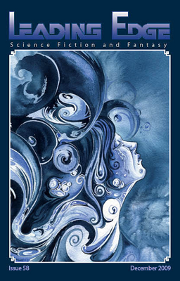
Since Thursday was Valentine’s Day, I picked out some chocolates and a copy of Leading Edge issue 58, where my first published work appeared. I was a bit worried that it would seem tacky, but some friends assured me that it wasn’t, and future Mrs. Vasicek seemed to really appreciate it.

There were a bunch of interesting panels on Friday. My favorite was probably the one on community building for creatives, with Sandra Tayler and M. Todd Gallowglass. They both had some very interesting stories and advice, as well as the other panelists. My biggest takeaway was that in order to build a community around my own work, I need to be a better participant in other creative and fan-based communities. Like LTUE, for example.

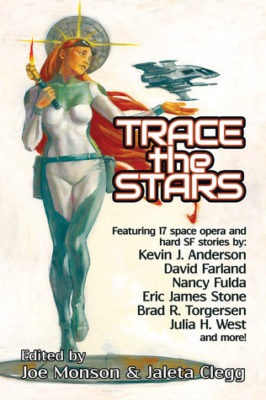
I also picked up a copy of the first LTUE benefit anthology, Trace the Stars. My mission for the rest of LTUE was to get as many authors from the anthology as I could find to sign it. Some of them weren’t there, but I did get most of the ones who were. One day, I’ll get all the signatures and turn it into a book of power! Wuah-haha!

The book signing was fairly low key. A lot of the big names didn’t show up, partly due to the weather, but there was still a good turnout. One of my very first fans who bought Desert Stars at my first ever book signing came over to chat. It was really good to catch up with him, and to let him know that I’m still writing and publishing.

There were a lot of really great panels on Saturday, on topics like surgery in space and what archaeology would look like on an artificially created world. Caught up with Eric James Stone and his wife Darci, who is a close friend of future Mrs. Vasicek. As we were all hanging out in the library, Brandon Sanderson walked up to say hi, and I was able to introduce future Mrs. Vasicek to him. We were actually both in Brandon’s class ten years ago, and didn’t know each other at the time. Brandon got a kick out of that.

My Saturday panels were very well attended and went off very well. The one on villains was particularly good, I think. There was just enough contrast in our viewpoints to keep it interesting without being too argumentative, and everyone had good points. When we made our plugs at the end, I urged everyone to subscribe to Pewdiepie, which got a kick out of the audience. I’m doing my part!

The panels were great, the banquet was great, catching up with old friends was also great. I may have spent a little more than my budget on books, but it was great to support my author friends, and I’m really looking forward to reading some great stuff!

All in all, another great year!

December’s book recommendations

I really enjoyed the experiment last month with the book recommendations. It seemed to go over fairly well, so now that it’s December let’s do it again!

Nothing Found

Don’t be fooled by the painfully self-published cover on this one. Captain Cosette is a light, clean, and really fun book. Imagine if Cinderella got a blaster rifle instead of a glass slipper, and became an ace starship pilot instead of going to the ball. I picked this one up a couple of years ago and really enjoyed it, and I think my readers will too!

Nothing Found

Michael Bunker is a really fascinating guy. He lives off-grid, writes off-grid, grows most of his own food, and is prepared for pretty much any apocalypse scenario you can think of. Not surprisingly, that’s also what he writes about. As a student of Russian history and literature, though, he puts a great deal of thoughtfulness into everything he writes. His stories are great, but I read him just as much for his insights into humanity, society, and the unsustainability of modern life.

Wick is an alternate history, where Hurricane Sandy in 2012 set off a series of cascading events leading up to the big SHTF. Just as Anatoliy Golitsyn and Yuri Bezmenov warned us, the global communist movement did not die in 1989, and Sandy is exactly the sort of crisis that the Soviet sleeper cells within the United States have been waiting for. The modern world as we know it is gone, and something truly terrifying is rising to take its place.

Nothing Found

“Redoubt” takes place in the same universe as Wick, but out in the Rockies. Three ex-special forces guys and an artist get holed up in a summer home high in the mountains when the big SHTF happens, and have to fight for their lives. Again, the thing about this story that really shines is Michael Bunker’s insights into modern society and how people deal (or fail to deal) with the end of the world.

Nothing Found

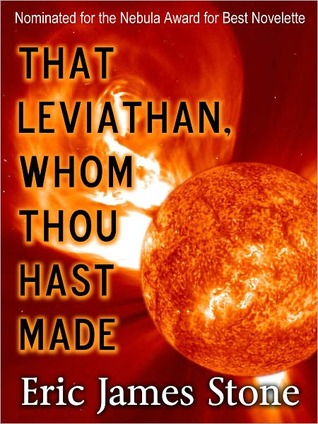
Eric James Stone is a friend of mine, and his novelette “That Leviathan, Whom Thou Hast Made” is my favorite work of his that I’ve read. It’s about an alien race of intelligent beings that live in the sun, and the human colonist who serves as the ecclesiastical leader to a small group of them who have converted to Mormonism. Theological hilarity ensues. It’s a fascinating story, and one of the most well-done treatments of religion in science fiction that I’ve ever read. I can see why it won a Nebula.

That pretty much does it for this month. Take care, and until next time, thanks for reading!

“It was too short.”

This, by far, is the number one criticism I seem to get in my negative book reviews. I never quite know what to think of it. On the one hand, a reader wouldn’t say something like that unless they thought it was good, since if they hated the book completely they would say something like “it was blessedly short” (and yes, I have gotten reviews like that). On the other hand, some of them really get worked up about it, to the point where I doubt they’ll ever read anything I write ever again.

Just to be clear, I’m not opposed to negative reviews, and I’m not responding to any of my reviews in particular. As a matter of principle, I believe that reviews are for readers and not for writers. I don’t generally respond to reader reviews except in very rare cases, and never to tell the reviewer that they’re wrong.

With that out of the way, what does “too short” actually mean? I can’t speak for all readers, but for me, when a book is too short it usually means that something in the story itself felt unsatisfying. In other words, something felt undeveloped, or rushed, or cut short without ever coming to a conclusion (or, in the case of cliffhangers, at least to a natural stopping point). In other words, “too short” isn’t a function of words or of pages, but of the story itself.

I’ve read short books that felt like they fit their length perfectly. A Short Stay in Hell comes immediately to mind. That book is a thin novella, barely more than a hundred pages in print, and yet it comes together so masterfully that I honestly don’t know what else could be added to make it longer. I would love to have more time to explore that particular world, but as it is, the story comes together perfectly within its own length.

That said, there are other books that I felt were too short even though they did fit their own length. That Leviathan Whom Thou Hast Made is an example of an award-winning book–clearly well written, clearly well constructed–that left me unsatisfied because it felt too short. Here, though, it was less a problem with the story itself and more just that I wanted more time to explore the alien culture of the swales. I would love to read a full-length novel set in the same universe, if for nothing else than for the fascinating world-building.

This makes me wonder: are there certain forms of fiction that tend to get more ire from readers just because of the constraints of the form? Do some readers hate novelettes just because they’re novelettes, or serials just because they’re serials? Judging from my own reviews, that seems to be the case. Even if I wrote the best novelette in the world, they would hate it because it’s not a novel.

So what am I supposed to do when readers tell me that my books are too short? Should I set a minimum word count and not publish anything unless it goes over that word count? I really don’t think so, because that sounds a lot like padding. Instead, the only solution that I can see is to focus on telling the best story and to not even worry about the length until it’s finished (and even then, only to know whether to label it a novel or a novella).

In the case of series, sometimes it can be difficult to tell whether to bring a certain thread to a conclusion or to leave it unresolved as part of the overall series arc. Certainly, each individual story needs to have an arc of its own, even if it ends on a cliffhanger. I’m still learning as I go, especially when it comes to writing series. But it’s certainly a lot of fun for me, and I hope it’s fun for you too as a reader.

In short, there’s not much I can do other than keep telling stories as best as I know how, and learn what I can from each story in order to tell better ones in the future. If “too short” means that something was unsatisfying, I’ll do my best to learn from it. But I’m not going to pad my novellas into novels just to hit a certain page count. The story itself should determine its own length.

Worldcon 2011: Wednesday

Just a quick update from Renovation before I crash for the night.

We left Provo pretty early–about 6:30, actually–and met up with Eric in Eagle Mountain.  The drive to Reno was pretty long, but we had some awesome geeky conversations along the way.  My favorite: how to successfully conduct an alien invasion.

So we rolled into town around 4:30, dropped our stuff off at the hotel, and hiked down to the convention center to register and wander around aimlessly until finding people we knew.  At least, that’s what I did, and even though it’s a big con (about 4k to 5k people) it didn’t take long to run into a bunch of writing friends from Utah.  The cool part: they had cornered Moshe Feder and were having a delightful conversation with him.  Awesome guy, Moshe Feder.  Very gracious and fun to talk with.

After that, I went with the gang to Tachyon Press’s panel.  It was pretty good; a little dry, but still interesting.  Kristy is really hoping to land an editing job with one of these companies, so she was more into it than I was, though I did ask a few questions about epublishing.  I asked Moshe too, and my general vibe is that people in the traditional system are still in a “wait and see” mode.

So then we all went to IHOP, which was fun; it was good to catch up a bit, as well as relax and enjoy some good food.  I went back to the con alone and browsed the freebie tables a bit, but there didn’t seem to be too much happening other than parties for the various committees trying to get their city voted for next year’s Worldcon.  However, there seem to be a lot of movies showing in the late evening hours here (something I haven’t seen at a con before), so in the future I’ll have to try that out too.  In any case, it was a pretty relaxing and uneventful evening.

Tomorrow is PACKED, though, and by packed I mean there’s waaay too much stuff going on for me to hit it all.  But out of all those, the one panel that I absolutely WILL attend is “Making It As a Writer” with Dean Wesley Smith, among others.  That one looks fascinating.

Other than that, I don’t have much to say.  The convention is just getting started, so there’s not a whole lot to report…yet.  I’ll keep you posted as the good stuff happens.  In the meantime, sleeeeeep.

Worldcon in T-minus 10, 9, 8…

So I just finished packing for Worldcon, including 4 apples, 1 lb ginger snaps, and enough PBJ material to last the weekend (because fast food is disgusting and expensive).  I’ll be leaving tomorrow at 6:30 am with Cavan to pick up Logan in Orem, then meet up with Eric in Eagle Mountain and head out for Reno, hopefully before 7:30.
This will be my first time at Worldcon, and I’m pretty stoked!  It looks pretty freaking huge–Charlie sent me the PDF of the pocket program, and it had maybe twenty times the number of rooms for panels, workshops…man, it’s going to be hard not to get lost.  Also, I don’t think they’ll be giving away free books like at World Fantasy, though I’ll keep an eye out for whatever I can find!

I don’t have any specific goals, but here is what I would like to do:

  • Meet up with the other Utah writers (there are a lot of us!).
  • Network with other indie writers and book bloggers.
  • Gather as much info on ebooks and the publishing industry as possible.
  • Discover up-and-coming short fiction markets and what they’re looking for.
  • Gauge the general zeitgeist of the science fiction & fantasy community.
  • Throw something at Brandon.
  • Have fun!

That’s just about it.  See you in Reno!

That Leviathan, Whom Thou Hast Made by Eric James Stone

When Harry Malan’s work transferred him to Sol Station deep inside the sun’s core, he didn’t expect to become a Mormon branch president over more than a hundred alien converts to the faith.  The Swales, ancient sun-dwelling beings with their own history and culture, travel the universe by naturally teleporting between stars.

When Harry learns that one of the members of his congregation has been raped, he determines to take it up with the chief Swale.  But at several thousand meters long and more than a hundred millenia old, the chief is revered by the Swales as a god incarnate.  To make matters worse, the only other eligible female on the station is an atheist xenoanthropologist determined to stop Harry from “polluting” the Swale culture.

In an alien society millions of years older than humanity, where gods were dwelling among mortals long before the birth of Jesus Christ, is there a place for those who convert to any of the human faiths?

This story was awesome, and I’m not just saying that because I’m a practicing Mormon.  The story concept was brilliant, the alien world was fascinating, and the issues raised were dealt with in a very balanced way.  This is a must read for any Latter-day Saint science fiction writer–or for aspiring writers of any religious faith, for that matter.  In fact, Eric James Stone has it available right now on his website for free–so check it out!

My only issue was that the story didn’t feel fleshed out enough.  The Swales were so fascinating, I wanted to spend more time with them–I wanted to explore their culture, learn more about their history and evolution, etc.  I also wished there were more detailed descriptions to make me feel like I was there.

I think that has more to do with the shortcomings of the medium than anything else, though.  The piece is an 8,000 word short story / novelette, so there isn’t a whole lot of room to flesh things out.  Still, the world is so fascinating, can you blame me for wanting more?

All things considered, “That Leviathan, Whom Thou has Made” definitely deserves the Nebula Award which it won earlier this year, and I wouldn’t be surprised if it wins a Hugo as well.  It represents a significant milestone in LDS literature, and is an excellent mainstream piece as well.  Whether you’re Mormon, Christian, Muslim, or whatever, if you’re a religiously devout writer of science fiction, this is a must-read.  And even if you’re not, it’s still a great story.  Highly recommended.

LTUE 2011

So LTUE (BYU’s science fiction and fantasy symposium) was last weekend, and it was awesome.

The venue was the BYU Conference Center just north of where DT used to be, and in my opinion this was a much better place to hold it than the student center, where it’s always been.  It felt a lot more professional, and allowed for better interaction.

It felt like there were a lot more people there this year, including two editors: Lisa Mangum from Shadow Mountain, and Stacy Whitman from Tu.  I didn’t try to pitch to either of them, since I don’t think they really publish what I write, but they were on a few interesting panels.  Tracy Hickman, Howard & Sandra Tayler, and Jessica Day George were also very awesome on all the panels they attended.

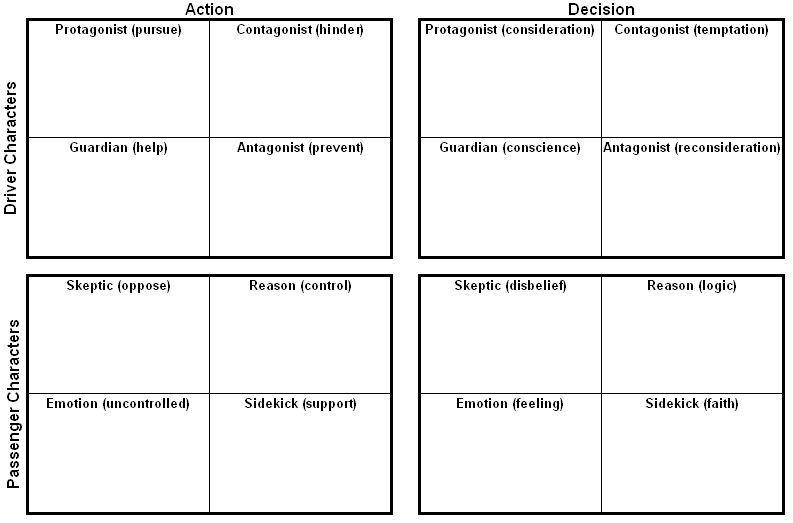
One of my favorite panels was the presentation by Tracy Hickman on Lord of the Rings.  He basically took it apart using Dramatica theory, showing how the series is composed of several distinct subplot, where each character (even the minor ones, like Eowyn) is literally the hero of their own story.

The presentation inspired me to go through some of my own novels and use the basic character archetypes from Dramatica to outline my own novels.  I wrote out the names of all the characters in WAFH and GE on notecards, then on the back wrote down which archetype they fulfilled based on who was the protagonist.

There were several other excellent panels as well.  I got a ton out of the “Can your dreams pay the bills?” one, with Sandra Tayler moderating.  She sure knows her stuff when it comes to the practical business aspects of a creative career.

I dunno; a lot of my writing friends claim to be at a point where panels at cons are less useful for them.  While I can see why they say that, I still find them helpful.  While a lot of the advice is stuff I’ve heard before, every once and a while someone will have a fascinating insight on things.  It’s like stories, I guess; even though there’s nothing new under the sun, everyone has a different way of making it their own, which is ultimately what makes the whole enterprise valuable.

Also, I had an awesome first this year: I signed my first autographed story!  Leading Edge had a booth in the hall, and while I was hanging out there, I mentioned to Eric James Stone how I had a short story published and joked around about signed copies.  To my surprise, he bought the issue and asked for me to sign it!

So yeah, my first signed copy of anything ever goes to Eric–thanks for the support!  Now I’ll see what I can do to make that signature actually worth something someday…

Oh yeah, one more thing: Dan Wells is going to name a character in one of his books after me!  According to Dan, the character (Gabe Vasicek) is “a big guy who wields a minigun.” Hehehe…can’t wait to read it!

Anyhow, LTUE was awesome this year, just as I’d expected.  The panels were enlightening and entertaining, the guests were gracious and easy to talk with, and the overall experience was just a lot of fun.

Just another update

Just another quick update, before I crash.

Went to the Book Academy Conference at UVU today.  It was fun, with several excellent panels by some local authors.  More about that in a later post.

My new mp3 player arrived today: a refurbished iRiver T10.  An ancient, nearly obsolete machine, but it’s got a good quality microphone, which all the other brands lack.  Besides, if it’s anything like my old iRiver ifp-890, it’s built to last.  With 1 GB of storage instead of 128 MB, it’s a step up in the world.

The revision of Mercenary Savior goes well, though it also goes slowly.  Only 1.2k words today, when I was hoping to finish this last chapter.  I’m right between part II and part III, with the twist ending that…well, I won’t give it away.  So far, I’ve managed to add a scene and rearrange several chapters without adding more words than I’ve cut.  That’s good–I need this draft to be tight.

I also dropped the money for plane tickets to World Fantasy 2010.  They came to about $300, which was cheaper than I was expecting.  I’ll be sharing a room in the next hotel over with Eric James Stone for about $50 per night, but there’s room for others if you’re willing to sleep on the floor.  Just let me know.

I think I’m going to experiment with my schedule next week and try waking up early to write instead of staying up late.  Maybe if I get the writing in first thing, it will help things flow later, and I won’t always feel like I’m playing catch up.  We’ll see.

One final thing: I’ll post more about this later, but I have a great idea for a direct sequel to Mercenary Savior kicking around in my head.  It would involve James leading the people of the Colony on an exodus into the heart of the Good Hope Nebula, where they would be completely cut off from the outside world–kind of like the pioneers.  It would also involve letting James grow up and giving him a romantic interest or two, something that I didn’t really do in the first book.

And before you say it, yes, I know the advice is to not waste time writing a sequel to a book you haven’t sold yet.  I think I could make this work, though.  Mercenary Savior, while far from perfect, has a lot of potential–perhaps the most potential of anything I’ve written.  I’d be surprised if I didn’t eventually find a home for it, and when I do, having a sequel already written can only be a good thing.

More on that later, though.  For now, sleeeep.

“That’s what it looks like when the infection sets in.”

So said Howard Tayler at CONduit today when he saw the expression on my face at the Aspiring writers Q&A panel.  We chatted a bit afterward, and he said something very encouraging: that if I continue to pursue my writing career with the same hunger he saw on my face, he believes I will be successful.  Awesome!

This weekend, I attended CONduit 2009 in Salt Lake.  It was my first con experience, and I had a great time!  Besides being just plain fun, it was very educational and inspiring.

I felt a bit unnerved at first to be surrounded by so many people that I barely knew, in a comfort-zone shattering kind of way.  I went up with  Charlie and Laura, though, and it helped to have friends sharing the experience.  By Saturday, we were all getting around very well.  By the end, I figured that I did know a lot of people there–and, surprisingly, that a lot of people recognized me.

I came away with a TON of ideas and things learned!  Here are just a few of them:

  • One of the panelists on Friday suggested this revision method: use search-and-replace to color all filler words (such as “really,” “just,” “very,” “was”; basically, the words I always overuse on this blog).  That way, you can easily see which sentences you need to rewrite.
     
  • Howard and Sandra Tayler mentioned, almost in passing, how they made it a matter of prayer before deciding to go full time on the web comic thing.  I definitely need to include the Lord more as I try to figure out how this writing thing is going to fit into my life.
     
  • In their Saturday panel, Howard made a very interesting remark about cultivating your personal image.  I realized that if I want to be seen as a professional by editors and agents, I need to adjust my wardrobe and appearance accordingly.  I don’t necessarily have to go the suit-and-tie route–Howard’s  image involves jeans and a button-up shirt–but my dress and appearance should say “I am competent, sharp, and serious about what I do.”
     
  • Dan Willis had a very interesting suggestion for writers: get and use business cards.  Networking is one of the most important business activities that aspiring writers can, should, and must engage in, so using business cards at conventions is very important.  It sounds so obvious, but I’d never given it much thought.   I’ll have to get some printed up for myself before I go to World Fantasy and Worldcon later this year. 
     
  • Between panels, I got into a fascinating conversation with Eric James Stone about networking at these conventions.  From that conversation, I learned how important it is to be genuine and personal as you network, to listen more than you talk, and to never see people as mere stepping stones for your career.  He got an anthology contract with Kevin J. Anderson through a con, and he never approached him with that attitude–ever.  Other people he saw who did, Anderson treated politely but never contacted.  You should certainly have a pitch ready, but you should also give time for contacts to develop.  Over time, people will remember your face and recognize you at these events.

conduit2009-jawaConventions are definitely great for networking, but I absolutely hate walking up to a stranger and asking for favors.  It makes me very nervous.  As a result, I’ve adopted the philosophy of asking myself what I can offer the person I’m trying to connect with, rather than asking something of them.  I tried to follow this philosophy at CONduit, even if all I could offer was a compliment on something they’d said on a panel.

Using this strategy, I was able to get into a lot of interesting, genuine conversations with some of the big names at the con.  Charlie, Laura, and I got into a long, interesting conversation with L. E. Modessitt at one point.  He gave me some advice on women, which Charlie found hilarious (he must have seen us bickering/bantering earlier).  Had some good conversations with Dave Wolverton as well–he probably recognized me as the crazy fanboy who had him sign a poster of his first (now out of print) novel.  It was also good to see Brandon and talk with him–I thanked him for his helpful (if harsh) comments on my English 318 final.  Other people like James Dashner and Julie Wright recognized me from LTUE, which was really cool.

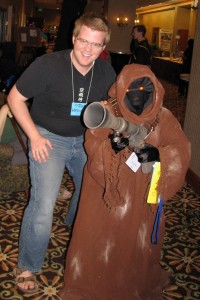
If people in the local scene are starting to recognize my face and my name, I must be doing something right.  That’s very encouraging.  Plus, the convetion was just plain fun. To top it off, the guy in the jawa costume was awesome.  All around, good times.  Very good times.