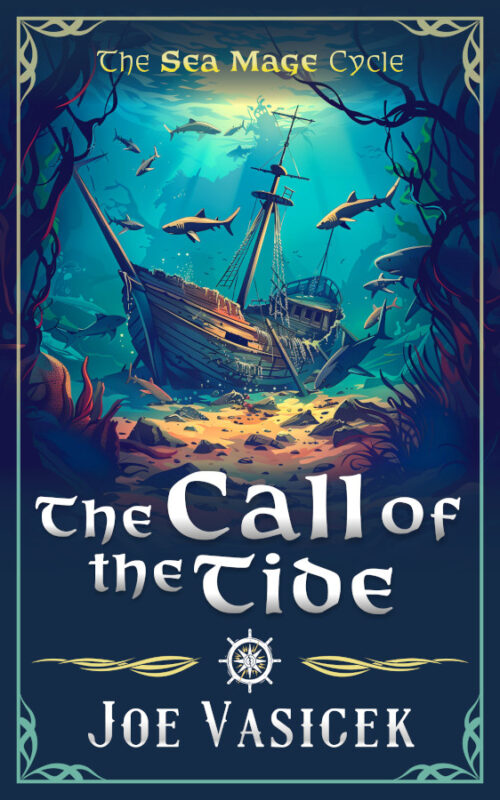
What would you do if the sea itself answered your command? If you could still storms, command ships, and crush your enemies with a single word—would you trust yourself to stop? The Call of the Tide is built around that question: not whether power exists, but whether the human heart can survive holding it.
At its core, this maritime epic fantasy asks a timeless question familiar to readers of artifact-driven fantasy like The Lord of the Rings: Is power something you wield—or something that slowly begins to wield you?
Where the Idea Came From
I’ve always been fascinated by stories where the very thing that makes a hero extraordinary is also what threatens to unmake him. Sea legends, pirate lore, and epic fantasy artifacts all circle the same idea: control over nature feels like freedom, but it can become domination in disguise. I wanted to write a story about a young sea mage offered the ultimate prize—command of wind and wave—and ask a simple “what if”: What if the greatest act of heroism isn’t using power well, but refusing it entirely?
How the Temptation of Power Shapes the Story
From the beginning of The Call of the Tide, power arrives not as brute force but as validation. Samuel has spent his life misunderstood and underestimated. When the Tidecaller’s Amulet offers him mastery over the ocean, it doesn’t just promise strength—it promises identity. It tells him he was meant for more. That subtle appeal is what makes the temptation dangerous.
As the story unfolds across privateer decks, naval commissions, and shadowed cult conspiracies, every major conflict circles back to the same pressure point: Will Samuel use the power available to him to secure victory quickly—or will he accept the slower, harder path of trust, loyalty, and restraint? The amulet can solve problems. It can silence enemies. It can ensure survival. But each time Samuel leans toward it, he risks becoming less himself and more a vessel for something colder and more absolute.
The true battle of the book isn’t fought only on the sea. It’s fought in moments of humiliation, captivity, and fear—when power feels like the only way to regain control. In the climax, Samuel must confront the ultimate realization that victory at any cost is not victory at all. The story becomes not just a tale of sea magic and naval adventure, but a moral test: is it better to rule through force, or to remain human?
What the Temptation of Power Says About Us
Power rarely tempts us with cruelty. It tempts us with relief. It whispers that if we just had more influence, more control, more authority, we could fix what hurts and silence what threatens us. The Call of the Tide explores that universal pull—the desire to stop feeling small, exposed, or powerless—and suggests that the line between protection and domination is thinner than we think. True strength may not lie in mastering the storm, but in mastering ourselves.
For readers who enjoy epic fantasy about moral choices, sea magic, artifact corruption arcs, and character-driven coming-of-age stories, this theme is at the heart of the journey.
Why This Theme Matters to Me
When I wrote The Call of the Tide, I was thinking a lot about what it means to grow into responsibility without losing your soul. Power, whether it’s talent, authority, or influence, always comes with a quiet test attached. I care about stories where ordinary people are offered something extraordinary—and have to decide what kind of person they will become when no one can force their hand. That question still feels real to me, and I hope it feels real to readers too.
Where to Get the Book










Related Posts and Pages
Explore the series index for The Sea Mage Cycle.
Return to the book page for The Call of the Tide.