A Letter To My 2011 Self

Dear Joe,

Well, 2011 has been an eventful year, hasn’t it? It sure didn’t feel like it when you were down in the trenches, but now that it’s over, you’ve got to admit, you sure came a long way.

You’ve discovered a lot of things about yourself since January. In your quest for economic security, you’ve learned that you’d rather work for yourself as a freelancer than be anyone else’s employee. You took the plunge and self-published, something you thought you’d never do (and yes, it’s okay to call it ‘self-published’–the stigma will be dead in another year). You attended your first Wordcon, made a couple of cross-country road trips, worked a ton of crap-jobs just to make ends meet, and now you’re on your way out of the country to try your hand teaching English. It sure seems like a lot, doesn’t it? Just wait. Next year is going to be just as full of changes, though it won’t always seem like it at the time.

I know, I know–cut to the chase and give me some advice already. Well, looking back on what you’re going to go through in 2012, here’s what I have to tell you.

First, don’t stress out so much about the whole self-publishing thing. You’ll figure it out all right. No, I can’t say whether you’re going to hit the turning point before the end of the year. In fact, that’s not even a healthy way to look at it, so stop thinking about it that way. Follow the slow growth model, and don’t angst about sales or price points so much. Keep your butt in that chair, because writing new words is still the most important thing you can do.

Don’t beat up on yourself so much for failing to meet your ridiculously high goals. You’re going to write a novel in the next six weeks, and the rest of the year is going to be a struggle. Right now, you place too much emphasis on your daily word count. Relax a bit, and don’t be too hard on yourself. You’ve still got a lot to learn about your own creative process, so take the time to figure it out.

By the way, you totally rock the beard. Growing it out was a great idea, no matter what your sisters told you back in 2010.

About your upcoming excursion to Georgia, the best advice I can give you is to remember what Spencer told you back in 2008. Adventures are like stories–they each have a beginning, a middle, and an end. You’re going to experience all of that in the next year. No, you probably won’t write another travel journal. Most of your experiences are going to be too personal for that kind of thing anyway. You’re going to accomplish all of your goals, though, so don’t worry–things are going to be just fine.

The most important thing you can do is keep yourself grounded spiritually. I know, I know, that’s always the most important thing. Well, it’s especially true now. Where you’re headed, you’re not only going to be the only Mormon, but the first Mormon to live there. Sundays are going to be a struggle. Everyone is going to think you’re crazy because you don’t drink. You’re going to make wine, though, and that’s going to be an interesting story for your friends back in Utah. Just be sure to keep doing the things you know you should be doing, and everything will turn out all right.

You’re going to love teaching English. Oh, you won’t love everything about it, but it’s something you’re naturally good at, so don’t worry about that. Just try to listen to your Georgian co-teachers and be more considerate of them. And don’t worry about the language. You’ll pick it up pretty quick. Just realize that Georgian verbs are impossible to conjugate unless you’re a native speaker.

I could tell you what your biggest mistake is going to be, but I think it’ll be better if you go ahead and make it. Just be sure to hope for the best, even as you plan for the worst. Follow the path of least regret, and you’ll make some really awesome memories–not to mention some truly amazing friendships.

At this point, I’d tell you you’re on the right path, but that isn’t exactly true. There is no ‘right’ or ‘wrong’ path for you right now, but you’re on a good one, so keep it up and see it through to the end. You’ll be glad you did.

Take care!

Joe
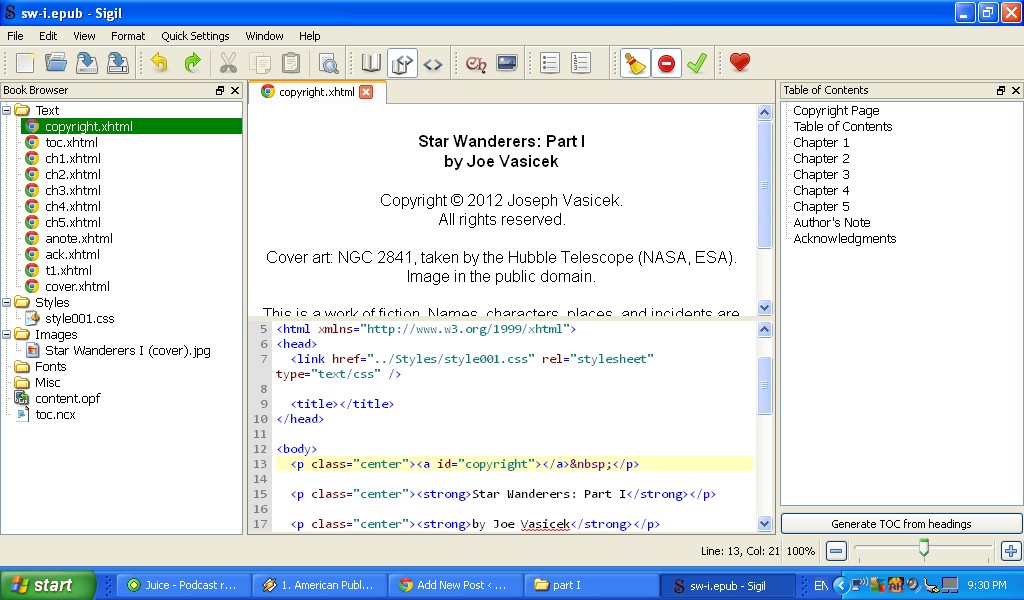
Adventures in ebook formatting

Under the hood of my latest ebook release, Star Wanderers: Part I.

So a couple of days ago, I set out on a quest to figure out a better way to build an ebook.  In the process, I ended up learning WAY more about ebooks than I’d bargained for, in the most awesome of possible ways.  Seriously, I don’t think I’ve ever felt so empowered as an indie author as I do right now.

My old process was extremely convoluted.  It basically involved saving my manuscript as HTML (introducing all kinds of excess code) and using four or five programs to cobble together a Frankenstein-like creation, with bolts sticking out of its forehead and extra arms and fingers sticking out of weird places.  The tools I was using were like blunt instruments, and I was operating them blindfolded.

So what changed?  Well, three things:

  1. I added the Writer2ePub plugin for Open Office / Libre Office,
  2. I downloaded an open-source epub editor called Sigil, and
  3. I watched this video:

So what did I learn?

<geek>

First of all, that ebooks are WAY simpler than I thought they were.  An epub is basically a zipped folder containing HTML files for the text, jpgs/gifs for the cover and any interior illustrations, a CSS stylesheet, maybe some extra fonts (if you want to get fancy), and two additional additional files ending in .opf and .ncx that look a lot like HTML files.

So why is this so exciting?  Because it means that if you know HTML/CSS, you can build a fully functional epub file using only notepad, windows explorer, and the command prompt.  THAT’S IT!  And if you want to learn HTML, you can do so for free at w3schools.com.

Basically, an epub is structured just like a website, except that an ebook reader reads it instead of an internet browser.  If you can build a website, you can build an epub with very little trouble.  Even if you can only tweak a website, you can build an epub with very little trouble.

</geek>

In other words, the barriers to entry for ebook publishing are ridiculously low.  If you’re patient and a good learner (or hell, just a good learner), there is not a single reason why you need to spend any money to format your ebooks, upload them directly to retailers, or do anything else.  Using tools that are 100% available for free, you can create a product that looks every bit as professional as anything coming out of New York–in many cases, even more professional.

So what’s my new process?

1) Format the master file in Open Office.

This includes adding the copyright page and table of contents, adding anchors (in OO they’re called “bookmarks”) and hyperlinks, adding the author’s note and acknowledgments, any teasers, etc.  I save the file in open document format, add “Smashwords Edition” on the copyright page and save it as a .doc file for Smashwords.

At some point, I’m going to upgrade to Libre Office, but I haven’t gotten around to it yet.  When I do, it’ll basically be the same thing.

2) Export as .epub using the Writer2ePub plugin.

I cannot tell you how happy I am with this Open Office / Libre Office plugin.  It pulls out all of the unnecessary formatting and breaks up every chapter into a separate, cleanly coded HTML file, all bundled together into a fairly simple epub.  SO MUCH BETTER THAN SAVING AS HTML.  Or Mark Coker’s “nuclear option,” for that matter.

I don’t add the cover at this point, though.  Writer2ePub adds some weird stuff if you do it that way, and I find it easier just to code it manually in the next step.

3) Finalize the .epub in Sigil.

Sigil is basically just an HTML editor with some extra functionality that allows it to build an epub from those HTML files.  It’s easy to learn, simple to use, and tells you exactly what’s wrong when something breaks.  Unlike Calibre and Mobipocket Creator, you can always see what’s going on underneath the hood.  Simple, clean, and elegant.  I love it.

This is the phase that takes the most work.  I add the cover, fill in the relevant metadata, tweak the CSS stylesheet for margins and indents, add the book guides, build the table of contents, etc.  If you want to know exactly how I do this, let me know and I’ll write up a post on it later.  It’s a little technical, but not too difficult.  Like I said, if you know even a modicum of HTML, you can figure it out.

Once this step is finished, I have the final epub version of my book.  I upload that to Pubit! and Kobo Writing Life, and just about anywhere else outside of Amazon where I sell my book.  Someday soon, Smashwords will hopefully allow you to directly upload an epub, at which point I’ll do that here as well.

4) Convert to .mobi with KindleGen.

Amazon uses its own proprietary format for ebooks, unlike everywhere else, which takes the open source epub format.  This is probably because of all the weird and funky stuff that Amazon likes to track for data collection purposes, although honestly, who knows?  A mobi file is about twice as large as an epub, and I suspect that that’s the reason.

KindleGen is a free program that Amazon has made available to developers in order to facilitate conversion of epubs and other ebook formats into mobi.  It’s a command line tool, which means that you have to get a little retro to use it.  But hey, I grew up in the 90s with DOS, so it’s actually kind of nostalgic.

Once you’ve got KindleGen installed to c:\kindlegen, all you basically need to do is go to the file folder where your ebook is saved and enter the following command:

c:\kindlegen\kindlegen mybook.epub -c1 -verbose

“mybook.epub” is whatever you named your epub file, “-c1” stands for standard DOC compression, and “-verbose” stands for verbose output (whatever that means).  There are other options you can enter, but I’m not sure what they do yet.  All I know is that if you want to convert from epub to mobi, this will give you a clean result.

There are a few small things that get lost in the conversion, so you need to add them as redundancies in the epub.  The biggest one I’ve noticed so far is the paragraph indents: if you go into the CSS stylesheet using Sigil and add p { … text-indent: 2em; … } that should fix it.

And that’s it!  Once this step is finished, I’ve got the final mobi version and can upload that directly to Amazon and my kindle.  Once that’s done, my book is available from every major ebook retailer in every country in the world.  Total time = maybe an hour (plus however long it takes for the retailers to publish the files to their stores).

I know it’s 2012 and this is old news by now, but do you have any idea how cool this is?  With one hour of work and two or three programs, all of which are available for free, I can produce a clean, professionally formatted ebook, and sell it around the world instantaneously with a marginal cost of zero.

And now, because I took the time to learn how to use the tools, I can be confident that there aren’t any bits of rogue or useless code in it either.  The only “black box” is really the mobi format, but I could probably crack that and figure it out if I wanted to.

So yeah, needless to say, I am extremely happy to be an indie writer. 🙂

If you’re thinking of self publishing, read this. All of it.

I just read a fascinating Q&A on Reddit with Hugh Howey, author of the self-published phenomenon Wool.  After six trancelike hours reading through all the comments, all I can say is “wow.”

Okay, I guess I can say a little more.  Yesterday, I listened to Brandon Sanderson’s lecture on self-publishing from his English 318 class this year.  While I agree with much of what he says, a lot of it is already out of date.  Probably the biggest thing is whether it’s still advantageous for indies to go with a traditional publisher after making a name for themselves.  In 2011, Amanda Hocking had some good reasons for going traditional.  In 2012, Hugh Howey has some very good reasons not to.

The other big thing, though, is this idea of author platform–that to be a successful indie, you have to find some way to drive large numbers of people to your books.  Well, not necessarily.  Hugh Howey was a nobody for three years, and the title that finally pushed him over the tipping point was the one he promoted the least.  To me, that shows:

  1. current sales are not a predictor of future sales, and
  2. a great book will grow into its audience independent of its author.

Granted, there may be a threshold that needs to be crossed before word-of-mouth really starts to kick in, but if a nobody with passable cover art and no author platform can cross it, that threshold isn’t very high–and that’s good news for all of us.

The way I see it, there are three big myths that writers struggle with in making the shift from traditional to indie publishing:

1) The flood of crap books will keep you from getting noticed

This grows out of the paradigm of limited shelf space–that the best way to get noticed is to have your book occupy more space relative to all the other books on the shelf.  This might be true in the brick and mortar world, but the rules are much different in the digital realm.

Think about it: how many new blogs are launched every single day?  Thousands, if not hundreds of thousands.  And yet people still find the good content amid the sea of crap.  On Youtube, an average of one hour of video content is uploaded every single second.  And yet there are still entertainers making a lot of money through their Youtube channels.

The rules in the digital realm are completely different from everything in the physical world.  Figuring that out requires a huge paradigm shift, one that even indie writers struggle with.

2) Publishing a book is an event that must be promoted

This grows out of the paradigm of velocity, or as Kris Rusch puts it, the “produce model” of publishing:

Every month publishing comes out with brand new product. Shelf space is limited in every single brick-and-mortar bookstore.  Big Publishing makes the bulk of its money during the first few months of a book’s existence.  So if a book sits on a bookstore’s shelf until the book sells and that sale takes six months to a  year, the bookstore and the publisher lose money.

Better to dump the old inventory on a monthly basis—for full credit for unsold items—than it is to have the inventory sit on the shelves and grow “stale.”

Of course, the flaw in this logic is that digital shelf space is unlimited, therefore books do not “spoil.” No matter how much time passes, an ebook can still be found in the same place.

Therefore, does it really make sense to make a big deal over an indie book release?  Maybe to jump start some word-of-mouth, but it’s not like your career is going to be harmed if you do nothing.  In fact, it might be better to hold off until you have a few more titles up, so that when you give the first one that push, readers will have something else to read once they’ve finished it.

3) To succeed you need to find a way to “break in”

This grows out of the gatekeeper paradigm, where the system is closed and the few entry points are guarded by a select group of taste makers whose job is to bestow legitimacy on those who meet the qualifications to get in.  It’s the concept of patronage, where success comes from being chosen by a wealthy benefactor, and it’s connected with the idea that you haven’t truly “arrived” until <fill in the blank>.

The flaw with this paradigm, of course, is that publishing is no longer a closed system.  The gates haven’t just been flung open, the walls themselves have been torn down.  The job of the taste makers is no longer to protect readers from the dross, but to lead them to the gems–which is honestly much closer to what it should have been in the first place.

So what does this mean for creators?  It means that there’s no longer a system to break into.  You don’t need to write better than everyone else, you just need to find (and keep) your 1,000 true fans.  Success isn’t bestowed upon you by some higher authority, it’s something that you discover on your own as you hone your craft and build your business.

Honestly, this is one that I still have a lot of trouble with.  When I left to teach English in Georgia, in the back of my mind I had this vague notion that I was going into a self-imposed exile, and wouldn’t come back or settle down until I’d “broken in.” Of course, this made me quite discouraged, because it felt like things were out of my control–or worse, that I’d somehow failed.

But listening to Brandon’s lecture and reading Howey’s Q&A session helped me to remember that it’s all still in my control.  I don’t need a benefactor, I just need a good plan, if that makes any sense.  So right now, I’m thinking things through and making the necessary revisions to that plan.  There probably won’t be any big ones–I still think I’m more or less on the right track–but it will be good to update my paradigm.

By the way, the title of this post applies to the Q&A with Hugh Howey, not to the post itself.  Though if you are thinking of self publishing, I hope it’s helped out in some way.

Also, I just finished part I of Wool, and it deserves every bit of praise that it’s got.  Expect to see a review of the omnibus shortly.

A few interesting things

In between teaching English and putting in my daily word count (between 1k and 2k most recently), I’ve come across some interesting things worth sharing.  If you’re a fellow writer, I’m sure you’ll appreciate this stuff, but even if you’re just a reader, it’s worth checking out.

First, there’s an excellent article at The Nation on the rise of Amazon and how it took the publishing world by storm.  The author isn’t very pro-Amazon, but he paints a much more reasonable and far-seeing picture than anything I’ve seen from the Amazon-bashers.  If you’re interested in indie publishing at all, it’s a must-read.

The way I see it, Amazon has fundamentally changed the paradigm by cutting out the middle-man, facilitating a direct connection between readers and writers.  Everyone who sees them as some kind of harbinger of the apocalypse is so focused on their particular niche that they fail to see all the positive ways in which the system is being remade.

For example, ebooks never go out of print–never.  Isn’t that awesome?  And yet some people turn around and claim that Amazon is on some kind of crusade to destroy books and literature.  Wha??  Yes, they’re probably cannibalizing mass-market paperback sales, and perhaps even hardcover sales as well, but they’re also opening all sorts of new literary possibilities, the likes of which we haven’t seen since the days of Gutenberg.

Well, so much for that.  The next item is a lot less controversial: it’s a round-table discussion from Adventures in Sci-Fi Publishing in which several writers discuss productivity and various aspects of their writing process.  If you’re a writer, this is definitely worth checking out–it’s probably the most comprehensive discussion on the subject that I’ve heard in a while.

Some of my takeaways: the best way to unblock yourself and get the writing flowing again is to take a walk.  When I listened to the podcast, I was actually taking a walk for that very purpose–and it worked!  Also, if you have the time but the writing isn’t flowing, it’s better sometimes to do something else rather than force it.  If you do try to force it, chances are that you’ll just get a bunch of crap.  For some writers, that’s just part of priming the pump, but for me, I’ve got to take the time to fill the well.

Third, I just listened to a fascinating interview on the Sword & Laser podcast with Todd McAffrey.  I’d tell you what it’s about, but really, they went off on so many fantastic tangents, it’s really more interesting just for that.  The practicalities of space exploration, human-host bacteria and emergent AI, the secrets of the human brain and the potential for long term collective consciousness–reminds me of an uber-nerdy conversation I had at the con-suite for World Fantasy 2010.  Man, those were good times.

To be honest, I took issue with many of McAffrey’s comments.  When it comes to science and engineering, he’s extremely intelligent, but when it comes to bio-ethics, the sociological implications of his ideas, and a general awareness of the proverbial 99% of humanity that still lives on less than $10 USD per day, I think he’s a little too short-sighted.  But if you put us in a room together, the argument would be so fascinating it would definitely be worth listening to.

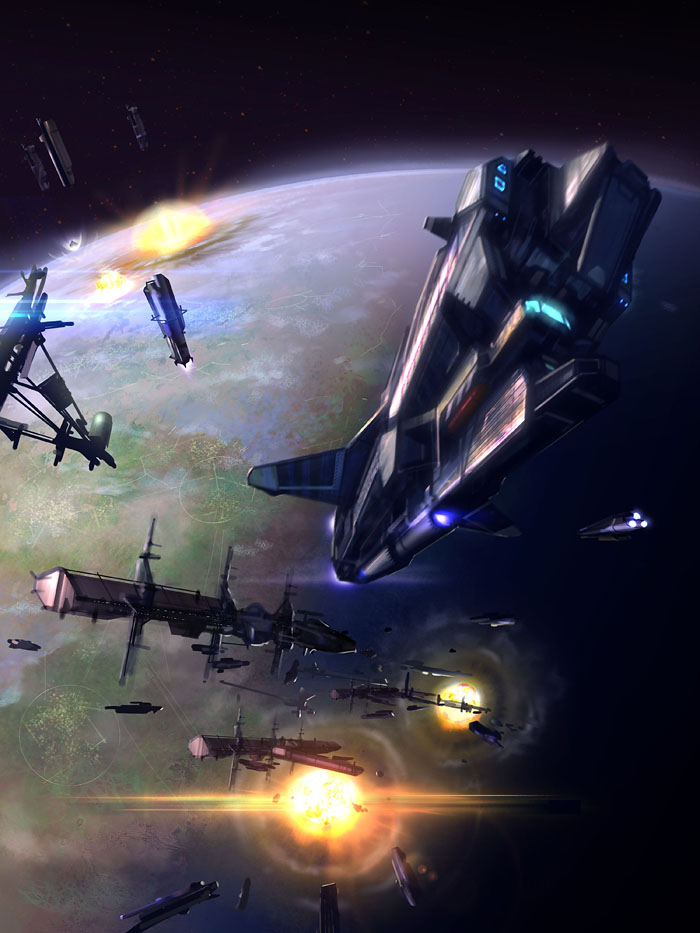
Finally, I just got the new cover art from Hideyoshi for Bringing Stella Home, and it is seriously kick-ass.  Check it out!

Now that is what I call Science Fiction!  Expect to see the updated ebook with the new cover in the next couple of weeks.

Journey to Jordan is now up on Amazon and Barnes & Noble!

That’s right–my travel journals from the 2008 study abroad to Jordan are now up on Amazon, Barnes & Noble, and almost everywhere else!  Here’s a complete list:

Kindle | Kindle UK | Kindle DE | Kindle FR | Kindle ES | Kindle IT | Nook | Smashwords | Kobo | Diesel | Xinxii | Sony | iTunes

Kobo, Xinxii, and Sony should be coming in the next couple of weeks.

I initially set the price for the illustrated version at $4.95, but the transaction fees are a lot less than I thought they would be, so I’ve decided to drop it down to $2.99 with the unillustrated version.  The changes should be reflected on Amazon and Barnes & Noble in a few hours.

I had an amazing, life-changing experience in Jordan, and after coming home, I had big dreams of turning my travel journals into a book.  Because of ebooks and indie publishing, that dream is now a reality.  From the description:

In 2008, Brigham Young University partnered with the University of Jordan to organize a summer study abroad program for its Arabic students. Scattered across West Amman in home-stays coordinated with Amideast, these students spent the summer living, studying, playing, and adventuring in the Middle East.

This is the travel journal of one of those students, and gives a detailed and intensely personal account of his time there. Besides the cultural experience of living with a Palestinian family in an Arab country, it tells the story of a critical juncture in his life, and how traveling across the Middle East helped to shape his personal growth, his spirituality, and his love for a people far from his American home.

Kind of cheesy, but yeah. 🙂 I hope you like it–please share it if you do!

I’m about to embark on another adventure, so this probably won’t be the last travel journal I do.  Who knows–maybe a year or two from now, I’ll be doing a book like this on my experiences in Georgia.  Or better yet, I’ll make it back to the Middle East and do a before-and-after.  Whatever I do, I’ll be sure to keep you guys updated frequently–so definitely stay in touch!

plot vs. PLOT and an interesting serial publishing idea

Back in English 318 at BYU, Brandon Sanderson used to tell us that there was a big difference between “little-p plot” and “big-p Plot.” The first applies mostly to chapters and scenes, which he said he could teach us.  The second refers to the overall story structure, which he couldn’t teach in a classroom setting and said we’d have to discover on our own.

I’ve been thinking a lot about this recently, because it seems that my books are starting to fall into a recognizable pattern–and that pattern has some interesting potential for serials and other alternate forms of publication.  Each book is divided into 3-4 parts, each part is divided into 3-6 chapters (typically 5), and each chapter is divided into 3-5 scenes.  Here’s how it works:

Chapter 1: Setup for the basic story arc.  Introduction of the characters and setting, the prominent theme or premise, and a little foreshadowing of the coming conflict.
Chapter 2: The inciting incident, a discovery or event that starts the plot rolling and puts the characters in motion and conflict.
Chapter 3: Complications arise, the problem gets worse, the first attempt at a solution fails, generally leaving the characters at a loss.
Chapter 4: Setup for the resolution.  The characters discover or build something that will help them to settle the conflict.  They stop reacting and start to be more assertive.
Chapter 5: The resolution.  The characters either succeed or fail, but the arc comes to a close either way.  The story question is answered, the thematic elements come full circle, and the story either closes or moves on to the next part.

Basically, it’s the 3-act format divided into five chapters.  When I wrote Heart of the Nebula, all four parts fell into this pattern, and now that I’m writing Star Wanderers, I’m finding myself  falling into the exact same pattern again.  Stars of Blood and Glory is a little bit different; there are three parts instead of four, and each part is divided into six chapters instead of five.  But still, it’s all very structured.

In short, Brandon was right.  It took me a few books to really learn “big-p Plot,” but now that I’ve found a story structure that works for me, it’s starting to come quite naturally.

The cool thing about this particular structure is that it’s very conducive to serialization.  Each chapter is between maybe 3,000 to 5,000 words, so each complete sub-arc is between about 15,000 to 25,000.  That’s the length of a short novella, and it takes me only a month or two to write (sometimes three, depending on how much revision it needs).

The only reason I haven’t done more with serialization up to this point is because I’ve found that sharing my work while it’s still unfinished tends to throw a wrench in my creative process.  The idea of publishing a work in progress on a chapter-by-chapter basis scares me, because if one of the story arcs has a flawed beginning, I wouldn’t be able to fix it.

However, by following a five-chapter arc format (with bits and pieces here and there to hint at a larger overarching structure), I can see myself publishing a novel or epic in a serial format.  It would be something like the Perry Rhodan series, which follows an arc structure of 25 to 100 issues (each a small novella) per cycle.

So here’s how I’m thinking of doing it:

  1. Publish the first installment and price it at free while writing the second one.
  2. Publish the second installment and price it at free, raise the price of the first installment to $.99 and write the third one.
  3. Publish the third installment and price it at free, raise the price of the second installment to $.99 and write the fourth one.
  4. Publish the fourth installment for $.99, drop the price of the first installment to free and publish the completed novel for $2.99.

So what do you think?  Does it seem like a good way to publish a book?  It gives the reader a reason to keep coming back, and rewards those who got in early by charging them less for the completed work.  By selling the novel in shorter chunks, I would be able to put more work out and hopefully gain more visibility, especially by making a portion of it free at any given time.

I’m seriously thinking about publishing Star Wanderers this way, once I hear back from Writers of the Future.  I’ve already finished the rough draft for the second part; it probably needs a good revision or two before it’s ready, but since it’s shorter, it shouldn’t take more than a few weeks to get feedback from some first readers and finish the next draft.  And if the third part is already finished by then…

So many awesome possibilities! 🙂 What do you think?

Desert Stars is now published!

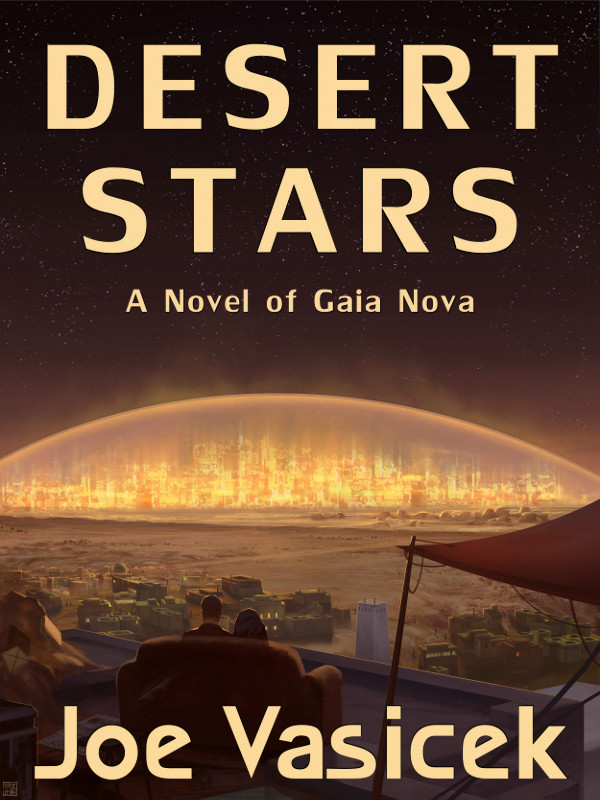
Desert Stars, my third novel (and second in the Gaia Nova series), is now available as an independently published ebook from Amazon, Barnes & Noble, and Smashwords.  Within the next couple of weeks, it’ll be available through Kobo, iTunes, Diesel, Sony, and Xinxii as well.

It’s been a long journey, and I’m thrilled to finally see it come through.  I started the first draft back in the fall of 2008, but had been working on ideas for the world since 2005, when I returned from my LDS church mission in California.  Spending the summer of 2008 in Jordan was a major catalyst for my imagination, and I soon was bursting with ideas for a far-future story on a desert world.

I got stuck in the winter of 2009, however–right before taking Brandon Sanderson’s English 318 class.  Since he encourages all of his students to work on something new, I decided to write a book in the same universe in order to work through some of the world-building things that were holding me up.  That book became Bringing Stella Home, which was a thrill to write all of its own.

The strategy worked; by the time I’d finished that one, I had a much clearer idea where to go with Desert Stars, and an awesome ending that was nothing like anything I’d planned in the first draft.  And so, after graduating in April 2010, I soldiered through and finished the rough draft that summer.

It still had a lot of problems, though.  Fortunately, my first readers were extremely helpful both in pointing those out and in giving me fantastic ideas for other things I could do.  In the second draft that winter, I completely scrapped a major subplot in the second half of the book and focused on perfecting the character arcs for the two main characters: Jalil and Mira.

Around this time, I made the paradigm shift from traditional to indie publishing.  Other projects like Genesis Earth and Bringing Stella Home took my attention for a while, as I learned the basics of the new world and prepared those books for publication.  However, I always kept coming back to Desert Stars: I knew I had a good story there, and I was just itching to bring it to its full potential.

In the fall of 2011, I finally had that opportunity.  The last draft flew by in three weeks, and was one of the funnest writing experiences I’ve had since I started writing seriously in 2007.  By the end, I knew it was ready.  I sent it out to my editor, Josh Leavitt, and started to prepare it for publication.

In writing any book, there are always moments that stand out; experiences where things come together in an unexpected yet memorable way.  One of those came to me in Jordan, while I was walking down Queen Rania street from the University of Jordan to Al-Dustour, and the phrase “Temple of a Thousand Suns” flashed into my mind and sparked the whole novel.  Another of those moments happened while I was driving from Salt Lake to Provo, and Mira’s final words in the last chapter came to me; I literally could not stop screaming for two or three minutes.

I could share more, but if I did, I’d find it difficult to maintain the illusion that I’m not a loony psychopath. 🙂

In any case, it’s just awesome to see the story come to maturity and embark out into the world.  I’m sure this isn’t the end of the journey, but it’s definitely entering a new and exciting phase.  I sincerely believe that this is my best book yet, and I hope you find it as worthwhile to read as I have found it worthwhile to write.  If you do, I would appreciate it greatly if you took the time to post a review, or share it with a friend.  Every little bit helps, and I’m grateful for whatever support you can give!

In the next couple of days, I’m going to send out a newsletter with some freebies including desktop backgrounds of the cover art.  If you’d like to get in on that, be sure to sign up for the email newsletter via the form on the sidebar; you’ll also receive notices for other giveaways, as well as new releases.  It costs nothing and you can always unsubscribe, so there’s no pressure or obligation.

And that just about wraps it up.  Now: on to the next book!

Why I won’t be signing up for KDP Select

In the last couple of weeks, there’s been a lot of discussion about Amazon’s new Lending Library program.  Just a few days ago, Amazon opened it up to indie writers with the KDP Select program.  By signing up, writers gain access to Amazon Prime members (US only), where readers can borrow the book for free and Amazon still reimburses the writer.

The catch?  Two, actually: writers agree to make their books exclusive to Amazon for 90 days, and payment for all KDP Select authors comes out of a monthly “fixed pot” of $500,000, where every writer gets a cut according to what percentage of the Lending Library downloads were for their books.

Reactions from the indie community have been mixed.  Within only a few hours, several thousand enthusiastic writers had signed up (the current number of participants is ~50k), but many others remain cautious and aloof.

The full range of reactions can be seen in the Kindle Boards thread.  Guido Henkel does a good job pointing out how the numbers don’t add up, while David Gaughran offers a compelling analysis that likewise dampers enthusiasm for the program.  On the Smashwords blog, Mark Coker pleads with writers to keep their options open, while at Writer Beware, A.C. Crispin points out some disturbing language in the terms & conditions that essentially amounts to a non-compete clause.

I’m sure that many others will weigh in on KDP Select in the coming days, and I look forward to reading their analysis, but I’ve already decided that I won’t be signing up with the program.  Even if no one else signs up, with 50k writer splitting a $50,000 pot, the average monthly paymentis only going to be $10.  Unless you’re one of the lucky bestsellers, you’ll probably make even less than that.

But the real reason I’m not signing up is because I don’t feel that it serves my readers.  If I put any of my titles through KDP Select, I’d be giving Amazon a 90 day exclusive, which means that my readers would be forced to either buy through Amazon or wait three months to buy my books.  I don’t feel that that’s fair to my readers, especially in territories where Amazon levies a $2 surcharge.

At this point in my career, my goal is to build up a dedicated fan base that looks forward to each new release.  To do that, I want to make my books available in as many places as possible.  Even if I’m not selling all that well right now at Barnes & Noble or the smaller retailers, it’s not worth it to cut those readers off and tell them to go to Amazon or wait.

However, the KDP Select program does foreshadow the next big phase of the ebook revolution, and that is the move to subscription services.  I expect that in the mid- to near-future, we’re going to see a lot of ebook lending models arise, kind of like Netflix for books.  The big question in my mind is how the writers are going to be compensated.

Like David, I have a lot of concerns with KDP Select’s “fixed pot” model.  Besides the lack of any guaranteed or minimum rate of compensation and the general opaqueness of the system, it fundamentally pits writers against each other in a zero-sum game, where one writer’s gain is another one’s loss.  To me, this represents a giant step backward.

When a reader finds something they like, they’re more likely to try out another book just like it.  This is how readers have historically found new writers, and it fosters a sense of community, where writers work together to reach out to new readers and expand the scope of the genre.  The “fixed pot” model disincentives all this and replaces it with a Machiavellian system that, at its worst, works against the natural advantages of the medium and undermines the genre community.

For all these reasons, I won’t be signing up for Amazon’s KDP Select.  The exclusivity hurts writers and readers, the numbers just don’t add up, and the “fixed pot” model represents a fundamental shift in bookselling that I cannot support.

How to make an ebook

Since I plan on publishing a number of books this next year, I decided to write down the step-by-step instructions for how I make my ebooks.

There’s 50 steps altogether and the process can get a little complicated, but if you follow the instructions it should all be very straightforward.  It takes me about two hours now to run through all the steps, and when I’m finished I have a .mobi file for Amazon, an .epub file for Barnes & Noble, a .doc file for Smashwords, and a couple .jpg files for cover art and thumbnails.

The best part is that all the programs are free, so once you know what you’re doing, it costs nothing but a couple hours of your time to actually make the ebook files.  Other than maybe another hour (if that) to upload the files to Amazon, B&N, and Smashwords, that’s all it takes to publish.

Since publishing isn’t a zero-sum business and all of us benefit when writers have options, I’m making this short manual available as a free PDF.  It may or may not work for you the way it works for me, but if it helps you to climb the steep learning curve that all of us face when we first start out, then I’ve done my job.

Vasicek epublication manual

Also, if any of you are more knowledgeable about formatting than I am, please let me know if you have any suggestions.  I’m always looking out for ways to make my books better, so none of this is set in stone (or print, for that matter 🙂 ).

Why I’m not submitting to the 2012 Amazon Breakthrough Novel Award contest

Last year, I submitted Genesis Earth to the Amazon Breakthrough Novel Award contest and made it to the quarter-finals.  I’m pretty sure I could do at least that well this year, but after reading the contest rules, I’ve decided not to participate.

Why? Because of this:

5. GRANT OF RIGHTS. By submitting an Entry and if you are selected as a Quarter-Finalist or Semi-Finalist, you grant Penguin the exclusive first publication rights to your Entry. If you are selected as a Quarter Finalist, Penguin’s exclusive first publication rights to your Entry terminate when you are eliminated from the Contest (unless you are selected as a Semi-Finalist); and if you are selected as a Semi-Finalist, Penguin’s exclusive first publishing Rights to your Entry terminate after June 30, 2012.

But mostly because of this:

A. Grand Prize. If you are selected as the Winner in a category, you will receive one of two Grand Prizes each consisting of a full publishing contract with Penguin to market and distribute your Manuscript as a published book…you may not negotiate the publishing contract with Penguin, and you must sign it “as is” upon receipt of the executable contract.

The language is a little unclear as to whether the grand prize winner can elect to turn down the publishing contract, but considering how merely submitting to the contest constitutes a grant of publication rights, I’m guessing no.

So why is this a big deal?  Because it gives the writer no room to negotiate.  Suppose the boilerplate contract is unfavorable when it comes to rights reversion, non-compete clauses, or derivative works.  Penguin could conceivably retain the rights to my book indefinitely, even if I’m earning less than $10 a year on it.  With a non-compete clause, they could forbid me from writing or publishing any other books.  Even worse, they could conceivably buy up rights to the world or the characters, making it impossible for me to write any other books in my own series without their approval.

But even if none of those unfavorable terms are in the contract, the standard royalty for erights is 25% of net, not gross.  For those of you who know the difference between net and gross, that’s a red flag in itself, but even supposing Penguin does pay me the full 25% of the 70% it receives from Amazon, that comes to only 17.5% of the cover price.  Right now I’m getting 70%.  Is it really worth it?

I checked the sales rankings for the last three years of ABNA winners, and they aren’t all that great.  The ebook versions for the 2010 winners have a slightly better ranking than mine, but they can’t be selling more than a couple of books a day.  At the prohibitively high price of $9.99, that’s $.30 less per unit than what I’m earning for Genesis Earth at $2.99.  And the 2009 winners?  Their sales rankings are abysmal.  Whatever Penguin did to market those books, it either didn’t work or they’ve given up and moved on to other things.

Now, I don’t expect to win the grand prize even if I submit to this contest.  Most of the previous winning novels are either literary, mystery, or mainstream YA–no science fiction.  Even so, by submitting to this contest, I would not be able to negotiate a publication contract with any other publisher until my book is eliminated.  That’s a headache I could do without.  And as for the consolation prizes, if this year’s Publisher’s Weekly reviewer is anything like last year’s, I already know what she’ll say: “science fiction is garbage.”

So yeah, I won’t be submitting to this year’s ABNA contest.  If I win, I’m forced to sign a contract that I haven’t seen and have no power to change, and if I lose, I get an unnecessary hassle for all my time and effort.  Thanks but no thanks.