The Nominees

The Squares of the City by John Brunner

The Moon Is a Harsh Mistress by Robert A. Heinlein

Dune by Frank Herbert
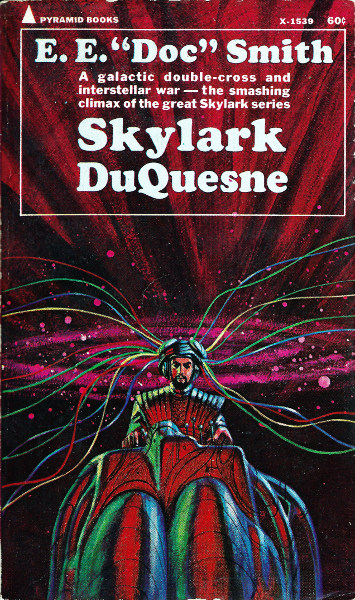
Skylark DuQuesne by Edward E. Smith

This Immortal by Roger Zelazny
The Actual Results
- Dune by Frank Herbert and This Immortal by Roger Zelazny (tie)
- Skylark DuQuesne by Edward E. Smith
- The Moon Is a Harsh Mistress by Robert A. Heinlein
- The Squares of the City by John Brunner
How I Would Have Voted
- Dune by Frank Herbert
Explanation
Dune is the most perfect science fiction novel I have ever read. I wouldn’t call it the best—in fact, I would say that Hyperion and Ender’s Game are marginally better—but it is the most perfect, in terms of genre conventions, tropes and archetypes, story structure, etc. It is a magnificent book, but it’s also the kind of book you need to read three or four (or five or six) times to fully appreciate.
My first reading of Dune was when I was still in high school. I almost didn’t get through it, just because the writing was so dense. But I was intrigued by Paul’s prescience and his struggle to avoid the timeline where the jihad happens, so I read it all the way through to the end. But most of the book went over my head.
My second reading was sometime in college. I don’t remember when, exactly—it might have been around the time I read 2001: A Space Odyssey, or when I first discovered Asimov’s Foundation novels. It may have been a year or two after that, when I’d decided to pursue writing as a career and felt like I needed to steep myself more in the science fiction genre. Either way, I enjoyed it much more that time, though still, most of the subtle nuances of the story still went over my head.
I read Dune the third time shortly after I got married, when my wife and I used to read in bed together (this was before we had a crib in our bedroom, which has been the natural state of affairs for most of our marriage now). This time, I finally got all of the stuff that I’d missed, like the politics of the great houses and the galactic empire, the impact of the Butlerian Jihad, the economics of the spice and the importance of the Spacing Guild, and the ecology of Arrakis and how it played into the story. It was amazing. World building on the level of Tolkien, or perhaps even higher. Truly incredible stuff.
Since then, I’ve tried to read most of the other Frank Herbert Dune books, but I gave up midway through Heretics of Dune. Dune Messiah was a really great wrap-up to the story of Dune, though it didn’t feel nearly as epic as the first book. Children of Dune was a fun read, and almost as good as the first one. God Emperor of Dune was a more of a slog, though the ending was fantastic. By this point of the series, I was starting to feel again like everything was going over my head, so that’s probably why it was so difficult.
I do plan to read all of these books eventually, though. And I may even give the Brian Herbert / Kevin J. Anderson books a try, though I’ve heard they’re not nearly as good as the original Frank Herbert books. The next time I attempt the series, I will probably look for some YouTube content to help explain it without giving away too many spoilers. Or maybe I’ll use AI as a reading companion (which would be a super ironic way to use AI, hehe).
So if the 1966 Hugos were held again today, I would definitely vote Dune as the top book. But to be frankly honest, I don’t think I could vote for any of the others, even though some of them are classics in their own right.
Heinlein’s The Moon Is a Harsh Mistress is the other big classic from this year, but I’ve just never been able to get through it. I’ve tried twice, but each time I’ve set it down in disgust, mostly because of all the weird sexual conventions in the future that Heinlein has constructed. There are some things that I really love Heinlein for, and other things about his writing that I simply cannot stand, and I have learned from experience to avoid any of his books where his views on sex are a major part of the story. But maybe I’ll try the audiobook sometime.
I should probably try to reread This Immortal, too. For some reason, the only Zelazny books I have ever managed to read are the Chronicles of Amber books, and I am currently taking a break midway between books 8 and 9 (or is it 7 and 8?) The first half of that series, following Corwin, were fantastic. Really great stuff. The second half, following Merlin, has been… not as great. I’m still enjoying it, but I constantly feel like I’m lost. But back to This Immortal… to be honest, I don’t remember why I DNFed it, but I think it came down to a combination of feeling lost and not really caring about the characters. But I should definitely pick it up and try it again (though it’s becoming a hard book to find).
I tried to read the Skylark series from the beginning, but it was super, super campy and I got bored with it. I can appreciate that it was a formative work during the pulp era of science fiction, and that many of the fans in the generation that started Worldcon and the Hugo Awards were first exposed to science fiction when they read those books as children. The equivalent for me would be the original Star Wars trilogy, and all the classic old Star Wars books by Kevin J. Anderson, Dave Wolverton, and Timothy Zahn. But unless you’re writing a dissertation on the history of science fiction, the Skylark books probably aren’t essential reading.
The Squares of the City is a surprisingly difficult book to find. It’s not at my local library, the library network’s audiobook app, or the BYU Library—which is unusual, because the BYU Library has one of the best science fiction collections in the country (they have all 300 or so of the Hugo nominated books in their collection, except maybe half a dozen). I think the paperback is currently selling for something like $200 on Amazon. But the ebook is available, and relatively cheap, though to be honest I only downloaded the sample. And after reading the first two chapters, that was enough for me to decide to DNF.
There’s nothing terrible about the book, but it just isn’t all that good. It’s about a European (or maybe American?) tourist visiting a fictional South American dictatorship, which is on the verge of a communist revolution. The thing that’s supposed to make the book unique is that Brunner played a game of chess while writing the book, and all of the major plot points are tied to specific chess moves from that game. In that way, it’s a little like Philip K. Dick’s The Man in the High Castle, where he used some kind of Chinese divination system to come up with the actual plot.
But we don’t remember The Man in the High Castle for the plot, and apprently, we don’t remember The Squares of the City for anything. My guess is that Brunner got nominated because of his politics, which made him a favorite among the Futurians and all the others in the fandom that were trying to turn science fiction into a vehicle for world communism. So basically, the spiritual predecessors of today’s blue-haired crazies who have completely taken over the Hugo and Nebula awards.