Navigating Woke SF, Part 1: Short Story Markets and Author Blacklists

Last year, I had a short story published in the anthology Again, Hazardous Imaginings: More Politically Incorrect Science Fiction. Not only was it one of my highest paying short story sales to date, but it also made it onto the Tangent Online 2020 Recommended Reading List with a *** rating, their highest tier. Only 13 out of 293 stories on the list received that honor—and making the list at all was an accomplishment!

But a funny thing happened after the anthology came out: for a stretch of several months, I stopped receiving personalized rejections for my short story submissions, and instead got only form rejections. Normally when I write a cover letter for a short story submission, I mention the last three markets that I was published in. For example: “My stories have recently appeared in Again, Hazardous Imaginings; Twilight Tales LTUE Benefit Anthology, and Bards and Sages Quarterly (forthcoming).” In a typical month, I’ll get maybe a dozen or so form rejections and a couple of personalized rejections, depending on how many stories I have out on submission.

Back in March, I started to notice that I wasn’t getting any personalized rejections. Suspecting that my publication credit in Again, Hazardous Imaginings wasn’t helping me, I decided to change things up and only list my publication credits for stories listed in Locus Magazine’s Year In Review issue. My thinking was that all of the Hugo and Nebula eligible markets give their yearly reports in that issue, and since all of the editors want to acquire stories that are likely to win awards, a publication credit in one of those markets is more likely to get them to pay attention.

Lo and behold, I started getting personalized rejections again.
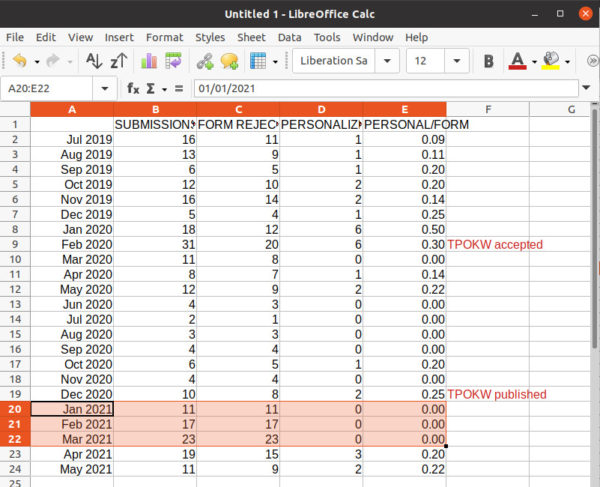
Just to make sure I wasn’t imagining things, I exported my data from The Submission Grinder and made a quick table of my submissions returned for each month going back to July 2019. Before “The Promise of King Washington” was accepted in February 2020, I was getting roughly one personalized rejection for every 5-8 form rejections. Then, for most of 2020, I went through a dry spell where I didn’t have many stories out on submission. Towards the end of the year, I got back in the saddle, and my personalized-to-form rejections ratio returned to what it had been earlier… but then Again, Hazardous Imaginings was published in December, and for the next three months, I received no personalized rejections at all. Then, around March-April, I stopped mentioning my publication credit in Again, Hazardous Imaginings… and I started getting personalized rejections again.

So what happened? Is there some sort of unofficial blacklist for stories published in Again, Hazardous Imaginings? Maybe, maybe not. I don’t know if any of the other authors in the anthology have had a similar experience, nor do I know for certain that mentioning the anthology in my publication credits caused this particular issue. It could be that I was submitting to higher paying markets at the beginning of 2021, and those markets just happen to be more stingy about personalized rejections. It could be that the pandemic has just sapped everyone’s energy.

But now that I’ve made this table, the one thing I cannot say is that the whole thing is just a figment of my imagination. There was a three-month period where I saw significantly fewer personalized rejections than usual, and it just so happened to coincide with the publication of the anthology Again, Hazardous Imaginings and my mentioning it as a publication credit in all of my cover letters.

It’s no big secret that most of the traditional short story markets in science fiction and fantasy trend somewhere between liberal and super woke. All you have to do to get a sense for this is subscribe to their podcasts or read their stories online. For most of 2020, I was subscribed to every science fiction podcast, and I frequently ended up skipping episodes because either the story was too woke, the author bio was little more than a checklist of intersectional victimhood groups, or the editor went off on some sort of political rant (typically of the “orange man bad” variety) that had little or nothing to do with the story. You can also get a good sense of the woke-ness by looking up these magazines’ submission guidelines and reading their diversity statements.

So for the last couple of months, I haven’t been listing Again, Hazardous Imaginings as a publication credit in any of my cover letters, and the response to my stories appears to have returned to the old normal… but it doesn’t sit right with me. Why should I have to hide that I was published in that anthology? Why shouldn’t I be proud of it? It did make Tangent Online’s recommended reading list with three stars, after all. Why should I waste my time submitting my stories to science fiction and fantasy markets that would see that publication credit as a black mark?

In other words, why not blacklist the blacklisters?

When an author decides not to submit their stories to a particular market, it’s often called a “self-rejection,” since the author has already decided that the story won’t be published before the editor gets a chance to consider it. But this is a little different. It’s not my own story that I’m rejecting, but the market as a whole. It’s making the conscious decision that if a magazine is too woke, I’m not going to have anything to do with it.

Here’s another way to think about it: why should I hold out for a year or longer, hoping to earn a couple of hundred bucks for it, when most of the markets that pay that well either aren’t interested in publishing the kind of politically incorrect stories that I tend to write, or aren’t going to publish an author like me who isn’t demonstrably woke enough? Even if I only end up selling it to a semi-pro market for less than fifty bucks, if it only takes a few months to make the sale because I’m not wasting time with the woke markets, does that make it worthwhile?

Or here’s yet another way to think about it: what other benefits do I get with my short story sales, besides how well it pays? If short stories are essentially advertisements for my other work, does it actually make sense to seek publication in the super woke markets, whose readers are mostly woke? Or does it make more sense to be published in the more conservative-leaning markets, with readers who are more likely to enjoy the other stuff that I write? And what about networking with similar-minded authors and editors? I made some really great connections through the anthology Again, Hazardous Imaginings, and even brought Andrew Fox, the editor, onto my newsletter for an interview. It was great!

All of this is happening as we’re starting to see an anti-woke cultural backlash gain momentum. Smarter people than me with a finger on the pulse of the culture say that the Snyder Cut is where the tide began to turn. The thing that tipped me off to it was the surprising waythat Coca-Cola walked back their critical race theory training after the “woke-a-cola” scandal. To my knowledge, there was no organized boycott, yet for a large corporation to backpedal so quickly tells me that they really took a hit to their bottom line.

In the coming months, I think we’re going to see a huge cultural shift against the woke moral panic that has gripped our nation for the last couple of years. That in itself is a subject for another post, but what it means for SF&F is that a lot of these woke awards and woke short story markets are well on their way to going broke. The few that endure will become niche markets for a very small audience that has completely divorced itself from the cultural mainstream—including the vast majority of SF&F readers.

Is it really worth hitching my wagon to such a horse? Or is it better to take a gamble on the up-and-coming markets that might not pay as much, but also aren’t carrying all the woke political baggage as magazines like Uncanny or Lightspeed?

Of course, if the answer to all of these questions is “yes, Joe—go for it!” the next big question is how to determine if a market is too woke? Because some of the markets have diversity statements that are fairly conservative-friendly, like “we welcome submissions from writers of all backgrounds!” and don’t use any of the woke value-signalling terms like “folx,” “latinx,” “QUILTBAG,” “indigenous,” “black bodies,” etc. In fact, I’m pretty sure that many of these markets only put out diversity statements to pacify the woke moral crusaders, in the same way that many boarded up stores and restaurants put up BLM signs hoping that the rioters sorry, the “peaceful protesters” would spare them.

One way to determine this is to look at which markets are chasing the wokest awards. The Hugos went woke in 2015, when “no award” swept the categories dominated by Sad Puppies nominees. That was really the moment when the fandom split, and the anti-woke readership abandoned the Hugos in disgust. The Rabid Puppies swept the 2016 nominations in what amounted to a hilarious sabotage operation (“Pounded in the Butt by Chuck Tingle’s Hugo,” hehe), but by 2017 that had all come to an end.

With that in mind, I went through all of the Hugo Awards to see which markets had either won an award or published a story that had won an award since 2015, and which markets had either been nominated or published stories that have been nominated since 2017. Here is what I found:

Hugo Winning Markets since 2015

  • Uncanny (5)
  • Lightspeed (1)

Markets with Hugo Winning Stories since 2015

  • Tor.com (5)
  • Apex (3)
  • Clarkesworld (2)
  • Lightspeed (1)
  • Uncanny (1)

Hugo Nominated Markets since 2017

  • Strange Horizons (5)
  • Beneath Ceaseless Skies (5)
  • Escape Pod (3)
  • Fireside (3)
  • FIYAH (3)
  • The Book Smugglers (2)
  • GigaNotoSaurus (1)
  • Cirsova (1)
  • Shimmer (1)
  • Podcastle (1)
  • Uncanny (1)

Markets with Hugo Nominated Stories since 2017

  • Tor.com (37)
  • Uncanny (18)
  • Clarkesworld (5)
  • Beneath Ceaseless Skies (3)
  • Fireside (2)
  • Lightspeed (2)
  • Asimov’s (1)
  • Strange Horizons (1)
  • Nightmare Magazine (1)
  • Diabolical Plots (1)

The counts for nominated markets/stories do not include the winners, but do include all of the nominations for 2021, even though the winners have not yet been decided.

I haven’t yet settled on a standard for deciding which markets are too woke for me to submit to. I suppose that’s something I’ll have to decide on a case-by-case basis, and for any who choose to follow my lead on this, it will have to be an individual decision. But I am rethinking the way I submit and publish my short stories, based on this experience. This post has already gone too long, and I still haven’t worked my new strategy out, but if you have any suggestions or ideas I’m interested to hear them.

Speaking Out Again

Hello there.

It’s been a very long time since I posted on this blog. I wonder if anyone is still following it. About a year ago, I pivoted from the blog to my newsletter, and while that’s going well, this blog has been mostly neglected.

And it would have continued that way, if not for recent events. I’m talking, of course, about the peaceful protests race riots Marxist insurrection domestic color revolution whatever the hell is happening in the United States right now. But the thing that really pushed me to action was Kris Rusch’s latest business post: Speaking Out.

Until that post, Kris was one of the people I admired most in the publishing industry. I’ve followed her business blog since 2010, and she was one of the most influential people in convincing me to take the plunge and self-publish. It’s been one of the best decisions of my life, not just from a career perspective, but from a personal perspective as well.

In her latest post, however, I feel that Kris went over the cliff with the rest of our fractured country. Here are the parts that got to me:

The letter [Jeff Bezos] posted on his Instagram page from some racist named “Dave” (last name redacted) told Bezos he would lose customers if he continued supporting Black Lives Matter. The letter is breathtaking in its racism…

…the people who bother me the most are the folks who, for economic or political reasons, can ignore the racism and hatred that spews daily from the White House…

I draw the line at hatred, racism, and bigotry in all its forms. I can’t respect a bigot. I don’t want to be near a racist…

If this post makes you feel the urge to write me a screed or tell me that I should tolerate the bigots for the sake of unity, please do me a favor and just leave.

What is a “racist”? What is a “bigot”? To the left-wing ideologues who control the cultural narrative right now, it’s anyone who dares to oppose their radical agenda. The mayor of Minneapolis is “racist” because he won’t abolish the police, in the midst of the most violent and destructive riots that city has ever seen. White people who refuse to literally kneel before people of color and denounce their white privilege in communist-style struggle sessions are now considered “bigots.” Anyone who dares to utter any sort of criticism or counter-argument to the narrative of Black Lives Matter is fired, canceled, humiliated, doxxed, and destroyed.

Does Kris not see this? When you are so ideologically possessed that a “bigot” is anyone who refuses to (literally) kowtow to your ideology, a tolerant and diverse society becomes impossible? When speech is violence and violence is speech, violence will be used to silence speech. Those who are kind to the cruel inevitably become cruel to the kind.

I tried to post a comment on her blog, explaining that some of these “bigots” who have unfollowed her or withdrawn their Patreon support aren’t doing it because they want to “silence” her, but because they feel she doesn’t recognize that they have legitimate reasons for disagreeing with her, and aren’t the bigots she thinks they are. Yes, Kris, it’s important to speak out, but it’s also important to listen.

What happened next was all too predictable. On a blog post about the importance of speaking up, Kris silenced me. The only comments that she has allowed are the ones that fawn over her and tell her she’s right. Typical.

I can endure a lot of bullshit, but two things I absolutely cannot abide: gaslighting and hypocrisy. So ultimately, it was this episode with Kris, a person I used to admire and respect, that spurred me into action.

This blog is going to become a lot more active in the coming weeks and months. The newsletter will still be my main vehicle for reaching out to readers and cultivating fans, but the blog will be a place to share my more controversial thoughts and opinions. That said, I intend to be very deliberate and conscientious about what I post here, and avoid shitposting, spewing outrage, or going off on political rants.

My working assumption is that the chaos engulfing our country will continue to escalate through the 20’s, and that things will get much, much worse before they get better. We may see an American holocaust. We may see American gulags. We are already experiencing the digital ghettoization of libertarian and conservative voices—or, more accurately, voices that refuse to conform to the cultural and ideological narrative of the progressive left.

That said, I am still optimistic about the future. I believe that after the chaos and violence plays itself out, we will return to the core values that make us Americans. The Republic will survive. Liberty will prevail. Enough of us will refuse to go over the cliff with everyone else that we will, when all of this is over, restore our country.

When that happens, the only people with any moral authority will be the ones who refused to bend the knee—the ones who had the courage to speak out at the risk of losing their careers, their livelihoods, and in some cases even their lives. People like Jordan Peterson, Tim Pool, Dave Rubin, Carl “Sargon of Akkad” Benjamin, and others who stand in the face of cancel culture to call out the lies—the gaslighting and hypocrisy—and serve the truth.

This is my mission statement for my writing career:

To serve the truth and empower my readers to be better people for reading my books.

I cannot remain silent and accomplish this mission. The forces that push us to bend the knee are the ones that compel us to speak out, because we must speak out if we refuse to go over the cliff with the rest of humanity.

I recognize that this is essentially the same argument that Kris was making. And on this point, I think she’s right. Where she goes off is in calling anyone a bigot who falls outside of her narrow echo chamber. I despise echo chambers and don’t intend to fall into any of them.

So I’m going to set some rules.

First, I’m going to assume that anyone who engages with this content is a reasonable person who has come in good faith, no matter their views. No matter how vociferously you disagree with me, I will always strive to see the best in you, and to be generous with the benefit of the doubt.

Second, I’m going to assume that most of my fans and readers are going to disagree, on some level, with the more controversial things that I post here. Some of them will agree and voice support, but others will roll their eyes and click away. I’m not going to fall into the trap of thinking that all good people see the world the way that I do, because that way lies madness.

Third, and most importantly, I’m going to bet that if I keep the first two assumptions on the forefront of my mind with everything that I post here, my readers and fans will stay with me even when I share an opinion with which they vociferously disagree. In today’s hyper-partisan atmosphere, that’s a very dangerous assumption to make, but I don’t think my readers are the kind of people who would jump off the cliff with the rest of humanity.

I think there’s still a majority in this country who see the insanity for what it is, but don’t know what to do about it. That’s the person I’m writing this blog for: the one who’s wondering if they’re the only sane one in a world gone mad. Until just a couple of years ago, that was who I was. But now, I believe that even with all the craziness right now, there are a lot more people like us than we realize.

So yeah, the blog is back, and it’s going to get spicy. I may lose a few readers because of it, though hopefully not too many as I keep to the three rules that I listed above.

And if you have any thoughts or reactions, I’m interested to hear from you! Like I said at the start of this post, I have no idea if anyone still follows this blog, but I guess we’ll find out soon enough. The newsletter will remain my main focus, but I’ll post to this blog as often as the spirit moves me, which may be sporadic but won’t be never. And I’ll try to keep it as timely and interesting as I can.

2019-10-10 Newsletter Author’s Note

This author’s note originally appeared in the October 10th edition of my author newsletter. To subscribe to my newsletter, click here.

I saw Joker yesterday. Don’t worry, I won’t give away any spoilers. It was every bit as incredible as I expected it to be, and yet in some key ways, not what I was expecting at all.

First, the basics. This movie is dark. Very, very dark. I believe this is the darkest, most terrifying iteration of the Joker ever made. Part of that is because it is so realistic. There are no magical superpowers, no aliens or infinity stones or any of that stuff. This story could have already happened in our world. It could yet happen.

That said, it is clear that the people who made it have deep respect and appreciation for the franchise. It isn’t like The Last Jedi, where the filmakers explicitly tried to subvert all of the things the fans love about Star Wars. In many ways, Joker is a homage to all of the iterations of Batman that have come before it. This could just as well be the origin story of Cesar Romero’s Joker as Heath Ledger’s.

Joaquin Phoenix is incredible. I didn’t think it was possible to do a better Joker than Heath Ledger, but Phoenix has done it. He really draws you into the Joker’s head, and his transformation from a broken misfit to a sociopathic supervillian is believable, compelling, and utterly terrifying. He earned every moment of the eight-minute standing ovation this movie received on its debut.

There is a dramatic arc to violence that very few movies, TV shows, or even books show in its entirety. When a character swings an axe at someone’s head, the scene usually cuts. You know what happened. But in Joker, you see everything. It’s a lot like Blade Runner in that respect. The bodycount is not that high, but the violence really hits you, and stays with you.

If you aren’t in touch with your dark side, this movie will profoundly disturb you. It will also screw with your mind. If you struggle with PTSD, this is probably one to avoid, unfortunately. Even if you think you like dark movies, this one may be too much for you. But if you do enjoy it, you will probably want to see it again, and again. There are so many layers to this movie that a single viewing is not enough to fully take it all in.

Without question, Joker is a major cultural landmark. It is, above all else, a brutally clear and damning indictment of all of us. In a world convinced that guns cause violence, Joker focuses on mental health and the cracks in our healthcare system. In a world obsessed with priviledge and inequality, Joker is about our pathological lack of empathy and compassion.

Part of the controversy surrounding this movie is the gulf between the critics who hate this movie, and the general audience, which loves it. After watching it, I think the critics can be divided into three camps.

First, there are the social elites who are so out of touch with the reality that the rest of us live in that Joker is anathema to their lived experience. It’s not that they hate it, so much as that they’re confused and bewildered by it. They are also bewildered by Brexit and the election of Donald Trump.

Second, there are the wokescolds who hate Joker because they recognize it as an indictment of themselves. They deride it as an “incel movie” because they know that their woke politics are partly responsible for creating a culture where “incels” are a thing, and that drives these people to violence.

I actually think that this isn’t the case for most of the critics. Sargon of Akkad recently put out a video on this, and while I agree with him that the wokescold critics see Joker as a mirror, I don’t think they see themselves as the people who drive the Joker into psychopathic madness. Instead, I think that the vast majority of the wokescold critics see themselves in the Joker.

In Milo Yiannopoulos’s interview with Jordan Peterson, he made the very salient point that the angriest, most radical people on the far left are, in their personal lives, broken and in pain. Often, they are victims of abuse. Personally, I would expand that to include many on the alt-right as well, but the point still stands.

The wokescolds want to see themselves as heroes working to overcome systems of oppression and inequality. They see themselves as builders, but Joker shows them that all they really want is to burn it all down. That’s why I believe this movie has provoked such a virulent backlash from the wokescolds: because it is a mirror that shows them as they really are, and they are terrified of what they see in it.

Without love, it is impossible for our culture and society to heal. That, I believe, is Joker’s ultimate message. The reason that Arthur becomes the Joker is because no one ever showed him any compassion, empathy, or love. He laughed through the pain until the pain made him laugh, and became the villain that Gotham deserved.

How often do we really listen to each other? How often do we reach outside of ourselves and genuinely connect? A recent study shows that the average American hasn’t made a single new friend in the last five years. Is that you? Is that your neighbor? The family across the street, or the guy who lives down the hall?

It doesn’t take much to reach out. Sometimes, all it takes is a smile—but isn’t that the joke? Somewhere, I hear maniacal laughter…

Addicted to Outrage by Glenn Beck

I wasn’t always a fan of Glenn Beck. When I was in college back in the 00s, I thought he was a pompous blowhard—and I was probably right. We’ve both changed a lot since then. I started listening to his radio show podcast in 2017 at the urging of a friend, and to my utter shock I found him to be both reasonable and insightful. I’ve been listening ever since.

If you’re a regular listener to Glenn’s show, most of what you’ll find in this book is stuff you’ve already heard. That said, on the show you pick it up in bits and pieces, whereas here it’s all laid out in one place, without any filler or extraneous back and forth. Having done both, I would rather read this book and listen to his show only occasionally than listen to his show religiously and skip this book.

The thing I like most about Glenn is that he’s one of the few political pundits who have checked their pride in recent years. In Addicted to Outrage, he gives his story: how he went from being one of the most prominent and virulent right-wing commentators to acknowledging that he’s been wrong about some things and completely changing his approach. He lost a few of his old-time fans who preferred the screaming, ranting Beck, but gained an ability to understand and speak the language of those on the other side of the political divide.

The main thesis of this book is that outrage, especially social media outrage, has become an addiction very much like alcoholism, and that the steps for recovering for alcoholism apply equally as well for healing our modern outrage culture. Glenn brings up a lot of interesting points about how the outrage in our culture is increasing, how social media is designed specifically to foster a chemical addiction through repeated dopamine hits, and how it feeds into all of our worst impulses and does serious damage to our health, our relationships, and our ability to live together.

The most interesting part for me was where he talked about how our outrage culture and the news cycle is distracting us from the truly important stuff that’s going on right now, such as the development of AI, the rise of big tech monopolies, technological disruption and the looming unemployment crisis, and geopolitical challenges that threaten to drive our world into war. Again, this is all stuff that Glenn covers regularly in his radio show, but it’s useful to have it all in one place.

My biggest criticism of Glenn is that his obsession with all of the ways that things can go catastrophically wrong turns him into something of a doom pornographer at times. He generally keeps it classy, but classy doom porn is still doom porn. I don’t think we’re anywhere near a hostile artificial general intelligence sweeping the world with nanobots and turning us all into grey goo, for example. That said, his prediction track record is surprisingly good, so even with the doom and gloom it’s still worth listening to him. At least he doesn’t (usually) cross the line into fear mongering.

Glenn’s love of the Constitution definitely shines through this book. He spends a great deal of it going through the Declaration of Independence and the Bill of Rights, which I found to be insightful. In one of the more interesting chapters he talks about how we should neither whitewash our history nor condemn it, but acknowledge both the bad and the good and strive to live up to the aspirational deals set forth in our founding documents.

All in all, it was a good and insightful read. If you’ve never listened to Glenn, this book is actually a really good place to start.

Extra Sci-Fi S3E3: The Two Towers

This episode of Extra Sci-Fi got me to thinking about a speech that Orson Scott Card gave when he visited BYU back in 2007. He said a bunch of interesting things that have stuck with me over the years, including (to paraphrase) “conservatism is the new counterculture.” He was probably ten to fifteen years before his time on that one. But the thing that struck me the hardest was this:

Fiction is the culture talking to itself.

This goes along with what I talked about in my commentary on the last Extra Sci-Fi episode: that every generation reinvents the world. How do they reinvent it? Through story. And because there’s a necessary give-and-take as part of the process, the bestselling fiction that a culture produces is a reflection of that culture’s values, the issues of the day, and the zeitgeist as it changes and evolves over time.

We can see this in the themes discussed in this video. While Tolkien denied that Lord of the Rings was allegorical in any way, I agree with the folks at Extra Credits that the world wars and the rise of fascism almost certainly influenced his depiction of good and evil. It’s probably also true that the conflict between industry and nature influenced the book too. This isn’t because Tolkien set out to tell a story about these things; rather, because Tolkien himself was a product of the culture of his day, that culture shines through in his works.

This makes me wonder about the stories that don’t become bestsellers. Are there lots of amazing, well-written stories out there that don’t succeed simply because they’re out of step with the ongoing cultural conversation? Kind of like Orson Scott Card’s argument, back in 2007, that “conservatism is the new counterculture.” He made that argument a decade before we reached peak social justice, and got pushed more or less into cultural irrelevance because of it.

Card might not be the best example, because of his role as a culture warrior as well as his fiction writing career. With his Ornery American column, he was basically a shitposter before shitposting was a thing. But I wonder: what are the stories that aren’t getting traction only because they don’t really speak to the culture?

Or is it even possible to write a story that doesn’t speak to your own culture? Since you are a product of the culture that you live in, does that mean that your stories will be a product of that culture too? That certainly seems to be the case with Tolkien. Hindsight is 2020, though, and it’s really tricky to account for unknown unknowns.

I don’t know. I guess the big takeaway is that if you want to be a sucessful writer, you should do everything you can to immerse yourself in your own culture, not only because that’s the best way to improve your storytelling instincts, but because all of the most successful stories contribute something meaningful to the culture’s ongoing conversation with itself.