T minus 24 hours and counting…

That’s right!  After much wrangling, I formatted it this morning and published it to Amazon this afternoon.  In less than 24h hours, it should be up for sale!

In many ways, Bringing Stella Home is a lot different from Genesis Earth.  For one, the scope is much larger, with the rise and fall of galactic empires and a war leaving billions dead in its wake.

At the same time, however, the stakes are very personal.  It’s not about turning the tide of human history or saving millions of lives; it’s about one boy who doesn’t want his world to fall apart, and will do anything to save the people he loves.

I put a content warning in the description because there’s a lot of darkness in this book.  It’s not for everyone; I know that some of my friends would find it shocking and offensive.  However, it isn’t my intention to glorify evil or celebrate immorality; rather, by portraying it honestly, I hope to make the struggle against it that much more meaningful.  There is, after all, an opposition in all things.

Writing this book was a watershed moment for me.  Not only is it the first book in a series which I hope to continue across many books, but it marked a shift in my writing.  Before the rise of indie publishing, I thought this would be the one that finally broke through the iron gates of the publishing industry and made my debut.  Perhaps that was why I was so reluctant to send it out; I didn’t want to experience the crushing blow of rejections from agents who didn’t think they could sell it, or editors who think that science fiction is dead.

But now, I don’t have to break through those iron gates; now, I can send this story out into the world and let the readers decide whether it’s any good.  And that’s exactly what I intend to do.

For all those of you who have helped bring this project up to this point, I want to sincerely thank you by giving you a free copy of this ebook.  I’ll be sending it out tomorrow, most likely; if for some reason I miss you, please email me and I’ll correct the mistake.  They say that writing is a solitary art, but this day and age, that’s no longer true.  So once again, thank you.

It’s been an exciting journey thus far, and something tells me that it’s only getting started.  I can hardly wait to see what the future will bring!

Wow, this is fun

I spent almost the whole day Saturday with family, but when I finally got around to working on Sholpan, I breezed through almost 10k words in only a couple hours.  Granted, it was mostly light revision and the material was fairly well polished to begin with, but still…it was just fun.

The best part of writing this novella has been rediscovering Stella’s story from Bringing Stella Home.  At first, I was a little worried that it might be a bit too shocking (and for some of my friends, it probably is), but there’s a lot of depth to the story, and the content, while definitely mature, is never gratuitous.

The story is basically about an innocent, sexually inexperienced young woman who struggles to keep her virtue and self-respect intact within the harem of the brutal space barbarians who have enslaved her.  While she starts from a position of almost total powerlessness, she finds ways to leverage herself without completely compromising her values.

I haven’t figure out the blurb yet, but that’s a pretty accurate description of the story.  It’s basically all of the scenes in Bringing Stella Home from Stella’s viewpoint, up through the first and second acts of the book.  In the third act, everything comes to a head, and…well, I won’t ruin it for you. 😉

I’ll probably finish Sholpan sometime later today.  My copy editor for Bringing Stella Home should be sending back the manuscript with his edits tonight, and I’ll spend the rest of the week going through and getting it ready for publication.  By Monday, it should be up!

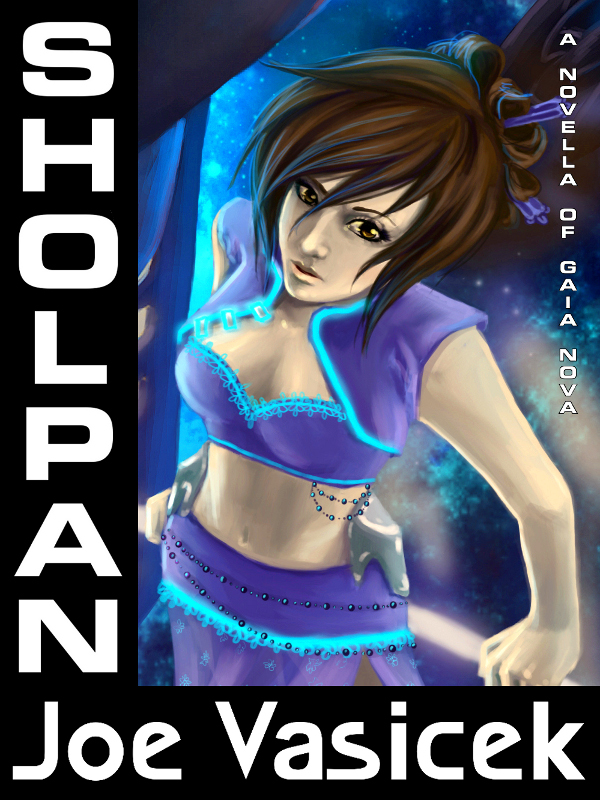
In the meantime, check this out: I was playing with the cover art yesterday afternoon, and came up with a cover for Sholpan.  What do you think?

The thumbnail:

…and the full sized image:

Man, this is so much fun!

Sholpan, or The Great Novella Experiment

So now that I’m finished with Desert Stars, the next project I’m working on is a companion novella to Bringing Stella Home titled Sholpan.  While Bringing Stella Home is about James and his quest to rescue his brother and sister, Sholpan is entirely from Stella’s point of view and traces her rise in Hameji society, from prisoner and slave to…well, I won’t ruin it for you.

I started writing it on Monday, and so far it’s been a lot of fun.  In some ways, it’s kind of a break for me, since I already know the story (most of the material is lifted straight from Bringing Stella Home, with a few extra changes to make the viewpoint tighter and build more character development).

At the same time, though, it’s a challenge because I’ve never written in the novella format before.  The definition as given by SFWA, has mostly to do with length:

For the purposes of the Nebula Awards, the categories are defined as follows:

  • Novel — 40,000 words or more
  • Novella — 17,500–39,999 words
  • Novelette — 7,500–17,499 words
  • Short Story — 7,499 words or fewer

However, I can’t help but feel that there are many other artistic elements to consider.  For example, the Oxford Dictionary of Literary Terms gives this definition:

novella [nŏ‐vel‐ă], a fictional tale in prose, intermediate in length and complexity between a short story and a novel, and usually concentrating on a single event or chain of events, with a surprising turning point.

Other sites I’ve browsed (including this post from The Galaxy Express, this review from 2009 of several small press novellas, and another interesting post on short stories vs. novellas vs. novels) leave me with the impression that novellas typically

  • can be read in one long sitting, such as a train ride,
  • center around one major conflict, idea, or issue,
  • have more room for rich settings and lavish descriptions,
  • tend to focus more intimately on character,
  • are compact enough to take risks with voice and theme, and
  • can end without a definitive conclusion to the central idea or conflict.

I must confess, I’m not an avid reader of novellas.  I’ve read some of the classics, of course: Dr. Jekyll & Mr. HydeThe Time Machine, Animal Farm, etc, but in terms of modern sf novellas, all I’ve really read is I Am Legend (and a few golden/silver age “novels,” if you count them).  Point is, I’m not an expert on novellas by any means.

However, the novella seems like a very promising format for epublishing, especially in conjunction with a novel.  Readers can pick up the novella for $.99 and get both a sample of the writer’s longer novel-length stuff, as well as a complete story in itself.

That’s what I want to do with Sholpan.  I want to write a less-expensive derivative work that’s artistically sound in its own right, while also driving interest in the full length novel.  Besides, it’s just fun to experiment with new styles and formats.

If this is successful, I can see myself writing a companion novella to most, if not all of my novels.  And who knows?  Maybe I’ll be able to sell some of those to more traditional print and electronic markets.  It’s worth a shot, and no matter what happens, I’m bound to learn something new.

So yeah, that’s my current writing project.  If all goes well, expect to see it out sometime this fall.  And if you have any comments or suggestions regarding novellas, please share!  I’m very interested to learn anything I can.

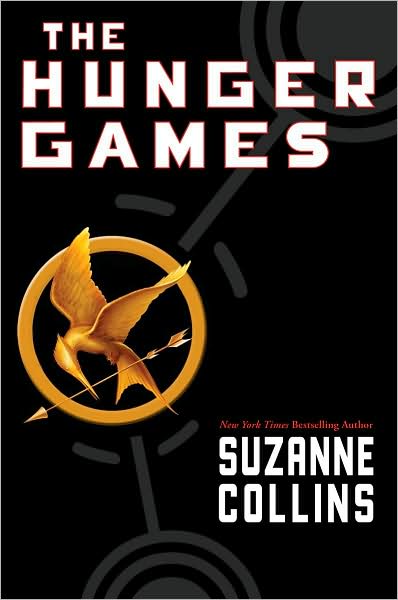
The Hunger Games by Suzanne Collins

This book review is going to be a bit unconventional, so please bear with me.

Normally, I only review books on my blog if I feel I can recommend them.  They might not be perfect, but overall, the praise outweighs the criticism. However, for me personally, The Hunger Games was a huge disappointment.

I’m not going to do a little book blurb like I usually do, because I want to spend all the available space on this post explaining the reasons why I was so disappointed.  Also because of that, this post will be full of spoilers.  Consider yourself warned.

First, let me say that I don’t think this book was all bad.  Suzanne Collins is very good at plot and pacing, and she knows how to keep a reader hooked.  In that way, this book reminded me of the old Michael Crichton thrillers that I devoured as a kid.

However, two crucial things killed about half of the suspense for me: the fact that this book was the first in a series, and the first person viewpoint.

From the very beginning, we know that Katniss isn’t going to die.  We know it, because she’s narrating the story to us directly (in present tense, which personally irks me, but I won’t go into that).  Unlike other gladiator-style heroic fantasies, where the major draw is to see who lives and who dies, we have that spoiled for us.

Of course, the argument in favor of the first person is that it helps the reader feel a closer connection with the viewpoint character.  The problem is, I never did.  At the end of the book, Katniss still feels like an outsider to me; I never felt like I got inside her head well enough to know who she really is.  When I try to imagine her, all I can envision is a wide-eyed mannekin.  She just didn’t come alive to me.

Why? Because the whole time, she’s only got one thing on her mind: survival.  I don’t see anything but fragmentary glimpses of her other motivations, and those are never fully fleshed out.  Her experiences growing up were just so traumatic that I can’t relate to her, and Suzanne Collins never provides a reference point outside of the awfulness of Katniss’s crapsack world.

Which is another thing that got to me: the setting.  Every time I opened the book, I dreaded going back to Collins’ world–and not in a good, “ooh, this world is so creepy/frightening” way, but in a “man, this place just makes me depressed” kind of way.  It wasn’t even that original–Panem is basically the USA as North Korea (though it could take place anywhere, for all the details Collins gives us).

What’s more, the setting is full of inconsistencies.  The people are starving to death, but the forests are full of game and wildlife.  In North Korea, people raze the forests for fuel and timber, driving all the game out.  Yes, I know the people of District 12 mine coal, but all of it presumably goes to Capitol, just like in District 11 all the grain goes to Capitol and the people still starve. Which makes me wonder: why are all the districts specializing in only one commodity?  That’s just stupid.

Which brings me to another thing: the sheer idiocy of the rulers of Panem.  If the Hunger Games are supposed to remind the people of how subjugated they are, why allow the tributes the opportunity to do something like pull a romance stunt?  Why spend all that time primping and preening them, interviewing them, and giving them an opportunity to manipulate the crowds?  When the people of District 11 sent Katniss the bread, why didn’t a government censor stop that from happening?  And finally, when Katniss and Peeta were the only ones left standing, why give them the opportunity to upstage the games by falling on each others’ swords?

Seriously, that last point got to me more than any of the others.  When they announced the rules change, that Peeta and Katniss were supposed to kill each other after all, why couldn’t the GM see the potential for things to go wrong?  Seriously, having them both kill each other–or refuse to kill each other–was such a blatantly obvious choice, I saw it the moment the rule change came into play.  The fact that the villains didn’t just threw me out of the story.

But that wasn’t the first thing that threw me out of the story.  The first thing was the parade, with Katniss and Peeta marching into the arena with their flaming cloaks.  All this time, Katniss has been set up as the underdog–she isn’t pretty, she isn’t strong, she’s mildly sympathetic for volunteering in place of her sister, but the audience in that arena is looking for blood, not sympathy.  So when the crowd goes wild for her and Peeta, I just didn’t buy it.

It only got worse as things went along.  When the tributes did the skill check, Katniss–who, from the beginning of the story, has been set up as the underdog–scores higher than anyone else.  Every time she’s in front of an audience, everyone is oohing and ahhing.  It made me want to gag.

Honestly, you know what it seemed like?  It seemed like Suzanne Collins fell in love with Katniss so much that she wanted to spoil her, even though the story required her to keep up the pressure.  She made sure to torture Katniss in the games–so much so that it felt downright melodramatic at times–but while they were still in Capitol, waiting for the games to start, Katniss felt like a spoiled Mary Sue.

And as for the romance, it fell completely flat from the beginning.  Katniss was nothing but a manipulative faker from the beginning–granted, because she needed to in order to stay alive, but the least she could have done was coordinate that with Peeta.

And that’s another reason why I had such little sympathy for her–she’s a callous, manipulative, lying little heartbreaker, like far too many women in this world.

So yeah, The Hunger Games was, in my opinion, a huge disappointment.  I can partially see why it did so well (strong female protagonist, excellent plot structure and pacing, lots of hooks and cliffhangers), but personally, I don’t think it deserves half the praise it’s gotten.  And after what friends have told me about the rest of the series, I can guarantee that I won’t be reading them.
Merchanter’s Luck by C. J. Cherryh

He was a down and out merchanter, the captain, crew, and sole proprietor of a run-down bucket of bolts spacecraft.  She was a daughter of one of the finest starfaring clans, with seven hundred cousins standing between her and the one thing she wanted more than anything else: command of a starship.

They met at Pell during the height of the Company War–the key strategic point on the border between Union and Earth.  Their fateful meeting would affect not only the outcome of the war, but the course of their own lives–for the starship Lucy of Wyatt’s Combine was not at all what she seemed to be.

Before I review this book, I need to issue a disclaimer: you probably aren’t going to enjoy it very much unless you’ve already read Downbelow Station.  Cherryh isn’t the best at easing her readers into her worlds, and without the background on Union, Alliance, and the Company War, you’ll probably be hopelessly lost.

That said, I absolutely loved this book.

The premise is so awesome.  Space adventure hardcore, with a beautiful love story set amidst an epic interstellar war, where alliances are constantly broken and no one can be trusted…oh man, I LOVED this book!

While the premise seems pretty standard, C. J. Cherryh transcends the well-worn tropes and cliches of her genre by intimately developing her characters and working their motivations into the story until they are the ones driving the plot, and not the other way around.

Every character is unique, and though they act in ways that may seem strange to our modern sensibilities, there are always reasons for everything they do, cultural or otherwise.  As windows into their far-future spacefaring culture, they give the reader a wonderful view of Cherryh’s unique and marvelously constructed universe.

The thing that surprised me the most, however, was the sharp contrast between this book and Downbelow Station. While Downbelow Station traces the epic arc of the Company War through the viewpoints of a large cast of characters, much like Tolkien or Dune, Merchanter’s Luck focuses more on the characters themselves, in much the same way as David Gemmell or Ursula K. Le Guin.  In other words, while Downbelow Station is comparable to “high” or epic fantasy, Merchanter’s Luck would fall closer to “low” fantasy or sword & sorcery.

The interesting self-realization I took from the book was that I’m much more interested in the intimately personal stories than the sweeping epic tale of the Rise and Fall of cultures and civilizations.  I suppose that’s why I’m more of a David Gemmell nut than a Tolkien fanatic, and perhaps why I’m more into space opera and military sf than epic fantasy.  In all of my novels, the focus is always on the individual characters and their personal conflicts, and whenever I get sidetracked and focus too much on the overworld story, it always falls apart. 

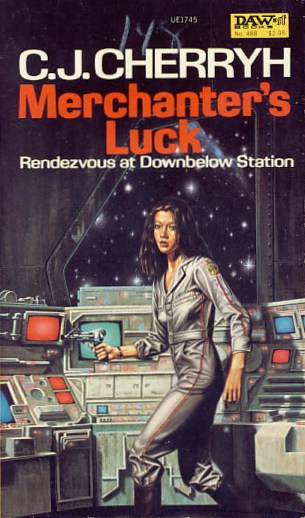
Merchanter’s Luck definitely doesn’t get sidetracked, and that’s why I loved it so much.  I fell in love with the characters almost from the very first page–from the blurb on the back cover, even.  And most of all, I fell hopelessly in love with the starship Lucy:

You know you’re doing science fiction right when your readers bemoan the fact that they weren’t born in the 26th century, when they could command their own spaceship.  C. J. Cherryh is an amazing writer, and if I had the chance, I would teleport into her Union-Alliance universe in a heartbeat.

If you love well-crafted far-future worlds and stories about the people that live in them, check out Downbelow Station (or really, just the first chapter–that’s all you need for a solid grounding) and read this book!

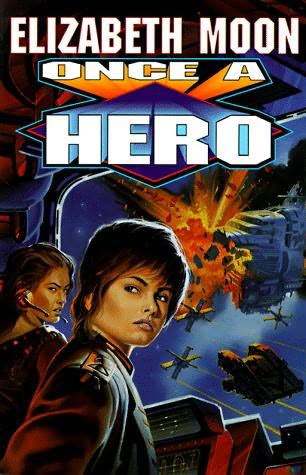
Once a Hero by Elizabeth Moon

Esmay Suiza never asked to be a hero.  All she wanted was to leave her dysfunctional home and join the navy.  But after surviving a mutiny and leading her spaceship to a most unlikely victory, everyone seems to be showering her with unwanted attention–or worse, examining her files for signs of command potential.

No, all she wants is to disappear–and now that her family has offered her a generous inheritance on her home world of Altiplano, she finds herself tempted to leave the stars behind and settle down for a while.

Little does she know, her family has hidden secrets from her–secrets from her past, which have the power to undo and destroy her.  Unfortunately, being a hero has a price–and the trauma of combat has already unearthed things from her subconscious than she cannot keep buried any longer.

This was my first time reading Elizabeth Moon, and I enjoyed it quite a bit.  Moon is extremely good at portraying a complex, believable military culture; she was a Lieutenant in the Marines, and definitely knows how to do military SF right.

My favorite part of the book was the descriptions of Altiplano, and Esmay’s experience returning to her homeworld of Altiplano.  Elizabeth Moon does an excellent job of creating a captivating world and transporting the reader there.  I fell in love with Altiplano almost instantly–not only with the planet itself, but the culture and the people, the whole society.  Excellent job.

Elizabeth Moon also does an excellent job developing her characters and giving them believable internal conflicts.  The way she portrays Esmay’s PTSD is quite striking, and very interesting.  Her struggles feel very real, and important too.  I think this novel helped me to better understand those who suffer from similar traumatic experiences, and that was very meaningful.

Storywise, however, I had a few minor issues, most of them having to do with the plot.  Things dragged a bit in the middle; when Esmay left her homeworld, I lost a sense of progression and felt that she was just wandering around.

When the antagonists came in–basically, a hostile army trying to capture her ship–I felt that Esmay solved her problems too easily, without any real try-fail cycles.  It gave me the sense that Esmay was some kind of superhero girl–not quite a Mary Sue, but toeing the line.

And Esmay’s love interest…I didn’t really get into him at all.  He seemed like a stereotypical damsel in distress, except with the sexes reversed.  I heard once that in good romance stories, the girl readers want to be the female protagonist, and the guy readers want to be the male protagonist.  Yeah…call me a chauvinist, but I never really wanted to be that guy.

I hate to be too critical, though, because Elizabeth Moon’s writing is quite good.  She has an excellent grasp of character, and her ability to transport her readers to another time and place more than makes up for her shortcomings with plot and story structure.  Also, I get the sense that this isn’t her best work.

In any case, if you’re a fan of military SF, you’ll probably enjoy this book.  I enjoyed it, and I will certainly be reading more Elizabeth Moon in the future.

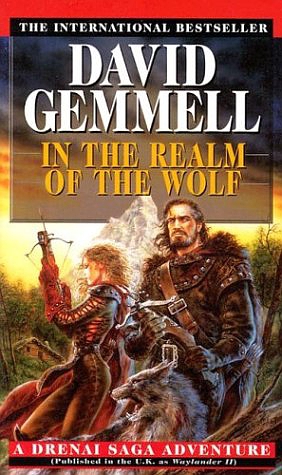
In the Realm of the Wolf by David Gemmell

Never leave home without a weapon, Dakyras taught his adopted daughter Miriel.  Though they live a quiet life alone in the mountains, death is never far from the man known as Waylander.

When the Assassin’s Guild puts out a high price on Waylander’s head, both Waylander and Miriel find themselves on the run.  With them come two ill-fated gladiators from Drenai: the loyal and steady Angel, and the arrogant and reckless Senta.  Both men vie for Miriel’s hand–and both are honor bound to kill each other.

But in the face of the evil hunting Waylander, Angel and Senta must lay aside their vendetta and take up arms against the Gothir army hunting the Wolf clan, tribe of the prophesied chieftain that will one day unite the Nadir.  For deep in the realm of the Wolf lies a castle more ancient than the three empires–a castle whose dark secrets threaten to upset the global order forever.

This book was awesome.  I loved every moment of it.  With each page, the story just got better and better, right up to the climactic finish.  If you’re looking for a rousing adventure, you can’t go wrong with David Gemmell.

One of the things I loved the most about this story was the love triangle between Miriel, Angel, and Senta.  At first, I thought I knew who was good, who was bad, and which one she’d end up with, but then things changed and I wasn’t too sure.  Even though I hated Senta at first, I spent most of the book vacillating with my feelings on him.  And the way things ended–I wasn’t disappointed.  Not one bit.

Even though the overall story conflict was much, much larger than life, Gemmell’s characters always felt very real.  Perhaps it has to do with the way their true nature always seems to come out in battle–and Gemmell gives them plenty of opportunity to show their true nature.

It also has to do with the things they’re fighting for, though–the stakes are always clear for each character, and when they’re confused what they’re fighting for, that’s made clear too.  Though the conflict itself is larger than life, the stakes for each individual character never are.

The ending really took the cake for me, though.  When I finished the book, I couldn’t help but smile.  Gemmell is a master at writing endings that make you want to stand up and cheer.

As awesome as this book was, though, the last book in the trilogy, Hero in the Shadows, is so much better.  The last scene of that book stands out so much more to me, now that I know everything about Waylander’s past.  So.  Freaking.  Epic.

But do yourself a favor: don’t read the last book first, like I did.  Start with Waylander, which is a good book–not great, but good–and read through the trilogy.  If you love stories about true heroes and epic adventures, you won’t be disappointed.

Thoughts after finishing In the Realm of the Wolf

Wow.  I just finished In the Realm of the Wolf by David Gemmell a couple hours ago, and it was AMAZING.  So amazing, in fact, that I want to write a post examining my reaction to it before I write the review.

You know that ecstatic, otherworldly feeling you get when you finish an amazingly good book?  Where you feel like you just came home from a long, epic journey and you can’t stop thinking about it?  Where your mind is racing with all sorts of new and beautiful ideas, as if you’ve opened your eyes for the first time?

That’s how I felt after finishing this book.

As a writer, I want more than anything for my readers to have the same experience when reading my books.  I don’t expect everyone will, but I want to be able to connect with a good chunk of my readers this way.  David Gemmell does this for me, and my main question is therefore: how does he do it?

Looking back, I’ve got to say that the book started good and steadily got better, right up until the awesome finish.  The first two chapters were good, but around the third chapter, my expectations started to be exceeded.  It wasn’t until the last half of the book that I realized just how much I was connecting with the characters, and when the climaxes hit, I found myself rooting for them more than I usually do.

So I guess escalation had something to do with it.  Gemmell starts with a pretty simple plot: Waylander has to evade a bunch of guild assassins out to kill him, but he doesn’t want to because his wife just died and he’s depressed.  Then more and more characters get involved, and the stakes steadily grew until the fate of global empires hung in the balance.

Yet throughout it all, the focus was always on the personal conflicts and the impact of the events on the individual characters.  The vast armies sweeping the land were more of a background setting element than anything else; the real story lay in the choices the characters made and why they made them. And when the characters started confronting their demons, I rooted for them as if they were my close, personal friends–or more than friends.

Yet Waylander himself is very much a larger-than-life character.  He’s a better hunter and tracker than the Sathuli tribesmen, a better swordsman than most of his opponents, by far the best crossbowman in the Drenai saga, and a cold, efficient killer with a body-count of hundreds.  Not only is he rich enough to support the bankrupt king of Drenai singlehandedly with his vast financial assets, but in each of the three books in his trilogy, he plays the most pivotal role of any character in the rise and fall of nations and empires.

And yet…I can still connect with him.  Why is that?

Maybe it’s because he’s far from perfect.  He vanquishes hundreds of soldiers, assassins, monsters, and demons, but he doesn’t escape uninjured.  In Realm of the Wolf, his less-than-perfect swordsmanship is a key element of the plot.

It’s the internal conflict, however, that really makes me connect with him.  Don’t get me wrong–I’m not a cold, unfeeling killer, nor have I lost my whole family to roving bandits–but I can understand his struggle to find happiness in the face of so much evil, both within him and without.

Or maybe it’s not so much that I understand him as that I’m fascinated by him, and I don’t know why.  It certainly helps that he has a soft side–that he’s not a complete monster.  In all the books, his quest is always to save lives, not just to take them, and every once and a while he does something to keep my sympathy.  The way he spared the Sathuli scout in Realm of the Wolf, for example.

Overall, though, I think it’s the characters and their conflicts that made this book come alive.  Waylander is basically an adventure tale with some interesting characters; In the Realm of the Wolf is also an adventure tale, but the personal stakes are much higher, and the focus is more on the characters than on the rise and fall of empires.

Anyways.  I still feel like there’s something elusive that I’m not quite getting, but those are my thoughts after finishing this book.  If you didn’t find it helpful, I hope you at least found it interesting.  And if you have the chance, read the trilogy!  It’s goood!

When taking a break is not enough

So these past few days, I’ve been taking an unofficial break from writing.  After I finished Mercenary Savior 3.0, I didn’t feel that the time was quite right to start my next project.  Plus, I figured that after working so hard, I kind of deserved a break.

It’s been kind of weird, though.  In some ways, it’s kind of relaxing not to be writing every day, but in other ways, it’s unsettling.  I don’t feel like I’m recharging the well–I just feel like I’m being lazy. Writing is hard work, but it’s satisfying work, and I miss that sense of satisfaction.

I hope to get it back soon, though.  I’ve got a rough outline and a ton of ideas for my next project, and I kind of know where I want to start.  The trouble is, I still feel that something is missing, and I’m not sure what it is.  Maybe the best way to overcome that is to blog about my ideas and see what happens.

So for this next project, I want to recycle the story and characters from Hero in Exile, which I left unfinished back in winter of 2009 (right around the time when I finished Genesis Earth).  It takes place on Gaia Nova, a planet that is half desert/wilderness, half densely settled urban arcologies.  The main character is a boy named Jalil who became separated from his parents when their ship was destroyed in orbit; they threw him into an escape pod with his mother’s ID pendant, and he crashed into the desert.  A local tribe of Bedouin-type nomads took him in and raised him, but he’s always wanted to get back to his biological family and find out who he really is.

Things get complicated, though, because the sheikh of the tribe has no sons, and therefore wants to marry Jalil off to one of his daughters in order to keep the tribal holdings in the family.  He’s so desperate that he orders one of his daughters, Mira, to seduce Jalil by any means necessary.  Since chastity and virginity are highly valued within the tribal society, Mira feels very uncomfortable about doing this.  She has feelings for Jalil and would like to marry him, but not in that way.  At the same time, however, she doesn’t want to disobey her father.

The story starts right around the time when Jalil sets out in quest to find his biological family and learn of his true origins.  He decides that the best way to do this is to go on a pilgrimage to the Temple of a Thousand Suns, deep in the urban arcology side of the planet.  The sheikh of the tribe sends Mira with him, under the pretense that she’s making the pilgrimage.  The real reason she’s going, however, is to catch him in a moment of weakness and seduce him, thus forcing him through the stain on her honor to marry her and return to the tribe.

Jalil, however, is completely oblivious of all this.  He is totally naive to the ways of the world, and believes very strongly in honor, virtue, and other high moral ideals.  As he and Mira leave the desert and descend into the morally corrupt world of the arcologies, however, Jalil finds himself becoming more and more disillusioned.  He and Mira become closer and closer physically, yet further apart in the ways that really matter because of the poison of deception and manipulation that has come into their relationship.  Eventually, they both find themselves forced to make some defining decisions, just as everything they’ve known and believed is shattered and destroyed.

That’s the general idea, at least.  I suppose you could call it a romance where the main obstacle to them getting together is the intense pressure on them to have sex. It’s probably been done before, but hopefully my sci fi take on the idea will make things interesting.

I still feel like I have a lot of prewriting work to do, though.  I want to make Mira and Jalil both viewpoint characters, and to do that I need to have their backstories and motivations worked out very well.  With Jalil, I think I’m ready to start, but I’m not so sure about Mira.

Anyways, that’s where things stand.  Do you like the idea?  Don’t like it?  See something interesting that I haven’t seen?  Let me know–please let me know.

Oh, and I need a new title.  Hero in Exile is way too cheesy.

Red Mars by Kim Stanley Robinson

For eons, sandstorms have swept the barren, desolate landscape of the red planet.  For centuries, Mars has beckoned to mankind to come and conquer its hostile climate.  Now, in the year 2026, a group of one hundred colonists is about to fulfill that destiny.

I first picked up this book two and a half years ago, when I was still trying to read a novel a week.  I’ve got to be honest; this was the book that made me break that new years resolution.  It is freaking huge, and some points are more interesting than others.

That said, this is an awesome piece of hard science fiction.  Lots of people have written about Mars, but very few have done it believably.  Kim Stanley Robinson does an job here–you can tell that he put in a ton of research, both into Martian geography (areology?) and feasible technology.

When I read science fiction, however, that’s not what I generally read for.  I’m more interested in characters, conflict, and thematic elements–in other words, the stuff that makes for a good story.  As far as that stuff goes, my opinion of Red Mars is somewhat mixed.

For example, the first chapter starts out with a murder, as seen from the point of view of the murderer.  Right away, I’ve got a reason not to sympathize with the main viewpoint character.  When we get into his mind and I see his motivations for killing the character, I like him even less–and he’s one of the main, driving characters.

Some of the characters are more sympathetic, and I enjoyed the sections in their point of view.  Others, however, were just plain boring–I neither loved them nor despised them.  Because of this, a lot of the character drama early in the novel didn’t engage me much; stuff was happening, but I didn’t really care.

When it comes to setting, Red Mars is also somewhat mixed.  Robinson goes to great depths to describe the Martian landscape, and several of his setting descriptions were quite interesting and wonderful.  At the same time, he explains everything in a very clinical, scientific way–his imagery is never as poetic and captivating as Ray Bradbury’s, or Ursula K. Le Guin’s, or George R. R. Martin’s.  I came away with a lot more knowledge about Mars, but not quite as much of a sense of wonder.

Things did get interesting once the political tensions started to come into play.  Robinson’s portrayal of the colonization of Mars raises a lot of interesting questions about the political relationship between Earth and Mars once those colonies start to become self-sufficient.  He follows things through right to the war for independence, and the implications of the conflict are quite interesting.  I finished the last hundred pages or so at a sprint.

All in all, I wouldn’t recommend this book unless you’re already a fan of hard science fiction.  Like most hard sf, character and conflict plays second string to scientific plausibility.  Within its sub-genre, however, Red Mars is awesome.  Let’s just put it this way: even though I got bored with it the first time, I knew I would one day pick it up and finish it.  I don’t regret that I did.