Trope Tuesday: Came Back Strong

This trope, also kown as apotheosis, is by far my favorite part of the hero’s journey.

Up to this point, the hero has faced a lot of tests and trials.  Some of them he’s passed, some of them he hasn’t, but the setbacks haven’t yet been enough to stop him.  Sure, the costs have been high–he may have lost a friend or mentor, for example–but at least he’s still in the game.  Then, just as he experiences the power of love (meeting with the goddess) and reconciles with the ultimate power in his life (atonement with the father), what happens?

He dies.

This may be literal or metaphorical, physical or spiritual–but whatever form it takes, the hero has to lose something significant, up to and including…well, everything.  After all, there are so many things worse than death.  While all the other failures up to this point left him more or less intact, this one completely shatters him–and in the process, transforms him.

Like a phoenix rising from the ashes, the hero comes back from the dead, often with a level in badass.  By dying, he gains that last piece of knowledge, experience, or resolve that he needs to defeat the big bad and gain the ultimate boon of his quest.  Whoever or whatever he was before, that person wasn’t strong enough to pass the test–but now, he is.

When done well, this is a stand-and-cheer moment of the best possible kind.  It’s the culmination of everything the hero has gone through, not just in terms of plot, but character as well.  Years from now, you might forget everything else in the story–even the parts that you loved–but you’ll remember how you felt when you got to this part.

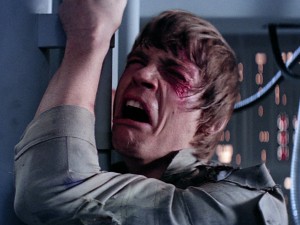
One of my favorite examples of this trope is in the clip I posted from the Matrix.  Seriously, when Neo realizes that he is The One, that is one of the best moments in all of cinema.  The Empire Strikes Back also has a moment like this, though since the movie is essentially a tragedy, there’s a lot more emphasis on Luke’s death (falling through the gas mine shaft after confronting Darth Vader) than his resurrection (getting a new hand and reuniting with his friends).  The oldest examples, of course, come from mythology–Odin gained the ability to use magic by sacrificing himself on Yggdrasil, and before returning to Ithaca, Odysseus first had to journey to Hades to pay his old friend Agamemnon a visit.

So as writers, how are we supposed to get this trope right?  I’m by no means an expert, but my gut instinct tells me that the way to nail it is to be as excited about this moment in the story as we want our readers to be when we get to that point.  Even though storytelling is ostensibly just making stuff up, it’s not something you can fake–if you aren’t excited about your own story, how do you expect your readers to even care?

Fortunately, this is often the part of the story that drives us to write everything else.  There have definitely been times when I could hardly wait to get through the other stuff and finally write the chapter where this happens.  Bringing Stella Home was a big one–and that’s all I can say, at the risk of giving spoilers.  Star Wanderers is another one, though it wasn’t until I was midway through Fidelity that it really came to me.  Desert Stars was more of a Heroic Second Wind, which is basically Came Back Stronger without the death.  However, there was definitely a transformation, both for Mira and Jalil.

So yeah, I really, really, REALLY love this trope.  When done well, it’s one of those things that can turn a run-of-the-mill adventure story into something both soul-searching and powerful.  You can definitely expect to see me play with it a lot in the future.
Trope Tuesday: Well Done Son Guy

What happens when this trope goes horribly, horribly wrong.

So the hero gets the call to adventure, initially turns it down, meets a mentor figure who gives him some sort of supernatural aid, crosses the threshold of adventure, faces a series of tests and trials, loses his mentor, experiences the power of love…and then what?  Well, if we’re playing the hero’s journey straight, the next step is atonement with the father, also known as well done son guy.

Before passing the ultimate test, the hero must first confront the force that holds the ultimate power in his life.  This is often some sort of father figure, though it can also be a close friend or a rival.  Often, the main reason the hero set out on the journey in the first place was because he felt a need to prove himself and gain the respect of this figure.  For that reason, the climax often involves some sort of reconciliation or closure between these two characters.

In discussing this trope, Joseph Campbell said the following:

Atonement consists in no more than the abandonment of that self-generated double monster—the dragon thought to be God (superego) and the dragon thought to be Sin (repressed id). But this requires an abandonment of the attachment to ego itself, and that is what is difficult. One must have a faith that the father is merciful, and then a reliance on that mercy…

The problem of the hero going to meet the father is to open his soul beyond terror to such a degree that he will be ripe to understand how the sickening and insane tragedies of this vast and ruthless cosmos are completely validated in the majesty of Being. The hero transcends life with its peculiar blind spot and for a moment rises to a glimpse of the source. He beholds the face of the father, understands—and the two are atoned.

While this may, on the surface, seem just like a simple “I’m proud of you” moment, the full significance goes much deeper.  This is the moment where the hero finally receives validation for all his struggles, where he realizes that everything he’s been through has been worth it.  It’s a tremendous moment, and an important element of any story that follows the hero’s journey paradigm.

The reason why the hero’s journey resonates so strongly throughout our culture is because it powerfully and effectively fulfills one of the major purposes of all story–to help us better understand ourselves, the world we live in, and what it means to be human.  For that reason, this trope is one of the things that can either make or break a story.  When done well, it can turn the work into a classic.  When done poorly, it can make us wish we had our money back.

I’d talk about this trope in my own work, but I don’t want to give any spoilers.  In Bringing Stella Home, there’s something of a gender inversion, as the title would imply.  In fact, there’s a gender inversion in Star Wanderers as well, though you’ll have to wait until part IV to read it.  In Desert Stars, it’s more of a personal moment, but the whole novel is a lot more intimate and personal than a save the world type of adventure.

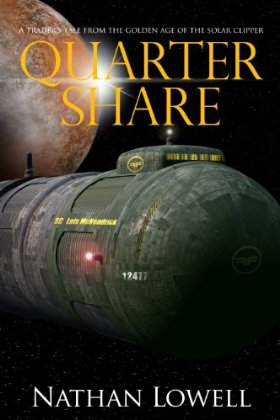
Quarter Share by Nathan Lowell

Ishmael Wang never thought he would sign up with the crew of a solar clipper, traveling the stars as part of a merchant collective.  But when his mother unexpectedly dies, leaving him with barely enough money to pay next month’s rent, he finds himself without any other choice.  Fortunately, the starfaring life suits him quite well–surprisingly well.

I picked up this novel because it appeared in the “customer’s also bought” section of my own novel, Genesis Earth.  It was a fun read, though to be honest I put it down for almost seven or eight months before finishing it.  The reasons for that should be clear by the end of this post.

Don’t get me wrong; there are things that I liked a lot about this book. The beginning set up is excellent–I really felt drawn into the story, and felt for the challenges that Ishmael was facing.  As he started to make friends and explore his new world, the wish fulfillment factor became a major draw.  I mean, who wouldn’t want to sign up with the crew of a solar clipper and travel across the stars?

But somewhere in the middle, the book started to lose steam.  Ishmael’s internal conflicts with the death of his Mom faded into the background until they completely disappeared.  Everything that he set out to accomplish, he did so successfully after the first or second try.  The story took on a sort of video game quality, where the main focus was leveling up: from quarter-share to half-share, from this test to that test, etc.  Even some of the aspects of the world-building became mundane, with mushroom-growing asteroids and space station flea markets becoming just another way to make a profit.

While there were aspects of the trading game that I liked, the lack of any real conflict made me lost interest in the story. The beginning is very strong, and the middle, though weaker, is still okay, but the ending just sort of fizzled without a real climax.  If you’re only reading for wish-fulfillment, that probably isn’t a problem, but if you want something else, you’re probably better off looking elsewhere.

Trope Tuesday: Big Damn Heroes

You know the drill.  The clock is ticking down to zero, the evil hordes are swarming through the gates, the virgins are about to be sacrificed and the damsel in distress is about to be lost forever–and then the  heroes show up in all their glory to save the day.

This happens all the freaking time, which means that if you want to make a living telling stories, this is not a trope that you should ignore.  And with good reason.  Not only does it give the writer ample opportunity to play with suspense and action, but it arguably lies at the very core of what makes a hero a hero:

David Gemmell, according to this interview with Ian Graham, defined a hero simply as “someone who does heroic things.” They might not always take the right side, or they might not even care about doing what is right, but when the universe conspires to bring them to a moment of decision, they make the choice that all of us would like to think that we would take and do something extraordinary.

I like this definition of a hero.  It strikes me as a lot more honest than the perpetual do-gooder whose only motivation is Truth, Justice and the American Way (though those characters can–and do–have Big Damn Hero moments of their own).  Also, it means that true heroism is not contingent upon actually winning.  History may be written by the victors, but that doesn’t cheapen the experience of those who actually lived it.

Of course, if the heroes don’t save the day, it’s pretty hard to pull off a crowning moment of awesome without bringing in the Bolivian Army.  Either the heroes find out that they’re too late, or they make things worse, or (as is so common with Othar Tryggvasson of Girl Genius) they just prove that their ego is too big for its own good.  When taken to the extreme, the heroes may even be in danger of turning to the dark side.

The biggest danger with this trope is turning it into a Deus Ex Machina.  The thing that makes Big Damn Heroes so incredibly satisfying is the sense of climax when they show up to save the day.  Thus, proper foreshadowing is key.  Yes, the rule of cool still applies, but if that’s all you rely on, you’re not going to be able to pull it off to maximum effect.

One of my favorite examples of this trope is Liam Neeson in Taken.  Plenty of action movies are more violent, but few are more satisfying.  It’s the perfect pick-me-up after a long crappy day at the office–not that I work in an office anymore.  I wonder why…

In any case, this is a great trope to look out for, and definitely one to master, especially if you’re writing any sort of action-adventure story.

If it kills me

I will finish this novel if it kills me. At the rate things are going, it just might.

Things are kind of tough for me right now.  I desperately need a new job–the one I’ve got is slowly sucking away my soul without even paying enough to get by–and job rejections are way worse than rejections from publishers (I’ve been getting a lot of both, by the way.  Not that I’m looking for pity, but yeah.).

As if that weren’t bad enough, my current novel, Worlds Away from Home, is turning out to be a train wreck.  There are all sorts of problems with character motivations, improper foreshadowing and plot set up, etc etc.  That makes it REALLY hard to get motivated to write each day.  Yesterday, I wrote only 245 words (youch).  Today, I did about 2.2k, but that’s still way less than I need to be doing.

The thing that worries me the most is the thought that the audience for this particular story may be slim to nonexistent.  It’s solid space opera, but with a romantic element that challenges a lot of the mores of our modern, sex-saturated society, as well as many of the conventions of romance within science fiction.

The main female protagonist is something of a pushover–but she has to be, in order for her growth arc to have any umph.  The main male protagonist is an orphan on a quest to discover his own origins, kind of like a cross between Mogli and Pip.  His quest, combined with her parents’ manipulative attempts to get them physically intimate too soon, are the main things keeping them apart.

But in a genre where physical intimacy usually marks the romantic climax, how do you make it out to be the obstacle against that climax?  Will science fiction readers go for that, or will they hurl my book across the room because of it?

Well, if they hurled my current draft, I wouldn’t blame them one single bit.  So many plot holes and awkwardly written scenes–ugh.  I’ve got to seriously rethink so much about this story.  But a later draft?  I don’t know–maybe it would work.  It would probably need other hooks to keep them engaged, such as cool world building elements, but I think I could make those work.

Anyway, I suppose it’s nothing unusual.  For every book I’ve written, I’ve come to a point in the rough draft where I thought the story was completely unworkable and should be scrapped.  It’s a tortuous, masochistic process, but I suppose it’s normal.  That’s some comfort, at least.

My goal is to finish this abomination by August 15th, then move on to polish Mercenary Savior and make it really shine.

Another goal is to get a decently paying job (at least $8/hr at +25 hours per week) in order to afford to go to DragonCon in September.  Another goal is to reteach myself algebra and calculus through the math books my dad (who is a geometry teacher) is letting me borrow.  Another goal is to actually get a social life.  BLARG.

Near scare and an awesome idea for the next novel

I wrote 1,780 words this morning–not bad.  After such a good start, I figured I’d finish the last 720 for the day after finishing the day’s errands.

Long story short, when I finally settled in at 11pm to do a little writing before going to bed, I had some weird problems.  Openoffice froze up, I ended it prematurely, and it turned out that that somehow corrupted one of the files I had opened.  Instead of being 370 KB, it was now over 1,000 KB, and every time I tried to write something,  it froze up for nearly half a minute.

In the end, I had to delete it.

Fortunately, this was NOT the main file for Mercenary Savior. Thank goodness!  It was just the revision notes.  I had copies of both (both about a week old), but I’m glad it wasn’t the main file, because I’d have lost over thirty pages of revisions.  Yikes.

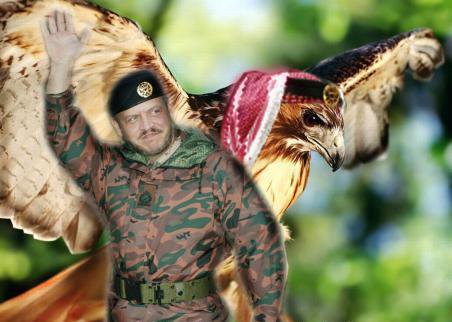
On a totally different note, I had an awesome dream this morning–one that I’m totally using in next novel I’m going to write (probably recycling much of Hero in Exile).  It’s hard to describe it exactly, which is why I added this really weird picture to this post.

You may be wondering, “what the crap is that supposed to be?” I’ll tell you: it’s Arab.  It’s Arab on so many different levels it makes me happy inside.  I took it from the facebook profile pictures album of an old friend of mine from the ELC in Provo.  What’s so Arab about it?  Well, there’s 1) King Abdullah II 2) in battle fatigues 3) waving to the people 4) with an eagle in the background 5) wearing a Bedouin hutta 6) and some kind of military insignia on the agal.  So freaking Arab.

So what was my dream?  Well, it was kind of like a cross between Lawrence of Arabia and…a lot of weird stuff.  At one point, King Hussein of Jordan commanded me to go into the desert east of Jerusalem and raise an army.  I had a lot of questions, so he explained exactly what he wanted me to do–and in so doing,  he explained exactly how the Bedouin fight wars.

Instead of keeping a standing army, a military leader must draw the warriors of the other tribes to his banner through his charisma, egalitarianism, reputation, etc.  The warriors join his campaign, not to serve some grand concept of country, but to win spoils and glory.  Once the campaign ends, they disband and return to their tribes until the next leader rallies them together.

Because of the way this works, a charismatic leader can pass through the desert virtually by himself, only to come out on the other side with a fearsome army.  This is what happened in Lawrence of Arabia when Lawrence took Aqaba–he passed through the desert with a token force of barely fifty men, but the feat (and his brilliant diplomatic skills) so impressed the Bedouins on the other side that they rallied to him and stormed the city.  From the Turks’ point of view, the army came out of nowhere and crushed them.

So that’s what I’m thinking I need to do at some point in my next novel: have the main character, poor and destitute, go out to the desert and rally the tribes with nothing but his charisma.  I’ve already got the rough (VERY rough) outline of the story in my head, and this plot point fits perfectly into this one section where I was worrying that things lagged too much.

Oh man, I’ve got such awesome plans for this book!  But first, must revise Mercenary Savior and send it out.  Don’t worry, I’m enthusiastic about that project, too. It will get done!  Momentum is building–I’ll  more than make up those 720 words tomorrow.

Climax (thank you Ennio Morricone)

Just passed the major climax in the middle of Bringing Stella Home.  In a moment that I hope is as poignant to the reader as it was to me, I…well, let’s just say I’m glad I’m not my main character.

I hit the climax doing a 1,765 word sprint, with this song playing on repeat:

So awesome. I just hope that when I wake up from this daze, my writing doesn’t suck.

Next, gotta finish up the chapter, clean up the mess, give the denouement. After every emotionally poignant climax, I think it’s critical to have a good denouement to give those emotions their proper release and bring everything full circle, bring some proper closure. Best denouement of any story I know: the Throne Room from Star Wars IV:

The denouement for my story will not be nearly so triumphant. But then again, it’s not the final climax–there’s a lot more to come, a lot more pain and suffering for my main character to endure.

I’m 2/3rds of the way through this rewrite now. I hope I’m not being too melodramatic, or that the story sucks. They say it’s not enough to be good–to make it as a writer, you have to be brilliant. Does this story have that potential? Gosh, I hope it does. As it stands, though, it sure needs a lot of work.

But still–it’s been awesome writing it.

Battle scenes are HARD

I’m in the middle of revising a major battle scene right now.  This is supposed to be one of the more important climaxes of the book, adding a lot more tension and emotion as the novel approaches the main climax.

Let me just say, writing a good battle scene is tough.  The first version of this one…yeah, it sucked.  Hardcore sucked.  I’m cutting whole sections at a time–five hundred words, eight hundred words–and completely rewriting them from the ground up.  I’m not sad to see these sections go, either–they were BAD.

I think the most difficult thing is to keep the pacing up without confusing the reader.  For that reason, I reconceptualized most of the action here and made it simpler.  I also repeated several times the main point of tension–basically, will we get out of here before reinforcements come and kick our trash?  I hate it when a fight scene is so confusing that the tension just leaks out.  I don’t want that to happen here.

At the same time, I’m trying to filter everything through the viewpoint character.  Too often, I’ll read an action scene that’s just a blow-by-blow of the physical action.  That gets boring REALLY fast.  Without character, you have no stakes.  I want the stakes to be high from the very onset.

Still, it’s hard.  I don’t know if I’m succeeding yet.  I probably won’t until I distance myself from what I’ve written tonight and take a good, hard look at it.

Since I can’t do that until the third revision, I’m not going to worry about it.  Better to write it out now and move on than to try so hard to get everything perfect that I can’t see the story for the words.

On the plus side, I’ve been listening to a LOT of Star Wars battle music while writing this.  That’s always fun!

This sucks and I’m a horrible writer

It’s getting really, really hard for me not to believe that statement, especially as I finish up with the middle part of this novel.  I’m starting to realize that I made a whole bunch of mistakes pages and pages ago, and that the climaxes just aren’t working without everything set up right.

I know, cognitively, that it’s mostly just psychological and that this book probably isn’t as bad as I think it is, but I’m finding it hard to convince myself of that.  I got to the climax of part II yesterday, and it was…not what I’d had in my head.  That’s probably what’s frustrating me the most.  If I can’t write down the story as I have it in my head, what does that mean?  It either means I’m a terrible writer, or that I didn’t get the setup right (or both…gah!).

So…where do I go from here?  Throwing out the entire story isn’t an option–I’m not going to allow myself to do that.  I could, however, put it on the back burner for a while, let it simmer…or I could do or die and finish the 1.0 draft, no matter how crappy it turns out.  I suppose that would accomplish something for my self esteem, but is that the way to best serve the story?

Fortunately, this past week we talked about revision in English 318.  Listening to my recording of the class gave me a few ideas.  I could make a list of known problems, with their fixes, and continue as if I’d already made them.  I think I did that a few times with The Phoenix of Nova Terra, but I don’t know how I feel about that now.  I could probably make it work…

The main issue is that I feel very, very distant from this book.  A month ago, I was immersed in the thing, writing over a thousand words each day, just chugging it out.  Now, for various reasons, other things have come up and drawn away my attention, so I don’t feel that I’m really in this world anymore.  I feel like I’m more of an outsider, writing for the sake of writing rather than trying to tell this story the way it wants to be told.  I can’t really remember what I wrote a hundred pages ago, despite that big sheet of butcher paper up in my closet.

Another thing that complicates all of this is that I’m really, really excited about the other novel, Genesis Earth. I’ve gotten back comments from most of my alpha readers, and I’m all but chomping at the bit to start working on it again.  If I had nothing else going on, no pressing obligations or assignments, with the enthusiasm I have for this project I could probably finish the second draft in a week, and the third draft the week after that.

So…what’s next?

Well, I think I’m going to start the revision on Genesis Earth today or tomorrow.  When I was this enthused about revising Pheonix, I decided to wait and finish Genesis Earth instead, and the enthusiasm for that project died down surprisingly fast.  Better to start now than wait until I’ve got the free time but struggle with motivation.

In the meantime, I’m going to finish the current chapter of Bringing Estella Home and let it rest for a bit.  I’ll probably reread what I’ve got from the beginning, make a few revision notes, perhaps an outline of sorts–try to figure out what’s wrong, what I need to change to make it work.  I’ll restrain myself from actually making those revisions (though I did that, mid-draft, for Genesis Earth, and it turned out alright…sort of), but once I feel I’m sufficiently “into” the story again, I’ll get back to work and finish the 1.0 draft.  Hopefully, I’ll be able to do all that before the end of May.

The trouble here is that I’ll probably end up writing the first draft of this novel and revising the other one at the same time…something I tried last September and failed miserably.  However, by the time all of this is finished, inshallah school will be over and I won’t have to worry about it.  Things are looking really good for me to get an internship in NYC, which makes me think I should drop my Spring classes and just take it easy for a month before I start (as for housing, that’s a whole other conundrum…).

Gah!  Writing is complicated.  Is this something I want to do for the rest of my life?  Something I can do?  I don’t know.  I really don’t know.  I just have to keep on writing through this depressing pessimism and trust that it will pass.

As a side note, I took the title of this post from a Writing Excuses episode some time ago; here is the link to that episode, in case you want to hear it.

Ugghhhhh…

Man, I am sick.  It sucks.

I’m also at a low spot in writing this novel.  That sucks too.

When you get towards the last third of the book you’re writing, you start to have doubts about the whole project.  Is this really any go0d?  Is the story really holding out?  Things slow down a lot, and you lose most of the enthusiasm that carried you through the first half.  The daily drudgery of writing becomes harder and harder, and pretty soon you can’t see beyond the chapter you’re presently writing.  It’s not a whole lot of fun.

Then, as you get into the final stretch, the ending comes into sight and you start to regain a little bit of the enthusiasm.  Your goal isn’t too distant, and you start to see how things wrap up to bring you to that final climax and ending.  You find yourself believing in the story again, and excited to see it to the grand finale.

Of course, the actual writing gets harder and harder, exponentially, right up until the last page, but you’ve regained the motivation and you have at least a portion of the drive.

Right now, I’m kind of at the low point.  It doesn’t help that school is starting to get busier, too.  It certainly doesn’t help to be sick, even if it does give me more time around the house (man, I need to get out…I need to get out…).  But I’m almost at the end of the second act–one climactic battle, one huge and tragic development, one major try-fail cycle, and then I’m on the final stretch.  I’m currently at 64,250 words, so I should wrap up part two by about 68k and finish up the novel at around 100k.  Perhaps a little longer, but I don’t think part three is going to be much longer than part two.

One of the major doubts I have about this novel is that it’s too predictable.  All of my readers from English 318 have been making their predictions, and…really, most of them are correct.  In fact, they’re correctly predicting stuff that happens WAY later, stuff from part three that I haven’t written yet.  If this story doesn’t have any surprises, I worry that it might not be as good.

On the other hand, it has some ideas and concepts that are really drawing in my alpha readers, particularly with the Hameji.  Over and over again, that’s the comment I get–they want to find out more about the Hameji.  This is something that might help me to carry the book, even if it is a bit predictable: show this barbarian spacefaring culture at their most brutal, make them the key antagonists, and then slowly humanize them until the readers understand exactly why they do what they do, and even come to agree with them.  That is pretty fun.

So we’ll see how that goes.  In the meantime, I’m going to go to bed early–9:30 or 10:00.  This sickness is just killing me, and I don’t know of anything more effective at curing it than sleep.  G’night.