If I were a character in Twilight…

I don’t know why I did this, but I saw it while wasting time on the internet and somehow suckered myself into it.

Twilight Quiz

Judging from all the advertising crap I had to go through just to get this result, I’m probably going to be spammed to high heaven for the next ten years. Fortunately, all of the personal information I provided is fake, except for the email (hehe, the guys at the Arabic house are probably going to get some pretty funny junk mail next year…).

It’s been a long time since I read Twilight, but I can vaguely remember liking this character. He probably was the one most like me.

I’m just glad I didn’t end up as Edward, because that kid is ridiculously abusive.

Goal shift for Ashes

These past few weeks, I’ve been killing myself trying to write Ashes of the Starry Sea. I’ve made some good progress, as you can see on the sidebar.  Today I broke 200 pages.  Not too bad.

However, the pace has just been killing me.  4k words per day is something I can do…but 4k words per day on the same project?  It’s burning me out.

What’s more, to keep up the pace, I’ll have to put all my other projects completely on hold for the month of July.  That, or write MORE than 4k per day, which would be excruciatingly painful.

So I looked at my calendar tonight and figured that if I pushed back my self-imposed deadline for Ashes to the weekend before school starts, I can cut my daily wordcount in that book in half.  2k per day in Ashes–not bad.  That I can do.

What’s more, with the other 2k, I’ll have enough room to work on my other projects, Genesis Earth 3.0 and Bringing Stella Home 2.0.  I’m starting to get really excited for those, very motivated.  For Bringing Stella Home, I’m practically chomping at the bit.  I want to make that story shine!

Inshallah, juggling two projects at a time will be helpful, not harmful.  During the school year, when I was juggling work, school, and writing, it didn’t work.  Now, however, with writing the only major obligation, I’m hoping that two projects will help keep my creative mind fresh, if that makes sense.  When I get burned out on Ashes at 2pm, I can switch to Genesis Earth and work on something that excites me.  When I get burned out on that at 9pm, I’ll be excited about Ashes again.  Etc etc.

Besides, if I want to be a professional writer, project juggling is an important skill I’ll need to learn.  Inshallah, I’ll get it to work this time.

Wow!  If all goes according to plan, I’ll have all three novels finished and polished before school starts at the end of August!  July to write Genesis Earth 3.0, August to write Bringing Stella Home 2.0, and both months to finish Ashes of the Stary Sea 2.1.  Yeah!

In other news, Charlie finished Warbreaker by Brandon Sanderson and reviewed it on her blog.  I was also reading Warbreaker, but about 200 pages in found that it just wasn’t working  for me.  I’ll probably finish  it someday, but for now, it’s on hold.

I hate to say anything bad about it, since Brandon has been something of a mentor to me (and his Mistborn books are some of the best fantasy that I’ve read!), but I shared many of Charlie’s complaints with the book.

The biggest thing, however, was the way he fell into long, frequent info dumps about the world.  Every time, I felt that it stopped the action and jolted me out of the story, like reading a college textbook.  The world was okay, but the way he presented it just didn’t work for me.

That, and the way the characters acted.  When Siri got carted off near the beginning to be the wife of the God king, the fact that she hardly showed any fear or anxiety about have sex with the guy just threw me out.  She was just like “oh, well,” and was nervous about everything else EXCEPT for the sex part.  From then on, I had believability issues with her character.

Finally, let me just say that when I write my steampunk flower novel, I want to make one of the characters a Circassian janissary.  I just think it would be really cool to put a Circassian in the book, as either a good guy or a bad guy (or, more likely, a grey-area guy).  If you’re wondering what I’m talking about, check out the video below:

“Why people read”

Dave Farland puts out this great e-newsletter called “Dave’s Daily Kick-in-the-Pants.” For the kick today, he suggested the following exercise:

You probably have a good idea about what you want to write—horror, mainstream, fantasy, historical, romance, westerns, religious fiction, and whatnot. Sit down for ten minutes and on the left-hand side of your paper, list five things that you feel you most like in the fiction you read. On the right-hand side of your paper, list the biggest potential danger that you see in trying to create that effect.

Doing this exercise will help you understand who your potential audience is, and some of the challenges that you may face in reaching that audience.

This was my response:

Why I read:

1) To meet interesting characters and get lost with them in an exciting fantastic world.

2) To think deeper about fundamental truths I see in my own life.

3) To feel like I understand another person and connect with them.

4) To be reassured that true heroism is real, alive, and within the realm of possibility.

5) To experience beauty in the language and metaphor, the imagery and tension.

Potential dangers:

1) Trying to write about a world without a story–all info dumps, exposition, lacking interesting characters with whom the reader can journey and experience the world.  Story IS experience, and experience does not exist independent of the person doing the experiencing.

2) Waxing allegorical or didactic in the writing–trying to force the message instead of leaving it open for the reader to discover multiple layers of meaning.

3) Focusing so hard on the character that the plot lacks the structure and tension to keep the reader interesting.  Characters do not exist separate from plot or setting; they change and grow in reaction to both.

4) Creating a hero whose struggle is so far removed from the real world or our real life experience that the reader feels that this type of person could only exist within the pages of a book.  Or, trying so hard to follow the monomyth structure that the story falls flat (ie Star Wars I, II, III).

5) Thinking that poetic license frees you from basic rules of style and grammar.  Creating metaphors that are so unusual that they are merely non sequiturs.  Writing prose so thick and “literary” that it kicks the reader out of the book.

something

So…I figure it’s been a week and I should probably post something on this blog.

Wow.

Well, work is underway on Ashes of the Starry Sea, and I’m starting to have a love-hate relationship with it.  Most writers say you first novel isn’t that good, and you just need to get it out of your system so you can write the real stuff.

Well, this is my first finished novel…but it’s not my first novel attempt.  My first novel attempt was in 8th grade, and I am happy to report that it no longer exists.  Anywhere.  No, seriously, I lost (or destroyed) it after my mission, and I am perfectly happy with that.

My second novel attempt was in ninth grade, and I still have a copy of it, though I haven’t looked at it in a while.  Somewhere around page one hundred (single spaced) I realized that the story wasn’t going anywhere, and I got all angsty and depressed about it.  Then, midway through tenth grade, I realized that the problems were fixable, and stopped being angsty and depressed.

And then I got bored and moved onto other things.

For the next two years, I started all sorts of projects but never really got anywhere with them.  This was when I came up with my “great golden idea” that I wanted to hide from the world until I had the skill to turn it into my masterpiece.

I’ll tell you what the idea was right now: a high school kid learns how to control his dreams and realizes that the dream world is just as “real” as the waking world.  An amazonian dream mage named Lachoneus takes him on as his apprentice and he saves the world from demons while struggling to turn his dream-world relationship with his hs crush into a reality in the waking world.

It’s got potential, but if this is the best idea I ever come up with, I’m going to be very disappointed.  Fortunately, I kept writing through this phase.

My next project that got past page ten happened my senior year.  I created an island fantasy world with a Greek aesthetic and started what I thought was a character study on my sister.  If she ever read it, she probably wouldn’t see any similarities between Sareli and herself, but she was kind of distant from all of  us in those years.

Then my mission happened.  Not much time for writing there, but even so, I had this one idea that was so good that I spent a handful of p-days in my second area writing it out longhand.  It was supposed to be this incredbly poignant allegory based around Lehi’s dream.  I got about two chapters in it before things got too busy for me.

When I came home, I picked up a story that I’d started before the mission and got pretty far with it…word-wise, at least.  The pre-mission version was based on this game I used to play with my Zaks building blocks.  When I got back, I renamed it Planet New America and envisioned it as Jesus’ second coming as experienced by American colonists on another planet, under Chinese occupation.

Sound pretty bad?  Yeah…about 60k words in I realized it had no plot and put it on the “back burner.” I haven’t picked it up since.

Sophomore year went by, and I wrote a short story and an undeveloped novel that I thought was a short story.  Decision LZ150207 was the short story, and it’s getting published!!! in The Leading Edge.  I signed the contract yesterday (woot!).  The Clearest Vision was the undersized novel, and…it was pretty bad.  Cheesy, sentimental, poorly written–but some of the ideas were cool.  Too bad it probably isn’t marketable.

Then, in the summer of 2007, I decided I was going to start another novel!  This one was going to be…<drumroll please> a Final Fantasy 6 fanfic (huh?!).  Thankfully, I had a much more original idea in gestation, and Aneeka convinced me to run with it.

Thus began the rough draft version of Ashes of the Starry Sea, my first finished novel and my current primary project.

So, yeah, they say to throw out your first novel…but I wrote at least five significant partial drafts before I got to Ashes. I think that’s enough to justify my assessment that this story’s going potential.  I still worry about it, though…I’m only in chapter 4 and I’m already struggling with the same angsty doubts that don’t usually hit until about halfway through.

The other day, though, I sent out my first three chapters to Charlie, who read them at work and gave me her assessment.  I thought that the main character, Ian, was weak and boring, that the first chapter didn’t have enough of a hook, that it took too long to get into the action, etc.  To my surprise, this is what she said:

Charlie: “Charlie is the coolest person I know”
say it.
me: charlie is the coolest person I know
Charlie: thank you.
me: because she read my first three chapters
Charlie: I just sent them to you
me: oh, nice
Charlie: 😀
me: they kick my other characters’ trash?
Charlie: yes
me: really?
how so?
Charlie: I like them
I can see their dinstinct characteristics very well
they’re developed subtly and efficiently
me: yeah?
Ian isn’t boring?
Charlie: no
I like him more than michael
me: ???
how?
Charlie: because he has definite character
me: he does?
Charlie: I totally understand how he thinks and his motivations after three chapters
yeah. He’s a passive weenie of a guy, but I like him
me: he’s a passive weenie and he isn’t boring?
Charlie: nope
I like him
me: you like him even though he’s a pansy?
Charlie: yeah
I like him because he’s a pansy
me: really?
huh
I don’t understand
Charlie: I’m sorry?
I like that you don’t have a complacent protagonist
me: Ian isn’t complicated?
sorry for all the questions
I’m just trying to understand
Charlie: no
me: so you like him because you get him
Charlie: that’s part of it, yeah
me: but if he’s weak and doesn’t start being proactive for very long, you’re going to stop liking him
is that right?
Charlie: I am expecting him to grow, yes
me: ah, so it’s the potential for growth that hooks you
Charlie: yeah

Like any first novel, Ashes of the Starry Sea has some serious plot issues, against which I’m currently banging my head.  However, despite the voices inside and outside of my head, it’s probably got potential.  Now I just need to convince myself of that.  Hopefully, as the story progresses, the story itself will do the convincing.  And you know what?  If I shut up and listen to it, it just might do that.

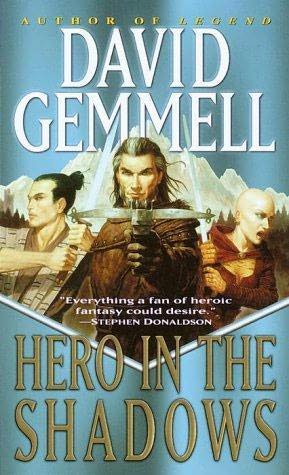
Hero in the Shadows by David Gemmell

Waylander gave up his dark life as an assassin years ago–or so he thought.  When an ancient magic gateway begins to break down and evil beings from another world set out to reconquer the lands of Kydor, Waylander finds himself caught up once again in the cycle of war and bloodshed.

Waylander joins forces with Kysumu, a rajnee warrior who has been training all his life to be the best swordsman, and Ustarte, an escaped  changeling experiment who has come from the demon world to organize a resistance.  But when the spirit of Qin Chong comes from the past to aid the fledgling resistance, he comes to the unlikeliest person of all–the ditch-digger Yu Yu Liang.  As Kysumu wrestles with envy over the spirit’s choice, he comes to understand what it truly means to be a hero.

This book was good. Way good.  Not only was it a thrilling action/adventure story, it was full of deep, wonderful insights into the nature of courage and cowardice, life and death, good  and evil, and true heroism.  David Gemmell’s books are full of wonderful insight, and deliciously complex in the way they deal with life’s most important and meaningful questions.

I read the last hundred pages at a breathless sprint.  So many of the characters died!  Yet even though the story was very violent, I didn’t feel that it was excessively so.  The violence always had a reason to be there, and added something to the story.

What really surprised me was how Gemmell redeemed even some of his most evil characters.  Just when you think one of the main antagonists is soulless and outright evil, he shows you another side of the character and makes you rethink him/her entirely.  Amazing.

Not only where the “good guy” characters imminently likeable, they were surprisingly relatable.  I felt like I understood exactly how Kysumu felt, having spent his whole life training to be the best warrior, only for the spirit of Qin Chong to choose a clumsy, shameless commoner.  As he struggled with his  jealousy, I felt I knew exactly what he was going through.  Interesting stuff.

Waylander, too, was very interesting.  Even though he was the best warrior out of anyone in the book, he was far from invulnerable or perfect.  He had a dark side that was very believable–not too gritty or over the top.  In fact, I think Waylander was originally an antagonist in the earlier books in the series.

When I read White Wolf, I had issues with the plot structure and excessive use of flashbacks.  Not so with this novel.  The plot progressed wonderfully, keeping me engaged and interested the whole time.  The twist ending was delicious!  Wonderfully satisfying.

Above all else, this is a book that means something, that actually says something.  I came away from this book satisfied, not only because of the excellent, entertaining story, but because of the way the story made me think.  Gemmell is an expert at creating depth to his characters and his stories, pulling you beneath the surface to glimpse at things that are really important and meaningful.

Outlining for a discovery writer

I’m almost finished with the rough draft of Bringing Stella Home, but I can’t shake the feeling that this draft really sucks and is full of holes.  

Part of that is probably that I wrote the whole thing  out of the top of my head.  The only part that I really took the time to outline was the back histories of the mercenaries–and that gave me material to make the story a LOT stronger.  This probably means that I need to do more outlining in the future.

I think I know now what to do and not to do.  Here’s my list of do’s and don’ts for someone like me who is more of a “discovery writer”:

Do’s:

  1. Keep a list of brief explanations for setting elements (history, cultures, traditions, technologies, magics, etc).  These do not need to be full length articles, but they should have enough information to trigger your knowledge and/or record the things that you are likely to forget.
  2. Keep profiles of all the major/viewpoint characters.  These should:
    –Briefly explain their backstory, including parents/family/origin, childhood, education/training, major formative events, etc.  This part should be fairly extensive, and will help you discover even more things about your character as you write your story;
    –Explain, in some detail, their motivations–not just their desires, but the basis behind their desires.  These usually grow out of the backstory;
    –List some basic stats: age, height, distinctive physical characteristics–basically, the stuff someone is going to get on a first impression;
    –List their important strengths.  This part can be sparse, but you should at least be aware of the things in which they are competent;
    –List their important flaws/handicaps.  This part can also be sparse, but it should be extensive enough to at least make you aware of and/or get you to think about the potential conflicts that will arise;
    –Explain why this character is sympathetic–why the reader is going to like this character.  You MUST make a conscious effort to think this out.  As the writer, you will love your characters simply because you created them, but the reader will not share in this euphoria.  Write this section like a pitch, as if you’re addressing the reader (I haven’t tried that yet, but it sounds like a good idea and I’m going to try it on my next project).
  3. Keep an ongoing list of all the major plot conflicts, with a checklist for each one of things that must/should happen in order to make the conflict as juicy and story-rich as possible.  These lists should be sparse: one sentence to explain the conflict (character vs. character), and each point of the checklist should also be one line.  You will flesh out each of these points as you go along, and you may even add new conflicts and get rid of old ones as your story takes shape.

Tip: None of these sections needs to be extensive.  Sometimes, it will work better if you simply cut and past excerpts from your novel in the appropriate places in your outline.  This may be especially helpful for setting elements and minor characters.

Tip: Not all of your outlining has to be done before you start writing.  The outline should be an organic document that expands and changes with your draft, and your best ideas will come as you write the story, not as you write the outline. The outline exists to serve the story, not the other way around. 

Don’ts:

  1. Don’t feel that you have to write encyclopedia-style articles on all of your setting/worldbuilding elements.  You are the only one who will see these, so you don’t have to extensively edit or proofread these sections.
  2. Don’t try to explain every detail of your characters’ personalities.  When you have a clear backstory, these will come out naturally.  To write believable characters, figure out the basics and then GET OUT OF THE WAY and let them take over.
  3. Don’t outline the plot; outline the major plot conficts with their necessary events, but expect these to change as you write.  This should be the most flexible part of your outline.
  4. NEVER feel that you have to fit your story to the outline.  The outline exists to serve the draft, not the other way around.  Use it as a reference and a set of guidelines, not a set of rules.  You will discover your story as you write and daydream about it, not as you write your outline.
  5. Don’t worry if your outline is spotty and full of holes.  You’re not writing this to an uninformed audience; you’re writing this to your future self, who can fill in the holes quite well.  In fact, your outline only exists to fill in the holes in your future self’s head and point him in a clear direction.
  6. Don’t worry if your story gets ahead of your outline on the rough draft.  For discover writers, outlines are more of an after-the-fact thing anyway, and your outline will continue to grow and expand in the rewrite.  In fact, you may find it more productive to write the rough draft in a burst of frenzied creative energy, leaving 90% of your outlining for the rewrite.

These are a few of the things that work for me, as a discovery writer.  I haven’t tried out everything on the do’s list, but looking back, I can see that they would have helped tremendously if I’d done them while writing Bringing Stella Home.  

Just because you’re a discovery writer, that doesn’t mean that you shouldn’t keep an outline.  It just means that you need to keep a different kind of outline, one that will enhance your discovery writing process rather than constrain it.

Genesis Earth pitch and other assorted thoughts on writing

Today I got together with Charlie after her work and discussed how to pitch my novel Genesis Earth.  We did it in the following way: I took a few minutes to explain what the book was about, while she wrote down the words that stood out and excited her.  Later, I took the words and worked out a thirty second pitch for it.

It was HARD!  I spent nearly two hours after meeting with her just to write out a stupid four or five sentence blurb!  Selling your work is totally different from producing it.  Anyway, here’s what I came up with:

Michael has never set foot on Earth, but it haunts him as much as the legacy of his parents.  So when his parents build the first artificial, traversable wormhole, he sets out with his mission partner, Terra, to explore the Earthlike planet on the other side.  They arrive only to discover an empty, abandoned world and an unresponsive ghost ship advancing towards them.  When Terra’s schizoid tendencies threaten her mental stability, they both must learn to trust each other in order to confront the mysteries of the new universe–and the personal insecurities that keep them from what they truly desire.

I have that down to 29.6 seconds.  I should probably cut it shorter, but as it is it only has about half of the words that Charlie wrote down.  If I cut it any more, I’m afraid it just won’t make sense.

It’s a start, though, and talking with Charlie helped me out tremendously.  I realized that when I’m selling this stuff, I need to focus on the characters.  Sure, all the worldbuilding stuff is interesting, but it’s not what hooks the reader.  If all you’ve got is thirty seconds, don’t cut to the chase–and don’t give a synopsis!  Synopsis =/= pitch!

Charlie was exhausted, so as we talked, she started ranting in a way that can be described as bluntly honest.  Interestingly enough, most of what she said was actually quite helpful, not only for Genesis Earth, but also for my other projects.

The most helpful thing she mentioned was that when you’re writing characters, you often have to pick out their distinctive character traits and consciously overemphasize them.  If you don’t, the reader might not pick up on it and find your characters stale and boring.  While I hate melodrama and try to keep my novels free of it, I also need to keep my characters interesting.  It’s a fine line to walk, but one that you can’t avoid.

She also said that it’s very easy for protagonists to be more boring than the main characters.  I think this is probably because we rely on formulas and cliches when we’re starting out, since that’s much less risky than breaking the rules we don’t yet fully understand.  The protagonist is the character closest to the trope, while the side characters can do what they want without threatening the integrity of the story.  

Charlie said that because it’s so easy to fall into the trap of a boring protagonist, you need to consciously choose the traits that are interesting about that character and work them into the story as much as possible.  I realized, as she said that, that my main protagonist for Hero in Exile is, indeed, a boring character.  I need to pick out the things that make him interesting and consciously work those into his character.

This got me to think about planning.  I’ve found that if I try to outline a novel when I set out to write the rough draft, I end up telling a completely different story.  However, if I try to write a second draft without an outline, I have a hard time keeping things straight and fixing all the stuff I missed while discovery writing the first draft.

(I’m really upset now, because I was going to mention something that I need to foreshadow in the next revision of Genesis Earth, but…I totally forgot what it was!  GAH!!!  That’s what I get for not outlining!)

Charlie then started to rant about some of our writing friends, and how she would never listen to criticism on her writing from someone she considered to be an inferior writer to herself.

That part was…interesting.  While I agree 110% that arguing with criticism is a sign of a poor writer, I don’t think it’s especially useful to rank writers in terms of “good” or “bad.” I would like to believe that I can learn something from everybody, and not just what not to do.  Perhaps that’s optimistic, but I think it’s also practical–I’ve found that a bloated ego can shoot you in the foot six ways to Sunday before you even know what’s going on.  I’ve found that not just through one unfortunate experience, but through several.

Brandon Sanderson said something very interesting in the last email he sent out to his English 318 class: he said that in New York, editors and agents don’t rank manuscripts by “good” and “bad,” they rank them by how much work they think it needs to be publishable.  There is a distinction between the two, just as there’s a distinction between recognizing something that works really well and something that follows the rules.  

That’s about all I have the time for now.  I’ve got to get to bed.  Late night internet == bad idea.

Spin by Robert Charles Wilson

What would you do if you knew that the world was going to end in the next thirty years? That one day, before the end of your natural lifespan, the oceans will boil and the forests burst into flames, and life on this planet will come to an end? That you, your children, and even humanity itself have no future–that everything will end with you?

When the mysterious beings known as the Hypotheticals encase Earth in a temporal warp field that causes years to pass outside for every second on Earth, that is the uncomfortable question that all of mankind must confront. In five billion years–less than forty years on Earth–the sun will burn up its hydrogen and expand into a red giant star. When that happens, the sun will swallow the Earth and every living thing will die.

Some people turn to religion for answers.  Some turn to Science.  Some put off the question, living their lives as if the end will not come.  But as the years pass and the unavoidable apocalypse looms nearer, humanity begins to spiral out of control, and civilization itself looms on the verge of collapse.

The year the stars fell from the sky, thirteen year old Tyler Dupree discovers that he is in love with his best friend (Jason Lawton)’s sister, Diane.  The dynamics of the friendship between the three, however, make it impossible for Tyler to express his true feelings–and, in any case, Diane doesn’t seem interested in being anything more than a friend.

When the Spin hits, all three of them find themselves on radically different and sometimes conflicting paths.  Diane turns to evangelical Christianity and the frenzied religious outporing the Spin inspires.  Through his father, Jason rises to become one of the most influential scientists and directors in the Perihelion Foundation, the premier aerospace agency and Spin-related policy forming body in the US.  

Tyler, however, pursues the same middle class life he probably would have followed anyway–medical school, followed by a career as a doctor.  Still, his undiminished feelings for Diane and his frienship with Jason draw him into the center of the Spin hysteria and behind the scenes in the circuitous Spin-era politics.

Diane, now married to a fervent believer in a free love fundamentalist cult, comes to rely on Tyler as her only link to the outside world.  Meanwhile, Jason Lawton pursues perhaps the most grandiose and ambitious project mankind has ever attempted; the terraformation of Mars. 

With the temporal distortion of the Spin, millions of years of evolution turn Mars into a verdant green world in only one Earth year.  When Jason launches the first manned mission to the planet, barely a week passes before the the first Martian-born human returns to mankinds ancestral home–a descendant of a civilization millenia older than our own.  This small, dark-skinned, wrinkled man comes with a tantalizing message that may prove the key to finally understanding the Hypotheticals and the Spin itself.

But all of this may be too late, because the Spin membrane is finally beginning to show distressing signs of failure, and the sun has already grown hot enough to boil the oceans and scorch the planet.

I loved this book.  Honestly, I have to say it is one of the best science fiction books I have ever read.  Better even than Ender’s Game, better even than Foundation or any of the other classics.  No other book that I’ve read has done everything that I believe a good science fiction book should do.  I would highly recommend this book to anyone and everyone.

Like Clarke and a lot of the older classics in the science fiction tradition, Spin addresses some of the grand questions with which science and humanity have always wrestled.  What is the ultimate end of mankind?  The ultimate end of evolution?  Are we unique in this universe?  What is our place in the cosmos?  What is transcendence, and can we as a mortal species achieve it?

Unlike much of the older works, however, Spin addresses these questions through solid, developed, rich characters and a human drama that is as engaging as anything in any other genre.  When I read this book, I felt connected with these characters.  I genuinely cared about them.  They were real, distinct people who changed and grew based on their choices and experiences.  Furthermore, their struggles and conflicts echoed my own.  It felt true.  Tyler’s unrequited love was not only utterly believable, it kept me just as engaged as the grand ideas and the science fiction elements.

As science fiction, the ideas in this book were some of the most original and eye-popping ideas I’ve ever seen.  There was definitely a sense of wonder, as thick and beautiful as Clarke or Heinlein or Asimov.  The thing that made these ideas so great, however, was the eminent believability that accompanied them.  Robert Charles Wilson thought out the implications of everything, and showed them through concrete, human details.  His Martian landscapes were as real and believable as his picture of the New England countryside.  I not only felt that I was there, I felt that I was in this world, where the end-of-everything panic had set in, causing all sorts of bizarre, almost post-apocalyptic (pre-apocalyptic?) social changes.  It was truly fascinating.

But it wasn’t just the storytelling that engaged me: Robert Charles Wilson’s prose is among some of the best that I’ve ever read.  Reading this book really was like eating cheesecake.  The writing not only flowed, it shined, yet in a way that illuminated the meaning behind the words rather than drawing attention to the words themselves.  Wilson’s metaphors were not only rich and beautiful, they expressed the meaning behind the text so clearly that in each case, I don’t think he could have gotten across that particular impression, that feeling, in any other way.  Everything was calculated, and I would read pages and pages of text without even realizing how far I’d come.  Incredible.

I did have one issue with my first readthrough, back in July of last year: the Martian civilization, while grand, didn’t feel grand enough.  I mean, in 0nly four thousand years of history, look how far we’ve come here on Earth–all of our religions, all of our science, all of our discoveries and everything else.  We can hardly even remember what it was like, four thousand years ago–yet in Spin, the Martians know all about the reasons why Earth spawned their civilization, all of the questions that the Earthers have been asking about the Hypotheticals, etc.  I almost think that the Martians would have a more mystical view of Earth; that their understanding of us would be steeped in legend, and that they would have forgotten who we really are.

In my second readthrough, however, this was less of an issue to me.  Wilson really does make the Martians seem alien, a separate, distinct culture with a long, rich tradition.  His Martian citizen is very distinct from any of the Earthers, and notices some very small things that we always take for granted.  So, even though there could be more of a feeling of grandeur, Wilson already paints a very believable, very grand view of the Martian civilization he invents.

I am not exaggerating one bit when I say that this is probably the best science fiction book I have ever read.  I would recommend it above and beyond anything else I’ve reviewed here on this website.  If you haven’t already, pick up this book and read it.

New directions

This past week, I’ve been going through Bringing Stella Home at quite a good clip.  I’m going through the rough draft as I had it at the end of April, making some major revisions that hopefully are going to make it easier to write the middle section.  

I’ve been going along at a good clip, getting through as many as seven thousand words a day (it helps that I’m not taking classes or working right now), but today I hit something of a wall and realized I couldn’t go forward if I didn’t have some serious  backstory worked out.  So, instead of writing much in the book itself, I went through each of the characters in this mercenary unit and wrote out ALL of their backstories.

It was fun, and took a lot more time than I was expecting.  It also surprised me how much it fleshed them out, made them all real people.  I could go through and write a prequel to this novel now, where the viewpoint alternates between all of these characters and tells how they got together and formed the unit that they are now.  I won’t do that, since it would take too much time, but now I can do it, and that’s going to help out a ton in figuring out what has to happen next.

For this project, one of my goals is to experiment with the three act structure and see if I can strengthen my writing by strictly following that story format.  Well…when I say strictly, I don’t mean that I’ll make the characters do stupid things just to move the plot where it needs to go.  At least, I’m going to try not to end up doing that–we’ll see how it ends up.  The first draft is probably going to be horrendous.

Speaking of horrendous, I’ve been surprisingly discouraged with this story in the past few days.  I mean, it’s probably just me, but it seems that this novel is really just a piece of crap.  Of course, it’s a rough draft, so it’s supposed to be crap, but it’s just frustrating.  Then again, my writing group in English 318 seemed to be really into this story–sometimes, it seemed that they struggled to find things to critique about it–but I wonder if a lot of the positive stuff they said wasn’t just because they were being nice.

Meh.  It doesn’t matter.  Of course this draft is going to need a lot of work–it’s a rough draft, for crying out loud.  If I didn’t think it needed some serious work, something would be wrong with me.

The cool thing is that part I ends at about the 30k mark–right smack at 25%, assuming this novel ends up being about 120k.  That’s exactly where it should be, according to the three act structure.  Encouraging!

I mapped things out on my calendar, and I’ve figured that if I do 3,00 words a day, I can finish this draft by the 15th of June.  3,000 words a day shouldn’t be too hard to manage–I’ve got another 40k of stuff from the previous unfinished draft, and while much of that needs some deep revisions, I can probably recycle at least two thirds of it without making too many changes.  I’ve got a couple of conventions coming up here–CONduit and BYU Writers for Young Readers–but I think I can still make things average out quite nicely.

15th of June.  It’s a good target.  It also gives me practically the entire summer to revise and re-revise my other novels, perhaps even start a completely new project.  Huzzah!

(image courtesy photo researchers)

Ugh. Just ugh.

Man, it was hard to write.  So hard, I only just finished, and it’s 1:30 am.  Ugh.

The reason it was hard was because the character’s reactions in this scene needed to be totally revamped.  That also necessitated a complete shift in the structure of the writing, because the rough draft consisted almost entirely of internal feelings and reflections.  Indeed, the rough draft of this scene was about as close to an info dump as I will ever allow myself to come.

Or so I tell myself.  The first rewrite tried to keep things internal, just with the new reactions and motivations, but…well, before I knew what I was doing, I was info dumping.  Yes.  Shame on me, I went and committed one of my greatest pet peeves.  And I felt dirty afterwards, too.

Well, guess what happened?  I just kept writing, dumping out the info that I , but it kept coming out slower and slower, like wringing the last few drops out of a washcloth.  I didn’t know where to end, so I decided to cut it out somewhere in the middle…but then I got to the next scene from this character’s point of view, and realized that I was lacking the right transition to that part of the story.

Everything was falling apart.

So…I couldn’t just cut out all that stuff that I’d vomited onto the page.  It was a butt ugly info dump, but I had to get it across somehow.  I decided the only way to do it was to add in an extra scene.

 Trouble was, for the sake of the flow of the  chapter itself, I couldn’t just add all that stuff in another scene.  For starters, the nature of the stuff I’d just dumped on the page necessitated two scenes, but I didn’t have another one to bring in to break them apart.  I didn’t want to have three scenes all in a row from the same point of view–that would just be clumsy.

Ugh.  Just ugh.

So, how to solve it?  Take out a chainsaw and perform some delicate surgery.  I threw out virtually the entire info dump that I’d spent a good part of my day writing, and made some fundamental changes to the world that I’m writing that totally negated all of that previous stuff (I can do that, you know.  One of the perks of being a science fiction / fantasy writer–you can play god with the world you create).  Then, with the new changes I’d made to the world, I came up with a totally different scene–one that actually worked–and inserted that after the very brief, almost prologue-ish opening scene of introspection.

And then, when I was working with something a little more concrete, I was back in that wonderful place where character shines through and suspense builds through a functional plot.  No more info dumping–I felt so clean, so free of sin.  Great.

It still took bloody forever to finish, though.  All that wrangling from earlier in the day killed my momentum, so it was an uphill battle the whole way.  Ugh.

Looking back, am I satisfied with what I wrote?  Honestly, no.  But the revisions it need are the kind that can wait until the 2.0 draft, not the kind that are preventing me from finishing the first draft.

Those problems, I’m afraid, are yet to come.