Drawing up the starmaps

I’m a big fan of indirect sequels, where each book tells a standalone story but incorporates many of the same characters as other works and is set in the same world.  Sharon Creech did this with Walk Two Moons and Absolutely Normal Chaos: the main character from ANC was a minor character in WTM.

The thing is, I write space opera, which means that each novel spans at least two or three different star systems.  After four or five novels, it can get really hard to remember where all the stars are in relation to each other.  So, taking my own advice from an earlier post, I drew up a starmap for my universe.

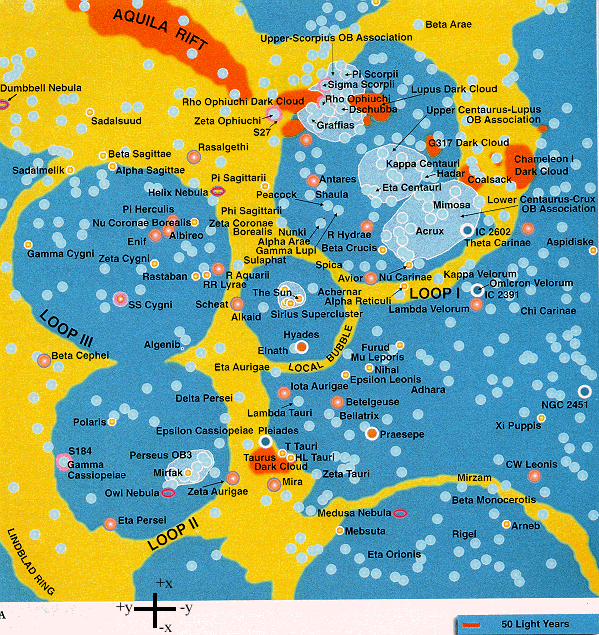
For a pattern, I used these maps of the region of space local to Sol.  I’ve since forgotten where I got them; I think wikipedia, or maybe the atomic rockets site:
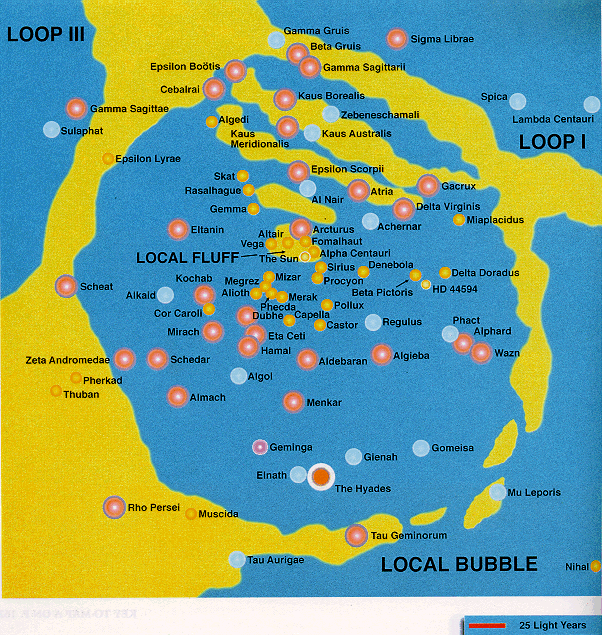
Since they’re only 2-dimensional, they have some obvious shortcomings, but for my purposes they work just fine.  The thing I like the most about these maps is that they show rough distributions of interstellar gas and dust.  In my Gaia Nova universe, areas of high density (such as the interiors of nebulae) are off limits to the FTL technology, so finding a way to show that was absolutely critical.

And so, after playing around with MS Paint and The Gimp, this is what I came up with:
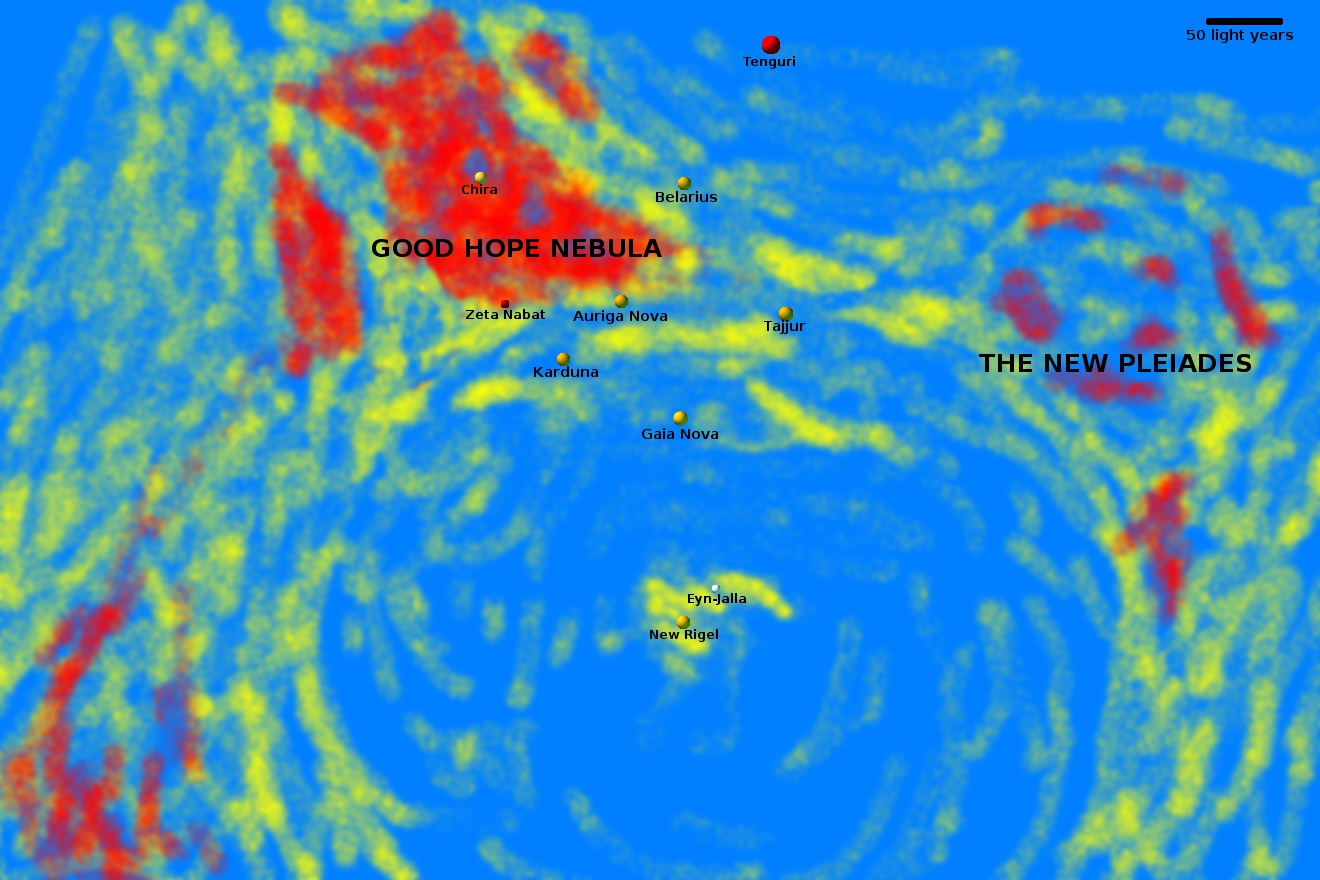
It’s definitely a work in progress (seeing as I’ve only got about a dozen stars up so far), but I’ve got to be honest–I geeked out hardcore when I was finished with this thing.  Whether you’re writing fantasy or science fiction adventure (which I’d argue is a branch of fantasy), there’s just something about having a map…

The best thing is that it’s REALLY easy to update.  If I want, I can throw up half a dozen new stars in fifteen minutes–or rearrange the current arrangement of stars with the simple click of a mouse.  That’s good, because I don’t want to spend all my time drawing up maps–the map is just a tool to help me write the stories.

And oh man, I’ve got a lot of stories to tell! 🙂
Gliese 581g: The first New Earth?

My friends, the revolution has begun.

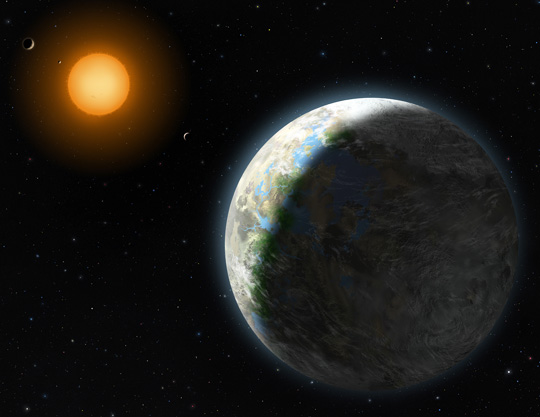
Scientists from UC Santa Cruz announced today the discovery of Gliese 581g, the first planet discovered in the habitable zone of its star.  Let me repeat: the first planet discovered in the habitable zone of its star.

In this habitable zone, temperatures are just right to support life as we know it here on Earth–that’s why it’s known as the “habitable zone.”  Of course, there are several other conditions that need to be met before we can know whether the planet is truly habitable, but one of the most important criteria has already been met.

According to the report, this planet sounds like one of the rainbow worlds from Isaac Asimov’s Foundation trilogy.  It’s tidally locked to its star, which means that one side of the planet is always in day, while the other side is always in night.  If life as we know it exists on this world, it’s probably limited to the narrow band of twilight between the extremely hot day zone and extremely cold night zone.

The scientists calculate that the planet is about three times as massive as Earth, which means that if it’s a rocky world (as opposed to an ocean world), gravity on the surface would be about 1.2 times that of Earth.  The host star, Gliese 581, is only twenty lightyears from Earth–the 86th closest star to our solar system.

But the best part is that the scientists feel that there are many, many more worlds like this out there.  They detected Gliese 581g using the radial velocity method, which uses the star’s wobble to detect the planets tugging on it.  Typically, this method is only good for discovering “hot jupiters”–very massive gas giants in extremely tight orbits (sometimes with a period of only a few Earth days).  However, by the fact that scientists were able to find a planet in the habitable zone using this method, they predict that similar Earth-like planets are extremely common.

That is so cool, I don’t know what to say other than “the revolution has begun.” And truly, it’s a revolution.  When we start discovering hundreds of Earth-like planets, and find that several of them have conditions perfect for supporting life (or better yet, actual evidence of life present), it’s going to change everything about how we think of our place in the universe.

This is an incredibly exciting time to be alive!  Now if only I could live long enough to join the first colonization mission to one of these worlds…

Update on things

Revised the first chapter of Mercenary Savior today.  I will probably revise it a couple more times before this draft is finished, but at least I’ve done it once.

For some reason, most of my alpha readers didn’t give me too many comments to work with.  I’m not sure if that’s a good thing or a bad thing, but in practical terms it means I’m mostly on my own.  Still waiting for some to get back to me, though.

Last week, I wrote the prologue, where as a young woman Danica returns to her home only to find her family massacred by hired thugs.  It was…surprisingly dark.  Charlie liked it, though, so that’s a good thing.

Charlie also complimented me on my prose, saying that it improves every time she reads something of mine.  That’s a pleasant surprise, since I certainly don’t notice any difference–but then again, I’m so close to my own writing that improvement is hard to see.  Good to know that my craft is getting better, not getting worse.  Thanks!

Last week, I realized that I didn’t have any submissions out for Genesis Earth. None at all.  I sent out a query on Saturday, but it was surprisingly difficult.  Submitting is definitely not my strongest point; I really need to work on that.

In unrelated news, I’m flying home tomorrow to spend the week with my parents.  I asked to come home for my birthday present; my mom’s health insurance through her work covers me until September, but only in Massachusetts.  Since I haven’t had a dental checkup in years, I figured it would be good to get that done.  Also, it’s a nice break and a chance to see my folks.  I’m looking forward to it.

Let’s see, what else is going on?  Oh!  The Kepler Mission announced a press conference for Thursday to discuss “an intriguing star system” they recently discovered.  Needless to say, I can hardly wait!

Also, no less than 6 fellow quarkies are moving in to my apartment complex this next semester.  Six!  And they’re all girls!  If Baggins old place was Bag End, and his new place is Rivendell, our complex is freaking Minas Tirith.  And we’re forming a dinner group, too!  This next year is going to be awesome.

And that’s just about it for what’s new in my world.  I came just shy of 4k in Mercenary Savior today, and I hope to keep that up (or do more) until I get a new job.  For now, let me leave you with this EPIC chipophone presentation from lft.  8-bit music ftw!

Gah! It sucks

I’m about a third of the way through To Search the Starry Sea, and my greatest fear at this point is that it isn’t as good as the last novel I wrote.  Because if it isn’t as good, that means that I’m getting worse, not better, and if I’m getting worse, that means I’m never going to make it as an author, because I’m not even published yet, and if I’m not going to make it as an author, that means I’m going to have to do what I’m doing NOW for the rest of my life, which means that I’m going to be miserable and life is going to suck…

<pant> <pant> <pant>

Seriously, though, sometimes I wonder if I’ve really made the right choice.  To Search the Starry Sea is much more of a happy adventure story, but sometimes I feel that it lacks depth and meaning.  I’m starting to get feedback from my alpha readers for Bringing Stella Home, and their reactions to it are surprisingly encouraging.  That story moved people–but this one?  I don’t know.

Then again, Bringing Stella Home is dark, gritty, and very tragic.  I remember feeling depressed by the story even as I wrote it.  Is that the kind of story I want to be known for?  If I can write something deep and meaningful and have it be optimistic and adventuresome, that would be a lot better.

I’m discovery writing it hardcore, which means that side characters often come to play a much more central role than I’d thought, and events that I thought I could cover in a chapter, I have to cover in two.  I have an idea where the story is going to end up, though, and it’s going to be awesome. How awesome?  Let me show you:

Yeah, it’s going to be awesome.

I think the key to keeping it meaningful is 1) to keep in mind the main character’s inner conflicts, framing them in a way that the readers can relate to their struggles, and 2) keeping the overall growth arc constantly in mind.  How does what’s happening affect how the character is changing?  That kind of stuff.

I hope I can finish this in two months.  I’m mired in the middle of it right now, and the end is far from sight.

In the meantime, I think I’ll get some sleep.

It’s full of stars!

I have a confession to make…

I should have been writing these past three hours.  I really should have been writing.  But a couple of days ago, I downloaded this awesome program called Celestia.  And when I say awesome, I mean awesome!

Imagine Google Earth.  Now, imagine Google Earth…for the Universe.

I told you it was awesome.

Anyway, I just downloaded all the messier objects , gps satellites, and some other random addons, and spent the last two hours playing with them when I should have been writing. Gah!

Oh well, I guess you can call it research. 🙂

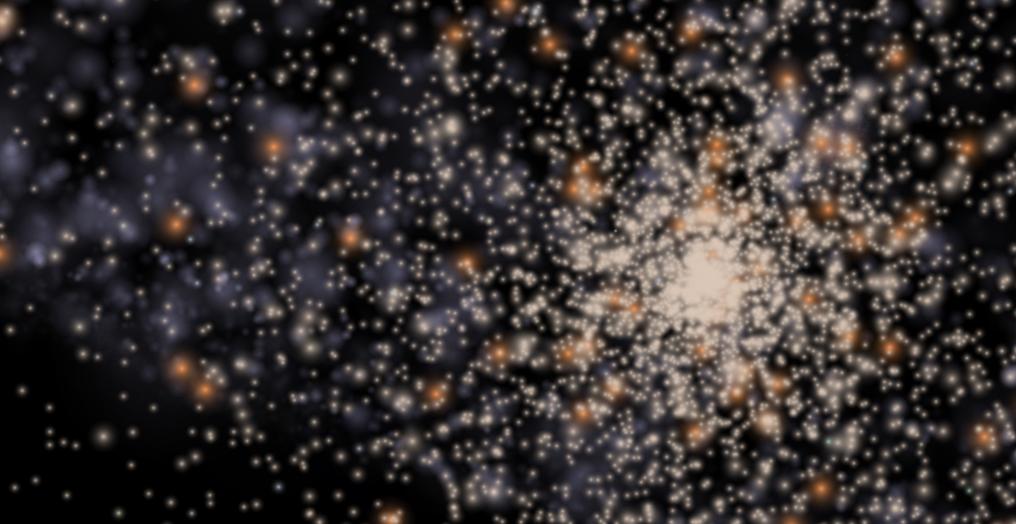
My goodness–words cannot describe how cool this stuff is.  It’s like…like a planetarium on my computer.  I’ve never felt so small in such an incredibly vast universe!  And oh my heck, do you know what it’s like outside of our galaxy?  No stars–just blackness everywhere!  It’s so freaking scary!  And inside of those massive globular clusters, like M13–holy cow!  What would it be like to live on a planet in one of those clusters??

I should probably stop rambling.  But…but…it’s just so awesome!

This is the kind of stuff I’ve been writing all my life!  Stars and galaxies and planets, other worlds–and now, at last, I can get some kind of a tiny picture of what it all looks like.  I feel like the nexus 6 soldier from Blade Runner: “I’ve seen things…” Seriously, this has the potential to revolutionize my writing.  The things I’ve seen…

But anyway, time to get my mind off the stars (at least temporarily) and write!

Quick worldbuilding question

For To Search the Starry Sea, I’m writing from the point of view of a far future starfaring culture completely independent of Earth. They’ve preserved our concepts of “hour,” “day,” and “year,” but these units of time do not correlate in any way with the revolutions of the worlds on which they live (basically, a set of tidally locked moons orbiting a gas giant planet several AUs from its sun).

The people of this culture use terms like “morning,” “evening,” “day,” and “night” to describe their waking and sleeping cycles, but having been cut off from Earth for so much time, they don’t associate these times with the position of the sun.  In order to convey that this is different, I’m thinking of spelling “afternoon” like “afternune,” to show that there’s been some cultural drift since the migration from Earth.

Does that work?  Or if  you had to read “afternune” instead of “afternoon,” would it completely throw you out of the story?

Or am I just not making any sense at all?

Never a good time to write

I’m on vacation now, staying with my uncle in Midland.  The rest of the family will be out here in a couple of days.  In the meantime, I’m visiting with relatives, going Christmas shopping, and trying to finally finish Bringing Stella Home 2.0.

It’s not going to be easy, though, with all the family stuff going on.  I managed 1,221 words yesterday, but most of that was after midnight.  I get the feeling this is going to be pretty common for the rest of the time here.

There’s never a good time to write–but I think that’s the norm.  If I’m not busy with exams or schoolwork, it’s family obligations or traveling.  There is never a steady routine that gives me time to write.

I suppose part of being a writer is learning to write anyway.

So anyways, my goal is to finish Bringing Stella Home 2.0 before the new year.  I’m about 26k words from the end, so with only 10 days or so to go, that’s going to be almost 3k words per day.  A little steep, but definitely doable.  Also, since this isn’t the polished draft that I’m going to be sending out to publishers, it doesn’t have to be perfect–just good enough for me to make perfect on the next pass.

And now my Dad’s calling me, asking if I’m up and ready to go.  I’ll have to cut this short here, but in the meantime, check this out: explanetary systems forming in the Orion nebula.  Holy crap, this is awesome!  Maybe I should go back to school and become an astronomer.

Movin’ along

I submitted a story to the Writers of the Future contest today.  Basically, I took the scene from Genesis Earth that won the Mayhew Contest this year, slapped just enough of an ending on it to make it feel like a coherent story (inshallah), changed a couple of universe details, and sent it out.  Time will tell if anything will come of it.

On Sunday, I home taught this girl who just graduated in astronomy!  She told me all about her capstone project, studying the variance in luminosity of a distant star getting its insides sucked out by a black hole / neutron star / something ridiculously cool.  We geeked out on stars more than on the scriptures!

Now I need to make friends with someone who works at the BYU observatory and hang out with them at their work.  With my next door neighbor the president of the BYU Astronomy club (no joke!) that might be a possibility.  And then we can order heavenly pizza and chill out reading The Leading Edge </inside joke>.

Ashes is coming along.  Did my 4k today, but it feels…like it isn’t going the way I want it to.  I’m  at 30% right now, provided the finished draft is under 150k, which might be difficult to pull off.  Lots and lots of sludging for the next month–I’m in the middle of the blue collar work of writing.  Middles are not my forte, but I think I’ll learn.

Dude, why didn’t I study astronomy in college?  I’m sorely tempted to change my major and go through another three years as an undergrad, just so that after I get my masters I can live at a place like this: