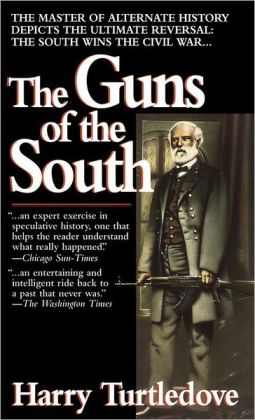
As those of you who’ve read my short story “The Gettysburg Paradox” know, I’m a huge fan of both the US Civil War and time travel stories. Harry Turtledove’s The Guns of the South is, quite possibly, the best combination of the two.
The novel starts just a few weeks after Gettysburg. The Army of Northern Virginia is in disarray, and a defeated Robert E. Lee has been forced to face the truth that the Confederacy has no real hope of winning the war. Then a bunch of time travelers in strangely mottled uniforms show up out of nowhere and supply his army with strange new guns called AK-47s.
Immediately, the tides of war change. Lee soundly defeats Grant at the Battle of Wilderness and presses on to Washington DC, which falls overnight. Triumphant, the South immediately sets about the peace negotiations with their northern neighbor, and prepares for a presidential election which Lee is expected to win. But disagreements about the fate of the new American nation soon arise between Lee and his benefactors, sparking a conflict that is truly out of time.
There’s so much to love about this book. Turtledove’s attention to detail is meticulous, not just in the obvious major ones, but in the little ones that have a disproportionate impact. For example, Lee appreciates the killing power of the AK-47s, but what impresses him even more are the MREs that the time travelers carry. When the gunmakers in Richmond pick apart the AK-47 in an effort to replicate it, it’s really fascinating to get their take on its functions. It really does read like a bunch of 19th century denizens puzzling over technology that they barely understand.
But what really got to me were the characters. Having read The Killer Angels and Jeff Shaara’s prequel and sequel to that great novel, Robert E. Lee felt like exactly the same character, just in a different book. His genteel sense of propriety, his calm but unshakeable sense of honor, his love of his men and respect for his enemy—it really was the same guy. And the decisions he makes after the war is over, while truly radical, are also eminently believable.
It’s not just Lee, either. Lincoln, Soward, Longstreet, Forrest—all of them feel very much like the people they really were, inhabiting an alternate reality. Turtledove’s research into their characters and personalities was meticulous. And it wasn’t just the big names, either, as all of the 19th century characters, including a prostitute who pretended to be a man in order to join the infantry, are based on real people who actually lived.
Fantastic book—a must-read for anyone with an interest in time travel or the US civil war. Whether those interests intersect for you or not, you’ll thoroughly enjoy this book.
The sequence of events that made the American Insurgency inevitable had its roots in a political shift that had occured more than a century earlier. It began with the Progressive Era, barely a generation after the first civil war, dovetailed into the New Deal, and culminated with the near complete subversion of the United States.
It is worth taking a moment to review the founding documents and constitutional principles of the United States, to show how far the country had strayed from them in the decades leading up to the American Insurgency.
In 1776, the Declaration of Independence established the philosophical foundation of the US Constitution; namely, the principle of natural rights and the social contract:
That to secure these rights, Governments are instituted among Men, deriving their just powers from the consent of the governed, That whenever any Form of Government becomes destructive of these ends, it is the Right of the People to alter or to abolish it, and to institute new Government, laying its foundation on such principles and organizing its powers in such form, as to them shall seem most likely to effect their Safety and Happiness.
This established the principle that rights are not bestowed by the State, but are held in reserve by the people. The purpose of the State is not to bestow favors or priviledges, but to preserve those rights and liberties which the people naturally possess.
The most important of these were enumerated in 1789 by the Bill of Rights, which were:
The right to free speech and freedom of religion.
The right to bear arms.
The right from quartering soldiers.
The right from unreasonable search and seizure.
The right to due process.
The right to a speedy and public trial.
The right to a trial by jury.
The right from cruel and unusual punishment.
The right to retain all other rights not explictly enumerated.
The right to retain all powers not explicitly granted to the federal government.
Together with the Constitution of 1788, these documents established a limited government, charged not with providing for the “common good” but protecting the individual rights and liberties of the people.
A century later, during the Progressive Era, this began to shift dramatically. Unlike the Founding Fathers, the 19th century Progressives saw government as a vehicle for achieving social reform. The concept of social engineering, so anathema to the constitutional principles of limited government, was gradually introduced until it became commonplace. Congress passed numerous laws that overreached their Constitutional mandate, and a Supreme Court dominated by Progressives upheld them. This incremental gutting of the Constitution laid the groundwork for the massive expansion of federal power under President Franklin Delano Roosevelt.
Today, FDR is largely regarded as one of the worst presidents in the history of the United States. In the years leading up to the American Insurgency, however, he was regarded as one of the best. The entitlement programs of FDR and his immediate successors had not yet failed, though the writing was on the wall, and the national debt, while skyrocketing to dangerous heights, had not yet driven the nation to bankruptcy.
It is difficult for us, looking back with the benefit of hindsight, to conceive how the people living at this time could not see the writing on the wall. While some of the more forward looking ones certainly did, the vast majority simply assumed that the broken system would continue to plod along as it always had.
However, it was not only a broken system that brought the country to its knees, but the secret combinations of power that sought to exploit it.
It is impossible to accurately document all of the players who were actively working to subvert the United States in the late 20th and early 21st centuries. We may never know whether it was a monolithic effort by a single global organization, or a loose ideological confederation of various political factions. However, we do know that there was a subversion effort of some kind, because the effects of it are measurable and well documented.
The subversion process, as described by Soviet defector Yuri Bezmenov, has four stages:
During the Cold War, the KGB actively funded or provided support to several left-leaning political groups in order to push the United States through these processes. The Soviet Union collapsed before the subversion was complete, but the process continued well into the 21st century until the crisis which caused the American Insurgency.
The purpose of demoralization is to effect a generational shift in basic moral values, laying the foundation for the disintegration of society. This was achieved through the social upheaval known at the time as the “culture wars.”
In the 1950s, divorce was rare, abortion was unheard of, most children were raised by their biological mother and a father, and religious practice was a major aspect of public life. By the 2010s, none of these were true. A lot of this was due to changes in government, which made divorce and abortion common and easy, incentivized single mothers on welfare to have more children, incentivized young couples to cohabit instead of getting married, and forced religious institutions to either adopt practices that ran contrary to their moral teachings or to retreat from the public sphere. In other areas, such as education, employment, law enforcement, and the media, similar trends can be documented that underscore a massive shift in social values.
The demoralization of the United States was more or less complete by the early 2000s. The destabilization process was already underway, but it accelerated dramatically under President Obama during the 2010s. During this stage, the society being subverted is pushed into violent confrontation with itself in order to foment a crisis. The race riots in Ferguson, Missouri marked a dramatic shift in race relations, ultimately leading to violence against the police. As law and order broke down, crime increased dramatically, especially in minority communities. Violence also became normal at political rallies and university events.
Historians disagree as to whether Hillary Clinton was supposed to merely further the destabilization of the country or bring it though crisis to the final stage of normalization. However, they almost universally agree that she was a major player in the subversion of the United States. Donald Trump, her Republican opponent in the 2016 election (the last year in which the Repulican Party would be a force in national politics), was probably also propelled to power by the secret combinations working to subvert the country, though most historians believe he was merely exploited by them, and not an active conspirator.
It is a testament to the resilience of the American system of government that the country did not collapse under Hillary Clinton’s presidency. However, her far-left policies pushed the United States past the point of no return. Before she was impeached and thrown from office in 2021, the Constitution was largely a figurehead document, exerting little force on the underlying political philosophy of the federal government.
The first and fifth amendments were largely dismantled in the aftermath of the college protest movement in the mid 2010s. The fourth amendment was rendered toothless by mass surveillance by the NSA, upheld by Clinton’s Supreme Court. The ninth and tenth amendments had been ignored for decades, and were effectively buried by Clinton’s sweeping economic policies following the Great Collapse in 2017.
The second amendment was the last thread by which the Constitution hung, and when President Ward attempted to annul it in 2026, the result was war.
Alright, it’s time to go through another story notebook. This one covers the spring and summer of 2010, right after I graduated. It was a weird transitional period in my life, when I didn’t really know what I was doing or where I was going, but I was determined to keep on writing anyway.
I filled three pocket notebooks with story ideas in 2010, and last time I mistakenly thought I’d covered one that went from graduation through the end of the year. While putting my records in order before going abroad, I found that this one actually came a little earlier.
Lots and lots of story ideas…2010 was definitely a good year for that. So anyhow, here we go:
A planet settled by people with aircars: there will be no asphalt roads, only packed earth.
An interesting consequence of futuristic technology; too often, stories come up with something flashy without really thinking through all of the implications. Can you imagine a world without asphalt? If you can, then please take me there!
A task-oriented woman who thinks men are fickle because they’re always trying to come across as macho, trying to save face, etc.
This makes me think of something I heard somewhere about gender roles and politicians. If I remember it correctly, most men go into politics for the fame, power, and glory, while most women go into politics because something in their community is broken and they feel it’s their duty to fix it. Not sure if that’s true or not, but this story idea made me think of that for some reason.
Humanity has been domesticated by a super-intelligent alien race and bred into several different breeds with wildly varying physical characteristics.
In other words, a post-human universe where humans have been bred as pets, like dogs. Can you imagine a world where the physical differences between humans of different races are as great as this:
Can these two even physically reproduce?
A fantasy where the traveling hero is actually the bad guy.
I think Girl Genius already beat me to that, though Othar is more of an annoyance than a genuine villain.
An interstellar Sir Richard Burton.
Now that would be an interesting series. Sir Richard Burton was a British adventurer who went to the Middle East before doing that was cool. He made the first English translation of the 1001 Arabian Nights (as well as the Kama Sutra, apparently), and was one of the first European explorer to sneak into Mecca–certainly the first non-Muslim explorer. I hear he was quite a character.
A planet on a highly eccentric orbit where habitability is sustained by large glowstones that absorb high amounts of energy and emit heat slowly.
Ooh, I’d forgotten about this one. I’ll have to use it sometime–maybe in a science fiction / fantasy mashup. You know, with dragons and stuff.
A werewolf who is tame around just one person.
I’m pretty sure this one has been done, and I’m also pretty sure I’m not interested in reading it. Sorry, Twilight fans–or maybe you’re welcome?
A landscape more vertical than horizontal, where the architecture reflects this (like the old Knight building).
The Knight building was a multi-split-level administration building at BYU where Leading Edge used to meet. Lots of stairs, entrances on just about every level–it was a weird building (but not quite as weird as the JKB). But yeah, a vertical landscape would be cool–though I guess that’s pretty common in cyberpunk, with all those cities.
An alien species that communicates only by touch.
“What the–augh! Get it off of me!” Thus begins humanity’s first interstellar war.
Purgatory for fictional characters, where all the plot hole stories go.
I’m pretty sure that was a South Park episode.
A religious order that believes that developing math skills is the key to self and enlightenment, becuase math is the only science that is completely a priori.
Heh, I’ll bet my Dad would like that story. It might be the first one of mine that he actually buys.
A man frames himself to go to prison so that he can go to law school / have time to write.
When you’re unemployed and struggling to make ends meet, some otherwise unsavory options begin to look pretty attractive…
What if humanity had a blight like the American Chestnut, where everyone over the age of 20 dies of a horrible disease?
I actually started writing that one. Finished the first chapter, kind of in a pseudo-Victorian first person style, like Robinson Crusoe. I have no idea when I’ll finish it, but the universe is really, really fascinating.
A world where novelists / storytellers convey their tales telepathically without translation into words.
And then SOPA gets passed, and all of us creative types are screwed.
What if the mountains were sentient? What would they think of the human race?
“Dang it! Not another cavity!”
Land of the sleeping rainbows
I think this is actually a real place in southern Utah; I just thought it would make a cool story prompt.
What if the Amish really are 18th century people, guarding a natural time portal in central Pennsylvania?
That would be a fun one to research. “Hello, I’m writing a time travel novel…can I join your village for a year?”
Marital therapy that involves swapping bodies.
I’m pretty sure Disney did something like that in the 60s. With the way the country has changed, I’m sure it would be much different if someone did it again today.
And that just about does it for this notebook. As always, feel free to use any of these ideas in your own work. It isn’t “stealing” if it hasn’t actually been written yet (unless congress passes a revamped version of SOPA that…hmm, that gives me an idea…).
For those of you who may not know, quark is BYU’s science fiction and fantasy club. I had the good fortune of being one of the club’s vice presidents for two years while I was a student, and I still keep in touch with a ton of friends from that group.
One of the funnest things about quark is the online werewolf games–currently, I’m GMing a round based on Interstella 5555. Recently, Jerle and I decided to put together a database of all 49 rounds that we’ve played over the years, compiling player stats, setting up rankings, and other such nerdy things.
While I was going across some of the older threads, I came across this amazingly hilarious premise for round fourteen:
In the year 1815 Napoleon conquered Russia.
In 1817 he conquered China.
By 1830 he was the ruler of continental Europe, Asia, and parts of Africa that were interesting.
In 1834 he invaded Antarctica and defeated the United Federation of Penguins and Polar Bears.
His successor sent ships to conquer America and England, and succeeded, but not without a fight.
The year is 2015.
The entire world speaks either French or English, or, more likely, some mixture of two.
A great scientist has invented a Time Machine.
The only hope for penguins and polar bears is to infiltrate high-security research facility in New Paris, use the device to go back in time and present a plush toy of a penguin to young Napoleon. A rogue rebel Greenpeace group assists the penguins/polar bears.
The research facility is guarded by an elite team of 15 highly-trained frenchpeople. Through great ingenuity Greenpeace was able to replace three of them with its agents. Those three must kill everyone else and use the time machine.
There is also a rumor that one of the elite guardsmen has been replaced by a clown.
 The sequence of events that made the American Insurgency inevitable had its roots in a political shift that had occured more than a century earlier. It began with the Progressive Era, barely a generation after the first civil war, dovetailed into the New Deal, and culminated with the near complete subversion of the United States.