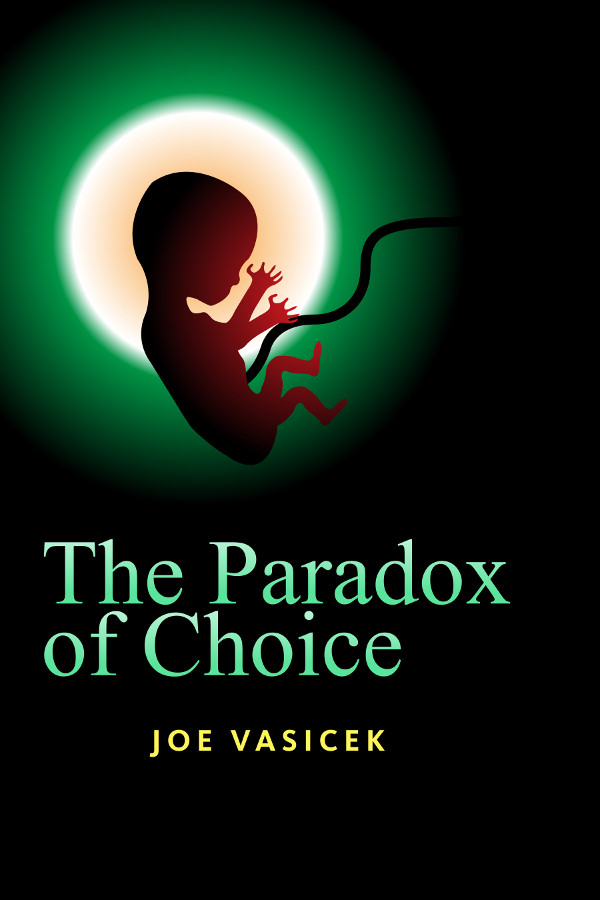
The argument that converted me from pro-choice to pro-life

On the issue of abortion, I would consider myself to be very pro-life. I have written several explicitly pro-life stories, including “The Paradox of Choice,” “The Body Tax,” and “The Freedom of Second Chances.” My wife and I also donate monthly to Preborn, a charity / Christian ministry that provides free ultrasounds and support to pregnant women seeking abortions.

I was not always pro-life, however. In fact, if you’d asked me fifteen years ago where I stood on the abortion issue, I would have described myself as either pro-choice or leaning pro-choice. So what was it that changed my mind?

First, a little background about myself. I grew up in a comfortable middle-class home, with three younger sisters and a mother and father who were married and faithful to each other. Abortion was not a thing that I had any direct experience with; it was little more than a vague concept that I heard other people arguing with. And although I grew up in a religious household, we lived in a Democrat stronghold (western Massachusetts) and both of my parents were Democrats, so of course the default position that I grew up with was pro-choice.

I didn’t really hear the abortion issue debated until high school. I went to an elite preparatory academy in Pioneer Valley, so I was surrounded by people who were far left even by Massachusetts’ standards. My position, which I more or less absorbed from those around me, was that abortion was a tragic but sometimes necessary procedure, and that it wasn’t the place of men or the government to tell women what they couldn’t do with their own bodies. Basically, the “safe, legal, and rare” position.

However, there was one pro-life argument I heard at that time that planted a seed in my heart. The school paper printed a debate on the abortion issue, and the student who wrote the pro-life side argued not from the legal position, but from the moral position—specifically, asking the question “when does life begin?” Since we cannot know when life begins, the student argued, we should err on the side of preserving life and treat the unborn child like a full human being from the moment of conception. If we believe that murder is wrong, erring on the other side—that of preserving the mother’s autonomy—would risk committing an immoral act, since we cannot positively say that abortion does not take a human life.

It was an interesting argument, and I didn’t really have a counter to it. However, the abortion issue didn’t rank very high on my list of priorities, so I filed it away and forgot about it, reverting back to the default position which I’d more or less absorbed. If pressed, I would say that I didn’t like abortions, but that it was something best left between a woman and her doctor. I didn’t really give the “when does life really begin?” question any serious thought.

However, one thing I did give serious thought to was the atrocities committed by the Nazis during World War II. The liberal, post-modern position that I more or less absorbed from the air around me was that history (or at least the part that really mattered) began in the 1930s, that the Nazis represented the ultimate evil, and that “never again” was civilization’s most sacred value—not just for the holocaust, but for all forms of genocide, nuclear proliferation, and global war. As a kid, I read every (non-boring) World War II book that I could get my hands on, and was profoundly moved by several of the photographs that I saw, especially of the Nazi death camps. Later, in middle school, I read Jane Yolen’s The Devil’s Arithmetic, which further cemented my revulsion of the holocaust, and my determination that I was not and would never be the kind of person who would assent to that sort of atrocity.

Fast forward to the 2000s. After serving a two-year mission, I attended Brigham Young University from 2006 to 2010. The contrast was stark. In Massachusetts, I had been the odd “conservative” kid surrounded by liberals. In Utah, I was the odd “liberal” kid surrounded by conservatives. And though BYU is not the most conservative school in the United States (that would probably be Hillsdale), the air that I found myself in was much more conservative than anything I’d experienced growing up.

Overall, the experience was good for me. I found myself questioning a lot of my unspoken political assumptions and coming to conclusions that would have surprised my earlier teachers and mentors. For example, I independently came to appreciate the second ammendment and the right to self-defense, mostly from participating in BYU’s jujitsu club and learning how to physically defend myself. I also gained a deep appreciation for the principle of free speech, since studying contrasting viewpoints was so key in shaping my own worldview at that time.

However, I still didn’t give much thought to the abortion issue, since 1) it wasn’t directly relevant to my life at that time, and 2) it was just a really icky thing to think about. If pressed, I probably would have said that I was against using abortion as a form of birth control, and that some restrictions should be put in place to prevent that from happening, but that I didn’t think Roe v. Wade should be overturned. I had never known a world before Roe v. Wade, and thus was more comfortable sticking with the default that I’d grown up with. As a faithful Latter-day Saint, I knew that I would never put a woman in a position where she would consider getting an abortion, so the status quo was enough for me.

As a side note, I should point out that the official position of the Church of Jesus Christ of Latter-day Saints is that abortion is wrong in all cases except where rape, incest, or the health of the mother create extenuating circumstances. As missionaries, if we wanted to baptize someone who had either had an abortion themselves or had participated in one, we had to move it up the chain to a higher ecclesiastical authority to interview them and determine whether the prospective convert needed to demonstrate more repentance. Later, as a member of a bishopric, abortion was something we had to seriously consider when convening disciplinary councils. It is possible to get an abortion as a Latter-day Saint without getting excommunicated, or to come back into full fellowship after being excommunicated for abortion, but you have to go through your local (and sometimes area/general) authorities to work it out—and even then, they will strongly encourage you not to go through with it. But there is quite a bit of room for nuance in the church’s position on abortion.

Not that I ever really gave the deeper nuances of the issue any serious thought during this period. In fact, the one question that I never really asked myself was “when does life actually begin?” If pressed, I probably would have taken the position from that high school debate article, that since we don’t know we should probably err on the side of assuming life begins at conception, but I never really thought through the full implications of that position, again because 1) it didn’t directly impact my own life, and 2) the whole abortion issue was just icky.

Fast forward to 2015. I had graduated from college, traveled the world a bit, spent a few years bouncing around odd jobs and more or less living on my own, and made the best decision of my entire life: to not pursue a graduate degree. If I had gone on to grad school, I would have racked up a whole lot of debt, delayed my exposure to the “real world,” and failed to learn a number of important and life-changing lessons from the school of hard-knocks. And now that I finally felt like I was getting my feet back under me, I began to question all of my prior political assumptions, especially since the Obama years were coming to a close. I had voted for Obama in 2008, but vowed that I would never vote for a Democrat again, and was frankly disgusted with the intersectional coalition and its crusade for anti-racism and social justice.

It was around this time that I discovered Jordan Peterson. I was deeply impressed with Peterson’s earnest sincerity, intellectual honesty, and courage of his convictions. I was also intrigued by many of his arguments, which ran contrary to so many of the things I’d grown up with. One of these was his argument that most of us would have gone along with the Nazi atrocities, if we had lived in 1930s Germany. His argument was basically: “we’d all like to think that there was something unique about the Nazis that made them so evil, but that isn’t true. They weren’t so different from all of us. You may think that you wouldn’t have gone along with all of the atrocities that the Nazis committed, but the truth is that you probably would have gone along. After all, you’re not so special. You’re just as much a product of your times as the Germans in 1930s, and they really aren’t as different from us as you think they are. Don’t kid yourself. You’re just as capable of evil as they were.”

This argument struck something deep within me, partly because “never again” was such a core part of my own personal identity. Was I the kind of person who would have resisted the evils of the Nazis? Or in fact, was I not that special, and also not that different from those who had gone along with the Nazis’ terrible crimes? The only way to know for certain was to compare our times with the times of the Nazi regime, to see if there was anything comparable to the holocaust in our own time.

As soon as I asked that question, it was like my eyes were suddenly opened. There is indeed an atrocity comparable to the holocaust in our times, and it has become so ingrained into our culture that in many places—such as the blue state where I grew up—it is almost like part of the air that everyone breathes. That atrocity is the genocide of the unborn. If life truly begins at or near conception, then we have committed 10x holocausts since Roe v. Wade, a full order of magnitude more blood than the Nazis spilled. Moreover, we have slaughtered the most innocent, voiceless, and powerless people among us: our own children.

It all comes down to the question “when does a human life begin?” As far as I can tell, there are only two answers to that question that are logically consistent and scientifically sound: “at conception” and “I don’t know.” Viability is a moving target that changes with innovation and technology: in another decade, we may have found a way to grow children outside of the female womb, making them viable from literally the point of conception. Capacity for pain is also a moving target, since we’re still learning all sorts of new things as our technology improves. Sentience doesn’t work because people in comas are both alive and non-sentient. Heartbeat doesn’t work because it is possible to put an animal into suspended animation, where their heart has stopped beating, and successfully revive them. We can’t exactly do that to humans yet, but it’s only a matter of time and innovation before we can.

Now, I cannot say for certain that abortion is always wrong. Just like there are circumstances when it is just to shoot someone to death (such as during a violent home invasion), I understand that there may be circumstances where an abortion is similarly warranted. These are the edge cases like rape, incest, and health of the mother that the pro-choice pro-abortion activists always fall back on. The clearest of these is probably ectopic pregnancy, which is almost always fatal for both the mother and the child. But of course, what the activists never tell you is that almost all of the abortion bans that have been put into place since the end of Roe v. Wade have exemptions for ectopic pregnancies, which are not considered legally to be abortions. But I grant that there are other cases, such as depression and suicidal tendencies, that fall into a gray area morally. I also grant that a strict pro-life position has far-reaching implications for things like IVF and surrogacy that may or may not go too far. Frankly, I’m not at all sure where I stand on surrogacy and IVF.

But when you take a clear-headed and logical view at the way our culture practices abortion, focusing not on the legal intricacies but the simple question “when does a human life begin?” it becomes very clear that our current regime is not only comparable to the Nazi regime, but may actually exceed the Nazis in objective measures of evil. After all, what made the Nazi holocaust so evil? The sheer size of the death count? Ours is an order of magnitude larger. The innocence of the victims? No one is more innocent than the unborn. The motivations behind the killing? Hatred is one thing, but the worst evils have a quality of banality to them that our narcissistic and apathetic obsession with personal convenience captures better than almost anything else.

If it seems so unthinkable to claim that the evils of our own time exceeds the evils of the Nazis, that’s only because we are living so close to our own historical moment that we cannot see it clearly for what it is. Our modern liberal culture operates on the unspoken assumptions that 1) history only meaningfully began in the 1930s, 2) the Nazis represent the ultimate evil, and 3) “never again” is our civilization’s most sacred value (though with the October 7th massacre, that last one is beginning to fray). But if you can step back from that worldview and take a more objective look at our own historical moment, it quickly becomes obvious that we’re not as different from the Nazis as we think we are. After all, there is nothing new under the sun.

The overturning of Roe v. Wade was not the end of our culture’s abortion regime, but merely a shift in the argument and an opening of a new phase. And frankly, I am disgusted by the way that the Republicans have infiltrated and exploited the pro-life movement, cynically transforming it into a get-out-the-vote operation rather than treating this issue for what it is: the fundamental moral question of our times. In the 19th century, that question was slavery. Today, that question is the value of human life—and future generations will judge us just as harshly for our own position on that question as we judge the plantation slaveholders of the antebellum south. And well should they!

In sum, I wasn’t converted from pro-choice to pro-life until after I was confonted by an argument that forced me to take a good, hard look at my own worldview. At the heart of that argument was a very simple question: “when does a human life begin?” After considering that question deeply, I not only changed my position on the issue, but changed it so deeply that my wife and I now donate monthly to a Christian pro-life charity, even though we are not evangelical Christians. In fact, I’m fairly certain that I have deep theological differences with the people in the Preborn ministry, and that most of them have been taught to view my own Latter-day Saint faith as an abominable heresy. But I’m willing to lay all that aside, because in this day and age, I think that the value of life is a much bigger issue than any of that. And when my great great granchildren look back on my life, I hope that they can say that I rose above the evil of my times.

A Crippling Realization

I have come to realize something that is, in some ways, making it very difficult for me to keep writing. Not in the short or the medium term—I’m actually making quite good progress on my current novel WIP, and am optimistic about finishing my three unfinished trilogies in the next couple of years. But when I look on the horizon, this thing that I’ve come to realize is looming like a storm cloud, and I worry that if something doesn’t change, and change soon, that storm is going to wipe me out.

When Orson Scott Card spoke at the BYU Library in 2007, he made a profound statement that had a great influence on my writing, and my decision to write. He said that stories and fiction are how the culture talks to itself. In other words, if you want to understand a particular culture, look at the stories that it produces.

The problem is that unfortunately, I have come to despise almost everything about our current culture.

I hate all the hypocrisy and virtue signalling that we see online. I hate how that virtue signalling has poisoned almost every major franchise, from Star Wars and Marvel to the commercials and advertisements that we consume on a daily basis. I hate how the virtue signalling of our gatekeepers has allowed our cultural vandals to erase our history and destroy our cultural icons.

I hate how our education system has become corrupted. I hate how it has been transformed into an indoctrination system that brainwashes everyone who goes through it, producing nothing but legions of woke fanatical footsoldiers and hordes of incompetent midwits. I hate how it holds our children hostage for the benefit of the unions, and how it utterly exterminates our children’s natural creativity and curiosity in order to turn them into nothing but cogs in society’s grand machine.

Above all else, I hate and hold in utter contempt how our culture has become anti-life, and promotes the unrestricted wholesale slaughter of our unborn children as a moral good. I hate how this rejection of the value of life has trickled down into every facet of our society, poisoning how we see each other and how we treat our fellow men. I sincerely believe that our ongoing genocide of the unborn exceeds the evil of the Nazi holocaust in every moral and ethical dimension. I also hope that future generations have the moral clarity to hold us in greater contempt than the Nazis, and plan to do everything within my power to make that a reality.

I hate the sexual revolution, and how it eviscerated the traditional family while also producing the most prudish and sex-negative society that this nation has ever seen. I hate how our sexually “liberated” culture celebrates our worst perversions and teaches us to define ourselves by our basest urges, instead of urging us to strive for something higher and better. I despise the transgender movement that is butchering our children and annihilating their innocence, all for the carnal gratification of the worst sexual predators among us.

I hate how our culture rejects the things of God. I hate how that even most self-described Christians have never read the Bible cover to cover. I hate how our churches are led by moral cowards who fear to offend their followers more than they fear to offend the Almighty. I hate how many of our priests and pastors have come to serve Mammon more than they serve God.

I hate almost every book and story that has won a major literary award within my lifetime. When I survey the field of science fiction and fantasy, I see hordes of talented writers willfully prostituting themselves to the spirit of the age, and pleasuring the whore of Babylon for the praise and glory of the world. When I read the books that our culture holds up as the greatest contemporary works, I am disgusted by the sexual depravity and nihilistic materialism that pervades them. Aside from Brandon Sanderson and a few obscure authors whose works the culture is actively working to suppress, I find nothing redeemable or even genuinely thought-provoking in any of these contemptible works.

Most of my readers are over the age of 55, probably because of just how much I hold our contemporary culture in such contempt. And yet, I cannot help but despise the Boomers for robbing me of my birthright and leaving me buried in a mountain of debts that neither I, nor my children, nor my grandchildren will ever be able to repay. Every generation before the Baby Boomers aspired to give their children lives that were better than their own, but the Boomers squandered everything that the previous generations gave them, and left their children sicker, poorer, and more unloved. In fact, the Boomers cared so little for their children that they locked down the entire country, deprived them of the crucial years of their education, and forcefully injected them with an experimental jab, all out of fear that the virus would shave off a few of their rapidly waning years. The Boomers are the ones who gave us our totally dysfunctional education system, Roe v. Wade, the sexual revolution, and the genocide of the unborn. They are the ones who pushed God and religion out of public life, and corrupted our churches to the point where they would not recognize the Lord if He came down and preached a sermon to them Himself. If our country falls into a second civil war, it will be because of the Boomers more than any other generation.

And now we hear of wars and rumors of war in the east, and people tell me that we are closer to nuclear annihilation than at any other point in my lifetime. And yet, when I look at how corrupt and utterly depraved our society has become, I cannot help but wonder if that would be such a bad thing. We read that the sword of the wrath of the Almighty is bathed in heaven, and that the angels are pleading with the Lord to let it fall, so that it will purge our iniquity from the face of this Earth. Sometimes, I find myself raising my voice with the same plea.

I recognize that “the culture” is not monolithic, and that there are many people who hold similar opinions and think and feel the same way that I do. And I hope you don’t take the wrong idea from this rant: I’m not about to throw my life away, or do something terrible. I have a loving wife and family, and friends in my life who are genuinely good people. It’s funny how that even as things seem to get worse and worse as far as the country is concerned, the people immediately around me don’t seem nearly as bad, and my own personal life actually seems to be getting better.

But as a writer, it’s my duty and responsibility to be a part of the wider cultural conversation, in order to write stories that resonate properly with my readers. To do that, I need to keep my finger on the pulse of a culture that I have come to hold in utter contempt.

How long can this situation stand? Either the culture needs to change, or I need to change something about what I’m doing, which means that I should probably change myself. Should I change my view of the culture, or should I channel that contempt into my writing somehow?

One of the reasons I started writing the Zedekiah Wight stories under my J.M. Wight pen name is to help maintain my sanity in the face of this dilemma. I just finished writing a short story where Zedekiah basically instigates the nuclear annihilation of the galaxy, because of the reasons I outlined above. I was planning to release that story in April, but I may move it up a couple of months. Zedekiah Wight is the character who fascinates me the most right now, even though almost half of my writing group despises him. Is he a madman, or is he the last sane man in a galaxy that has gone absolutely insane? I honestly do not know.

And what about me? Is my utter contempt of the culture a sign that I’ve gone crazy, or that the world has gone crazy all around me? And what does that mean for my writing?

What’s really behind the “Mormon Church”‘s stance on the Respect for Marriage Act?

Earlier this year, the US Supreme Court overthrew Roe v. Wade in the Dobbs v. Jackson decision. This was a major legal and cultural earthquake. A big question that arose from this decision was how will this affect Obergefell v. Hodges, which codified same-sex marriage as legal back in 2015? Most of the conservative justices stated that Dobbs does not affect Obergefell, but Justice Thomas stated that he was willing to revisit that case.

In response, congress crafted the Respect for Marriage Act, which would require the federal government to redefine “marriage” in a way that would recognize same-sex marriage equally with traditional marriage. What does this mean for those who believe that marriage should be limited to a union between a man and a woman? As I understand it, those who espouse this view could be prosecuted for discrimination if this bill passes. There are some protections for religious institutions, but many conservatives believe that these are too weak, and that this law would put us on the slippery slope to churches losing their tax exempt status and possibly even being forced to perform same-sex marriages.

To everyone’s surprise, the Church of Jesus Christ of Latter-day Saints came out with an official statement in support of this legislation, or specifically, this “way forward.” There’s been a lot of noise in the press about this, most of which is either misinformed or outright misinformation, so here is the full statement:

The doctrine of The Church of Jesus Christ of Latter-day Saints related to marriage between a man and a woman is well known and will remain unchanged.

We are grateful for the continuing efforts of those who work to ensure the Respect for Marriage Act includes appropriate religious freedom protections while respecting the law and preserving the rights of our LGBTQ brothers and sisters.

We believe this approach is the way forward. As we work together to preserve the principles and practices of religious freedom together with the rights of LGBTQ individuals, much can be accomplished to heal relationships and foster greater understanding.

Some outlets, like the Washington Post (where democracy dies in darkness), are reporting that this statement represents a doctrinal shift for the church, and an embrace of same-sex marriage. However, a careful reading should demonstrate that this is fake news calculated to create a false narrative and manufacture consent for that false narrative. Sadly, this is typical of MSM rags like the Washington Post.

Other commentators argue that the restored church has “surrendered to the spirit of the age” and is siding with Utah Senator Mitt Romney, who is ready to sign the Respect for Marriage Act as it stands, instead of Utah Senator Mike Lee, who is pushing for an amendment to the bill that would strengthen the protections for religious freedom.

Frankly, I don’t see that. The church’s statement does not endorse any specific legislation, but “this [new] approach,” and expresses support for “the continuing efforts of those who work to ensure the Respect for Marriage Act includes appropriate religious freedom protections.” (emphasis added) Yes, the statement came out before the bill passed the house and Mike Lee put forward his amendments, but I don’t see anything to indicate that the Church of Jesus Christ of Latter-day Saints is siding with Romney over Lee.

But has the restored church gone over to the spirit of the age? At best, it appears that the church is making a strategic retreat in the culture wars. It’s certainly a far cry from the Proposition 8 debate in the 00s, in which Californians ultimately voted to ban same-sex marriage. What a different world that was! With this most recent statement, it appears that the church has switched from defending the traditional definition of marriage to pushing instead for protections on religious freedom.

How are we supposed to square this with paragraph 9 of the Family Proclamation? That was the question that Greg Matsen asked on the most recent episode of the Cwic Media podcast. For reference, here is paragraph 9 in its entirety:

“We call upon responsible citizens and officers of government everywhere to promote those measures designed to maintain and strengthen the family as the fundamental unit of society.”

When you read the rest of the Family Proclamation, which is a line-by-line, point-by-point refutation of many of the radical gender theories currently taking over our society (which is remarkable, since the proclamation was issued in the 90s, long before any of these radical ideologies had hit the cultural mainstream), it certainly seems to be at odds with the church’s recent statement, which supports “preserving the rights of our LGBTQ brothers and sisters” and “the rights of LGBTQ individuals.”

But what if those two documents aren’t at odds at all? What if the best way to “preserve and maintain” traditional marriage in our current cultural climate is also to preserve LGBTQ rights? In other words, what if the church isn’t capitulating or retreating from the marriage issue, but making a strategic retreat in anticipation of a new front opening up in the culture wars—a battle which will make strange bedfellows of same-sex marriage proponents and the defenders of traditional marriage?

In an ideal world, the church would want to foster a society in which the laws of the land are in harmony with the laws of the restored gospel—in other words, a society that defines marriage as between a man and a woman. Obviously, we don’t live in that society (at least, not here in the United States). So what are our options instead?

On the one hand, we can accept that same-sex marriage is now the law of the land, and seek to promote laws that strengthen both the traditional family and the families of same-sex couples together. On the other hand, we can push for the libertarian approach of “getting the government out of the marriage business altogether,” removing the tax benefits and legal protections of marriage and making the state totally agnostic to marriage and families.

Which of those two paths is more likely to “maintain and strengthen the family as the fundamental unit of society”? Which of those paths is more likely to lead to a society where marriage is considered to be obsolete and unnecessary?

Which brings us to the next major front in the culture wars, which I believe is going to be between those who view marriage and family as a social goods, and those who view the family as a “system of oppression” and want to deconstruct and abolish it altogether. We got a sneak peak of this in 2020, when the Black Lives Matter movement posted the following statement on their website:

We disrupt the Western-prescribed nuclear family structure requirement by supporting each other as extended families and ‘villages’ that collectively care for one another, especially our children, to the degree that mothers, parents, and children are comfortable.

At the time, this statement created some controversy, and the organization ultimately took it down. If you search online for information about it, you get a bunch of articles “debunking” that BLM ever advocated destroying the traditional family. But the radical left’s modus operandi is first to hide and deny what they’re doing, then to accuse you of doing what they’re actually doing, then to ridicule you for pointing out what they’re doing, and finally to attack you for opposing it at all. We’re already well into the first phase of that process.

Black Lives Matter isn’t the only faction in the radical left that would love to destroy or abolish the nuclear family. Those who are pushing to normalize pedophilia would love to see such a cultural shift too. Same with those who are pushing the Cloward-Piven strategy of making us all more dependent on the state. Same with the Malthusian climate change alarmists who are pushing the depopulation agenda.

If this is the next big front in the culture wars, then conservatives might play right into the hand of the enemy by continuing to push a losing cultural battle for the traditional definition of marriage. After all, what better way to “get the government out of the marriage business” than to point out that we can’t even agree on the definition of marriage in the first place? And once the state becomes agnostic to marriage, we’re well on the slippery slope to a society that views the family itself as obsolete and unnecessary.

I would love to live in a society that recognizes the traditional definition of marriage as being between a man and a woman, and that vigorously promotes measures to maintain and strengthen the family as the fundamental unit of society. Unfortunately, at this point it’s going to take a generational struggle to get us to that society—perhaps even a multi-generational struggle—and we’re not going to win that struggle by fighting the last generation’s war.

So has the restored church capitulated on the issue of traditional marriage? Has it surrendered to the spirit of the age? Hardly. If anything, I think the brethren are just as far-sighted and inspired as they were when they gave us the Family Proclamation. Be prepared to make some very strange bedfellows in the coming years.

The argument that converted me to pro-life

I’ve never been one of these pro-abort people who sees abortion as a virtue or a fundamental right. I do understand the “my body, my choice” argument and still think that it carries some weight—after all, bodily autonomy is an important component of personal liberty and sovereignty—and for a long time, that argument had won me over. I also bought into the lie (and it is a lie) that when abortion was illegal, thousands of women were dying in back-alley abortions, so therefore it’s better to legalize and regulate it than it is to just make it illegal across the board. I also believed (and to an extent, still believe) that there are circumstances where an abortion should be legal, such as ectopic pregnancies, other instances of severe health threats to the mother (including mental health), and cases of rape and incest.

But mostly, I just didn’t want to think about abortion. It’s a very icky subject. Also, because I’m a man and will therefore never be pregnant (contrary to extreme leftist dogma, which apparently holds that nothing in this world is real, or sacred, or true), I didn’t think that the issue really affected me, and was more or less bullied into believing that as a man, I wasn’t qualified to have an opinion. This was something to be left “between a woman and her doctor,” and to my shame, I was content to leave it that way.

Then I graduated from university and went out into the “real world,” declining to pursue a master’s degree (which I am totally convinced is the best life decision I have ever made). After a few years outside of the cloistered halls of academia, my political views began to change rather radically. I can’t point to a single thing as my “red-pill moment,” but the insanity of the 2016 US election brought the pot to a boil, and I found myself rethinking everything that I thought I knew.

One of the voices of reason and sanity that I discovered during this time was Jordan B. Peterson. I don’t know what Peterson’s views on abortion are, and frankly I wouldn’t be surprised to find that he adopts a position that makes most pro-lifers uncomfortable. He’s very good at being a contrarian. But while I was following Peterson, reading 12 Rules for Life and listening to a bunch of his lectures and interviews, I came across this point that he often makes:

You probably would have been a Nazi. They weren’t all that different from you—and besides, you’re probably not as virtuous or as heroic as you think.

We like to think of the Nazis as being extraordinarily evil, but the truth is that they were ordinary people who just happened to live in an extraordinary time and place.

Not unlike the times in which we currently live.

That argument really stuck with me. As the oldest child in my family, I was often told that I needed to set a good example for my younger siblings, and so I grew up thinking of myself as someone who would do the right thing, even if no one else was doing it. The thought that I am the kind of person who would have consented, or even participated, in something as evil as the holocaust was utterly hateful to me. That’s not who I thought I was.

But how could I prove to myself that I was not, in fact, that person? How could I know? I thought about that for a long time—not just about the Nazi thing, but about the Milgram experiment and the Stanford prison experiment as well. Was I the kind of person who would blindly follow the rules, no matter how horrific they were? If I wasn’t that person, how would I know?

As I pondered over this question, I began to reframe it. Instead of asking what I would have done if I’d lived in 1930s Germany—a historical counterfactual that is impossible to disprove—I began to wonder if there was anything happening today that future generations will look back on with the same horror and contempt that we look back on the holocaust.

In other words, is there anything happening today that we all blindly take for granted, or that we all just turn our heads away from, but that future generations who are removed from our historical context will look back on and ask “how could you all have gone along with that? How could you possibly be that evil?”

This prompted me to look at the abortion issue in a completely different way. And the more I studied it, the more convicted I became that this is our generation’s equivalent of the holocaust.

In fact, the more I examined our own genocide of the unborn and compared it with the holocaust, the more I came to realize that we may have actually exceeded the evil of the Nazis. Consider this:

The Nazis killed about six million Jews and several hundred thousand (at least) more people from groups such as the Roma, the Jehovah’s Witnesses, homosexuals, the mentally handicapped etc. But in the time since Roe v. Wade legalized abortion in the US, we have aborted 65 million children—an order of magnitude more than the victims of the holocaust.

The holocaust didn’t go on much longer than a decade: the Nazis came to power in 1933, and surrendered to the Allies in 1945. But our own genocide of the unborn has been happening for multiple generations now—nearly fifty years.

The holocaust happened in the context of a post-war Germany where the people were shattered and impoverished, and children were literally starving to death in the streets. Our genocide of the unborn has happened during a period of such incredible prosperity that it is unparalleled in human history.

While many of the victims of the Holocaust were innocent children, there were also many adults who perhaps were not so innocent or powerless. But no one is as innocent and powerless as the unborn.

Generally speaking, the Nazis weren’t killing their own family when they sent the Jews off to the death camps. But with abortion, we are slaughtering our own children—our very flesh and blood.

Many women who get abortions are deceived by the pro-abort arguments, and do not believe that they’re committing an evil act. But many of the German people were deceived by the Nazis as well. Is that really a valid excuse?

I won’t go into all of the pro-life arguments. There’s a lot that can be said about Margaret Sanger and Planned Parenthood’s connection with actual Nazis and other eugenicists (and how that connection still exists), as well as a lot of good arguments—both religious and scientific—about how life begins at conception, and the unborn are as deserving of human rights, including the right to life, as any other living person.

But you’ve probably already heard all those arguments. I doubt there’s much that I can rehash here that will change your mind. I will, however, link to an excellent podcast that does put forward all those arguments, so you can examine them if you’re curious:

With all of that in mind, I came to realize that there is a way to know whether I’m the kind of person who would have been a Nazi, and that involved answering the question:

“What are you doing about the genocide of the unborn?”

Now, I recognize that those who disagree with the pro-life side are not, for the most part, heartless monsters who do not deserve to live. There are a few extraordinarily evil serial killing abortionists out there, but most pro-choicers are genuinely decent folk who happen to see things differently. I get that. The same was probably true of most Germans in the 1930s: they weren’t extraordinarily evil, but ordinary folk like you and me who just happened to be caught up in the mass psychosis of their time.

I do believe that we are witnessing the formation, or perhaps the final expression, of a mass formation psychosis over the abortion issue. With all of the hysteria surrounding Dobbs v. Jackson and the Supreme Court’s decision to return the abortion issue to the states, the left is coalescing around this issue—but they aren’t content with “safe, legal, and rare” anymore. Instead, abortion is now proclaimed as something virtuous, and the women (and “men”) who get abortions as heroes. It’s perverse, deranged, pathological, and evil in the extreme.

So what should we do about that? Take up arms? Punch a Nazi? Go back in time and kill baby Hitler? No. The kind of people who fantasize about such things are also, in the abortion context, the kind of people who bombed abortion clinics in the 80s and 90s, or who send death threats to abortionists and pro-abort activists. All of those actions play right into the pro-aborts’ hands.

But the truth is that the sword cuts two ways. If most of us are the kind of people who would have gone along with the Nazis, then the people who actually did support the Nazis weren’t extraordinarily evil—and neither are most of the people who are going along with abortion. Their evil—our evil—is of the ordinary variety.

And how do we fight ordinary evil? By changing hearts and minds so that it comes to be regarded as extraordinary.

As a writer, I recognize that I’m in a unique position to do that. And it isn’t an accident that in the last few months, my writing (most of it currently unpublished) has taken a very pro-life bent. Not that I’m trying to evangelize a pro-life position—that would be propaganda, not art—but my recent work has a much more pro-life bent to it, and I don’t intend to hide or run away from that.

Not surprisingly, I haven’t been able to find a home for these stories in the traditional sci-fi magazines and anthologies. And at this point, I’m assuming that many of these editors have put me on some sort of author black list for my pro-life themes—in fact, I’d be surprised if none of them had.

But no matter. This is what rings true to me, and it would be an artistic betrayal to self-censor my pro-life sensibilities at this point. And that would be just as bad as producing mere propaganda.

In the next few months, I plan to self-publish several stories that have been influenced by my pro-life views, assuming that they don’t get picked up by a magazine or anthology first. The first one is “The Freedom of Second Chances,” scheduled for December, and another one, “The Body Tax,” is scheduled for January.

Beyond that, I don’t have anything specific planned, but I’m sure I’ll be writing more unapologetically pro-life stuff moving forward. And of course, there’s still “The Paradox of Choice,” which I’ve released into the public domain in case anyone wants to republish it or rewrite it or otherwise make it their own:

The Paradox of Choice: A Short Story

The Paradox of Choice: A Short Story

“In cases where there may be severe deformities… I can tell you exactly what would happen. The infant would be delivered. The infant would be kept comfortable. The infant would be resuscitated if that’s what the mother and the family desired, and then a discussion would ensue between the physicians and the mother.”

More info →

Steelmanning the pro-aborts

Remember when the wrongfun brigade screamed and shouted and gnashed their teeth that the Sad Puppies were cheating the Hugo Awards through “slate voting,” or whatever the hell they called it? That we were somehow gaming the system to put our racist, sexist, misogynistic, fascist authors (many of whom were non-white, female, and/or flaming libertarians) on the ballot? Well… if you’ve been paying attention to the Dragon Awards, you know by now that those accusations were always flat-out lies, because the wrongfun brigade has been doing exactly the same thing they accused us of doing: cramming the wokest garbage on the Dragon Awards ballot, year after year after year.

It’s a toss-up which book is the worst offender, but so far I think that The Future of Another Timeline by Annalee Newitz takes the “worst book ever nominated for a Dragon by the wrongfun brigade” award. Seriously, if I were to write a parody of a book written by a washed-up second-wave feminist desperately trying to stay culturally relevant by proving her woke bona fides, there would not be any substantial difference between that and the actual novel. The villians—I kid you not—are an evil time-traveling brotherhood of men’s rights activists who are trying to rewrite history so that women are enslaved as breeders for the Patriarchy. Thankfully, the righteous sisterhood (er, trans-sister, non-binary… damn, that’s awkward) of uber-feminists thwarts the evil MRAs and defeats them in an epic time travel war. Abortions for all!

Seriously, it is clear from the very first page of this woefully inadequate toilet paper substitute that Newitz has never even attempted to thoughtfully and meaningfully engage with a men’s right’s activist, let alone an actual feminist who engaged meaningfully with them. And that’s what I find so fascinating. There was a time when the left was actually pretty good about engaging their ideological opponents on their own terms, and steel-manning, rather than straw-manning, the opposition’s arguments. Today, the left is totally incapable of that. That’s why all of the books that the wrongfun brigade afflicts upon us read like parodies, and why all of the awards that the wrongfun brigade has taken over are best taken as a list of books to avoid.

But all of this got me to thinking: am I capable of steel-manning the left’s argument on a position with which I vehemently disagree? Can I make their argument for them in a way that would make even the most rabid, foaming-at-the-mouth feminist nod reluctantly and admit: “yes, that is exactly what I believe”?

Let’s find out, shall we?


Since the dawn of time, women have been bound and fettered to their wombs. The ability to give birth, which the right sees as a privilege and a blessing, is actually the source of all the inequality between the sexes, and the reason why women have never been as free or as liberated as men.

Throughout history, men could have sex as often as they wished without any fear of becoming pregnant from the encounter. They might fear getting their female partner pregnant, but they always had the option to walk away. In contrast, women had to be constantly aware of the fact that any sexual encounter—whether wanted or not—could lead to nine months of exquisite physical torture, followed by a bloody birthing experience that often resulted in her death. And even in those cases where the mother survived, she now had a child who would be physically dependent on her for years, and mentally or emotionally dependent on her for decades. All of this could result from even the most innocuous sexual exploration—or a single unwanted rape.

Without reliable birth control—and many traditional religious societies still discourage birth control, same as they have for centuries—even a comfortably married woman could expect to spend the majority of her life bearing and caring for children, whether or not she wanted to. And because this experience was universal to all women, society developed strict gender roles that discouraged women from pursuing an education or a career. How could a woman pursue such things, when so many small children depended on her? In this way, the womb defined a woman’s station in life, and she had very little control or say in the matter. After all, what sort of a wife could deny her husband sex? And what sort of a woman could make a living in a world of men without a husband?

The invention of the birth control pill did a lot to liberate women, but it didn’t do enough. At best, the pill granted women a reprive that allowed them to see what the world might be like if they were no longer bound to their wombs. After all, even the most reliable birth control fails from time to time, especially if you forget to take it (or find it too difficult to obtain).

This is where the issue of abortion comes in. Conservatives like to smear us as being “unscientific” or confused about when life begins, but in truth that is just a side issue—a distraction from the real issue, which is liberating women from their wombs. Because the power to create life isn’t empowering at all if it only goes one way. If you have the power to give, but not to take, that power can be used against you. Same if you have the power to create, but not to destroy.

This is why abortion needs to be both legal and readily available through all stages of pregnancy: because unless women can choose to abort the life within them, then they will never be truly liberated. Nature has given them the power to give life, but without the power to take it, women will always be second-class citizens, confined to the restrictive gender roles imposed on them by their wombs. This is why birth control alone is insufficient: it only blocks the ability to create life, and that imperfectly. But power has to flow both ways.

Conservatives make a lot of noise about the value of life, but they are suspiciously silent on the issue of quality of life. Indeed, they seem to be unable or unwilling to consider that some lives simply are not worth living. Thus, they are willing to make exceptions to their pro-life stance for things like ectopic pregnancies—conditions where the choice is between letting both the mother and the baby die, or killing the baby to save the mother—but they fail to see how the same principle might apply in situations where the woman has to choose between aborting the child to obtain a successful career, or have the child and condemn them both to a life of abject poverty.

Not all life is equal. Some lives are more worth living than others, and some people’s lives are so terrible that they wish they’d never been born. How is it virtuous or noble to give anyone that kind of a life? It isn’t. Abortion is a hard thing, but sometimes it is necessary, and the alternative—the pro-life position—is downright cruel.

But that isn’t the main reason why abortion is so important. The main reason is that it liberates women from the fetters of the womb. It grants them the antithesis to the power that nature grants them, the power to create life, and thus allows them to pursue whatever sort of path they wish. Many women who have abortions go on to have children later in life, when the time is right for them. And because of those abortions, they are better able to care for those children, when they do come.

At this point, we should talk about how men control women’s bodies. Now, it’s obvious that there isn’t some super-secret Patriarchy society that meets on Tuesdays to discuss how they can advance their goal to turn all women into slaves for breeding purposes. That’s not what we mean when we say “controlling women’s bodies.” However, it is natural for people to fear the things that they don’t understand, and to try to exert control over the thing that they fear. Men clearly don’t understand women—that fact has been memed so often, it’s practically self-evident. So is it really all that hard to believe that men often try to exhert control over women, out of their fear and misunderstanding?

This control takes on many forms, but perhaps the most common form is that of gender roles. Men want women to take on a defined role because, among other things, that makes women understandable. But these roles are often more constrictive than the corresponding roles imposed upon men. A “mother” is often subject to a higher standard than a “father,” and is judged much more harshly when she fails to live up to that role. Also, the role of “mother” grants a lot less bodily autonomy than that of “father.” Is it really hard to see how this becomes a mechanism of control—specifically, over women’s bodies?

The issue at the heart of all of this is liberation. Freeing women from the harsh realities imposed upon them by their wombs is just the beginning. The ultimate liberation is the freedom to redefine reality itself—to decide whether or not one actually is a woman, and transcend the restrictions of sex and gender altogether. And why shouldn’t we exercise this power? Since the dawn of time, humans have been creatures of innovation, refusing to accept the constraints that nature has imposed upon us. When we looked up at the birds and saw that they could fly, we didn’t say “that’s nice, but nature didn’t give us that ability, so we should just stay in our place here on Earth.” Rather, we took inspiration from the birds and kept innovating and inventing until we, too, had the ability to fly. Why should sex or gender be any different?

This is why feminism and transgenderism aren’t actually at odds. It’s also why the new “what is a woman?” meme on the right, however cute, is totally irrelevant. Yes, it is true that ever since the dawn of time, a woman has been defined as an adult human female. That isn’t interesting. What is interesting is what women may become, after they’ve been liberated. Or men, for that matter. Because the liberation of women also ultimately liberates all of humanity: male, female, and everything in-between.

Liberation is the goal. Liberation is the key. Accept no boundaries, and refuse to live by the rules that are imposed upon you. Partake of the forbidden fruit, and you too may ascend to godhood. Refuse to accept the stories of Icarus and Prometheus as cautionary tales. Rage, rage against the dying of the light.

Fisking Hysteria

So a couple of days ago, I finished revising “The Freedom of Second Chances” and started looking for places to submit it. That was how I found this anthology call, for a pro-abortion anthology titled Aseptic and Faintly Sadistic: An Anthology of Hysteria Fiction. The guidelines were so unbelievable that I just have to fisk them on this blog. Here we go!

Hysteria

Interesting title for an anthology. I’m sure this will feature only the most thoughtful and enlightening stories that the speculative fiction field currently has to offer.

Irrational.

Okay.

Frenzied.

Uh, okay.

Unreasonable.

Oookay.

Unable to speak their own experiences. 

One of those things is not like the others. One of those things just doesn’t belong.

Seriously, if you are free to be as irrational, frenzied, and unreasonable as you wish, then what exactly is preventing you from being able to “speak [your] own experience”? If you are still free to do this:

…then you are not being silenced by the pro-life crowd.

(As a side note, you would not believe how difficult it was to find that video. YouTube search would not bring it up, no matter how many combinations I tried. Even Brave search mostly brought up music videos and disgusting sex tapes. I had to go to The Comments Section by Brett Cooper, look up the video where she briefly reacted to it, freeze the frame, and scroll through a couple pages of search—not on YouTube, or on Google, or on Duck Duck Go (all of which are “curated” now), but on the Brave browser’s native search engine.

But tell me again how your side is the one that is “unable to speak their own experiences.” I’m sure that’s why this hilarious and eminently meme-able video about a story in the current news cycle has only received 10k views in the four days of its existence, and no mention on Know Your Meme at all. After all, it’s not like conservatives are the ones being censored and shadowbanned.)

In the case of abortion specifically, we have been told for decades in the United States that Roe v. Wade was safe

No, I’m pretty sure that was just something that you people told yourselves.

and that we were overreacting, illogical, needlessly aggressive—hysterical.

Actually, “safe, legal, and rare” was pretty much the majority viewpoint until Trump became president and all of the masks came off. So tell me, was “safe, legal, and rare” a lie from the very beginning?

Now look. We were none of those things. 

Then why is the title of your page literally “Hysteria Submission Call”? Because it seems to me that all of those words—”overreacting,” “illogical,” “needlessly aggressive,” and “hysterical”—describe you people perfectly. As further evidence:

Aseptic and Faintly Sadistic:

It is so wonderfully fitting that the title of your anthology invokes the Marquis de Sade, the man who asked why everyone else’s pain should be more important than his pleasure. After all, why should 60 million dead babies—a death count that would make Hitler blush—be more important than your freedom to have promiscuous, irresponsible sex?

An Anthology of Hysteria Fiction,

I have literally never considered the combination of those two words until I saw them in your anthology call.

which is presented by CHM and will benefit the Chicago Abortion Fund, is seeking dark speculative fiction from anyone directly at risk as a result of the Supreme Court’s ruling on Roe v. Wade, defined inclusively. 

But exclusively of, you know, actual women. After all, I noticed that you never mentioned the word “woman” in that sentence. Pretty weird, considering that Roe v. Wade was supposed to be about “a woman’s right to choose.” Or was that always a lie, too?

Guidelines

Genre: Dark speculative, widely defined. Don’t self-reject!  

Oh no, honey. It’s not me that I’m rejecting when I say that you people will never see any of my work. Though I was tempted to troll you by submitting “The Freedom of Second Chances,” since it’s the most pro-life story I’ve written so far in my career. But I decided to fisk your anthology call instead.

Theme

Hysteria. 

Interpret the theme broadly. You don’t have to beat me over the head with the connection.

But how can it be “hysteria” if we aren’t beating you over the head? After all, that’s what the Trump years were all about: beating the narrative over all our heads until morale improved.

I am willing to look at everything from retellings of “The Yellow Wallpaper” to sci-fi space opera rockstars. Feel free to take on one of the many faces of the monstrous patriarchy directly.

Isn’t it curious how “the Patriarchy” totally isn’t a crazy conspiracy theory, but the Wuhan lab leak theory, or the efficacy of ivermectin in treating covid, or the reports of alarming menstrual irregularities and increased rates of myocarditis in people who took the covid vaccine all were. But since the pandemic, the difference between conspiracy theory and conspiracy fact has been between 4-6 months—except for the truly crazy conspiracy theories, like the idea that the moon landing was a hoax. Or the Patriarchy.

Because if you can’t now, when the heck can you? 

Well, your anthology call is certainly taking this “hysteria” theme seriously. So points for consistency, I guess.

Open To: Anyone directly at risk as a result of the Supreme Court’s ruling on Roe v. Wade, defined inclusively

But once again, defined exclusively of actual, you know, women. And by “women,” I mean adult female humans, because those are, you know, the only people who can actually get pregnant (emojis notwithstanding) and therefore, you know, the only people who can actually get abortions.

Seriously, though, it is amazing what sort of knots these people will tie themselves into in order to avoid having to answer the question “what is a woman?”

(Also, this is a knitpick, but it’s worth pointing out that there’s a typo in that sentence, since it ends without a period. Pertinent because the anthology call was supposed to be written by a professional editor.)

Word Count: Maximum 5,000 words, no minimum. 

Reprints: No.

Multiple Submissions: No.

Simultaneous Submissions: Yes! But please alert us immediately if the piece is accepted elsewhere and needs to be withdrawn.

In all fairness, I have to give these people credit for allowing simultaneous submissions. In this era of digital publishing, it is insane for publishers to expect writers to give them exclusivity when deciding whether or not to purchase publishing rights. It’s also inconsiderate, but that was true before digital publishing.

Simultaneous submissions are one of my industry hobby horses. Maybe I’ll write a blog post about that, though it may get me blacklisted from a few of these magazines. Then again, I’ve probably already been blacklisted for writing stories that are pro-life. Remind me how Dobbs v. Jackson makes you “unable to speak [your] own experiences” again? Oh, right.

Pay: 

6 cents/word (USD)

As this is a charity anthology, authors who would like to contribute more and who are safe to do so may waive pay. This is completely optional, and we will never ask you to do this; you can only request it upon acceptance. 

Except you kind of just did ask, in a passive-aggressive sort of way.

Date Open: July 18

Date Closed: August 1

Format

Shunn-ish. I don’t need your home address or phone number, we haven’t even met.

The sentiment is mutual.

https://www.shunn.net/format/story.html

No need to stress about the cover letter, but if you are a member of a marginalized community underrepresented in discussions of reproductive justice, feel free to note that if you are comfortable. 

Notice again that they never actually mention the word “woman.” Which is incredible, because in the very act of discussing “marginalized” and “underrepresented” groups, they are literally erasing and marginalizing half of the people on this planet. Never forget: accusation = projection = confession 100% of the time with these people.

Submissions: AsepticAndFaintlySadistic@gmail.com

Please use this format for the subject line of your submission email.

Last Name; Story Title; Word Count

Other Stuff

The Editor Likes:

Forward-thinking,

Translation: pro-trans propaganda that refuses to acknowledge the existence of women.

expertly crafted

Translation: the sort of thing an English major would write.

speculative fiction. Work that uses innovative forms,

Translation: the sort of thing that wouldn’t appeal to people who like fun, entertaining stories. Because that would be wrongfun.

original voices, 

Translation: “We’re looking specifically for a previously unpublished writer who checks all the right intersectional boxes, so that when xe becomes an award-winning darling of the field, we can say that we were the first ones to publish xer.”

broken timelines, 

I actually had to look this one up. Apparently, they want to publish the next “Unknown Number,” because if an artist can duct tape a banana to a wall in a gallery and call it fine art, then a writer who checks all the right intersectional boxes should be able to win the Hugo with a Twitter thread. Or something.

metafiction, 

Translation: post-modern garbage.

etc, but is still legible.

But will you accept my submission if it’s written in crayon?

Think Carmen Maria Machado, Nadia Bulkin, Mona Awad, Rivers Solomon, Angela Carter, Emily M. Danforth, Caitlin R. Kiernan. 

The only one of those writers I’ve actually heard of is Rivers Solomon, and from what I can tell her faer main claim to fame is that she fae checks all the right intersectional boxes.

Absolutely Not

TERF-y, gender-essentialist fiction. 

Lest you think I exaggerate when I say that these people want to erase and marginalize women, we have it right here, straight from the horse’s mouth. No trans-exclusionary radical feminist stories, aka anything that defines “woman” as an adult human female, no matter how feminist it might otherwise be.

Trans activists talk big about how everyone who opposes them treats them like they “don’t exist,” but that is exactly what they are doing to women: erasing them. Once again, accusation is ALWAYS projection is ALWAYS confession with these people.

Gratuitous sexual assault, gratuitous violence, and unchallenged -isms and -phobias (body horror welcome). 

I’m not surprised. Abortion is the ultimate body horror.

The Title Comes From: Margaret St. Clair’s fantastic short “Brenda” (Weird Tales 1954). 

Thanks for the tip. I will certainly avoid that one.

Why the Chicago Abortion Fund: It looks like, for the foreseeable future, Illinois is going to be the only state with abortion protections in place serving a very large section of the country.

And by “protections,” of course they mean that there will be no protections in Illinois for the unborn.

Abortion funds are especially critical at this time, as they provide financial assistance to directly cover the costs of abortion. 

Because those abortionists really need their lamborghinis!

The Chicago Abortion Fund provides grants from between $100 to $300 dollars to those seeking abortion services, and they attempt to provide this grant for 100% of the people who contact them. They also provide assistance in locating additional funding, as well as with travel and associated expenses. 

From their website: The mission of the Chicago Abortion Fund is to advance reproductive autonomy and justice for everyone by providing financial, logistical, and emotional support to people seeking abortion services and by building collective power and fostering partnerships for political and cultural change. We envision a world where everyone has the freedom and autonomy to create lives, families, and communities that are healthy, safe, and thriving and where the full range of reproductive choices, including abortion, are accessible and affirmed. 

If these people are truly “pro-choice,” why are they so obsessed with shutting down crisis pregnancy centers? Just look into the crazy eyes of Elizabeth Warren as she talks about it, and then ponder on the fact that dozens of crisis pregnancy centers have been firebombed and vandalized by the left-wing terrorist group Jane’s Revenge in just the past month. Why?

Because the “pro-choice” crowd only really believes in one choice: abortion. But having only one choice means that you have no choices at all, meaning that “pro-choice” is actually a lie. Just like “safe, legal, and rare.” Just like “a woman’s right to…”

Which brings me back around to the most incredible thing about this anthology call: the fact that the words “woman” and “women” do not appear anywhere, even though this is supposedly a pro-abortion anthology. In fact, the anthology call goes out of its way to discourage submissions that are “gender essentialist,” meaning that they affirm the scientific, biological nature of sex. In a pro-abortion anthology call!

It is impossible to satirize these people. They are so possessed by their radical ideology that they satirize themselves without realizing it. In a sane and healthy world, the anthology would be a failure, the publisher would go bankrupt, and the stories themselves would quickly fade into cultural irrelevancy—

—which may happen yet. The cultural tides are turning, and these people are so devoid of self-awareness that they are totally blind to it. That is precisely why the overturning of Roe v. Wade caught them so flat-footed. And instead of responding to this setback with introspection and reflection, they immediately jump to hysteria, not realizing that doing so wins no converts and turns away many who would otherwise be sympathetic.

They are losing.

They are losing HARD.

Moreover, they have no idea how hard they are losing.

In their arrogance, they will fall.

And after they do, future generations of readers will look back in wonder and bewilderment at anthologies like this one that were products of their insane (and interesting) times.


I don’t usually do these fisking articles, but in my efforts to find more traditional markets to send my short stories, I’ve come across some truly insane submission guidelines. Since none of these markets is likely to publish anything by a conservative straight white cisgender Latter-day Saint Christian male such as myself, I don’t see much harm in fisking a couple more of them. What do you guys think?

The Paradox of Choice: A chilling glimpse of an all-too possible future.

In cases where there may be severe deformities… I can tell you exactly what would happen. The infant would be delivered. The infant would be kept comfortable. The infant would be resuscitated if that’s what the mother and the family desired, and then a discussion would ensue between the physicians and the mother.


The Paradox of Choice

Enough small talk, Ruth. You didn’t come here to chat.

Is it really that obvious?

I’m afraid so. Who’s the father?

I don’t know, Jezebel. I can picture his face, but I can’t remember his name. I don’t even have his number. It was just one night—this was never supposed to happen.

Mmm hmm.

I’ve made a horrible mistake.

Don’t say that about yourself, dear. You’re a very strong woman. I’m sure we can find a way to fix this.

You are?

Absolutely. This is the current year, after all. Women have rights.

I know, but I think it may be too late. This is something I have to live with now.

Don’t be ridiculous, Ruth. It’s your choice.

Yes, but my baby is already three weeks old. I mean, look at him. He has my eyes.

You can’t seriously think of that as your baby.

Why not? He’s mine, isn’t he? I’ve already given birth to him.

Yes, you have. But the Supreme Court ruled that personhood does not extend to infants until they possess the ability to comprehend language. Until then, that thing is no different from a dog, or a cat.

But Jezebel, this is my child!

Not until its brain develops well enough that it can speak. Until then, there’s no legal difference between terminating him or putting down a dog.

How can you say that? Look at him, Jezebel! Look at how expressive his face is—how his eyes follow you—how he smiles.

Ruth, please. Don’t let your emotions cloud your judgment. Do you know how much other women have sacrificed to give you this choice?

No, but—

You are an empowered, modern woman. This is your choice. Don’t be ashamed of that. Be proud. Celebrate it.

But what if I don’t want to go through with it?

Come on, Ruth. Be reasonable. Are you really in a position to raise a child?

No, but I—

Then the most merciful thing you can do is terminate it, while you still can.

What?!

It’s true, and you know it. If you decided to keep it, you’d most likely find yourself trapped in the cycle of poverty, a single mother for the rest of your life. And is that any way to raise a family? Trust me, Ruth. Better to let it go.

But how is that worse than killing him?

The statistics don’t lie. A life trapped in poverty is not worth living.

How do you know that?

Are you seriously going to fight with me on this? You’ve led a privileged life, Ruth. We both have. It’s cruel and barbaric to bring a human life into the world under lesser circumstances than you’ve enjoyed.

But I already have.

No, you haven’t. Not according to the law.

But—but what if the law is wrong?

Ruth, dear. Please. You’re changing the subject. We aren’t talking about the law, we’re talking about you. About your life. About your freedom. About your choice.

I don’t know, Jezebel. It’s just… it doesn’t feel right to kill my child.

There you go again, calling it a “child.” Do we need to go over this again? It’s not a real child until it can speak.

But some babies can learn to make signs when they’re only a few months old. They can make gestures for food, for play, or for when they’re tired or hurt. Doesn’t that count?

Don’t get caught up in the minutiae of it, Ruth. The truth is, this is your choice, and anyone who tells you otherwise is just trying to shame you into silence. Don’t be ashamed. Don’t let them silence you.

I don’t know.

What do you mean, “I don’t know”? Do you doubt the science of brain development? Do you think you know better than the Supreme Court of the United States?

Okay, okay. I’m sorry.

Then what is holding you back?

Look at him, Jezebel. Isn’t he the cutest thing you’ve ever seen?

I know you feel attached to it, Ruth. And I know how hard this must be for you to hear. But I promise you, there is nothing wrong with letting it go.

Are you sure?

Yes. In fact, it would be a mercy.

But Jezebel—I can’t.

What do you mean?

I can’t put down my baby. It doesn’t seem right. Even if it is a mistake, it’s my mistake.

Then why should you have to carry it with you for the rest of your life? Why do you refuse to let it go? There’s still time for you to make this right. Be brave, Ruth.

How is it “brave” to kill my child?

We’ve been over this, Ruth. It’s not a “child.” Not yet.

Child or not, it’s still my own flesh and blood. I carried it to term and gave birth to it. I gave it life.

Yes, but it’s not a real person.

How can you say that? It laughs, it cries. It has feelings. If I don’t put it down, it will one day grow up to be a man. To be my son. His children will be my grandchildren. And who knows but what he’ll accomplish more in his life than I will in mine?

There you go, letting your emotions get the best of you again.

But where’s the line, Jezebel? When does he become a real human person? I’ve already brought him into this world.

Yes, you have. But until the law says he’s a person, he’s not one.

Is that what it all comes down to, then? The law?

I didn’t come here to argue with you about the law, but if that’s what it takes to convince you, then so be it. Yes, it all comes down to the law. If the law says you’re a person, you’re a person. If it doesn’t, then you’re not. Why make this more complicated than it needs to be?

Because… what if the law is wrong?

It isn’t wrong. This is your right. Your choice.

But isn’t murder a choice, too?

No, Ruth. Murder is a crime. It breaks the law.

But is that the only thing that makes it wrong?

Why should it matter?

Because putting down this child—I mean, terminating this life—it feels a lot like murder.

It’s not, Ruth. The law says so.

But what if the law said that I’m not a person? What if it said that you were within your rights to kill me? That would be murder now—would it still be murder then?

Ruth, I—

And who makes the law, anyway? How do we know that they’re right? I mean, yes, I know that without law, we can’t have a functioning society, but what if our laws are bad? What if following the law is wrong?

Don’t be ridiculous. Following the law isn’t wrong, because it’s the law. And the law says that you have a choice.

But—

Enough arguing, Ruth. Are you going to make your choice, or not?

What if I choose not to?

Ruth, Ruth, Ruth. How many times must we go over this?

But you said it was a choice. That means that I have options. I don’t have to kill—I mean, terminate it. If I did, it wouldn’t be a choice, would it?

That’s not the point.

Yes, it is. And it feels like you’re trying to make the choice for me.

Only because it’s the right one.

Why?

Because it’s empowering.

Then why does it feel like you’re trying to force it on me?

Don’t argue with me, Ruth. This is for your own good. One day, when you’re a happy, successful woman, you’ll look back on this conversation we had and thank me. Oh look, it’s beginning to snow.

It’s too warm outside to be snow.

My mistake. At least it’s good for the plants. Now, do you need me to come with you to the crematorium? I’m here to help you, Ruth. Every step of the way.

I don’t know. I just—

You just what?

Never mind.


Author’s Note

On January 22, 2019, New York enacted the Reproductive Health Act, which legalized abortion up to the moment of birth and repealed criminal charges for harming unborn children. A few weeks later, the Repeal Act was proposed in Virginia, which would have similarly repealed abortion restrictions in the state. In discussing this bill, Governor Ralph Northam said the following:

“In cases where there may be severe deformities… I can tell you exactly what would happen. The infant would be delivered. The infant would be kept comfortable. The infant would be resuscitated if that’s what the mother and the family desired, and then a discussion would ensue between the physicians and the mother.” (Julie, Cary, Ralph Northam, Ask the Governor with Va. Gov. Ralph Northam, WTOP-FM, 30 January 2019)

Governor Northam’s hypothetical case bears a striking resemblance to the 1939 case of baby Knauer, one of the first victims of child euthanasia in Nazi Germany. Baby Knauer was born with many severe deformities, including blindness, imbecility, and missing limbs. Hitler himself authorized the killing of the child. (Staatsarchiv Nürnberg, United States of America v. Karl Brandt et al., zitiert nach Ulf Schmidt: “Outbreak of War and Euthanasia. Results of Recent Research into the ‘Knauer Child’ in 1939.”) After baby Knauer, the Nazi eugenics program rapidly expanded to include forced euthanasia of the mentally ill and handicapped, and ultimately evolved into what we now know as the Holocaust.

In today’s political discourse, we have a tendency to use the Nazis as a proxy for the ultimate evil. Nazis don’t just exist on the spectrum of good and evil; Nazis are the scale. However, a compelling argument can be made that abortion in the United States exceeds the evil of the Nazis.

First, consider the numbers. Six million Jews were exterminated in the Nazi Holocaust, plus several hundred thousand Romani, Homosexuals, Jehovah’s Witnesses, and disabled. However, since Roe v. Wade, more than sixty million babies have been aborted in the United States alone. (Number of Abortions – Abortion Counters. http://numberofabortions.com/ accessed 9 March 2019) The number of babies aborted in the United States is an order of magnitude larger than the Holocaust.

Second, consider the historical context. In the 1920s and 30s, Germany was a shattered nation laboring under the burden of war reparations, hyperinflation, and starvation. In contrast, we are living in an unparalleled era of prosperity. The Germans turned to the Nazis out of fear and a sense of national crisis; we “shout” our abortions out of the apathy and selfishness of our own decadence.

Third, consider the victims. The German Jews were a distinct people with their own unique culture and religion. It wasn’t very difficult for the Nazis to “otherize” them, because they were already a peculiar people. In contrast, we are slaughtering our own flesh and blood, the fruit of our loins—our children.

The United States was founded on the principle of three unalienable rights: life, liberty, and the pursuit of happiness. And yet, when we look back at our own history, we find it difficult to comprehend how our fore-bearers could believe these things and still own slaves. I believe that future generations will look back on us in much the same way, and question how a people who claim to believe in the unalienable right of life could assent to the wholesale slaughter of the unborn.

Any woman who has carried a child to term will tell you that the baby inside of her has their own tastes and personality; that they sleep at certain times and wake at certain times, and get angry, happy, upset, or calm while still inside the womb. The science of biology tells us that from the moment of conception, a fetus possesses its own unique DNA, which determines hair color, eye color, sex, genetics, personality—everything that makes us human, short of actual lived experience. The point of viability is constantly being pushed back by developments in lifesaving technology, making it a poor moral standard. Is a child aborted at twelve weeks today any less of a human being than a child born in future decades, when we will have the technology to save that baby outside of the womb?

I don’t want to judge anyone who has had an abortion. I don’t know the details of every case or what lies in every human heart, and I cannot say with certainty that every abortion is wrong. However, I can say with certainty that every abortion ends a human life. When I look at what my nation has done, and the blood on our hands of the most innocent and powerless among us, I feel to echo Thomas Jefferson’s words: “I tremble for my country when I reflect that God is just, that his justice cannot sleep forever.”

This story was very difficult for me, and I wasn’t originally going to write it. The idea for it came to me several years ago, but it wasn’t until April 2017 that I felt impressed that this was something I needed to write. Even then, I only wrote it halfway. But the events of 2019 convinced me that I needed to dust off this old manuscript and bring it to completion.

Because I want this story to have the furthest reach, I am publishing it under a Creative Commons Attribition 4.0 International license (CC BY 4.0). Feel free to download it, upload it, meme it, rewrite it, and even resell it for your own profit. All I ask is that you copy this license and provide a link to the original.

I’ll end with this quote from Defying Hitler by Sebastian Haffner:

“We watched the earlier events unfold. They occupied and excited us… but they did not confront us with ultimate decisions of conscience. Our innermost beings remained untouched. We gained experience, acquired convictions, but remained basically the same people. However, no one who has, willingly or reluctantly, been caught up in the machine of the Third Reich can honestly say that of himself.”

I believe that we are living in a similar time. The assault on the sanctity of life deeply affects us all, both individually and as a society. In writing and publishing this story, I hope to have done some small part.

Thank you for reading.

Creative Commons License

The Paradox of Choice by Joe Vasicek is licensed under a Creative Commons Attribution 4.0 International License.

Reworking The Paradox of Choice

The events in New York and Virginia of the past couple of weeks have been interesting, to say the least. The abortion debate has escalated dramatically, with talk of fourth-trimester abortions and keeping the infant “comfortable” while “a discussion would ensue between the physicians and the mother.”

Without getting too much into the politics of it, this discusion has put me in a very awkward position regarding one of my stories. It’s a very short piece, titled “The Paradox of Choice,” and it depicts two women having a conversation about whether or not to “abort” a baby who’s already been born. The narrative is entirely dialog, so it isn’t clear until the middle of the story that they’re talking about a living, breathing baby who happens to be sitting between them.

I wrote the story as a bit of a shock piece, to show that the line between infanticide and aborting an unborn child isn’t as clear as people think. When I wrote it, though, I thought that infanticide would still be considered abhorrent. I had no idea that the Overton window would shift as quickly as it has.

Hence the awkward position. Clearly, this story needs to be rewritten, but how? Expanded, perhaps? By adding more descriptions to actually show the baby? Or do I need to abandon the “shock piece” aspect and turn it into more of a reasoned discussion of evil?

I wasn’t originally going to write this piece, but a couple of years ago I felt a strong impression that I needed to. Even then, I only did about the minimum of what I needed to do to get it onto the page. This isn’t the sort of thing that I usually write. But now, I suppose I need to revisit it and put in the effort to make it properly shine.

Either way, it’s insane how quickly the debate is shifting.