Must…build…momentum

Man, nothing throws a kink in your writing life like a major paper.  This semester, I’ve got the mother of all undergraduate papers to write–the CAPSTONE.

Interestingly enough, I’ve been having a lot of fun with mine.  A lot. I’ll spare you the gory details, but basically my capstone is a statistical study of the effects of Israeli politics on the Israeli-Palestinian conflict, specifically whether Israeli political fragmentation leads to increases in the level of conflict.  One of these days, I’ll get around to showing you the tables, because they are fairly compelling.

Well, on Monday, the rough draft was due–the complete rough draft.  Minimum: 20 pages.  Professor Christensen doesn’t care how you get your paper in, though, so long as it’s on his desk when he shows up for work Tuesday morning.  So basically, I locked myself in the SWKT and wrote the last half of the thing in the TA office.  The building closed, but around midnight I finished the thing and slipped it into the dropbox!  Huzzah!

And now that my capstone is complete (at least, the first draft), you have NO IDEA how liberated I feel!  It’s awesome! Like, I actually have free time right now!  It’s been so long, I’ve totally forgotten what that feels like.  Freedom!

And now that I look back on the last three weeks of my writing, all I can say is ouch.

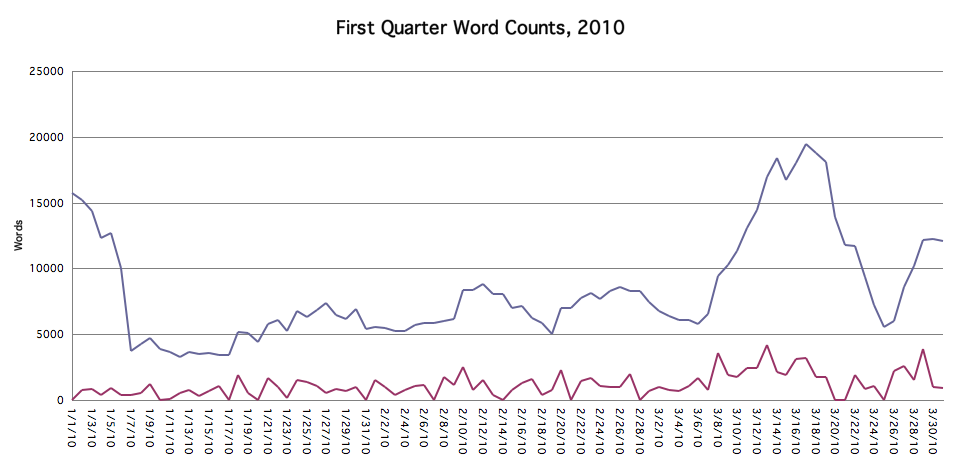
I’ve hardly worked on either of my novels at all these past two weeks.  The 7-day word counts have been steadily dwindling, and last week it actually hit zero.  Yikes!  I don’t think that’s happened since…since finals last semester or something.

Well, I’m going to fix that!  Yesterday, I churned through about 2.5k words in the revision of Genesis Earth, and I plan to keep it up all this week until school starts beating me up again.  That probably won’t be until after Thanksgiving, which gives me just enough time to finish this revision.

Hopefully, this week I’ll be able to do at least 1.5k daily.  It’s going to take hard work to build momentum again, but once I’m up and running, finishing this beast shouldn’t be hard.  Then I can devote more time to finishing the current incarnation of Bringing Stella Home, which should have been finished long ago.

And then, finally…something new!

I need a new deadline

Two, actually.  I’ve got two unfinished projects, both of them on the sidebar: Genesis Earth 4.0 and Bringing Stella Home 2.0, both of which have stalled in recent weeks.

Here’s what I’m thinking: I’m currently swamped with school, and have been for the last several weeks, but after tomorrow, most of the urgent important stuff will be finished, and I’ll have some breathing space until after Thanksgiving break.

That should be enough time to finish Genesis Earth, at least before the end of the break.  It will require some commitment, but that’s what personal deadlines are for, right?  Making a commitment.

As for Bringing Stella Home, it’s been so long since I’ve worked on that beast, I’m not sure what state it’s in.  I do know that I’ll have to do a complete rewrite from the beginning before it’s anywhere near submittable.  However, I’m not going to scrap the current rewrite, because even though it isn’t fixing all the major story issues, it is helping me to put the chapters and scenes in the right order.  Without that, I won’t have a good foundation for the next rewrite–that’s what happened to me on the various revisions of Ashes of the Starry Sea.

So the personal deadline I’m setting for Bringing Stella Home is the end of the year.  I want both projects to be completely finished by then, so I can start 2010 with something completely new.  It’s been way too long since I worked on a new story.

A Canticle for Leibowitz by Walter M. Miller, Jr.

It was said that God, in order to test mankind which had become swelled with pride as in the time of Noah, had commanded the wise men of that age, among them the Blessed Leibowitz, to devise great engines of war such as had never before been upon the Earth, weapons of such might that they contained the very fires of Hell, and that God had suffered these Magi to place the weapons in the hands of princes, and to say to each prince: ‘Only because thine enemies have such a thing have we devised this for thee, in order that they may know that thou hast it also, and fear to strike.’

But the princes, putting the words of their wise men to naught, thought each to himself: ‘If I but strike quickly enough, and in secret, I shall destroy those others in their sleep, and there shall be none to fight back; the earth shall be mine.’

Such was the folly of princes, and there followed the Flame Deluge…

In the new dark ages of man following the nuclear apocalypse, an order of Catholic monks preserves the last vestiges of civilization: a shopping list, an electrical diagram, and other assorted scraps of a long-dead world.  As mankind rises from the dust, inevitable tensions arise between the church and the world, between Jerusalem and Babylon, Christ and Lucifer.

This book is epic.  Epic. I can’t begin to describe how incredible it is.  Virtually every page, especially towards the end, is packed with meaning.  A cautionary tale of the folly of man in this fallen world, this story held me captivated right up to the chilling final chapter.  Bravo.

As I understand it, Walter M. Miller Jr. wrote this book in the late 50s / early 60s, during the height of the Cold War.  Science fiction at that time was both sweepingly visionary and frighteningly pessimistic about the future of mankind, and this book successfully captures both extremes.  Like Asimov’s Foundation series, it reads more like a collection of elongated short stories, but Miller’s characterization and attention to detail is superior, in my opinion, to Asimov’s.

The most fascinating aspect about this book is the way that Miller hearkens to the past to give us a vision of our future.  Many of his ideas are straight out of Augustine and Aquinas–indeed, in several places, the story feels like it’s set in 3rd or 4th century Europe, which only adds to the delicious irony.

Yet, while this book has a strong Catholic feel, I never felt alienated or excluded from its intended audience.  Maybe it’s because my Mormon heritage is more compatible with Catholicism than other religious beliefs, but I don’t think it’s just that; the issues in this book are human issues, not just religious issues, and by focusing on that fact, Miller makes the story much more universal.

Even with all the deep, philosophical elements, this story is wonderfully entertaining.  Irony abounds, especially in the first section, in which a young novice takes a simple electrical diagram from the pre-deluge world and, completely unaware of its significance (or lack thereof), spends the rest of his life making a beautiful illuminated manuscript of it.  Even though the sections were  short, I quickly fell in love with the characters in each one, and connected with them almost instantly.

The final scene, in particular, was incredibly touching.  I won’t spoil it for you, but let me just say, if you are or ever have considered taking your own life, read this book, just for the final scene.   The degree to which the last abbot clings to life, even in the face of so many good reasons to give up, is just incredible.  And the final scene, in which…I won’t ruin it for you.  Just read it!

A Canticle for Leibowitz is one of the most powerful, meaningful books I have read in my life.  It is more than a good read, more than epic.  I class it as one of the best works of fiction this genre has ever produced.  If you have ever wondered about the destiny of mankind, or the proper relationship between the secular and the spiritual in our modern age–read this book!

Thoughts on World Fantasy 2009

Since it’s been a couple of days since World Fantasy 2009, I guess I should share some of my thoughts before life starts pulling me in other directions.

First of all, I was surprised at how similar it was to LTUE, CONduit and other convention/symposium events I’ve already attended.  The basic format was the same: dealer’s room open all the time, with panels every hour until the evening.  The only real differences from that were the hotel bar downstairs, the consuite upstairs, and the parties at night.

Second, I was extremely surprised to see so many other people from Utah.  Honestly, there were about thirty or forty of us, about half of whom I knew from LTUE, CONduit, English318–and the others all knew someone I knew from one of those places.  It’s funny to think that we traveled nearly a thousand miles just to network with each other, but that’s pretty much the case.

Third, I was surprised at how much drinking was going on.  Maybe it’s just because I don’t drink, but it doesn’t make sense to me to come to a business meeting and get intoxicated in front of the people you’re trying to impress.  Not that I was uncomfortable.  There were enough other non-drinkers there that I didn’t feel out of place, and even the outright drunks were more entertaining than anything else.  If anything, I guess it was an interesting anthropological experience (kind of like reading Twilight, except…different).

Fourth, I was surprised at how down-to-Earth and accessible everyone was.  Big name authors, editors and agents at the major houses, staff and editors from the small presses–everyone was very friendly and accessible.  I talked with Ann VanderMeer briefly about my capstone project on Israeli politics.  I talked with David Drake about the difference between him and Haldeman.  I talked with Kay Kenyon about Star Control II and Alastair Reynolds.  I talked with Liz Gorinsky (editor at Tor) about Jake Von Slatt, Jim Frankel (senior editor at Tor) about Guy Gavriel Kay, Guy Gavriel Kay about Brandon Sanderson, Brandon’s Agent Joshua Bilmes about Eddie, his assistant-gone-agent, etc etc.

None of this was planned; it all just happened.  Everyone was very friendly.  In fact, I was particularly surprised at how many people became interested in me when I said I was an Arabic / Mideast studies major.  I ran into Brent Weeks’ wife in the bar and talked with her for almost half an hour about Egypt and the Middle East, and she actually seemed interested in what I had to say.

At the same time, I was surprised at some of the tackier things that happened, too.  Maybe this is just my pet peeve, but at every single panel I attended, someone in the audience raised their hand and said “I don’t really have a question, but…” and went on and on for several minutes discussing one of their ideas–TAKING TIME AWAY from the panelists and the people with genuine questions.  Some people even tried to pitch books that way!  Laaaaame.

I will say, though, that as far as pitching books, it wasn’t exactly what I was expecting.  From Brandon’s Class, it seemed that a lot of these people would let you send your full manuscript if you just asked them…and maybe that was the case, but other Utah friends at the convention told me that when they tried to pitch, it didn’t turn out so well.  I generally felt a lot of question, so I tried to err on the side of being non-aggressive.  At least I can mention in a cover letter that I saw them.

The last thing that surprised me was a lot more personal, but out of everything else, it probably surprised me the most. I saw several aspiring writers who seemed so stressed out about breaking in, and it surprised me, because…I don’t feel that way at all.  In fact, I felt a strong sense of peace as I thought about my future.  It’s not a question of “if” I’ll be published, but “when,” and getting there is going to be an exciting adventure.

Anyhow, I enjoyed World Fantasy 2009 a ton!  It was an overwhelmingly positive experience.

I <3 Lunasa

Lunasa is an Irish folk music band–one of the best that I know. If you haven’t heard of them, you should check them out.

I mean, at the very least, check out Kevin Crawford’s mad whistling:

Crazy!

Sometimes, when I wonder what I should do after I graduate, I get these starry eyed dreams of becoming a celtic rockstar–or, at the very least, a street musician. That would be kind of fun, sitting out in the open air, playing music to the world, waiting on the charity and generosity of strangers. I mean, at least for the first couple of hours, that would be fun–wouldn’t it?

Yeah, better stay in school. In the meantime, though, here is one of my own original pieces. Not anywhere near as awesome as Lunasa, but not too shabby either:

Street musician…maybe I should try it. Or maybe I should wait for the spring first…

Thoughts after finishing A Canticle for Leibowitz

Wow.  Wow.

This book is INCREDIBLE. I’ll review it later, but first I want to put down some of my initial thoughts.

With any great book, you come to a point where you realize, consciously or not, that it just can’t get any better.  The story, the characters, the world, the ideas and stakes, the overarching conflict–it combines so perfectly that you don’t think you could possibly ask for more.

And then, if it’s a true masterpiece, it crosses that threshold and gets even better.

A Canticle for Leibowitz did that.  Somewhere in the second half, after I was completely caught up in the story, it exceeded my expectations and went to a whole new level.  I remember the exact passage where it happened:

They shook hands gingerly, but Dom Paulo knew that it was no token of any truce but only of mutual respect between foes. Perhaps it would never be more.

But why must it all be acted again?

The answer was near at hand; there was still the serpent whispering: For God doth know that in what day soever you shall eat thereof, your eyes shall be opened: and you shall be as Gods. The old father of lies was clever at telling half-truths: How shall you “know” good and evil, until you shall have sampled a little? Taste and be as Gods. But neither infinite power nor infinite wisdom could bestow godhood upon men. For that there would have to be infinite love as well.

I love books like this: books that not only have a good, entertaining story, but that have a deeper, more thoughtful dimension. Stories that make me think and reflect on the real world, that open my eyes and help me to see things in a new way. It’s what I read for.

Yes, the story was somewhat didactic and preachy…but it worked. Even though it was trying to make an explicit point, so much of the symbolism and metaphor was open ended that the readers could draw their own conclusions–and see a number of things that perhaps went beyond the point the author was trying to make.

I guess there’s two ways to write didactic fiction: the open approach, and the closed approach. With the open approach, the author uses a lot of symbolism and allegory, but in a way that explores principles and themes rather than building up to a predetermined point. Good examples of this (in my opinion) include The Chronicles of Narnia and The Neverending Story. The closed approach involves consciously working everything around a conscious agenda: examples of this include His Dark Materials and Lord of the Flies.

I don’t care much for the closed approach–I can’t stand it even when I agree with the underlying ideology (as in Orson Scott Card’s Empire).  Those kinds of books don’t stimulate genuine thought or reflection.  The open kind, though–that I can appreciate.  Even though I disagree with many of Heinlein’s views, I can appreciate his books even when they’re preachy because they make me think.

Anyways, those were some of my thoughts after finishing A Canticle for Leibowitz. This book is epic–truly epic.  It wowed me just as much as David Gemmell’s Legend. This is a book I’m going to remember for a long, long time.

If you care at all about the role of faith in forming our society, or the complex interplay between religion and politics, or the ultimate end of humanity–you have got to read this book!

back in Provo

Just arrived in Utah, after a LONG drive.  Nevada is so freaking huge…and empty.  Blegh.

Considering I need to be in class at 9am tomorrow, I’m going to post this and go straight to bed.  Goodnight.

more later

Saturday was a great day.  I wish I had the time to blog all about it, but unfortunately I need to get up a little early tomorrow and I need the extra sleep.  More later, though–I promise!

World Fantasy 2009 — second day

Friday was a long, awesome day  at World Fantasy.  I feel like I’m floating around on a sea full of big names and interesting people, and it’s surprisingly less intimidating than I thought it would be.

The day started with a number of panels.  I attended “Writing human characters, whether or not they’re human” and “VaanderMeer on VanderMeer.”

The VanderMeer panel was very enjoyable–Ann and Jeff are down-to-Earth good people, and it was interesting hearing their stories, especially Ann on her experiences as an editor.  At one point, she could have shared any number of slushpile horror stories, but she didn’t.

Took lunch at Lee’s Sandwiches, for no other reasons than price and nostalgia. I used to eat at Lee’s all the time when I lived in San Jose, because it was so cheap.  It’s been so long, but it was exactly as I remembered it.  Good times.

Met up with Daniel Alonso, another writer friend from LTUE/CONduit.  It was good to see him.  We wandered around the dealer’s room for a while and struck up conversations with various people, including David Drake.  Talked with Drake about the difference between him and Haldeman–apparently, in Haldeman’s novels, nobody trusts anybody, whereas in David Drake’s novels, people mistrust everyone but the comrades in their unit.  Interesting.

Let me just say, once again, that I am surprised how many people from the Utah scene are here at World Fantasy.  On the “Writing non-conciliatory fantasy” panel, I recognized at least a dozen other Utah writers, and there were probably at least as many there that I didn’t recognize!  Surprising, when you consider the panel was about anti-heroes.

Besides the “Writing non-conciliatory fantasy” panel, I attended “Invention vs. tradition” and “The last resort” in the afternoon.  Both were very interesting, but unfortunately I was very tired after the last one, so didn’t catch as much from it.  That’s what happens for late afternoon / early evening panels, generally.

Went to a book release party for Edge publishing.  It was an interesting event.  Barbara Galler-Smith and Josh Langston wrote Druids together long-distance, having only met over the internet.  They both seem like pretty cool people, just from running into them.  From the readings, the book reminded me a bit of David Gemmell.

Had dinner with some other writers from the Utah scene–Josh, Isaac, and Jancy.  Talked with Jancy for quite a while–turns out she’s from Santa Clara, got a master’s degree from BYU with John Bennion as her advisor.  It also turns out that she recently switched agents; she’s represented by Eddie now, Joshua Bilmes’s old assistant.  We talked about my book and whether it’s YA or not,  which went on to a very interesting discussion of YA themes.  Jancy’s a way cool person.

The evening event was a giant mass autographing party in the ballroom.  Everyone was there doing a signing.  I hung out at Dan Wells’s booth and met Mary Robinette Kowal.  She was way cool, easy to talk with, interesting and humble.  Yet another down-to-Earth good person at this convention.

Met a lot more people from the Utah scene in the evening, such as J. Aleta Clegg, who was around when LTUEThe Leading Edge, and Quark were founded.  Also talked with Julie Wright, found out that she’s an editor as well as a writer, talked about the blog she co-authors and Leading Edge.  Yet more down-to-Earth good people.

After that, drifted from party to party, until everyone was so drunk that my attempts to make useful contacts started to become counterproductive.  Had fun at the same time, though.  Good people, good times.

I’m looking forward to tomorrow!

World Fantasy 2009 — first day

After four years, I’m back in California!  Yay!

Okay, now that I’ve got that out of my system (because California is, without a doubt, the most awesome state in the union), let me just say that the first day of World Fantasy 2009 was most excellent.

For Cavan, Alex and me, the day began at about 4:30 am, when we woke up early to road trip it out to San Jose.  The salt flats near Dugway were very beautiful in the early morning light, as were the mountains.  Nevada stretched on forever, but a little bit of Ennio Morricone helped it pass enjoyably.  After Reno, we descended through the Sierras, passed Sacramento and the Central Valley, crossed over the gorgeous bay area mountains and arrived in San Jose without incident.

Well…there was one incident.  We got a little lost finding Alex’s friend’s house, and pulled a U-turn that ticked off one of the local drivers.  She honked her horn and shouted out her window: “go back to Utah!”

California, I love you.  You haven’t changed at all since I left. 🙂

We’re staying with Alex’s friend, within walking distance of the downtown area where the convention hotel is situated.  No, really, we couldn’t have planned it better.  Alex’s friend is way chill.

After we registered, we scoped out the hotel.  It feels a lot like the hotels in Cairo–big and grand, with lots of marble and large open spaces.  We browsed around the dealer’s room, saw lots of small publishers, some of whose books I’ve reviewed for Leading Edge. Everyone was very friendly and easy to talk with.

The only panel  tonight was on the Google book settlement, and it was very informative and helpful for someone as clueless on this issue as me.  Some very choice words were exchanged between the president of SFWA and a Google employee in the audience, but most of the panelists had the same  opinion–that the settlement would set a terrible precedent for copyright law and should be fought tooth and nail.  Interesting, timely stuff.

We heard about a party on the top floor, so we decided to check it out, and low and behold!  Practically the entire convention was there.  Ran into some familiar faces from LTUE and CONduit; it turns out that there are one or two dozen people from Utah at this convention, and most of us already know each other.  How awesome is that?

Let me just say, I am so happy that I have friends at this convention.  All that networking in Utah over the last two years is really paying off.  It’s so much easier to meet new people when you’re working together as a group.  I’m starting to get an idea of the editors/agents here that I should contact and how to approach them.  I’m also meeting a lot of other aspiring writers, making new friends.

In short, the party was not only productive, it was lots of fun.  Met new people, reconnected with old friends from the Utah scene, got the scoop on Dan Well’s Serial Killer book and the pending sequels (which I’m eagerly anticipating), and just had an overall great time.

An excellent finish to a very eventful day–and the convention has only just begun!