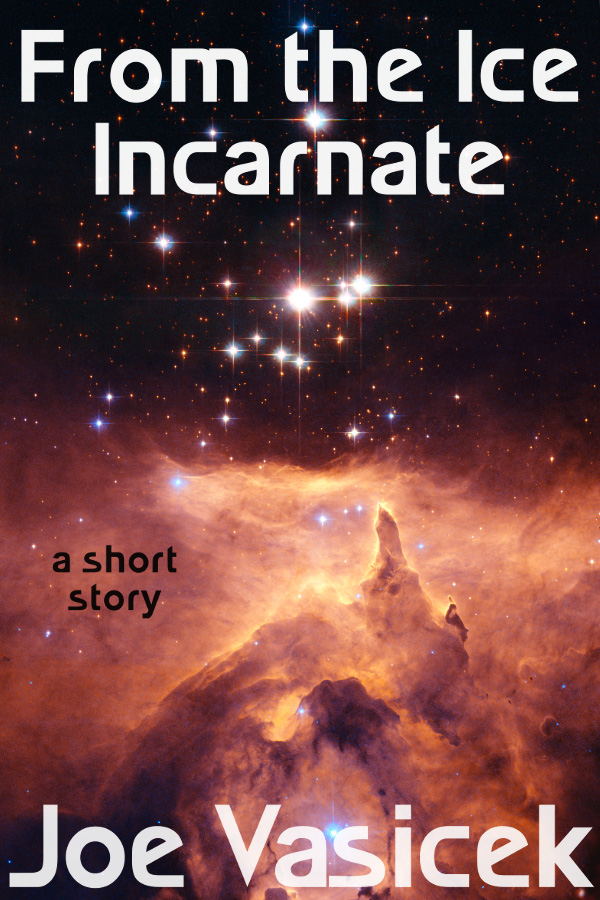
“The Class That Wouldn’t Die” is up!

Just a heads up: the latest issue of Mormon Artist magazine is out, and my article about BYU’s “class that wouldn’t die” is in it! What’s more, Orson Scott Card himself commented on it.  Squeeeee!!!

If you’d like to read the full article, you can find it hereMormon Artist is published online for free, so be sure to check out the rest of the issue too.

A huge thanks to all the people who helped me out with the research–and an apology to those I should have gotten to, but ran out of time and space to include them.  My goal in writing this was to collect as many oral histories and primary sources as I could find, and put it in a context where the people who were there could tell the story themselves.  I hope I’ve done that without making too many factual errors, but if I have, please let me know.

Also, I would like to personally thank everyone who was a part of Xenobia and the class that wouldn’t die–the people who started LTUE, Leading Edge, and Quark, which have become the bedrock of BYU’s thriving sf&f community.  Thank you so much–all of this stuff has greatly impacted my life, helping me to connect with like-minded friends and to grow tremendously as a writer.  We really do stand on the shoulders of everyone who’s come before, so thank you!

Squeeeeeee!!!!!

Encouraging realizations

So today I realized something about my writing process that encouraged me quite a bit.  With every project so far that I’ve finished, revised, and polished (or will soon be polishing), I went through a depressing period where the draft absolutely sucked and I questioned whether I was just wasting my time with the whole project.  I went through it with Genesis Earth, I went through it with Mercenary Savior, and I’m going through it right now with Worlds Away from Home.

None of that is new, of course; what’s new is the realization that this phase is an essential part of my personal writing process. In other words, it’s not a distressing thing that I’m going through this phase–it’s actually a sign that things are normal.  The story has potential but needs a significant overhaul, so until I complete that overhaul I’m only going to see how much it sucks.

The trick, of course, is keeping momentum.  I’ve found that if I consistently write 2,500 words per day, my mind is so absorbed in the story that I can make good headway on it.  I only revised through about 1.4k today, but I cut off at least another 2k of useless fat, so I suppose that works.

I also submitted Genesis Earth to two agents, so overall, today was quite productive.  I’ll probably count those as my submissions for this week, to allow people time off for the holidays.  Of course, I won’t stop writing!

Story Notebook #4

Alright, it’s been too long since the last time I posted any story ideas here on this blog, so I thought I’d go back to my old notebooks and post a few of them here.  Currently, we’re on notebook #4, which basically covers the second half of 2009.

And so, without further ado…here goes!

A society in which infanticide, up to the first two years, is not considered a crime (since infants are not conscious in the same way as adults and children)

Youch–talk about a dystopia!  Which makes me wonder, what kind of a society would develop this belief?  Probably not one that values human life–or rather, one that somehow considers adults to be more “human” than young children.

As a direct result of this society’s system of values, there’s probably going to be a lot more promiscuity–or perhaps the promiscuity is what causes this belief to be engendered in the first place?  It reminds me of an ancient Carthaginian brothel, where hundreds of baby bones were found stuffed in the narrow alley between the brothel and the next building over.

Blegh–icky stuff!  Which is to say, it’s probably good story material. 🙂

A near-future dystopia in which the extras in movies (made in overpopulated developing countries) literally act out battle scenes, because hollywood studios can afford to pay for the loss of life

I got this idea from a comment by Dave Wolverton at a con, in which he said that in China, the maximum fine for negligent homicide is $10,000.  This is one of the reasons why so many movie studios do business there–if their extras die or get injured, they aren’t held nearly as liable as in the United States.

Of course, if the maximum fine is $10,000, why not put that in a deposit up front and have the workers fill out a form indicating who should get the money if they die?  You can then have gladiatorial movies and TV shows, where people actually die.  It sounds sick, but I’ll bet you could find a significant audience for that kind of thing.

Economically speaking, it’s a win-win-win situation.  The studios save on safety equipment and profit from the relatively cheap labor costs; the workers benefit whether they live or die, because either way, they’re getting paid much more than they would ever make otherwise; and the host country benefits, because the survivors can then be conscripted to form an elite corps of warriors.

The only real downside is the utter moral depravity of it all–but hey, we’ve already crossed that moral line so many times, what’s to keep us from crossing it again?

A time travel device that allows collection of data from the future without affecting causality–how would this change political science?

By “without affecting causality,” I think I meant that the time travel device itself wouldn’t cause any huge problems–that one could use it to observe without interaction, something akin to Orson Scott Card’s Postwatch. And of course, because I was so deeply engrossed in school at the time, the first application that came to mind was political science.

It would certainly lend a degree of credibility to the science, something which it currently does not enjoy.  It would probably also lead to fierce debates about fate vs. free will between the positivists and the interpretivists–something that has already been ongoing for some time.

My second novel (Genesis Earth) was, in some ways, a response to that debate.

A character who always has the latest liberal candidate’s bumper sticker on the same corner of his/her car, so that it builds up over time.

Interesting character quirk–though since it could only really makes sense in our world, I would never write about it.  Stories set in the real world bore me.

An MMORPG for orcs and elves where they play as humans

Check it out!  I’m a level 80 corporate CEO with the ability to cast ‘complete financial collapse’ and totally screw you out of a job!

Zombie insects

Oh noes!  Even worse if humans can become infected.

Sentient planets

Already done; the book is called Solaris.

Golfing on the Moon or Mars

This…would actually make a fairly awesome short story.

Were-squirrels!

Sounds like something Terry Pratchett would write if/when he parodied the urban fantasy genre.

What if all of us are characters in someone’s story?

God help us all!

A psychic agency that allows you to instant message dead relatives

Personally, I’d never stop wondering whether it’s just an elaborate hoax.

And that’s all for notebook #4!  Don’t worry–I swear I’m not as screwed up as these story ideas make me out to be.

Out of it

Man, I feel like I’ve been so out of it recently.  I’ve been getting up around 9 am or 10 am every day, going to bed every night around 2 am or 3 am, and running around so much that I hardly seem to have time to write.  Life is good, and between plasma and phone book deliveries I’m earning enough to get by, but my days are very unstructured and that’s not good for my writing.

So here’s what I need: a stable job that facilitates my writing.  For the past year, I’ve been working random odd jobs and temporary jobs, and while they pay enough to get by (just barely), the variability and lack of long-term security is just too much to juggle on top of writing.  I’ve got to find something else.

Trouble is, I’m afraid that if I settle for a dead end job, it’ll put such a stigma on me that I won’t be able to get a better job later if the writing career doesn’t take off.  I’m pretty confident that I’ll eventually be able to make a living off my writing, but I don’t know how late or how soon that’s going to happen.  The last thing I want is to end up as a wage-slave without a future.

Anyway, despite the lack of daily structure, I really love the flexibility that this phone book delivery job is giving me.  Pay is on a per route basis (like newspaper delivery), and the supervisor is really awesome and easy to work with.

If I want, I can take the mornings easy, do personal chores for a while, deliver a couple hundred phone books and write in the evenings.  That’s basically what I’ve been doing these past three weeks.

I really hate going to bed and waking up late, though.  That’s not sustainable.  If I come to my writing only at the very end of the day, it’s going to be a wash.  I might get a thousand words in, but if I’m not consistently crossing the 2.5k threshold every day, my heart really just isn’t in to it.

In any case, WAFH 2.0 is coming along fairly well.  I’ve got a good idea where I want the story to go, and the characters seem to be working out.  Also, I think I’ve found my big reason for wanting to write this story–I’ll write more about that in a later post.

This next draft isn’t going to be perfect, but hopefully I can get rid of all the major story problems (and there are a TON of major story problems!).  I suppose my goal at this point is to make it good enough to send out to my first readers.  The rough draft is so full of crap, I wouldn’t let anyone read it if they paid me.  Blegh!

Also, I know it’s only been a month, but I think I’m going to do another cover to cover revision of Mercenary Savior in the next few weeks.  I really want to get it polished enough to start sending it out–preferably by the end of the holidays–so that’s probably going to take priority. If it goes as fast as Genesis Earth 5.0, I should have the entire manuscript done in about three or four weeks.

And another thing–I’m going to set a new goal: submit at least one thing to an agent/editor every week.  Right now, I tend to go on splurges where I’ll send out half a dozen queries, then sit around for a month without really doing much to try to break in.  I feel like I need to be more consistent on that front, because submitting is definitely one of my greatest weaknesses.  They say everything comes better with practice, so I might as well send stuff out more regularly.

Anyhow, that’s how things are going right now–disjointed and all over the place, but somehow things still get done.  I just wish I could get more done, but who doesn’t?  Anyhow, there’s always next week–may it be better than the last.

Getting back into things

So yesterday, I wrote through 4k words in WAFH 2.0 without even realizing it.  I didn’t feel very productive, because I only did about 500 words at a time before something came up and I got distracted, but by the end of the day, ended up accomplishing a lot.  That was a pleasant surprise.

In terms of my writing, I’ve been really out of things since Thanksgiving.  I finished Genesis Earth 5.0 right before the vacation and started outlining WAFH 2.0 immediately after, but…man, the rough draft REALLY sucks.  Like, sucks so bad I’ll have to completely throw out part III and start from scratch.

Fortunately, I think I’ve got a good idea what to do.  I’ve outlined about eighteen complete plots and subplots, so that’ll probably help out with keeping things tight.  The rough draft has a lot of shotgun writing, which means I have a lot of stuff to cut out–and now that I see where things are going, I know how to cut it.

One thing that worries me, however, is that I don’t have a strong driving reason to write this book–or maybe I do, but I just haven’t noticed it yet.  I’m hoping that’s the case, but I don’t yet know, and it’s really bugging me.

For Genesis Earth, it was the first line (“Earth was a ghost that haunted me”) and the cryo scene.  For Mercenary Savior, it was the ending, and the way it resonated with an old Western I saw as a kid.  With both projects, I got to a point of desperation somewhere between the first and second drafts where I wanted to throw everything out and never work on it again–but with both projects, that driving reason kept me going until I made it work.

With WAFH, however, I’m not sure what it is that’s driving me to write it.  For now, though, I’ll just press through until I find out.  I really hope I’m not just wasting my time writing this (because the rough draft sucks REALLY bad) but past experience has told me to ignore my own self-doubts at this phase.

Which reminds me: this week’s Writing Excuses podcast is really amazing.  I just listened to it an hour or two ago, and the advice this time around was exactly what I needed to hear.  Brandon’s advice in particular is very good: he basically says to stop worrying and enjoy what you’re doing.

So do I enjoy all of this?  In spite of all the angst I’ve spilled, I think I can say that I do.  When you’ve got a good story, and you know that it’s good, and you tell it in a way that moves someone else in a personally meaningful way–man, there’s nothing that compares to that.  I look back now on stuff I used to think was absolute drivel, and I’m amazed.  It takes persistence and drive and a little bit of crazy, but once you can get to that point, it makes everything you did to get there worth it.

The only thing now is to find out why WAFH is worth writing, and to hang onto those reasons at all costs until the story comes into its own.  Wish me luck!

Looking for a life experience

This week, I got hit by some good news and some bad news.

The good news was that I got a short term seasonal job, delivering phone books.  That should keep me solvent for the rest of the month, at least until I can find something slightly more permanent.

The bad news?  I heard back from the company with the wilderness job, and it turns out I didn’t get it.

So now I’ve got to figure out what to do with my life for the next  year.  My writing career, as always, is plan A, but that’s more of a mid- to long-term thing.  And honestly, that’s how I want it.

I feel that I need to do something big–to go on some kind of adventure.  I’ve been working hard to hone my craft, but I feel that I need to acquire some kind of significant life experience, not only to boost my writing, but just to grow as a person.  It’s tempting to look for a comfort zone and camp out in it, but I don’t think that would be the best thing for me to do right now.

Before I graduated, I decided not to go to graduate school yet for a few reasons.  First, I was sick of school, and felt that I needed a break. Second, I didn’t know what to go in for, and didn’t want to go to grad school just to postpone figuring things out.

Third, I wanted to get out of the cloistered halls of the university and gain some real world experience.  I’d spent my whole life up to that point in academia, and was sick and tired of being sheltered from the “real world.” I wanted to get out and see what things were really like on the other side of the ivy.

For the past eight months, I’ve been bouncing around in Utah, working odd jobs to get by.  It’s a different set of stresses and problems, and while I can’t say I’m unhappy, I certainly can’t say that I’m fulfilled.  Being unemployed is about as unfulfilling as you can get and still be breathing.

I could probably find and hold down a graveyard job until my writing career takes off, but somehow that doesn’t seem much better.  I don’t just need a job to facilitate my writing–I need a major life experience to broaden my perspective on things.  I was hoping the wilderness job would provide me with both of those, but unfortunately that’s no longer an option.

So what next?  Here’s an idea: maybe I could go abroad and teach English for a year.

I used to joke with all my friends that if I didn’t get the wilderness job, I’d probably leave the country and go on an adventure–but really, why not?  A chance to see the world, use the teaching and language learning skills from my degree, and acquire new skills that might come in handy later on.  Plus, when I come back, I’ll sure have a lot of interesting things to write about.

The big question in my mind is what I need to do to get ready.  I suppose the best thing would be a TEFL certificate–I could probably get one of those in a month or two through online classes.  But…is that really the best path?  And what is the best program to go through?  A couple of friends of mine who have taught English abroad for the past couple of years say you don’t need a certificate to get a job, but they were working with kids, not adults.  And for the English teaching jobs in the Middle East (especially the gulf), you really do need certification.

So I guess I still need to think it through.  Right now, my top three destinations would probably be Japan/Korea (for the earning potential), Saudi Arabia (for the Middle East experience), or the Czech Republic (for the chance to connect with my roots).

I don’t know, though.  I’ve still got to weigh the pros and cons.  I’ll probably do that in a later post–but for now, that’s what I’m thinking about.  And the more I think about it, the more attractive it becomes…

The technological singularity: a thing of the past?

One of the latest trends in science fiction is the concept of the technological singularity — the point in history at which technological advances occur so rapidly that we can no longer learn the new stuff fast enough to keep up with it.

I hear a lot of people talk about this at cons, and I’ve read/listened to quite a few stories about this concept.  Basically, these stories posit a world where science has become a new magic, and our world has been transformed beyond all intelligible recognition.

However, a recent post on the excellent Rocketpunk Manifesto blog made me wonder if we’ve already passed the point of singularity in our own society.  The post basically asserted that the period 1880 to 1930 saw so many sweeping technological advances that the world in 1930 would have been unrecognizable to a person from 1880, whereas our current society would still be intelligible to a person from 1930.

This made me wonder: how far into the singularity have we already come?  How much of our technological infrastructure has become so advanced that the common man lacks the capacity to comprehend it?

Think about it.  Fish around in your pockets and pull out your phone.  Do you understand how it works well enough to take it apart and put it together again?  To rebuild the device from parts?  Do you own the tools and machinery to construct the parts from which it is made?

How about the building in which you currently find yourself?  Do you possess the knowledge to build a comparable structure that performs the same functions?  That keeps you sheltered and provides the same light, heat, electricity, and internet connection that you now enjoy?

There was a time, not too long ago, when people would move out to the wilderness and homestead land by building their own homes from available natural resources.  If you needed to build your own house, as so many people used to do, could you do it?

How about your means of transportation?  If necessary, could you take apart your car and rebuild it again from the ground up?  Could you perform basic maintenance on it if you needed to?  How many of us can change our own oil–and how many of us are dependent on others for such a simple service?

Or what about the things we take most for granted–our understanding of the way the universe works.  Do you really understand the principles of physics?  Do you comprehend how electricity or magnetism really works, or are you still thinking in overly-simplified terms like electrons flowing through a circuit like water?  Even the most intelligent physicists can’t reconcile electromagnetism with Newtonian physics, so what makes you think you know so much?

How much of what we think we know is really just an illusion, meant to keep us pacified and docile?  To give us a false sense of security–that someone is in control, so we can rest easy?  Does anyone REALLY understand 100% how the economy works?  Do any of us know who or what is really in charge anymore?  Have we unwittingly handed over the reigns of control to some digital algorithm so basic to our newly networked way of life to be practically invisible?

Looking at how few of us are truly self-sufficient, and how much power we’ve ceded to forces beyond our control, our modern society seems so delicate and fragile.  Can anyone REALLY say that our society is not in danger of falling apart?  That our way of life is not an unnatural and unsustainable aberration?

Anyhow, those were some of my initial thoughts.  The more I compare the science fiction of the past with the reality of the present, the more predictions I see coming true in the most unexpected of ways.  The singularity may have less to do with uplinked consciousnesses and more to do with Google’s SEO algorithms than we are comfortable admitting.  And realistically, the light bulb may prove to be more revolutionary than anything Apple has ever or will ever produce.

Slogging through a funk

Just a quick update, since it’s 3 am and I’m kind of in a daze after playing Halo: Reach on Xbox live with my roommate.  Whoa, decompressing…

This whole week, I’ve been in a weird funk.  It sucks to be unemployed, especially since I can’t commit to anything long term because I’m waiting to hear back from the wilderness job.  Man, I really hope I get it–but even if I do, I’ll need to raise some cash to keep me going through January until the paychecks start coming in.  And if I don’t get the job, I have no idea what I’ll do.

But mostly, it has to do with my writing.  I’ve been running through the rough draft of Worlds Away from Home, and…holy crap, it REALLY sucks.  It sucks to the point where I’m not sure exactly how to fix it.

Part of it probably has to do with my initial ambitions for it, which I probably set too high.  I originally wanted to write a science fiction romance that turned the “romance” element on its head by having the sex be the thing pushing the characters apart rather than bringing them together.  I got a little too didactic in the rough draft, though, and failed to tell a story that, at it’s root, is meant to entertain.

That’s probably the most important thing–to tell a story that’s fundamentally entertaining.  So I’ve been looking at that, and I’m finding that there are significantly fewer plot threads here than there were in Mercenary Savior.  That, and there’s considerably less suspense.  The character arcs are still sufficiently complex, I think, but there aren’t nearly as many hooks and cliffhangers as my other work.

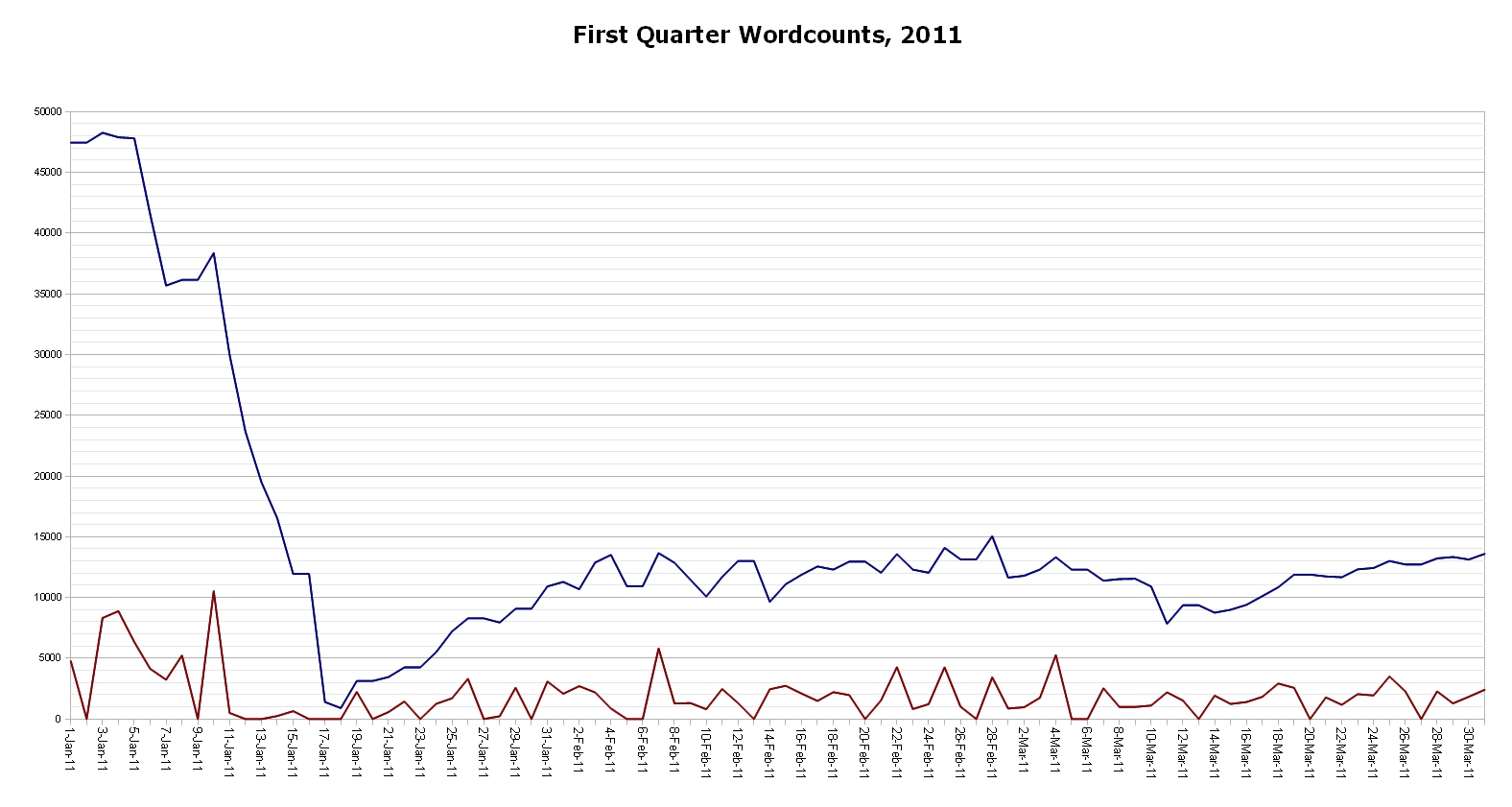
This whole week, I’ve been vacillating between “alright, I can do this” to “this novel sucks and I should just throw it out and never work on it again.” In fact, I drew up a chart today of all the novels I’ve started, finished a first draft, and finished a polished draft–and the results are a little stark.

I only just produced a fully polished draft for Genesis Earth, so at 2010 I’ve finally gotten one novel to the point where I think it’s as good as I can make it without an editor/agent to help.  One freaking novel–and that’s after two years of work.  Mercenary Savior, I’m finding, isn’t quite where it needs to be, though it’s close–probably I’ll nail it down in early 2011.  But other than those two?  I’ve got nothing.

I started Worlds Away from Home back in 2008, and I’m wondering whether I was even good enough back then to craft a story that could carry through a complete novel.  Ashes of the Starry Sea was probably a bit too ambitious, and Genesis Earth, while it ended up working out, was so small in scope that it wasn’t that hard to pull off.

Is something fundamentally flawed with Worlds Away from Home? Did I bite off more than I could chew?  Is the story premise so screwed up that I should just abandon it and reuse it occasionally for scraps?

I have no idea.  Maybe I’m just being too angsty–after all, I started Genesis Earth BEFORE I started Worlds Away from Home, and that one turned out great.  It took two years, of course, but it worked out in the end.

So will this one work out?  Probably, I suppose–but only if I can solidly get behind it.  I’m trying to put together a detailed plot outline to figure out what the story needs, but if I can’t find something else–something on par with the cryo scene and the first line of Genesis Earth, which for the longest time were the only two things keeping me from trashing that project–if I can’t find something redeemable like that, I might just drop this monstrosity and let it die.

Blarg.  I hate this.  I might just take a break from things and write a couple short stories.  This whole week, I’ve been writing nothing but outlines and revision notes–I need to do something a little more creative.

Anyhow, that’s what I’m currently slogging through.  Before the end of next week, I’m hoping to find out whether I’ve got that wilderness job or not.  Let’s hope…

Change in direction

Just a quick update on things before I go to bed.

After giving it some thought, I’ve decided to put Into the Nebulous Deep on hold for the time being.  The main reason for this is that it’s a direct sequel to Mercenary Savior, and if the first one doesn’t sell…yeah, not the best business decision.

I figure the best way to do it is to have a series of indirectly linked standalone novels set in the same world.  That way, a publisher could pick up any one of them after rejecting all the others, but if you want to bundle them into a series and sell them together, you can do that too.

That’s my strategy–I like the universe I built for Mercenary Savior, and I’m going to keep it for the foreseeable future, but for now, the trilogies and duologies will have to wait.  In any case, I’ve written down my major ideas for ITND, so I’m sure I’ll be able to pick up where I left off if/when MS sells.

Instead, I’m going to start working through the second draft of Worlds Away from Home. It needs a ton of work, but having finished the rough draft, I know that the story has potential.  At this point, I’m actually very enthusiastic about it, so hopefully that will help drive momentum.

Right now, I’m in the outlining stage.  I’m taking a page from Dan Wells and using his seven point story structure to draw out all the plot lines and character arcs.  When I did this for MS 4.0, I had to outline about fifteen arcs before I felt it was sufficiently tight; it will probably be the same for WAFW 2.0 as well.

Currently, I’m in the middle of outlining chapter six.  If all goes well, I’ll finish outlining and start writing by the end of the week.

In the meantime, I’ve been doing a lot of submitting.  Sent out another short story to Leading Edge–oh, and by the way, they accepted a poem of mine, so expect to see that in a forthcoming issue.  I also submitted the latest draft (5.0) of Genesis Earth to a few agents, so hopefully that will lead to something positive.

In other news, I’m looking for a job again.  Oh joy.  I’m hoping things will work out with the wilderness job, but if not, I still need something to tide me over for the Christmas season.  It’s stressful, but at least I’m not broke yet, which is good.  If I can’t find work and have to buy gear for the wilderness training, however, I just might be.

I’m confident things will work out, however.  I’ve found that they always do, even if not in the way I wanted or expected.  Just keep swimming.

In the meantime, check out this AWESOME 8-bit remix of one of the tracks leaked from Daft Punk’s upcoming album for the movie Tron. Dude…this makes me so incredibly happy.  And the 8-bit art!  I nabbed it and turned it into my avatar for the Quark forums.  In case you want to use it, here’s a copy.

8-bit Daft Punk FTW! The only thing more epic would be if Daft Punk and E.S. Posthumus joined forces–but if that happened, hosts of heavenly angels would descend upon our planet and usher in an era of global peace and universal prosperity. But dude, I would give my firstborn son to acquire that music.

You laugh, but I’m only half joking…

A Game of Thrones by George R. R. Martin

Almost twenty years have passed since the fall of the Targaryen dynasty–twenty years since the last of the dragons was seen in the Land of the Seven Kingdoms.  Now, the libertine Robert Baratheon sits on the Iron Throne, blind to the conspiracies and secret combinations that surround him.

In this dangerous time, Ser Jon Arryn, the King’s Hand, dies of mysterious causes.  Most of the realm accepts the official story that the death was natural, but when Arryn’s wife Lysa sends a letter to her sister, Catelyn and her husband Ser Eddard Stark immediately suspect that the death was orchestrated by the Lannisters.  Only one thing remains: to travel to King’s Landing and uncover the proof.  Soon, King Robert calls on Ser Eddard to become his new Hand, giving them the perfect opportunity to do this.

Little does Ser Eddard know, the intrigue goes much deeper than any of them realize.  For the Lannisters are gathering an army, and Queen Cersei and her brother, Ser Jaime, harbor a secret that would tear the realm apart.  Meanwhile, the last of the Targaryens bears a child prophesied to rule the world, while far to the North, an ancient evil bides its time, waiting to sweep the seven kingdoms with horror the likes of which has not been seen in a thousand years.

Winter is coming–and the people of the Seven Kingdoms are ill prepared to face it.

Everyone seems to be talking about George R. R. Martin’s Song of Ice and Fire series these days–next to The Wheel of Time, it’s probably the biggest epic fantasy line of the last ten or fifteen years.  Martin is well known for killing off his characters and writing in shades of gray, so I thought it would be good to give this series a try.

As soon as I picked up the book, I was hooked.  Martin knows how to craft a beautiful, engrossing fantasy world.  In order to leave no doubt on that point, observe:

Yeah, that pretty much sums up what Martin did with his Land of the Seven Kingdoms. It’s an awesome fantasy world, and I found myself lost in it from the first page.

I must admit, however, after hearing so much about the Song of Ice and Fire series, I was surprised at how few characters died in this book. That’s not to say everyone survived–in fact, Martin killed my favorite character, which made me feel HORRIBLE–but I was expecting there to be more. However, this is the first book in the series, so I assume that the really crazy stuff happens later.

While overall I loved A Game of Thrones, I admit I did have a few misgivings about the book. Martin really does write in shades of gray, and while that makes the story unpredictable and surprising, it also makes things very dark and austere. Martin seems to have no interest in redeeming his characters, and when any of them try to be noble, he cuts them down at every turn.

Personally, I don’t care for that. Flawed characters may be more relateable, but seriously flawed characters (or characters with no interest in overcoming their flaws) turn me off. In this way, Martin is practically the antithesis of David Gemmell; whereas Gemmell makes you love his characters despite their flaws, Martin keeps you reading in spite of the fact that you hate all his characters.

How does he do it? By creating a beautiful, wondrous world. By crafting a masterful story full of intricate twists and turns. By making you hate some of the characters so #%$^! much that you have to stick around and see how they die. It’s all entertaining and extremely engrossing, but at the end of it all, I didn’t come away with any real love for Martin’s characters–except perhaps for a couple of Eddard’s kids, who are still young enough to be somewhat innocent.

I suppose it’s all a part of this new non-conciliatory movement in fantasy. Don’t get me wrong; A Game of Thrones is an EXCELLENT book, but it’s very…non-conciliatory. If that’s your thing, more power to you, but I personally prefer stories about redemption, where romance still lives and even the most unlikely character can be a True Hero, if only for a few fleeting, glorious moments.