Last week, George R.R. Martin surprised no one and disappointed everyone when he announced that The Winds of Winter would not come out before the next season of the Game of Thrones TV series that covers the events in that book. He apologized profusely to his fans, most of whom seemed to take it graciously, at least to his face. However, it spawned some heated discussions in the online communities that I frequent (most notably The Passive Voice) about the implicit contract between writers and reades.
This discussion is not new, even with regard to Mr. Martin. Way back in 2009, Neil Gaiman addressed this issue in a blog post where he stated quite memorably that “George R.R. Martin is not your bitch”:
People are not machines. Writers and artists aren’t machines.
You’re complaining about George doing other things than writing the books you want to read as if your buying the first book in the series was a contract with him: that you would pay over your ten dollars, and George for his part would spend every waking hour until the series was done, writing the rest of the books for you.
No such contract existed. You were paying your ten dollars for the book you were reading, and I assume that you enjoyed it because you want to know what happens next.
So that’s one end of the spectrum: that writing is an art, that it can’t be forced, that trying to force it is wrong, and that writers have no obligation to their readers to force anything. Readers should not stalk their favorite writers or tell them what they should or should not be doing to produce the next book. As Mr. Martin said in his latest post:
Unfortunately, the writing did not go as fast or as well as I would have liked. You can blame my travels or my blog posts or the distractions of other projects and the Cocteau and whatever, but maybe all that had an impact… you can blame my age, and maybe that had an impact too…but if truth be told, sometimes the writing goes well and sometimes it doesn’t, and that was true for me even when I was in my 20s.
On the other end of the spectrum, we have Larry Correia. Two days after Mr. Martin announced that The Winds of Winter would not be finished in time for the TV series, Mr. Correia announced his own plans for the year: which of his books are coming out, which books he plans to write, which project he’s going to collaborate on, and which conventions and events he will (or more notably, will not) be attending.
I don’t know whether he meant this as a dig at Mr. Martin specifically, but he included the following statement:
To all those sensitive artist types who whine about how they can’t rush art, and can’t get any writing done, oh, BS. Quit your crying, put your big girl panties on, and treat it like your job. Because it is a REAL JOB. And like all real jobs, if you don’t work then you shouldn’t GET PAID. So shut up, quit screwing around, and get back to work.
The part that really stood out to me, though, was his announcement that he would not be at DragonCon or GenCon this year:
I’m skipping DragonCon and GenCon this year, which pains me because I love those, but again, I’m trying to up the novel production, and all those cons in a row over the summer kick my butt.
I found it interesting because George R.R. Martin is well-known as a frequent convention attendee, to the point that by his own admission attending these conventions is his “way of life.” Larry Correia knows that his writing productivity takes a hit when he attends too many conventions, but George R.R. Martin either doesn’t know or has chosen to prioritize attending fannish events over his own writing.
This made me curious about Mr. Martin’s writing productivity, so I did a little digging and found the following figures, calculated by his fans:
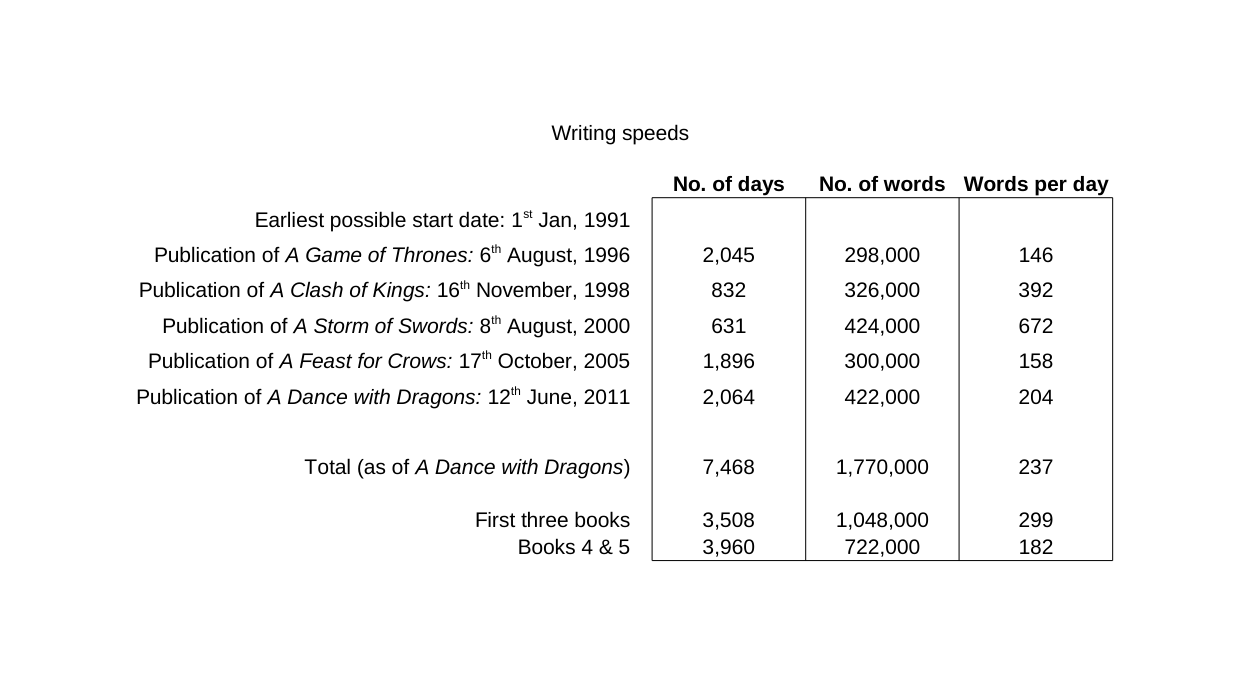
Those numbers are rather stunning. He averaged only 200 words a day when writing A Dance with Dragons? Just for reference, this blog post is about seven hundred words so far, and I’m writing it while taking a break from my other writing (word count so far today: 1,100 words, and that’s a little low). Even if we allow for five drafts written at the same speed, five drafts still only comes to 1,000 words a day.
Now, I do think Mr. Gaiman makes a good point that it is neither healthy nor helpful to try and micromanage everything that a writer does. We can’t spend every waking hour working on the next book, and even if we did, it probably wouldn’t turn out as well, because refilling the creative well is an important part of the writing process. And I also have to admit that if you ran a similar calculation on my own books (especially the early ones), you would probably find some similarly embarrassing figures.
(Though to be fair to myself, I tend to have multiple irons in the fire at any given time, so a straight start date to publication date calculation doesn’t tell the whole story—and it probably doesn’t tell the whole story with George R.R. Martin as well. But still, even if those figures were twice as high, they would still be absurdly low for a working writer.)
When Mr. Gaiman and Mr. Martin say that the writing “comes when it comes” and there’s nothing they can do about it, I think they’re wrong. Dead wrong. Writing is an art, but it is also a craft. It can’t be forced, but it can be structured. Mr. Correia has evaluated how productively he writes and structured his convention-going plans accordingly. Has Mr. Martin?
I also think they’re dead wrong about the writer having no obligation to the reader. That’s total bunk. Reading is an act of collaboration between the writer and the reader: without readers, stories would never exist. They would just be markings on a page, or electrons on a drive, or at best ideas and daydreams in the writer’s head. If a tree falls in the forest, does it really make a sound? If a book is never opened, does it ever tell a story?
Part of this may be the difference in perspective between indie writers and traditionally published writers. In the traditional system, writers were paid an advance on royalties by their publishers. The contract also allowed for royalties, but those figures were set so low that most books never earned out their advance. Publishers made up for it by raising the advances for the writers they wanted to keep.
In contrast, indie writers live and die by their royalty checks. Had a good month? Congratulations, you can afford to eat. Had a bad month? Tsk, tsk. Better hurry up with that WIP of yours, because the longer it takes to publish it, the longer it takes for you to get paid.
But even for the fantastically successful writers who never have to worry about how they’ll pay their bills, I still believe that they have as much of an obligation to their readers as the rest of us. Without readers, we would not be able to do what we do. Without readers, it would be impossible to pursue writing as a career. We all want to live the dream, and the only way to do that is by treating our readers well.
So George R.R. Martin may not be your bitch, but I most certainly am. Writing is not something that happens only sometimes: it’s my job, and I do it every day. And as for accountability, I absolutely feel that I’m accountable to my readers. They are the whole reason I am able to do this in the first place. If that makes me their bitch, then so be it.

 It’s worth pointing out that there are a lot of figures from history who fit this trope. A

 So it’s not yet 2016, and the first salvos in the Sad Puppies 4 campaign have already been fired, in the form of