Algorithms, social media addictions, and the endless churn of content

In the last 5-6 years, I’ve noticed a shift in most of the media content that I consume. Content has proliferated at an unprecedented rate, and the churn—or the rate at which new content pushes out old content—has become one of the driving factors for those of us trying to make our careers in this way.

We see it on YouTube, where three or four adpocalypses have massacred various channels, and where copystrikes have become part of the game. YouTubers who don’t put up content every day, like Tim Pool or Pewdiepie, quickly lose views and subscribers even when they do put up new content.

We see it in video games, where companies like Paradox are now making the bulk of their money on DLCs, some of which make the vanilla version almost unplayable. Back in the 90s, a game was a game was a game. You could get expansion packs for some of them, but that was just bonus content, not a core part of the gaming experience, or the business model.

It’s a huge issue in journalism, where the news cycle has accelerated so much that weeks feel like months, and months feel like years now. Remember the Kavanaugh hearings? That was less than a year ago. The Covington kids controversy happened this year. Everyone is in such a race to break the story that the quality of journalism has fallen considerably, but by the time the corrections come out, the news cycle has already moved on. Fake news indeed.

The churn has also become a major thing in the indie publishing scene. For the last few years, the established wisdom (if there is any) is that you need to publish a new book about every other month—preferably every other week—to keep your entire catalog from falling into obscurity. There’s a 30-day cliff and a 90-day cliff, at which points the Amazon algorithm stops favoring your books over new ones. And now, to complicate things, AMS ads are taking over from more organic book recommendation methods, like also-boughts. The treadmill is real, and it’s accelerating.

I’ve been thinking a lot about this, and I can think of a few things that may be driving it. I don’t have any statistics or firm arguments to back it up yet, just a couple of hunches, but it’s still worth bringing them up to spark a discussion.

First, social media has taken over our society, not only in public life, but in personal life as well. Now more than ever before, we use Facebook, Twitter, Instagram, Snapchat, and other social media to interact with each other. The problem is that these social media sites are incentivized to get us addicted to them, since we are the product they sell—our data, our time, and our eyeballs. Every like is another dopamine hit. Every outrageous headline is another injection of cortisol.

We have literally become a society of drug addicts. The drugs may be naturally produced by our bodies, but big tech has figured out how to manipulate it like never before. And as addicts, we are always looking for our next hit.

That’s not all, though. There’s a feedback loop between the end-users who consume content, and the algorithms that deliver content recommendations to the end-users. When something new gets hot on social media, the algorithms act as a force multiplier to drive it even further. But because of our addiction, and the fact that we’re constantly looking for the next hit, things can fall off just as quickly as they rise. Hence the churn.

It’s also a function of the massive rate at which content is proliferating across all forms of media. I’m not sure how many millions of English-language books are published any year now, but it’s much, much more than it was back when tradpub was the only real game in town. Same with videos, music, news blogs, etc. With so much new content coming out all the time, and so many people on social media ready to share it, the conditions for churn have never been stronger.

But there’s another, more sinister aspect to all of this, and it has to do with the biases of big tech and Silicon Valley. Yes, there is a feedback loop that governs the algorithm, but it goes both ways: the people who write the algorithm can, within constraints, use it to reprogram all of us, or even society itself.

I don’t think it’s a mistake that the churn is worse on sites that are run by big tech, or worse on content creators who depend on the platforms that big tech provides. The authors experiencing the worst burnout all seem to be exclusive with Amazon and Kindle Unlimited, and news sites that are getting hit the worst now (Vice, Buzzfeed, etc) all depended on clickbait tactics to ride the Facebook algorithm.

There are a few content creators who seem to have escaped the churn. As a general rule, they seem to be scaling back their social media usage and developing more traditional income streams, like subscriptions, sponsorships, and email lists. Steven Crowder, Tim Pool, and Pewdiepie are all examples. A few of them, like Alex Jones, Carl Benjamin, and Paul Joseph Watson, are learning how to swim by getting tossed in the deep end. Big tech has deplatformed them, but they’re learning—and showing to the rest of us—that it’s possible to make your own path, even when all the algorithms conspire against you.

I recently listened to a fascinating interview on the Jordan Peterson podcast, where he talked with Milo Yiannopoulos. Milo fell out of the public sphere when allegations of pedophilia emerged, getting him banned from CPAC in 2018. His career isn’t over, though, and his future prospects look quite bright, especially with the plan he’s been putting together. If he succeeds, big tech and the algorithms will never be able to touch him.

In my post a couple of days ago, I argued that one of the unique advantages of books over other forms of media is that they are timeless. As Kris Rusch puts it, books aren’t like produce—no matter how long they sit on the shelf, they don’t spoil. We are still reading books that were written centuries ago.

If that’s true, then there must be something about books that makes them resilient to churn. In fact, books may be the antidote to churn. That’s basically Jeff VanderMeer’s thesis in Booklife. It’s also worth rereading Program or Be Programmed by Douglas Rushkoff, where he offers some helpful rules to keep social media and the algorithms from completely taking over our lives.

So as indie writers, what’s the best way to deal with all of this? I’m not entirely sure. Back in 2011 when I first started indie publishing, slow-build and long-tail strategies seemed a lot more viable than they do now. But if there is something inherent in books that makes them the antidote to churn, then there has to be a way to take advantage of that.

I’ll let you know when I find it.
Thoughts on Minimum Viable Product

So I read an article on Draft2Digital’s blog about Minimum Viable Product and what it means for writers, and it got me to thinking about what that means for books in general, and my own books in particular.

From what I’ve managed to gather (and I could be totally wrong), the controversy in the indie writing community over MVP began when the guy who started 20 Books to 50K first started a topic on KBoards, talking about how he’d used the MVP concept to launch a successful career. This rubbed the KBoards groupthink in the wrong way, and they ran him out with torches and pitchforks, so he started his own group. Indie writers have been arguing about it ever since.

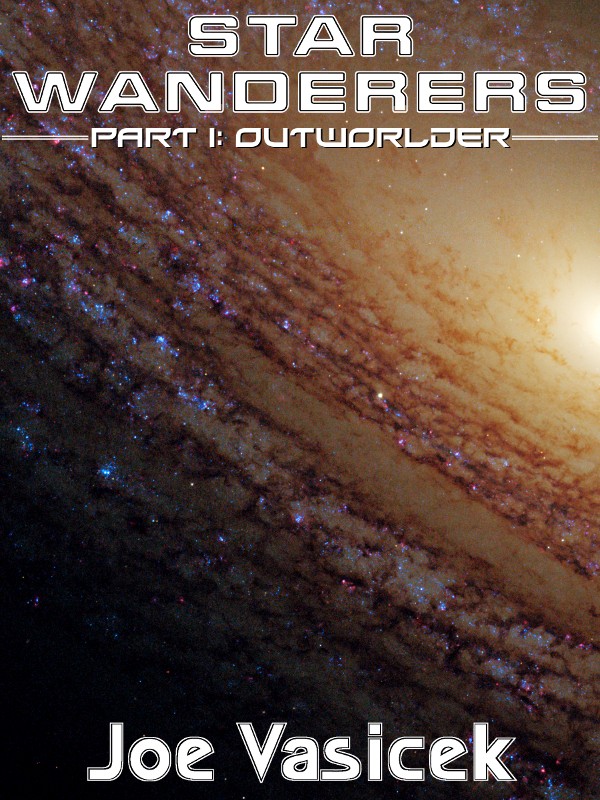
On the one hand, I can’t really criticize the concept, because I kind of followed it myself. When I published my first three books, I sunk a fair amount of money into them, and when I realized it was going to take a long time to earn that back I shifted strategy, publishing the best quality work that I could on a shoestring budget. The result was this:

Ah, the good old days when I was young and stupid (now I’m just stupid). Cover art taken from NASA, which is all in the public domain. Title and subtitle font taken from a free font site, author font cribbed from an old 90s-era Sid Meier’s Alpha Centauri CD-ROM. No gradients or visual effects on the text itself—even the drop shadow is just a mirror image of the text in black, offset diagonally by a few pixels. As if that’s not enough, the aspect ratio is 3:4, which makes me want to grate my teeth.

So that was my minimum viable product at the time. The other novellas had very similar covers, with NASA space art, free fonts, and everything else. I also self-edited most of them, though I did have some editing student friends who volunteered to proofread the later ones. Surprisingly, the books sold. By 2013, they’d earned enough that I could afford to hire out a cover designer, who made the covers the books have today. Needless to say, the quality is much better.

I guess you could say the MVP strategy worked for me, though I’m not so sure it would work as well today. The key point, though, is that once I could afford to upgrade to a better quality product, I did so. The production aspect of a book is stuff like the cover art, copy editing, proofreading, etc. Most of that stuff can be upgraded over time, so if you have to do it on a shoestring budget, it’s not such a big deal.

But in my opinion, the writing itself is completely different. Some writers will go back and rewrite their books after they’re published, but I think that’s a horrible idea. What about the readers who enjoyed the first version? It’s okay to fix things like typos, or maybe remove some bad language but changing things so completely that the story itself changes is just wrong. It’s how we end up with memes like this:

A lot of people got pissed at George Lucas for the changes he made to the original Star Wars trilogy, myself included. It’s one thing to update the CGI for the X-wing dogfights, but it’s something else entirely to rewrite the characters. Han shot first, dammit!

So as far as MVP goes, I don’t think it works for writing—at least, not the kind of books that I’m trying to write. Perhaps in some genres, like porn, clickbait, and Buzzfeed articles, it’s better to put as little time and energy into the writing as you can get away with, but for the books I like to read, I want to know that the author did their best work. You can’t produce your best work and simultaneously aim for what’s minimally viable.

Of course, as the Draft2Digital blog post points out, that doesn’t mean that you should write slowly and slog through endless revisions. Sometimes the best books are written quickly, in a single draft. One of the great enduring myths is that there’s a correlation between how good a book is and how long it takes to write it, and another enduring myth is that revisions always make a book better.

I know there are some indies out there who have had great success by reading the one-star reviews and rewriting their books accordingly. To which I say: you shouldn’t use paying customers as beta testers like that.

Some media formats, like blogs, TV, or magazines, are designed to be ephemeral or to be changed or updated over time. Books are not. As Stephen King put it in On Writing, when we write a book, we are acting as time travelers, packaging up our stories and sending them forth, to be recreated in the mind of a reader long after we have written it. Books are unique like that.

So that’s what I think about minimum viable product. It’s a useful way of thinking about all the stuff you can update later, but for the story itself, it’s a horrible idea. Write the best book you can right now, then send it out into the world and write another one. That’s my strategy, at least.

Genesis Earth now available in paperback

For the last couple of months, all of my paperbacks have been unavailable due to some quality control problems with KDP Paperback. The quality of their product is substantially inferior to CreateSpace, unfortunately. But for now, it still remains the best option for getting my books out in paperback, so that’s what I’m doing until I can put them up through Ingram Spark.

To mitigate the quality problems, I’ve made a new cover design which I hope to replicate across all of my paperback books. The biggest problem was that the cover was misaligned beyond the margin of error in the cover template, meaning that the front cover would bleed into the spine, or vice versa. As you can see, the new design has a solid background that wraps around the whole cover, with the text and art well outside of the margin of error. If Amazon screws this up, you’d be justified in asking customer service for another copy, or a refund.

In any case, I’m going to roll out the new paperbacks gradually over the next few months, as I manage to get to them. The inside content is changing slightly, in that I’m including the author’s notes at the end. I’m also adding chapter names to my earlier books, where previously they were simply “Chapter One” or “Chapter Two.” Other than that, everything is mostly the same.

I like the way the design for this one turned out. The paperback cover itself is slightly darker than the image shown, but all I’ve got right now is the proof, so I’ll post images after I’ve ordered a few author copies to sell. Hopefully by the end of this year, all of my books novella length and longer will be up in print as well as ebook!

Tim Pool on fear and success

Tim Pool is a liberal journalist that I follow online, mostly to balance out the conservative pundits like Ben Shapiro that I listen to. He recently put out this video, where he describes some of the lessons he learned from skateboarding, and how he applied that to become a successful entrepreneur. Really great stuff, especially if you’re a self-employed creative trying to build a career.

Tolkien the movie

Future Mrs. Vasicek and I saw this movie over the weekend, and it was fantastic. Ten out of ten. It really hit home for me, not only as a Tolkien fan, but as a writer too.

A few of the critics are panning this movie, but pay no attention to them. They’re probably just upset that they didn’t receive any bribes to give it a positive review. That seems to be the pattern these days: glowing reviews from the critics, but a terrible audience score. With this one, it’s the exact reverse.

I’m not sure which part I liked the most, since there was so much to enjoy, but I really liked how the movie went in and out of Tolkien’s experiences in World War I, and used that to tie everything together. It was a really different world before that war, and the generation that fought it also accomplished a lot of remarkable stuff. You can also really see how it influenced his stories.

I also really liked how for most of his life—indeed, perhaps for all of it—Tolkien was a really unassuming guy. He didn’t know that he was going to write the seminal fantasy epic of the modern era. For years, he just made stuff up for himself, and only shared it with his closest friends.

The friendship he developed with his prep school buddies was one of the best parts, definitely. And the romance between him and Edith was also really well done. I also liked how his benefactor, the Catholic priest, wasn’t portrayed as a straight up bad guy, as Hollywood so often portrays religious people these days. They had their clashes, but you did get the sense that he genuinely wanted the best for Tolkien all throughout it.

So yeah, fantastic movie! Screw the critics and go see it for yourself!

Time is a gift

Just a quick post today. This week is already shaping up to be pretty crazy, so I may have to do a couple more just to keep up the blogging streak.

Anyone remember The Phantom Tollbooth? Great movie, and an even greater book. Definitely a classic. This is my favorite song.

Now to go make the most of my own time today…

Defying Hitler by Sebastian Haffner

I picked this one up from Glenn Beck’s recommended reading list, and found it to be pretty good. The most disappointing part is that it was never finished, so what starts as a history of the Third Reich up to 1939 actually ends in 1933. It would be really fascinating to get Haffner’s account of events like the Night of the Long Knives or Kristallnacht, but unfortunately we never will.

That said, what we do have is a truly remarkable account of the fall of the German Empire, the chaos and collapse of the post-war order, and the transformation of German society as the Nazis rose to power. Most histories try to be objective, or at least try to limit their subjectivity. Not so with this book. As Haffner puts it:

Clearly, historical events have varying degrees of intensity. Some may almost fail to impinge on true reality, that is, on the central, most personal part of a person’s life. Others can wreak such havoc that there is nothing left standing… I believe history is misunderstood if this aspect is forgotten.

This book is not quite a history, and not quite a memoir. Rather, it falls somewhere between the two, combining the best of both forms to paint an extraordinarily vivid picture of one of the most terrifying times and places in modern history.

By far, the best part of this book is the depth and precision with which Haffner describes historical events and their effects on the German people. The only other author I know who is more precise with his language is Jordan Peterson. Because of this, it is very easy to imagine yourself in Haffner’s position, and to see the struggles of our time reflected in his story.

The parallels in Haffner’s account between Germany of the 1920s and 30s, and the United States today, are truly striking. It’s not a one-for-one comparison, of course, and the people today shouting “Nazi!” the loudest are obviously dead wrong. But the trends are headed in the same direction, and some of the more disturbing nuances are starting to rhyme.

My biggest takeaway from the book was this: when we reach a point where our neighbors are getting disappeared, it’s time to either take up arms or bug the hell out. In Germany, that happened well before the Nazis rose to power, which surprised me. But that wasn’t the only takeaway, by far. The book is full of them.

For anyone with an interest in the rise of Fascism and 20th century history, or anyone with an interest in politics and current events, I highly recommend this book.

George WARSHINGTON

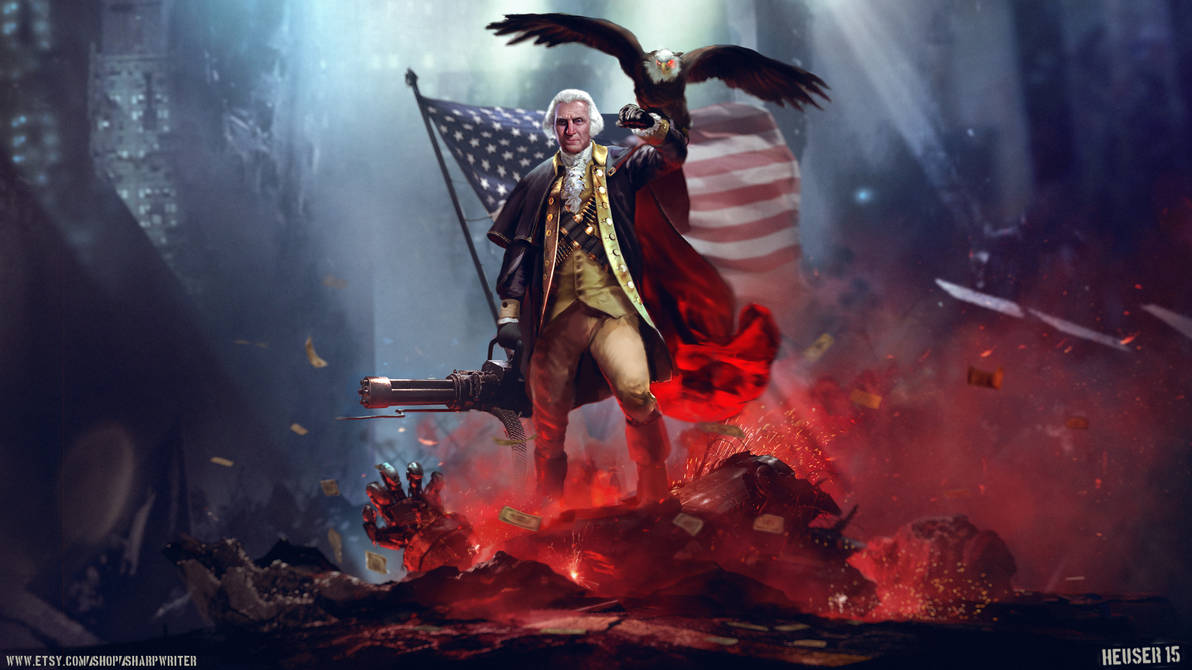
I’ve fallen behind on my blogging, so to keep things up here’s a picture of the most badass American ever to live, in all of his glory. Have a great day!

Gotta go fast!

So they’re making a Sonic the Hedgehog movie, and the character design for Sonic is so bad that it’s spawned a bajillion memes. Within days of the trailer’s release, it got so bad that the director said they’d redesign the animation, and suddenly thousands of nine-year-olds became drunk with power.

I have a few thoughts on the whole Sonic fiasco. The first game came out when I was seven, and even though I only ever played it at friends’ houses, stuff like the Green Hill Zone theme definitely scratches the nostalgia itch. That said, never got into it as much as some people.

The new movie actually doesn’t look all that bad. I mean, it doesn’t look great, but it’s got potential. I really like seeing Jim Carrey as Robotnik, that could be really fun. Also… well, okay, that’s pretty much all that looks good so far, but just because it’s a horrible trailer doesn’t mean the movie has to be crap. Right?

The fact that Paramount Pictures made this movie reminds me of the early 00s, when superhero movies started to get big again, and the major studios really screwed up some of the big franchises. Fantastic four, I’m looking at you. Basically, the big studios were treating these intellectual properties as cash cows instead of treating them with the passion and love of the original creators. It was also very disrespectful to the fans.

Unless I’m mistaken, that’s actually how we got the Marvel Cinematic Universe. After the failures of Hulk, Fantastic Four, and Fantastic Four: Rise of the Silver Surfer, Marvel decided to do everything in house, because the major studios kept screwing things up so badly. With Blade and X-Men in the 90s, they’d proved that movies with B- and C-list superheroes could still be profitable, so they reacquired the rights to as many characters as they could and went all in on it. Thus was born the MCU, and there was much rejoicing.

It’s particularly interesting to me as an indie writer because the pattern is very similar to what’s happening in the book industry. It basically goes like this:

  1. Technological disruption renders the legacy business models obsolete.
  2. Independent creators start to steal market share from the old guard companies.
  3. The old guard goes through a period of mergers, acquisitions, and layoffs.
  4. They start to cut corners because too much is expected of the people who are left.
  5. The old guard companies become dependent on blockbuster hits to stay afloat.
  6. The bean counters take charge, further killing the old guard’s creative spirit.
  7. Several intended blockbusters fail spectacularly, driving further downsizing.
  8. The independent creators eat the old guard’s lunch.

And that’s why I’m still indie.

Is this what’s happening with Sonic the Hedgehog? Looks like it to me. We’ll have to see how this all plays out, but I’m not expecting much. On a more positive note, though, the best way to enjoy a crappy movie is to go in with low expectations. It worked for me with Indiana Jones 4, so maybe it’ll work with the new Sonic movie.

In the meantime, here’s Pewdiepie reviewing some of the hilarious memes that have come from all of this:

The evolution of US girl names

Here’s something interesting, just for fun. The shift in name popularity over the years reflects my own family tree surprisingly well. It’s also fascinating to keep in my cultural trends as you watch this video.