Searching for a routine

Just a quick update post. My parents came over to visit last week, and we’ve all come down with a mild cold, so our family routine has been more or less up-ended. That’s just the nature of routines, though: they work until they’re inevitably disrupted, at which point you need to reassess and adapt to the new circumstances.

In our case, the big thing we need to adapt to is our two year-old daughter. Currently, I watch her in the morning and my wife watches her in the evening (we both work from home). Which works out pretty nice, especially since she’s just started taking one long nap (usually in the morning) instead of two shorter ones.

I’ll have to talk with Mrs. Vasicek about how we want to adjust our schedules because of that. But before we do that, I suppose I should break down the elements of what I need to accomplish, and figure out how best to do those:

Writing

My daily writing goal is to hit at least 1k new words, and 2.5k words on what I call the daily index. Basically, new words count 1x and words revised or other words (such as what I’m writing now for this blog) count .5x. So I could hit the daily index by writing 2.5k new words in my WIP, or 1k new words and 3k words revised.

It’s a fairly modest goal, but I’ve found it quite challenging to hit it consistently. For that reason, I allow myself one admin day (for doing all the mindless work and/or refilling the creative well) per week, but I really do need to hit those daily writing goals more regularly. And I’ve found through sad experience that the longer I put off doing the writing, the harder it gets to actually do.

So what I really need is to start writing first thing in the morning. If I can get 500 words in before breakfast, that would be fantastic. But the trouble with that is that I’m the one watching the baby while Mrs. Vasicek makes breakfast, and the baby is always—always—super hangry when she wakes up. I know we’re supposed to minimize screen time, but I usually put on something for her to watch to keep her happy. But that’s usually either piano music or Tabernacle Choir, so I suppose I could write on my other monitor while the video plays on the other one. And sometimes I get lucky and the baby wanders off to the kitchen to get a piece of whatever Mommy is cooking. So I could probably fit in some writing that way.

The other obvious time to fit in some writing time is during her nap. I usually need at least a little time to decompress first (putting the baby down can be an ordeal) but if I set a timer, that would probably help keep the down-time from taking up all of naptime. Also, it would probably help if I read a book instead of browsing the internet. Reading is much better for decompressing than vegging out on the latest clickbait trash.

If I can hit 500 words before breakfast and another 500 words during naptime, it should be much easier to hit word count later. The first couple hundred words are always the hardest. After hitting 1k words, it’s surprisingly easy to write another thousand. So getting those words in early is the key.

Publishing

In my experience, there are four kinds of publishing tasks, forming a 2×2 grid:

Takes very little brainspaceTakes a lot of brainspace
Tend to enjoy
Tend to procrastinate

Tasks that require a lot of brainspace are things like writing a blog post, or writing a book description, or responding to fan mail. Tasks that take very little brainspace are things like crunching numbers, typesetting a print book, or submitting books for promotions.

The procrastination angle is a bit more personal. I imagine the kinds of things I tend to procrastinate are very different from the things that other people procrastinate. But the big danger here is that the tasks I actually enjoy will become the excuse for procrastinating something else—like writing. For that reason, I try to limit myself to only 1 hour of publishing tasks per day.

But when is the best time to fit in that hour? If I do it first thing to get it out of the way, there’s a very good chance I’ll just keep working through the timer and end up having an admin day. On the other hand, if I put it off to the end of the day, then writing tends to fill up that space instead—which isn’t terrible, but these publishing tasks do need to get done sometime.

What I probably need to do is set a time in the middle of the day, maybe around 3pm when we start intermittent fasting. That should be late enough not to turn the day into an admin day, but early enough that I still have time and energy. Besides, for me writing isn’t usually a continuous thing: instead, it tends to happen in creative bursts with a little bit of necessary downtime in between. So setting 3pm as the publishing tasks time shouldn’t interrupt my writing time too badly—and if I happen to be in the flow, I’ll just push on to the next stopping point and do publishing tasks then.

I have a pretty good accountability system in place to maximize the productivity of that hour, so I’m not concerned about needing more time or dropping the ball on the important-but-not-urgent tasks. However, I will procrastinate some of those important-but-not-urgent tasks if I’m not mindful enough. So this is probably the best way to handle all that:

Takes very little brainspaceTakes a lot of brainspace
Tend to enjoyLeave for the next admin day.Pay closer attention to the time.
Tend to procrastinateStart first, then listen to podcasts.Plan it out ahead.

Of course, this will change depending on how urgent/important the task is. The mindless enjoyable tasks tend to be neither urgent nor important, but that isn’t always the case. And by “start first, then listen to podcasts,” what I mean is to start it off with a good amount of focus, then switch on a podcast in the background after I’ve hit my stride.

Reading

Reading is something that I enjoy, but it isn’t a mindless activity, so if I’m not careful I’ll end up filling my free time with useless things like playing a phone game. So reading time needs to be scheduled.

My wife and I have found that reading before bed tends to work really well, so long as we don’t put off going to bed. The key to that is to turn off the computer before getting the baby down, which means accomplishing all of my work (including personal stuff) before about 7pm. Also, on the nights when it’s my turn to do the dishes, it helps to do those sometime during the afternoon, to keep the rest of the evening free.

We also do a fair amount of reading in the early morning (theoretically, we wake up at 5am, though we haven’t been as good about that lately), but when the baby gets up, it’s usually time to start the morning routine, so it isn’t good to rely on that time.

I could probably also fit in some reading time while watching the baby. The key here is to cut back on podcasts, which probably would be a lot healthier, considering how many political podcasts I listen to. Also, as I mentioned above, reading would be a great way to decompress after putting the baby down for a nap.

So that’s pretty much what I have in mind: start off each day with writing time, carefully schedule and limit publishing time, and be more deliberate about reading time. Hopefully that works.

Christians: The Most Marginalized and Underrepresented Minority in SF&F (By Design)

So I’m reading The Expanse, and I recently finished the third book in the series, Abaddon’s Gate. Really great book! I thoroughly enjoyed it. Lots of action, lots of adventure, and a very optimistic ending, which is not something you see a lot of in science fiction and fantasy these days.

However, there was one small thing that bugged me about one of the major viewpoint characters: Anna, the Christian pastor. To be fair, they played her religious devotion straight, and didn’t just make her a hypocrite or the bad guy—which is another thing we don’t see a lot of in SF&F these days (more on that later). But they also made her a lesbian, and to be honest, yeah, that bugged me.

Why did that bug me? Because most conservative Christians (and most Muslims, by the way) believe that homosexuality is a sin. Not that being attracted to the opposite sex is inherently sinful, but that acting out on those sexual desires is. Of course, there are plenty of liberal churches that do not believe this, but their theology is in conflict with all of mainstream Christian teaching from the time of Christ himself. So by making Anna a lesbian, the authors were basically saying “yeah, she’s a Christian, but she’s not that kind of Christian.”

Not that I blame the authors for doing that. I totally get that they were writing for a mainstream SF&F audience and wanted to be able to bring up theological topics in the story without turning off any non-religious or LGBT readers. By making the religious character a lesbian, they signalled that the character was “safe,” even if she was a Christian.

But it got me to thinking: when was the last time that a mainstream, bestselling book, movie, or series had a devoutly religious Christian main character who 1) is not a villain or anti-hero, 2) is not a hypocrite, and 3) is not LGBT? Kind of like the Bechdel test, except for Christians.

Firefly comes to mind, though that was twenty years ago. Monster Hunter International has a devoutly religious side character—does he get his own book? I haven’t read far enough in the series yet to know. Looking at my bookshelf, I can see A Canticle for Leibowitz, The Speed of Dark, Hyperion, and Folk of the Fringe, but all of those books are old now. The most recent award-winning example I can think of is Eric James Stone’s novelette “That Leviathan Whom Thou Hast Made” (2010).

I’m having a very hard time thinking of anything published in the last ten years that passes the test. Even with authors like Larry Correia and John C. Wright, those guys have faced tremendous pushback from the left. It really does seem like there is an effort, at least from some quarters to erase good, faithful, conservative Christian characters from SF&F, and to ostracize or marginalize any authors who dare to buck that trend.

It reminds me of a family history podcast from NPR that I checked out once, only to find that the very first episode was about someone finding that two of their ancestors were gay. Laying aside the rather obvious (and hilarious) biological problems with that—adopted family is still family, after all—the implication here was that by making family history LGBT, NPR was making it “safe,” probably for their liberal listeners who have come to associate family history with the Latter-day Saints.

At the same time, we’ve heard a lot in recent years about how important it is to include underrepresented groups in fiction—to make sure that every reader can find characters who “look like them,” or “love like them.” And yet, none of the people championing this cause seem to care whether I can read about characters who “look like me” when it comes to religion. In fact, it seems that the people screaming the loudest about how we need “more diverse books” and more “own voices” are also the loudest in trying to erase and marginalize Christians like me.

So was it really ever about “representation” or “diversity” at all, or was all of that lip service about tolerance and diversity just a Trojan horse from the very beginning? Because here’s the thing: if I as an author don’t include any LGBT, BIPOC, or LMNOP characters in my books, I’ll get slammed by the woke activists for not having enough representation in my books… but if I do include any “marginalized” characters, then I’ll be accused of cultural appropriation. Unless, of course, my book promotes the woke activists’ agenda visavis things like climate change, ESG, gay pride, etc.

“Show me the man and I’ll show you the crime” said Lavrentiy Beria, one of the most psychopathically evil agents of the Soviet Union. That is exactly the same principle that the woke movement operates on, and unfortunately, that movement has come to dominate the SF&F field (just look at what they did to Mercedes Lackey). So really, it should not come as a surprise to anyone that they don’t apply the same principles of tolerance, diversity, and equal representation to conservative Christians—which are rapidly becoming the most marginalized and underrepresented minority in science fiction and fantasy.

So what is the solution? Honestly, it may just be to smile and turn the other cheek. If we give these people enough rope, they will hang themselves with it. Get woke, go broke. Granted, there are reasons to be worried about ESG, Big Tech, and Amazon’s dominance, but it is still possible to build a resilient author career where you aren’t beholden to all that. The more of us accomplish that, the less power these woke crazies will have over us.

Lash out in kind, bend the knee, or smile and turn the other cheek… definitely the third option is best. It’s what Christians have been doing since the time of the Savior Himself, and is the unique genius of the religion that has allowed it to thrive in the face of so much persecution. But it’s important to keep in mind that turning the other cheek is not the same as bending the knee.

Good Morning Planets

I’ve been following Astronomy Picture of the Day longer than any other blog—since 2006, in fact. Usually, the pictures are okay but not all that memorable. This one, however, is amazing. Planets one through six of our solar system, all captured in one amazing shot. Very well done.

By the way, if you’re looking for something astronomy related that will blow your mind:

Print vs. Ebook vs. Audiobook: When To Own

In last week’s post, I tried to make a comprehensive list of all the pros and cons associated with the various book formats. The purpose of that exercise was to figure out when to acquire a book in print, in audio, in ebook form, or some combination of all three. It’s long been my goal to build a magnificent personal library, and with the upsides (and downsides) of each format in mind, I think I’ve developed some personal guidance toward that end.

For the purpose of this exercise, I think it’s best to consider first what the platonic ideal would be, if money or availability were no object. So assuming that every book is available in every format, at a price that I can afford, this is what I would do.

If a book is worth owning, it’s worth owning in print.

For all the advantages of digital format, print is still better in enough ways that if I’m going to own a book, I want to own it in print. This really comes down to the rule of thumb that if you don’t hold it, you don’t own it. Also, the fact that print books are immutable, more private, and so much easier to share.

However, my calculation would be different if I hadn’t married and settled down. Back when I was a global nomad, ebooks were so much better than print, and even when I was a student my print books were more of a liability than anything. I moved so much in my college years that for most of the time, my books just sat in cardboard boxes under my bed. When I left on my internship, I ended up giving most of them away.

But now that I’ve settled down, print books are definitely the way to go. As for hardbacks vs. trade paperbacks vs. mass-market paperbacks, or used vs. new, I still have to figure that out. Personally, I prefer MMP to the other print formats, but that’s mainly because it’s what I grew up with and because I don’t really care if it gets banged up. For the purpose of building a personal library, the calculus is probably quite different.

If a book is worth rereading, it’s best to have a digital copy too.

There are a lot of reasons to own a book even if you’re probably not going to reread it—for example, if you want to share it with your friends, or display it prominently on your shelf. But if money were no object, I would want to own at least one digital format of every book I plan to reread. That way, if something happens to the print copy, I have another one to fall back on.

More than that, though, I think it would be interesting to change up the reading experience by rereading it in another format. Does a book hold up in audio as much as it does in print? How about ebook? Maybe it would be fun to see which passages other people have highlighted and shared the most.

Also, if I’m planning to reread a book at the same time as my wife or my friends are reading it, it would be great to have a digital copy so that they can borrow the print one. Or maybe they get the digital copy, and I keep the print one.

For all these reasons, multiple formats seems like the way to go, provided that money is no object. But then, the question becomes whether to get the ebook, the audiobook or both? To figure that out, here are the questions I need to ask:

Do I want to find and share my favorite passages?

One of the biggest advantages of ebooks that make that format unique is that the text of an ebook is searchable. That is no small thing for the kind of books that I want to go back through and pick out certain passages. Print books are better for flipping through, but they aren’t text-searchable in the way that ebooks are.

Another unique advantage of ebooks is that you can share passages that stick out to you, or see what passages other people have highlighted and shared. So if it’s the kind of book that I want to go back and think about, or reread certain passages in greater depth, the best digital format for that is probably ebook.

Do I want to read it quickly, without too much depth?

The biggest advantage of audiobooks is that your eyeballs can be elsewhere while you read. So with audiobooks, you can fit more reading time into the interstitial parts of your day, like commuting or doing chores, but it comes at a tradeoff because you’re not going to be concentrating all that much.

However, that probably won’t be as much of a problem on a reread, since you’re already familiar with the story. But it will be a different reading experience, one where your attention is not as concentrated. For that reason, I lean more toward owning a book in audiobook if it’s the kind of think I want to reread for enjoyment, not for depth.

But I can’t buy it all!

Okay, so all of this is great if money is no object, but few if any of us live in that world. I certainly don’t, and some of these formats—especially the audiobooks—can get to be quite expensive. So, what’s the best thing to do?

Since I tend to be more of a spreadsheet guy, my solution is to make a list of all the books I want to own, in each format. Some of these books will end up on various wishlists, and will probably come my way as gifts. For others, I just need to keep an eye out for good deals—it’s surprising how many excellent books come through the local thrift stores, some of them in rare or signed copies.

But the key here is patience. If you’re time-rich and money-poor, learn how to wait and keep an eye out for good deals. Books tend to come and go, just like so many other things in life.

So that’s how I plan to acquire books going forward. What about you? What’s your personal guidance on when to own a book?

The Generational Cycles of Grimdark vs. Noblebright

A couple of months ago, I was discussing genre trends with my indie publishing mastermind group where we drew some fascinating connections between grimdark fantasy, noblebright fantasy, and Strauss-Howe generational theory. In that discussion, we came up with a theory that predicts when each type of fantasy (grimdark, nobledark, noblebright, and grimbright) will be ascendant, and explains exactly why. According to this theory, grimdark is currently in the beginning phase of a multi-generational decline, and will be replaced by noblebright as the ascendant form of fantasy by about the mid-2030s.

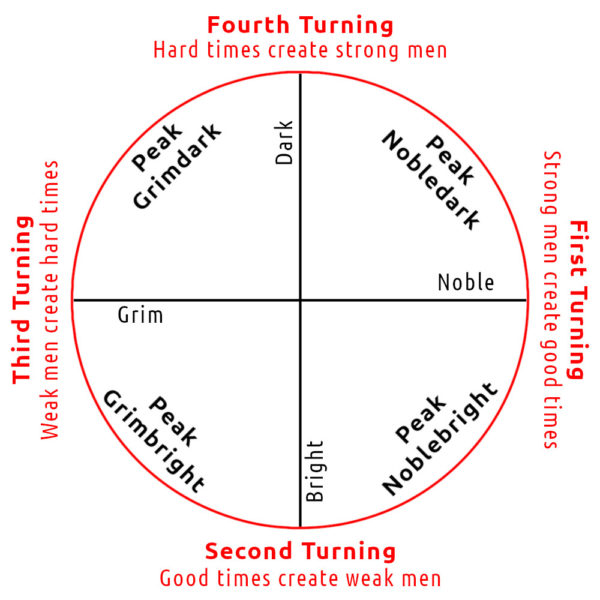
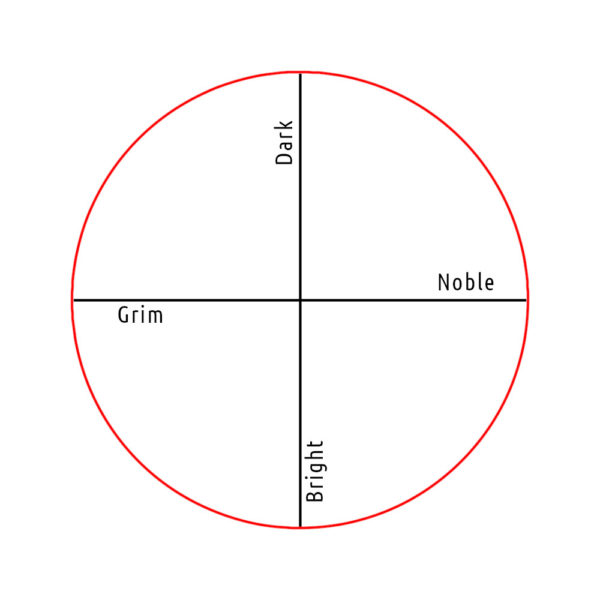
To start, we need to understand the difference between grimdark and noblebright. Both forms of fantasy exist on a field with two axes: noble vs. grim and bright vs. dark.

The bright vs. dark axis describes whether the fantasy takes place in a world where good usually triumphs over evil (bright), or a world where evil usually triumphs over good (dark).

The noble vs. grim axis describes whether the characters have the power to change the world (noble), or whether they do not (grim).

Thus, with these two axes, we get the following combinations:

  • Noblebright: A fantasy world where good usually triumphs over evil and the characters have the power to save it.
  • Grimbright: A fantasy world where good usually triumphs over evil, but the characters aren’t on a quest to save it and are usually preoccupied with smaller concerns.
  • Grimdark: A fantasy world full of moral shades of gray, where evil usually triumphs over good and the characters are either anti-heroes or otherwise fail to save the world.
  • Nobledark: A fantasy world where evil usually triumphs over good, but the characters are empowered to change it.

These categories are subjective to some degree, and fans will often disagree about which category to put each book/series. However, I think that most fans will agree on the following examples:

  • Noblebright: The Chronicles of Narnia by C.S. Lewis
  • Grimbright: The Princess Bride by William Goldman
  • Grimdark: A Song of Ice and Fire by George R.R. Martin
  • Nobledark: Lord of the Rings by J.R.R. Tolkien

Next, let’s review in the broadest possible terms William Strauss and Neil Howe’s generational theory. To really understand their work, I highly recommend that you read The Fourth Turning. I have some criticisms of the finer nuances of that book, but their ideas are really excellent, and their predictions hold up surprisingly well three decades later.

If I had to boil their theory down to one simple, easy-to-understand statement, it would be this:

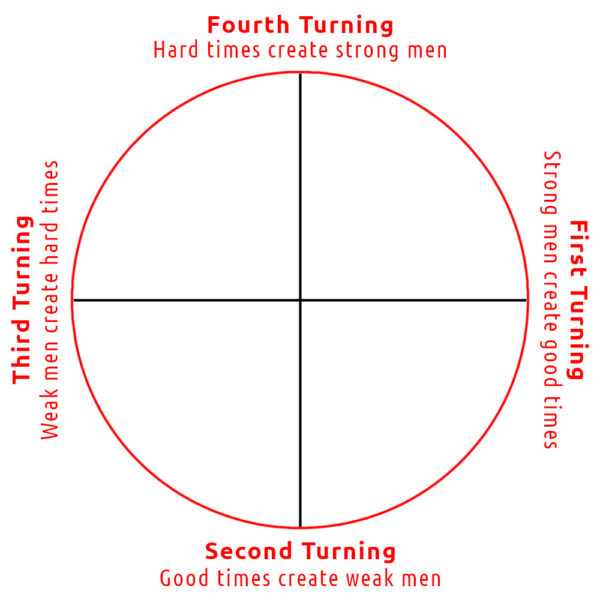
Strong men create good times.

Good times create weak men.

Weak men create hard times.

Hard times create strong men.

Thus, our society and culture passes through a secular cycle that takes about 80-100 years to complete (or in other words, the length of a long human life). The cycle has four seasons, or turnings, each one corresponding to a generational archetype (since it takes about 20-25 years for people born in the one turning to start having children of their own, thus moving us into the next generational turning).

The first turning happens when the society comes together after resolving a major crisis (eg the Revolutionary War, the Civil War, World War 2) and builds a new, stable order. The second turning happens when their kids rebel against that order, seeking freedom (eg the First and Second Great Awakenings, and the various counterculture movements of the 60s). The third turning happens when the order breaks down completely and everyone goes their own way (eg World War I, the Roaring Twenties, and the culture wars of the 90s). Finally, the fourth turning happens when the society faces a major existential crisis that totally reshapes it.

According to the theory, each axis of the grimdark/noblebright field corresponds to a different generational turning. Thus, stories that are noble have the most resonance in a first turning, stories that are bright have the most resonance in a second turning, grim stories resonate most in a third turning, and dark stories resonate most in a fourth turning.

In other words, the generation that comes of age during a major existential crisis will tend to gravitate more toward fantasy where evil typically triumphs over good, whereas the generation that comes of age during a period of rebuilding will tend to gravitate more toward fantasy where the characters have the power to change the world. And so on for bright and grim stories: the generation that comes of age during a spiritual awakening will gravitate more toward stories that take place in a world where good usually triumphs over evil, and the generation that comes of age in a declining and/or decadent society will gravitate more toward fantasy where the characters are relatively powerless.

Another way of thinking about it is to consider what each generation is not going to be drawn to, or which stories are not going to resonate well. An American who came of age in the 40s and 50s, when US power was on the rise and the Pax Americana was reshaping the world, isn’t going to resonate well with grim stories about powerless characters. Likewise, a boomer who came of age during the counterculture movements of the 60s and 70s isn’t going to resonate well with a dark fantasy world where evil usually triumphs, because (as much as they hate to admit it) they grew up in a very sheltered world that generally made sense—so much so, in fact, that they couldn’t help but rebel against it.

According to this theory, the next generational turning begins when one of the four forms of fantasy (noblebright, grimbright, grimdark, or nobledark) is at a peak. Over the course of the turning, that fantasy form declines until the next form in the cycle becomes ascendant, at which point the next generational turning begins.

Thus, at the start of a first turning, nobledark stories are typically ascendant, where the fantasy worlds are dark and morally gray, but the characters are empowered to save the world. As that generation successfully establishes a new order, the culture’s taste in fantasy shifts away from dark stories and toward noblebright stories, where the characters are still empowered but the world is more ordered and stable.

At the start of the spiritual awakening that characterizes a second turning, noblebright fantasy is ascendant: stories with an optimistic outlook on the world where the characters are larger than life. But as the awakening progresses, people in the society care more about freedom and individuality and less about the group, so stories about characters who sacrifice everything to save their world resonate less with them. Thus, by the end of the second turning, the ascendant form of fantasy is grimbright, which is really more of a slice-of-life fantasy about beloved characters having fun (but not world-altering) adventures.

At the start of a third turning, where the social order has started to break down and corruption begins to permeate all levels of the society, these grimbright stories start to take a darker tone. Readers find it too “unrealistic” to believe that good always triumphs over evil, and they certainly do not believe that good people have the power to change the world—at least, not the “smells like teen spirit” world that they inhabit. Their tastes shift away from the fun, adventurous slice-of-life of grimbright, and toward the dark and gritty anti-heroes of grimdark.

Finally, at the start of the fourth turning, grimdark is ascendant, but readers are starting to lose patience with it. As each new crisis in the real world compounds with all the others, they find it unbearable to read about characters that don’t have the power to change the fantasy worlds they inhabit. At the height of the fourth turning, society reaches an existential breaking point where, in the words of Strauss and Howe, “all of [our] lesser problems will combine into one giant problem, [and] the very survival of the society will feel at stake.” (The Fourth Turning, p277) At this point, readers are ravenous for books about characters who are empowered to fight back against the tides of evil and darkness. Grimdark fantasy declines and nobledark fantasy ascends.

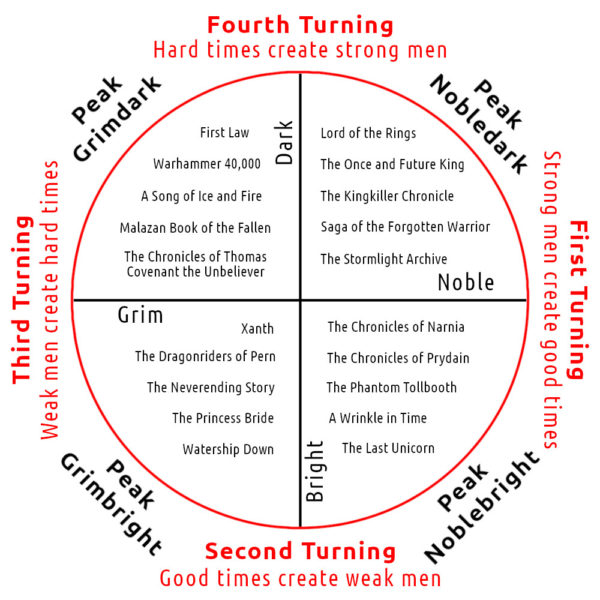
I haven’t read all of the series in the diagram above, but I do have a pretty good sense of most of them, and I put the diagram together with the help of my mastermind group. The key thing about it is that each fantasy series came out in roughly the generational turning that corresponds with each quadrant.

Now, it’s worth pointing out that these trends aren’t absolute. In each of the secular seasons, you can find examples of contemporary fantasy that runs counter to trend. For example, David Gemmell’s Drenai Saga came out in the 80s, at the start of the last third turning when grimbright should have been ascendant, and yet the Drenai Saga is solidly nobledark. Terry Pratchett’s Discworld books had their heyday in the 90s, 00s, and arguably 10s, but they probably fall into grimbright (though you could make the argument that, as absurdist fantasy, they are more similar to grimdark: stories where good and evil really doesn’t matter, and the characters are just doing their best to go along).

But the theory doesn’t state that each fantasy form’s antithesis dies completely when that form is ascendant: only that it reaches a nadir of decline in its resonance with the culture. But without sufficient contrast, the ascendant form cannot stand out. Thus, there still has to be some noblebright Paolini to provide sufficient contrast with the grimdark of Abercrombie and Martin, some low fantasy slice-of-life Legends and Lattes grimbright to make the epic nobledark high fantasy of Sanderson stand out stronger.

According to this theory, as we continue to muddle our way through this present fourth turning, the decline of grimdark fantasy will accelerate, and the bestselling fantasy books of the 2020s will mostly be nobledark. And indeed, we can already see that happening with the meteoric rise of Brandon Sanderson (especially his Stormlight Archive series), the popular enthusiasm surrounding Larry Correia (whose Saga of the Forgotten Warrior falls squarely into nobledark), and the enduring anticipation of Patrick Rothfuss’s fans for the conclusion to the Kingkiller Chronicle. Meanwhile, enthusiasm for George R.R. Martin has waned significantly with the train wreck of Game of Thrones, and Abercrombie, though still quite popular, seems to be testing the nobledark waters with his YA books.

It would really be interesting to do a deep dive on the generational archetypes and make a study of how that affects the fantasy forms that run counter to the cycle. But that’s beyond the scope of this blog post, and frankly I need to get back to writing my own books. But what do you think of this theory? Does it resonate with you, or is there something that we missed?

How SFWA ruined science fiction (and why it needs to die)

There was a time when science fiction was bigger than fantasy. More people read it, more authors wrote it, and more editors demanded it. Would-be fantasy authors were steered toward writing science fiction, because they knew that it would sell better than the stuff they actually wanted to write.

Now, the roles are reversed. More people read fantasy, more authors write it, and more editors are demanding it (except in the short story world, but none of them are in it for the money, which proves my point). For every year of the Goodreads Choice Awards, the fantasy section has gotten more total votes than the science fiction section. And authors like me, who often prefer to write science fiction, are instead veering more toward fantasy, because we can see that it sells better.

I’m not decrying this shift. I enjoy fantasy differently than I enjoy science fiction, but I genuinely enjoy them both. And as science fiction writers have pivoted to writing fantasy, I think it’s improved fantasy considerably, with magic systems that actually have rules and fantasy worlds that are actually realistic, given our understanding of physics, geography, etc. So just to be clear, I’m not complaining about this.

But I have wondered more than once how it got to be this way. What caused science fiction to fall out of favor? What made readers turn toward fantasy instead? Why has science fiction been on a general decline for the better part of half a century?

There was a time when science fiction was fun and inspiring. When scientists, engineers, inventors, and pioneers cited their favorite science fiction stories as major inspiration for their work. These were the people who put satellites in orbit, who put a man on the moon, who invented computers and the internet and in many ways built our modern world. And it worked both ways: not only did the fiction writers inspire the scientists and pioneers, but the new discoveries and inventions inspired the next generation of science fiction writers to write fun and inspiring stories about that.

What broke the cycle? What got us to the point where today’s kids no longer dream about becoming astronauts or paleontologists, but about being YouTube stars and “influencers,” whatever the hell that means? Why is there such a dearth of truly inspiring science fiction nowadays?

To be sure, there are a lot of factors at play, and no one single person or organization bears all of the responsibility. But if I had to point to just one thing as the primary cause, it would be SFWA.

The Science Fiction and Fantasy Writer’s Association, formerly known as the Science Fiction and Fantasy Writers of America, formerly known as the Science Fiction Writers of America, was started in 1965 by noted author and Futurian member Damon Knight. (Who were the Futurians? We’ll come to that later.) It is a professional organization for writers with a membership requirement of making at least 3 professional short story sales (only from SFWA-approved markets, of course), or a professional novel sale (also only from SFWA-approved markets), or to make something like $5,000 in sales on a single title if you’re self-published (which involves opening the kimono to these sleazeballs), or… frankly, I don’t know what the membership requirements are these days, and I don’t think SFWA does either, because their membership requirements page currently says that they have “a plan to create a comprehensive market matrix or scorecard to better guide creators toward professional publishers,” and that they are just now “starting with short fiction markets on this rollout.” Whatever the hell that means.

In practice, SFWA is a very snobbish club of “important” science fiction (and fantasy?) writers, or rather, a club of snobbish people who consider themselves to be important. Every year, they give us the Nebula Awards, which are supposed to represent the “best of the best” that science fiction (and fantasy?) has to offer.

The reason I’m keeping “fantasy” in parentheses is because the organization was very clearly founded with a focus on science fiction, and to the extent that it later expanded to include fantasy, it did so as a means to stay relevant in a world where fantasy had come to dominate science fiction. At least, that’s what I gather. But even if I’m wrong about that, I’m not wrong that the SF in SFWA originally standed for “science fiction,” and that the addition of fantasy came much later—and not without a ridiculous amount of controversy typical of this toxic and disfunctional organization.

Those of you who have been following the devolution of the genre since the dumpster fire that was the response to the Sad Puppies will no doubt agree that SFWA is a major part of the problem. But the thing that may (or may not) surprise you is that SFWA was toxic from the moment of its inception, and was always the primary factor in science fiction’s decline.

To see why, let’s go back to the Futurians. This was a small but tight-knit community of superfans, kind of like the Inklings, whose members went on to found Worldcon, the Hugos, DAW books, the Nebulas—and yes, SFWA itself. These were all people who grew up with the pulps, were active during the golden age, and became the movers and shakers in the field in the latter half of the 20th century: people like Donald A. Wollheim, Frederik Pohl, Isaac Asimov, Damon Knight, and others.

The key thing to know about the Futurians is that they were left-wing radicals. In the 1930s, when communism was a very dirty word, Pohl was literally a communist. Wollheim was also a believer in communism, and stated that science fiction writers and fans “should actively work for the realization of the scientific world-state as the only genuine justification for their activities and existence.” (Carr, Terry (1979). Classic Science Fiction: The First Golden Age p430) According to Asimov, the Futurians broke off from the Greater New York Science Fiction Club precisely because of their political and ideological differences. In short, the Futurians were all true blue, dyed-in-the-wool, die-hard Marxists of one stripe or another, and they were very overt about bringing their politics into their fiction.

When I first started to get involved in fandom, I heard an apocryphal story that at the very first Worlcon, there was a schism between the group of fans who wanted science fiction to advance the cause of global communism—basically, the Futurians’ view—and the majority of fans, who just wanted to read and talk about fun science fiction stories. That first major schism (or so the story goes) became the root cause of every fannish conflict and controversy that has ever happened since.

Now, if we had to sum up the chaos and insanity of the last ten years in just three words, most of us would probably agree that “politics ruins everything” is a fair assessment. For science fiction, it was no different. The science fiction of the golden age, for all its flaws, was fun, adventurous, inspiring—and not overtly political (for the most part). Then, in the 60s and 70s, science fiction took a strong turn to the political left, glorifying sexual liberation and Marxist utopias, and pounding the idea that the world was going to end very soon in some sort of climate catastrophe, or a nuclear holocaust brought on by politicians like Goldwater and Reagan.

I used to think that science fiction was an inherently political genre, but why should it be? After all, there is nothing inherently political about science. If the pandemic has taught us anything, it’s that the moment science becomes politicized into “The Science,” it becomes toxic and unreliable. And the more I read, the more I’m convinced that this is true of science fiction as well. The difference between art and propaganda, truth and narrative, is the same difference between science and “The Science.”

What happened in the 60s and 70s was science fiction’s version of the long march through the institutions, as the Futurians and their ideological allies came to dominate the professional side of the field. Even though they were outnumbered and their political views put them solidly in the minority, they took their love of science fiction way more seriously than everyone else, and so while a lot of those early fans of the 40s and 50s either grew out of science fiction or moved on to other things, the Futurians and their allies stayed. Science fiction was their life. Science fiction was their passion. And thus they became the next generation of authors, editors, and publishers.

Through SFWA, they were able to leverage their position and influence into real power. With Worldcon and the Hugos, anyone who was willing to shell out the money could vote or join the convention, and a lot of people did. It was much more democratic that way. But with SFWA, you had to sell enough stories to the qualifying markets—and increasingly, all of those qualifying markets came to be run by left-wing political ideologues.

In a recent Project Veritas expose, an engineer at Twitter explained that one of the reasons why Twitter has such a left-wing bias is because the left-wing extremists refuse to compromise on any of their views. According to the engineer, right-wingers tend to say “I disagree with what the other side is saying, but I don’t think they should be silenced for it,” whereas left-wingers tend to say “that’s violence and hate speech, and if you don’t censor it, I won’t use your platform.” Because the left-wingers are the super-users, Twitter is more likely to cater to them, and thus rewards their extremism instead of limiting it.

A similar dynamic emerged in science fiction, where the left-wing editors and publishers—many of whom had always viewed science fiction as a means to achieving their ideological ends—rewarded politically like-minded authors with story sales, publishing contracts, favorable reviews, and the Nebula Award. These left-wing authors went on to join SFWA and vote for other left-wing authors in the Nebulas, feeding the cycle.

Meanwhile, all the other authors and fans—the ones who cared more about telling good stories than conveying a political message—only stuck around so long as the quality of the stories hit a certain minimum threshold. And I’ll be the first to point out that there were many left-wing authors who wrote genuinely good stories: Ursula K. Le Guin, for example. But there were also some real hacks who were awarded the Nebula mainly because of their politics. Since the minimum threshold was different for every reader, as the stories got more political, more and more readers abandoned science fiction.

In other words, the reason why science fiction became so political was because the institutions—most notably, SFWA—rewarded political purity more than they rewarded telling a good story. From the beginning, SFWA had this toxic dynamic, because it was founded by political ideologues who wanted to use science fiction to achieve their ideological ends. And because politics ruins everything, SFWA ruined science fiction.

How does all of this end? With an insanely toxic purity spiral and a collapse into cultural irrelevance. That is what we are witnessing right now, with the recent brouhaha over Mercedes Lackey accidentally saying “colored people” instead of “people of color.” (Both terms are equally racist, by the way: it’s just that the one flavor of racism is more fashionable right now.) The purity spiral has been ongoing for years, perhaps since SFWA’s inception, and the collapse into cultural irrelevance is well underway. The only questions left are 1) how much damage will be done before SFWA fades into much-deserved obscurity, and 2) if science fiction has a comeback from its long decline, who or what will turn it around?

As to the second question, it’s possible that the damage is permanent and nothing will stem the genre’s decline. That’s what ultimately happened to the western, after all. Or maybe it will follow the same path that horror did, with some authors adapting to the changing market and rebranding as something else (ie urban fantasy, paranormal romance), while the genre purists languish, at least in terms of commercial viability.

Or maybe, if SFWA just dies, science fiction will begin to experience a renaissance. Same thing at this point if Worldcon doesn’t survive the pandemic (or gets totally captured by the Chinese, which honestly would be an improvement). With the advent of indie publishing, the field is very different right now, and we’ve already seen some amazing indie authors like Andy Weir and Hugh Howey take the field by storm. Without the toxicity of SFWA holding us back, I think we will see some very good things come out of the genre in the coming years.

But for that to happen, SFWA really does need to die, or at least fade into cultural irrelevance like the Author’s Guild and the Libertarian Party. Starve the beast. Don’t let them have any of your money. Mock the organization relentlessly, both online and offline, or else ignore them entirely. And if a book or a story wins a Nebula, take that as a mark against it. I’ve read all but five of the Hugo and Nebula award winning novels, and now I can say with certainty that the best predictor that I will personally hate a book is if it won a Nebula but not a Hugo. Test that out for yourself. If you haven’t been red-pilled yet, you’ll probably be surprised.

Also, check out this podcast if you haven’t already. Good stuff as always from Steve Diamond and Larry Correia.

Print vs. Ebook vs. Audiobook: Pros and Cons

Print

Pros:

  • A printed book is a hard, physical copy that cannot be altered, edited, deleted, revoked, remotely accessed, or otherwise tampered with by a third party who does not have physical access to the book.
  • The reading experience is totally private. Governments, corporations, and other third parties cannot easily know about what you read or how you read it.
  • Marginalia is easier with a print copy. All you need is a pencil and maybe some tabs or sticky notes.
  • It is easier to flip through a print book than any other book format. Much better for reference.
  • Print books are fantastic for sharing and borrowing. You don’t need any devices, permissions, or anything. Just take it off the shelf and put it into the borrower’s hands.
  • Does not require any sort of power source or electricity to read. Works perfectly fine when the power is down.
  • Print books can be quite collectible, and some are worth quite a lot, depending on first editions, cover art, etc.
  • You can get your copy signed by the author(s), which is always fun. It also makes the book more collectible.
  • When you finish reading the book, you have a totem or artifact to commemorate the reading experience.
  • The books that you choose to put on a public shelf can be a way of expressing yourself: your tastes, opinions, and any fandoms or communities to which you belong.
  • Used copies are typically very cheap, even for bestsellers and signed copies, and with enough patience and resourcefulness they are not too difficult to find.

Cons:

  • Because they exist in the physical world, print books take up space, and can be quite heavy and bulky.
  • Print books are prone to damage from things like water, mold, food, drink, fire, blood, parasites, etc.
  • Even though you don’t need electricity to read a printed book, you do need some kind of light source.
  • Print books are easy to lose, especially if you loan them out. A portion of the people who borrow your books will invariably lose them or forget to return them.
  • Because of their bulkiness, it is difficult to transport books, especially in large quantities. Even a single book has limited portability, especially if it is a hardback.
  • If you want to borror a printed book from the library, you have to go to the library to get it.
  • Print books are not text-searchable.
  • Print book$ can be quite expen$ive to buy new, e$pecially the hardback edition$.

Ebook

Pros:

  • Ebooks are the most portable format, by far.
  • The file size is tiny, typically just a few megabytes.
  • You can read an ebook on almost any digital device.
  • You can read ebooks in the dark, especially with an ereader that has a backlight. This makes it possible to read in bed when your spouse/partner is asleep.
  • Fonts are adjustable, so if you need large print to read, you can do that with any ebook.
  • It is very easy to borrow an ebook from the library. All you need is a library account and an internet connection.
  • Footnotes can be hyperlinked, so they don’t take up space on the bottom of the page (or worse, interrupt the narration).
  • You can easily save comments, highlights, notes, etc, and share them all with your friends.
  • Marginalia is not permanent with ebooks, nor does it mar or deface the book.
  • It’s easy to look up unfamiliar words using the ereader device’s (or app’s) dictionary.
  • If you’re reading something potentially embarassing, people in your immediate vicinity can’t tell.
  • Ebooks are length agnostic, meaning that the reading experience is the same for a short story as it is for a novel. No having to lug around a bulky chihuahua-killing doorstop of a tome. You can read a massive million-plus word box set just as easily as a pamphlet.
  • Indie books are typically very cheap, and you can fill up your ereader with free books quite easily.
  • With enough patience and a keen eye for good deals, you can even buy traditionally published ebooks at a good price.
  • Ebooks are text-searchable.

Cons:

  • Ebooks require a power source. While most ereader batteries hold a charge for quite a while, you do eventually need to recharge them.
  • While you don’t need an internet connection to read an ebook, you do require internet to download it to your device.
  • Legally speaking, when you purchase an ebook, you’re actually just licensing it and don’t technically own it.
  • Ebooks can be changed remotely by third parties, or even deleted and removed from your device.
  • Privacy is a potential issue with ebooks, as third parties can see what you’re reading, and corporate entities can—and often do—gather data on your reading behavior.
  • PDFs and images are clunky and difficult to read, at least on some devices.
  • Bad formatting is much more of an issue ebooks, and can actually make the book unreadable.
  • It is a lot more difficult to flip through an ebook.
  • Traditionally publi$hed ebook$ are ridiculou$ly expen$ive.
  • Sifting through all of the crappy self-published ebooks to find the few good ones can be quite a challenge.

Audiobook

Pros:

  • Unlike print books and ebooks, which require your eyeballs to read, you can listen to an audiobook while your attention is focused elsewhere.
  • Because listening is a more passive activity than reading, you don’t need to concentrate as much to listen to an audiobook as you do to read a print book or ebook.
  • It’s easier to get through (most) longer or more difficult books in audio than it is in print or ebook format.
  • Borrowing audiobooks from the library is easy: all you need is an account and reliable internet.
  • Audiobooks are as portable as your smartphone, tablet, or other device that you use to listen to them.
  • Audiobooks can fit reading into the interstitial spaces of your day, such as when you are commuting or doing chores. Time that would otherwise be spent in mindless activity can now be used to fit in your reading time, making it possible to read a lot more books.

Cons:

  • Audiobook file sizes are enormous. It’s difficult to fit a sizeable library of audiobooks on a single device.
  • It is almost impossible to browse or “flip through” an audiobook, so they aren’t great for reference and good luck if you ever lose your place.
  • Marginalia is difficult with audiobooks. Most apps allow you to take little audio clips, but it’s still quite clunky.
  • Just like ebooks, audiobooks can be altered or deleted by remote third parties.
  • Just like ebooks, privacy is a potential issue, with third parties gathering and selling data on your reading behavior.
  • Just like ebooks, you don’t technically own your audiobook. What you’ve purchased is the license, not the copy itself.
  • Audiobooks are much more temporally constrained. You can listen on 2x speed and higher, but that isn’t the same as skimming or speed-reading.
  • Because the reading experience is more passive, audiobooks tend to be more forgetable than print/ebooks.
  • A bad narrator or performance can kill an audiobook, much more than a bad presentation kills a print/ebook.
  • Because it requires less mental concentration, the reading experience is not as deep with an audiobook as with an ebook, and you may have difficulty recalling details.
  • Mo$$t audiobook$$ are ridiculou$$ly expen$$ive, even more $$o than traditionally publi$$hed ebook$$.

Did I miss any?

Why my pronouns are His Majesty / His Majesty’s

I am 90% certain that the views I am about to share are the reason that I was disinvited as a panelist from LTUE, Utah Valley’s local science fiction convention/symposium. LTUE used to be a fantastic convention, and I still have a lot of friends who are regulars there. But sadly, the convention has become increasingly woke in the past few years, and now appears to be entering the “go broke” phase of that process. It didn’t help that just a few weeks before the 2022 convention, they decided to require proof of vaccination from all attendees, and refused to offer refunds on memberships that had already been purchased.

I recognize that I probably wouldn’t have been disinvited from the convention if I’d just passively gone along with the preferred pronouns thing, staying in my lane and not making waves. But here’s the thing: because of my personal views on the issue, that would have been moral cowardice. And moral cowardice is, I believe, the root cause of much of the insanity happening in the world today. It’s the reason why those 19 kids in Uvalde, Texas are dead: because of the moral cowardice of the police who refused to do their damned jobs and stop the mass shooter. It’s the same moral cowardice that allows evil people in high places to silence their underlings, for fear of losing their pensions, or positions, or jobs, or whatever. It’s the same moral cowardice that allows groomers and radical ideologues to use social media to dominate the culture war, because good and reasonable people are afraid that if they say what they honestly believe, they will incur the wrath of an online mob and be canceled. I don’t agree 100% with Tim Pool on how to put this principle into practice, but I do agree that arguing “I have kids, I can’t afford to be canceled and lose my job” isn’t enough to absolve you of your moral cowardice. The only way to reverse the madness that our world is currently passing through is for a critical mass of us to stand up, be brave, and reject the moral cowardice that has gotten us into this mess in the first place. After all, it’s not like the nature of evil has changed in the last few years.

So I hope you’ll excuse the rant, but the things I’m about to say are things that would qualify me as a moral coward if I refused to say them. I believe them that firmly. And before anyone accuses me of “violence” (as we see so often from those who wrongly conflate speech for violence and violence for speech), I want you to know that there is no hatred or malice in my heart that is driving me to say these things: only a firm and unyielding conviction of the truth, as I understand it.

In the last few years, it has become fashionable for people to post their “preferred pronouns” on their online profiles, or to give their “preferred pronouns” when introducing themselves. The underlying idea is that it is wrong to assume a person’s gender, and that if someone considers themselves to be queer or transgender, we should all affirm their delusions. Indeed, calling transgenderism a delusion is enough to incur the wrath of the online hate mobs and get you canceled for being a “transphobe.” But here’s the thing:

I will not respect your pronouns.

I will never respect your pronouns.

“Preferred pronouns” are a form of controlled speech, and controlling people’s speech is how you control their minds. But I don’t want my mind to be controlled, especially not by people who I believe to be deluded at best, and malicious at worst. People who would like to see my views silenced and my person canceled.

You see, I reject the idea that gender and biological sex are separable. I believe that gender is innate, immutable, and biologically essential. Yes, I recognize that there are nuances to the biology of sex, like people who are born with XXY chromosomes or other intersex conditions. It doesn’t change my personal view that gender and biological sex are inseparably connected.

My views are rooted in my personal faith. In fact, my church’s teachings are very clear about the role of gender in our lives:

All human beings—male and female—are created in the image of God. Each is a beloved spirit son or daughter of heavenly parents, and, as such, each has a divine nature and destiny. Gender is an essential characteristic of individual premortal, mortal, and eternal identity and purpose.

So for me, the question of gender is not a small issue. It is central to my faith, which makes it a hill that I am absolutely willing to die on.

But here’s the thing: if you don’t share my religious views, I totally understand. I’m not trying to preach to you, or convert you, or force you to accept my views on this issue. We can agree to disagree and still get along just fine with each other, even if you believe in transgenderism and preferred pronouns.

I just want you to return the favor.

When you try to control my speech by insisting that I use your “preferred pronouns”–especially when you get all worked up about it–what I hear is “fuck your religion, fuck your faith, fuck your God, and fuck you. Bend the knee, you transphobic white supremacist, or I will put a target on your back and destroy you.”

No, thank you.

I’m not going to deny a central tenet of my faith. I’m not going to be cowed into affirming something that I believe to be wrong. I hold no malice toward those who disagree with me, but I refuse to live by lies or to bend the knee to the false gods of the woke regime.

And because of how important this issue is to me, I’m not going to be passive about it, either. That is why my “preferred pronouns” are His Majesty / His Majesty’s. I am 100% serious about that. And don’t forget the capitalization, you bigot.

“But Joe! How can you insist that people use your preferred pronouns when you refuse to use theirs? Doesn’t that make you a hypocrite?”

You need to familiarize yourself with Saul Alinsky’s Rules for Radicals, my friend. Rule 4: “Make the enemy live up to its own book of rules.” Also, rule 5: “Ridicule is man’s most potent weapon. There is no defense. It is almost impossible to counterattack ridicule. Also it infuriates the opposition, who then react to your advantage.”

When I started doing this, it was just a harmless joke. Intuitively, though, it just didn’t seem right to answer “what are your preferred pronouns?” with the blandly normal (and thus obviously discouraged) “he/him.” I didn’t go out of my way to make that joke, but in instances where I couldn’t avoid it, such as when the submission guidelines (or convention questionaires) required that I give my preferred pronouns, that was the answer I always gave.

And I sincerely believe that it is the right answer. I didn’t choose this ridiculous regime, but if you’re going to force me to live under it, then I’m going to make you live by your own rules, dammit. That’s what you get for trying to control my mind by controlling my speech. And if you’re going to blacklist me, or disinvite me, or call me a “transphobe,” or otherwise excommunicate me from your society, so be it. I will not bend the knee.

A man is an adult male human. Pronouns: he/him.

A woman is an adult female human. Pronouns: she/her.

They/them is typically used to indicate plural, but can be used in some circumstances to refer to an individual when it is not possible to determine their gender. However, no one’s gender is inherently such that “they/them” pronouns are requisite in all cases.

If that offends you, get over yourself. I say that with all of the love in my icy cold heart. Seriously, you will be happier, healthier, and more fulfilled if you change your life to conform to reality, rather than trying to change reality to conform with yourself.

But I’m not going to force your speech. If you want to post your “preferred pronouns” on your profile, or introduce yourself with them, I’m not going to be offended or try to stop you. I just won’t use them.

As for my “preferred pronouns,” how you respond to those tells me everything I need to know about you.