Love and Duty in Rescuer’s Reward

What do you do when the person you’re falling for is also the person you can’t choose—because kingdoms, treaties, and livelihoods are balanced on your decision? Rescuer’s Reward keeps returning to that central tension: when love becomes real, does duty become a prison—or a test of what kind of person you’re willing to be?

Where the Idea Came From

This story grew out of a simple “what if” that I can’t resist: what if a romantic rescue at sea didn’t solve a princess’s problems—but made them sharper? I wanted to take a classic fantasy-adventure setup (a daring captain, a dangerous voyage, a high-born passenger with enemies) and collide it with the unglamorous reality behind royal life: marriages that function like treaties, personal feelings that become political liabilities, and the quiet pressure of knowing your choices don’t only belong to you. That kind of conflict—between what your heart wants and what your role demands—felt like the right engine for a tight, propulsive book.

How Love and Duty Shape the Story

Julietta’s situation is defined by duty from page one: she’s headed toward an arranged marriage meant to secure alliances, trade access, and stability for her people. She isn’t naïve about it, and she’s not looking for a melodramatic escape hatch—she genuinely understands why the marriage matters, and she’s trying to be worthy of the responsibility placed on her.

Then Jason enters the story as the most dangerous kind of complication: not merely charming, not merely helpful, but someone who sees Julietta as a person rather than a symbol. As their bond deepens, the romance stops being a fantasy of “running away” and becomes a moral problem with teeth. Love creates a new possible life—but it also raises the stakes of every choice, because a single impulsive decision could ripple outward into consequences for kingdoms, crews, and innocent people caught in the machinery of power.

What makes the theme work (and keeps it from feeling like a soap opera) is that duty isn’t just a royal burden. Jason has obligations too—to his ship, to his crew, to survival, and to the kind of honor that keeps a man from taking what he wants just because he can. So the story’s tension isn’t “love versus duty” as a slogan; it’s love and duty pulling on both characters, forcing them to decide what integrity looks like when you don’t get a clean option.

What This Theme Says About Us

Most of us will never negotiate a marriage treaty, but we all recognize the feeling behind it: the moment when wanting something doesn’t make it right, and responsibility doesn’t stop being heavy just because you’re tired. Love can be a profound good—yet it can also tempt us to excuse selfishness, to hide the truth, or to treat other people as collateral damage. Rescuer’s Reward asks whether love is strongest when it wins at all costs…or when it’s willing to be honest, costly, and honorable in a world where choices have consequences.

Why This Theme Matters to Me

I love the kind of love story that forces people to tell the truth, keep promises, and weigh the cost of what they want, because that’s where love becomes more than a feeling. And, honestly, writing this book under intense pressure (trying to finish a full novel on a tight deadline) made me think a lot about duty in my own life—how commitment often means pressing on when it would be easier to quit, and how the “reward” for doing the hard thing isn’t applause, but the quiet satisfaction of having been faithful to what matters.

Where to Get the Book

Related Posts and Pages

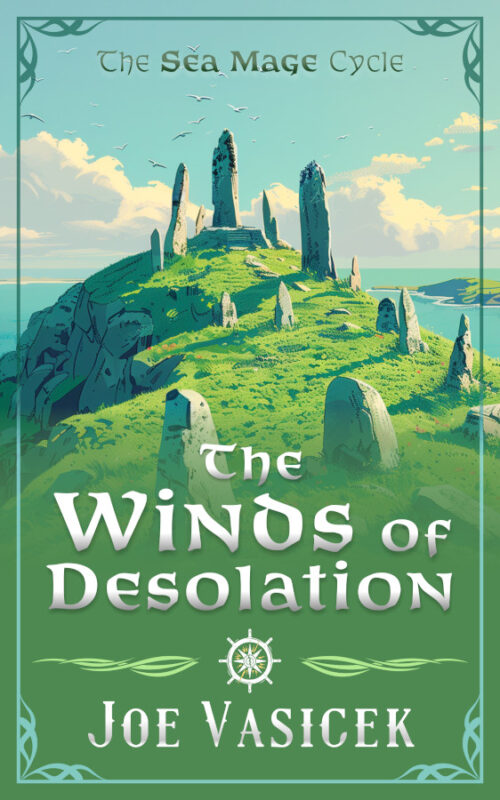
Explore the series index for The Sea Mage Cycle.

Return to the book page for Rescuer’s Reward.

Is Rescuer’s Reward for You?

Rescuer’s Reward is a swashbuckling fantasy adventure about a reluctant sea captain chasing a royal bounty—only to discover that love, loyalty, and honor are worth far more than gold. It delivers high-seas action, magical duels, pirate intrigue, and a slow-burn romantic arc set against a backdrop of political tension and looming war. If you enjoy fast-paced maritime fantasy with heart, this story invites you aboard.

What Kind of Reader Will Love Rescuer’s Reward?

If you love…

  • swashbuckling fantasy with pirates, privateers, and sea battles
  • character-driven adventure where motives evolve from greed to genuine devotion
  • romantic tension rooted in honor, class differences, and impossible choices
  • stories about unlikely alliances and uneasy partnerships
  • classic quest narratives with magic, intrigue, and high emotional stakes

…then Rescuer’s Reward is probably your kind of story.

What You’ll Find Inside

Rescuer’s Reward follows Captain Jason Callidor, a debt-ridden sea captain who sets out to rescue Princess Julietta for the sake of a royal reward—only to find himself entangled in pirate politics, magical warfare, and feelings he never planned for. As rival captains circle, privateers bargain, and enemy fleets maneuver in the shadows, Jason must decide what kind of man he wants to be. The novel blends naval fantasy action with romantic tension and questions of honor, delivering a brisk, adventurous read that balances sword fights and spellcraft with vulnerability and emotional growth.

What Makes Rescuer’s Reward Different

Fans of classic swashbuckling tales and maritime fantasy will recognize the daring rescues, ship-to-ship battles, and charismatic rogues—but Rescuer’s Reward leans more heavily into character motivation and emotional transformation. Where many pirate fantasies focus primarily on treasure or conquest, this story explores the shift from self-interest to self-sacrifice. The magic system enhances naval combat without overwhelming it, keeping the focus on human choices rather than spectacle. At its heart, this is less about plunder and more about becoming worthy of love.

What You Won’t Find

If you’re looking for grimdark nihilism, explicit content, or relentless brutality, this probably isn’t that. While there are battles and betrayals, the tone ultimately bends toward hope, loyalty, and redemption. The romance is sincere rather than graphic, and the story favors emotional payoff alongside its action.

Why I Think You Might Love Rescuer’s Reward

This book represents a turning point for me creatively. It began as an experiment in pushing myself to write faster and more boldly—but it became proof that adventure stories can still carry heart. At its core, Rescuer’s Reward asks a simple question: what happens when the reward you chase turns out to be less valuable than the person you’re trying to save? I think readers who enjoy courage under pressure, growing affection under impossible circumstances, and heroes who learn who they are in the middle of danger will find something meaningful here.

Where to Get the Book

Related Posts and Pages

Explore the series index for The Sea Mage Cycle.

Return to the book page for Rescuer’s Reward.

Without AI, I would probably not be writing

I recently got another anti-AI one-star review that I want to pull apart, because it’s pertinent to what I want to say. I actually came up with the title for this post before I received the one-star review, so I’m not just fisking this one for the sake of fisking. With that said, though, there is definitely a lot to pull apart.

I was prepared to rate this as 2 stars. It is repetitive with no real character depth or development and a sincere lack of dynamic or engaging writing. 

Two stars… so magnanimous! In all seriousness, though, it’s worth pointing out that in spite of all the book’s flaws, she did read it all the way through. That’s important for later.

Then I read the “author” note at the end of the book that was defending their use of generative AI in their writing process…. not only that but also seemingly insulting other writers who are anti-AI claiming that readers dont seem to care about it.

You know what’s insulting to any author, whether or not they are “anti-AI”? Putting scare quotes around the word “author” when referring to them Though I suspect that she did that on purpose, fully intending to insult me, whereas I did not intentionally insult anyone. For the record, this is the passage from the author’s note that she claims is “insulting” to authors by saying that “readers dont [sic] seem to care about [AI writing]”:

Besides which, after sharing The Riches of Xulthar with lots of readers, I’ve found that most of the rage and vitriol against AI-assisted writing is on the writer side of things, not the reader side.

The other thing is that I was not trying to “defend” my pro-AI stance through the author’s note, just explaining my writing process and sharing the story behind the story like I do in the author’s notes I write in the back of all my books. That’s not me being “defensive,” that just me sharing my story.

But there is something profoundly narcissistic about the way this reader is framing her review. Because I stated something about readers that contradicts her anti-AI worldview, I must be intentionally “insulting” her (or the anti-AI authors she’s white knighting for, which amounts to the same thing). Because I wrote about how I used AI to help write the book, I must be “defending” myself against her anti-AI views. This kind of narcissism can only really come from someone who lives in an echo chamber and is not used to having their worldview challenged.

Well Joe, you are wrong. This book was lifeless and dull and the use of AI showed. Everything was one dimensinal and flat. Word choises were even static. We (readers) get it… FMC had auburn hair. There are other words besides auburn to describe it….

I’m not going to deny, there is some legitimate criticism here. Rescuer’s Reward was one of my earlier AI-assisted books, when I was still experimenting a lot and learning how to incorporate AI into my creative process while still preserving my voice and writing multi-“dimensinal” [sic] characters and stories. So it doesn’t surprise me all that much that I missed the mark with this particular reader for this particular book. Lesson learned. Thanks for the feedback and the useful data point.

With all of that said, though… I can’t help but notice that she read the whole book.

I have yet to hear a compelling AI argument in the reralm of artistic expression and this “book” just exemplified everything yet again. No heart. No depth. Not good.

This is the crux of the issue, and the reason I wanted to frame this post as a line-by-line response to this review. Is there “a compelling AI argument in the reralm [sic] of artistic expression”? Or is any author who uses AI committing an unforgivable transgression against their art?

Here’s the thing: most of the other authors I know gave up writing a long time ago. We all started out with bright-eyed dreams about telling great stories and creating great art, but the hard truth is that it’s almost impossible to make it as an author.

There are many reasons for this: people don’t read very much in today’s culture (I personally blame the public school system for that), and the publishing industry has always been brutally rapacious and exploitive of writers (just read The Untold Story of Books by Michael Castleman—it’s a really fantastic history of the written word).

But the writing itself is also very hard. There’s a reason why even many succesful writers are like this guy, single and living in what amounts to a glorified shack. Most of my writing friends quit when they got married and starting having kids. I sincerely hope that they’re just on a 20+ year hiatus, and plan to get back to writing again someday, because some of the stuff they wrote was really, really good (I’m looking at you, Nathan Major!) But sadly, that won’t make up for the stuff they would have written, but never did.

My wife and I just had our third child. Writing with small children is very difficult, especially when your wife has a full-time job. I love them all to death, though. If I had to choose between being a single writer, or putting my writing on hold for 20+ years and having to restart my whole writing career from zero, just to be able to raise a family, I wouldn’t hesitate for a moment to make that choice. But it would put a huge burden of guilt on my wife, because my writing was one of the key things that drew her to me back when we were dating. And while our marriage is probably strong enough to survive that, I can’t deny that it would be an incredible strain.

Without AI, I probably would be facing this choice right now. Even though I had managed to streamline my writing process in the last few years, I’ve never been an especially fast writer. Without AI, it took me about a year to write each novel—and that’s before all the demands on my time and energy that come with having small children.

But AI has enabled me to continue to pursue my career and my art, even through this period of life. Not only does this help me to be a better husband and father (which is ultimately the most important thing), but it also means that my readers don’t have to wonder about the things I would have written, but never did. I can write those books now. I can give those stories to the world.

I’m not talking about AI slop. I’m talking about incorporating AI into the creative process deeply enough that it enhances, rather than replaces, my human creativity. We don’t have to be afraid of AI. It makes so many things possible—including running a profitable indie author business while raising (and soon homeschooling) 3+ small children. But it takes a lot of practice to get to that point. And generative AI is still so new that I don’t think there’s anyone who’s truly mastered the art of AI-assisted writing.

My Sea Mage Cycle books are mostly for practice. They’re meant to be fun, light reading. If it gives my readers a satisfying respite from all the doom and gloom in the world these days, I consider that book a success. The experience of writing each of them has helped me to be a better AI-assisted writer. And while the earlier ones may read like AI slop, that won’t be the case for long.

Fisking 1-star reviews bashing AI

They say that authors should never respond to one-star reviews. That’s generally good advice, and for most of my career, I’ve studiously kept it. However, I’ve recently begun to get a new kind of one-star review that baffles me—reviews that essentially say: “the book was good, but it was written with AI so I hate it.”

Here’s an example:

This book is written with AI. Incredibly disappointing as a reader to give a book/author a chance and then to get to the end of the book only for the “author” to then announce the AI card. If I could give zero stars, I would for this alone. I also didn’t appreciate that this use of AI was not announced until the ending Author’s Note. If “authors” are going to cut corners and put their name to computer-generated mush, they should be willing to put that information on the front cover. The book struggled to find its pace, and some parts read as though they were written for a child’s short story competition while others felt as though the writer was snorting crushed up DVDs of Pirates of the Caribbean as they wrote.

Let’s break it down:

This book is written with AI. Incredibly disappointing as a reader to give a book/author a chance and then to get to the end of the book only for the “author” to then announce the AI card.

Yes… but I can’t help but notice that you got to the end of it. In other words, you finished the book. Also, from the way you tell it, it seems that you didn’t realize the book was written with AI until you got to the very end. So based on your own behavior, it doesn’t seem that quality was the issue.

I also didn’t appreciate that this use of AI was not announced until the ending Author’s Note. If “authors” are going to cut corners and put their name to computer-generated mush, they should be willing to put that information on the front cover.

Okay… but if my book was just “computer-generated mush,” why did you finish it? And why were you surprised when you learned that it was written with AI-assistance?

I can understand the objection to books that were written solely with AI, with little to no human input. But that’s not how I write my AI-assisted books. Instead, I outline them thoroughly beforehand, write and refine a series of meticulously detailed prompts (usually using Sudowrite), and generate multiple drafts, combining the best parts of them to make a passable AI draft. And then I rewrite the whole thing in my own words, using the AI draft as a loose guide with no copy-pasting.

Why would I go through so much trouble? Because of how the AI drafting stage gives me a bird’s eye view of the book, allowing me to identify and fix major story issues before they metastasize and give me writer’s block. Before AI, that’s where 80% of my writer’s block came from, and it often derailed my projects for months, so that it took me well over a year to write a full-length novel. But with AI, I’m no longer so focused on the page that I lose sight of the forest for the trees. So even though generating and revising a solid AI draft adds a couple more steps to the process, it’s worth it for the time and trouble that it saves.

That’s the way I use generative AI in my writing process. But there are many other ways—and I hate to break it to you, but most authors use AI in one way or another. If an author uses Grammarly to fix their spelling and grammar, should they disclose that on the cover? If they use MS Word? What if they used a chatbot to brainstorm story ideas, but went on to write it entirely themselves? Should that also be disclosed?

The book struggled to find its pace, and some parts read as though they were written for a child’s short story competition while others felt as though the writer was snorting crushed up DVDs of Pirates of the Caribbean as they wrote.

Yes… but again, I can’t help but notice that you finished the book. And after you finished it, you were surprised to learn that it was written with AI. So with all due respect, I’m going to call BS on your objections here. I think you only decided you hated the book after you learned it was written with AI, and you came up with these objections after the fact. Whatever.

I think a lot of the people who object to AI are really just scared and angry. They claim to have principled, ethical objections to the technology, but few of them follow through to implement that principled stance into every area of their lives. After all, if you use Grammarly, Google Docs, or MS Word, you are using generative AI just as surely as I am using ChatGPT and Sudowrite. For most people, the ethical objections are just a smokescreen for their general fear of change. They’re fine with embracing the convenience the technology offers them in their own personal lives, but they insist that everyone else—including me—live according to their principles, no matter how inconvenient or difficult it may be.

As an example of that, check out this one-star review:

The arts! Whether visual, performance, or literary—my haloed experience has been the act of creating and sharing a connection to the profound or sublime. Why, then, would any artist—musician, dancer, sculptor, painter, or author—offload (abdicate) the act of creation to AI? Process versus product. Mr. Vasicek included an afterword for this volume, describing his workflow and the efficiency of collaboration with AI: a 6,624-word day! another volume completed! Mr. Vasicek obviously owns the skills to weave rich character development and scenes. Perhaps Mr. Vasicek’s AI collaboration explains why these characters, the plot, the narrative—and subsequently, the entire story— are so flat and undeveloped. Although his lead male shows some undeveloped promise, the mother’s too-oft used “dear” and “my love,” and the daughter’s clutching at her mother’s apron are cringe-inducing. Perhaps Mr. Vasicek might eschew AI-assisted writing, seeking a future of quality over quantity.

Let’s break it down:

The arts! Whether visual, performance, or literary—my haloed experience has been the act of creating and sharing a connection to the profound or sublime. Why, then, would any artist—musician, dancer, sculptor, painter, or author—offload (abdicate) the act of creation to AI?

Because for some of us, writing is more than a “haloed experience”—it’s an actual job. It’s what we do for a living. And if you want to do your best work, you need to use the best tools. We used to build houses with plaster and lath and wrought-iron nails, using hand tools and locally-sourced lumber. But today, you’d be a fool not to use power tools and materials sourced from a building supply store, or your local Home Depot. If that makes your building experience less profound or sublime, so be it.

Process versus product. Mr. Vasicek included an afterword for this volume, describing his workflow and the efficiency of collaboration with AI: a 6,624-word day! another volume completed!

I’m not gonna lie: there is a certain degree of tension between art-as-product and art-for-art’s-sake. But the two are not mutually exclusive. A house can still be a beautiful work of art, without taking as long as a cathedral to build it. Likewise, a book can still be a beautiful work of art, without taking as long as Tolkien’s Lord of the Rings.

Again, you’re trying to pidgeon-hole me into your “haloed” idea of what a “true artist” should be. Which would make it absolutely impossible for me to make a living at this craft. If all of us writers followed that path, there are a lot of wonderful books that would never get written. And I doubt that the overall quality of the books that do get written would rise.

Mr. Vasicek obviously owns the skills to weave rich character development and scenes.

Now we get to the interesting part. I checked this reviewer’s history, and this was the only review they’ve written for any of my books. Therefore, I can only assume that this is the only book of mine that they’ve read. But if that’s the case, how do they know that I have “the skills to weave rich character development and scenes”? If the book I wrote with AI was pure trash, why would they say that I obviously have some skill?

Once again, we’ve got a case of “I enjoyed this book, but it’s written with AI so I hate it.” In other words, it’s not the book itself that you hate, so much as the way I wrote it. You object to the idea of authors using AI, not to what they actually write with AI.

Perhaps Mr. Vasicek’s AI collaboration explains why these characters, the plot, the narrative—and subsequently, the entire story— are so flat and undeveloped. Although his lead male shows some undeveloped promise, the mother’s too-oft used “dear” and “my love,” and the daughter’s clutching at her mother’s apron are cringe-inducing.

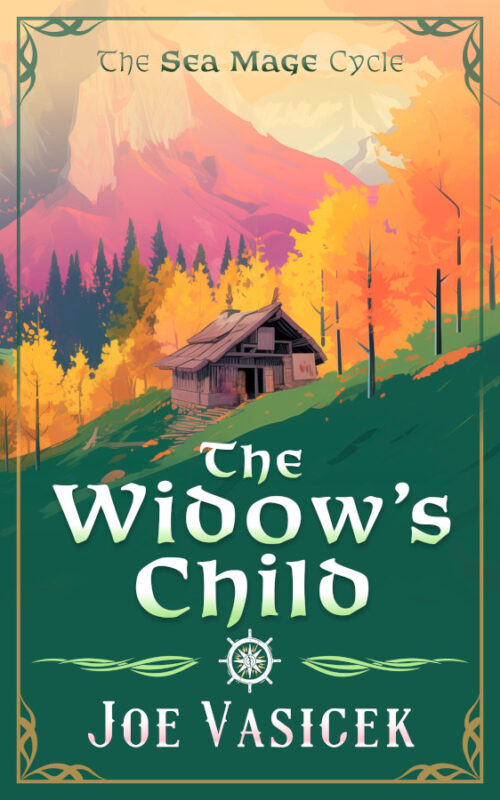
Finally, some specific and legitimate criticism. And while I do think there’s a degree of retroactively looking for faults after enjoying the book, I’m totally willing to own that these criticisms are valid. This particular book (The Widow’s Child) was one of my first AI-assisted books, and I was still learning to use these AI tools as I was writing it. I did the best I could at the time, but if I were to write it today, I could probably do a lot better, smoothing out the annoying AI-isms that you’ve pointed out here.

But the book is currently sitting at 4.4 stars on Amazon (4.1 on Goodreads). And the other readers do not share your objections. Here is another review, pulled from the same book:

Since waiting a year or more to read the next book in a sequel is hard on my stress levels, I’m liking this AI. It means talented authors like Joe Vasicek can churn out an outline faster. Then he can bring in his talented ideas, such as the content of this heart-stopping adventure of The Widow’s Child, to fill out the nitty gritty in record time.

Clearly, it’s not the case that all (or even most) readers feel the same way about AI as you do.

Perhaps Mr. Vasicek might eschew AI-assisted writing, seeking a future of quality over quantity.

Why can’t we have both? Why can’t we have quantity with quality? Why can’t AI make us more creative, instead of replacing our human creativity?

This is all giving me flashbacks to the big debate between tradition vs. indie publishing, back in the early 2010s. Back then, the debate was between purists who said that indie publishing would destroy literature by flooding the market with crappy books. Indies argued that removing the industry middlemen would create a more dynamic market that would give readers more choices and allow more writers to make a living. Both were right to some degree, and both were also wrong about some things. In the end, we reached a middle ground where “hybrid publishing” became the norm.

The same kind of debate is happening right now between human-only purists and AI-assisted writers. The biggest difference is dead internet theory. In the early 2010s, the ratio of bots to humans on the internet was still low enough to allow for a lively debate. Today, there’s so much bot-driven outrage on the internet that most of us are just quietly doing our own thing and avoiding the debate.

That same bot- and algorithm-driven outrage is driving a lot of peole to be irrationally angry or afraid of AI. With that said, I can understand why so many people are upset. And I do think there are a lot of valid criticisms about this new technology, including its environmental impact, copyright considerations, how the models were trained, and the societal impact it’s already starting to have. But if we don’t have an honest and good-faith debate about these issues, we can’t solve any of them. And we can’t have a good-faith debate if one side is coming at it from a place of irrational anger or fear.

In any case, I find it super annoying when readers who clearly found some value or enjoyment in my books turn around and give it a one-star review merely because they don’t like how I used AI. And at the risk of going viral and soliciting more one-star anti-AI reviews, I think its worth voicing my views on the subject and opening that debate. So what are your thoughts on the subject? How do you feel about using AI as a tool to help write books? Can we have quantity with quality? Can AI help us to be more creative, not just more productive? What has been your experience?

New permafree first-in-series: Rescuer’s Reward

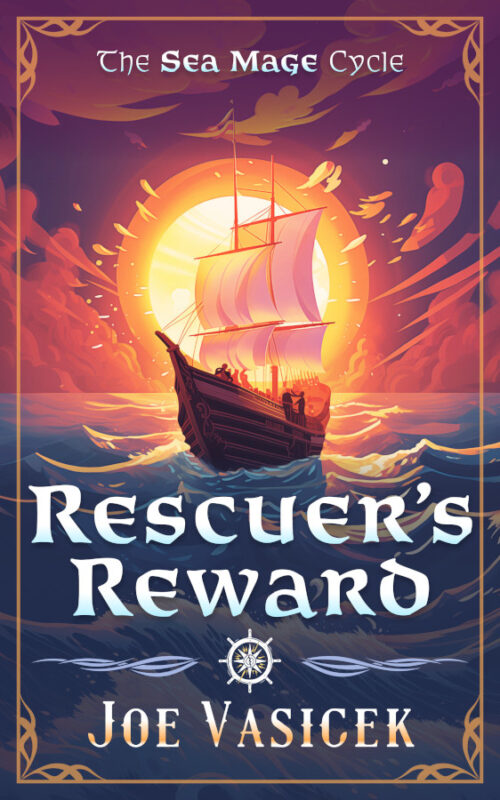
I have decided to make Rescuer’s Reward the permafree book for my Sea Mage Cycle fantasy series. If you haven’t yet read any of these books, this is a great place to start. It’s not the first book chronologically, but it is the first book that I published in the series, and since the Sea Mage Cycle is really just a series of interconnected standalones (kind of like most of Louis L’Amour’s westerns), you won’t miss anything by starting here.

Rescuer’s Reward

Rescuer’s Reward

A captain in debt, a princess in peril, and a fate that neither can foresee.

All Jason ever wanted was to sail the Azure Sea as a merchant ship's captain. But money problems have him up to his eyeballs in debt, and if he doesn't return to port with the gold, his dreams will be dashed forever. So when the princess of a far-off kingdom is kidnapped by pirates en route to her wedding, Jason merrily takes up the chase, staking his future on the reward for her safe return.

Yet the competition for the princess proves fierce, and Jason soon learns that there are far more powerful forces behind her kidnapping than any of them realize. And though Princess Julietta has no qualms about marrying for political advantage, the last thing she wants is to be a mere trophy in a different sort of game.

As duty, desire, and destiny clash, only one thing is certain: they both must risk everything to earn the ultimate reward.

Order Now!
About the Book
Details
Author: Joe Vasicek
Series: Sea Mage Cycle
Genres: Action & Adventure, Action & Adventure, Fantasy, Fantasy, FICTION, Romance, Sea Stories
Tag: 2024 Release
Publisher: Joe Vasicek
Publication Year: April 2024
ASIN: B0CTFVNKFL
List Price: $13.99
eBook Price: free!
Audiobook Price: free!
Joe Vasicek

Joe Vasicek fell in love with science fiction and fantasy when he read The Neverending Story as a child. He is the author of more than twenty books, including Genesis Earth, Gunslinger to the Stars, The Sword Keeper, and the Sons of the Starfarers series. As a young man, he studied Arabic at Brigham Young University and traveled across the Middle East and the Caucasus Mountains. He lives in Utah with his wife and two apple trees.

Preview
Some of the links in the page above are "affiliate links." This means if you click on the link and purchase the item, I will receive an affiliate commission. You will not receive any additional charge. As an Amazon Associate I earn from qualifying purchases.

Fantasy from A to Z: L is for Love

What is love? (Baby don’t hurt me…)

Seriously, though, what counts as “love” in fantasy these days? The romantasy subgenre is taking the field by storm, but much of it seems to be outright pornography, at least to me. Back when Twilight was all the rage, I at least understood the romantic angle, even if I didn’t particularly care for it. But now, there’s all this stuff about mate-bonding, consent/non-consent, something called “the omega-verse,” and a weird hierarchy of various forms of bestiality that I frankly cannot follow at all.

I should take a few steps back, and perhaps abandon romantasy altogether. I’m sure there are plenty of non-pornographic books in that subgenre—in fact, I’m fairly certain that one of my old college friends, Charlie Holmberg, was a pioneer in it. Everything of hers that I’ve read is pretty good, and also quite understandable, even to a dopey guy like me. 

Outside of romantasy (and paranormal romance, which it appears that romantasy has more or less cannibalized), the love stories are pretty straightforward. Epic fantasy in particular tends to have at least a couple of romantic subplots in every book—which makes sense, considering how expansive the subgenre is trying to be. After all, if you’re writing a story where the world itself is a major character, you’ve got to have at least a few good love stories in there too.

But as the internet has continued to spawn narrower and narrower niches and subcultures, all existing in their own little subcultures, things on the extremes have gotten… weird. And as the gender divide appears to be widening with each subsequent generation, especially in areas like politics and culture, it’s beginning to seem like we aren’t even speaking the same language, even when it comes to something as basic and essential as love.

Now, male-coded romances are pretty easy to understand (though I could be biased… I am a man, after all). It starts with a boy who really wants a girl. Like, really, really, really wants a girl. He likes her so much, he spends the whole book trying to get her—and by the end, he either wins her, or he realizes that he doesn’t actually want her, he wants this other girl he met along the way. If things get spicy, it’s all very straightforward and everyone generally has a good time. If there are issues with rape or non-consent, those are generally separate from the romantic subplot

And often, male-coded romances don’t even include much spicy content at all. Even Robert E. Howard’s original Conan the Barbarian stories were pretty mild, in terms of spiciness. Yes, there was usually a scantily-clad female love interest, described in such a way as to increase Howard’s chances of getting his story featured on the magazine cover (and thus earning double the pay). But when it came to the actual, you know, kissing and stuff, Howard never went into graphic detail. The most he would do was hide behind euphemisms like “he crushed her in his arms.” All of the ejaculations in his stories were saidisms—as in, “look out!” he ejaculated, waving his hands wildly (and you would be shocked how often he used “ejaculated” as a saidism—seriously, I think there’s at least one in every classic Conan story).

(Side note: just because Robert E. Howard’s Conan stories were pretty mild on the spiciness scale, that does not mean that subsequent authors kept it mild. Lin Carter and L. Sprague de Camp tended to keep it more in the vein of the original, but Robert Jordan’s Conan was… let’s just say, it was too much for me.)

And it used to be that female-coded romances were pretty simple, too. An ordinary, boring girl somehow finds herself the object of attraction between two incredibly powerful (and incredibly sexy) men from the other side of fairy, who are positively obsessed with her. However will she choose between them both? Oh, look—now they’re fighting each other to determine which one gets her. Stop fighting, you sexy fairy men! But seriously, however will she choose?

Somewhere along the line, that morphed into a thing called “reverse-harem,” which (as I understand it) is where the girl throws up her hands and decides that she can’t possibly choose between them, so she chooses them all. Which meant, of course, that the love triangles quickly turned into love dodecahedrons—since if you’re going to have a harem, you might as well fill it up with as many sexy fair men as you can. 

And then somehow, things got really weird—and also, really toxic. According to Malcolm and Simone Collins (who know more about this subject than I do), some of the more toxic behaviors that romantasy normalizes include:

  • Fated or “mate-bond” relationships that override consent,
  • Extreme male possessiveness portrayed as genuine love,
  • Drugging and public humiliation portrayed as romantic tension,
  • Huge age and maturity gaps between partners,
  • Serial betrayal framed as female empowerment and playing hard-to-get,
  • Intentional miscommunication, with heroines refusing to talk through their problems—again, often framed as female empowerment,
  • Violence rebranded as safety, since the love interest will never really hurt the heroine, 
  • Wish-fulfilment with serial partners, often framed as a justification for serial betrayal mentioned above, and
  • Lazy trope stacking (eg “rich-fey-boyfriend,” scent/marking, etc) without confronting the darker implications of coercive and non-consenting relationships.

Sadly, it seems that all of these toxic aspects of romantasy are reflections of the current state of modern dating and relationships. For example, in a world of online dating where ghosting and fading is all-too common, serial betrayal is a bit of a power fantasy, as is wish-fulfillment with serial partners, since if “true love” doesn’t work out, there’s always another one just a swipe away. Similarly, because women who have taken multiple sexual partners find it difficult to pair-bond with any of the later ones, the concept of “mate-bonding” may have arisen as a way to recapture that lost sense of bonding that comes with the “first time.”

Call me old fashioned or out of touch, but I preferred it when things were simpler, and the traditional boundaries around sex and relationships were still very much in force. There’s something charming about the love stories that were written before birth control and the sexual revolution, where men had to woo their women and get them to say “I do” before any of the bedroom gymnastics became a factor. Of course, I’m totally biased, because my wife and I both have a “body count” of exactly one.

I think romantic love is one of the greatest things in the world. I think that sex is also a wonderful and a beautiful thing, especially when it is used to fulfill its primary purpose: to facilitate lifelong pair-bonding between a man and a woman. In my experience, this is an even more important purpose of sex than procreation, though of course that is a very important (and very fulfilling) secondary purpose.

I don’t read or write romantasy, so you won’t find any of those tropes in my books. You will find a lot of romantic love, though, especially in my sea mage cycle books. Rescuer’s Reward is probably the closest thing I’ve written to a straight up romance, at least in the fantasy genre. The Widow’s Child also has a strong romantic subplot, though it goes a little further than fade-to-black. And of course, the Soulbond King books are going to have a lot of romance, since the magic system requires a man and a woman to become bonded in love in order to unlock their unique magical powers. Those books are going to be a lot of fun to write.

Independence Day update

Happy 4th of July, everyone! It’s Independence Day here in America, when we celebrate our nation’s birthday by doing all of the most American things possible: fly our flags, eat lots of meat, and blow things up. God bless America!

It’s been a busy month so far, with family visiting from out of town all last week, and lots of kids all over the place. Great for our kids, who got to play with their cousins, but not the best for writing. Oh well. It looks like things are going to settle down for the rest of the month, which is really good, especially for my wife, who is racing to finish her PhD before she starts her new teaching job. So I will definitely be helping her with that.

On the writing and publishing side of things, I am actually going to take advantage of this time to catch up on all of the non-writing things, like publishing tasks, that I’ve fallen behind on. When August rolls around, things are going to get really crazy, with our move back to Orem as my wife starts her new job, so I want things to be set up really well for that.

I will continue writing, though: just at a slower pace. If I plan to do about an hour a day, and make that a consistent thing, I think I can keep that up through the crazy times that are coming. Not only are we moving and starting a new job, but we also have a new baby due to be born very shortly after all of that. So I fully anticipate that it’s going to be a crazy year.

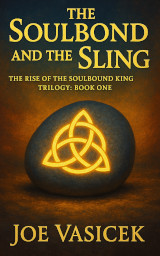
(still not the final cover)

My plan right now is to keep plugging away at The Soulbond and the Sling, slowly but surely, until the AI draft is complete. At the rate that I plan to go, however, it probably won’t be finished until August or September.

I’ll also be working on the human draft of The Road to New Jerusalem, but since my plan is to submit that to the Ark Press contest in October, I’m not too worried about rushing that one. Besides, it’s a much shorter novel, so it shouldn’t be that hard. A part of me wonders if I’ll finish that one before The Soulbond and the Sling.

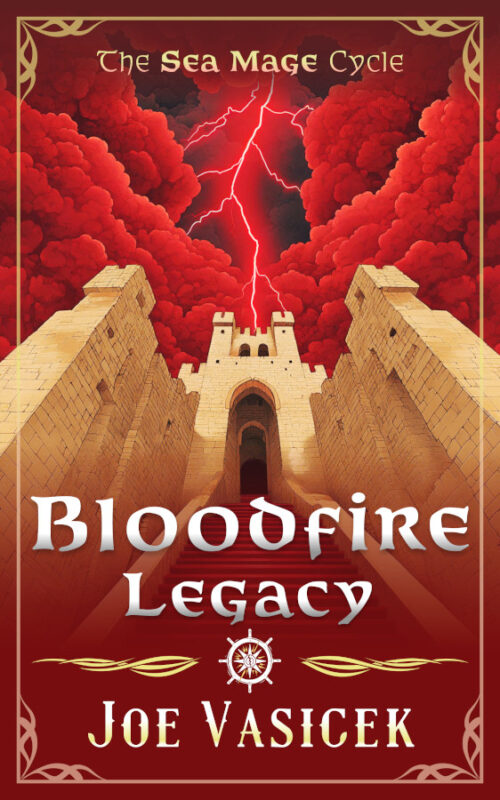
In the meantime, I plan to publish Bloodfire Legacy in paperback, ebook, and audiobook as soon as I go through the edits and get it formatted! In fact, that’s the next big thing I plan to work on in the next two weeks. With luck, it should be out very soon.

So those are the big things that I’m working on right now. I’m also going to try and finish all the blog posts for Fantasy from A to Z before the end of the month, though they will probably run through the first half of August or so. And once Fantasy from A to Z is done, I will turn that into an ebook exclusive for my newsletter list, and make my current newsletter exclusive, Science Fiction from A to Z, available as a regular ebook (and maybe audiobook and paperback as well).

All of this is part of my plan to pivot toward being more of a fantasy author. Right now, I’m a science fiction author who occasionally writes fantasy. In the future, I want to be known as a fantasy author who occasionally writes science fiction. Most of my science fiction leans heavily into fantasy tropes anyway, so it shouldn’t be too difficult to make the change. Hopefully most of my readers follow me over as I make the transition.

Toward that end, I’m happy to report that Rescuer’s Reward, the first novel in the Sea Mage Cycle, is now available as a permafree book! If you like fun quick fantasy adventures with a touch of romance, I think this will be right up your alley. All of the Sea Mage Cycle books are pretty short, and they all stand alone, though they often have recurring characters. Check it out and give it a read!