Excerpt from Genesis Earth

I spend a lot of time posting about my writing, but up until now I’ve never posted any of it.  Well, I figured it was time to change that and post something from my second unpublished novel, Genesis Earth.

Here’s how I’ve been pitching it in my queries:

Michael Anderson is a young, obsessive planetologist haunted by the fear that he will never live up to the legacy of his astrophysicist parents. Terra Beck is the outcast child of a bitter divorce, who only wants to run away and immerse herself in her one true passion: astronomy. Neither of them has ever set foot on Earth, but when Michael’s parents construct mankind’s first artificial wormhole, both of them are naturally chosen for the exploration mission to the Earth-like planet on the other side.

Shortly after their arrival in-system, Michael finds himself in an unanticipated first contact situation when an enormous alien ship appears out of nowhere and begins to converge on their position. When it ignores all their transmissions and shoots down their probes, the situation quickly degenerates into an emergency. To make matters worse, Terra secludes her self in the observatory and stops sharing her data with him.

Alone, twenty light years from the nearest human being, they must learn to open up and trust each other. As Michael struggles to keep the mission from falling apart, he is forced to reexamine his deepest, most unquestioned beliefs about the universe–and about what it means to be human.

Right now, I’m running it through a fifth draft before I send it to an agent I met at World Fantasy.  Here is the prologue, where Michael begins his tale.

Enjoy!

Chapter 1

Earth was a ghost that haunted me. She was the single greatest thing that set us space-born apart from the older generation, the five hundred members of the original mission team. Though Heinlein station was the only home I had ever known, I soon learned that Earth, a world I had never seen except in pictures and videos, was where I was truly from.

My parents set the decorative screens in their bedroom to cycle through pictures of old Earth. While they were busy working in the lab, I would often sneak inside and stare at those images for hours. The landscapes and skyscapes they depicted were always so alien to me. Unbroken blue expanse overhead, instead of the grayish space rock of our asteroid. That line between floor and sky known as the ‘horizon.’ Solid ground underfoot, instead of the milky starfield shining up through transparent floors. Trees, plants, and shrubbery growing freely without the aid of hydroponics. Hundreds of human beings walking down wide open-air corridors called ‘roads,’–more people than I’d ever known in my life.

When I was about five years old, I used to ask my mother to bring out her photo album–the one with actual, physical pictures from the old world. I would sit on her lap and stare wide-eyed at the pictures as she explained them to me. That was my uncle, that was my grandmother, those were my cousins: faces from an unreachable world nearly half a light year away and getting further every moment.

One day, sitting on my mother’s lap, I glanced up from the album and saw tears in her eyes. That was the first time I had ever seen my mother cry. It made me feel frightened and unprotected, even in her arms. I never asked her to show me the pictures of Earth again.

Perhaps you’ve found, as I have, that the things that frighten you incite more fascination than the things you love. I trace the beginning of my career as a planetologist to that childhood incident, sitting on my mother’s lap. Years later, when I began my graduate level education, there was never a question in my mind what I would study. I had already chosen.

To me, planetology was never about physics, geology, or chemistry. Those were only the details. It wasn’t even about making a lasting contribution to the science–at least, not when I first started. I studied alien worlds simply to turn the lights on–to dispel the ever-present ghost of Earth that had haunted me from my childhood.

Did it work? Not really. But as I grew, my fascination with Earth grew with me.

Fourteen might seem like a young age to enter one’s chosen field, but you must realize that half the people on Heinlein station were highly trained physicists and engineers. With so many scientists on board, there was no shortage of teachers for those of us who grew up on the station. My parents personally tutored me, and they were two of the most brilliant physicists Earth had ever produced. They were, in fact, the chief scientists over the Mission itself.

The Mission was the closest thing to religion that I ever had. If religious devotion is measured by sacrifices incurred on the basis of unproven belief, I suppose that everyone on the station qualified for sainthood. We had set out from Earth to create mankind’s first wormhole, or prove that it could not be done. For this, my parents had given up everything: family, friends, their homes. Everything. The only safe place for such an experiment was two light years from Earth, and so we spent my entire youth and childhood in transit, not knowing whether the Mission would succeed or fail.

My study of planetology won me a great deal of admiration from the old timers, much to my surprise. Grown-ups who only a few years ago had chastised me for playing hide-and-go-seek in the labs now treated me like someone important. The scientists and engineers routinely asked me what I thought we’d find once we’d opened the wormhole. After all, why would a fourteen year old study about alien worlds if he didn’t expect to visit them someday? They treated me as if I had run some sort of gauntlet or passed a test of tremendous faith. I was one of them, united in the hope of a successful outcome to the great experiment–or, stranger still, I was a role model to them, someone with the faith they struggled so much to keep.

They could not have been more wrong. I didn’t want to explore new planets or set foot on an alien world. The closest I ever came was through the eyepiece of a telescope, and that was the way I wanted it. My studies were purely academic.

When I turned eighteen, we arrived at ground zero. The station became a flurry of nervous energy as we maneuvered into position and set up the hundred trillion kilowatt NOVA generators and focusing mirrors for the graviton beams. With everything spread out across hundreds of cubic kilometers of space, it took us nearly two months before we were ready.

Twenty two years after embarking from Earth, on June 24th, 2143 C.E., the day of the experiment finally arrived. That day forever changed the course of my life.

At the moment of truth, I lay sprawled out on the transparent floor in my room, watching the stars turn beneath me. Large crowds had gathered in other locations to watch, but I preferred to be alone. My father’s voice came over the station-wide radio, giving his moment-by-moment report. Though I was alone, the excitement on the station was so thick could almost taste it.

I hear that it’s common for people on Earth to dream about falling from a great height. I’d never had that dream–the concept of vertigo meant nothing to me. I think I got a taste of it, however, as I watched the wormhole form in the sky.

The starfield began to spread out from a single dark point, the way a film of oil on water separates when it touches a drop of soap. The hole grew surprisingly fast, pushing the stars aside and forming a circle of warped, diffused starlight around its edge. I gasped in fright; the center was pure black, the color of an abyss. As it grew larger, I felt as if it were sucking me in. Soon, however, the hole stabilized, as if it had always been there.

As the station rotated, I discovered that the wormhole had warped the starfield beyond all recognition. I tried to find the constellations I’d known so well, but could only pick out one or two. I felt sad knowing I’d never see any of them again.

The scientists didn’t take much time off to celebrate, but when they did, they went completely wild. Alcohol was everywhere in abundance, from numerous stores and hoards that had been kept for this very occasion. The shiest, most reserved people danced drunk in the hallways, and old enemies who hadn’t talked for years walked up and down the corridors with arms on each others’ shoulders. A spirit of happy, universal friendship swept over the station. People let their guards down, took off their masks, and momentarily forgot any hard hard feelings. It was a glorious time–the end of history.

Eventually, though, the celebration lost steam, the hangovers died down, and we woke up to face the inevitable future. Our robotic probes explored the wormhole and made some basic observations of the other side.

Their findings were frightening enough to sober us all.

Graviton theory told us how to create an artificial wormhole, but it gave us no way to predict where it would open up. We could expect one of three possible outcomes: first, that the wormhole opened to a different location in our present universe; second, that it opened to a different location and different time in our universe; or third, that it opened to an entirely different universe than our own. In every meaningful way, however, we were shooting blind in the dark.

The first observations showed a universe very much like our own, with stars, galaxies, and other nebulae. Just twenty light years away, orbiting a yellow-white main sequence dwarf, the probes discovered a handful of exoplanets. One of them, a terrestrial world, orbited within the star’s habitable zone. An initial spectroscopic survey revealed that the atmosphere of the planet was rich in oxygen and nitrogen–just like Earth.

That was when we detected the signal.

The last probe to return picked up an unnatural high frequency radiation burst, originating from the system with the planet. It lasted only half an hour before dissipating, but was powerful enough to be detectable halfway through the wormhole. No naturally occurring object emitted that kind of signal. The only thing we could compare it to was the radio emissions from a standard NOVA engine–but even then, the signal was more than a hundred times more powerful than anything our technology could produce.

In other words, something strange was out there–something we couldn’t explain. The only way to find out more was to send out a mission to explore the alien star.

As the only qualified planetologist young enough to survive cryofreeze, I was an obvious pick for the mission from the very start. Though I never wanted to go, I couldn’t refuse; if I had, my parents would have killed me. This, they believed, was our moment in history–our moment to make a truly historic contribution to science and humanity. Why wouldn’t I jump at such an opportunity? Of course I would go.

I didn’t become a planetologist to set foot on alien worlds. That was the last thing I ever wanted. After we opened the wormhole, however, what I wanted no longer mattered.

Or so I thought.
Update on things

Revised the first chapter of Mercenary Savior today.  I will probably revise it a couple more times before this draft is finished, but at least I’ve done it once.

For some reason, most of my alpha readers didn’t give me too many comments to work with.  I’m not sure if that’s a good thing or a bad thing, but in practical terms it means I’m mostly on my own.  Still waiting for some to get back to me, though.

Last week, I wrote the prologue, where as a young woman Danica returns to her home only to find her family massacred by hired thugs.  It was…surprisingly dark.  Charlie liked it, though, so that’s a good thing.

Charlie also complimented me on my prose, saying that it improves every time she reads something of mine.  That’s a pleasant surprise, since I certainly don’t notice any difference–but then again, I’m so close to my own writing that improvement is hard to see.  Good to know that my craft is getting better, not getting worse.  Thanks!

Last week, I realized that I didn’t have any submissions out for Genesis Earth. None at all.  I sent out a query on Saturday, but it was surprisingly difficult.  Submitting is definitely not my strongest point; I really need to work on that.

In unrelated news, I’m flying home tomorrow to spend the week with my parents.  I asked to come home for my birthday present; my mom’s health insurance through her work covers me until September, but only in Massachusetts.  Since I haven’t had a dental checkup in years, I figured it would be good to get that done.  Also, it’s a nice break and a chance to see my folks.  I’m looking forward to it.

Let’s see, what else is going on?  Oh!  The Kepler Mission announced a press conference for Thursday to discuss “an intriguing star system” they recently discovered.  Needless to say, I can hardly wait!

Also, no less than 6 fellow quarkies are moving in to my apartment complex this next semester.  Six!  And they’re all girls!  If Baggins old place was Bag End, and his new place is Rivendell, our complex is freaking Minas Tirith.  And we’re forming a dinner group, too!  This next year is going to be awesome.

And that’s just about it for what’s new in my world.  I came just shy of 4k in Mercenary Savior today, and I hope to keep that up (or do more) until I get a new job.  For now, let me leave you with this EPIC chipophone presentation from lft.  8-bit music ftw!

Almost at four

I’ve got half a dozen things I could blog about, but it’s 2 am and cleaning checks are tomorrow, so I think I’m going to give a quick update and go to bed.

Worlds Away from Home is doing quite well–I’m only two chapters and five scenes from the end.  I’d push really hard to finish it tomorrow, but I’m still waiting on some of my alpha readers for Mercenary Savior and probably won’t start that project until after I go back to Massachusetts at the end of the month.

I’ve been thinking a lot about the seven point story structure Dan Wells talked about at LTUE 2010 (which I missed, but caught on youtube), and I’ve got a TON of ideas for Mercenary Savior now.  I’m practically chomping at the bit to start analyzing this story and working out all the complex plot and character elements.  That’s very good.

While chatting with one of my alpha readers for Mercenary Savior, I had an interesting idea for a direct sequel.  Basically, while James’s storyline has some closure (or should, after I finish this next revision), he’s still got a lot of growing and maturing to do.  My mind is already working it out…should I make that my fifth novel?  Or move on to something else first?  The thing about direct sequels is you can’t sell them without the first book, and if the first book doesn’t sell…

I’m applying for Redcliff Ascent; if all goes well, I’ll be participating in the November training (since September is full).  At first, I was hesitant about this (since I kind of need a job now), but looking at it now, that’s probably the best time to do it.  It’s after World Fantasy, which gives me time to finish Mercenary Savior, and late enough in the year that I can still finish that article for Mormon Artist.  Plus, I can easily get a schedule that allows me to attend LTUE 2011.  The only disadvantage is that I won’t be able to attend all of Brandon Sanderson’s English 318 classes, but that’s not such a big deal (seeing as I’ve taken the class twice already!).

Other than that, life is good.  I’m going home in a week to see my parents and get my teeth done (since my mom’s health insurance covers me until my birthday in September–why pay for a checkup when you could have it for free?), and I’m definitely looking forward to that.  And now that I’m almost finished with Worlds Away, I can see that it’s got potential, and that’s encouraging.  Not this draft, certainly, but once I fix all the holes, it could really go somewhere.

Either way, it’s going to be nice having four novels under my belt.

Story notebook #2

A while ago I rediscovered my first story notebook and wrote a few posts on it.  I promised I’d do the same for my other story notebooks, so here’s the next one.

For those of you who may be surprised that I’m sharing all my story ideas, let me explain why I’m doing this.  First, ideas are cheap, especially in genres as imaginative and inventive as science fiction and fantasy.  What really matters is the execution, and any two people’s take on the same idea is going to be different. For that reason, I’m not too worried about anyone “stealing” my ideas.

Second, and more importantly, I believe that the only way for ideas to grow in value is for them to be shared.  Ideas that get horded only worsen with age, because they’re not being explored. Only by exploring ideas can they come into their full potential, and the best way to explore ideas is to share them.  When we fail to share our ideas, we inevitably fail to explore them from all angles, because working alone in a vacuum, we’re so much more likely to miss something crucial.

Enough of that.  Here are the story ideas from my second notebook, roughly covering the fall of ’08, right after I finished my first novel and got back from Jordan.

How will myths arise in the space exploration age? Previously, myths formed perhaps because people had very limited means of communication and limited means of world awareness. Now, technology allows much better spread of information and science, but in isolated spacecraft, will [the conditions of isolation that lead to myth formation] return?

An interesting and somewhat complicated thought. How do myths form, anyway? I suppose that at the very least, the extreme isolation of space will lead to a proliferation of wildly different cultures and worldviews.

Just as the Catholic monks set up a monastery in Iceland, so people will go beyond the explored universe in the age of space travel and set up a religious order there.

Fascinating–and I think it runs somewhat counter to the grain, too. Most people tend to see space explorers as either adventurers or absolute believers in pure science–but what about the devoutly religious? If the Catholic monks set up a monastery in Iceland, is it possible that the monks of some other religious order may set one up on Mars, or Alpha Centauri, or Gliese?

And…that’s all I’ve got in this notebook. Sorry–there’s lots of scribbling and calculating for Genesis Earth, as well as library call numbers for books about Saladin and the Crusades, but not too much else in the way of story ideas. For more, you’ll have to wait until story notebook #3.

Second Quarter 2010 report

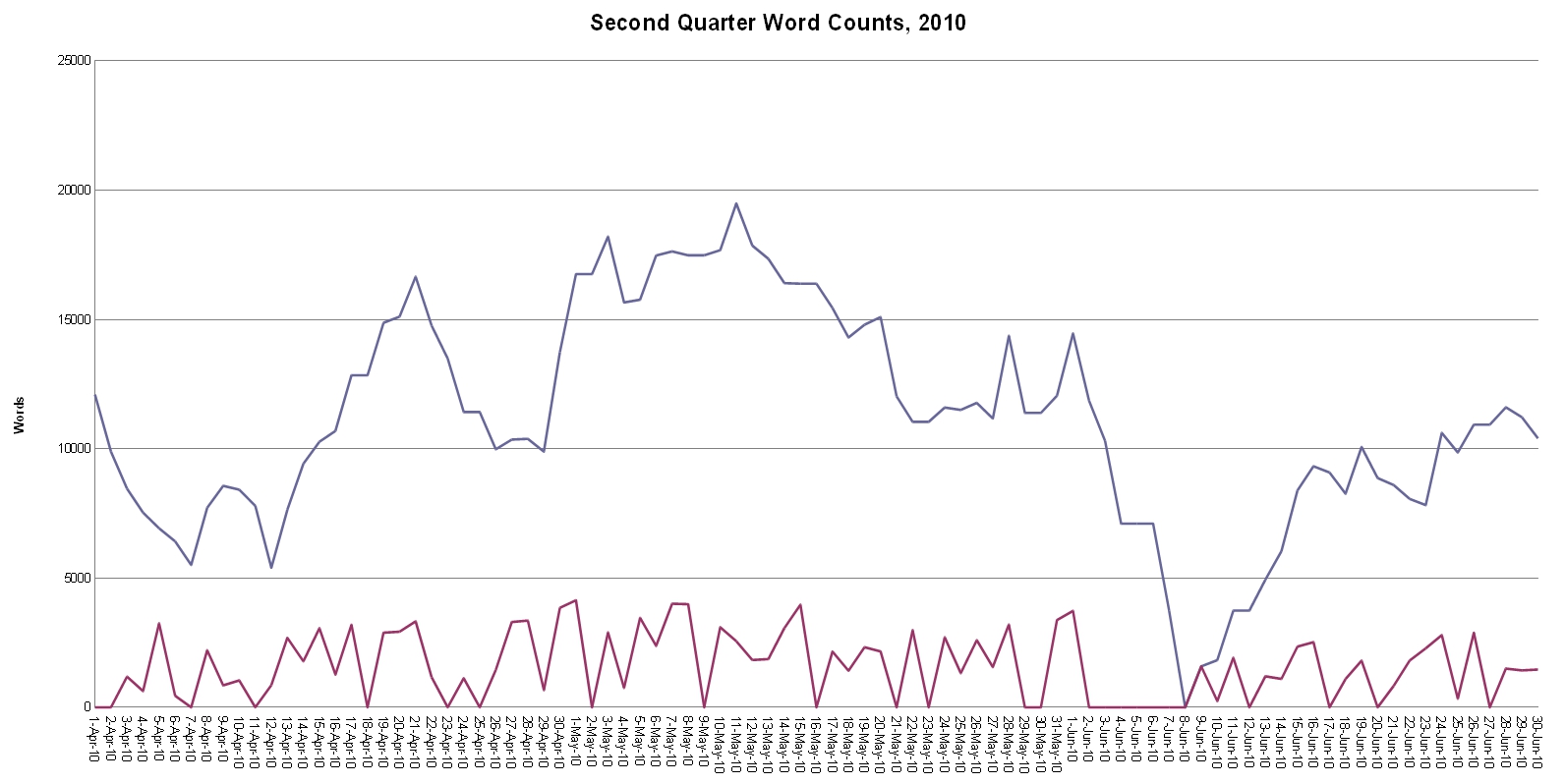
As you may or may not know, I keep a spreadsheet of my daily word counts.  Nerdy, I know, but you’d be surprised how helpful it can be with keeping goals and staying motivated.  As part of that, I’ve decided to do a quarterly report here on my blog.  Here’s my report for April 2010 through June 2010:

The red line shows my daily word count, and the blue line shows a running 7-day total.

At the beginning of April, I was somewhere in the middle of writing Mercenary Savior 3.0. I was also in the middle of a long and strenuous debacle with BYU’s Washington Seminar.  Long story short, I got kicked out under disputed circumstances.

Anyway, that explains the sharp dip in the first couple of weeks.  I returned to my parents’ house in Massachusetts on April 6th and spent a week there before moving out to Utah; that explains the short lived bump from April 6 to April 12.

So three weeks before graduation, I came back to Utah with no job, no apartment, no transportation besides my own feet–nothing.  Fortunately, some friends helped me out, and for the rest of April and most of May I at least had transportation (bike) and a roof over my head.

Without a job, I had lots of writing time, and I used it well, as you can see.  The sharp dip at the end of April corresponds with graduation, when all the family was over and I was spending most of my time with them.

Things dropped off the second half of May, though, and I’m not sure why.  Perhaps it was writing fatigue?  I was coming up on the end of Mercenary Savior, and as I remember, the revision was fairly tough.  Also, I was stressed out about not having a job, and spent much of my free time looking for work.  I found my current part-time job at the end of May, and had a few spikes, but my output never totally recovered.

As an experiment, I took a week off from writing after finishing Mercenary Savior on the first of June.  I thought that this would help me recharge my creative batteries and get off with Worlds Away from Home on a good start.  Instead, I found that taking the time off made it harder to get back into creative writing mode, and so I struggled for the first week or two to really get that project off the ground.

Lately, I’ve been trying to bump up my output above 10k per week, without much success.  For some reason, I seem to have fallen in a rut where I can’t write more than 2k per day.  2k is good, but it’s not the level where I want to be.  I want to finish Worlds Away from Home in the first couple weeks of August, so that I’ll have plenty of time to polish Mercenary Savior for World Fantasy in November.

I think that part of the problem lies in the nature of the work.  Mercenary Savior was all straight up revision, with very little new content.  Worlds Away from Home, however, involves a ton of new content.  Yes, I’ve got all that stuff I wrote back in the fall of 2008, but I’ve also added a new viewpoint character and significantly changed the basic storyline.  Only about half of the old stuff is recyclable, and I’ll run out of it in 100 pages, roughly at the midway point of the novel.

After revising for so long, it’s hard to get used to writing a first draft.  I’m not sure how to describe it, except that it takes a lot more mental energy–a LOT more.  Plus, there’s always the nagging voices that tell you what you’re writing is crap–and when you’re writing your rough draft, the voices are usually right!  Tuning them out is starting to be a challenge.

Overall, though, I’m very optimistic.  My main goal is to produce one solid, polished novel a year, and I’m still on schedule to accomplish that.  Mercenary Savior requires AT LEAST another revision before it’ll be good enough to send out to editors and agents, but I’ve got half a year to do that.  As for 2011, I’ll almost certainly have the first or second draft of Worlds Away from Home before January 1st.  Things are going well.

And on that note, I think I’m going to take a shower and go to bed.  Night.

Writer’s block? Tallyho!

Just a quick post before I go to bed.

Health problems suck when all you’ve got is catastrophic insurance.  I started breaking out in this weird rash last week, and I went into the clinic today.  It was seventy five dollars well spent, but…man, seventy five dollars?

So between taking the bus all over the Provo/Orem area to get to and from the clinic, picking up the antibiotics from Macy’s, and cooking treats for institute, I didn’t get much writing done.  At the same time, though, I feel like I should have gotten a lot more writing done–that really, I was just putting it off with all the other chores.

“Writer’s block” is this generic phrase used to describe a number of writing related maladies–kind of like “consumption” back in the 1800s, I guess.  Right now, I’m suffering from a particularly unusual strain: I’ve got some decent plot and character ideas, I know what I want to write, but I just can’t seem to bring myself down to write it.  Not consistently, anyways.  This past week, I’ve only been hitting 1.4k words per day, when I need to be doing 2.5k in order to make my 15 August deadline.

The irregularity of my schedule certainly isn’t helping, but I think it goes deeper than that.  I’m currently treading new territory, going places where the first draft never went, and I can’t help but feel that the stuff I’ve written prior to this point is just crap.  That’s what’s so debilitating–the recognition of all the mistakes I’ve made thus far.  Some of them are relatively major–level twos, at the very least.

Well, just like the best proscription for the flu is to get rest and drink lots of water (and pop lots of antibiotics when that doesn’t work), the best proscription for writer’s block is to sit down and write! So that’s what I plan to do.  Tallyho!

…except, not right now.  It’s 1:00 am and I’m fighting some kind of bacterial infection.  Gotta sleep, but then…tallyho!

(oh, and in totally unrelated news, an agent requested to see the full manuscript for Genesis Earth! Must not get hopes up…must not get hopes up…too late.  Tallyho!)

The need to change

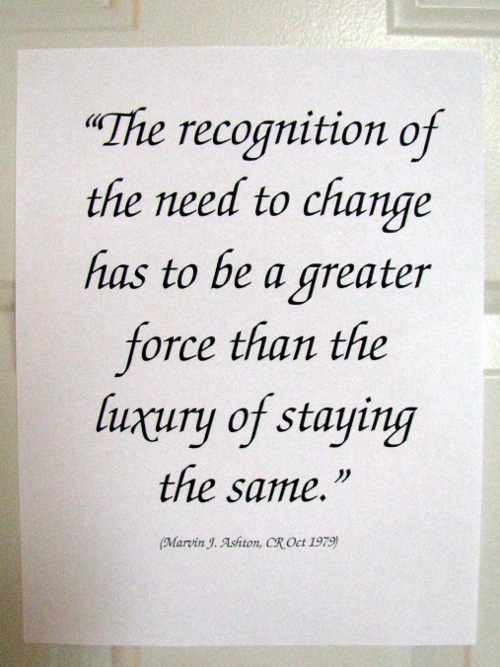
I picked up this sign at institute last Wednesday. The lesson was on our desires; specifically, how the thing that we truly desire deep down is often the thing that we get.

The main reason I posted this sign on the door was to motivate me to get a better job than my current one.  However, it applies to so many other things as well.

Take writing, for example: if I’m going to actually turn this writing thing into a full time career, I’ve got to bust my butt to make it happen.  Writing a paltry 250 words each day on a novel you’ve been working on for the past twenty years just isn’t going to cut it.

I got two form rejections today, and that made me realize that I need to be more serious about submitting my work.  So instead of working of working on Worlds Away From Home, I researched a slew of agents, rewrote my query letter for Genesis Earth, and sent out four carefully prepared and researched submissions.  I don’t want to spend any more time bouncing around from job to job than I have to–I want to break in and make this writing career take off.

So far, I’ve gotten approximately 14 rejections for Genesis Earth: ten form rejections, one personalized rejection, one rejection after the partial was requested, and two that I haven’t heard back on but have been out for so long they’ve probably been rejected.  Interestingly enough, rejection itself is not that hard for me to deal with: it’s building the motivation and nerve to submit to the next place that’s tough.

But I’ve got to do it.  I feel kind of like Hachimaki from the anime series Planetes, who quits his job without taking the severance package when he applies for the Jupiter mission.  If he has the safety net, he knows that he’ll get lazy, so breaks goes out on his own, even sleeping on the streets for a while during the initial tryouts.

I haven’t quite fallen that low yet–I’ve got an apartment, a bike, and a job, even if it’s only a subsistence level one.  But when it comes to long term careers, I’m putting everything into my writing right now–there isn’t anything else.

It’s still discouraging to get rejected, but I’m still very optimistic that things will work out.  Even if everyone rejects Genesis Earth, I’ll have Mercenary Savior ready to submit before the end of the year.  It’s just a matter of time–I just hope it happens soon.

In the meantime, here’s the opening sequence from Planetes.  Such an awesome series–I’d take a job with Debris Section in an instant!  Even garbage collecting is cool when it’s IN SPAAACE!!

An interesting concept

Last night, I was hanging out with a friend of mine and a couple of girls in the apartment complex where I currently live.  We got to talking about books, and one of the girls said something really interesting:

Every book needs to have one thing that the main character knows that the reader doesn’t know, and one thing that the reader knows that the main character doesn’t know; otherwise, it’s too boring.

That’s a fascinating concept.  I know that both things are important, but I’ve never connected them together.

When the reader knows something that the main character doesn’t, it can make for great suspense.  A good example of this is this scene from Xenogears, when the characters are trying to hunt down a monster in the sewers (skip to 6:37):

It’s harder to pull off having the characters withhold information from the readers, but it can be done. I think a good example of this is the scene from Star Wars V: The Empire Strikes Back when the Millenium Falcon arrives at Bespin and C3PO gets shot:

Granted, nothing really vital is withheld here, since by this point Master Yoda has seen Luke’s friends in danger, and Bobba Fett has clearly followed them to Bespin–but the audience still doesn’t know exactly what’s going on, and so it creates suspense.

In terms of Orson Scott Card’s MICE quotient, this would definitely fall under the “information” component of stories. In Brandon Sanderson’s class (and in my own reading), I’ve focused a lot on character, setting (milieu), and plot (event), but I haven’t thought a lot about information.

I wonder how my own novels measure up to this principle. Let’s see…

In Genesis Earth, there are a lot of things that Michael and the reader doesn’t know, but not much that one knows and the other doesn’t. There are, however, quite a few things that Terra knows that the reader doesn’t. Those all come out in the middle, though. In terms of information withheld from the reader, I suppose you could count Terra’s feelings for Michael, in the buildup before the climax, but that’s about it.

In Mercenary Savior, the reader knows a TON of stuff that James doesn’t know–it’s a major source of the suspense in that novel. In terms of things the characters know that the reader doesn’t, there’s much less, but I can think of a few things Danica knows that are kept mysterious until a key climax. Those aren’t foreshadowed until maybe 50 or 100 pages before the reveal, but I suppose it still counts.

Thinking WAY back to my first practice novel, Ashes of the Starry Sea (which I will probably never publish), there is, again, a TON of stuff the reader knows that the characters don’t. Basically, every character is clueless in some crucial way, and the resulting comedy of errors drives the plot. In terms of information withheld from the reader, though, there’s not as much. There is a point where Ian runs off without an explanation, but I’m not sure if that’s just my own poor writing. I could probably pull it off in a revision, but I don’t know when or if that will ever happen.

So yeah, I suppose I’ve done that in my own writing. I suppose it’s much easier to do this in third person, however–Genesis Earth is entirely in first person, and there isn’t anything Michael thinks about that the reader doesn’t see. He is an unreliable narrator at times, but he’s not the character withholding the information–and if he was, I don’t think it would have worked very well.

In any case, it’s a very interesting principle. I’ll have to keep it in mind.

When taking a break is not enough

So these past few days, I’ve been taking an unofficial break from writing.  After I finished Mercenary Savior 3.0, I didn’t feel that the time was quite right to start my next project.  Plus, I figured that after working so hard, I kind of deserved a break.

It’s been kind of weird, though.  In some ways, it’s kind of relaxing not to be writing every day, but in other ways, it’s unsettling.  I don’t feel like I’m recharging the well–I just feel like I’m being lazy. Writing is hard work, but it’s satisfying work, and I miss that sense of satisfaction.

I hope to get it back soon, though.  I’ve got a rough outline and a ton of ideas for my next project, and I kind of know where I want to start.  The trouble is, I still feel that something is missing, and I’m not sure what it is.  Maybe the best way to overcome that is to blog about my ideas and see what happens.

So for this next project, I want to recycle the story and characters from Hero in Exile, which I left unfinished back in winter of 2009 (right around the time when I finished Genesis Earth).  It takes place on Gaia Nova, a planet that is half desert/wilderness, half densely settled urban arcologies.  The main character is a boy named Jalil who became separated from his parents when their ship was destroyed in orbit; they threw him into an escape pod with his mother’s ID pendant, and he crashed into the desert.  A local tribe of Bedouin-type nomads took him in and raised him, but he’s always wanted to get back to his biological family and find out who he really is.

Things get complicated, though, because the sheikh of the tribe has no sons, and therefore wants to marry Jalil off to one of his daughters in order to keep the tribal holdings in the family.  He’s so desperate that he orders one of his daughters, Mira, to seduce Jalil by any means necessary.  Since chastity and virginity are highly valued within the tribal society, Mira feels very uncomfortable about doing this.  She has feelings for Jalil and would like to marry him, but not in that way.  At the same time, however, she doesn’t want to disobey her father.

The story starts right around the time when Jalil sets out in quest to find his biological family and learn of his true origins.  He decides that the best way to do this is to go on a pilgrimage to the Temple of a Thousand Suns, deep in the urban arcology side of the planet.  The sheikh of the tribe sends Mira with him, under the pretense that she’s making the pilgrimage.  The real reason she’s going, however, is to catch him in a moment of weakness and seduce him, thus forcing him through the stain on her honor to marry her and return to the tribe.

Jalil, however, is completely oblivious of all this.  He is totally naive to the ways of the world, and believes very strongly in honor, virtue, and other high moral ideals.  As he and Mira leave the desert and descend into the morally corrupt world of the arcologies, however, Jalil finds himself becoming more and more disillusioned.  He and Mira become closer and closer physically, yet further apart in the ways that really matter because of the poison of deception and manipulation that has come into their relationship.  Eventually, they both find themselves forced to make some defining decisions, just as everything they’ve known and believed is shattered and destroyed.

That’s the general idea, at least.  I suppose you could call it a romance where the main obstacle to them getting together is the intense pressure on them to have sex. It’s probably been done before, but hopefully my sci fi take on the idea will make things interesting.

I still feel like I have a lot of prewriting work to do, though.  I want to make Mira and Jalil both viewpoint characters, and to do that I need to have their backstories and motivations worked out very well.  With Jalil, I think I’m ready to start, but I’m not so sure about Mira.

Anyways, that’s where things stand.  Do you like the idea?  Don’t like it?  See something interesting that I haven’t seen?  Let me know–please let me know.

Oh, and I need a new title.  Hero in Exile is way too cheesy.

Falling behind

Man, CONduit is at the end of this week, and I’ve still got a good 14k words to go in Mercenary Savior. Today, I only wrote 1,300 words.  I have no idea why my productivity has fallen so much, but it’s not good.

It might not be a totally bad thing, though.  I’m having trouble finding a ride up for Friday, so I might end up spending two or three hours on the bus.  If that’s the case, I might have some writing time then.

I read something interesting on Dave Farland’s daily kick (the email newsletter he sends out–it’s free, btw, and very helpful).  Basically, he said that it’s better to wait to submit something until it’s absolutely perfect than to submit something for the sake of submitting it.

This is making me rethink my plan to start submitting Mercenary Savior right after I finish this draft.  It’s much improved, I think, from the first couple of drafts, but it still needs a lot of work.

As I run down my list of revision notes, I keep thinking “dang, I didn’t pull that off as well as I’d hoped” or “that last scene could have been better.” It’s hard, though, to juggle so many changes; you can only do so much work at once.  Mercenary Savior is going to need another revision after this one before it’s polished.

The only thing is…that means I only have one novel to submit to agents/editors.  Is that a bad thing?  Now that I’m in the real world, I’m anxious to launch my writing career, but at the same time I don’t want to shoot myself in the foot.

I suppose the first thing to do is to finish this beast.  Ugh.