Major project shift

I’ve got this goal to finish my current work-in-progress, To Search the Starry Sea, by May 1st 2010.  However, the deeper I get into the story, the more I realize how many problems it has–how much it sucks, in other words.

Normally, this wouldn’t keep me from dropping the project or putting it on hold.  It happens with every rough draft (or second or third draft, for that matter); midway through every project, I start to get all angsty and worry that the project sucks, that it’s beyond saving, that I’m wasting my time, etc.

However, this time it’s different for a number of reasons.

First of all, the story itself doesn’t suck. However, it does have a weak beginning and a poor setup, which makes it very difficult to develop the middle section.  With better conflict foreshadowing and character introductions, I could tear right through this section, but without that, I’m floundering more and more.

A couple months ago, I started to realize this, so I started a set of revision notes for the next draft.  My thought was “if I know the story needs changes, rather than going back and changing them, I can just make a note of them and move on.”

However, that approach isn’t working because the unwritten changes aren’t impacting the story as fully and completely as they would if I’d write them out.  If the changes were minor, I could let them go–but when they have to do with something fundamental, like setting up a romantic subplot, or turning a minor character into a major character into a major viewpoint character, I can’ t just make a note of the change and move on–I need to write the thing to see what it changes.

In other words, I need to restart this project from the beginning.  But if I do that while I’m still angsty about it, it’s going to end up like crap.  I’ve got to let it sit for a while.

It’s frustrating, because I really want to finish a straight draft from start to finish.  For both Genesis Earth and Bringing Stella Home, I only finished the rough draft after dropping the project for a while and restarting it at the beginning.  If it works, I guess it works, but it would be nice if the creative process were more linear.  Blegh.

All is not lost, however.  Most of my first readers for Bringing Stella Home have gotten back with their feedback, and it’s been extremely helpful.  I’ve got a clear direction and lots of ideas for where I want to take that story, and now that I’ve spent some time away from it, I can honestly say that it doesn’t suck all that bad.  In fact, after a lot of work, it might actually be decently good.

There are several reasons why it makes sense to work on Bringing Stella Home right now.  For example,

  1. I’m excited about it.  Better to capitalize on that now than wait until after the enthusiasm has died.
  2. I’ve got lots of ideas flowing to me now.  I could try to write them all down for later, but why not try them out now, while they’re still fresh?
  3. I’m sending Genesis Earth out to a bunch of places, and the rejections are starting to come in.  If I can respond to a rejection by sending out a second book in a timely way, I will look much more like a professional, and the agents/editors will take me more seriously.

My goal was to have To Search the Starry Sea done by May 1st.  Let’s see if I can do Bringing Stella Home 3.0 (and yes, the title will change) by that day instead.  And if that proves too difficult, what with graduation, internship, looking for work, and figuring out life, at least I can reach the halfway mark by then.

So that’s my new goal: Finish Bringing Stella Home 3.0 by May 1st, 2010 (or at least be halfway finished). To do that, I’ll have to read through all the comments by the end of this week and have the revision notes all figured out.

Better get started!
Thoughts on writing characters

A couple months ago, I was listening to one of my personal recordings of Brandon Sanderson’s English 318 lectures from last  year’s class.  The topic was writing characters.

Brandon outlined several techniques for making characters sympathetic.  He also outlined how to round them out: give them flaws and handicaps, as well as little quirks to make them unique and memorable.

However, I couldn’t help thinking that something was missing in his formulation.

Before I continue, let me say that I’m not disparaging or criticizing Brandon Sanderson’s abilities to write compelling, well-rounded characters.  As his novel Mistborn shows, writing characters is one of his strengths.

At the same time, I feel that the “checklist” approach to writing characters can be dangerously counter-productive.  Too often, characters in sub-par novels feel like a patchwork of characteristics and personality traits, not like actual, real people.

When I asked Brandon about this, he said that his techniques should be seen as tools, not as fundamentals.  He then went on to say that the most important thing to keep in mind is the character’s motivations–why they want what they want.  Beyond that, you just have to tweak the character until they fit into their role.

After thinking about it for some time, I came to the conclusion that the best way to write characters is to keep two essential rules in mind:

Rule #1: Every character is the hero of their own story.

Rule #2: Every story is composed of three parts: beginning, middle, and end.

The first rule is straightforward: every character sees their life as a story in which they are the main character.  This is because all of us, as human beings, view our own lives in this way.  We may look at other people and consider them nothing but extras in the story of our life, but they certainly do not think of themselves in this way.

To apply this rule, however, we need to understand what it exactly means to be the hero of one’s own story.  We can only understand this when we realize that a story is composed of three basic parts: beginning, middle, and end (or, as we see ourselves: past, present, and future).

Every hero has an origin and a destiny.  Without these, they don’t have a story; they don’t have a beginning and they can’t have a meaningful end.  This is why the hero cycle begins with the miraculous birth and ends with ascension and apotheosis.

Writers should keep this in mind as they sketch their characters.  If you don’t know where your character came from–who their parents are, where they  grew up, what were their major formative experiences, etc–your characters are going to fall flat because they’re just extras in someone else’s story; they have no story of their own.

Likewise, your characters need to have a destiny.  If you’re a discovery writer (like me), this might be harder because you don’t know, from the outset, where everyone’s going to end up.  Keep in mind, though, that rule #1 applies to the story the characters tell themselves just as much as the story you’re telling the reader.

Each character’s individual story is like a thread, which the writer weaves together with other threads to form a beautiful tapestry.  That tapestry is the novel; without the individual characters’ stories, the work would feel week, shallow–threadbare.

Of course, it’s not always possible (or a good idea) to reveal everything about every character.  It’s also not always possible to outline every character in great depth–not without catching “worldbuilder’s disease.” Instead, the rules of worldbuilding should apply–only use 10% of your worldbuilding in the actual story, no info dumps, etc.

I don’t think that’s a comprehensive theory of character just yet, but I think it’s a step closer to one.  If you have any ideas or suggestions of your own, please do share.

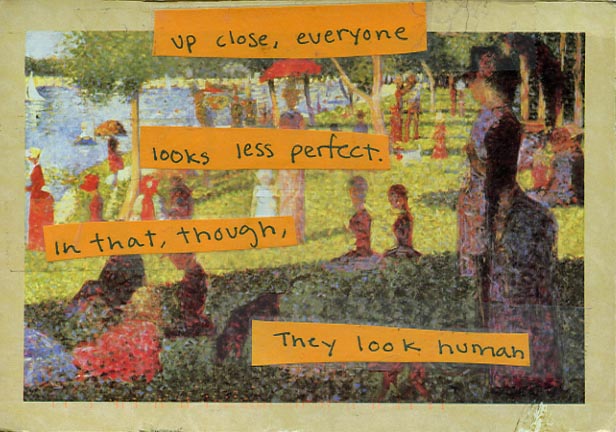
Image courtesy Postsecret

Thoughts after finishing A Canticle for Leibowitz

Wow.  Wow.

This book is INCREDIBLE. I’ll review it later, but first I want to put down some of my initial thoughts.

With any great book, you come to a point where you realize, consciously or not, that it just can’t get any better.  The story, the characters, the world, the ideas and stakes, the overarching conflict–it combines so perfectly that you don’t think you could possibly ask for more.

And then, if it’s a true masterpiece, it crosses that threshold and gets even better.

A Canticle for Leibowitz did that.  Somewhere in the second half, after I was completely caught up in the story, it exceeded my expectations and went to a whole new level.  I remember the exact passage where it happened:

They shook hands gingerly, but Dom Paulo knew that it was no token of any truce but only of mutual respect between foes. Perhaps it would never be more.

But why must it all be acted again?

The answer was near at hand; there was still the serpent whispering: For God doth know that in what day soever you shall eat thereof, your eyes shall be opened: and you shall be as Gods. The old father of lies was clever at telling half-truths: How shall you “know” good and evil, until you shall have sampled a little? Taste and be as Gods. But neither infinite power nor infinite wisdom could bestow godhood upon men. For that there would have to be infinite love as well.

I love books like this: books that not only have a good, entertaining story, but that have a deeper, more thoughtful dimension. Stories that make me think and reflect on the real world, that open my eyes and help me to see things in a new way. It’s what I read for.

Yes, the story was somewhat didactic and preachy…but it worked. Even though it was trying to make an explicit point, so much of the symbolism and metaphor was open ended that the readers could draw their own conclusions–and see a number of things that perhaps went beyond the point the author was trying to make.

I guess there’s two ways to write didactic fiction: the open approach, and the closed approach. With the open approach, the author uses a lot of symbolism and allegory, but in a way that explores principles and themes rather than building up to a predetermined point. Good examples of this (in my opinion) include The Chronicles of Narnia and The Neverending Story. The closed approach involves consciously working everything around a conscious agenda: examples of this include His Dark Materials and Lord of the Flies.

I don’t care much for the closed approach–I can’t stand it even when I agree with the underlying ideology (as in Orson Scott Card’s Empire).  Those kinds of books don’t stimulate genuine thought or reflection.  The open kind, though–that I can appreciate.  Even though I disagree with many of Heinlein’s views, I can appreciate his books even when they’re preachy because they make me think.

Anyways, those were some of my thoughts after finishing A Canticle for Leibowitz. This book is epic–truly epic.  It wowed me just as much as David Gemmell’s Legend. This is a book I’m going to remember for a long, long time.

If you care at all about the role of faith in forming our society, or the complex interplay between religion and politics, or the ultimate end of humanity–you have got to read this book!

Why I love Robert Charles Wilson

From Mysterium, which I plan to review here soon:

“Do you ever wonder, Howard, about the questions we can’t ask?
“Can’t answer, you mean?
“No. Can’t ask.
“I don’t understand.”
Stern leaned back in his deck chair and folded his hands over his gaunt, ascetic frame. His glasses were opaque in the porch light. The crickets seemed suddenly loud.
“Think about a dog,” he said. “Think about your dog–what’s his name?”
“Albert.”
“Yes. Think about Albert. He’s a healthy dog, is he not?”
“Yes.”
“Intelligent?”
“Sure.”
“He functions in every way normally, then, within the parameters of dogness. He’s an exemplar of his species. And he has the ability to learn, yes? He can do tricks? Learn from his experience? And he’s awarer of his surroundings; he can distinguish between you and your mother, for instance? H’es not unconscious or impaired?”
“Right.”
“But despite all that, there’s a limit on his understanding. Obviously so. If we talk about gravitons or Fourier transforms, he can’t follow the conversation. We’re speaking a language he doesn’t know and cannot know. The concepts can’t be translated; his mental universe simply won’t contain them.”
“Granted,” Howard said. “Am I missing the point?”
“We’re sitting here,” Stern said, “asking spectacular questions, you and I. About the universe and how it began. About everything that exists. And if we can ask a question, probably, sooner or later, we can answer it. So we assume there’s no limit to knowledge. But maybe your dog makes the same mistake! He doesn’t know what lies beyond the neighborhood, but if he found himself in a strange place he would approach it with the tools of comprehension available to him, and soon he would understand it–dog-fashion, by sight and smell and so on. There are no limits to his comprehensions, Howard, except the limits he does not and cannot ever experience.
“So how different are we? We’re mammals within the same broad compass of evolution, after all. Our forebrains are bigger, but the difference amounts to a few ounces. We can ask many, many more questions than your dog. And we can answer them. But if there are real limits on our comprehension, they would be as invisible to us as they are to Albert. So: Is there anything in the universe we simply cannot know? Is there a question we can’t ask? And would we ever encounter some hint of it, some intimation of the mystery? Or is it permanently beyond our grasp?”

This is the kind of science fiction that I love: the kind that brings me right up to the limits of human knowledge and makes me feel naked in the face of the unknown. The kind where the aliens truly feel alien, not like an unusually bizarre race of human beings. I want the aliens to surprise me–I want to feel that there’s something about them that is completely beyond my comprehension. Something sublime, something romantic.

In all of his books that I’ve read, Robert Charles Wilson captures this feeling spectacularly. So does Arthur C. Clarke, C. J. Cherryh, and Orson Scott Card. Larry Niven, Jerry Pournelle, John Scalzi and Alastair Reynolds are excellent writers, and I’ve genuinely enjoyed their books, but their aliens are too…understandable. Too clear cut, too defined. After a while, you don’t feel that there’s anything left to surprise you, anything that is so alien it’s beyond your grasp.

In some ways, I think this boils down to the author’s worldview. Those with a more positivist worldview believe that the world is fundamentally understandable, and that every phenomenon can be modeled and predicted, provided that we have a sophisticated enough understanding of natural law. The interpretivist worldview, on the other hand, posits that while truth may exist, there are limits to our understanding–that some things are inherently unpredictable and impossible to model.

I used to think that I was a positivist. Then I took Poli Sci 310 with Goodliffe, and it turned my world upside down. Genesis Earth is, in some ways, a product of that personal worldview shift. I don’t think I’m anywhere near on par with my aliens as Wilson, Clarke, and Card are with theirs, but I hope I’m on my way.

WOTF rejection

So a couple days ago, I got a phone call from my Mom.  A piece of mail had come in from the Writers of the Future contest.

Yeah, it was a standard form rejection.

Well, everyone puts in their time.  I guess this counts toward that.  A modified version of this story did well in the Mayhew contest, so I know it’s not utterly bad.  But I can see, in retrospect, how it wouldn’t do well with WOTF.

The main body of the piece was a scene I took from the middle of my novel–really, it was more of a scene than a coherent, unified story.  I threw on a beginning and an end, to try to fix that problem, but it probably didn’t mesh well with the real meat of it.  Which is fine, because it was originally meant as a scene, not a short story.

The thing is, I’m just not much good at short stories.  I don’t usually read them, and I don’t generally write them.  Novel writing is my craft–every time I try to write a short story, I end up writing a novel.  Once and a while, something clicks and a short story pops out (kind of like a Polaroid), but it’s not the usual thing.

So I’m not discouraged by this rejection from submitting to WOTF again, it’s just that it’s going to be kind of sporadic.  I have one more short piece that I could submit to the contest right now, but I don’t expect it to go far.  Still, it’s better than letting it sit in my hard drive.

In the meantime, I should probably submit that WOTF piece elsewhere, see what happens.  That’s probably what I’ll do.

What I really need to do, though, is work on my novel.  World Fantasy is coming up!

Battle scenes are HARD

I’m in the middle of revising a major battle scene right now.  This is supposed to be one of the more important climaxes of the book, adding a lot more tension and emotion as the novel approaches the main climax.

Let me just say, writing a good battle scene is tough.  The first version of this one…yeah, it sucked.  Hardcore sucked.  I’m cutting whole sections at a time–five hundred words, eight hundred words–and completely rewriting them from the ground up.  I’m not sad to see these sections go, either–they were BAD.

I think the most difficult thing is to keep the pacing up without confusing the reader.  For that reason, I reconceptualized most of the action here and made it simpler.  I also repeated several times the main point of tension–basically, will we get out of here before reinforcements come and kick our trash?  I hate it when a fight scene is so confusing that the tension just leaks out.  I don’t want that to happen here.

At the same time, I’m trying to filter everything through the viewpoint character.  Too often, I’ll read an action scene that’s just a blow-by-blow of the physical action.  That gets boring REALLY fast.  Without character, you have no stakes.  I want the stakes to be high from the very onset.

Still, it’s hard.  I don’t know if I’m succeeding yet.  I probably won’t until I distance myself from what I’ve written tonight and take a good, hard look at it.

Since I can’t do that until the third revision, I’m not going to worry about it.  Better to write it out now and move on than to try so hard to get everything perfect that I can’t see the story for the words.

On the plus side, I’ve been listening to a LOT of Star Wars battle music while writing this.  That’s always fun!

Summer roundup

Alright, with the first week of school already over, I figure I should recap and evaluate my writing progress this summer.

When school ended in April, I was still waiting to hear back from Brandon Sanderson’s agent about an internship.  My backup plan (which I started as soon as classes ended) was to stay in Provo and write full time.

Sanderson’s agent ended up taking on a different intern, which ended up being the best for both of us, since I get the sense that he was looking to mentor someone who would go on to become a professional agent.  Me, I was just looking to network and develop some connections in the publishing world, which I did anyway (at least in the local Utah scene).  Besides, Provo is WAY cheaper than New York!

From the beginning, I treated writing as a full-time job.  I set project deadlines, daily and 7-day wordcount goals, and spent somewhere around 8 hours a day working on my various projects.  I submitted a full to an editor from the BYU Writing and Illustrating for Young Readers conference and partials to the other two editors.  I also submitted to the Writers of the Future contest and to the LDS Publisher Christmas story contest (much smaller, but geared toward a niche market).

I started keeping my stats on May 25th, using a spreadsheet to keep track of my daily wordcount for each of my projects, the daily total wordcount, the 7-day cumulative wordcount, and any writing I did for synopses or revision notes.  Since BYU’s summer recess begins in April, I missed the stats  for the first three weeks or so, but I kept consistent records since then until now.

From May 25th to August 31st, I wrote 244,065 words in 8 projects (3 short stories and 5 novel drafts).  I averaged 2,490 words per day.  Adjusting for Sundays (I typically take Sundays off), I averaged 2,906 words per day.

My goals were to write 4k words per day, and to shoot for a constant 7-day total of 24k, but to never let that total dip below 12k words.  In 98 days, the 7-day running total only went below 12k eleven times–on those particular days, I was either traveling, moving out, moving in, or extremely busy with back-to-school chores.  For the two weeks I was on vacation, I still wrote more than 12k words each week.

Interestingly enough, out of the eight fiction projects, only one was a rough draft–a short story that I worked on for two days and never completed.  The vast majority of my writing went into revising novels that I’d already written.

I completed the first draft of Bringing Stella Home in early June (my third complete novel rough draft).  Later, in July, I began the second draft.  I’m currently just over halfway through with the revisions and hope to finish by October 10th.

I started a revision of my first novel, Ashes of the Starry Sea, but decided midway through that I was running up against diminishing returns and decided to drop it (I completed the rough draft in April of 2008–it was my first finished novel and the reason I started this blog, waaaaay back in August 2007).

I started a new draft of Hero in Exile, making some drastic revisions, but found it difficult to juggle more than one writing project at a time and put it on the back burner.  I may or may not pick it up again once Bringing Stella Home 2.0 is finished.

I completed the third draft of Genesis Earth and started to submit it.  I will probably do one language/readability edit before the World Fantasy convention in late October and try to sell it while I’m there.

Overall, the summer was a practice run to see if I could write full time and survive the insanity.  I always feared, as a child, that if writing became my full time job I would come to hate it.  I found, however, that writing full time (8+ hrs/day, 6 days/wk) only made me enjoy it more.  Now that school is back in session, I already wish I had more time and mental space to dedicate to my writing.

I miss the summer, but not because of the lazy days, or the parties, or the vacationing–I miss the opportunity to write full time!  Provided I can find a way to support a family off of this, I can definitely see myself turning this into a career.  In the meantime, I’ll keep honing my craft and start working on getting an agent.

Now, more than ever, I feel that breaking in is more of a question of ‘if’ than ‘when.’

🙂 🙂 🙂

I’m back!

Wow, I’m back from vacation.  Not “back” as in back in Utah, but “back” as in no longer at the cape.  We drove home to Western Massachusetts this evening and arrived just a couple hours ago.

Family vacation this year was lots of fun!  It was me, mom and pop, and Sarah and Mykle at a local cottage for about a week.  We went to Nauset Light Beach, Coast Guard Beach, Race Point Beach, Provincetown, Hyannis, Moby Dick’s restaurant, the Cape Cod Natural History Museum, and, of course, good old Sheep Pond in Brewster (Brew-stah).  When we weren’t out and about, we were either watching movies or playing Hearts and Shanghai, the Vasicek family card game of choice.

It was a lot of fun to hang out with the family at Cape Cod, but after a week I’m ready to head back into life as usual.  My back is fried, I’ve had enough Shanghai to make me sick (especially considering how CRAZY our family games can get!), and I’m looking forward to no longer smelling like salt water or sun tan lotion.

I’m also looking forward to writing again.  I kept up the writing at the cape–about 1k to 2k each day, mostly in the evening–but man, stuff like moving and vacations and travel and having fun tends to throw out your daily routine.  I haven’t had one for the last week and a half, and I want to get back to something a little more stable (not to mention productive).

Alas, the summer is just about over.  I’ll be flying back to Utah on Tuesday, moving all my stuff into my new apartment on Wednesday (Ben Crowder is going to be my roommate–I think it’s going to be a fun and interesting semester!), helping a friend move her stuff out of storage on Saturday, and doing other get-ready-for-school things on the other days, including filling out the FAFSA, getting parking stickers, books, figuring out what’s going on with my double-major capstone, and blah blah blah other boring annoying stuff.

Gah!  Why can’t I just write all day, every day?  Looks like those days are over…<sob>.

Someday, inshallah, I’ll make that dream a reality.  Someday soon, inshallah!

To write on vacation or not to write?

That is the question.

These last couple of weeks have been very unproductive.  I hate it.  Yeah, there have been reasons–moving apartments, sister’s graduation, coming home, etc.  Worthless excuses–I should have been writing more, and I didn’t.

At the same time, taking a break every now and again is very important.  Sometimes you just have to sit back and recharge your creative batteries–otherwise, you’ll overwork them and they’ll die.  What better way to kill your productivity than that?

I noticed, back at the beginning of the month, that I  needed a break.  I produced about 85k words each month in June and July, and I’ve been sloshing through the middle of Bringing Stella Home 2.0 for some time now.  Consequently, my creative brain seemed to  shut down about two weeks ago (or at least switched to power-saving mode) and I haven’t been writing at a consistent rate since.  Blargh.

So I know I need a vacation.  I’ve needed it for some time.  And now that I’m here in Massachusetts, heading to the cape on Saturday, I’ve got the perfect opportunity to relax and recharge my batteries.

Trouble is, if I stop writing altogether, will I lose momentum?  Will it take me another week just to get back into the story?  I’ve already lost so much productivity, it makes me feel disgusted.  I need to be so much further along in this story than I am if I’m going to meet my (self-imposed) deadline.

So, I’m wondering–should I write while I’m on this vacation?

Of course, I’m not going to spend eight hours a day writing full time, the way I have been for most of this summer.  I’m going to relax.  But should I set a modest goal of 1k words a day while I’m there?  I kind of think I should.

Don’t worry, though.  I’m going to take time off for fun as well.  I’ve been looking forward to this trip for a very long time!

As if writing weren’t fun enough already. 🙂

Slush puppy feedback

A few weeks ago, I read a submission for The Leading Edge (I volunteer read slush for the magazine) from a lady from Germany.  The story was about a dwindling race of indigenous natives being driven from their lands by a corporate, high-technology society.  This one girl gets lost in the wilderness and everyone thinks she’s dead, but she’s really taken by this magical demigod woman who the natives worship.  One of the natives basically sells his soul to integrate with the invaders, while the main character fights them up to the end.

It was an interesting story with some poignant moments, but way too much for 15,000 words.  I wrote in my comments that this lady was really writing a novel and that she should try her hand at it, because if she pulled it off with some skill the story was good enough that I’d be willing to buy it.

Well, today we got a postcard in the mail from the same lady, thanking us for our kind comments!  Here’s what she said:

Dear Director,

I want to apologize for sending you “Kith and Kin” which contained some inappropriate content*…it was kind of you to permit reviewers “RJ” and “JV” to comment nonetheless, and I found their comments detailed, thoughtful, and helpful!  The piece has now placed elsewhere.  Thank you for your time.

Very truly yours,

Suzanne Sykorn in Germany

That was kind of her to send a note!  Good to know, also, that people find my comments helpful.  The editors gave me the postcard, so it will be a nice writerly keepsake to add to my collection of rejection letters (and acceptance letter!!).

For my own career, I think I’ll do like this lady and send out postcards whenever I get a personalized rejection.  It’s definitely a kind, thoughtful gesture.

*The inappropriate content mostly had to with sex and drug use.  It didn’t bother me, as callous and profane as I am, but I think some of the other slush readers had issues.  Since Leading Edge is a BYU publication, we have to follow BYU standards in what we publish.