Must…build…momentum

Man, nothing throws a kink in your writing life like a major paper.  This semester, I’ve got the mother of all undergraduate papers to write–the CAPSTONE.

Interestingly enough, I’ve been having a lot of fun with mine.  A lot. I’ll spare you the gory details, but basically my capstone is a statistical study of the effects of Israeli politics on the Israeli-Palestinian conflict, specifically whether Israeli political fragmentation leads to increases in the level of conflict.  One of these days, I’ll get around to showing you the tables, because they are fairly compelling.

Well, on Monday, the rough draft was due–the complete rough draft.  Minimum: 20 pages.  Professor Christensen doesn’t care how you get your paper in, though, so long as it’s on his desk when he shows up for work Tuesday morning.  So basically, I locked myself in the SWKT and wrote the last half of the thing in the TA office.  The building closed, but around midnight I finished the thing and slipped it into the dropbox!  Huzzah!

And now that my capstone is complete (at least, the first draft), you have NO IDEA how liberated I feel!  It’s awesome! Like, I actually have free time right now!  It’s been so long, I’ve totally forgotten what that feels like.  Freedom!

And now that I look back on the last three weeks of my writing, all I can say is ouch.

I’ve hardly worked on either of my novels at all these past two weeks.  The 7-day word counts have been steadily dwindling, and last week it actually hit zero.  Yikes!  I don’t think that’s happened since…since finals last semester or something.

Well, I’m going to fix that!  Yesterday, I churned through about 2.5k words in the revision of Genesis Earth, and I plan to keep it up all this week until school starts beating me up again.  That probably won’t be until after Thanksgiving, which gives me just enough time to finish this revision.

Hopefully, this week I’ll be able to do at least 1.5k daily.  It’s going to take hard work to build momentum again, but once I’m up and running, finishing this beast shouldn’t be hard.  Then I can devote more time to finishing the current incarnation of Bringing Stella Home, which should have been finished long ago.

And then, finally…something new!

Thoughts on World Fantasy 2009

Since it’s been a couple of days since World Fantasy 2009, I guess I should share some of my thoughts before life starts pulling me in other directions.

First of all, I was surprised at how similar it was to LTUE, CONduit and other convention/symposium events I’ve already attended.  The basic format was the same: dealer’s room open all the time, with panels every hour until the evening.  The only real differences from that were the hotel bar downstairs, the consuite upstairs, and the parties at night.

Second, I was extremely surprised to see so many other people from Utah.  Honestly, there were about thirty or forty of us, about half of whom I knew from LTUE, CONduit, English318–and the others all knew someone I knew from one of those places.  It’s funny to think that we traveled nearly a thousand miles just to network with each other, but that’s pretty much the case.

Third, I was surprised at how much drinking was going on.  Maybe it’s just because I don’t drink, but it doesn’t make sense to me to come to a business meeting and get intoxicated in front of the people you’re trying to impress.  Not that I was uncomfortable.  There were enough other non-drinkers there that I didn’t feel out of place, and even the outright drunks were more entertaining than anything else.  If anything, I guess it was an interesting anthropological experience (kind of like reading Twilight, except…different).

Fourth, I was surprised at how down-to-Earth and accessible everyone was.  Big name authors, editors and agents at the major houses, staff and editors from the small presses–everyone was very friendly and accessible.  I talked with Ann VanderMeer briefly about my capstone project on Israeli politics.  I talked with David Drake about the difference between him and Haldeman.  I talked with Kay Kenyon about Star Control II and Alastair Reynolds.  I talked with Liz Gorinsky (editor at Tor) about Jake Von Slatt, Jim Frankel (senior editor at Tor) about Guy Gavriel Kay, Guy Gavriel Kay about Brandon Sanderson, Brandon’s Agent Joshua Bilmes about Eddie, his assistant-gone-agent, etc etc.

None of this was planned; it all just happened.  Everyone was very friendly.  In fact, I was particularly surprised at how many people became interested in me when I said I was an Arabic / Mideast studies major.  I ran into Brent Weeks’ wife in the bar and talked with her for almost half an hour about Egypt and the Middle East, and she actually seemed interested in what I had to say.

At the same time, I was surprised at some of the tackier things that happened, too.  Maybe this is just my pet peeve, but at every single panel I attended, someone in the audience raised their hand and said “I don’t really have a question, but…” and went on and on for several minutes discussing one of their ideas–TAKING TIME AWAY from the panelists and the people with genuine questions.  Some people even tried to pitch books that way!  Laaaaame.

I will say, though, that as far as pitching books, it wasn’t exactly what I was expecting.  From Brandon’s Class, it seemed that a lot of these people would let you send your full manuscript if you just asked them…and maybe that was the case, but other Utah friends at the convention told me that when they tried to pitch, it didn’t turn out so well.  I generally felt a lot of question, so I tried to err on the side of being non-aggressive.  At least I can mention in a cover letter that I saw them.

The last thing that surprised me was a lot more personal, but out of everything else, it probably surprised me the most. I saw several aspiring writers who seemed so stressed out about breaking in, and it surprised me, because…I don’t feel that way at all.  In fact, I felt a strong sense of peace as I thought about my future.  It’s not a question of “if” I’ll be published, but “when,” and getting there is going to be an exciting adventure.

Anyhow, I enjoyed World Fantasy 2009 a ton!  It was an overwhelmingly positive experience.

I <3 Lunasa

Lunasa is an Irish folk music band–one of the best that I know. If you haven’t heard of them, you should check them out.

I mean, at the very least, check out Kevin Crawford’s mad whistling:

Crazy!

Sometimes, when I wonder what I should do after I graduate, I get these starry eyed dreams of becoming a celtic rockstar–or, at the very least, a street musician. That would be kind of fun, sitting out in the open air, playing music to the world, waiting on the charity and generosity of strangers. I mean, at least for the first couple of hours, that would be fun–wouldn’t it?

Yeah, better stay in school. In the meantime, though, here is one of my own original pieces. Not anywhere near as awesome as Lunasa, but not too shabby either:

Street musician…maybe I should try it. Or maybe I should wait for the spring first…

Thoughts after finishing A Canticle for Leibowitz

Wow.  Wow.

This book is INCREDIBLE. I’ll review it later, but first I want to put down some of my initial thoughts.

With any great book, you come to a point where you realize, consciously or not, that it just can’t get any better.  The story, the characters, the world, the ideas and stakes, the overarching conflict–it combines so perfectly that you don’t think you could possibly ask for more.

And then, if it’s a true masterpiece, it crosses that threshold and gets even better.

A Canticle for Leibowitz did that.  Somewhere in the second half, after I was completely caught up in the story, it exceeded my expectations and went to a whole new level.  I remember the exact passage where it happened:

They shook hands gingerly, but Dom Paulo knew that it was no token of any truce but only of mutual respect between foes. Perhaps it would never be more.

But why must it all be acted again?

The answer was near at hand; there was still the serpent whispering: For God doth know that in what day soever you shall eat thereof, your eyes shall be opened: and you shall be as Gods. The old father of lies was clever at telling half-truths: How shall you “know” good and evil, until you shall have sampled a little? Taste and be as Gods. But neither infinite power nor infinite wisdom could bestow godhood upon men. For that there would have to be infinite love as well.

I love books like this: books that not only have a good, entertaining story, but that have a deeper, more thoughtful dimension. Stories that make me think and reflect on the real world, that open my eyes and help me to see things in a new way. It’s what I read for.

Yes, the story was somewhat didactic and preachy…but it worked. Even though it was trying to make an explicit point, so much of the symbolism and metaphor was open ended that the readers could draw their own conclusions–and see a number of things that perhaps went beyond the point the author was trying to make.

I guess there’s two ways to write didactic fiction: the open approach, and the closed approach. With the open approach, the author uses a lot of symbolism and allegory, but in a way that explores principles and themes rather than building up to a predetermined point. Good examples of this (in my opinion) include The Chronicles of Narnia and The Neverending Story. The closed approach involves consciously working everything around a conscious agenda: examples of this include His Dark Materials and Lord of the Flies.

I don’t care much for the closed approach–I can’t stand it even when I agree with the underlying ideology (as in Orson Scott Card’s Empire).  Those kinds of books don’t stimulate genuine thought or reflection.  The open kind, though–that I can appreciate.  Even though I disagree with many of Heinlein’s views, I can appreciate his books even when they’re preachy because they make me think.

Anyways, those were some of my thoughts after finishing A Canticle for Leibowitz. This book is epic–truly epic.  It wowed me just as much as David Gemmell’s Legend. This is a book I’m going to remember for a long, long time.

If you care at all about the role of faith in forming our society, or the complex interplay between religion and politics, or the ultimate end of humanity–you have got to read this book!

World Fantasy 2009 — second day

Friday was a long, awesome day  at World Fantasy.  I feel like I’m floating around on a sea full of big names and interesting people, and it’s surprisingly less intimidating than I thought it would be.

The day started with a number of panels.  I attended “Writing human characters, whether or not they’re human” and “VaanderMeer on VanderMeer.”

The VanderMeer panel was very enjoyable–Ann and Jeff are down-to-Earth good people, and it was interesting hearing their stories, especially Ann on her experiences as an editor.  At one point, she could have shared any number of slushpile horror stories, but she didn’t.

Took lunch at Lee’s Sandwiches, for no other reasons than price and nostalgia. I used to eat at Lee’s all the time when I lived in San Jose, because it was so cheap.  It’s been so long, but it was exactly as I remembered it.  Good times.

Met up with Daniel Alonso, another writer friend from LTUE/CONduit.  It was good to see him.  We wandered around the dealer’s room for a while and struck up conversations with various people, including David Drake.  Talked with Drake about the difference between him and Haldeman–apparently, in Haldeman’s novels, nobody trusts anybody, whereas in David Drake’s novels, people mistrust everyone but the comrades in their unit.  Interesting.

Let me just say, once again, that I am surprised how many people from the Utah scene are here at World Fantasy.  On the “Writing non-conciliatory fantasy” panel, I recognized at least a dozen other Utah writers, and there were probably at least as many there that I didn’t recognize!  Surprising, when you consider the panel was about anti-heroes.

Besides the “Writing non-conciliatory fantasy” panel, I attended “Invention vs. tradition” and “The last resort” in the afternoon.  Both were very interesting, but unfortunately I was very tired after the last one, so didn’t catch as much from it.  That’s what happens for late afternoon / early evening panels, generally.

Went to a book release party for Edge publishing.  It was an interesting event.  Barbara Galler-Smith and Josh Langston wrote Druids together long-distance, having only met over the internet.  They both seem like pretty cool people, just from running into them.  From the readings, the book reminded me a bit of David Gemmell.

Had dinner with some other writers from the Utah scene–Josh, Isaac, and Jancy.  Talked with Jancy for quite a while–turns out she’s from Santa Clara, got a master’s degree from BYU with John Bennion as her advisor.  It also turns out that she recently switched agents; she’s represented by Eddie now, Joshua Bilmes’s old assistant.  We talked about my book and whether it’s YA or not,  which went on to a very interesting discussion of YA themes.  Jancy’s a way cool person.

The evening event was a giant mass autographing party in the ballroom.  Everyone was there doing a signing.  I hung out at Dan Wells’s booth and met Mary Robinette Kowal.  She was way cool, easy to talk with, interesting and humble.  Yet another down-to-Earth good person at this convention.

Met a lot more people from the Utah scene in the evening, such as J. Aleta Clegg, who was around when LTUEThe Leading Edge, and Quark were founded.  Also talked with Julie Wright, found out that she’s an editor as well as a writer, talked about the blog she co-authors and Leading Edge.  Yet more down-to-Earth good people.

After that, drifted from party to party, until everyone was so drunk that my attempts to make useful contacts started to become counterproductive.  Had fun at the same time, though.  Good people, good times.

I’m looking forward to tomorrow!

World Fantasy 2009 — first day

After four years, I’m back in California!  Yay!

Okay, now that I’ve got that out of my system (because California is, without a doubt, the most awesome state in the union), let me just say that the first day of World Fantasy 2009 was most excellent.

For Cavan, Alex and me, the day began at about 4:30 am, when we woke up early to road trip it out to San Jose.  The salt flats near Dugway were very beautiful in the early morning light, as were the mountains.  Nevada stretched on forever, but a little bit of Ennio Morricone helped it pass enjoyably.  After Reno, we descended through the Sierras, passed Sacramento and the Central Valley, crossed over the gorgeous bay area mountains and arrived in San Jose without incident.

Well…there was one incident.  We got a little lost finding Alex’s friend’s house, and pulled a U-turn that ticked off one of the local drivers.  She honked her horn and shouted out her window: “go back to Utah!”

California, I love you.  You haven’t changed at all since I left. 🙂

We’re staying with Alex’s friend, within walking distance of the downtown area where the convention hotel is situated.  No, really, we couldn’t have planned it better.  Alex’s friend is way chill.

After we registered, we scoped out the hotel.  It feels a lot like the hotels in Cairo–big and grand, with lots of marble and large open spaces.  We browsed around the dealer’s room, saw lots of small publishers, some of whose books I’ve reviewed for Leading Edge. Everyone was very friendly and easy to talk with.

The only panel  tonight was on the Google book settlement, and it was very informative and helpful for someone as clueless on this issue as me.  Some very choice words were exchanged between the president of SFWA and a Google employee in the audience, but most of the panelists had the same  opinion–that the settlement would set a terrible precedent for copyright law and should be fought tooth and nail.  Interesting, timely stuff.

We heard about a party on the top floor, so we decided to check it out, and low and behold!  Practically the entire convention was there.  Ran into some familiar faces from LTUE and CONduit; it turns out that there are one or two dozen people from Utah at this convention, and most of us already know each other.  How awesome is that?

Let me just say, I am so happy that I have friends at this convention.  All that networking in Utah over the last two years is really paying off.  It’s so much easier to meet new people when you’re working together as a group.  I’m starting to get an idea of the editors/agents here that I should contact and how to approach them.  I’m also meeting a lot of other aspiring writers, making new friends.

In short, the party was not only productive, it was lots of fun.  Met new people, reconnected with old friends from the Utah scene, got the scoop on Dan Well’s Serial Killer book and the pending sequels (which I’m eagerly anticipating), and just had an overall great time.

An excellent finish to a very eventful day–and the convention has only just begun!

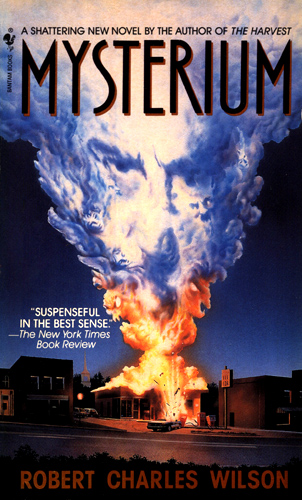
Mysterium by Robert Charles Wilson

Nobody knows why the government chose the small town of Two Rivers, Michigan, as the site for a top secret military project.  Even most of the people involved in the project don’t know what it’s really about.  That’s alright, because most of the denizens of this backwoods community are used to minding their own business.  But after a mysterious explosion bathes the entire city in light, that becomes impossible.

On the outskirts of town, all the roads and power lines dead end in ancient virgin forest.  It’s as if a perfect circle has been drawn around the town on the map, and everything within the circle has been transported to a parallel world.

A very unfriendly parallel world.

Robert Charles Wilson’s writing is awesome.  I could eat up his prose all day.  It not only flows beautifully, it’s clear and transparent, to the point where I forget that I’m reading and feel as if I’m there.  He always uses the right expression, the right metaphor, and yet his prose never attracts so much attention to itself that it distracts from the story.

I noticed several similarities between Mysterium and Wilson’s other novels that I’ve read.  All of them start in our modern world and move into a mysterious, unfamiliar milieu.  All of them involve strange religions and religious conflicts.  All of them involve male and female characters struggling to face personal relationship problems and eventually coming together.  In these ways, this story felt very much like Spin.

At the same time, I can definitely tell that this is one of Wilson’s earlier works.  The story flows like a thriller, but lags in certain points.  After the town is transported into the parallel dimension, the story seems to meander without any clear direction.  For several chapters, I lost the sense of progress that usually accompanies a good plot.  The resolution receives very little foreshadowing–the “surprising yet inevitable” element was only “inevitable” three or four chapters from the end.  If it weren’t for Wilson’s beautiful writing, I would have put this book down in the middle.

<spoiler alert>

Unlike Spin, I found the milieu of this story somewhat depressing–not necessarily because of the setting itself (though it’s not the kind of alternate present that I’d want to live in), but because the people of Two Rivers never go back.

According to Card, there are two basic types of milieu stories: stories where the protagonist returns profoundly changed, or stories where the protagonist “goes native” and becomes assimilated.  But…if the new world isn’t the kind of place you’d want to live in–in other words, if it’s dystopian (and Wilson’s alternate world in Mysterium is fairly dystopian)–then there’s this tension of “will the protagonist make it back?  Will they return?” And if they don’t return, the story is emotionally disappointing.  That was the case for me with Mysterium.

</spoiler alert>

From this review, it probably sounds like I hated this book.  That wasn’t the case–not at all!  This was a good story, and I enjoyed it.  I finished the last hundred pages at a sprint at 1:30 in the morning–it was definitely that kind of a book.  I couldn’t put it down.  And at the same time, it was thoughtful and profound (as you can tell from my previous post, “Why I love Robert Charles Wilson“).

I’ve probably said enough.  If you like thrilling, parallel world adventure stories with a contemplative, thoughtful “what if?” element, read this book.  Even with all the misgivings I’ve mentioned here, it’s good SF.  Very good.

Why I love Robert Charles Wilson

From Mysterium, which I plan to review here soon:

“Do you ever wonder, Howard, about the questions we can’t ask?
“Can’t answer, you mean?
“No. Can’t ask.
“I don’t understand.”
Stern leaned back in his deck chair and folded his hands over his gaunt, ascetic frame. His glasses were opaque in the porch light. The crickets seemed suddenly loud.
“Think about a dog,” he said. “Think about your dog–what’s his name?”
“Albert.”
“Yes. Think about Albert. He’s a healthy dog, is he not?”
“Yes.”
“Intelligent?”
“Sure.”
“He functions in every way normally, then, within the parameters of dogness. He’s an exemplar of his species. And he has the ability to learn, yes? He can do tricks? Learn from his experience? And he’s awarer of his surroundings; he can distinguish between you and your mother, for instance? H’es not unconscious or impaired?”
“Right.”
“But despite all that, there’s a limit on his understanding. Obviously so. If we talk about gravitons or Fourier transforms, he can’t follow the conversation. We’re speaking a language he doesn’t know and cannot know. The concepts can’t be translated; his mental universe simply won’t contain them.”
“Granted,” Howard said. “Am I missing the point?”
“We’re sitting here,” Stern said, “asking spectacular questions, you and I. About the universe and how it began. About everything that exists. And if we can ask a question, probably, sooner or later, we can answer it. So we assume there’s no limit to knowledge. But maybe your dog makes the same mistake! He doesn’t know what lies beyond the neighborhood, but if he found himself in a strange place he would approach it with the tools of comprehension available to him, and soon he would understand it–dog-fashion, by sight and smell and so on. There are no limits to his comprehensions, Howard, except the limits he does not and cannot ever experience.
“So how different are we? We’re mammals within the same broad compass of evolution, after all. Our forebrains are bigger, but the difference amounts to a few ounces. We can ask many, many more questions than your dog. And we can answer them. But if there are real limits on our comprehension, they would be as invisible to us as they are to Albert. So: Is there anything in the universe we simply cannot know? Is there a question we can’t ask? And would we ever encounter some hint of it, some intimation of the mystery? Or is it permanently beyond our grasp?”

This is the kind of science fiction that I love: the kind that brings me right up to the limits of human knowledge and makes me feel naked in the face of the unknown. The kind where the aliens truly feel alien, not like an unusually bizarre race of human beings. I want the aliens to surprise me–I want to feel that there’s something about them that is completely beyond my comprehension. Something sublime, something romantic.

In all of his books that I’ve read, Robert Charles Wilson captures this feeling spectacularly. So does Arthur C. Clarke, C. J. Cherryh, and Orson Scott Card. Larry Niven, Jerry Pournelle, John Scalzi and Alastair Reynolds are excellent writers, and I’ve genuinely enjoyed their books, but their aliens are too…understandable. Too clear cut, too defined. After a while, you don’t feel that there’s anything left to surprise you, anything that is so alien it’s beyond your grasp.

In some ways, I think this boils down to the author’s worldview. Those with a more positivist worldview believe that the world is fundamentally understandable, and that every phenomenon can be modeled and predicted, provided that we have a sophisticated enough understanding of natural law. The interpretivist worldview, on the other hand, posits that while truth may exist, there are limits to our understanding–that some things are inherently unpredictable and impossible to model.

I used to think that I was a positivist. Then I took Poli Sci 310 with Goodliffe, and it turned my world upside down. Genesis Earth is, in some ways, a product of that personal worldview shift. I don’t think I’m anywhere near on par with my aliens as Wilson, Clarke, and Card are with theirs, but I hope I’m on my way.

WOTF rejection

So a couple days ago, I got a phone call from my Mom.  A piece of mail had come in from the Writers of the Future contest.

Yeah, it was a standard form rejection.

Well, everyone puts in their time.  I guess this counts toward that.  A modified version of this story did well in the Mayhew contest, so I know it’s not utterly bad.  But I can see, in retrospect, how it wouldn’t do well with WOTF.

The main body of the piece was a scene I took from the middle of my novel–really, it was more of a scene than a coherent, unified story.  I threw on a beginning and an end, to try to fix that problem, but it probably didn’t mesh well with the real meat of it.  Which is fine, because it was originally meant as a scene, not a short story.

The thing is, I’m just not much good at short stories.  I don’t usually read them, and I don’t generally write them.  Novel writing is my craft–every time I try to write a short story, I end up writing a novel.  Once and a while, something clicks and a short story pops out (kind of like a Polaroid), but it’s not the usual thing.

So I’m not discouraged by this rejection from submitting to WOTF again, it’s just that it’s going to be kind of sporadic.  I have one more short piece that I could submit to the contest right now, but I don’t expect it to go far.  Still, it’s better than letting it sit in my hard drive.

In the meantime, I should probably submit that WOTF piece elsewhere, see what happens.  That’s probably what I’ll do.

What I really need to do, though, is work on my novel.  World Fantasy is coming up!

September recap

So, September’s over now.  Where in the heck did all that time go?  In some ways, I can still remember the summer…but in other ways, it’s never been further away.

So, what did I do this past month?  Plenty.  I got a good start on school (14 credits this semester), I quit the writing advisor job and replaced it with two TA jobs, and I turned 25 years old.  Quarter century…and still in school.  I feel like some kind of relic. “An elegant weapon for a more civilized age…”

As far as writing goes, I wrote 41,649 words total, averaging 1,602 words per day (not counting Sundays–counting Sundays, I averaged 1,388).  I passed the 3/4ths mark on Bringing Stella Home 2.0 and started work on Genesis Earth 4.0.

Not bad!  I’m surprised I wrote so much; 41k is almost as much as nanowrimo.  However, I can’t help but wonder: how many of those words are good words?

It’s a much more subjective thing to measure, but I do feel that my craft has improved.  Now that I’ve started the rewrite on Genesis Earth, I’m catching a surprising number of sentences and paragraphs that could be much better phrased.  For today, I “wrote” 1,616 words, but only got about 1,000 words further into the story (I measure wordcount with compare documents, totaling all the deletions and additions).  After the last revision–just last July–I felt very satisfied with the draft as I’d written it.  The fact that I’m changing so much on this rewrite shows that I’ve set the bar a lot higher for quality of writing (at least, I hope that’s what it means).

School is still kicking my trash.  I’ve got papers up the wazoo this entire month–3 major ones, two minor ones, and at least one midterm, not to mention all the midterms and papers I’ll be grading.  Oh, and I’m reading about a dozen academic articles per week. Dense articles.  The kind that suck your life out through your eyes.

Because of all that, and because of World Fantasy at the end of the month, I’ve decided to  put Bringing Stella Home on temporary hold until I finish the revision of Genesis Earth. Got to put priorities first, and that’s how it falls.  If the revision takes longer than expected, I may have to change my personal deadline for Bringing Stella Home to Thanksgiving.

But come Thanksgiving, I am definitely starting something new!