Paradigm shifts and finding balance

Yesterday, I was going to write a post about how pathetic this past week was: I only wrote about 1.5k per day (while unemployed), and spent most of my time on the internet reading blogs.

However, after reading some more of Dean Wesley Smith’s blog series, Kililng the Sacred Cows of Publishing, I have to admit that this week wasn’t a total loss.  Because of what I’ve read this week, I’m starting to have a major paradigm shift about the publishing world, and that likely will have a huge impact on my writing career, hopefully for the better.

If I can sum up how my views have changed into one statement, it would be this: that in order to succeed in this business and avoid the common pitfalls, I need to learn how the entire publishing system works as a whole, so that I can game it to my advantage.  A lot of the hard and fast “rules” of the industry are actually myths that make for bad business, for writers as well as editors and agents.  But when you look at the system from a rational choice perspective, the flaws become obvious.

Take, for example, the “rule” that editors only accept unagented submissions.  What does that do for the industry?  It turns agents into the first tier of gatekeepers that new writers need to get past.  But agents don’t pay writers; they get a 15% commission off of the books they manage to sell (which, according to DWS, is excessive, but that’s another topic).  And they don’t get paid at all for reading slush.

So agents are spending more of their time doing things that pay less money, pressuring them to take less risks and work only with what they “know” will sell.  This leads them to ignore the fresh, unconventional voices that turn the tropes on their heads and have the power to take the market by storm.

Furthermore, because of their newly christened gatekeeper status, they make their writers rewrite their manuscripts until they read just like clones of Harry Potter or The Davinci Code.  And when the agents’ three or four closest buddies turn the book down, they come back to the writer and tell them to write something else.

It’s an extreme view, for sure, but it has a few good points.  The incentives are all in the wrong places, with too many opportunities for the gems to fall between the cracks.  And while the response from everyone in publishing is to cling to the myth and scream “the system works!” I have to wonder, does it really?

This comment from one of the threads struck me with particular force:

“The biggest mistake you can make is giving complete power over to someone who will never care as much as you do.”

Youch.  And yet, it makes so much sense.  How many writers’ careers have been ruined by doing just that?  Ceding too much power to people who simply don’t care as much as they do, all in the name of some “rule” of publishing?

Of course, that’s not to say that the publishing industry is full of cheats and sleazebags.  I’ve spent some time with professionals at World Fantasy and other conventions, and I’ve been very impressed with all of them.  It’s just to say that writing is a business, and that writers need to approach their careers in the same way as anyone who’s self-employed.  Certainly it’s important to work with other professionals, but that doesn’t mean handing over the fate of your business to them.

So anyways, what with all the business research I’ve been doing, I suppose the last week isn’t a total loss.  However, I definitely feel a need to get back into writing.  My deadline for WAFH is in two weeks, and the next 40k are going to require the biggest changes.  So here’s my plan for the next two weeks:

  • Get up at 7 am every day.
  • Write at least 2.5k words per day (500 during LTUE).
  • Fill out at least 5 job applications per day.
  • Take a week-long Halo fast.

Probably the single biggest thing killing my creativity right now is the angst that comes from money woes.  I redid my budget yesterday and realized I can get by this month without dipping too deeply into reserves, but still, that’s no substitute for a reliable source of income.  Trouble is, it’s hard to find motivation to apply for jobs when most employers don’t even respond to your application, but hopefully a concrete goal will make that easier.

As for Halo, as much as I love the game, I just don’t have time for it right now.  Personal writing deadlines are coming up, LTUE is just around the corner, and I’m falling too far behind to spend my time on video games.

I’m also going to make a concerted effort to get up earlier.  If I stay up past midnight, I’m usually just dicking around on the internet, whereas my mornings are almost always productive.  Plus, I hate sleeping in–hate it.  Gotta get up earlier.

So anyhow, that’s the plan.  Now, if you’ll excuse me, I’ve got some writing to do…

Some thoughts on the future

I went to the first class of English 318 yesterday, and the lecture got me to thinking about my mid- to long-term future as a writer.

Brandon spent most of the period organizing the class, which was made doubly difficult by the ridiculously small classroom size.  I swear, bureaucracies exist only to make life difficult.  This year, for the sole sake of screwing with everyone, they are trying to limit his class size to thirty people (twenty students, ten auditors), but that’s a whole other rant in and of itself.

Oh well–at least there’s still room on the floor.

Anyhow, after getting all the administrative stuff done, Brandon talked about the practicalities of being a writer.  He made the very interesting point that as a writer, it doesn’t matter where you live–moving further away from the city won’t negatively affect your earnings, unlike most jobs.  That means you can save a lot of money on a house if you’re willing to live 50 to 100 miles away from a major population center.

That got me to thinking: maybe, once my writing career starts taking off, I’ll move down to southern Utah for a while.  The country is absolutely gorgeous down there, and the people don’t seem hard to live with.  Small house with lots of space, maybe a garden, lots of outdoor stuff all over, plenty of privacy–sounds great!

So here’s a tentative map of the next few years:

present–fall 2011: Get a job, build some credit, get TEFL certified.  Keep writing, attend some cons (LTUE, Worldcon), develop new projects.

fall 2011–2012: Teach English abroad for a while (Korea, Japan, etc), build up some savings, have some adventures.  Keep writing and submitting.

2013–2014: Get a teaching job in the Middle East (gulf region), have some adventures down there, continue to build savings and gain experience.  Hopefully I’ll have broken in to publishing at this point; if not, keep on trying.

2015–2020: Come back to Utah (maybe Salt Lake), live off of savings for a while and really focus on building the writing career.  Attend cons and workshops, network, write like crazy (the adventures will probably give me lots of material), work on promotion if I’ve already got a publishing deal, etc.

2020–????: Hopefully, somewhere along the line I’ll meet my wife and get married.  Also by this time, my writing career will hopefully be earning me a living–enough, at least, to support a family.  With all these things in place, we’ll select a home out in southern Utah, settle down, and start having kids.

That’s one plan, at least.  When 2020 rolls around, I’ll probably laugh at my naive and short-sighted view of the future–but at least it’s something to work with.

Brandon did make the point that it’s not as hard to make a living as a science fiction & fantasy writer as most people say–which isn’t to say it’s easy, but it is possible.

According to Brandon, about 1,000 to 2,000 writers in sf&f are currently making a full-time living.  Most of them are mid listers–authors you probably haven’t heard of, but see their books occasionally in the stores.  If your books sell about 5,000 copies in hardcover over the first three years in print, your publisher won’t cut you–and with the way ebooks are changing things, new business models will certainly evolve, presenting a whole new host of challenges and opportunities.

Bottom line, this is something achievable, so long as I keep producing consistently and work hard to improve my craft.  I’m very optimistic about the long-term.

Now, all I need is to find a job…ugggggggh.

(image courtesy Postsecret)

Looking for a life experience

This week, I got hit by some good news and some bad news.

The good news was that I got a short term seasonal job, delivering phone books.  That should keep me solvent for the rest of the month, at least until I can find something slightly more permanent.

The bad news?  I heard back from the company with the wilderness job, and it turns out I didn’t get it.

So now I’ve got to figure out what to do with my life for the next  year.  My writing career, as always, is plan A, but that’s more of a mid- to long-term thing.  And honestly, that’s how I want it.

I feel that I need to do something big–to go on some kind of adventure.  I’ve been working hard to hone my craft, but I feel that I need to acquire some kind of significant life experience, not only to boost my writing, but just to grow as a person.  It’s tempting to look for a comfort zone and camp out in it, but I don’t think that would be the best thing for me to do right now.

Before I graduated, I decided not to go to graduate school yet for a few reasons.  First, I was sick of school, and felt that I needed a break. Second, I didn’t know what to go in for, and didn’t want to go to grad school just to postpone figuring things out.

Third, I wanted to get out of the cloistered halls of the university and gain some real world experience.  I’d spent my whole life up to that point in academia, and was sick and tired of being sheltered from the “real world.” I wanted to get out and see what things were really like on the other side of the ivy.

For the past eight months, I’ve been bouncing around in Utah, working odd jobs to get by.  It’s a different set of stresses and problems, and while I can’t say I’m unhappy, I certainly can’t say that I’m fulfilled.  Being unemployed is about as unfulfilling as you can get and still be breathing.

I could probably find and hold down a graveyard job until my writing career takes off, but somehow that doesn’t seem much better.  I don’t just need a job to facilitate my writing–I need a major life experience to broaden my perspective on things.  I was hoping the wilderness job would provide me with both of those, but unfortunately that’s no longer an option.

So what next?  Here’s an idea: maybe I could go abroad and teach English for a year.

I used to joke with all my friends that if I didn’t get the wilderness job, I’d probably leave the country and go on an adventure–but really, why not?  A chance to see the world, use the teaching and language learning skills from my degree, and acquire new skills that might come in handy later on.  Plus, when I come back, I’ll sure have a lot of interesting things to write about.

The big question in my mind is what I need to do to get ready.  I suppose the best thing would be a TEFL certificate–I could probably get one of those in a month or two through online classes.  But…is that really the best path?  And what is the best program to go through?  A couple of friends of mine who have taught English abroad for the past couple of years say you don’t need a certificate to get a job, but they were working with kids, not adults.  And for the English teaching jobs in the Middle East (especially the gulf), you really do need certification.

So I guess I still need to think it through.  Right now, my top three destinations would probably be Japan/Korea (for the earning potential), Saudi Arabia (for the Middle East experience), or the Czech Republic (for the chance to connect with my roots).

I don’t know, though.  I’ve still got to weigh the pros and cons.  I’ll probably do that in a later post–but for now, that’s what I’m thinking about.  And the more I think about it, the more attractive it becomes…

Things I learned from working in a call center

Over the summer I worked part time at a local call center.  At the time, it was just what I needed: a flexible job that helped me pay the bills while figuring out where I wanted to go next.  That said, I learned very quickly that call center work is not the sort of thing I want to do for large portions of my life.

I’m glad to say I quit my job on good terms with the management, and was one of their more productive interviewers.  I don’t harbor any hard feelings against the company I worked for or any of the particular employees.

However, I do want to reflect a bit on the nature of the work itself, which was less than awesome, as well as some of the things I learned about myself in the process.  Since this has nothing to do with the company itself, I’m not going to mention it by name.  Also keep in mind that the things I have to say are heavily influenced by my own opinions, so they may not apply to you.

That said, here are some of the things I learned from working in a call center:

1) In the long run, jerks only punish themselves.

I spoke with a lot of incredibly rude people in this job.  I also spoke with a lot of people who were courteous and well-meaning.  Without exception, the jerks seemed overstressed and miserable, while only the courteous people ever seemed genuinely happy and content with their lives.

I think the way we treat others says more about ourselves than anything else.  People who are mean and nasty to each other are never truly happy.

2) A small amount of patience makes most things go faster and smoother.

I hated it when people told me “just put ten for everything.” As an interviewer, I couldn’t do that–I was required to ask every question verbatim.  Those who were patient enough to let me do that got through the survey quickly and painlessly, while the impatient people who tried to rush things almost always got upset.

I think it’s safe to say that this has a general application as well.  When we’re patient enough to let things happen the way they’re supposed to, things happen faster and more smoothly.  When we try to rush things that shouldn’t be rushed, we screw up.

3) The ability to genuinely listen is a rare skill.

I can’t tell you how many times I asked a simple question on a survey, only to find the person on the other line answering something completely different.  I didn’t expect anyone to drop everything and devote their full attention to me, but how much effort does it take to answer a simple question?

I’ve known for a long time that listening is a skill that requires work to cultivate, but apparently, it’s also one that few people have truly mastered.  If you can’t understand a straightforward question well enough to give a yes or no answer, how can you understand something as complex as another person’s feelings?

4) Political campaigns are evil.

This is a little tongue in cheek, but I stand by it one hundred percent.  Every survey we conducted for a political campaign asked questions that were clearly geared toward developing negative campaign ads and manipulating public perception.  None of them asked how the government could best serve the people.

5) Having a flexible work schedule makes writing both easier and harder.

It makes it easier because you can plan your time around other things that are going on; it makes it harder because your days generally have less structure.

I think I hit a pretty good balance by working in the morning and writing in the afternoon, then going in to work again in the evenings if I needed the hours.  Call centers are always looking for people to work in the evenings.

6) Reducing everything to numbers makes human interactions meaningless.

This was, by far, the thing I found most frustrating about my work.  I talked with hundreds of people from all over the country and didn’t connect with hardly any of them on a personally significant level.  It was all about checking off boxes, where each completed survey was just another number in the system.

This tended to be more true of the short surveys, less true of the longer ones.  For that reason, I loved it when I got a survey that took twenty or thirty minutes to complete.  It’s very hard to talk with someone for thirty minutes without making some kind of a connection with them, however fleeting.

7) If you have a love of learning, find a job that lets you use your mind.

To be perfectly honest, I never felt completely satisfied at my work.  A robot with sufficiently advanced voice recognition software could probably have done my job as well as I could (at least for the ninety second surveys).  Over time, I felt like my work was turning me into a robot.

That’s ultimately why I felt I had to get out.  Maybe I have a problem with authority, but I can’t stand being just another cog in the corporate machine.  There’s got to be a way to pay the bills and still live life meaningfully.

Image courtesy W. Lowe

Am I an “emerging adult”?

I read a fascinating article in the New York Times today about “emerging adulthood”– basically, the modern trend of twenty-somethings (such as myself) who aren’t growing up and settling down. Says the article:

It’s happening all over, in all sorts of families, not just young people moving back home but also young people taking longer to reach adulthood overall. It’s a development that predates the current economic doldrums, and no one knows yet what the impact will be…we’re in the thick of what one sociologist calls “the changing timetable for adulthood.”

The debate goes like this: on the one extreme are those who claim that the age range of 18 to ~30 represents a distinct stage of life, similar to adolescence, in which people are still developing their goals, plans, and worldviews, and should not be expected to take on the full weight of adult responsibilities. They use neurological studies to back this up, showing that the brain is not fully developed until roughly the age of 25.

On the other extreme are those who basically argue that such a definition would give twenty-somethings just another excuse to postpone growing up–that they need to stop leeching off of others and face the real world. They point to the fact that those who skip this phase, starting careers and families in their early twenties, don’t miss anything “universal and essential” for their development.

Cole Thomas, "The Voyage of Life: Youth"

Of course, the debate is much more complex than these two extremes.  I won’t describe it in depth here: do yourself a favor and peruse the article for yourself.

My own views on this issue are mixed.  I tend to think that most of my peers are putting off adulthood more because they’re scared or lazy than because of anything else, but at the same time, I do believe that there are others who would like to grow up and move on, but don’t feel like they have a secure footing on this slippery thing we call the “real world.” I’d put myself in that category.

As an example, let’s examine how I’m doing with the transition to adulthood.  The five traditional milestones of the transition, according to the article, are:

1) Completing school
2) Leaving the home
3) Achieving financial independence
4) Getting married
5) Having a child

How am I doing with each one?

1) Completing school

I graduated in April of this year with a bachelors in political science and a bachelors in Middle Eastern studies & Arabic.  If that’s sufficient schooling to consider my education complete, then I’ve passed this mark.

In today’s world, however, many career paths require an advanced degree.  Political science especially is considered little more than a stepping stone, either to law school or a masters in public administration or public policy.

Middle Eastern studies is the same; most students go on to study Arabic at a graduate level, or else work in Washington DC for a while before getting a masters.  The only path that bypasses further education is the military, though I’m not sure if you can start working at the State Department with just a bachelors.  I doubt it.

None of those paths appeal to me, so as far as education is concerned, I’m basically stranded on a stepping stone in the middle of the river, unsure where to go.  I could get a generic job that only requires that you have a bachelors, but without an advanced degree, my career possibilities at this point are extremely limited.

Of course, in terms of my writing career, the educational requirements aren’t quite so stringent–you just need to write well.  However, I don’t think my creative writing is going to pay the bills anytime soon.  Eventually, I hope, but not yet.

2) Leaving the home

This is one I can solidly say that I have achieved.  I officially left home in 2003 and I have never stayed there for more than a couple of months since.  I have my own apartment and don’t plan on ever moving back in with my parents.

This is a very important thing to me.  When I was nineteen and preparing to leave on my two-year LDS mission, I remember thinking distinctly to myself that I was ready to leave home and set out on my own.  Saying goodbye was tearful and emotional, but I never struggled with homesickness on my mission (except in one apartment where I couldn’t bring myself to use certain silverware because it was the exact same kind we had at home).  In college, I never experienced homesickness at all.

I love my parents, but I will never move back in with them.  If I did, I would consider myself a failure.  That’s not that I consider others who move in with their parents to be failures–their circumstances are not mine–but I would never do it.  I’d go to an old family friend who occasionally takes in transients before I went to my parents.

3) Achieving financial independence

This is a milestone that I’m working to achieve.  For the past three months, I’ve been living completely independent of my parents, but I’ve just barely been able to make ends meet.  I have yet to find a mid- to long-term job, and a significant portion of my income currently comes from donating plasma.

In absolute terms, however, I am currently 100% financially independent.  I graduated from BYU with no debt whatsoever and a significant sum of money in the bank.  Right now, I’m paying for my own car and health insurance, my own rent, my own groceries, and from month to month I’m not losing any money.

Of course, I’m also living in a 6-person student apartment in Provo, which (hopefully) isn’t going to be the case a year from now.  When I move on, will I still be financially independent?  That’s certainly the plan, but only God really knows.

4) Getting married

Ha. Ha. Ha.  Definitely not there yet.

Not that I don’t want to be there.  Finding and marrying the right girl is definitely on the agenda, but it generally requires three things: 1) another person, 2) finding that person, and 3) winning that person over.

Historically, I have a remarkably poor track record on the “winning over” variable of the equation–it’s one of the reasons why Chloroform by Flickerstick is my favorite love song. However, I think the faulty variable in this case is the “finding,” and that’s totally my fault.  Here in Utah, there is no shortage of girls my age willing to get married–I just haven’t been putting in the effort to find them.

Why?  Because I’m lazy?  Because I’m scared?  Because I don’t know what I want?  Because I’m naturally independent and don’t feel a compelling need for an intimate relationship?  Probably some combination of all four.

The truth is, I just can’t see myself in a married relationship yet.  I can’t envision it.  How can you set goals when you lack any kind of vision?

I don’t blame anyone but myself for any of this.  Regardless, marriage is a milestone that I have yet to reach.

5) Having a child

To my knowledge, I haven’t done this yet.  Considering certain laws of biology, as well as the fact that I’m saving myself for marriage, it would be extremely disturbing (to say the least!) if it turns out that I have.

But even if I were married to a female of the human species capable of assisting me in accomplishing such a thing, is this something we would really want to do at this stage of our lives?  Raising children requires a lot of time, energy, maturity, and money.  The first three, we could probably manage, but is it really a good idea to start a family when you don’t have a steady, well-paying job?

Regardless, this milestone is so far ahead on the map that I haven’t given it hardly any thought.  The last time I tried to imagine what it would like to be a father was probably on my mission or shortly thereafter.

Is that a bad thing?  A sign of immaturity?  Maybe.  I don’t know.

Cole Thomas, "The Voyage of Life: Manhood"

Conclusion

I suppose, if there is such a thing as “emerging adulthood,” I would fall squarely in that camp.  Does that mean I just need to stop being irresponsible and grow up?  No–it’s much more complicated than that.

So many factors in the transition to adulthood depend on outside factors over which I have little control.  Financial independence, for example, hinges on getting a steady job.  Marriage depends on the right person saying “yes.” Responsibly having children requires both a spouse and financial independence.

At the same time, there is more that I could be doing–indeed, more that I should be doing.  The danger of society treating emerging adulthood as a legitimate stage of life is that it will inadvertently create a comfort zone that keeps otherwise capable adults too sheltered to deal with the real world.

I don’t want to be sheltered.  I want to do battle with this elusive “real world” on its own terms and kick its backside.  But am I ready to settle down?  I’m not sure.

I suppose the only thing that can be said for certain is that according to the five milestones, my younger sister Kate is more of an adult than me.  Ouch.  But if she can do it…I’m not even going to finish that statement.

One of these days, I’ll get there.  In the meantime, I’ve got a long way to go.

End in sight

Things are winding down for my current work in progress, Worlds Away from Home–or should I say winding up, since I’m just a chapter or two from the major climax?  In any case, by the end of the week, inshallah, the rough draft will be finished. <crosses fingers>
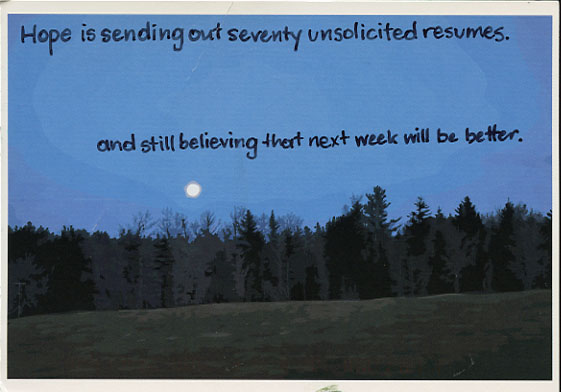

It’s been tough, but I’m cautiously optimistic that I’ll be able to salvage it, probably sometime after World Fantasy 2010.  Drafting is not my strongest point; I’m much better at revision.  My goal is to have a fully polished draft before the end of 2011.

As far as the real world goes, things are starting to come together as well.  I’m going home at the end of the month to get my teeth checked before my Mom’s insurance no longer covers me, and when I get back this temp agency should have a warehouse job lined up for a while, if I can’t find anything else.  I’m cautiously optimistic that my sister will help me get a job at the residential treatment center where she works, which would be awesome, and of course there’s always the possibility that BYU will lift the hiring freeze (pretty soon, they’ll have to).

So here’s my plan for the next few months: quit my job at the call center and go home in two weeks, then either work through the temp agency through September/October or find something better.  The wilderness job I was looking at has their training in November, so I’ll start the application process now in order to have that option in case everything else falls through.  And if all else fails, I’ll go teach English in Asia for a year.

Meanwhile, I hope to stay in Utah until at least February, preferably until April.  There are a lot of good resources here for writers, and I hope to take advantage of them.  After I finish the rough draft of Worlds, I will throw everything behind Mercenary Savior and get it polished in time for World Fantasy 2010.

And then?  Who knows.  I’d kind of like to try my hand at a fantasy novel; I’ve got the start of an idea for a magic system, and enough knowledge of Middle Eastern history to throw in a sweet medieval Arab flavor in the mix.

In terms of the real world, my plan is to reteach myself Algebra, Geometry, and Calculus using some excellent resources my Dad is sending me, then go back to school in a hard science…probably.  Still not sure what I want to do school-wise, but hopefully I’ll figure that out in the next year or two and head back soon.

That is, if I don’t get published and launch my writing career by then.

So that’s what my life is looking like right now.  If you’re still reading and aren’t bored stiff (or if you just skipped to the end of the post, which is what I would have done), here’s an excellent song from one of my favorite Celtic bands, The Rogues:

If it kills me

I will finish this novel if it kills me. At the rate things are going, it just might.

Things are kind of tough for me right now.  I desperately need a new job–the one I’ve got is slowly sucking away my soul without even paying enough to get by–and job rejections are way worse than rejections from publishers (I’ve been getting a lot of both, by the way.  Not that I’m looking for pity, but yeah.).

As if that weren’t bad enough, my current novel, Worlds Away from Home, is turning out to be a train wreck.  There are all sorts of problems with character motivations, improper foreshadowing and plot set up, etc etc.  That makes it REALLY hard to get motivated to write each day.  Yesterday, I wrote only 245 words (youch).  Today, I did about 2.2k, but that’s still way less than I need to be doing.

The thing that worries me the most is the thought that the audience for this particular story may be slim to nonexistent.  It’s solid space opera, but with a romantic element that challenges a lot of the mores of our modern, sex-saturated society, as well as many of the conventions of romance within science fiction.

The main female protagonist is something of a pushover–but she has to be, in order for her growth arc to have any umph.  The main male protagonist is an orphan on a quest to discover his own origins, kind of like a cross between Mogli and Pip.  His quest, combined with her parents’ manipulative attempts to get them physically intimate too soon, are the main things keeping them apart.

But in a genre where physical intimacy usually marks the romantic climax, how do you make it out to be the obstacle against that climax?  Will science fiction readers go for that, or will they hurl my book across the room because of it?

Well, if they hurled my current draft, I wouldn’t blame them one single bit.  So many plot holes and awkwardly written scenes–ugh.  I’ve got to seriously rethink so much about this story.  But a later draft?  I don’t know–maybe it would work.  It would probably need other hooks to keep them engaged, such as cool world building elements, but I think I could make those work.

Anyway, I suppose it’s nothing unusual.  For every book I’ve written, I’ve come to a point in the rough draft where I thought the story was completely unworkable and should be scrapped.  It’s a tortuous, masochistic process, but I suppose it’s normal.  That’s some comfort, at least.

My goal is to finish this abomination by August 15th, then move on to polish Mercenary Savior and make it really shine.

Another goal is to get a decently paying job (at least $8/hr at +25 hours per week) in order to afford to go to DragonCon in September.  Another goal is to reteach myself algebra and calculus through the math books my dad (who is a geometry teacher) is letting me borrow.  Another goal is to actually get a social life.  BLARG.

Looking for work (and possibly an adventure)

Ever since graduation in May, I’ve been doing my best to support myself and be 100% financially independent.  I haven’t gotten a steady, well-paying day job yet, but fortunately summers in Utah are cheap and I’ve more or less been able to make ends meet.

That’s not to say it’s been easy, though.  I’m operating under an extremely limited budget, and things are only going to get worse in August.  My current employment is more or less a dead end job, and I’m going to need to find something else if I want to stay in the black (and keep myself mentally sane).

Here’s what I’m trying to do to change that, in order of priority:

1) Apply for full/part time positions at BYU. My ideal job at this point would be to use my writing/editing/mentoring skills as a BYU employee in some capacity. Not only would I be able to stay in Utah Valley where all my writing contacts are, I’d be able to take classes at BYU for free! Besides, BYU is an organization behind which I can completely throw myself. Having graduated from there, I believe 110% in the university’s mission and the value of a BYU education.

The trouble is that there are probably hundreds of other graduates in my position trying to do that right now. More spots might open up quickly if the economy improves, but the competition is still going to be fierce.

2) Apply for a bookstore job in Utah Valley. Working in a bookstore might mesh very well with my aspirations to become a full-time writer. It would give me a chance to see a useful side of the publishing/bookselling industry, as well as opportunities to network with authors, readers, and booksellers. The pay might not be great, but as long as it’s full time and pays at least minimum wage, it would be enough.

I hear that a lot of local venues are going to be making hiring decisions later in August, as the summer term at BYU comes to an end and the students start moving back to Provo. For that reason, I’ve been holding out contacting places like Chapters (formerly Pioneer Books) and Barnes and Noble–the last thing I want is for my resume/application to get swamped under a huge pile of other applicants.

3) Apply for a Wilderness Therapy job. There are a lot of these in Utah, and I hear that they’re always looking for new staff. The work is strenuous–one to three weeks out in the wilderness with a bunch of troubled teens, living in survivalist conditions–but the life experience may well be worth the extended time commitment. Besides, considering how much it will cut down my living expenses (since I won’t be spending money in the wilderness), the pay should be pretty good. I may be able to save up a sizable amount.

The main reason I’d want to do this is because of the adventure. I feel that at this point in my life, I need to do something big–something I can look back and point at as a major milestone or accomplishment. For this reason, I almost want to take a wilderness job more than a BYU or bookstore job, but the tradeoffs are pretty serious. My social life will probably suffer, as well as my daily writing schedule.

Redcliff Ascent has their next staff training session in September. If I’m still looking for work by then, I’ll probably take it.

4) Try to find some opportunity in the Middle East. When I came back from Washington DC in April, I decided to hold out for a year before returning to the Middle East to see how the tensions between Iran, Israel, and Lebanon play out. While I still think there will be a war, however, I’m less worried about getting caught up in a bad situation if I’m in, say, Jordan or Egypt.

This would also be an awesome adventure. The trouble, though, is how it may cut into my writing career here in the states. I’ve already bought tickets to World Fantasy 2010 in October, so I probably won’t be leaving before then. Besides, most Middle East jobs only pay enough to cover living expenses–not enough to save up, or even buy a ticket back. Getting stranded in a developing country might not be so fun.

5) Take any part-time retail/labor job I can find in Utah Valley. This is the last option, because I don’t want to end up with a job that, for all intents and purposes, isn’t going to lead to anything bigger and better. If it pays the bills, though, might as well take it.

That’s what I’m currently trying to do to improve my employment situation. In the meantime, I’m looking up part time jobs and gigs on craigslist and trying to be as resourceful as I can. It’s not fun being poor.

Inshallah, though, something big will come my way. I have every confidence that things will work out for the best, whatever happens.

Image courtesy Postsecret.

Braving the unexpected rough spots

Right now, I’m going through this unexpected rough spot in my novel, where I know what’s supposed to happen (or at least I have enough of an idea to wing it fairly well), but the writing just isn’t coming.  This happens every time I hit the two thirds mark, and it really sucks.

Currently, I’m using two methods to get through it: 1) keep a running chapter-by-scene outline of the next few scenes, and 2) use a loose adaptation of story theory models (such as the hero’s journey) to keep perspective on things.  Right now, this is what my chapter-by-scene outline looks like:

Chapter 14
14.1: Jalil
Jalil meets LARS, who with Michelle shows him the ship. Jalil learns that Lars has a connection with the Farlen family and that the Stewarts are from his parents’ home.
14.2: Mira
Mira returns home an outcast. Sheila rails at her for failing to seduce Jalil, while Sathi pulls her into his quarters to tell her that he’s arranged for her speedy marriage.
14.3: Jalil
The Bridgette launches from GN-2 using a gravity whip maneuver. The ship heads out for the L2 point, using a second gravity whip around GN-2b. Jalil realizes this is goodbye.

Chapter 15
15.1: Mira
While Mira prepares herself to get ready to meet her cousin Ibrahim, Tiera approaches her in private to apologize for calling her a whore. Tiera advises her to stand up for herself.
15.2: Mira
IBRAHIM’s convoy arrives. As Sathi and Ibrahim’s father conduct negotiations, Mira meets him and is surprised to find that she’s attracted to him.
15.3: Mira
Mira, Surayya, Amina, and Tiera discuss Ibrahim in the women’s quarters. Tiera advises Mira not to pursue him, but Surayya and Amina convince her to go ahead with it.

Chapter 16
16.1: Jalil
Lars and Michelle tell Jalil about the Colony. They show him pictures, and he has flashbacks.
16.2: Jalil
While making maneuvers around GN-2a, the Bridgette receives news of Hameji movements near Karduna. Jalil learns a bit of the Hameji.
16.3: Jalil
The Bridgette arrives at the L2 station and enters the starlane. Jalil’s first experience as an adult making the jump.

Chapter 17
17.1: Mira
???

As you can see, I’ve broken down each chapter by scene, with the viewpoint character indicated as well as a short one or two line description of what happens. When a new character comes along, I mention them by name in ALL CAPS. I use the auto font color for story that I’ve already written, and the stuff that remains to be written in red. Also, I only outline a handful of scenes ahead of my current position.

That’s the method that works for me.  I have no idea if it will work for you, but feel free to give it a try or let me know what methods you’re using.

I’m finding that even though I’m more of a “discovery writer,” certain methods of outlining give me much greater flexibility to discovery write than simply winging it all on the fly.  In particular, I find that outlining my characters and keeping a running scene-by-scene map for the next couple days helps to keep me on track.

I ran into this problem earlier in the week: without any kind of outline, and no previously written material to fall back on, I had no idea what to do.  Instead of sitting at my keyboard doing nothing, though, I plotted out the next few scenes to give me some idea what to do.

That helped me out for a while, but now…man, it’s still rough.  I did 3,251 words yesterday, but today I only hit 1,555.  It’s a lot, I know, but with all my free time, I should be hitting more.  Much more.

I suppose the only way out of this slump is to write–and write I certainly must.  I seriously need a real job, and right now I’m looking into the field staff position at Wilderness Quest.  If they hire me, I’ll need to finish this novel before I start work, since I’ll be out in the wilderness for three weeks at a time and the last thing I want is to pick up a half-finished project after it’s gone cold–especially when I’ve got to rewrite Mercenary Savior for World Fantasy 2010.

So that’s what I’m looking at right now.  Three weeks, inshallah, and Worlds Away from Home 1.2 will be finished.  Hopefully by then, I’ll have a real job too.

To close, check out this awesome version of the Corridors of Time song (Zeal theme) from the Chrono Trigger soundtrack.  I’ve heard maybe twenty or thirty different arrangements of this excellent composition, and this one takes the cake.  Beautiful.

Forward to new ground

A couple days ago, I finished writing through the material I’d written for Worlds Away From Home back in 2008 before I dropped the project.  For the first time since March, I find myself drafting entirely new material.

It’s a little bit unnerving; I’m a much better reviser, I feel, than straight up writer.  Revising is awesome because I know that the book is getting better, whereas drafting is frustrating because the written story never turns out as awesome as it was when it was in my head.

At the same time, it’s really fun to play fast and loose with your book.  Need a new character?  Throw him in!  A new romantic subplot?  Go for it!  A new planet for the characters to visit?  Sure, why not?

I will say, though, that it’s much harder to keep up a steady writing rate when you’re drafting new material.  My daily word count has fallen to about 2k, give or take a few hundred words.  In order to finish this by August 15, I just need to do 2.2k per day, but I’m sure something will come up and I’ll find myself in a crunch by the end.

One thing that might throw a kink in the works is getting a new job.  Being underemployed really sucks, and I want to move on to a new job by the beginning of August.  Easier said than done in this economy, right?  Well, there are some options open to a young, single college grad in my position: namely, a wilderness job.  I’ve been holding out on that because eight days in the wilderness for every six days off seems like a lot of time away from other pursuits, but the more I look at it, the more appealing it seems.  Six days completely off, with no money problems…hmm…

Which reminds me: would it be lame to put up a donate button on this blog?  One that said “buy me a (non-alcoholic) drink” or something like that?  I don’t want to ask for money, but if you guys feel like throwing it at me, who am I to hold you back?  I don’t expect it to earn much, but something is better than nothing, especially these days.